
Strike

February 26, 2024

It has been warm over the last several days (+70F/+20C) and Melissa has taken to keeping the patio doors open to allow the dogs free access to the yard and house.  While we do have a “doggie door” in the kitchen, it was installed for a toy poodle (Canis familiaris – all domestic dogs) and would hardly provide access for our 75 to 85 pound (34 to 38.5 kg) pups, although Loki does try and stick his head and front feet through the door.  While working this morning melissa noticed two house sparrows (Passer domesticus) had taken advantage of the open door and decided to check out the succulents stored on the porch.  Melissa quickly shut the kitchen door, and then chased the sparrows back outside, then closed the outside door to prevent more birds coming inside.  After sitting back at her work chair, she heard a loud bang as a Eurasian collared dove (Columba decaocto) struck the patio glass.  The bird fluttered away, unhurt but obviously dazed.  I found this ironic as opening my browser it featured another article on the apparent bird strike that killed Flaco last week. 

When I looked online, I found one of the major problems in the interaction between humans and birds is the occurrence of window strikes.  Most strikes are associated with tall skyscrapers with reflective windows, but nearly 50% of bird collisions occur at homes.  It is estimated between 365 and 988 million birds are killed annually in the US by building strikes.  Approximately 56% of these deaths occur at low-rise buildings, 44% at residences, and only 1% at high-rise buildings.  This is second only to mortality from feral and free-ranging domestic cats when considering types of human-caused bird mortality.  The problem exists because birds cannot see glass and only see the reflections of their surroundings or the interior of a home or building if the light inside is brighter than outside.  Birds’ bodies are fragile, and they seldom survive a first collision to learn from their mistakes.  Even birds that can fly away after a collision may die from internal injuries or from predation due to their wounded state.  Birds are especially vulnerable when seeking escape cover after being frightened by predators (real or perceived) or by loud noises.  Window strikes by males their reflection to be a rival for territory or a mate are usually more of an annoyance to the homeowner than a threat to the bird.

One suggestion to avoid window strikes is to make the glass doors and windows more visible.  When you put something on the outside of the window it can make it more visible to birds.  The Cornell Lab of Ornithology and the Bird Collisions Program of the American Bird Conservancy provide a few suggestions.  Creating patterns or designs on windows help break up reflections and can appear as a barrier to birds.  However, these markings must be applied to the outside of windows as any reflections on the outside of the window may obscure markings on the inside.  You should also use white or light colors to maximize contrast and visibility.  The markings should be visible from at least 10 feet (3 m) away to give birds time to see them and react.  Grids of dots or lines are very effective if they are placed no more than 2 inches (5 cm) apart over the entire window surface.  Wider spacing will create apparent gaps that smaller birds may still try to fly through.  Stripes should be at least one-eighth inch (.5 cm) wide, and dots at least one-quarter inch (1 cm) in diameter and bigger is better.  Hmm, I just installed large picture windows on the porch and bay to let in the light.

THOUGHTS:  There are commercially available films that can stop strikes when applied to the outside of a window that appear solid from the outside but cannot be seen when looking out.  Many of these products and do-it-yourself ideas are discussed on the American Bird Conservancy’s website.  Although the male eastern bluebird (Sialia sialis) has attacked the window, the collard dove was the first actual strike.  There are always decisions and tradeoffs with any human improvements .  Act for all.  Change is coming and it starts with you.
Flaco

February 24, 2024

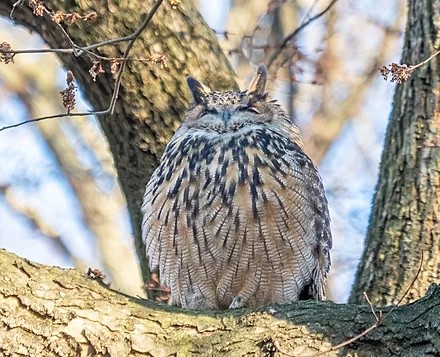
My NY Times feed shared the sad news that Falco, the Eurasian eagle-owl that I blogged about earlier this month died Friday night after apparently striking a building on the Upper West Side in New York City (NYC).  The Wildlife Conservation Society, which operates the zoo that had housed Falco, said the owl had been found on the ground after apparently hitting a building on West 89th Street.  Building residents contacted a rescue organization who retrieved him and declared him dead a short time later.  Zoo employees took him to the Bronx Zoo, where a necropsy will be performed to determine the cause of death.  Flaco had escaped when vandals shredded his mesh enclosure in February 2023 and spent his last year as a free bird.  One sad aspect of the freedom Flaco obtained was as a nonnative species he was destined to never find a mate.  Still, he could be heard hooting into the post-midnight darkness to establish his territory and declare his interest in breeding.  Flaco’s last reported hoots were heard from a water tower on West 86th Street at 3 am last Sunday.  On Friday, Flaco was found just a few blocks away.

When I looked online, I found Eurasian eagle-owls (Bubo bubo) like Flaco are strictly territorial and will defend their territories year around, but territorial calling appears to peak from October to early January.  Territory size averages 5.8 to 30.9 miles2 (15 to 80 km2).  Territories are established by the male who selects the highest points in the territory to sing, allowing their song to be heard at great distances.  Nearly as important in territorial behavior as vocalization is the white throat patch.  When stuffed specimens with flared white throats were placed near an owl’s territory, males reacted quite strongly and often attacked the stuffed owl, while reacting more mildly to a stuffed owl with a non-flared white throat.  In January and February, the primary function for vocalization is courtship.  Eagle-owls often pair for life but usually engage in courtship rituals annually, most likely to re-affirm pair bonds.  

After his escape, Flaco settled in Central Park but around Halloween began to venture into the city and embarked on a tour of Manhattan where he would turn up on the terraces and air-conditioners that resembled the cliff ledges Eurasian eagle-owls are accustomed to.  He would spend the day sleeping out of the wind and then fly out at dusk to hunt.  Each day Flaco spent outside his zoo enclosure was risky.  Striking a building, especially a window, could have (and finally did) proved lethal.  Flaco also faced threats from the rodenticide in the rats that he ate, and a fatal collision with a vehicle.  He was able to avoid vehicles by sticking mostly to rooftops, water towers, and other elevated elements of his new environment.  The risk of being killed by a building strike was serious.  The National Audubon Society says as many as 230,000 birds a year die in New York City from window strikes.  This is especially hazardous at night when lights illuminate indoor vegetation and can confuse birds who navigate by starlight.  While Flaco never found a mate, he may have been defending his territory against his own reflection in a window.

THOUGHTS:  Flaco caused concern for a variety of reasons when he escaped.  Flaco had hatched in North Carolina and had never lived outside of his small enclosure prior to his escape.  Some worried he would not be able to feed himself or even know how to fly.  Instinct quickly took over and he fed on the numerous rats which also call NYC home.  Others feared the owl might feed on native bird populations.  Attempts to recapture him proved futile and were finally abandoned.  Flaco appeared to do well in his foreign environment, even if only for one year.  It may have been the best year of his life.  While we cannot gauge the thoughts of Flaco, living twice as long in captivity may have seemed more like an eternity.  Act for all.  Change is coming and it starts with you.
GBBC 24

February 22, 2024

I cannot believe it.  I missed this year’s Great Backyard Bird Count (GBBC).  I found out about this event from my mom in 2021.  She had come across an article in her newspaper saying the weekend was approaching.  With her heads up I was able to find the links that lead me to the Cornell Labs eBird site.  Since then, I have been participating in the weekend and submitting lists of the birds I have spotted in my backyard feeders.  I submitted one list in 2021, three in 2022, and two in 2023.  These 15-minute snapshots (or longer) are short enough to not distract from other activities yet still provide an accumulative look at the health of bird populations in my area (Arkansas, US).  The participants to the GBBC extend around the world, meaning bird populations in other areas are also tracked and recorded.  The lists are combined and submitted to help researchers at the National Audubon Society, Cornell Lab of Ornithology, and Birds Canada learn more about how birds are doing, and how to protect them and their environments.  The 27th annual GBBC was last Friday to Monday (16th to 19th).

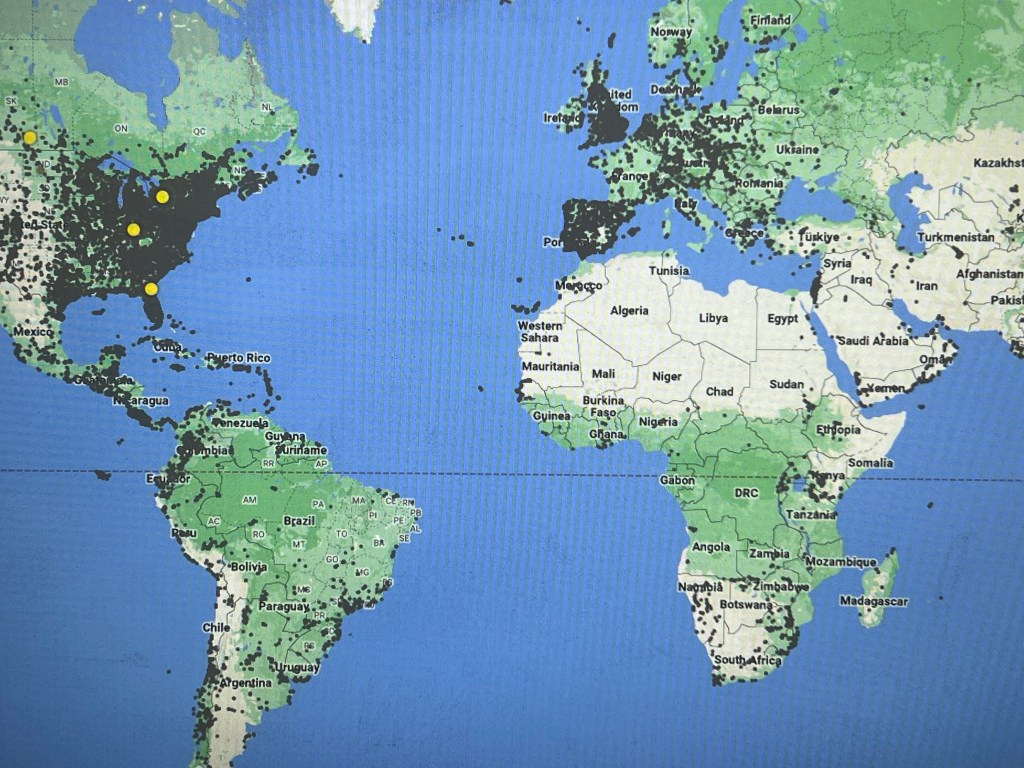
When I went online, I found the Great Backyard Bird Count (GBBC) was launched in 1998 by the Cornell Lab of Ornithology and the National Audubon Society.  The count was the first online participatory-science project, or called community science or citizen science, to collect data on wild birds and display the results in near real time.  Birds Canada joined the project in 2009 to expand capacity to support participation in Canada.  The GBBC became a global project in 2013 when it began entering data into eBird, the world’s largest biodiversity-related participatory science project.  In 2015 nearly half of known bird species worldwide were reported.  The data collected annually during the event is subject to verification by experts to overcome potential shortcomings in the abilities of amateur participants (i.e., misidentification).  The tally as of today is a total of 294,900 completed checklists from 253 subregions across the globe.  A total of 7,834 species were observed.  The Clements Checklist of Birds of the World identifies approximately 10,906 bird species globally.  Species observed in this year’s count represent 71.8% of the world’s birds.

This year’s GBBC checklists come from 209 of the 253 subregions.  There were 323 checklists reporting 30 species from Antarctica.  The US (165,623), India (51,352), and Canada (24,546) submitted the most lists.  Columbia (1348), Ecuador (1118), and India (1030), and Brazil (1000) reported the most species. This is not surprising due to the diversity found in their tropical forests.  Neoh Hor Kee of Malasia observed the greatest number of species (409) with only 23 completed checklists.  Second place went to Juan Lopez (a bird tour guide) of Columbia who observed 295 species with 13 checklists from around the world.  In the US, Eric Piage completed the most checklists (45) and reported the greatest diversity of species (161).  The checklists are still arriving and can be submitted until March 1st.

THOUGHTS:  While I was chastising myself for not participating in the GBBC this year, I found I was not the only one who was lax.  I was not alone as no checklists had been submitted from 44 subregions, and one checklist had reported no birds.  I have had times when I sat at my window watching the feeders and not seen a bird, and it is always disappointing.  The highest bird counts come from areas where birds thrive, while the lack of checklists are generally associated with desert environments.  There were 95 checklists with 93 species submitted from 14 of the 27 provinces of Ukraine and 200 checklists with 94 species submitted from 19 of the 83 provinces of Russia.  Even in strife there is common ground.  Act for all.  Change is coming and it starts with you.
Monarch

February 21, 2024

(AP Photo/Marco Ugarte, File)

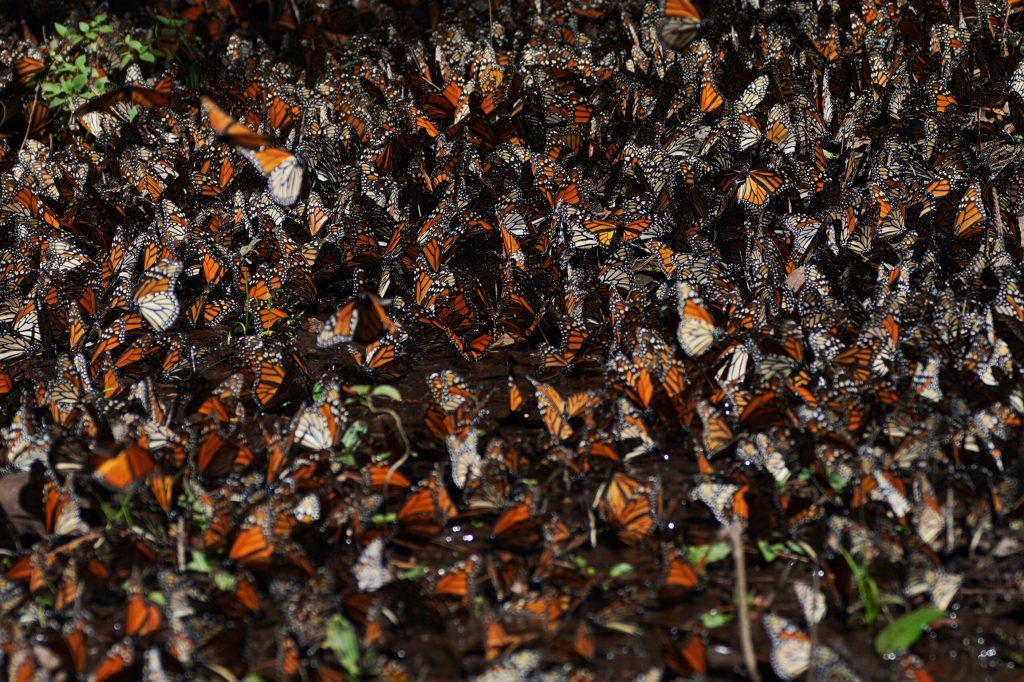
The front page of today’s local newspaper carried a USA Today article on how last year’s drought has affected butterflies.  This year’s eastern monarch butterfly population wintering in Mexico is the second smallest on record.  The survey taken by the World Wildlife Foundation measures the area they cover in their winter grounds rather than a true census.  This year’s estimate found the eastern monarch population only took up 2.2 acres (8903 m2) or 59% less than during the 2022-2023 season.  To put 2.2 acres in perspective, it is less than two football fields.  The lowest footprint occurred in the 2013-2014 season with 1.7 acres (6879.6 m2) covered.  This information has just been released in an article sponsored by Okies for Monarchs, an education and outreach initiative to raise awareness of monarch butterflies and increase monarch habitat in Oklahoma.  Oklahoma represents critical habitat along the flyway from Wisconsin to Mexico.

When I went online, I found the monarch butterfly (Danaus plexippus) is a milkweed butterfly (subfamily Danainae) in the family Nymphalidae.  The monarch is regionally known by other names, including milkweed, common tiger, wanderer, and black-veined brown.  The species is one of the most familiar North American butterflies and an iconic pollinator.  Monarch wings feature an easily recognizable black, orange, and white pattern, with a wingspan of 3.5 to 4.0 inches (8.9 to 10.2 cm).  The eastern North American monarch population is notable for its annual southward migration in late-summer or autumn from the northern and central US and southern Canada to Florida and Mexico.  During the fall migration, monarchs cover up to 3000 miles (4,828 km) which is repeated with a multigenerational return north in the spring.  The western North American population of monarchs west of the Rocky Mountains generally migrates to sites in southern California, but individuals have also been found overwintering in Mexican sites. 

Monarch populations are extremely sensitive to high heat and drought, and both are becoming more prevalent as the climate continues to change.  The major contributing factor for the species decline is loss of habitat.  Even though the annual survey is taken in Mexico, the loss of habitat affects the monarch all along the migration route (hence Okies for Monarchs).  Karen Oberhauser, founder and director of the Monarch Larva Monitoring Project in Wisconsin, says, “We need habitat everywhere -— where they breed, where they migrate and where they winter.” Oberhauser said. “But right now, the biggest correlation with monarch numbers is the amount of breeding habitat that’s been lost up here (Wisconsin).”  Last year severe drought covered much of the US, and this makes milkweed (genus, Asclepias) less nutritious.  The monarch depends on milkweed to lay their eggs on and to eat.  Oberhauser said conservation efforts to build habitat and restore breeding grounds will be key to preserving the monarch population, even as climate change makes extreme weather more likely.

THOUGHTS:  I mentioned several years ago that as director of a rural camp I tried to improve habitat along the monarch flyway by transplanting milkweed plants out of mown areas and into an area where I had seen the butterflies congregate.  While the transplant did not work (drought), it was worth a try.  Restoration of critical habitat is essential for all endangered species.  In February 2015, US Fish and Wildlife Service reported nearly a billion monarchs had vanished from overwintering sites since 1990 due in part to a loss of milkweed caused by herbicides.  Some may argue it is just a butterfly, but that ignores the monarch’s role as a prolific pollinator.  We might say if the monarch cannot eat, we will not be far behind.  Act for all.  Change is coming and it starts with you.

Postal

February 20, 2024

I have mentioned how my local newspaper has been cutting back on delivery.  This began in earnest during the pandemic as the Saturday edition was stopped but the price was the same (shrinkflation).  The next move came as Holiday editions were either not printed or came out the day before.  This was disconcerting as I never knew if the paper was not printed, or my carrier had not delivered the paper.  I eventually found the front page would carry a disclaimer (in small print at the bottom) explaining when the paper would not be delivered.  Correspondence from the newspaper office suggested I could still receive the paper (including the Saturday edition) online and tried to convince me to switch to this reduced priced edition.  When I finally switched to online only, the carrier continued to deliver the hard copy edition to my driveway.  Last week the publishers decided to forego carriers and have the newspaper delivered by the US Postal Service.      

When I went online, I found switching newspaper delivery from costly carriers to the US Postal Service is becoming the norm as the decline of print journalism has left publishers with fewer ways to cut costs.  Newspapers have been delivered by mail in the US for centuries.  The earliest second-class mail began in colonial times, and many weekly newspapers have relied on the postal service for their entire existence.  Many small dailies in rural areas switched to mail delivery after the financial crisis of 2007-08.  For major metro dailies it is not uncommon to provide postal delivery for readers outside primary circulation areas.  Gannett, the nation’s largest newspaper publisher, makes all 400-plus of its titles available for postal delivery, primarily for readers who relocate but want to maintain connections to their previous communities.  Some newspaper executives who have relied on postal delivery for decades wonder why the change is taking so long. “It’s high-quality delivery at predictable times,” said Tim Price, senior vice president at Boone Newsmedia Inc.  “If our primary goal is to get the printed product in the hands of the readers, we can do that with the post office.”

One of the problems with receiving your printed copy of the newspaper by mail is it no longer covers breaking news.  Tim Franklin, senior associate dean at the Medill School of Journalism, Media at Northwestern University, said he expects more local news organizations to at least explore a moving to postal delivery, “because the potential cost savings are huge, and it eliminates the headache of carrier turnover”.  This also raises an existential question of what a printed newspaper should be in the digital era.  “What’s breaking news at press time may be old news by the time it hits the mailbox.  So, the printed newspaper needs to be relevant in other ways.”  That means feature stories that are in-depth, contextual, and personal.  I have read print newspapers are primarily read by Boomers like me who like the tactile feel of paper.  Whether the publication is delivered via carrier, postal, or digital means in depth coverage of relevant local events is what keeps me a subscriber.

THOUGHTS:  My two brothers and I cut our respective teeth in the business world becoming newspaper carriers when we were in Grade School.  While our small town did not have a daily paper, the Big Town in our mostly rural area of Kansas distributed one.  My older brother got the job of delivering 100+ newspapers to our community of 600 and subbed out smaller routes to my younger brother and me (I later learned these were the parts of town he did not like delivering to).  In my lifetime the walking paperboy has shifted to adults in cars traversing wide areas.  The shift to postal delivery eliminates the job of carrier which often supplied a secondary income.  A technological shift is always accompanied by the loss of one job and the creation of many others.  We cannot bemoan the past, but rather adapt for the future.  Act for all.  Change is coming and it starts with you.
Upset

February 17, 2024

This past week I witnessed two separate behaviors that reminded me how dogs can be like humans.  The first was as I prepared to feed the kids.  We have a weekly Sib Call, but I had canceled this week as we planned to attend the Ash Wednesday service.  I told the kids it was time to eat and started preparations for their supper.  My brother missed the cancel text and thought he was late for the online chat, and instead gave me a call.  I stopped preparing the kids supper and sat in my chair to talk.  While Loki laid on their bed staring at me, Zena did not seem happy and paced back and forth in front of me.  Our conversation went on for a half hour as Zena became more perturbed.  She had finally had enough and walked over and stomped on my foot to get my attention (this was a first).  She then seemed upset as she walked off a little way and stared at me.  While this may have been me attributing human action (anthropomorphic) to her response, it worked.  I hung up and fed the dogs.

When I went online, I found a Newsweek interview of Kait Hembree, a vet technician, saying your dog does become upset and will let you know it.  If your dog has a “negative association” or is upset with you “it will be clear by their body language.”  This comes as no surprise as dogs are incredibly perceptive and sensitive beings that can sense emotions and read the facial expressions of humans.  Research shows dogs combine hearing and sight to correspond happy and angry human faces with happy and angry vocalizations, according to Stephanie Gibeault, a certified personal dog trainer, in a 2018 article for the American Kennel Club.  A study in September 2021 published in Scientific Reports also found dogs can “distinguish intentional actions from unintentional behavior”.  This body language might entail moving away from you, being more aloof, or avoiding your gaze when you look in their direction.  It could also mean sitting in another location if you come near them or holding their tail low or even between their legs.  “They might even go as far as snarling or growling at you,” Hembree added.  If you notice these signs, it’s important to remember these are just signals letting you know your dog needs space.  You should probably give it to them.

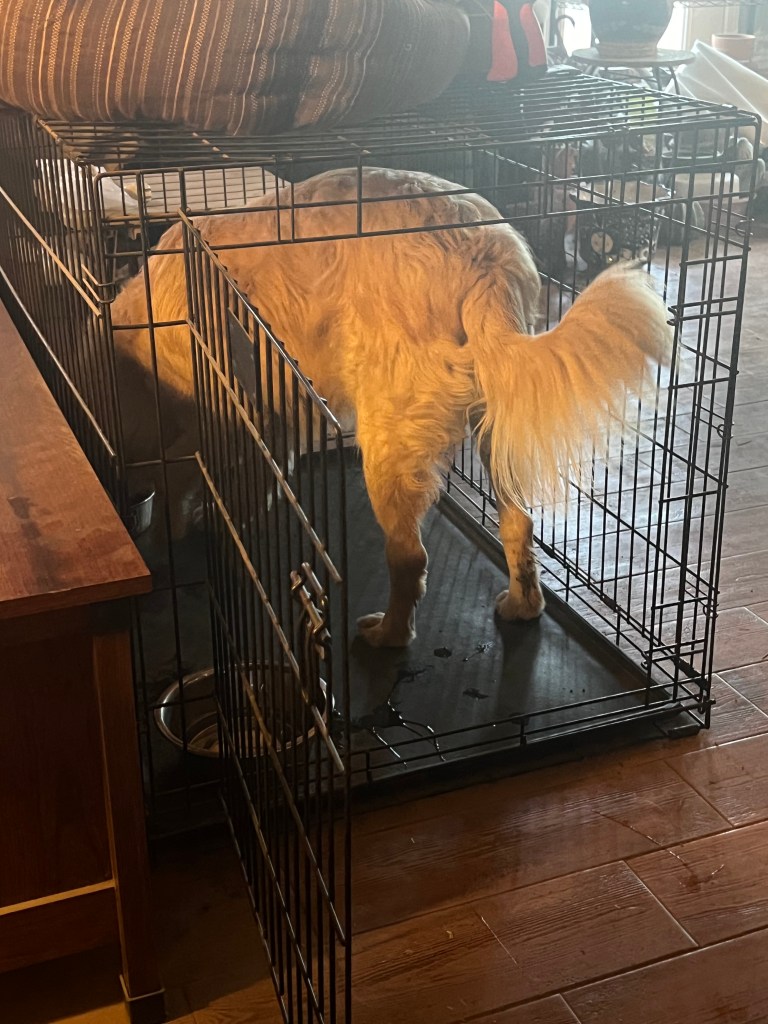
The second action came as Loki began eating his nightly kibble in segments.  We feed the kids at the same time but in separate rooms.  When Loki was younger, he would wolf down his food and then go into the kitchen to eat anything that was still in Zena’s bowl.  This made Zena upset so we had to keep them apart.  As Loki matured, we no longer closed the kennel door, but we still fed him in it.  Zena will walk into the living room (where the kennel is) and check how much food is left in Loki’s bowl.  Only after asserting Loki is still eating would Zena return to her bowl for the rest of her food.  This last week Loki has only been eating half of his food and then he checks out how Zena is doing before going to lay on the bed.  It is only after Zena has finished and had come into the living room that Loki would go back into his kennel and start eating again.  While Zena drinks from Loki’s water bowl, she will not go into the kennel.  They are both highly food motivated, and this seemed to be Loki’s way of letting Zena know he had food, and she did not.

THOUGHTS:  Saving food was a tactic used by my younger brother and I when we traveled in the car.  We did not eat out often, except when traveling to my grandparent’s house.  Dad would stop about halfway, and we would get hamburgers, fries, and a drink.  We sat in the car at the drive-in and ate our meal.  When everyone was done, dad would continue the drive.  However, my brother or I would try to hide a partial bag of fries to be produced in front of the other during the trip.  This was always a waiting game.  You had to sneak the bag into hiding and then weigh the cost of eating cold fries.  I have found that making others upset over what you have can bring unwanted consequences.  Now I eat my fries before they get cold.  Act for all.  Change is coming and it starts with you.
CEZ

February 15, 2024

© Front Page Detectives

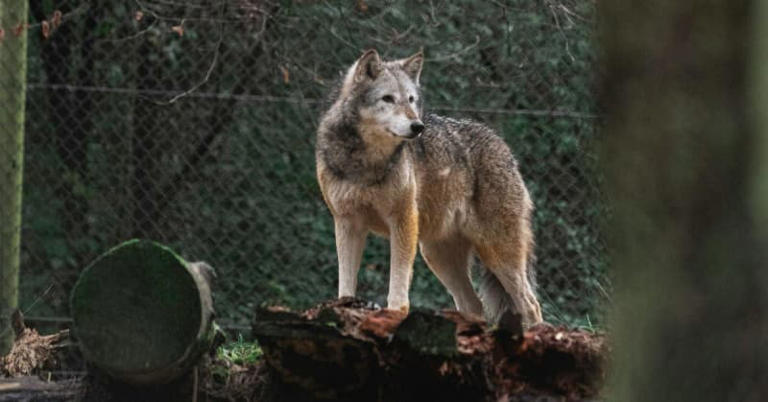
While scrolling I came across a February 5th report on how animals are thriving in the Chernobyl Exclusion Zone.  The Chernobyl nuclear power plant exploded in 1986, releasing radioactive material into northern Ukraine and Belarus.  It is the most serious nuclear accident in history and caused the evacuation of over 100,000 people due to the health risks from radioactive waste.  Many still think of the area as a post-apocalyptic wasteland, but science tells us something different.  While the land surrounding the plant is mostly off limits to humans, it has become a haven for wildlife, with Eurasian lynx (Lynx lynx), European bison (Bison bonasus), red deer (Cervus elaphus), and other animals in the thick forests.  New research shows the population of wolves (Canis lupus) in the zone is genetically different from their counterparts outside of the region.  Irradiated wolves seem to have developed mutations that increase their odds of surviving cancer.  The Chernobyl Exclusion Zone (CEZ) covers 1,081 miles2 (2,800 km2) of Ukraine and represents the third-largest nature reserve in mainland Europe.  The CEZ has become an iconic, if accidental, experiment in rewilding.

When I went online, I found the Chernobyl Exclusion Zone (CEZ), officially called the Chernobyl Nuclear Power Plant Zone of Alienation, is a designated zone around the site of the Chernobyl nuclear reactor disaster.  The CEZ was established by the Soviet Armed Forces soon after the disaster, and initially encompassed a 19 mile (30 km) radius from the Chernobyl Nuclear Power Plant.  The boarders have since been altered to cover a larger area of Ukraine.  The CEZ borders another administered area, the Polesie State Radioecological Reserve, to the north in Belarus.  The CEZ is managed by an agency of the State Emergency Service of Ukraine, while the power plant and its massive concrete and steel cap (sarcophagus) are administered separately.  The CEZ is the area of highest radioactive contamination, and its purpose is to restrict access to hazardous areas, reduce the spread of radiological contamination, and conduct radiological and ecological monitoring.

Unlike humans, the gray wolves in the CEZ never left, and the local population has grown to seven times denser than populations in other protected lands in Belarus.  This has led scientists to ask if the wolves are genetically resistant or resilient to cancer, or if the wolves are thriving because humans are not interfering with them.  Cara Love, an evolutionary biologist at Princeton University, has been studying these wolves for a decade to try and understand how they survive.  Love and her colleagues took blood samples from the wolves in 2014 to understand their reaction to cancer-causing radiation, and some were fitted with radio collars to gather information on their locations and exposure to radiation.  The research showed the wolves are exposed to more than 11.28 millirem of radiation daily, or over six times the legal limit for human workers.  Researchers also noted the wolves have altered immune systems (like patients undergoing radiation treatment) and genetic analysis suggests parts of the wolves’ genome have developed some resilience to cancer.  Love hopes to use the findings to identify protective mutations that increase human odds of surviving cancer.

THOUGHTS:  In 2023, scientists found the semi-feral dogs living in the CEZ were also genetically different from pet dogs elsewhere.  Genetic mutations are changes to your DNA sequence happening during cell division.  Mutations could lead to conditions like cancer, they may not have any effect on your health, or they could help the individual adapt to their environment over time.  The wolves and dogs of the CEZ appear to have done the latter.  As the mutation passes to subsequent generations, it becomes a normal part of the (wolf or human) genome and evolves from a gene variant into a normal gene.  My physical anthropology friends told me this is part of the evolutionary process we are not yet able to understand.  Love hopes to find out.  Act for all.  Change is coming and it starts with you.
Triops

February 15, 2024

Image credit: L.Carter/NPS

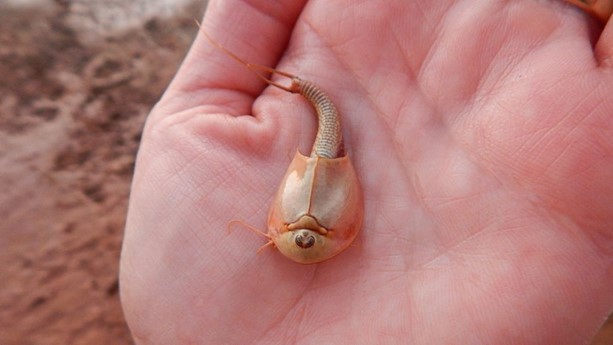
Scrolling down my Edge browser I came across a video posted on Live Science explaining the hundreds of tadpole-like creatures that appeared after heavy rain.  Officials at Arizona’s Wupatki National Monument reported hundreds of prehistoric creatures had hatched from eggs in a temporary lake in the desert landscape.  Lead ranger Lauren Carter said the creatures look like mini-horseshoe crabs with three eyes.  Their appearance was first reported by tourists who saw them in a temporary, rain-filled lake within the ceremonial ball court at the monument.  The court is a circular walled structure about 35 yards (32 m) across.  Carter knew the monsoon in late July had filled the ball court with water but did not expect anything living in it.  She first assumed these were tadpoles from toads who live in burrows during the dry season.  When Carter scooped one up, she noticed a familiarity with reports of a creature when she had worked at Petrified Forest National Park in northeastern Arizona called a Triops.  The Central Michigan University said the dinosaur shrimps’ eggs could lay dormant in the desert for decades until adequate rain falls make a lake to provide habitat for the eggs to hatch, mature, and lay eggs for the next generation.

When I went online, I found the American tadpole shrimp (Triops longicaudatus), or longtail tadpole shrimp or dinosaur shrimp, is a freshwater crustacean of the order Notostraca, resembling a miniature horseshoe crab.  The shrimp is characterized by an elongated, segmented body, a flattened shield-like brownish carapace covering two thirds of the thorax, and two long filaments on the abdomen.  The genus name Triops comes from Greek “ops”, meaning “eye” prefixed with Latin tri- or “three”, and refers to the animal’s three eyes.  Longicaudatus is an Latin neologism combining longus (“long”) and caudatus (“tailed”) and refers to the long tail structures.  Triops are found in freshwater ponds and pools, often in places where few higher forms of life can exist.  Triops are usually greyish yellow or brown in color and differ from many other species by the absence of the second maxilla (mouth parts).  As the name suggests, the elongated tail structures (cercopods) are often nearly as long as the rest of the body.  The species (with the cercopods) may reach 3.0 inches (75 mm) long.

Triops’ appearance has changed little since the group emerged in the Devonian period (419 million to 359 million years ago).  This ancient and morphologically consistent lineage has led some to call the creatures “living fossils” or dinosaurs, a term that is also used to describe deep-sea coelacanths (fish of the order Coelacanthiformes) and horseshoe crabs (order Xiphosura).  Because their water habitats are temporary, they mature quickly and go from eggs to breeding adults in two to three weeks.  Triops are hermaphrodites (each has both sexual organs), but they can reproduce sexually and even produce offspring from unfertilized eggs (unisexual). This flexibility in reproduction helps each generation of Triops raise the next, even in extreme environments like the Arizona desert.   Triops’ eggs can enter a state of dormancy where the eggs stop developing and dry out (diapause).  Diapause allows the eggs to survive when their pools evaporate.  The eggs can stay in diapause for up to 27 years waiting for water to return so they can hatch.  This is a long wait to become alive.

THOUGHTS:  While the cicada may live underground for up to 17 years, that is different than the 27 years of diapause that may occur with the Triops.   Diapause is observed in all the life stages of arthropods, especially insects, and embryonic diapause (delayed implantation) is a reproductive strategy used by more than 130 types of mammals and possibly humans.  In mammals the pre-embryo (blastocyst) does not immediately implant in the uterus but remains in a non-dividing state of dormancy until conditions allow for attachment to the uterine wall to proceed.  This may also result in a long wait to be alive.  Act for all.  Change is coming and it starts with you.
St.

February 14, 2024

Wellcome Images, CC BY

Last February 14th I mentioned about how Valentine’s Day has become the third most expensive holiday in the US, with Americans spending US$26 billion, or an average of US$192.80 per person.  This spending comes from the exchange of cards, flowers, candy, and lavish gifts in the name of St. Valentine. While Melissa and I try not to go overboard, I cannot resist giving her the card, flowers, and candy expected of a dutiful beau.  While we tend not to dine out due to the crowds and expense, I do like to cook a good meal for us to enjoy together.  American excess was clear yesterday when I went to the market for the ingredients of tonight’s meal.  The regular flower section had expanded with bouquets scattered around the front of the store and an entire aisle of fresh cut flowers and red boxes of candy replacing the cookies and sweets that had been there the week before.  While love and romance may be at the heart of our modern celebration, St. Valentine was no patron of love.

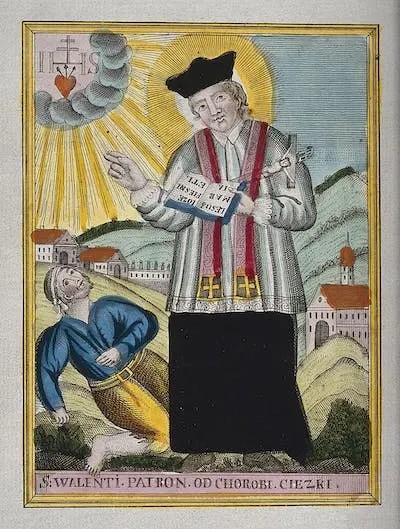
When I went online, I found St. Valentine’s Day originated as a liturgical feast to celebrate the beheading of not one but several Christian martyrs who died on February 14th.  Information on the martyred Saints was compiled by an order of Belgian monks who spent three centuries collecting evidence for the lives of saints from manuscript archives around the known world.  The monks were called Bollandists after Jean Bolland, a Jesuit scholar who began publishing the massive 68-folio volumes of “Acta Sanctorum” (“Lives of the Saints”) beginning in 1643.  Successive generations of monks continued the work until the last volume was published in 1940.  The Brothers dug up every scrap of information about every saint on the liturgical calendar and printed the texts arranged according to the saint’s feast day.  The volume encompassing February 14th contains the stories of a handful of “Valentini,” including the earliest three of whom died in the third century.  All that is known of the earliest Valentinus is that he died in Africa, along with 24 soldiers.  Sometimes all the monks could find was a name and the day of death.

We know a little more about the other two St. Valentines.  A late medieval legend reprinted in the “Acta” was accompanied by a Bollandist critique about its historical value.  A Roman priest named Valentinus was arrested during the reign of Emperor Gothicus and put into the custody of an aristocrat named Asterius, who made the mistake of letting the preacher talk.  Valentinus told of Christ leading pagans out of the shadow of darkness and into the light of truth and salvation.  Asterius told Valentinus if he could cure his foster-daughter of blindness he would convert.  He did cure her and the whole family were baptized.  When Emperor Gothicus heard the news, he ordered them all to be executed, but only Valentinus was beheaded.  The body was buried along the Via Flaminia highway that stretched from Rome to modern Rimini and a chapel was later built over his remains.  The third third-century Valentinus was a bishop of Terni in the province of Umbria, Italy, who got into a similar situation by debating a potential convert and afterward healing his son.  He was also beheaded on the orders of Emperor Gothicus and his body buried along the Via Flaminia.  The Bollandists suggested this may be two different versions of the one legend. 

THOUGHTS:  Whether he was African, Roman, or Umbrian, none of the St. Valentines seem very romantic.  One died along with soldiers and the other two (one?) died along with the family they had miraculously converted.  The only common thread was they were all beheaded.  That might not sell well on a greeting card.  The love connection appeared over 1000 years later when English poet Geoffrey Chaucer (The Canterbury Tales) decreed the February feast of St. Valentinus to the mating of birds and English audiences embraced the idea of February mating.  Sometimes it seems easier to reconfigure the facts than to face the truth.  Act for all.  Change is coming and it starts with you.
ADT

February 13, 2024

Toward the back of the front section of my local newspaper, I came across a USA Today article on a woman who completed a two year trail journey across the US.  Briana DeSanctis set out on January 1, 2022, from the Atlantic Ocean and arrived at the Pacific this last Sunday (February 11, 2024).  Years ago, DeSanctis completed the 2,190 mile (3,524 km) Appalachian Trail and said she felt like she needed a new challenge.  The trail crosses the Colorado Rockies at an elevation of over 13,000 feet (3,962+ m).  DeSanctis backtracked to be able to hike both the northern and southern sections of the cross country trail.  The trek included long solitary stretches but was interspersed by encounters with the diversity of America’s inhabitants.  “Everyone that you meet takes you in and shows you a little part of their world,” DeSanctis had previously said.  DeSanctis documented her journey on social media and regular columns for the Daily Bulldog, a Maine news outlet.  She is the first woman the American Discovery Trail Society is aware of who completed the trail on her own.

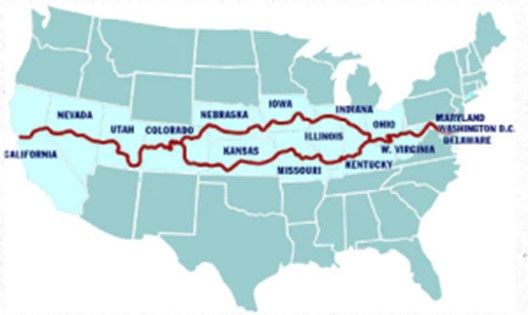
When I went online, I found the American Discovery Trail (ADT) is a system of recreational trails and roads that collectively form a coast-to-coast hiking and biking trail across the mid-tier of the US.  Horses can also be ridden along most of the trail.  The coastal trailheads are Cape Henlopen State Park (Delaware) on the Atlantic Ocean and Point Reyes National Seashore near San Francisco (California) on the Pacific Ocean.  The middle of the trail has northern (through Chicago) and southern alternates (through St. Louis).  The total length of the trail, including both the north and south routes, is 6,800 miles (10,900 km).  The northern route covers 4,834 miles (7,780 km) with the southern route covering 5,057 miles (8,138 km).  The ADT is the only non-motorized coast-to-coast trail in the US.  Along the way, the trail passes through 14 national parks, 16 national forests, and uses sections of or connects to 5 National Scenic Trails, 10 National Historic Trails, and 23 National Recreation Trails.  Part of this distance coincides with the North Country Trail (Midwest and Northeastern US), the Buckeye Trail (Ohio), the Continental Divide Trail (Colorado), and the Colorado Trail (Colorado).  The ADT passes through 15 states and the District of Columbia.  That is a long hike.

The National Trails System Act of 1968, as amended, calls for establishing trails in both urban and rural settings for people of all ages, interests, skills, and physical abilities.  This trail system is designed to promote the enjoyment and appreciation of trails while encouraging greater public access to the diversity and ecosystems of the US.   The National Park Service (NPS) oversees the development of trails and encourages both public and private agencies to develop, maintain, and protect the trails.  The ultimate vision is for the cooperation and support of a nationwide trails community to create an interconnected, cross-country trail system to include national scenic trails, national historic trails, and national recreation trails.  The NPS website currently lists 11 National Scenic trails, 21 National Historic trails, and almost 1,300 National Recreation trails located in all 50 states, the District of Columbia, and Puerto Rico.

THOUGHTS:  I have yet to hike any of the ADT system.  When I lived in Utah, I used to take my son on many weekends to hike the canyons and trails of the southeastern part of the state.  These were exhausting yet exhilarating hikes that became what I loved most about my time there.  Now that my son has a family of his own, they take time to hike the scenic trails of the Northwest.  He also joins friends on an annual trek along a portion of one of the many trails systems.  Sharing what you love with others creates an opportunity for them to in turn pass that love along.  It is the basis of nurture and culture.  Act for all.  Change is coming and it starts with you.