
Productivity

August 21, 2023

It has been brutally hot across the US southern states this summer.  Temperatures in Arkansas this week have (and will) hover over 100F (37.8C) with feels like temperatures (factoring humidity) of over 115F (46C).  That has made it hard for me to want to go outside to care for my containers or my yard.  The kids still want to go outside and eagerly rush the door when it is opened, but it is not long before they are ready to come back inside, and they always take a long drink before laying down exhausted.  Even inside the air conditioned house (kept at 80F/26.6C) I find it hard to get motivated to do much of anything.  I try and force myself to water in the evening and occasionally get to the store during the afternoon.  Beyond that I sit in front of the fan in my office and work crossword puzzles.  I wondered if my lack of productivity was due to the heat or just the general malaise of dog days of summer.

When I looked online, I found studies consistently confirm that room temperature and work productivity are directly related.  Research suggests a direct link between hot temperatures and lower productivity, but also that the correlation is more prominent in men.  Women were found to be more productive in warmer temperatures, especially when tackling verbal and mathematical tasks.  The results showed that women performed better in warmer temperatures, whereas men performed better in cooler temps.  The researchers noted the increase in women’s productivity at higher temperatures was much larger than the subsequent decrease in male productivity at the same temperature.  This suggests the best case scenario for a workplace is to err on the side of warm versus cool, as the decrease in the men’s productivity is canceled out by the increase in women’s productivity.  That assumes the genders are evenly distributed in terms of roles and responsibilities.  In the US, the Occupational Safety and Health Administration’s recommended indoor temperature as a range of 68F to 76F (20C to 24.5C).  

Overexertion in the heat can lead to heat exhaustion or heat stroke which can be fatal, and it is important for employees to take frequent breaks and stay hydrated on hot days.  This suggests employees would be less productive on a hot day compared to a day with pleasant weather.  The Becker Friedman Institute at the University of Chicago tested this idea by studying companies in India.  The researchers found that productivity declined at a rate of 2 to 4 percent for every 1.8 degree Fahrenheit (1C) after temperatures rose above 80F (27C). Workers were also more likely to take off work or call in sick during hot weather.  The study notes every time the average annual temperature in India rose by 1 degree Celsius, the country’s overall productivity declined by 3 percent.  Since global temperatures are set to rise over the next decades, this means we will all experience less productivity.

Thoughts:  Lack of productivity is often associated with the dog days of summer, or the hot, sultry days of summer.  While this is generally associated with the lazy dog sleeping in front of a fan, historically it referred to the period following the heliacal rising of the star system Sirius (the “Dog Star”), which Hellenistic astrology connected with heat, drought, sudden thunderstorms, lethargy, fever, mad dogs, and bad luck.  They are now taken to be the hottest and most uncomfortable part of summer in the Northern Hemisphere.  Productivity in the office, and the field, is a result of compromise.  That is true for the sexes as well as acclimatization.  Act for all.  Change is coming and it starts with you.
Ötzi

August 18, 2023

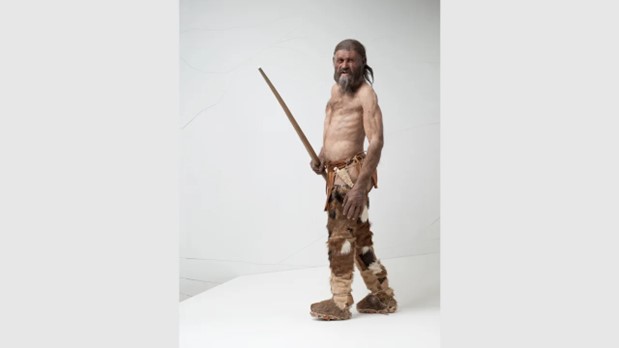
Today’s newspaper reveled new discoveries have given a different insight to the mummified remains of a man found by hikers in a glacier in the Italian Alps in 1991.  The man had been killed by an arrow shot into his back and had then frozen into the ice.  The mummy was found along with his clothing and gear, including a copper axe, a longbow, and a bearskin cap.  The mummy is Europe’s oldest known natural human mummy, offering an unprecedented view of Copper Age (Chalcolithic) Europeans.  The nature of his life and the circumstances of his death have been the subject of much investigation and speculation.  An earlier draft of the mummy’s genome was published in 2012 but with the advances in genome studies a new examination was conducted in 2023.  As the mummy was discovered in Ötztal Alps, it has been given the nickname “Ötzi”.

When I looked online, I found a new study of ancient DNA extracted from Ötzi’s pelvis revealed the 5,300-year-old mummy had dark skin and dark eyes and was probably bald.  This contrasts with the original reconstruction of Ötzi that depicts a pale-skinned man with a full head of hair and a beard.  It was originally believed the skin was discolored and the hair lost through the frozen mumification process.  Albert Zink, coauthor of the research published Wednesday in the scientific journal Cell Genomics, said “the dark skin color of the mummy is quite close to the Iceman’s skin color during (his) lifetime.”  Zink noted this is not surprising as many Europeans at that time likely had darker skin coloring than many present-day Europeans.  Lighter skin was an adaptation to changes in climate and diet, as farmers have less vitamin D in their diet than hunter-gatherers.  The iceman consumed a lot of meat, which was confirmed by the analysis of his stomach showing the presence of ibex and deer meat.

According to the study, the genome sequenced from DNA taken from Ötzi’s pelvis was more complete than a previous genome that was pieced together in 2012 when the field of ancient DNA was still in its infancy.  The latest research helps clear up a puzzle in Ötzi’s ancestry.  The 2012 study revealed that he had traces in his genome from the steppe people, sometimes known as Yamnaya, who only arrived in Europe centuries after his death.  The new study shows that this early result was probably the result of contamination by modern human DNA.  The 2023 study on Ötzi’s genome evidenced a high proportion (90%) of Anatolian-farmer-related ancestry with a lesser contribution from European hunter-gatherer-related ancestry.  The genome also appeared to rule out a previously proposed genetic affinity between Ötzi and present-day Sardinians.  When researchers compared Ötzi’s genome with those of other ancient humans, they found he had more in common with early Anatolian (Turkey) farmers who did not have much interaction with his European hunter-gatherer contemporaries.  The iceman most likely lived in a relatively isolated area with only limited contact to other populations and low gene flow from hunter-gatherer-ancestry-related populations.  When he did have contact, it may have been his last.

Thoughts:  This is not the first time the story of Ötzi has been rewritten.  It was originally thought that Ötzi froze to death, but a 2001 X-ray revealed an arrowhead in his shoulder, which would have been fatal.  The mummy also had a head injury, possibly sustained at the same time, and his right hand shows a defense wound.  “The whole story of the Iceman is intriguing, including the mystery of his violent death . . .  and the question why he was up there in the high mountains when he was killed,” Zink said.  Ötzi appears to represent the long standing conflict between different groups and lifeways.  The farmers of the valley did not associate with the hunter-gatherers of the mountain and likely did not understand (or respect) the differences.  In our globalized world we cannot afford to make the same mistake.  Act for all.  Change is coming and it starts with you.

Child

August 17, 2023

(Terrence Collingsworth / Associated Press)

Inside the front section of yesterday’s newspaper was an article on a lawsuit asking the US government to enforce the 1930’s era law that requires the government to ban products created by child labor from entering the US.  The nonprofit group International Rights Advocates filed the suit as Customs and Border Patrol and the Department of Homeland Security were ignoring the extensive documented evidence of child labor in cultivation of cocoa headed for major US based chocolate companies.  These companies had already agreed in 2001 to stop using the child sourced cocoa by 2005 (they did not) and now say they will eliminate the worst forms of child labor in their supply chains by 2025.  A 2019 study found 790,000 children, as young as 5 years, were working the Ivory Coast cocoa plantations.  Ivory Coast officials have said they are taking steps to eradicate child labor, but blocking the imports to US companies would devastate the nation’s economy.

When I looked online, I found the Fair Labor Standards Act of 1938 (FLSA) was signed into law by President Franklin D. Roosevelt on June 25, 1938.  This was among 121 bills signed by the president 9 days after Congress had retired from session to avoid pocket vetoes.  The law had faced corporate and judicial opposition and had been altered and rewritten by Congress for the last year.  The final form of the act applied to industries whose combined employment represented only about one-fifth of the labor force.  FLSA banned oppressive child labor and set the minimum hourly wage at US$.25, and the maximum workweek at 44 hours.  The act became effective on October 24, 1938, effectively banning the use of child labor under the age of 16 years.

Child labor violations have been on the rise in the US since 2015 after steadily declining for years.  In 2015 the federal Wage and Hour Division found 1,012 minors employed in violation of child labor laws, with an average of 1.9 violations per case.  That number grew more than triple to 3,876 in 1922 and averaged 4.6 violations per case.  Most violations occur in places where it is appropriate for minors to work.  That means teenagers are working too many hours at a grocery store or operating a fryer and staying too late at a fast-food chain.  The US generally has good child labor laws, except for agriculture where minors as young as 12 can work long hours and agriculture’s hazardous-occupation orders are not as strict.  While child labor violations can affect minors of all backgrounds, Reid Maki, director of child labor advocacy for the National Consumers League, says “a lot of the kids we see working in exploitative situations tend to be from immigrant families. . . and Latino,” often harvesting fruits and vegetables.

Thoughts:  One of the central allegations of the lawsuit is that while the chocolate company defendants did not own the cocoa farms, they “knowingly profited” from the illegal child labor.  According to the submissions, the defendants’ contracted suppliers were able to provide lower prices than if they had employed adult workers with proper protective equipment.  Saving a few pennies on your favorite bar of chocolate should not come at the cost of exploiting a child and destroying any possible future they may have.  That is true in the US, and for US company’s supply chains abroad.  Act for all.  Change is coming and it starts with you.

Okeanos

August 16, 2023

Hidden in the back section of today’s newspaper I found an article on deep sea mapping happening off the Alaskan coast.  A team of 48 researchers and crew are part of the National Oceanic and Atmospheric Administration’s (NOAA) five month mission aboard the Okeanos Explorer, a reconfigured naval vessel.  The ship is outfitted with the tools and technology to look deep into the ocean and collect data that can be shared in real time with onshore researchers as well as the researchers onboard.  The deep ocean off Alaska’s Aleutian Islands is one of the least mapped places in the US, with only 34% of the Alaskan seafloor mapped.  This is also one of the nation’s largest coastal ecosystems, and only a fraction of it has been seen.  NOAA has a goal of mapping all US deep waters by 2030 and near-shore waters by 2040.

When I looked online, I found the Okeanos Explorer has traveled the globe, exploring everywhere from the Indonesian “Coral Triangle Region” and benthic environments in the Galápagos, to areas in the Gulf of Mexico, canyons and seamounts off the Northeast US Atlantic coast, and marine protected areas of the Pacific.  The Okeanos collects baseline data in unexplored areas to further knowledge, while setting the stage for more in-depth exploration in the future.  Prior to being acquired by NOAA in 2004 and commissioned in 2008, Okeanos operated as the US Naval Ship Capable, a T-AGOS class vessel.  The NOAA ship was named by students from Illinois’ Woodstock High School in a nationwide ship-naming contest.  In ancient Greek cosmology, Okeanos was the river/ocean that encircled the world.  The ship is homeported in Newport, Rhode Island.

Okeanos Explorer is the only federal vessel dedicated to exploring the largely unknown ocean for the purpose of discovery and the advancement of knowledge.  NOAA Ocean Exploration owns the mission equipment used during expeditions on Okeanos and coordinates the ship’s exploratory missions.  The two remotely vehicles are operated via a partnership with NOAA Ocean Exploration and the Global Foundation for Ocean Exploration.  Missions of the 224-foot vessel include mapping, characterization of the site, reconnaissance, advancing technology, education, and outreach.  Everything done is focused on understanding, managing, and protecting the ocean.  The Okeanos uses a variety of advanced technologies to explore and characterize unknown or poorly known deepwater ocean areas, features, and phenomena at depths ranging from 820 to 19,700 feet (250 to 6,000 m).  The ship is equipped with four different types of mapping sonars that collect high-resolution data about the seafloor and the water column, a dual-body remotely operated vehicle (ROV) capable of diving to depths of 19,700 feet (6,000 m), and a suite of other instruments to help characterize the deep ocean.  The ship not only sends data to onshore researchers but can livestream dives to the public.

Thoughts:  Okeanos Explorer maps the undersea landscape, but also discovers new species in the unique environments it explores.  Scientists believe only 10% of the world’s ocean species have been identified, and that there are around 2 million yet to be discovered.  Of the nearly 250,000 known marine species, scientists believe all fully aquatic marine mammals emit sounds, as well as at least 100 invertebrates and 1,000 fish species.  Fish and invertebrates use sound for basic life functions.  Tiny oyster larvae use sound to guide them to a healthy reef.  Cetaceans (whales, dolphins, and porpoises) have evolved over millions of years to use a variety of complex sounds to help navigate, communicate, and mate.  When healthy, vibrant environments start to go quiet, it is a sign they are dying.  When marine areas are protected, the species communication returns, and the vibrancy of the reef comes back.  The deep sea areas already suffer from pollution and steps need to be taken to protect these irreplaceable sites and species.  Act for all.  Change is coming and it starts with you.

Lawsuit

August 15, 2023

(Thom Bridge/Independent Record)

At the back of the front section of today’s newspaper I found an article on a lawsuit working through the courts in Montana.  Sixteen Montana youths between the ages of 5 and 22 sued the state, the governor, the Montana Department of Environmental Quality, the state’s public commission office, and other state departments in 2020 over Montana’s fossil fuel-based energy system.  The lawsuit cited scientific evidence that burning fossil fuels is contributing to global warming that is already causing them harm.  The judge’s ruling said a provision in Montana’s Environmental Policy Act violated the right to a clean environment, guaranteed under Montana’s state constitution, by promoting the continued use of fossil fuels.  The court said a provision in the law preventing the state from considering the climate impacts of energy projects is unconstitutional.  The decision is based on the provision in the Montana Constitution that guarantees citizens a “clean and healthful” environment.  At least three other states (Pennsylvania, New York, and Hawaii) have similar language in their constitutions, and all have similar lawsuits.

When I looked online, I found the carbon dioxide emissions which are at the heart of the lawsuit are associated with energy and industrial production and come from a range of fuels.  The contribution of each source has changed significantly over time, and still shows large differences by region.  Early industrialization used coal-fired power and emerged in Europe and North America during the 1700’s.  By the late 1800’s there is a growth in emissions from oil and gas production.  By the late 1900’s there are emissions from flaring and cement production.  Solid and liquid fuel now dominate industry, although emissions from production of gas are significant.  Cement and flaring remain comparably small even at a global level.  Total emissions from different sources are largely reflected by the population of a given country.  The distribution of emissions across different fuel sources is also dependent on energy production and mix in each country.  In the US or the UK, oil followed by gas are the largest contributors.  In China and India coal is much more dominant, and in Russia the largest emissions come from gas.

In ruling on the lawsuit, the judge did not lay out specific steps for the state to take, but the order opens the door for state officials to consider climate impacts in future policy decisions, on energy and mining projects, or efficiency and emissions standards.  The state opposed the lawsuit largely on procedural grounds, arguing the challenge was overly broad and that Montana’s specific contribution to global greenhouse-gas emissions could not be identified and therefore was not the state’s responsibility to regulate.  Montana’s Republican-majority legislature has supported fossil fuel infrastructure in the resource-heavy region and passed a new law this session explicitly prohibiting analysis of greenhouse gases and climate effects in environmental-impact reviews by state agencies.  That law was blocked by Monday’s ruling.  The Montana attorney general’s office said it planned to appeal, saying that Monday’s ruling was “absurd” and that the trial was a “weeklong taxpayer-funded publicity stunt.”

Thoughts:  In a 1999 landmark decision (MEIC v. Montana DEQ) the Montana Supreme Court ruled unanimously that Montanans’ constitutional right to a clean and healthful environment (Article IX, Section 1) is “a fundamental right and one that is intended to be preventative in nature.”  The lawsuit was filed because the Montana Department of Environmental Quality had allowed the Seven-Up Pete Joint Venture to pump millions of gallons of arsenic-tainted water into the Landers Fork and Blackfoot Rivers without treatment.  The Supreme Court’s ruling said blanket exemptions are unconstitutional unless the State can show a compelling State interest in granting them.  Caring for the environment ultimately comes back to caring for humans as well as the planet.  We are not at odds with the planet and need to stop acting like we are.  Act for all.  Change is coming and it starts with you.

Continent

August 10, 2023

While I have been reading articles on the shrinking glaciers on Greenland and the melting tundra in Alaska and Siberia there has been little mention of the frozen south.  Now scientists are reporting this remote and desolate land is recording record shattering temperatures of 70F (17.8C) above normal over the summer of 2023 (northern winter).  The temperature extremes also vary wildly from the east to the west side of the continent.  The western peninsula is seeing dramatic loss of ice sheets while the east has at times gained ice.  One western ice sheet has been named the Doomsday Glacier as it has been melting so fast.  The sea ice that surrounds Antarctica is also melting, turning from a record high to the lowest amount ever recorded.  Martin Siegert and Anna Hogg who coauthored the research paper state that if the trend continues it will result in disappearing coastlines and increased global warming as the light reflecting ice disappears across the continent of Antarctica.

When I looked online, I found Antarctica is Earth’s southernmost and least-populated continent.  This southern landmass is situated almost entirely south of the Antarctic Circle and surrounded by the Southern Ocean (Antarctic Ocean) and contains the geographic South Pole.   Antarctica is the fifth-largest continent, with an area of 5,500,000 square miles (14,200,000 km2).  Most of Antarctica is covered by the Antarctic ice sheet which has an average thickness of 1.2 miles (1.9 km).  The continent on average is the coldest, driest, and windiest of the seven continents, and has the highest average elevation.  The land is a polar desert, with annual precipitation of just over 8 inches (200 mm) along the coast and far less inland.  Nearly 70% of the world’s freshwater reserves are frozen in Antarctica.  If they were to melt it would raise global sea levels by almost 200 feet (60 m).  Antarctica holds the record for the lowest measured temperature on Earth at −128.6F (−89.2C), while the coastal regions can reach temperatures over 50F (10C) in summer.  Native animal species include mites, nematodes, penguins, seals, and tardigrades. Where vegetation exists, it is mostly lichen or moss.

The Protocol on Environmental Protection to the Antarctic Treaty (PEP) was enacted in 1998 and is due to be reviewed in 2048.  The treaty restricts the exploitation of the resources of Antarctic continent, including the small deposits of minerals that have been found.  The treaty also makes tourism subject to the provisions of PEP.  The self-regulatory body is the International Association of Antarctica Tour Operators.  Tourists are allowed to arrive by small or medium ship at specific scenic locations with accessible concentrations of iconic wildlife.  Over 74,000 tourists visited the region during the 2019-2020 season.  While 18,500 arrived on cruise ships that did not include excursions on land, the other 55,500 impacted the coastal shores.  Some conservation groups have expressed concern over possible adverse effects caused by these visitors and have called for limits on visiting cruise ships and a tourism quota.  The response by PEP has been to develop guidelines that set landing limits and closure or restricted zones on the more frequently visited sites.  Qantas now operates commercial overflights to the continent from Australia.

Thoughts:  The population of researchers in Antarctic continent varies from around 4,000 in summer to 1,000 in winter, with another 1,000 personnel (ship crews and scientists) doing onboard research in the surrounding waters.  At least 11 children have been born in Antarctica.  These extra 60,000 people (tourists and researchers) on land have their own impact on the fragile environment.  “Because it is there” used to be sufficient reason to challenge the wilds.  It now appears to have shifted to, “Because I can”.  Act for all.  Change is coming and it starts with you.
Rainforest

August 8, 2023

Photograph: Ueslei Marcelino/Reuters

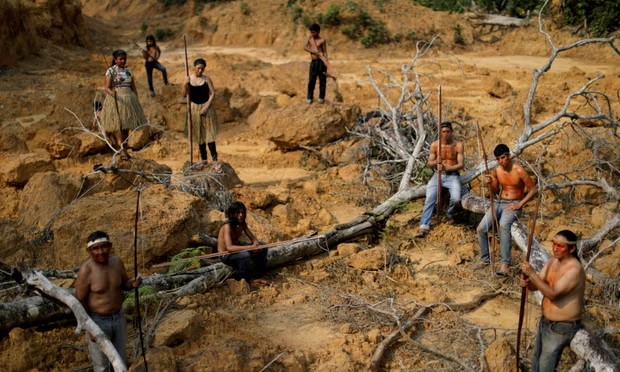
The nation and world section of today’s local newspaper lead with the summit being held in Brazil this week.  For the first time in 14 years the presidents of the eight countries and one territory that are home to the Amazon rainforest met in Belem, Brazil, to discuss a common course to protect the rainforest and address organized crime.  The45 year alliance known as the Amazon Cooperation Treaty Organization has been ineffective and only met three times previously and three of the countries did not send representatives to this summit.  This is Brazilian president Luiz Inacio Lula da Silva’s second attempt to bring the coalition together to address the deforestation of the rainforest.  During his first presidency in 2009 da Silva called a similar summit that was only attended by one other president and the president of France (French Guiana).  Peru is also seeking an agreement to attack drug trafficking and other illegal activities that plague the area.  While outside the official summit, 20,000 Indigenous peoples and others from different Amazon countries have scheduled 400 parallel events to bring attention to the crisis.

When I looked online, I found the deforestation of the rainforests continues relentlessly, prompting concerns governments will not meet a COP26 deal to halt and reverse deforestation by the end of the decade (2030).  COP stands for “Conference of the Parties”, and the one in Glasgow was the 26th annual summit.  Ahead of the conference, 200 countries were asked for their plans to cut emissions by 2030.  COP26 was the moment countries revisited climate pledges made under the 2015 Paris Agreement where they were asked to make changes to keep global warming “well below” 2C (3.6F) and try to aim for 1.5C (2.1F).  The goal is to keep cutting emissions until they reach net zero by mid-century.  COP27 was held in Egypt in 2022 and is scheduled for Dubai in November 2023.

The Cop26 decision came in November of 2021 after a year where the Brazilian Amazon and Congo basin rainforest lost 11.1 million hectares of tree cover, including 3.75 million hectares of primary forest critical to limiting global heating and biodiversity loss.  The world’s Boreal forests also experienced a record loss driven by the worst wildfire season in Siberia since records began.  Experts called the continued deforestation a disaster for action on global warming and said the 143 governments that pledged to halt and reverse forest loss by 2030 at Cop26 held in Glasgow, had to urgently make good on their commitment.  The countries agreed to pledge further cuts to emissions of carbon dioxide (CO2), a greenhouse gas which causes climate change.  The agreement attempts to reduce coal (40% of annual CO2) by a commitment to “phase down” rather than “phase out” after an intervention by China and India.  The agreement also pledged to significantly increase money to help poor countries cope with the effects of climate change and make the switch to clean energy.  There is the prospect of a trillion dollar a year fund from 2025.  This comes after a previous pledge for richer countries to provide US$100 billion (£72bn) a year by 2020 was missed.

Thoughts:  Climate change agreements face pushbacks from three areas.  The wealthier Western countries industrialized early and substantially raised the CO2 levels burning coal oil, and gas.  Eastern nations entered later but now produce equal or higher levels of emissions as they ramp up industrialization.  The loser is the poorer nations who have not significantly industrialized, are now being asked to use more expensive sources of fuel when they do industrialize, but also suffer more from the effects of global warming.  That is the reason for reparations, and a stumbling block to both the East and West.  When we acknowledge (and pay for) past actions, it only grows more expensive as we wait.  Meanwhile, the rainforest disappears.  Act for all.  Change is coming and it starts with you.

Fritters

August 8, 2023

I have mentioned that I do most of the cooking at home.  When a couple decide to be together the housework and other tasks a single person is required to do are at least halved again for two people.  While household chores were traditionally the domain of the stay at home mom, that has changed since at least the 1950’s.  Now couples tend to divide the tasks so they are shared rather than assuming one person will do everything while the other lounges.  Shopping and making meals are some of the tasks I have chosen to take on.  I have been averse to using cookbooks since I first began to cook at age four (yes, my mom loved to tell the story of remaining silent as her women’s group told of the beginner meals being produced by their 8 to 10 year olds, knowing I did the same at half their age).  While I pride myself on creating (or trying to) innovative meals I know there are times I get into a rut and cook the same things over and over.  Last week I went to the store determined to come up with something new, and with less of an emphasis on red meat.  I made a yellow squash soup last spring that was delicious and thought that might be good again.  When I got the squash out last night, I realized it was too hot for soup.  Knowing Melissa is a southern girl, I instead went online and found a recipe for fritters, of course substituting the squash and altering the prescribed directions.

When I looked online, I found fritters can be any of various types of fried foods, generally consisting of small pieces of meat, vegetables, fruit, or dough.  Plain fritters are deep-fried cakes of chou paste or yeast dough.  Other fritters can be bits of meat, seafood, vegetables, or fruit coated with batter and deep-fried.  Small cakes of chopped food in batter, such as corn fritters in the southern United States, are also called fritters.  Fritters can be found in many types of cuisine.  The French beignets, Italian bigne, and Greek loukoumades are sweet cakes of the plain variety of fritters.  The batter-frying technique was introduced into Japan by the Portuguese and Spanish in the late 16th century and was altered to become tempura (they must not have liked following recipes either) that developed as a mixed fry of shrimps, herbs, and vegetables that is central to Japanese cuisine.  The Indian pakora is a savory deep-fried cake containing bits of cauliflower, eggplant, or other vegetables.  Fritto misto is an Italian dish of bits of meat, seafood, and vegetables dipped in batter and fried in olive oil.  A specialty dish of various local cuisines are flower fritters, using daylilies, roses, violets, acacia, elder blow, or squash blossoms.  Corn fritters, consisting of corn kernels, flour, egg, and milk, are served in many Southern homes and restaurants topped with fruit, jam, and honey.  This dish has its roots in both Native American and Indonesian cuisine.

Being a meat and potatoes Kansas boy, I tend to fry a lot of my meals.  Melissa is trying to eat smarter so last night I made a salad, baked squash fritters, and baked catfish.  I grated the squash (a new technique for me) and combined the squash with corn meal, milk, an egg, and Cajun spices.  While not fried, the fritters were excellent.  The baked catfish was ok, but not nearly as good as if it had been fried.  Next time I need to devise a different recipe for the fish that does not rely on the breaded coating.  

Thoughts:  Part of the fun of cooking is trying new techniques and discovering new styles of cuisine.  That was why I canned my pasta sauce and why I decided to make fritters.  Melissa also knows this is a way I try and support her, allowing her time to work while I do something I love anyway.  Partnerships that last tend to be built on shared responsibilities.  This is all the better if you can find something you enjoy but the mundane chores should be shared as well.  The adage may be, “happy wife, happy life”, but in today’s Western culture perhaps it should be, “happy marriage, do not disparage”.  Act for all.  Change is coming and it starts with you.

Tiger

August 4, 2023

Last summer I noted the eastern black swallowtail (Papilio polyxenes) enjoying the nectar of our Garden Phlox (Phlox paniculata) that line the bed along the front of our house.  While I have not seen another of that type, there have been a few monarch butterflies (Danaus plexippus), also known as the common tiger, flitting the phlox.  Yesterday I went out to the car and noticed another type of butterfly.  This was like the black swallowtail, but the front wings were primarily yellow with four black bands.  My first impression as it flitted from flower to flower was that it looked like a small tiger pouncing on its prey.

When I looked online, I found the eastern tiger swallowtail (Papilio glaucus) is a species of butterfly native to eastern North America.  It is one of the most familiar butterflies in the eastern US and ranges north to southern Ontario, Canada.  The tiger is present from spring until fall and will produce two or three different broods over that time.  Adults feed on the nectar of many species of flowers, mostly from those of the families Apocynaceae (oleanders), Asteraceae (daisies), and Fabaceae (beech and oak trees).  The tiger has a wingspan measuring 3.1 to 5.5 inches (7.9 to 14 cm) with females being the larger sex.  The male is yellow with the four black “tiger stripes” that I had seen on each forewing.  Females are dimorphic and may be either yellow or black.  The yellow morph is like the male but has an obvious band of blue spots along the hindwing, while the dark morph is almost completely black.  The young caterpillars are brown and white, and they turn green with two black, yellow, and blue eyespots on the thorax as they age, then turn brown prior to pupating (forming a cocoon). It will reach a length of 2.2 inches (5.5 cm).  The cocoon (chrysalis) varies from whitish to dark brown in color.  Hibernation occurs in this stage in locations with cold winter months.  The eastern tiger swallowtail is the state butterfly of Alabama (and state mascot), Delaware, Georgia, North Carolina, and South Carolina, and is the state insect of Virginia.

The tiger swallowtail presents a variety of defense mechanisms as it transitions through its life cycle.  The first three stages (instars) of the caterpillar are bird dropping mimics, a coloration that helps protect it from predators.  In later instars, the eyespots on the thorax serve to deter birds.  Like all members of the family Papilionidae (swallowtails), the tiger caterpillar possesses an osmeterium, an orange, fleshy organ that emits foul-smelling terpenes to repel predators.  The osmeterium is normally hidden and is located on the first segment of the thorax and can be turned inside out (everted) when the caterpillar feels threatened.  The combination of eyespots and osmeterium makes the caterpillar resemble a snake.  Dark morph females use Batesian mimicry (named after Henry Walter Bates and his work on butterflies in Brazil) where a harmless species imitates the warning signals of a harmful species as protection from predators by mimicking the poisonous pipevine swallowtail (Battus philenor).  The pipevine is more common in the south, where the dark morph females are also more prevalent.

Thoughts:  The male tiger does not use Batesian mimicry and are preyed upon more frequently than the females, so why are the females not all dark morphs?  There are two noted hypotheses.  The male avoidance hypothesis suggests the female disguises to evade male harassment, as courtship can be harmful.  The pseudosexual hypothesis suggests the male will aggressively approach the male-looking female, then shift to sexual behavior when they identify them as female.  One study found the Batesian females suffered less predation, but their fitness was reduced most by sexual harassment.  The others faced lower sexual harassment but lost fitness from predation.  Nature balances itself to achieve the best outcome for all.  Humans tend to focus on what is best for me right now.  Until we decide to work for the good of all (human and planet) we will fail.  Act for all.  Change is coming and it starts with you.
Ducks

August 2, 2023

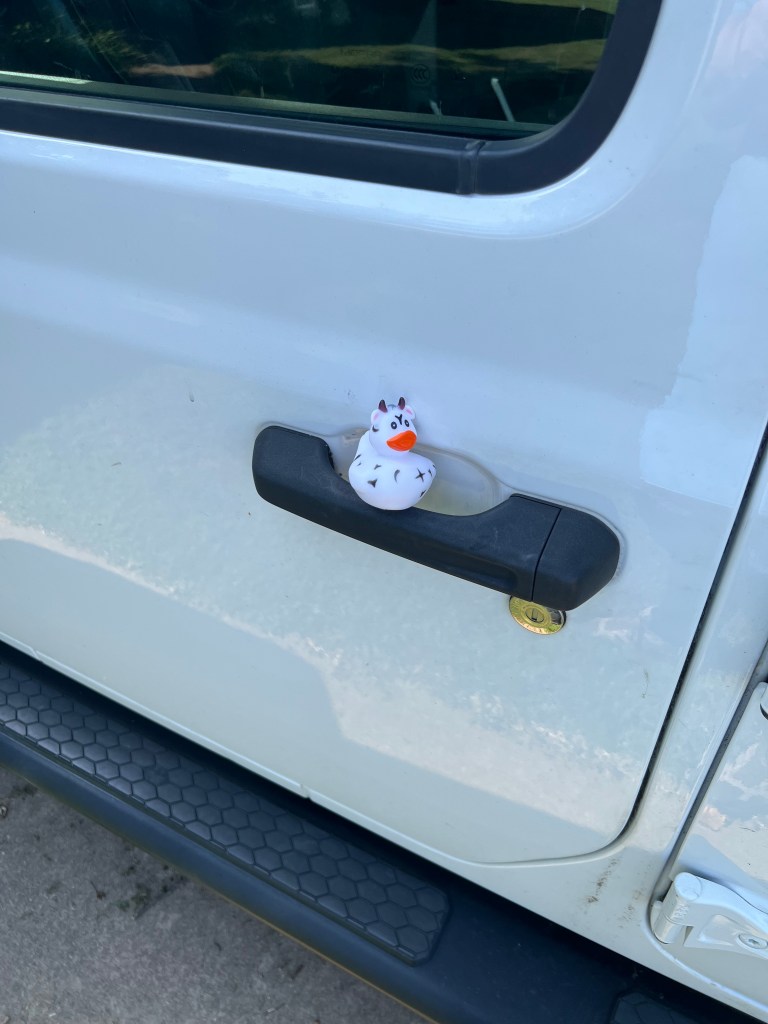
My unsuccessful quest for canning supplies on Sunday left me feeling frustrated and unsure if my efforts were going to turn into canned pasta sauce.  I came out to my car wondering what I should do next or where I now needed to check.  As I approached my vehicle, I noticed a small rubber duck sitting on the driver’s side door handle.  At first, I was taken back.  Who would have placed a rubber duck on my car and what was the intended meaning?  I remembered the story of how the Jeep wave had begun after World War II as ex-GI’s purchased surplus army Jeeps.  The Jeep wave became a recognition of camaraderie that brought this group together.  During the pandemic I also heard something about the Jeep ducks that were placed for this same reason and wondered if I had experienced being part of the Jeep ducks movement.

When I looked online, I found the heart of the Jeep ducks phenomenon is a desire to put a smile on someone’s face.  Jeep owners leave rubber ducks on other Jeeps to surprise the owner.  It is an inside joke and a random act of kindness among fans of the Jeep brand.  Jeep ducks are all about making strangers and travelers feel like they are part of something bigger and kinder.  The movement now known as Jeep Ducking began in 2020 in Ontario, Canada, during the early days of the pandemic.  After an ugly spat in a gas station parking lot, a Jeep owner named Allison Parliament needed to rely on a friend for a much-needed pit stop to calm down before continuing her travel.  To thank her friend, Parliament bought a bag of rubber ducks and hid them around his house as a joke before heading farther north to reach her family’s home.  Before those ducks were scattered around her friend’s home, Parliament put a single yellow duck on a stranger’s Jeep in the store’s parking lot, with a simple, sweet note saying, “nice Jeep.”  The owner of that Jeep saw her and laughed then suggested that she post about it on social media which she did.  That was the birth of a movement that now has more than 73,000 fans (and growing) on Facebook.  Parliament’s social media group is now the official Jeep duck account recognized by Jeep itself.

The question I had was what to do once one of the Jeep ducks shows up on my vehicle?  I could take a picture and post it on social media with the #duckduckjeep hashtag to share it with other members of the community.  I placed my duck on my dashboard as a badge of honor and I continue to keep waving to other Jeep owners as we pass on the road.  The ducks site suggested I could keep the duck you were given or pass that duck along to another Jeep driver.  The only real rule for the Jeep ducks is kindness.  You can buy rubber ducks to keep in your Jeep, then randomly put them on other peoples’ Jeeps as you see fit.  Jeep ducks are often placed just outside the driver’s side window, near the windshield wiper or in front of the inspection stickers, so the driver will easily see it before driving away.  You may want to leave one of the ducks on a Wrangler because you like the color, or on a Grand Cherokee because it’s the same model you drive.  There are no concrete rules for when or why to place the ducks.

Thoughts:  The Jeep ducks started out as a Wrangler thing, but the ducks are no longer exclusive to the Wrangler and can be found on Cherokees, Liberties, Compasses, and every other model bearing the Jeep logo.  Drivers of other car brands are co-opting the ducks trend and placing them on vehicles all over the globe.  When I was blessed with one of the Jeep ducks it brought a little joy to a day gone awry.  Bringing extra smiles to the world is welcome, regardless of whether it comes from a Jeep or any other vehicle owner.  Kindness is more contagious than hate.  Act for all.  Change is coming and it starts with you.