
Canning

August 1, 2023

To follow up on my first attempt at canning, it was both rocky and smooth.  The biggest problem was the seven last words that kill most projects (we’ve never done it that way before).  My inexperience added to the constant reminders that if you do not follow the recipe precisely, it could have a toxic result.  Despite feeling the pressure, I reminded myself the process has been successfully accomplished for over 200 years.  I ended up making the pasta sauce on Saturday night after placing the ingredients in three successively larger pots to find enough room.  I simmered the sauce for the required 20 minutes and then pureed the mixture to reduce the large pieces of tomato and help pulverize the seeds.  Melissa and I usually like our sauce chunky style, so we add our own sauteed vegetables and hamburger.  This should be no different than doing the same with my homemade sauce.

By Sunday it was time to get serious about canning.  Melissa reminded me I had given her a pressure cooker when we lived in Kansas, but I remembered a pressure cooker was different than a pressure canner so that was out.  We had a large pot Mellissa’s dad had used for cooking, but it did not have the bottom grate to allow the water/steam to get under the canning bottles.  Rather than purchase online or do the returns I decided to go to the store and buy what I needed.  The market’s website indicated they were available for pickup so I should be able to go inside and find what I needed.  I was wrong.  I could not find anything I needed.  I asked an employee (who asked the manager) where the canning tools might be and was told these were online items and not stocked in the store.  Back to the drawing board for more research and a second night of the sauce sitting covered in my refrigerator.

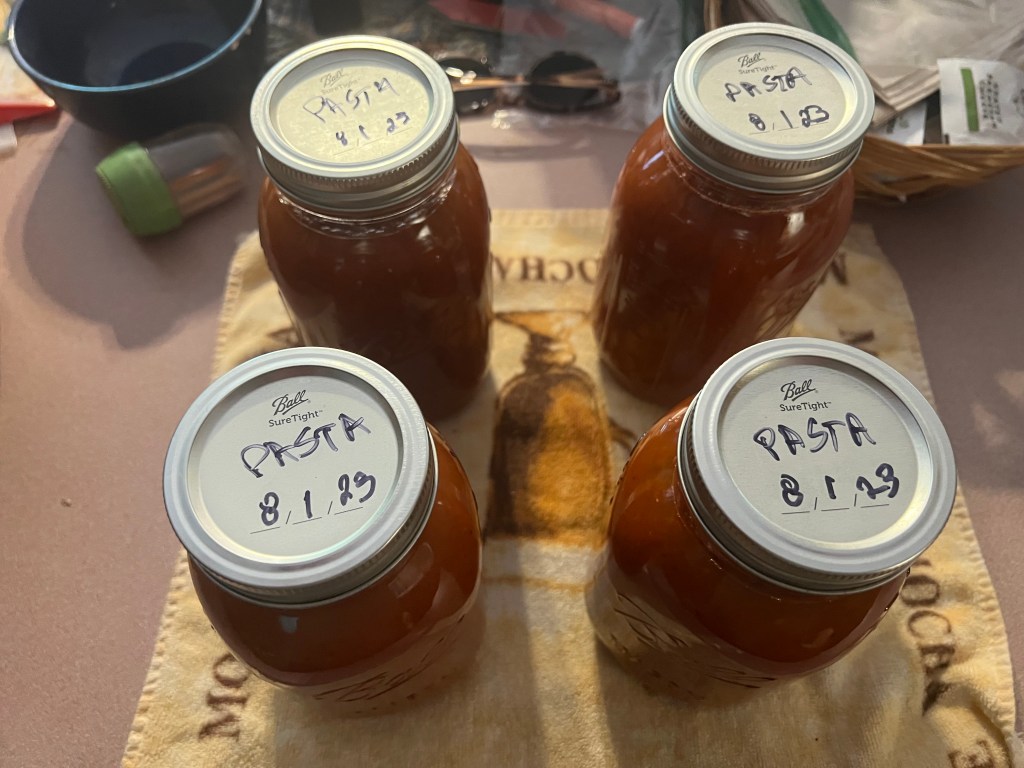
By Monday I was getting desperate as I knew I had to at least freeze the pasta sauce and a three day delay for shipping was no longer an option.  I checked the local hardware website and found they also carried canning supplies.  I asked the clerk and was shown the row of supplies, pots, and cooking aids I needed to accomplish the job.  I selected the needed tools and after much hesitation decided on the pressure canner rather than the water bath canner.  I no sooner got home than I regretted my decision.  Not only was the pressure canner three times more expensive, but it was also a different process than I had been researching.  I went back to the hardware store and replaced it with the water bath and a recipe book and finally forced myself to start the process.  I filled the canner to sterilize the bottles, put on another pot to sterilize the lids, and put the sauce on the stove to simmer.  After sterilization I filled the quart bottles with the hot sauce (and lemon juice for acidity) and hand screwed on the lids.  After forty minutes in the boiling water and five minutes rest it was time to remove the bottles so they could cool.  My fears were alleviated when we heard all four lids vacuum seal with a slight “pop” as they cooled.  My first attempt at canning was complete.  Now I have a year to enjoy my pasta sauce.       

Thoughts:  As I think back on my three day canning project, I realize it was not all that difficult.  The problems arose with my indecision and not having the right equipment before I started.  Even blanching and removing the tomato skins to make the sauce was easier this time than last week.  When I finally threw myself into the canning process it went smoothly as I followed the written and pictorial directions in my newly purchased canning book.  Having completed the process once I am ready to switch from making sauce to salsa with no fear.  Who knows, maybe even fruits and vegetables?  Life is often about overcoming our fear of the new and unknown.  We can allow our fear to keep us from trying, or we can overcome our fear and move forward.  We often find opening ourselves to new experiences and perspective add enjoyment and new friends.  Act for all.  Change is coming and it starts with you.

Water Bath

July 30, 2023

Between the heat and the birds, I have been losing tomatoes fast.  I have brought several loads inside the house but there are too many to fit in the refrigerator and they have been slowly deteriorating on the kitchen cabinet.  Yesterday I decided I needed to do something.  I had previously purchased what I thought I needed to can pasta sauce.  I prepared the sauce according to the recipe, including 12 pounds of tomatoes.  I placed the new canning jars in the dishwasher to clean them before I began the process.  We purchased a low energy dishwasher when we moved back to the house and while it saves energy, it seems to take a long time to complete its cycle.  By the time the wash cycle was done it was too late to start the canning process.  I was also a little apprehensive as I had never done any canning before.  I decided rather than buy a pressure cooker like my mom had (that I may never use again) I would use the water bath method to preserve the sauce.  Waiting one more day would let me review the process and be sure I was not pressed for time.   

When I went online, I found home canning or bottling, also known colloquially as putting up or processing, is the process of preserving foods, in particular, fruits, vegetables, and meats, by packing them into glass jars and then heating the jars to create a vacuum seal and kill the organisms that would create spoilage.  Although ceramic and glass containers had been used for storage for thousands of years, the technique of canning by applying heat for preservation was only invented in the first decade of the 1800’s.  Prior to the 1800’s food storage containers were used for non-perishable foods, or with preservatives such as salt, sugar, vinegar, or alcohol.  There are two primary ways to can foods.  Pressure canning is the only safe home canning method for meats and low-acid foods and requires a pressure canner.  A pressure canner is like a pressure cooker but heavier.  A small amount of water is placed in the canner, and it is turned to steam (normally 212F or 100C), but under pressure it is raised to 240F (116C).  Water bath canning is only appropriate for high-acid foods, such as jam, jelly, most fruit, pickles, and tomato products with acid added.  This method uses a pot large enough to hold and submerge the glass canning jars.  Food is placed in glass canning jars and placed in the pot with enough hot water added to cover the jars.  Water is brought to a boil (212F or 100C) and held there for at least 10 minutes.  Different foods require a different length of time under boil and larger jars require longer times.

After purchasing what I thought I needed to complete my water bath canning last week I realized I needed a magnetic wand to retrieve the lids from the boiling water to keep them sterile.  When I tried to find a wand at my local market it said there were kits available that included the wand, jar puller, and a wide mouth funnel to pour the sauce into the jar without spilling.  I could only find the wand in store as part of a set, but I only needed the wand.  The set was also less than the single wand.  Now I am torn between returning the two items I already purchased and buying the set or buying the wand online and waiting on 3-day delivery (and at a greatly reduced).  Bundling and online purchase appear to be two of the lasting effects of the pandemic. 

Thoughts:  Growing up my mom canned a variety of fruits and vegetables for use during the winter.  While I never participated in the process, I do remember seeing the rows of jars safely stored in the basement cellar.  Safety measures must be taken when preforming any home canning, including a water bath.  Ingestion of toxin in food produced by Clostridium botulinum can cause death and it is critical that consumers who can at home obtain proper and current information from a reliable source (i.e., not me).  Still, this is a proven way to store and keep summer produce for longer periods of time and a way to avoid wasting food.  Act for all.  Change is coming and it starts with you.
Beavers 2

July 28, 2023

Several years ago, I blogged about the restoration of beavers to Scotland after they had been hunted to extinction four centuries earlier.  Beavers are now a protected species, and while there are still those who object to their presence, the wetlands created are a protection against wildfires and provide a significant source of ecotourism.  Yesterday’s newspaper had an article reporting on California coming to the same conclusion.  California officials have begun to pay close attention to the beavers’ ability to help combat the impact of climate change.  California launched its new Beaver Restoration Program in 2022, which sees beavers as a nature-based aid for boosting biodiversity and mitigating wildfire risk.  And now, a new policy from California’s Department of Fish and Wildlife calls beavers a “keystone species,” highlighting their important role in upkeeping ecosystems.  A keystone species is a species that plays a critical role in maintaining the diversity and health of an ecosystem, and the removal of the species results in a cascade of impacts to the ecosystem.

When I went online, I found beavers influence their environment to utilize resources, particularly with dam building.  The dam raises the water level to keep the beavers safe to forage, cache food under water for the winter, and to increase protection around their lodge. The ponds become a habitat for critical and endangered species of animals and plants.  Hole nesting birds use the waterlogged trees that rot and create nesting habitat which is usually in critically short supply.  The wetlands are a haven for amphibians, and wildfowl find particular benefit from the beaver ponds for feeding and nesting.  The thousands of insects and invertebrate species benefit from beaver wetlands in one way or another.  The beaver dams are so efficient at retaining sediment that beaver wetlands eventually silt over and become “beaver meadows”.  These meadows are a virtual oasis for wildflowers and the rich mineral deposits left in the meadows offer optimal foraging for deer and other species.  The meadow is eventually invaded by alder, willow, and ash trees, arguably the most ecologically rich woodland type available.  Rather than a pest and nuisance, beavers are pivotal in combating climate change and the wildfires that decimate California and our world on an annual basis.

California experienced the over trapping, attempts at reintroduction, and removal by depredation (damage) permits that faced Scotland.  Beavers are now largely located in the Central Valley and northern part of the state.  While the number of beavers living in California is unknown, hundreds of permits are sought by landowners annually.  Kate Lundquist, director of WATER Institute, said the past three years of drought and wildfires have contributed to the motivation to fund and implement nature-based climate solutions.  “Beaver restoration is just that (sort of solution).”  California will continue to issue depredation permits but the state wants people to try other solutions before killing the animals.  These include wrapping trees with wire mesh or using flow devices on the dams to control the pond levels and prevent flooding.  California has two pilot relocation projects planned.  One will bring beavers back to the Tule River in partnership with the Tule River Indian Tribe.  The project has been in the works for ten years and they hope to reintroduce beavers later this year (2023).

Thoughts:  Even with Scotland’s growing ecotourism industry and government support, the 2022 Beaver Management Report by NatureScot stated 63 beavers were killed and 108 dams removed under license.  Another 15 beavers were translocated within Scotland.  This is mirrored by the hundreds of permits sought annually in California despite government support for beaver conservation.  Until humans put aside the immediate monetary gain in favor of long term protection of the planet, we will continue to move closer to midnight on the doomsday clock.  Act for all.  Change is coming and it starts with you.
Rat

July 27, 2023

Since I addressed the decimation of the bird population by outdoor cats, it is only fair to address another destructive enemy (along with humans) faced by the bird population, the rat.  Several days ago, I was sitting in my car having just exited the store.  There was a small hedge interspersed with trees that lined the grassy area of the parking lot and separating the lot from the ditch which held a small runoff stream.  As I turned the car on the frantic activity of a Northern mockingbird (Mimus polyglottos) caught my eye.  The bird was madly diving into the 2 foot (.6 m) high hedge.  I watched as the bird repeatedly dove into the bush.  I could not figure what was causing this activity until the bird neared one of the openings along the hedge.  That is when I saw a rat scurry across the opening with the bird diving to drive it away.

When I went online, I found the term rat refers to various medium-sized, long-tailed rodents.  Different species of rats are found throughout the order Rodentia, but stereotypical rats are found in the genus Rattus.  The Ancient Romans did not differentiate between rats and mice, instead referring to the former as mus maximus (big mouse) and the latter as mus minimus (little mouse).  Today a rat is typically distinguished from a mouse by its size.  Usually, the common name of a large muroid rodent will include the word “rat”, while a smaller muroid’s name will include “mouse”.  There are 56 known species of rats in the world, but the best-known rat species are the black rat (Rattus rattus) and the brown rat (Rattus norvegicus) both of which originated in Asia.  Rats are bigger than most Old World mice, which are their relatives, but seldom weigh over 17 1⁄2 ounces (500 grams) in the wild.  When the rat is introduced into locations where they did not previously exist, they can wreak grate amounts of environmental harm.  The black rat (or ship rat) is considered one of the world’s worst invasive species and has been carried as a stowaway on seagoing vessels for millennia.  The brown rat (wharf rat) has similarly been carried as a stowaway worldwide in recent centuries.

The ship and wharf rat has contributed to the extinction of many species of wildlife, including birds, small mammals, reptiles, invertebrates, and plants, especially on islands.  A rat is omnivorous and capable of eating a wide range of plant and animal foods and has a very high birth rate.  When introduced to a new area, they quickly reproduce to take advantage of the new food supply.  As the rat spread to isolated islands they preyed on the eggs and young of forest birds, which often have no other predators and no innate fear of predators.  Some experts think rats are to blame for between forty percent and sixty percent of all seabird and reptile extinctions, with ninety percent of those occurring on islands.  That means even though the rat may be responsible, humans accidentally introduced the rat to these new areas.

Thoughts:  While once considered a modern myth, the rat flood in India occurs every fifty years as armies of bamboo rats descend on rural areas and devour everything in their path.  Rats (and their fleas) have long been considered the main source of spread for the Bubonic Plague, even though recent studies show rats alone could not account for the rapid spread of the disease through Europe in the Middle Ages.  Unsanitary conditions and refusal to bathe and wash clothes could have had something to do with a flea outbreak which carried the pathogen.  The CDC lists nearly a dozen diseases directly linked to the rat.  “Rat” in the English is often an insult or signifies someone as an unscrupulous character.  An inflatable rat, or union rat, is a giant inflatable shaped like a cartoon rat, commonly used in the US by protesting or striking trade unions as a sign of opposition against employers or nonunion contractors to call public attention to companies employing nonunion labor.  Perhaps the mockingbird was justified to drive the rat away.  Act for all.  Change is coming and it starts with you.
Responsible

July 26, 2023

Photo via Jodie Wilson

Today was the day we had scheduled to get the kids spayed and neutered.  This is not only a good way to keep unwanted dogs and cats from being born, but also the law in our area.  While Loki was bred and registered, we suspect Zena was the result of a fence jump.  If the animal is running loose and captured by the pound it is spayed or neutered (at the owner’s expense) before it is returned.  Animals that are raised for breeding purposes must always be restrained, and if they escape the owner is subject to a fine of US$150.  The ordinance was put in place to combat the growing problem of feral cats roving the city.  Although stray dogs are a problem in other areas, they seem to be added to this ordinance to address the issue before it becomes a problem.  What is the responsible thing to do?

When I went online, I found there are more than 200 million stray dogs worldwide, according to the World Health Organization.  The American Society for the Prevention of Cruelty to Animals estimates about 3.3 million dogs enter US animal shelters every year.  In Houston, Texas, alone, there are more than 1 million stray dogs, according to the city’s pet shelter, BARC.  After Hurricane Harvey hit in 2017 thousands of dogs were rescued from the floodwaters.  The no-kill movement has contributed to the population growth, as the number of dogs and cats that are euthanized has decreased from 20 million to 3 million each year.  NPR reported there are nearly 14,000 shelters and pet rescue groups in the US that acquire almost 8 million animals each year.  Spay and neuter laws vary by state and have also driven the increase of abandoned dogs, especially in more rural, southern states.  Stray dogs can present safety issues when they roam in packs, causing traffic accidents, attacking residents, and spreading disease.  America’s cats, including housecats that adventure outdoors and feral cats, kill between 1.3 billion and 4.0 billion birds in a year.  What is the responsible thing to do?

When we took the kids in this morning one of the first questions asked was, “Have both dogs been microchipped?”  Microchipping your pet is another way to keep them safe, and in our area is also required.  If your pet runs away or gets lost the vet can run the microchip and find out who the owner is.  Apparently, a con artist in the northwest part of our state has been using this information to scam money from pet parents.  The Lester C. Howick Animal Shelter of Washington County (WCAS) released a statement after Facebook posts claimed that a scammer posing as an employee of the shelter is contacting those in the area with missing pets and asking for money to return the animals.  The man had been stealing information from microchip websites and lost pet flyers to scam the heartbroken pet parents.  WCAS’s official statement says, “For the record, we will never ask you to pay . . . If you receive a call from the Washington County Animal Shelter, it will be from our phone number.”  The scammer has turned a good resource into the mark of the beast.  What is the responsible thing to do?

Thoughts:  I was torn about taking the kids to be fixed and they both seemed to know it.  Loki became a terror scrambling in the waiting room and both were able to work their way out of their collars.  Zena remembered her recent visit for shots and wanted no part of going to the back room.  It will probably take awhile for them to forgive me, and they will need extra love over the next week.  While neither of our dogs are rescues they were both acquired as last resorts from their breeders.  Being a pet parent is a responsibility and that comes with both the good and the hard for your pets.  The same is true for being a human parent.  Being able to have children is not the same as being responsible enough to care for them.  Act for all.  Change is coming and it starts with you.
Honeybee

July 25, 2023

One of the postings on my neighborhood app today was a repost about how to attract bees and keep them.  The original post came from an Oregon woman whose neighbor kept beehives.  With all the hot weather they had been having she decided the bees needed a way to stay cool and hydrated.  After reading about watering bees my own neighbor had purchased a set of bee watering stations and they were actively attracting bees.  The back and forth banter provided other suggestions for your bee watering station.  Some suggested ice with just a little water so the melting ice would keep the station filled all day.  Others suggested DIY bee stations rather than opting for the store bought plastic models (less than US$10).  The key seemed to be keeping water in the station and providing the bees a place to land where they could drink without drowning.  Everyone who responded thought it was a “cool” idea.

When I went online, I found the western honeybee or European honeybee (Apis mellifera) is the most common of the 7 to 12 species of honeybees worldwide.  The genus name Apis is Latin for “bee”, and mellifera is Latin for “honey carrying”, referring to the species’ production of honey.  Like all honeybee species, the western honeybee is eusocial, creating colonies with a single fertile female (queen), many non-reproductive females (workers), and a small proportion of fertile males (drones).  Each colony can house tens of thousands of bees.  Colony activities are organized by complex communication between individuals, using both pheromones and the dance language.  The western honeybee was one of the first domesticated insects, and it is the primary species maintained by beekeepers to this day.  The western honeybee has been introduced to every continent except Antarctica, but there are indications the species is rare or extinct in the wild in Europe, and in 2014 the western honeybee was assessed as “Data Deficient” on the IUCN Red List.  The western honeybee is threatened by pests and diseases, especially the mites and colony collapse disorder.

Colony collapse disorder (CCD) is an abnormal phenomenon that occurs when most worker bees in a honeybee colony disappear, leaving behind a queen, plenty of food, and a few nurse bees to care for the remaining immature bees.  These disappearances have occurred sporadically throughout the history of apiculture, and have been known by various names (i.e., disappearing disease, spring dwindle, May disease, autumn collapse, and fall dwindle disease).  The syndrome was renamed colony collapse disorder in early 2007 in conjunction with a drastic rise in reports of disappearances of western honeybee colonies in North America.  Beekeepers in most European countries had observed a similar phenomenon since 1998, especially in Southern and Western Europe, and Northern Ireland.  There is no widespread acceptance among the scientific community for the hive collapse.  Suggested causes include pesticides, infections transmitted by Varroa (V. destructor) and Acarapis (A. woodi) mites, malnutrition, genetic factors, immunodeficiencies, loss of habitat, and changing beekeeping practices.  The only agreement is that the collapse is likely caused by a combination of factors.

Thoughts:  Many of the world’s agricultural crops depend on pollination by western honeybees.  In 2005 the UN’s Food and Agriculture Organization estimated the total value of global crops pollinated by honeybees was nearly US$200 billion.  Shortages of bees in the US have increased the cost to farmers to rent them for pollination services by up to 20%.  The US managed hive industry has been shrinking at a steady pace since 1961, predating the current CCD by several decades.  Doing whatever humans can to maintain the honeybee population is in humanities best interest.  Act for all.  Change is coming and it starts with you.
Detect

July 23, 2023

George McCaa, U.S. Bureau of Mines

Toward the back of the front section of today’s newspaper I found a list of the most seen birds in the US.  The top five species were highlighted for their individual uniqueness.   This begins with an immigrant to North America, the House sparrow (Passer domesticus).  The house sparrow originated in the Middle East and spread to most of Eurasia and parts of North Africa along with agriculture.  By the mid-19th century, it had reached most of the world, primarily through deliberate introductions.  The American goldfinch (Spinus tristis) comes in at #2 and is unique among its finch subfamily as the only bird to undergo a complete molt.  The male is a vibrant yellow in the summer and an olive color during the winter, while the female is a dull yellow-brown shade which brightens only slightly during the summer.  The Dark-eyed junco (Junco hyemalis) ranks #3 and is the most variable in color across the US.  These used to be called separate species but have been lumped together over the years.  The Mourning dove (Zenaida macroura) comes in at #4 and is one of the most harvested birds in North America.  Hunters killed 11 million birds in 2020 and another 9 million in 2021.  Still, the doves’ prolific breeding habits have saved them from decline.  Rounding out the list at #5 is the House finch (Haemorhous mexicanus) which is unique as both native and introduced in the US.  The species is native to western North America and Mexico and the birds were being shipped to New York City and sold as “Hollywood finches”.  When authorities cracked down on the trade (Migratory Bird Treaty Act) the pet store owners released the birds into the wild.  They thrived and within 60 years had reconnected with their western counterparts.  You can now detect all five birds in yards across the US.

When I went online, I found the Migratory Bird Treaty Act of 1918 is a US federal law enacted in 1918 for protection of migratory birds between the US and Canada.  The statute makes it unlawful without a waiver to pursue, hunt, take, capture, kill, or sell nearly 1,100 species of birds listed by the act as migratory birds.  The statute does not discriminate between live or dead birds and grants full protection to any bird parts including feathers, eggs, and nests.  A March 2020 update of the list increased the number of species to 1,093.  The US Fish and Wildlife Service issues permits for otherwise prohibited activities under the act.  These include permits for taxidermy, falconry, propagation, scientific and educational use, and depredation.  An example of this was the killing of geese near an airport, where they pose a danger to aircraft.  The law was enacted in an era when many bird species were threatened by the commercial trade in birds and bird feathers and allowed authorities to detect and prosecute the illegal trade.

Geoff LaBaron, director of the Christmas Bird Count for the National Audubon Science, said these common birds not only eat bugs and seeds of invasive species, but also provide enjoyment for backyard birders (like me).  These species serve as a barometer to detect the declining health of an environment.  Since these bird species are all on the decline, Ken Rosenberg of the Cornell Lab of Ornithology called them the “canary in the coal mine”.  “If we can’t keep healthy populations of these birds, that’s what’s really telling us our overall environment is degrading.” 

Thoughts:  The idea of placing a warm-blooded animal in a mine to detect carbon monoxide was first proposed by John Scott Haldane in 1895.  Canaries (Serinus canaria domestica) were use in British coal mines to detect carbon monoxide and other toxic gasses before they could hurt humans.  The canaries did not fare so well.  The practice was phased out in 1986 with the modern carbon dioxide detector.  Researchers estimate 862 million sparrows and 3 billion birds overall have been lost since 1970.  We need to pay attention to the canary.  Act for all.  Change is coming and it starts with you.

Stamps

July 20, 2023

Prior to mom moving to an assisted living center my sister came to help her downsize.   Mom was reluctant to donate over 90 years of memories and my sister came up with a way to make parting with the treasures more palatable.  All the sibs and grandchildren were connected to a group text called “who wants this”.  As the two of them worked through what would be kept and what was to be given away, photos were posted on the group, and we could respond if we would like to have the item.  The items ranged from pictures and nick-nacks to things obtained while mom and dad were on mission trips around the world (mom visited 92 different countries).  I arrived toward the end of the month long task to pick up items I had selected as well as the special items mom set aside for me.  Most of the “good stuff” had been selected, but there was a small steamer trunk filled with canceled stamps.  Since no one else wanted to mess with them I said I would take the stamps and find out what they were worth.

When I went online, I found stamp collecting is part of the field called philately, which is the study (or combined study and collection) of stamps.  Stamp collecting has been one of the world’s most popular hobbies since the late nineteenth century and the rapid growth of postal services around the world.   A philatelist may or may not collect stamps.  Most casual stamp collectors accumulate stamps for personal enjoyment and tend not to worry about the details.  A large comprehensive collection will require some philatelic knowledge and will usually require areas of philatelic study.  Postage stamps can be collected for their historic value, or for the wide range of ships, horses, birds, kings, queens, and presidents that are represented on the stamp.  Sales of stamps are an important source of income for some countries whose issues exceed their postal needs.  Their designs are made to appeal to collectors.

The Penny Black was the first postage stamp, issued by Britain in May 1840 and pictured a young Queen Victoria.  It was produced without perforations (imperforate) and had to be cut from the sheet with scissors.  While unused examples of Penny Black are scarce, used examples are common and depending on their condition may be purchased for US$20 to US$200.  It is suggested John Bourke, Receiver General of Stamp Dues in Ireland, was the first stamp collector.  Bourke assembled a book of the existing embossed revenue stamps, ranging in value from 6 pounds to half a penny, as well as the hand stamped charge marks that were used with them, in 1774.  His collection is preserved in the Royal Irish Academy, Dublin.  Stamp collecting began along with the first stamps issued and by 1860 thousands of collectors and dealers appeared around the world as this new study and hobby spread.  By the early 2000’s stamp collecting was in decline, but now seems to be making a revival among the millennial audience.  We have three stamp collecting outlets near me.  When I called only one bothered to call back.  They told me stamps no longer had value (except pre-civil War stamps) beyond their face issue.

Thoughts:   As I perused the stamps from mom, I noticed they were all canceled.  When I mentioned this, my brother told me how dad had gone through the case and retrieved all the unmarked stamps and used them to post letters.  Apparently, he had learned the same information when mom inherited them.  For several years dad had placed a variety of stamp values on the envelope adding up to the current cost to post a letter.  I noticed online there were many sites advertising stamps for sale, but I did not find any who offered to buy my collection.  Hobbies come and go and except for rare specimens’ collection is not a profitable investment.  Nothing is of real value until you sell it (including stocks) and like most things we collect, we do it for personal enjoyment.  That is true for stamps, buttons, thimbles, and spoons.  My son will someday consider what to do with my own collectables.  I wish him luck.  Act for all.  Change is coming and it starts with you.
Dixie

July 18, 2023

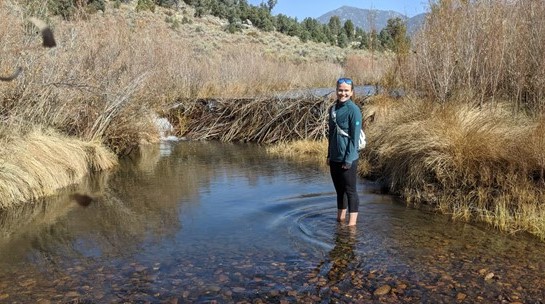
The back page article of yesterday’s newspaper reported on a conservationist victory as federal officials have decided to “revisit” the 2021 environmental review that cleared construction of a geothermal power plant in Nevada where an endangered toad lives.  Environmentalists and tribal leaders suing to block the project said the move will trigger a third review of the partially built power plant that the Bureau of Land Management (BLM) approved in December 2021.  The Center for Conservation Biology had joined the Fallon Paiute-Shoshone Tribe to sue the BLM in Reno’s federal court in January 2022.  The US Fish and Wildlife Service declared the Dixie Valley toad endangered on an emergency basis that April and then made the listing permanent in December.  The conflict underscores challenges faced by the current administration which has repeatedly vowed to protect fish and wildlife while also pushing development of green energy projects on federal lands to combat climate change.  The Justice Department represents the BLM and has yet to specify their next action.  At best, it will be several months before construction of the Dixie Meadows plant can resume.  So far, it is a win for the little toad.

When I went online, I found the Dixie Valley toad (Anaxyrus williamsi or Bufo williamsi) is a species of toad in the family Bufonidae indigenous to Churchill County, Nevada (US).   The toad was the first new toad species described in the US since description of the (now extinct in the wild) Wyoming toad (A. baxteri) in the 1970’s.  The Dixie Valley toad was originally considered an isolated population of the common western toad (A. boreas) until physical and genetic analyses found it to be a separate species in 2017.  The toad is descended from an ancestor that inhabited the large lakes and wetlands that covered the Great Basin in the Pleistocene until the receding water isolated the different populations, leading to speciation.  The toad is only found in a small complex of spring-fed marshlands in Dixie Valley.  The surrounding area is largely arid land with few aquatic resources, isolating the toad.  The spring complex in Dixie Valley is one of the hottest and most geothermally active systems in the region.

Dixie Valley (Paumu in Paiute) is a vast area spanning nearly 3,000 square miles near Fallon, Nevada, tucked between the Stillwater mountains to the west and the Clan Alpine mountains to the east.  The Fallon Paiute-Shoshone Tribe used the quiet valley to gather medicinal plants and other resources, put their dead to rest, and to find respite and healing among the mountains.  “When you’re out here, we ask people to be respectful because you just don’t know if you’re walking into one of the oldest churches in North America,” said Donna Cossette, a former tribal chairwoman.  Ancestors of the tribe have lived in the region for 10,000 years.  There are currently 1,562 enrolled members of the tribe, with 657 living in the tribe’s reservation.  In addition to the hot springs frequented by tribal members for ceremonies and healing, the area now includes a geothermal plant, a few scattered ranches, an endangered toad, and designated space for a Naval air station 68 miles (109 km) away.  In March 2022, leaders for the Fallon Paiute-Shoshone tribe traveled to Washington D.C. in a bid to protect their sacred valley by designating the area a national monument.  This would be Nevada’s fifth and the largest in the continental US.

Thoughts:   Indigenous tribes have been consistently moved or destroyed since European immigrants began to arrive in the Americas in the fifteenth century.  The moves were forced, and the locations deemed of little value to the invaders.  When gold, oil, or other resources were located on these lands they were again taken and the treaties “renegotiated”.  The sacred land of the Dixie Valley may not save it from exploitation, but that may change because of an endangered toad.  Act for all.  Change is coming and it starts with you.
Electric

July 15, 2023

I mentioned I had pruned the limbs hanging over our house and on the cars in the driveway last month.  This is an annual event that just keeps me ahead of the side limbs but does little to attack the height of both trees.  The Japanese Maple (Acer japonicum) is defined as “a small deciduous tree growing 16 to 32 feet (5 to 10 m).  Ours is getting close and since it is over the roof, I do not want it to fall in the wind.  The Bradford pear (Pyrus calleryana) has also survived the winds but is getting near its maximum height (16 to 26 ft or 5 to 8 m) at around 25 feet.  What I really need is a chainsaw to trim the tops and let them start over.  I have never liked the mess and bother of owning a chainsaw, especially when I have so few trees to take care of.  I have been seeing quite a few ads for electric power tools on TV and began to wonder if that might not be an easier and more ecological way to get the work done.  Luckily the two-day online sale included electric power tools.

When I went online, I found a power tool is a tool activated by an additional power source other than the manual labor used with hand tools.  The most common types of power tools use electric motors, but internal combustion engines and compressed air are also common.  Power tools are used in industry, construction, the garden, and around the home and are classified as stationary or portable.  Portable power tools are hand-held and have the advantage of mobility while stationary power tools have the advantage in speed and precision.  Early in the Industrial revolution factories had rows of power tools driven by belts from overhead shafts that first used a water wheel and later a steam engine.  The electric motor was introduced in the 1880’s and made the stationary and portable tools of today possible.  In 2022, the global market for power tools was estimated to be US$32.2 billion and is expected to grow to US$42.7 billion by 2030.

I was excited when Melissa told me we had received a delivery of a large package this morning.  I brought the large box inside and was pleased to feel the light weight.  I opened the box to find a slightly smaller box with writing identifying the contents as the dual electric weed eater and leaf blower.  I own two electric leaf blowers already, but they are corded and cumbersome.  I own three gas powered weed eaters but again I was trying to reduce my carbon impact.  Both tools needed to be assembled but that was an easy task.  I popped the battery into both the electric tools to make sure they worked.  Zena and Loki were afraid of the package when I brought it in, and even more so when I tested the tools indoors.  I was ready to tackle the yard and started weed eating along the maple bed.  I was 10 minutes into the job when the motor started to cut out and die.  I took the battery inside and plugged it into the charger.  It did not surprise me that there was not a full charge by the time it got to me from the factory.  I mowed the lawn to kill time until the battery had a full charge.  Hopefully it will last longer this time.

Thoughts:  I became accustomed to using a chainsaw when I worked at the camp.  The wooded areas and shade trees on the grounds were in constant need.  I did have the advantage of a full time caretaker who kept the saw in repair and sharpened the chains.  They even showed me how it was done so I was confident with the chains, but engines have never been my forte.  Electric power tools tend to be easier to maintain and have lower costs than combustion tools.  The big expense comes when you need to replace the batteries.  While I may be trying to reduce my personal carbon footprint, the US has the highest per capita carbon footprint in the world.  Transportation and household energy use make up the largest component of an individual’s carbon footprint with approximately 40 percent of total emissions in the first decade of the 21st century.  Electric power tools may be a small step, but it is a step (and an attitude).  Act for all.  Change is coming and it starts with you.