Plum Bayou

December 16, 2022

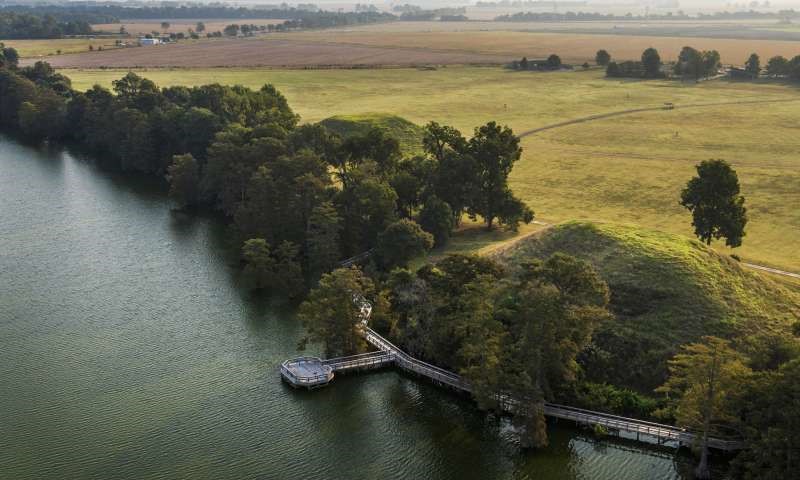
Melissa and I decided to spend our “date night” listening to a presentation by Dr. Paige Ford, Station Archeologist at Plum Bayou Mounds Archeological State Park and sponsored by the Ark-Homa Chapter of the Arkansas Archeological Society (and yes, we did go out to eat after the presentation).  The 18-mound Plum Bayou complex is the largest and most complex mound site in the state and has the tallest surviving prehistoric mound in Arkansas.  The site was used as a ceremonial ground by the Late Woodlands culture from 650 to 1050 CE.  An interesting aspect of the presentation was the name change that just occurred in November.  Formerly Toltec Mounds Archeological State Park, Plum Bayou is one of four National Historic Landmarks in the Arkansas State Park system.  

When I looked online, I found on November 2, 2022, the Toltec Mounds Archeological State Park’s name was officially changed to Plum Bayou Mounds Archeological State Park and the Arkansas Archeological Society (ARAS) research station was renamed the Plum Bayou Research Station.  After a lengthy process involving meetings and discussions with Tribal Nations, a public comment period, and successive approval by State Parks commissioners, the Arkansas Department of Parks, Heritage, and Tourism officially changed the name to Plum Bayou Mounds Archeological State Park.  This was not the first name change for the site, as it was initially referred to as the Knapp Mound Group, referencing the Knapp family who owned the land throughout the latter half of the 1800’s.  During this time there were many theories regarding who built the mounds in the southeastern US, and supposedly the Knapp family supposedly the Toltec civilization of Mexico built the mounds on their property (one of the theories) and the site became known by locals as Toltec Mounds.  When the property was acquired by the state in 1975 this common name was used, despite the researchers knowing it was not associated with the Toltec culture.

Martha Rolingson was the first station archeologist and conducted research on the site beginning in 1966 and continuing for the next 30 years.  Rolingson named the people associated with the site the Plum Bayou culture and identified this ceremonial mound site as a “type site” for the Plum Bayou culture, meaning it is the place where the characteristic artifacts of this culture were first identified.  When presented with changing the name of the park itself, it naturally follows to name the site after the Plum Bayou people who built it.  The Native Garden exhibit at the park was already named the Plum Bayou Garden, attributing the Woodland varieties of plants to the very culture in this region who interacted with and used them.

THOUGHTS:  I have been interested in sites like Plum Bayou since I researched the mound building Woodlands and Mississippian cultures in the central and southeastern US as an undergrad student.  One of Melissa and my early trips after we were married was a joint tour of several of these mound sites combined with key battlefields of the Civil War.  Along with fishing, visiting these sites is one of our shared joys.  Through the years I have found that sharing what you enjoy with a partner not only makes the experience more enjoyable, but it can also strengthen your relationship.  Spending time with others and creating shared memories builds bonds between spouses, friends, and can turn strangers and even enemies into lifetime companions.  This is especially good to remember during the holidays.  Act for all.  Change is coming and it starts with you.
Fusion

December 15, 2022

Yesterday’s NY Times Morning feed reported on a recent breakthrough in creating fusion energy.  Earlier this month scientists at the Department of Energy announced they had carried out a fusion reaction that produced more energy than went into it.  This implies humans can tap into the process that powers stars to produce energy on Earth.  Fusion provides a clean source of energy that could replace the polluting fossil fuels and help overcome climate change.  There are still serious barriers but if the remaining challenges can be resolved fusion could produce more energy than any of our current energy technologies.  It is unclear if scientists can reliably replicate the test they achieved.  There are questions if they can do it more efficiently, quicker, and on a scale to make it a viable alternative.  If not, yesterday’s announcement may amount to little more than laboratory science.

When I looked online, I found Fusion power generates electricity by using heat from nuclear fusion reactions.  In a fusion process, two lighter atomic nuclei combine to form a heavier nucleus, while releasing energy.  Devices designed to harness this energy are called fusion reactors.  Research into fusion reactors began in the 1940’s, but to date the only successful design to produce positive fusion energy (more power out than in) is the inertial confinement laser-driven fusion machine at the US National Ignition Facility.  The fusion process requires fuel and a confined environment with enough temperature, pressure, and confinement time to create plasma for the fusion to occur.  The blend of these figures results in a power-producing system known as the Lawson criterion.  Hydrogen is the most common fuel in stars, and gravity provides extremely long confinement times that reach the conditions needed for fusion energy production.  Proposed fusion reactors generally use heavy hydrogen isotopes (deuterium and tritium, or a combination) to allow them to reach the Lawson criterion requirements with less extreme conditions.  Most designs aim to heat their fuel to around 100 million degrees, which presents a major challenge in producing a successful design.

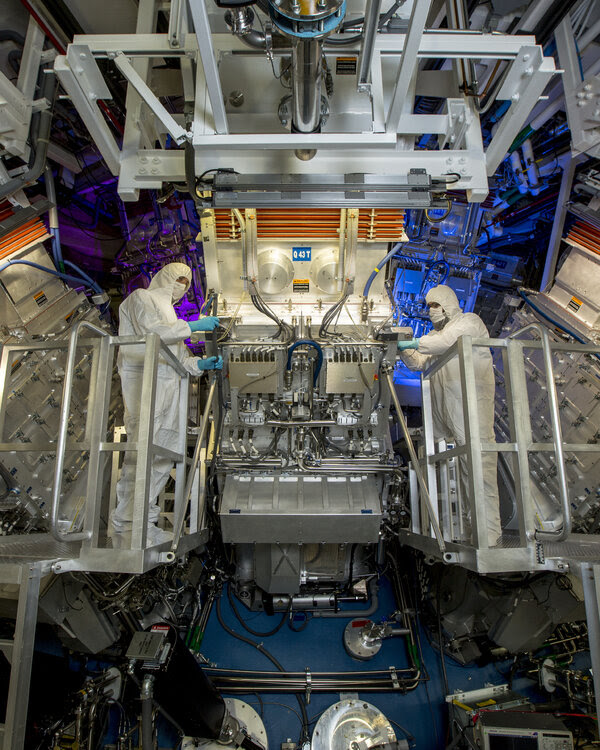
Most nuclear fusion experiments have used doughnut-shaped reactors and magnetic fields to trap hydrogen, fuse it, and release energy.  Those experiments have yet to produce more energy than they used.  The Department of Energy’s lab is different.  It fired 192 lasers at a tiny hydrogen pellet to heat the pellet and cause it to implode, fuse into helium, and release a blast of energy.  The lab has been conducting this experiment for years, tweaking how and where the lasers are fired.  These changes paid off on December 5th.  The resulting nuclear fusion produced about 50% more energy than the energy from the lasers.  As exciting as the results are to scientists, they say it will require decades of work before this breakthrough leads to widespread commercial use, if ever.  It is typical for scientific breakthroughs to start in unrealistic lab settings before they are refined for public use.  At the very least, this discovery shows that nuclear fusion can be a source of energy. Now they just need to turn it into a usable technology.

THOUGHTS:  While fusion promises to provide unlimited energy for the future, it is unlikely to be a viable source of energy by the 2035 deadline to eliminate all greenhouse gas emissions in the US from its electricity sector.  This plan relies on a sharp increase in wind and solar energy generation, although it may get a boost from nuclear fusion.  What is clear is that the US, and the world, cannot rely solely on any single power source.  Our reliance on fossil fuel provided a cheap power source that caused us to abandon improvements in other sources, much to our detriment.  Wind, solar, hydro, and geothermal energy all need to continue to be researched and improved.  Then together with fusion we may begin to reverse the climate catastrophe that is on our horizon.  Act for all.  Change is coming and it starts with you.
Orange

December 14, 2022

Today’s AP article in my local newspaper reported on the effect of this year’s hurricanes on Florida’s orange crop.  According to the US Department of Agriculture the twin storms of Ian and Nicole will cause a drop of 56% in Florida orange production compared to last year.  The latest forecast calls for about 18 million boxes of oranges to be produced this year, while last October the Department had estimated 28 million boxes.  Each box weighs about 90 pounds (40.8 kg).  The Florida Agriculture Commission said Ian damaged about 375,000 acres of commercial citrus in late September.  While Nicole did less damage in November, it struck some of the same areas.  Other citrus forecasts are also down, with grapefruit production coming in 200,000 boxes fewer than estimated and tangerines and tangelos at 100,000 fewer boxes.  The decline in oranges would make this the lowest season since World War II.  The harvest was 67 million in 2020-2021 and 41 million boxes in 2021-22.  The University of Florida estimated overall orange losses from Ian was at least US$1.56 billion.

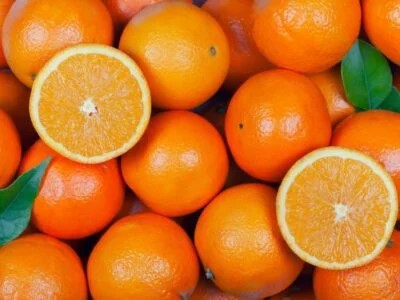
When I looked online, I found an orange is a fruit of various citrus species in the family Rutaceae, and primarily refers to the sweet orange (Citrus sinensis), to distinguish it from the related bitter orange (Citrus aurantium).  The sweet orange reproduces asexually, and varieties of sweet orange arise through mutations.  The orange originated in a region encompassing Southern China, Northeast India, and Myanmar, and the earliest mention of the sweet orange was in Chinese literature in 314 BCE.  As of 1987, orange trees were the most cultivated fruit trees in the world and are widely grown in tropical and subtropical climates.  The fruit of the orange tree can be eaten fresh, processed for its juice, or for its fragrant peel.  As of 2012, sweet oranges accounted for approximately 70% of the world’s citrus production.  In 2019, 79 million tons of oranges were grown worldwide, with Brazil producing 22% of the total, followed by China, and India.  Orange juice is a worldwide favorite, and 85% of all oranges produced are used to make juice.

Florida orange production was already in decline prior to this year’s hurricanes.  Florida has been hard hit by a bacterial infection called citrus greening.  The incurable disease is spread by the Asian citrus psyllid (Diaphorina citri) insect, which was first detected in Florida in 2005.  Trees affected by citrus greening produce smaller, bitter-tasting fruit.  Infected trees are cut down and burned to help stop the spread.  According to Statista, during the last growing season before citrus greening (2003-2004) emerged in a commercial context Florida produced 242 million boxes of oranges.  There is also a decreasing number of orange trees in Florida as land is developed that had been used by growers, and by growers deciding to just get out of growing oranges.  In 2006, there were 36.2 million Valencia orange trees in Florida, but that number has since fallen to 30.4 million trees.

THOUGHTS:  I enjoy eating oranges during the winter and usually buy a large bag to place in the refrigerator to keep them from spoiling.  The juiciness of the Valencia orange variety makes it best for juice, but I do not have a juicer.  I eat them and prefer the Navel orange variety as they are easy to peel.  While they are not as juicy as the Valencia orange, I do not like struggling to get the peel off, and usually lose a portion of a Valencia orange that I cannot get off the peel.  I try not to buy this orange but if I mistakenly buy a Valencia orange it tends to sit until it goes bad, and I throw it way.  There are dozens of different varieties of orange grown around the world and each differs in size, acidity, juiciness, peel thickness, and when they ripen.  Like the people who grow and prefer them, each has qualities that make them unique.  Act for all.  Change is coming and it starts with you.

Cup

December 13, 2022

AP Photo

Today’s NY Times feed commented on the potential for change in the winner of the World Cup.  Today marks the first of two semi-final games of the 2022 World Cup being held in Qatar.  All 21 previous men’s World Cups have only had finalists from either Europe or South America.  When Morocco qualified for the semifinals, it became the first African nation to get this far.  Today’s match features a more traditional lineup, with Croatia (Europe) and Argentina (South America).  The semi-final match tomorrow will feature Morocco (Africa) playing against the reigning champion France (Europe).  If Morocco can beat France, it will be the first country outside Europe or South America to make it to the final.  German Lopez of the Times said this is part of a self-fulfilling prophecy.

When I looked online, I found the game played at the World Cup is called Association football, commonly known as football or soccer.  This is a sport played between two teams of 11 players who use their feet to propel the ball around a rectangular field (pitch).  The object of the game is to score more goals than the other team by moving the ball into a rectangular framed goal defended by the other side.  The game is traditionally played with two 45 minute halves, or a 90 minute match.  There are an estimated 250 million active players in over 200 countries, making it the world’s most popular sport.  In the English-speaking world, association football is usually called “football” in Great Britain and most of Ulster in the north of Ireland.  People usually call it “soccer” in regions where other types of football are prevalent, such as Australia, Canada, South Africa, most of Ireland, and the US.  The term soccer comes from Oxford “-er” slang, prevalent at the University of Oxford in England from about 1875.  Initially spelled assoccer it was later reduced to the modern spelling.  The word soccer arrived at its final form in 1895 and was first recorded in 1889 in the earlier form of socca.

The World Cup reflects the history of both the tournament and the sport.  The tournament was a European invention that began in 1930 after disagreements between FIFA (Fédération Internationale de Football Association) and the Olympic Committee’s handling of the sport.  The European powers also spread the game more widely in places they had colonized, and it quickly took off in South America.  The first World Cup was hosted by a South American country, Uruguay.  European and South American countries had historical roots in the World Cup and have performed better in the tournament, so organizers made room for more teams from those continents.  Money also plays a role as richer countries can spend more on developing players.  Based in some of the richest countries in the world, European leagues, teams, and governments can spend more on developing better soccer players and programs.  The world’s best players go to Europe to play in its lucrative professional leagues, which are widely seen as the major leagues of men’s soccer.  Based on its historical success, South America also has more infrastructure than other continents to develop players and host top-notch, competitive leagues.  It is another way the self-fulling prophecy has played out.

THOUGHTS:  Morocco’s success in this year’s Cup and Qatar’s hosting are both signs of the possibility of the European and South American centers loss of power.  The next World Cup could also shake up the game as the initial rounds will include 48 teams (not 32) allowing for more geographic diversity in who qualifies.  Still, other signs suggest little has changed.  The other three teams remaining in this year’s World Cup are from Europe or South America.  European teams have also won the last four World Cups since 2006.  If Morocco does make it into the final, it will be an anomaly.  It will have to happen again in four years to make it a trend.  Act for all.  Change is coming and it starts with you.

Workers

December 12, 2022

I came across an article by Jane Thier published last month in Fortune on a global study by the Workforce Institute that found 38% of workers said they would not wish their job on their worst enemy, and the figure jumped to 45% among US workers.  Nearly half (46%) of workers surveyed would not recommend their job or company to their children or any young person they care about.  While everyone surveyed said they wanted financial security for their kids, they all agreed they would urge their children to pursue work that gives them the chance to care for and spend time with family, is personally meaningful and makes them fulfilled, and ensures a successful career path.  More than half (53%) of global workers said if they could go back, they would choose a different profession and 40% said they wish someone had warned them not to take their current job.  Nearly two-thirds of workers said they would switch jobs “right now” if they could, and nearly half do not want to work at all.  More than three in five workers admit they work to collect a paycheck, clock out, and go home, while only 11% of workers feel their job is their “calling.”

When I looked online, I found a global Gallup Poll saying out of the world’s 1 billion full-time workers only 15% enjoy what they do, while 85% are unhappy at their jobs.  This comes while employers voice how they stress work-life balance, employee engagement, and company culture.  There are several reasons for this discrepancy.  A worker’s happiness can depend on the relationship with the boss.  If you do not like your manager, you are not going to enjoy the work.  How you feel about co-workers is another issue.  You will not get along with everyone, but if you do not like the people you work with you will not be happy at work.  The type of work can be another factor and if you work just to pay bills it will be harder to find satisfaction in your work.  The effect of commuting to work may impact happiness.  We spend around one-third of our lives at work, and a stressful or long commute is another big reason for people feeling unhappy, even if they love their job.  Doing the same task day after day can also grind on workers.  That is true for both blue- and white-collar jobs.  When there is no prospect for growth or progression workers will begin to resent their employer.  Other causes might be a poor attitude, overwork, ethics, or jealousy.

When I worked as an Historian for the State of Utah, I was able to spend some time researching old mining towns and sites.  I enjoyed this and would often take my son with me on the weekends as we traveled around the state documenting these locations.  He was sitting in the back seat as we drove when he said, “I want to have a job like you when I grow up.”  This was followed by a pause, and then a query, “What do you do for a job?”  While he enjoyed the trips and exploration, the main portion of my work was review and compliance of workers with state and federal regulations.  I responded, “I am a petty bureaucrat.”  There was another pause and then, “I think I want to be a paleontologist.”  Somehow being a petty bureaucrat did not sound like an admirable profession.

THOUGHTS:  A popular saying goes, “Choose a job you love, and you will never have to work a day in your life.”  While some credit Confucius with this phrase it is unlikely as few workers had the option to choose an occupation in the 5th century BCE.   During the 1980’s, a Princeton professor used the saying to direct his students in their own job search and credited “an unnamed teacher” for the phrase.  Doing what you enjoy will help bring satisfaction, is not happiness, to workers.  It appears from the surveys most have not done this.  The closing words of Mr. Lizard the Wizard on every episode of the Touché Turtle cartoon were, “Be just what you is and not what you is not, those who do this have the happiest lot.”  Maybe Mr. Lizard knew Confucius.  Act for all.  Change is coming and it starts with you.
ChatGPT

December 10, 2022

My NYT The Morning news feed this week featured an article on how good artificial intelligence has become.  ChatGPT debuted last week and has already wowed users.  New York magazine journalists at asked it to write an article and got what they called a “pretty decent” story.  Other users got the AI to write solid academic essays on a variety of topics, and even to write some jokes.  German Lopez is the author of the article and said what is remarkable about these writings is their quality.  They could have been written by a human.  According to OpenAI, the company behind ChatGPT, they are now working on a better model that could be released next year.  This might improve the level of college English essays (Is it plagiarism if it is an original essay by an AI you own?).

When I looked online, I found ChatGPT is a large language model trained on a massive trove of information online to create its responses.  It comes from the same company behind DALL-E, which generates a seemingly limitless range of images in response to prompts from users and is the next iteration of text-generator GPT-3.  After signing up for ChatGPT, users can ask the AI system to field a range of questions, such as “Who was the president of the United States in 1955,” or summarize difficult concepts into something a second grader could understand.  It will even tackle open-ended questions, such as “What’s the meaning of life?” or “What should I wear if it’s 40 degrees outside today?”  Some users are getting more creative, with examples including asking for fairy-tale inspired home décor tips and giving it an AP English exam question (it responded with a 5 paragraph essay about Wuthering Heights). 

While some are in awe of ChatGPT, others are closer to the edge of fear.  This chatbot is so advanced it could render search engines and the countless jobs to maintain them obsolete.  ChatGPT already has more than 1 million users worldwide with its advanced functions in the first week.  These range from instantly composing complex essays and computer code to drafting marketing pitches and interior decorating schemes.  The AI’s ability to contrive poems and jokes was previously thought to only be relegated to humans.  ChatGPT’s capabilities have even sparked fears that Google may not have an online search monopoly for much longer.  Gmail developer Paul Buchheit tweeted on December 1st that, “AI will eliminate the search engine result page, which is where they (Google) make most of their money.”  Buchheit went on to say ChatGPT and similar AI will do to web search what Google did to the Yellow Pages.

THOUGHTS:  In a blog post last week, OpenAI said the “format makes it possible for the tool to answer follow-up questions, admit its mistakes, challenge incorrect premises, and reject (unsuitable) requests.”  As of Monday morning, the page to try ChatGPT was down, citing “exceptionally high demand,” and “Please hang tight as we work on scaling our systems.”  I guess there are still limits to the AI’s capability.  It is interesting that there were few complaints when Google did away with the printing and advertising jobs for the Yellow Pages (now in digital format), yet potential job loss for Google is touted as dreadful.  Every new technology replaces the “old ways” to be successful.  While this may be more rapid than before, it does not make it worse.  Jobs are rarely lost; the work is just changed to create different opportunities.  The trick is to be in the forefront of this progression rather than to resist and be left behind.  Act for all.  Change is coming and it starts with you.
Kosher

December 09, 2022

The lead story in the Living section of today’s local newspaper was about making bagel sandwiches for Jewish fans at the World Cup in Qatar.  The sandwiches are being made by Rabbi Eli Chitrik and sold out of his hotel room.  The kosher kitchen used is making more than 100 sandwiches a day.  Discussion to allow the kosher kitchen went on for five years prior to opening of the World Cup and included allowing Israelis in attendance at the Cup and direct flights from Tel Aviv, Israel, to Doha, Qatar.  Qatar has a history of public support for Palestinians and insisted this was merely to comply with FIFA hosting requirements and not a step toward normalizing relations with Israel, as happened in 2020 with Bahrain and the United Arab Emirates.  When Chitrik walks the streets of Doha he wears his religious garb, including a black hat and fringed undergarment (tzitzit).  Chitrik wants to show you can go anywhere in the world and live openly as a Jew, in the same way you should be able to live openly as a Muslim or a Christian. 

When I looked online, I found to function as a kosher kitchen there must be room to prepare meat and dairy products separately.  In modern kitchens this means separate counter space and some even have separate sinks, dishwashers, and ovens.  While prep space can theoretically be shared, it is essential to have separate sets of utensils, since the same pot or utensils cannot be used for both meat and dairy.  Before a kitchen can be used for kosher foods, all traces of non-kosher must be purged and utensils must be designated for meat, dairy, and parve (neither meat nor dairy).  A rule of thumb is that any non-kosher items must be removed in the same way it was absorbed.  A drinking glass can be rinsed thoroughly, but a cooking pot needs to be purged.  This requires waiting 24 hours and then being cleansed with boiling water (known as hagalah).  A skillet would need to be heated directly on the fire (known as libun) or run through a cleaning cycle in a self-cleaning oven.  Substances like pottery cannot be properly purged.  A porcelain sink cannot be made kosher, and the kosher user would need to not wash their dishes directly in a sink that had been used for milk and meat or parve.  Finally, any glass and metal utensils purchased from non-Jewish sources must be immersed in a mikvah (ritual bath).  The kosher kitchen in Qatar was also inspected by a rabbi prior to use.

The kosher kitchen makes challah on Fridays.  Challah is a special bread of Ashkenazi Jewish origin, usually braided and typically eaten on ceremonial occasions such as Shabbat (Sabbath) and major Jewish holidays (other than Passover).  Kosher challah is made of dough that has a small portion set aside as an offering, and the term challah also refers to the dough offering.  The word is biblical in origin, though originally referred only to the dough offering.  Similar braided, egg-enriched breads are made in other traditions.  The Polish chałka is similar, though sweeter than challah.  The Czech and Slovak vánočka is very similar and traditionally eaten at Christmas.  In Bulgarian and Romanian cuisine there is a similar bread called cozonac, while tsoureki bread is popular in Armenian, Greek, and Turkish cuisines.  Brioche is another egg-enriched bread, but it is not braided.  Unlike challah, which by convention is parve, many of these breads also contain butter and milk.  One article commented that if you add more sugar, challah becomes cake.  Regardless, it appears Qatar is letting the kosher fans eat it.

THOUGHTS:  Rabbi Mendy Chitrik (Chitrik’s father), who inspected the kosher kitchen prior to its use, said, “Religious rights and freedoms of Jews, as well as any other religious group, are very, very important to be safeguarded.  Football and food bring people together.”  This is an important lesson in acceptance that goes beyond the World Cup.  Act for all.  Change is coming and it starts with you.
Hogs

December 08, 2022

The University of Arkansas hogs are again looking good in all fall sports this year.  The football team finished 6-6 and are off to the Liberty Bowl on December 28th.  Men’s Basketball is currently ranked 9th, and the women (a perfect 10-0) just cracked the rankings at 21st.  Women’s volleyball advanced to the second round of the NCAA Tournament before falling 3-1 to 3rd seeded Oregon.  Women’s Soccer has consistently been dominant and entered this season ranked 11th.  Both Women’s and Men’s Cross Country are coming off SEC championships last year and are set to make another “run”.  This is rounded out this by the Swimming and Diving teams.  Then there are the Club Sports, with the UofA Quidditch Club (yes, Harry Potter) and both Men’s and Women’s Rugby.  As I thought how the Hogs tearing up the sports fields, I opened my local newspaper to again find a front page article on how feral hogs were still tearing up real fields.

The AP article stated the war on feral hogs in the US is in its eighth year and the invasive animals are still a multibillion-dollar plague on farmers, wildlife, and the environment.  The federal program has succeeded in wiping out the hogs in 11 of the 41 states where they were reported in 2014 or 2015, and there are fewer hogs in parts of the other 30.  However, despite more than US$100 million in federal money, an estimated 6 million to 9 million feral hogs still ravage our landscape.  They tear up planted fields by wallowing out huge bare depressions.  They out-eat deer and turkeys, while eating turkey eggs and deer fawns.  The hogs carry parasites, disease, and pollute streams and rivers with their feces.  Total US damages are estimated at a minimum US$2.5 billion a year.

The four worst-hit states are California, Oklahoma, Texas, and Florida, all with more than 750,000 hogs.   Arkansas, Louisiana, Mississippi, Alabama, Georgia, North Carolina, and South Carolina put their populations at 100,000 to 750,000.  The Texas population overall has been ‘fairly stable’ at roughly 3 million since 2011, said Mike Bodenchuk, state director for USDA’s Animal and Plant Health Inspection Service.  However, statewide reduction (not eradication) is likely to be a long way off with tools and money now available.  Hogs are so prolific that 70% of those in a given area must be killed each year to keep numbers stable.  To reduce populations, you only need to kill more than are born each year, but growth rates vary in different environments and hogs can have two litters a year.  That means we need to do more monitoring.

THOUGHTS:  My nephew graduated from the University of Kansas who is the Arkansas Hogs bowl opponent this year.  When the news was announced I received a text saying, “I smell bacon.”  Research is ongoing for ways to poison feral hogs without killing other animals.  The poison used is sodium nitrite, which is a preservative in bacon, but keeps the blood of live hogs from carrying oxygen.  Currently, the two major control methods are aerial shooting and remote-controlled traps that send cellphone pictures when a hog is inside.  While the hogs seem to represent a potential food source, procuring the elusive hogs has always been a problem.   Hogs are also known to carry at least 24 diseases, including salmonella, hepatitis, E. coli, swine influenza, and trichinellosis.  Another concern is brucellosis, which is spread by bacteria.  You do not have to eat the meat to contract the desease and can be infected from contact with blood, tissue, and other bodily fluids of infected hogs.  When invasive species are introduced into other environments it rarely has a good outcome.  Act for all.  Change is coming and it starts with you.

Legend

December 03, 2022

After I posted on the poinsettia, I got a suggestion from my niece that I should follow up about the mistaken concept that the leaves are toxic.  This idea was originally spread by a 1919 urban legend of a two-year-old child dying after consuming a poinsettia leaf.  In 1944, the plant was included in H. R. Arnold’s book Poisonous Plants of Hawaii based on this premise.  Though Arnold later admitted that the story was hearsay (I heard the same thing growing up) and that poinsettias were not proven to be poisonous, the plant was still thought by many to be deadly.  The legend was revived in 1970 when the US Food and Drug Administration published a newsletter erroneously stating, “one poinsettia leaf can kill a child”.  In 1980 poinsettias were prohibited from nursing homes in a county in North Carolina due to this alleged toxicity.  This illustrates the power of the urban legend.

When I looked online, I found an urban legend (sometimes contemporary legend, modern legend, urban myth, or urban tale) is a genre of folklore comprising stories or fallacious claims circulated as true, especially as having happened to a “friend of a friend” or a family member, and often with horrifying, humorous, or cautionary elements.  These legends can be entertaining but often concern mysterious peril or troubling events, such as disappearances and strange objects or entities.  Urban legends may confirm moral standards, reflect prejudices, or be a way to make sense of societal anxieties.  Urban legends in the past were most often circulated orally, but now can also be spread by the media, including newspapers, mobile news apps, e-mail, and most often, social media.  Some urban legends have passed through the years and even decades with only minor changes, such as in where the time of the legend takes place.  Generic urban legends are often altered to suit regional variations, but the lesson or moral remains essentially the same.

I attended the University of Utah around the time Jan Harold Brunvand was professor emeritus of English.  Brunvand is best known for spreading the concept of urban legend, or modern folklore.  Before his work folk tales were thought to only be associated with ancient times or rural cultures.  Brunvand’s breakthrough was to take concepts developed in the academic study of traditional folktales and apply them to stories circulating in the modern world.  Brunvand published tales like The Vanishing Hitchhiker (1981), The Choking Doberman (1984), The Mexican Pet (1988), Curses! Broiled Again! (1990), and The Baby Train (1993), along with others. While the poison poinsettia may not have achieved the status of a book, it is an established urban legend.

THOUGHTS:  When I was exploring the process of urbanization at the turn of the 20th century one of the urban legends I found was “The Good Girl Gone Bad”.  This appeared as news articles that were always “copied” from another source and carried by small town and rural newspapers as fact.  The legend told of a small town girl who goes to the big city, falls in with the wrong crowd, and becomes either a drug addict or prostitute, all ending with the report of the girl’s death.  At first, I thought this was tragic.  Then I noticed an almost identical story in small newspapers across the West.  When I mentioned this, a friend gave me a copy of the Brunvand’s, The Mexican Pet.  Joseph Campbell was one of the foremost scholars of comparative mythology.  He likened the Star Wars franchise to the Hero’s Journey legends found around the world.  These stories challenge, guide, and even caution us.  We are still being led (misled?) by the legends that are passed on as “having really happened to my friend’s cousin”.  We can blindly accept these stories or attempt to understand the reason behind why they persist.  Act for all.  Change is coming and it starts with you.

Rosetta

December 02, 2022

Buried in the back of the front section of today’s local newspaper I found an article about a request to have the Rosetta Stone returned to Egypt.  The debate over who owns ancient artifacts has been an increasing challenge to museums across Europe and America.  It has grown increasingly common for museums and collectors to return artifacts to their country of origin.  This is often the result of a court ruling but, in some cases, it is voluntary and serves as an act of atonement for past wrongs.  Nicholas Donnell, an attorney specializing in cases concerning art and artifacts, said no common international legal framework exists for such disputes.  Unless there is clear evidence an artifact was acquired illegally, repatriation is largely at the discretion of the museum.  As Britain’s largest museum celebrates the 200-year anniversary of the decipherment of hieroglyphics, all eyes have turned to the question of the ownership of the Rosetta Stone.

When I looked online, I found the Rosetta Stone is a stele composed of granodiorite inscribed with three versions of a decree issued in Memphis, Egypt, in 196 BCE.  This was during the Ptolemaic dynasty and on behalf of King Ptolemy V Epiphanes.  The Rosetta Stone is 3 feet 8 inches (1,123 mm) high at its highest point, 2 feet 5.8 inches (757 mm) wide, 11 inches (284 mm) thick, and weighs 1,680 pounds (760 kg).  The front surface is polished, and the inscriptions are lightly incised on it.  The sides of the stone are smoothed, but the back is roughly worked, suggesting it would have not been visible when the stone was erected.  The stella bears three inscriptions: the top register in Ancient Egyptian hieroglyphs, the second in the Egyptian Demotic script, and the third in Ancient Greek.  The decree has only minor differences between the three versions, making the Rosetta Stone the key to deciphering ancient Egyptian hieroglyphics.

The stone was believed to have originally been displayed within a temple and was probably moved during the Mamluk period (13th or 14th centuries CE) and eventually used as building material in construction of Fort Julien near the town of Rashid (Rosetta in French) in the Nile Delta.  It was found in July 1799 by French officer Pierre-François Bouchard during the Napoleonic campaign in Egypt.  When the British defeated the French, they took the stone to London under the Capitulation of Alexandria treaty in 1801.  In a statement, the British Museum said the 1801 treaty includes the signature of a representative of Egypt, referring to an Ottoman admiral who fought alongside the British against the French.  The Ottoman sultan in Istanbul was nominally the ruler of Egypt at the time of Napoleon’s invasion.  The stele has been on public display at the British Museum since 1802.

THOUGHTS:  The Rosetta Stone was the first Ancient Egyptian bilingual text recovered in modern times, and it aroused widespread public interest with its potential to decipher the hieroglyphic script.  Since its discovery, three other copies of the same decree have been located, the Nubayrah Stele (limestone), the Elephantine Stele, and the Philae obelisk.  All three remain in Egypt.  The article suggested the reason for not repatriating the Rosetta is the vast popularity and tourist dollars it brings to the Museum.  This is also behind the reason for bringing it home.  Egypt’s antiquities along the Nile act as a tourist magnet that netted US$13 billion in 2021, a pandemic year.  The fact the stone was discovered in Egypt and removed as the result of war might also have something to do with the request.  Act for all.  Change is coming and it starts with you.