Horseweed

August 10, 2022

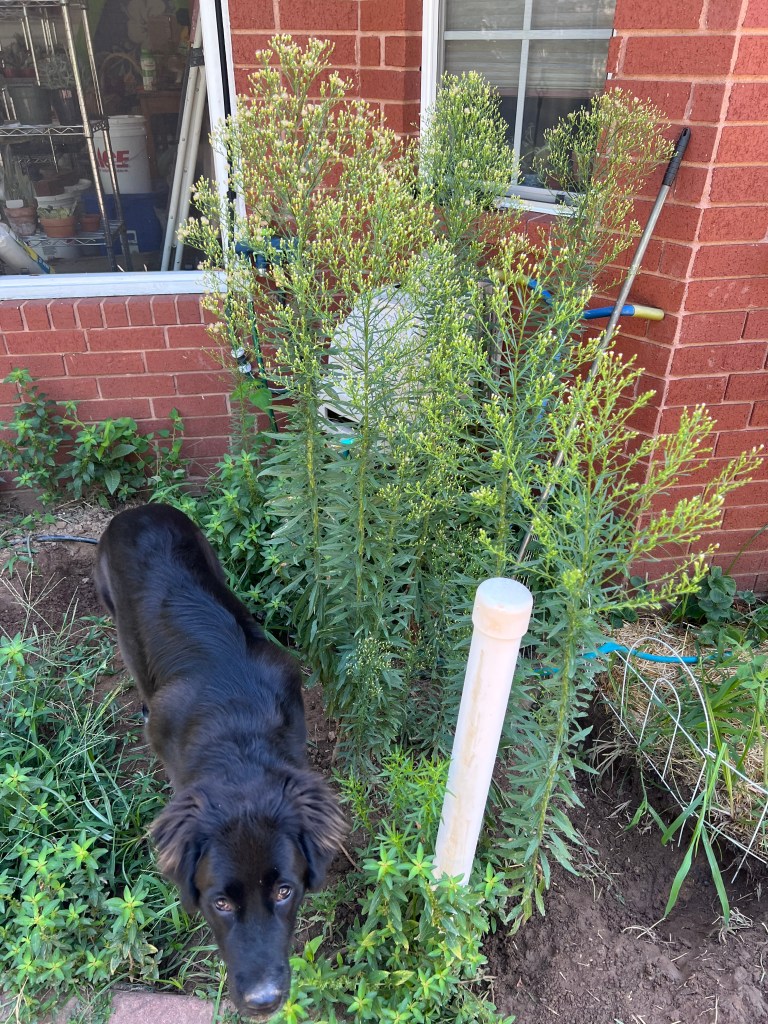
I thought it appropriate since I wrote on pigweed yesterday that I follow up with horseweed today.  I mentioned while I have placed a small fence around the areas where I grow vegetables, I allowed Zena access to two small areas of ground to run and play.  The larger area had been planted with the ground cover and the naked ladies (Amaryllis belladonna) I have written about.  The area next to the faucet had been used effectively for potatoes last year, but with Zena this has become the preferred digging area.  Her excavation has become intense, and I knew it was time to cut down some of the taller weeds and fill the holes back in with the soil she had piled on the cement pavers.  I was surprised to see how tall the weeds had grown, and when I googled, they were identified as horseweed. 

When I looked online, I found Horseweed (Conyza canadensis, formerly Erigeron canadensis L.) or marestail, is a common agricultural and landscape weed.   This annual plant is found in most of North and Central America.  As the plant matures, it forms a single, hairy stem up to six feet tall (nearly 2 m), with alternate leaves that are long, narrow, hairy, irregularly toothed, baseball-bat shaped leaves that lack leaf stalks (petioles).  The mature horseweed produces flowers at the top on the stem branches that look like tiny, white, daisy flowerheads.  Horseweed can be a huge nuisance to farmers and has developed a resistance to a variety of herbicides.  Horseweed only propagates by seed and is dispersed by the wind, with a single plant able to produce over 15,000 seeds.  The best way to get rid of horseweed is through tillage.  Horseweed seeds are small, and germination requires light.  Studies have shown that seeds will not germinate when buried more than 0.2 inches (1/2 cm).  That means the fields need to be plowed rather than tilled. 

Tillage is not practical in my garden but pulling the plants out is another effective way to get rid of horseweed.  Like pigweed, horseweed has not always been a nuisance and was also used as both food and medicine.  Young leaves and seedlings are edible and can be dried and stored for later use to help flavor meals (with a flavor like tarragon).  Indigenous North Americans often pulverized the young tops and leaves and ate them raw (like an onion).  The leaves are a good source of calcium and potassium as well as protein.  In traditional North American herbal medicine, horseweed was boiled to make steam for sweat lodges, taken as a snuff to stimulate sneezing during a cold, and burned to create a smoke to ward off insects.  

THOUGHTS:  My horseweed will not be used for anything.  Since it is in flower it is too late to eat the young shoots or leaves.  Since I really like onions (yet cannot get them to grow to save me) I will not eat the tops as a substitute.  However, I do not want to spread the 15,000 seeds to another area.  I tried to pull them earlier and found them difficult to remove.  Perhaps I should get Zena to dig them up for me, but more likely I will do it myself.  Another thing my attempts at subsistence gardening have taught me is when you rely on whatever is produced to survive, you find ways to utilize everything.  That is behind most traditional Southern cooking (collards, mustard, turnips, and kale; add the oysters, shrimp, crawfish, and crab; and end with pork and catfish).  Most would agree this has taken subsistence and necessity to new heights.  The same is true for traditional dishes of other areas.  Act for all.  Change is coming and it starts with you.

Pigweed

August 09, 2022

Melissa and I were watching a show on PBS last week concerning climate change and the fragile nature of the earth.  One of the persons interviewed was Neil deGrasse Tyson, an American astrophysicist, author, and science communicator.  Tyson’s comments addressed the effect of raising or lowering temperatures.  During the last ice age, the earth’s average temperature was only 8F (14.5C) less than today.  By contrast, the proposed 2F (3.5C) rise predicted by 2050 (if we control the greenhouse gasses) would result in widespread draught.  One of the trending stories on today’s weather app was about a super plant that might allow humans to modify crops to withstand draught and high temperatures.  The invasive pigweed thrives in hot and dry areas as easily as it does in your garden.

When I looked online, I found pigweed (Amaranthus retroflexus) is a species of flowering plant in the family Amaranthaceae with several common names, including red-root amaranth, redroot pigweed, and common tumbleweed.  Pigweed is native to the tropical Americas and has spread as an introduced species on most continents and in a variety of habitats.  The weed is an erect, annual herb reaching a maximum height of 10 feet (3 m).  The leaves are nearly 6 inches (15 cm) long on larger plants, with those higher on the stem being lance shaped and those lower on the plant being diamond or oval.  The plant is monoecious, with individuals bearing both male and female flowers.  The inflorescence is a large, dense cluster of flowers interspersed with spiny green bracts.  The fruit is a capsule less than 0.08 inches (2 mm) long with a “lid” which opens to reveal a tiny black seed.  The common name of “pigweed” was given as it grows where hogs are pasture-fed.  You are likely to see it in your lawn or garden as it grows in a variety of conditions and resists many herbicides.  I have not seen this plant in our yard or my containers.

While researchers are looking for ways to use pigweed to genetically modify cereal grains, the plant is already eaten as a vegetable in different parts of the world.  Pigweed can be used like you would any edible green.  No species of the genus Amaranthus is poisonous, but the leaves do contain oxalic acid and may contain nitrates if grown in nitrate-rich soils, so the water should be discarded after boiling.  The young shoots and leaves can be eaten raw, and the leaves are high in calcium, iron, protein, and phosphorus.  Many Indigenous peoples in the US West used pigweed for a multitude of food and medicinal purposes and it is sold as a vegetable in some Mexican markets.  The seeds are edible raw, roasted, cooked as a hot cereal, used as a thickener, ground into flour for use as bread, and even popped like popcorn.  If you are using pigweed from your garden, be sure you have not sprayed it with pesticides or herbicides prior to harvesting.  

THOUGHTS:  Using pigweed in the kitchen is one way to manage a plant that many gardeners call a pest or weed.  There are indications that using pigweed as a fodder for cattle can have adverse effects (bloating) in large amounts and may even be toxic.  I found it interesting that there were as many sites dedicated to eradicating pigweed as there were touting the nutritional value of the plant.  Once again, the definition of a weed is something that grows where you did not plant it.  We tend to treat people in the same manner and find ways to discourage them from being in a location where they are not expected.  If we instead allow them to thrive, we will find diversity also has benefits.  Act for all.  Change is coming and it starts with you.

Goodwill

August 06, 2022

Several months ago, I wrote about the old beanbag Melissa had saved.  It was filthy and I had removed the beans and washed the cover.  My thought was to take it as a donation to the local Goodwill store.  I have seen some of the “gently abused” items they receive and did not want this to be another one.  The problem came when I tried to get the beans back in the bag, and I lost a third of the foam balls “somewhere”.  At the time Zena had great fun chasing the little balls around the house and yard.  Since it was now in a depleted state, I kept the beanbag rather than donate it.  Melissa finally brought it inside to lay on when she plays on the floor with Zena.  It now has new life as one of Zena’s favorite toys as she pulls the bag around the floor and flips it over her shoulder.  Her favorite antic is to get a running start and jump into the middle of the bag as she chases her pull toy back and forth across the floor.

When I looked online, I found Goodwill Industries International Inc., or Goodwill, is an American nonprofit that provides job training, employment placement services, and community-based programs for people with barriers to employment.  Goodwill also hires veterans and people who lack education, job experience, or face employment challenges.  Goodwill was founded by Reverend Edgar J. Helms of Morgan Methodist Chapel in Boston in 1902.  Helms’ congregation collected used household goods and clothing discarded in wealthier areas of the city, then trained and hired the unemployed or impoverished to mend and repair them.  The items were redistributed to those in need or were given to the needy people who helped repair them.  In 1915 representatives of a workshop mission in Brooklyn, NY joined with Helms and Morgan Memorial Goodwill Industries was born.  The nonprofit is now funded by a network of 3,200+ retail thrift stores in 16 countries, including 165 Goodwill stores in the US and Canada.

I enjoy browsing the local Goodwill stores in the states where I live, although I do wonder about some of the product that reaches the shelves.  Goodwill has donation policies and will only accept items that can be resold.  Goodwill generally does not accept automotive parts, furniture showing signs of damage, large appliances, exercise equipment, hazardous materials, or building materials.  For liability reasons, Goodwill generally does not accept baby cribs or car seats, and sanitary regulations prohibit accepting mattresses.  Recent safety concerns have led to not accepting certain toys due to lead content in paint.  That still leaves the clothing, shoes, books, accessories (handbags, belts), dishes, furniture (good condition), household decorations, small appliances, and consumer electronics.  Depending on local laws, the value of the goods donated can be used as a tax deduction.  Zena is happy the beanbag was not donated.

THOUGHTS:  When I lived in California the back of the Goodwill store was across the street from where I worked.  This was also the door where collections were accepted during business hours.  The store had unwanted donations dropped after hours, usually at night, and there was a pile of “gently abused” items most mornings.  This forced the store to install cameras and motion lights as a deterrent.  While one’s donation is another’s treasure, trash is just trash.  Act for all.  Change is coming and it starts with you.

Hall

August 05, 2022

The American football season always seems to sneak up on me and this year was no exception.  While I was scrolling channels for Royals baseball last night, I noticed the Hall of Fame Game was going to be on.  The Royals had played an afternoon game which freed my evening up for football.  This year’s game featured the Las Vegas Raiders and the Jacksonville Jaguars.  The Jaguars currently have three Arkansas Razorbacks on the rooster with Jeremiah Ledbetter (defensive tackle), Grant Morgan (linebacker), and Montaric Brown (secondary).  The Hall of Fame Game is a week prior to the start of the pre-season and gives all three players an extra opportunity to impress the coaches.  Morgan is from the town where we live and played with our nephew.  He was considered too small to play and was a walk on for Arkansas.  He went on to be named to multiple All-America and All-SEC teams, served as a team captain in 2020 and 2021, and was twice named a Burlsworth Trophy finalist (most outstanding player who began as a walk on).  Morgan signed in 2022 as an undrafted free agent for the Jaguars.

When I looked online, I found the Pro Football Hall of Fame Game is an annual National Football League (NFL) exhibition game in Canton, Ohio, held the weekend of the Hall of Fame’s induction ceremonies.  The game has been played at Tom Benson Hall of Fame Stadium, located adjacent to the Hall of Fame building since 1962.  The NFL selects the two teams in advance of the preseason schedule, and they are usually announced around the time the new Hall of Fame members are announced, or Super Bowl week.  The teams selected try to match a notable player entering the Hall that year to maximize attendance and publicity of the game.  Since the Hall of Fame Game and the Hall of Fame induction ceremony are on the weekend before the normal NFL preseason season starts, both teams play an additional exhibition game compared to the remaining teams in the league.  All 32 current NFL teams have at least one appearance in the Hall of Fame Game.

One of the six players inducted into the Hall for 2022 was linebacker Sam Mills.  Mills signed with the Cleveland Browns as an undrafted free agent in 1981 but was released at the end of preseason because he was too small (5’9”).  In 1982, Mills signed with the Toronto Argonauts of the Canadian Football League but was released before the season because he was too small.  Mills finally got his chance in the United States Football League (USFL) with the Philadelphia/Baltimore Stars (moved to Baltimore in 1985).  In his three years with the Stars Mills became known around the league for both his tenacity on the field and his leadership off it.  Mills led the Stars to two USFL championships, was named to three All-USFL teams and is a member of the USFL’s All-Time Team.  He has been described as arguably the best defensive player (along with Reggie White) in the short history of the league.  After the Stars won the 1985 USFL title, head coach Jim Mora was signed to coach the New Orleans Saints.  Mills came with him and finally got a shot at the NFL.  Mills played 12 seasons in the NFL for New Orleans and Carolina and was named to the NFL All-Pro team three times.

THOUGHTS:  While American football likes to tout the “bigger, stronger, faster” motif, that is not always the case.  Of the 1696 players on 2012 NFL rosters, there were 323 players weighing 200 pounds or less (19%), 320 players under six feet tall (18.9%), and only 361 players weighing at least 300 pounds (21%).  Jack Shapiro was the shortest and smallest NFL player of all-time at 5’1” and 119 pounds, playing one game in 1929 for the NFL’s Staten Island Stapletons.  Mills is another example that desire, and heart (and skill) are more important than size.  That is true outside of athletics as well.  Stephen Hawking had a rare early-onset, slow-progressing form of motor neuron disease (ALS) which gradually paralyzed him over decades.  At the time of his death at 76 years in 2018, he was known as one of the foremost cosmologists in the world.  Act for all. Change is coming and it starts with you.

Velcro

August 04, 2022

It has been getting so hot over the last weeks that the plastic I put over the back door began to melt off.  Actually, it is not the plastic that is melting, it is the sticky glue on the back of the Velcro I used to seal the plastic to the door.  I was surprised as we had not had this problem before.  Then I realized we only put up our DIY porch greenhouse two winters ago, and last year we had taken the plastic off during the summer.  I had taken it off again this year, but Zena did not recognize the screen and went through the door, then the raccoon got into the bird seed.  Putting it back up solved the problem of both Zena and the racoon.  Now it is melting off the door during the day and I have been resealing it every night.  Melissa took Zena outside when we got up Sunday and the plastic had again fallen to the ground.  Zena saw a squirrel and took off, and since the plastic was not there as a deterrent, she went right through the screen again.  That meant it was time to buy new Velcro and redo the plastic over the bottom of the door.

When I looked online, I found Velcro was the creation of Swiss engineer Georges de Mestral, who had been inspired by a walk in the woods with his dog in 1941.  When they returned home de Mestral noticed the burrs attached to his pants and his dog’s fur.  When de Mestral examined the burrs under a microscope he saw the tips of the burr contained tiny hooks that attach themselves to fibers in clothing, like a hook-and-eye fastener.  The first challenge was finding a fabric he could use to create a strong bonding system.  He tried cotton but found it too soft and unable to stand repeated openings and closures.  After repeated testing, de Mestral learned synthetics worked best, and settled on heat-treated nylon.  To mass-produce his product, de Mestral needed to design a special loom that could weave the fibers in just the right size, shape, and density.  By 1955, de Mestral completed his improved version of the product.  Each square inch of material contained 300 hooks.  This was a density strong enough to stay fastened, yet easy enough to pull apart when needed.  De Mestral named his product “Velcro,” from the French words “velours” (velvet) and “crochet” (hook).  In 1955, he received a patent for Velcro from the Swiss government and began mass-producing Velcro in Europe and eventually expanding to Canada and the US.  Now if they could only develop a glue that did not melt in the summer heat.

While it took a while for Velcro to be accepted, it is now used everywhere from healthcare (blood pressure cuffs, orthopedic devices, and surgeons’ gowns) to clothing and footwear, sporting and camping equipment, toys and recreation, and more.  Velcro was used in the first human artificial heart transplant to hold parts of the device together.  Velcro has been used by the US military but has recently undergone modifications.  Velcro can be too noisy in a combat setting and tends to become less effective in dust-prone areas (deserts), causing it to be temporarily removed from military uniforms.  In 1984, on his late-night television show, comedian David Letterman wore a Velcro suit and had himself catapulted onto a Velcro wall.  His successful experiment launched the new trend of Velcro-wall jumping.  The game took off in New Zealand then moved to the US in 1991.  To no one’s surprise, this became a favorite bar game activity in the 1990’s.

𝗧HOUGHTS:  The process de Mestral used to develop Velcro by examining an aspect of nature and using its properties for practical applications has come to be known as “biomimicry.”  Biomimicry is about valuing nature for what we can learn, not what we can extract, harvest, or domesticate.  In the process we can learn about ourselves, our purpose, and our connection to each other and the earth.  Biomimicry has three elements at its core values and essence.  It learns from and emulates nature’s forms, processes, and ecosystems to create more regenerative designs.  It has the ethos of understanding how life works and creating designs that support and create conditions conducive to life.  Finally, as a concept it can (re)connect humans as part of nature to find our place in the Earth’s interconnected ecosystems.  This seems like affirmable ideals.  Act for all. Change is coming and it starts with you.
Package

August 03, 2022

Zena has gotten good about coming back to my office and letting me know it is time for her to go outside, and even better about letting me know it is time to eat.  Somehow, I have become the designated outside person.  She will often get up from in front of Melissa to walk back to my office to let me know it is time to go out or to eat.  When I am in my office it means that I am writing, and Zena will invariably come get me while I am in the middle of a thought.  Since Zena is still learning that she needs to go out I believe it is my responsibility to take her whenever she comes to me.  Melissa is suspicious that what Zena really wants is the treat that comes with her obedience.  I had fed Zena lunch and now an hour later she came back to tell me it was time to go out.  I put her leash on and opened the door to find a very large package sitting on the front porch.  Zena is always curious, but something about this package really got her attention.

When I looked online, I found a USPS letter carrier’s response to why packages are left on the front porch.  “Quite simply, packages are left on the porch because employees do not have enough time to wait for someone to answer the door, or to leave a pick-up notice for each package.  During the Christmas season a postal service rout may get over 100 packages a day.  It would take over three hours just to deliver just those packages if we had to do this for each one.  If you don’t want your package left on the porch, you can leave a note on your door, and/or get a signature confirmation or insurance where the package must be signed for at the time of delivery.”  If the package comes with the mail the carrier will generally leave our mail along with the package on the table along with Melissa’s succulents.  This is convenient for us and hidden from the street.  If the package is not left and you get a notice, you will have to go to the post office during their working hours to retrieve your package. 

Zena was quick outside and rushed back to investigate the package on the porch.  When I tried to scoot it inside with my foot it would not move.  Then I knocked the package over and it made a sound like gravel sloshing.  I figured it was more of the rock Melissa buys to put around her succulent arrangements.  I drug it in the house and told Melissa her rock was here, but she had not ordered any.  Zena was still curious, and I had to push her back as I opened the package.  Then I understood why Zena was franticly sniffing the package.  Inside the box was the fifty pound bag of puppy chow Melissa had ordered last week.  As usual, the box was twice as large as it needed to be to contain the puppy food.  The rest of the package had been stuffed with filler.

𝗧HOUGHTS:  My recollection is that prior to the pandemic (in the good ol’ days) drivers would knock or ring your doorbell prior to leaving a package at your front door.  Now there is rarely any indication something has been delivered unless it needs to be signed for.  The USPS does provide a phone app that notifies when something is delivered and gives an indication of what it is.  Melissa is a techie and has this and will occasionally ask if we got a specific piece of mail, although I have never seen it.  Leaving the package on the porch has given rise to porch pirates who roam the neighborhood looking for a package to steal.  It seems some will turn any convenience into their own opportunity.  Act for all. Change is coming and it starts with you.
Banning

August 02, 2022

My Sunday NY Times feed brought up the growing incidence of book banning in the US.  Freedom of speech is a fundamental right in America, but apparently that right ends if you write a book that says something other people disagree with.  Banning of books and pamphlets began as censorship in the Colonies in the 17th century and led America’s founders to draft the First Amendment to the Constitution.  The recent wave began at the end of last year according to a statement from the American Library Association’s (ALA) Office for Intellectual Freedom (OIF).  Between June 1 and November 29, 2021, OIF tracked an unprecedented 155 unique censorship incidents.  Most of the challenged books focus on LGBTQ issues, discuss racism in America, and/or “document the Black experience or the experiences of other BIPOC individuals.”  The crusade to suppress marginalized voices has picked up steam in 2022, with increasing numbers of parents, activists, school boards, and local policymakers seizing the chance to enact bans and restrictions on books in schools and public libraries.

When I looked online, I found book banning is the act of removing materials from a school or library’s collection because of objections from groups or individuals who say that they need to protect others (children) from the difficult information or ideas contained in the books.  While book banning today focuses on attempts to keep certain works of fiction out of the hands of impressionable children and young adults, the first instances of this censorship in Colonial America centered on objections to religious and political texts deemed too dangerous for the public.  This censorship continued even after passage of the First Amendment, with perhaps the most famous being the reaction to publication of Uncle Tom’s Cabin.  This is Harriet Beecher Stowe’s 1852 novel on the cruelties of slavery, and the first American work of fiction to become an international best seller.  Stowe’s novel was widely banned in the American South as “abolitionist propaganda” and is still challenged in the US today for its inclusion of racial slurs.  In response to the controversy, Congress passed the Comstock Act of 1873, which made it “illegal to possess, sell, give away, exhibit, or send obscene books, pamphlets, pictures, drawings, or advertisements through the mail, along with anything else considered lewd, lascivious, immoral, or indecent.”  Between 1874 and 1915, an estimated 3,500 people were prosecuted, but only about 350 were convicted.

Who has the authority to ban books depends on the institution where a book is located.  For schools this is generally the school board who gives the final approval on whether a book will be included in the school curriculum, the school library, or on a suggested reading list.  Most school districts have a committee that give recommendations to the board.   Book banning a set of “4 R’s” (redaction, relocation, restriction, and removal) that are contrary to the “3 R’s” taught in school (reading, ‘riting, and ‘rithmatic).  Redaction is when you put a line through a word you do not like or cover a particular image.  Relocation is when you remove something from its intended audience and aim it at a different audience (putting a children’s book in the young adult section).  Restriction is when you require permission to read something.  Removal is what most people think about when they hear about book banning.  This says the book needs to be removed “from the collection, from the curriculum, and from my sight.” 

𝗧HOUGHTS:  It is a violation of the First Amendment for the government to “ban books merely because it dislikes the ideas contained in those books, nor may it do so for partisan, political, or viewpoint-based reasons,” says Vera Eidelman of the ACLU.  Libraries are places where people can exercise their First Amendment rights by exploring a wide range of viewpoints, genres, and experiences.  First Amendment protections apply whether the government is banning books entirely or limits access to them by putting them in a separate section or behind the librarians’ desk.  There are 27 ratified amendments to the US Constitution.  You cannot have selective memory when it comes to supporting these amendments.  Each ensures a granted right.  Act for all. Change is coming and it starts with you.
Gas

August 01, 2022

The Nation & World section in today’s local newspaper carried an AP article on the emission problems caused from abandoned oil and gas wells in California.  California law limits the amount of climate pollution and every year the limit gets stricter.  California has historically been a large producer of oil and gas, and 35,000 inactive and uncapped wells now dot the landscape.  Even though the locations of these wells are known, regulators do not monitor the wells and their methane emissions are not included in the inventory of the state’s emissions.  The amount of methane (and other gasses) leaking from the wells is not known, but a 2020 study indicated the emissions from uncapped wells is “more substantial” than from capped wells.  A ton of methane was found to be 83 times worse for the environment than a ton of carbon dioxide over a 20 year period.  The Methane Accountability Project was signed into law in June 2022 by the State of California.  This authorized spending US$100 million on satellites to track methane leaks.

When I looked online, I found methane gas in its natural form has no color or odor, which makes methane exposure particularly concerning.  Methane exposure can cause health problems if you are exposed to concentrated quantities of the gas or if you’ve been exposed for extended periods of time.  Methane poisoning is a bit of a misnomer, as rather than being toxic it acts as an asphyxiant, depriving your body of oxygen.  Methane also poses a danger to the environment and is one of several greenhouse gases that contribute to global warming and climate change. ​ Greenhouse gases​ create a layer of insulation in the atmosphere that allows heat to enter the atmosphere then reflects the rays back towards the Earth rather than letting them escape again, increasing overall global temperature.  Approximately 80% of greenhouse gases come from carbon dioxide emissions, 10% from methane, and the remaining 10% from various other sources.

An oil or gas well is considered abandoned when it’s reached the end of its useful life and is no longer producing enough fuel to make money.  Many operators will then cap the well with a temporary seal.  These wells may sit in an “idle” or “inactive” state for months or even years posing a risk for methane to leak into the atmosphere and toxic chemicals into groundwater until it is properly plugged with cement.  If the company that owned the well went bankrupt, or if there is no owner found to plug or maintain it, the abandoned well is considered “orphaned.”  The cost to plug an orphaned well varies depending on its age, depth, and location.  In North Dakota, where some wells are drilled to depths of more than 20,000 feet, it can cost US$150,000 to plug a single well and restore the surrounding land.  In Pennsylvania, the state budgets about US$33,000 to plug each well.  Many states require companies to post bonds to pay for well plugging but the bond amount is generally far lower than the cost of plugging.  On federal lands, the average amount held in bonds was just US$2,122 per well in 2018.  Some groups are pushing states to tighten rules on how long a well can remain idle or to raise the bond amounts required of operators.

𝗧HOUGHTS:  An effort in 2005 to obtain funding from Congress for a federal oil and gas well-plugging program failed to secure much money.  States like Texas, Pennsylvania, New Mexico, and North Dakota, fund their plugging operations through fees or taxes paid by the oil and gas industry, but that money is not enough to plug all the abandoned wells.  Environmental restoration by other extraction industries is also neglected or deemed inexpedient or of a low priority, even though in much of the industrialized world it has been increasingly demanded by the public since at least since the early 1970’s.  If a company is allowed to make millions (billions?) of dollars by tearing the environment apart, should they not also be held accountable to make the site safe during extraction and put it back together once they are finished?  Act for all. Change is coming and it starts with you.

Service

July 30, 2022

We have become increasingly dissatisfied with the pest service who has been treating our house.  They primarily spray for insects around the outside of the foundation and put granules in the yard to kill the grubs and worms which proliferate and attract the moles.  They last sprayed in May, and I mentioned when Melissa later went to work on the front bed, she was attacked by pavement ants (Tetramorium caespitum) that had gathered underneath one of her agave’s.  Early summer we were still having rain and the ants had also entered inside and were on the kitchen bar.  I had gone out and re-treated the front bed and sidewalk with both granules and spray and we put ant traps in several locations along the bar.  I do not know if this worked or whether the rains stopped, and the ants no longer had incentive to come inside.  Although they were no longer inside, we continued to have trails along the sidewalk and bed.  That was when Melissa had enough and told me to cancel the service. 

When I looked online, I found ant infestations are among the most difficult to eradicate.  There are four common species of ants in our state.  The banded sugar ant (Camponotus consobrinus), also known as the sugar ant, refers to the ant’s liking for sugar and sweet food, as well as the distinctive orange-brown band that wraps around its gaster (posterior).  They are often found in the kitchen looking for something sweet to eat and cause problems when they get into food and contaminate it.  Odorous house ants (Tapinoma sessile) are a species also called the odorous house ant, sugar ant, stink ant, and coconut ant.  This species can be brown or black and are known by the rotten coconut smell they emit.  Fire ants (Pogonomyrmex barbatus) refer to several species of ants in the genus Solenopsis.  These little red ants are aggressive and bite in unison, causing severe pain and anaphylaxis in people allergic to their bites.  Fire ant nests look like little mounds of sand in the grass, and they expand rapidly.  Carpenter ants (Camponotus spp.) are large (0.3 to 1 in or 8 to 25 mm) ants indigenous to many forested parts of the world.  They build nests inside (preferably) dead, damp wood and may be attracted to your property when there are wood piles or wet firewood stacked in the yard.  The site indicated ants are almost impossible to get rid of without turning to a pest control service.

Like most pest services, it is easier to sign up than to cancel.  After Melissa had asked me to cancel, I had gotten busy with other projects and forgot about the service.  Then I received a text this week saying I was scheduled for the next treatment.  I called and canceled and was told a supervisor would call back to see why I was dissatisfied.  Several days later I got a call and explained the reason we used the service was to get rid of the ants and moles that we had in the yard, and the service was doing neither.  I agreed to give them one more chance to try and eliminate the ants (the mole was not their problem).  They would complete a thorough service, check back in seven days, and if it had not been effective, they would respray.  If I was not happy, I could still cancel.  We will see next week.

𝗧HOUGHTS:  Regardless of what happens with the ants I admit the technician was more diligent than they have been in the past.  When I told him of the problem, he took time to spray the yard as well as scatter the granules.  I asked him to spray the interior porch and the entryways, and he placed gel on all the probable traffic areas.  I was guaranteed these were all plant based substances that would not harm our succulents or Zena.  The final deterrent was to place glue traps near entryways.  One failing I noticed throughout out the pandemic was a lack of customer service.  I seemed we were all so stressed out that taking care of the needs of other was not high on the list.  This technician was an exception.  Great service should be the goal for all.  Act for all. Change is coming and it starts with you.

Bark

July 29, 2022

When Melissa let Zena out to play on the porch yesterday, she ran to the back of the fence and began to bark incessantly.  Zena usually only barks when she gets excited when we play at night or if she finds some new object in her familiar surroundings.  When I put my jar of sun tea out the first time she barked until I finally went outside and introduced her to the jar.  She quit barking when she knew it was not a threat and now ignores the jar if it is outside.  Zena will also bark at strange dogs or people she meets on our walks, but again stops when she knows they are not a threat.  That led Melissa to believe Zena must have found something new and she went out to investigate.  There was a young armadillo frozen along the trees just off the back fence.  When it saw Melissa, it decided to take off and Zena quit barking.

When I looked online, I found the Great Pyrenees do tend to bark a lot.  They were initially bred to guard livestock, and they use their bark to scare away predators and to alert their owners of potential dangers.  This protective instinct is what makes them excellent watchdogs.  This same instinct can make them a difficult pet to raise.  Pyrenees have a deep, loud bark to scare away intruders.  They also tend to sleep more during the day and stay awake at night to act as protection.  The continuous night barking at the slightest unexpected noise or movement can make them a challenging pet to keep in urban or suburban areas.  Pyrenees also have a reputation for being stubborn, independent, and hard to train, and it can be difficult to control their urge to bark.  Early training, which rewards them when they stop barking may help, but Pyrenees are not very treat-motivated.  The site closed, “If you’re looking for a quiet dog, other breeds may be a better choice for you.”  Lucky for us, Zena does not tend to bark and is highly motivated by treats.  We also keep her inside at night, so she does not investigate and bark at strange sounds.

When I went out to water my plants later, I saw the night critters had been active again.  I have had problems with something eating the tomatoes and strawberries but assumed these were the birds, especially since I have watched the blue jays flying out of my strawberry patch.  I have had problems with the soot cage being opened and knocked to the ground and have assumed it was the squirrel that I have seen nosing around the feeder.  I even had the raccoon that got onto the porch and into the bird seed bags forcing me to confine it in 5-gllon buckets.  With the heat most of my vegetables have only produced sparsely, but my pride has been the two small cantaloupes that have been growing on the vine near the house.  While one is still green, the other was beginning to ripen.  While I do not know, I assume the armadillo got to it, as it was torn off the vine and there were holes where something had chewed through the rind.  Maybe I should have left Zena outside to bark after all.

Thoughts:  The Arkansas Gardeners group that I am part of has two basic types of posts.  The first is the cool do-it-yourself projects.  These raised beds, makeshift greenhouses, and sun-shaded crop rows were prevalent as the growing season really got going toward the end of June.  Most posts now are of the second type, asking for advice on ridding the garden from insects and organic ways to eliminate weeds.  Now with the heat, there is a new category where people bark about the money spent preparing, planting, and watering plants without seeing any real produce.  One reason for my garden is an attempt to learn what it takes to be self-sustaining.  What has been re-impressed with this year’s vegetables is how fragile subsistence living can be.  Maybe I should go to the market for another cantaloupe.  Act for all.  Change is coming and it starts with you.