Crepe 2

July 15, 2022

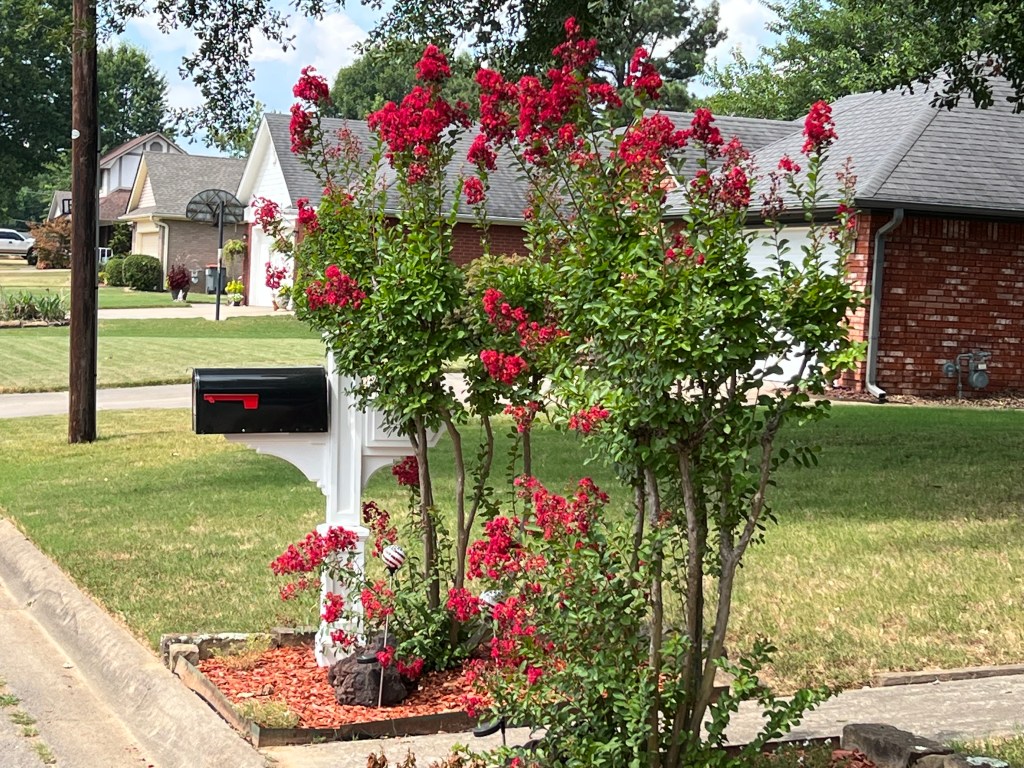
Last July I commented on the how the crepe myrtle bushes on either side of the driveway had decided to regrow after we had tried to eradicate them the previous year.  After removing the plant and as much of the root as I could, we planted a large agave in each of the two holes.  The mole we had been fighting appeared to take out both agaves, and then last year the crepe myrtles decided to regrow.  I decided to keep the bushes but wanted to shape them into single stem tree rather than the bushy mass they had previously been.  When Zena and I were on our walk I was taken by the myrtle plants that were in full flower on both sides of a mailbox planter.  This was exactly how I envisioned our crepe growing.

When I looked online for crepe myrtle (Lagerstroemia var.), I found it is a genus of around 50 species of deciduous and evergreen trees and shrubs native to the Indian subcontinent, southeast Asia, northern Australia, and other parts of Oceania, that has then been cultivated in warmer climates around the world.  It is a member of the family Lythraceae, which is also known as the loosestrife family.  The genus is named after Swedish merchant Magnus von Lagerström, a director of the Swedish East India Company, who supplied Carl Linnaeus with plants he collected.  These flowering trees are beautifully colored and are often planted both privately and commercially as ornamentals.  All varieties grow best in full sun.  The Red Rocket (Lagerstroemia indica ‘Whit IV’) variety of crepe myrtle appeared to be what we saw in the neighborhood mailbox planter. 

When I looked for tips on caring for my crepe myrtle, I found worst thing that can happen is pruning.  Crape “murder” usually occurs when an overly enthusiastic homeowner severely cuts back the top branches on crepe myrtle trees, ruining the natural shape and form of the plant.  Care should include limited pruning and little removal of growing branches.  Too much pruning from the top send suckers shooting from the bottom of the tree or the roots.  This in turn results in additional pruning and needless care.  Crepe myrtles are sometimes attacked by powdery mildew that can limit blooms.  Insects (aphids) may feed on the succulent new growth and create a substance called honeydew that attracts sooty black mold spores.  Getting rid of the aphids and mold is best done with a thorough overall spray of insecticidal soap or Neem oil.  It is best to limit pruning to thinning when needed.  However, this will not give me the shape I desire.  As mentioned last year, we have the crepe myrtle bush and not the tree in the neighbor’s yard.  That means I may never get the desired look. 

Thoughts:  While I am not yet resigned to our crepe never looking as good as our neighbor’s, I am beginning to lean that way.  The suckers I had cut away from our bush last year have returned to nearly overtake the bottom of the plant.  I am determined to give it one more year of pruning and shaping (can you say, “overly enthusiastic homeowner”?) and if it does not conform to my shape, will let it do as it will.  As I said last year, “At times you just need to bend with the will of nature.”  Last July we were thwarted by nature as we thought we were at the end of the pandemic.  Vaccinations were climbing and cases were falling.  Then we were hit with the Omicron variant.  Now we are resigned to live with the virus even as it drops from pandemic to endemic levels as BA.5 continues to spread around the US and world.  The variant appears to be more contagious but less lethal.  There are ways to protect yourself and others, but fewer seem willing to do so.  Act for all.  Change is coming and it starts with you.
Tracer

July 14, 2022

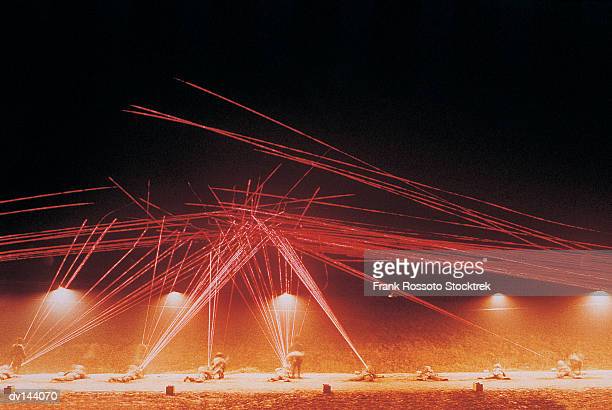
I learned on last night’s news that the prescribed burn I wrote about yesterday was not prescribed at all.  The Arkansas National Guard is on maneuvers at Fort Chaffee throughout the summer and it was the Guard that started the fire.  While the military reporting was correct in stating it was a “fire maneuver”, when it was associated with an actual fire the initial report (and me) had mistakenly assumed the cause was a fire.  It turns out the fire maneuver was a military term and not a civilian one.  The Guard had been practicing on the shooting range.  They had taken the precaution of making a 10 foot (3 m) fire break and had cleared the brush around the range with a prescribed burn, but the grass still caught fire and the fire jumped the break.  The guard was practicing using tracer bullets.

When I looked online, I found tracer ammunition (tracers) are bullets or cannon-caliber projectiles that are built with a small pyrotechnic charge in their base.  The United Kingdom was the first to develop and introduce a tracer round in a version of the .303 cartridge in 1915.  The US introduced a .30-06 tracer in 1917.  Prior to adopting red (among a variety of other colors) bullet tips for tracers, American tracers were identified by blackened cartridge cases.  The pyrotechnic composition is ignited by the burning powder when fired and burns brightly, making the projectile trajectory visible to the naked eye during day, and as a bright light during night firing.  This allows the shooter to visually trace the flight path of the projectile and then make any necessary ballistic corrections.  Prior to the tracer the shooter would have to confirm projectile impacts to determine accuracy.  As the effective range of ammunition increased this became nearly impossible even during day light.  Tracer bullets are usually loaded as every fifth round in machine gun belts, referred to as a four-to-one tracer.  Tracer fire can also be used as a marking tool to signal other shooters to concentrate their fire on a particular target during battle.

During World War II, aircraft with fixed machine guns or mounted cannons would sometimes have a series of tracer rounds added near the end of the ammunition belts to alert the pilot that he was almost out of ammunition.  The problem was that this practice alerted astute enemies that their foes were nearly out of ammunition.  A more common practice was to load the entire magazine as a four-to-one tracer.  This was used on both fixed offensive and flexible defensive guns to help mitigate the difficulties of aerial gunnery.  Tracers were common on most WWII aircraft except for night fighters.   These fighters needed to be able to attack and shoot down the enemy before they realized they were under attack and without betraying their own location to enemy defensive gunners.  The US relied heavily on tracer ammunition for the defensive Browning M2 .50 caliber machine guns on its heavy bombers such as the B-24 Liberator.

THOUGHTS:  In the UK, use of tracer rounds are restricted on National Rifle Association of the United Kingdom-operated ranges because of an increased risk of fire.  Use of tracers is usually only authorized during military training.  In the US, tracer ammunition is legal for personal use according to federal law, but some states prohibit tracer rounds from being sold and possessed by the public.  The use of tracer ammunition by civilians in the US has no practical application.  Two well-known fires were started by tracer fire in the last decade.  On February 24, 2013, a fire was started at DFW Gun Club in Dallas, Texas, and on July 3, 2018, the Lake Christine Fire near Basalt, Colorado was started by tracer rounds fired at a gun range.  There is a non-incendiary tracer ammunition which provide illuminated shots that do not produce heat or fires and can be shot indoors.  This was obviously not used.  Act for all.  Change is coming and it starts with you.

Prescribed

July 13, 2022

I got a text last night from a friend asking if we had been affected by the wildfire reported to be burning on the northeast side of our town.  I had neither seen nor smelled the fire when I was outside, but Melissa said the smoke was affecting her breathing.  County officials said the large fire that started at Fort Chaffee on Tuesday was 85% to 90% contained as of this morning.  Our mayor said residents on Hilltop Drive were evacuated for several hours because of the fire, but they were able to return later that night.  The area was still smoky this morning and small smolders could still be seen.  The Sheriff’s Office and local police are providing active patrols to make sure the fire stays contained.  Apparently, a “fire maneuver” (a prescribed burn) got out of hand at Fort Chaffee and spread up to the Hilltop neighborhood.  The county remains under a burn ban until further notice because of the heat and dry conditions.

When I looked online, I found that prescribed burns, or purposefully setting fire to woodlands and brush land, has long been an accepted practice in forest management to prevent future unwanted wildfires.  The US Forest Service cites three reasons for the practice.  The prescribed burn is used to clear the underbrush that can fuel a later fire, the burn adds nutrients back to the soil, and the burn promotes the growth of trees, wildflowers, and other plants.  Even when they are carefully planned, prescribed burns can get out of control.  The Forest Service did a study of prescribed burns several years ago and found three common reasons firefighters lost control of the flames.  The first was starting the controlled burn during a drought.  Second was poor communication among the firefighters.  Finally, was underestimating the amount of fuel (brush and debris) on the forest floor.  The Coalition of Prescribed Fire Councils report less than 2% of prescribed burns get out of control, and most of those are minor spillovers.

When I worked at the convention center in Kansas, we returned 10 of our 61 acres back to Tall Grass Prairie.  We placed signs explaining the prairie ecosystem and cut trails through the grass to allow visitors to observe the flora (plant) and fauna (animal) as the grasses would be up to six feet tall.  We also burned the acres every other year as part of their natural life cycle.  Prior to the prescribed burn we would make sure to cut breaks around the outside of the fields and water down the mown grass.  We also had a crew of six volunteers and support vehicles to monitor the burn.  Despite precautions, one year the pampas grass the next door owner used to mark their property caught fire from the heat of the prescribed burn.  We were able to get the fire out and only burned an area of about 10 square yards (9m2).  We reseeded the area with grass and replanted two trees from our property.  They seemed fine.

THOUGHTS:  When our prescribed burn got out of control it was one of the scariest moments of my life.  I was sitting next to the area and the ATV I was riding ran out of gas just as it all happened.  I was sitting on the trail and the heat of the flames were lapping at my face.  I finally jumped off the ATV and ran out of the flames.  As I thought back on the burn, it was never close to getting out of control, but fire can be very unpredictable.  While there is always that 2% chance of a prescribed burn getting out of control, the benefits outweigh the risk, and can help suppress future fires.  My niece serves in a covid ward at a large hospital and has remarked on the people wanting to get the vaccine now that they have covid.  Being proactive with a burn is no different than being proactive in health care.  Both require people to make the right choices in advance.  Act for all.  Change is coming and it starts with you.
Tires

July 11, 2022

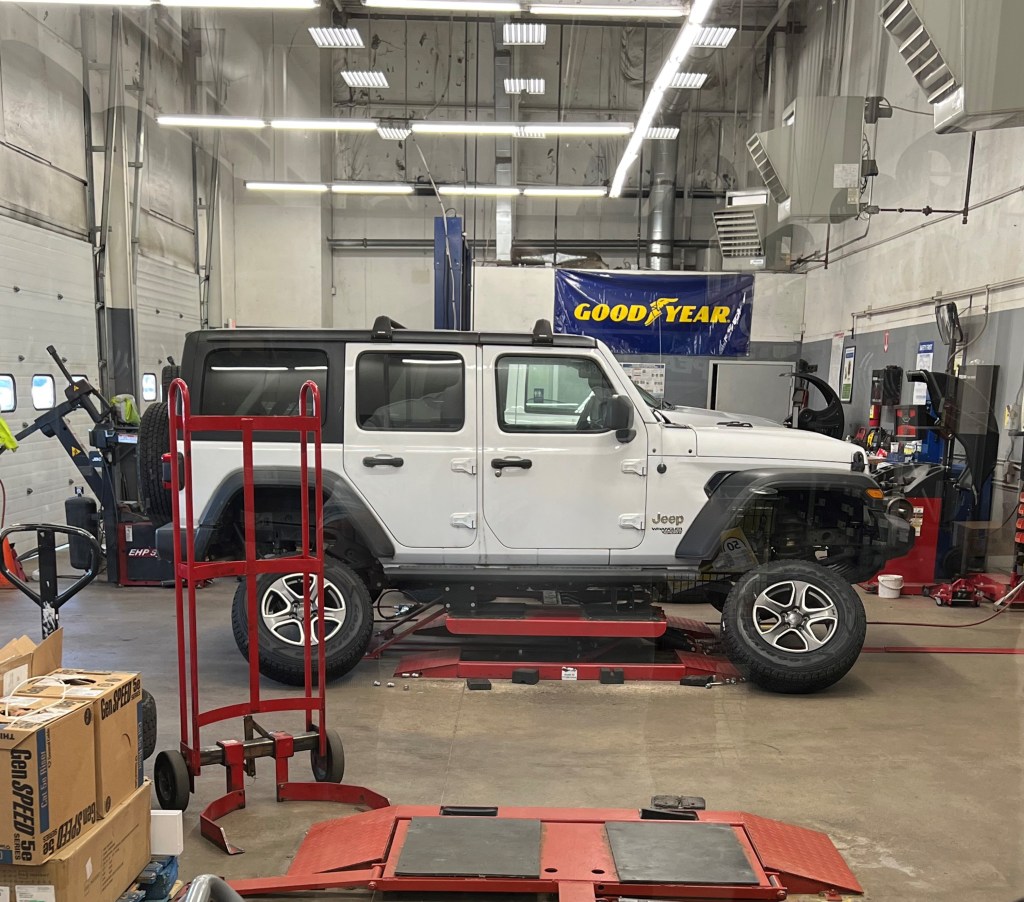
I have put 50,000 miles on my Jeep and the tires were needing to be replaced.  While the tread was not bare, it was low enough that I had done some hydroplaning during the last two heavy rainstorms coming off the mountain.  That was solidified two weeks ago when I caught a nail and got a flat just as I pulled into work.  I had a meeting to attend so I left the truck in the lot and went to my meeting.  Several of the men offered to change the tire while I was inside.  I was very appreciative and when I came out the spare was on.  That was the easiest tire I ever had changed.  I called around (and procrastinated) trying to find a shop who carried the same tire so I would have a consistent set of five.  When I found a shop, I needed to special order the tire and the web page said it would be 10 days for the tires to arrive.  I was not happy about it but ordered them anyway.  Two days later they arrived, and I set up an appointment to have the tires installed today.

When I looked online, I found modern tires are made from up to 30 different kinds of rubber as well as other components such as textiles, steel, antioxidants, and fillers.  Making tires is a five-step process that begins as the rubber, fillers, antioxidants, and other ingredients blended to create the gummy compound that will become the tire.  The compound is milled, cooled, and cut into the strips that form the structure of the tire.  The other elements of the tire are also prepared, like the fabric cords and steel belts.  These materials are assembled into what is known as a ‘green tire’, with the casing built first, followed by the tread, shoulder, and sidewall.  The green tire is cured and vulcanized in hot molds which compress the parts of the tire together and give its final shape, including the tread pattern and manufacturer’s sidewall markings.  Curing enhances the tire’s flexibility and elasticity.  The final step is an inspection.  Some tires are pulled from the line to be checked by x-rays and randomly selected tires are cut open to ensure they meet manufacturing standards.  Other tires are run on test wheels, or road-tested to evaluate handling, mileage, and traction performance.  Tires are rated (and priced) based on the manufacturing process and can last from 40,000 to 80,000 miles (64,375 to 128,750 km), depending on the application.

The shop where I purchased my tires was located next to the big box store in town.  When I arrived for my appointment, there were two workers and only one car in the bay.  I paid for my tires and was told it should take an hour to complete the job and they would call me.  I left for the box store to do some shopping.  I only had two items I needed and an hour to kill so I putzed my way slowly through the aisles looking to kill time.  I got my items and a couple more spur of the moment buys (it may not be there when you come back), tried on a pair of light weight shoes (did not feel right), and grabbed some pre-made sushi I ate for lunch sitting in the snack area.  When I looked at my watch it had been 1½ hours since I dropped the car and I had not heard back.  Now I had to do what I was trying to avoid, sitting in the shop watching my car sit idly while other customers were waited on.  Maybe the ten days included the time I would sit in the shop waiting to get the tires installed.

THOUGHTS:  As I sat in the shop waiting for my tires, I decided to put the time to use.  We subscribe to on-line data storage that is connected to my phone.  I have used my phone to occasionally download files for quick looks but do most of my work from a computer.  Since I had time, I decided to write my blog from my phone.  This was a little more difficult as I did not have the keyboard or multiple screens I have come to rely on, but it was doable.  When I proudly told this to Melissa her response was that she has been doing this for years.  The hardest part of doing something new (different) is often just being willing to try.  That is true for blogging from my phone, and it is true for changes because of the pandemic.  Different does not mean bad, it means different.  Act for all.  Change is coming and it starts with you.
Dewclaw

July 09, 2022

When I played with our previous dog Bella, I was often scratched by the small claw spaced about three inches above both of her front paws.  I wondered why this claw was there as it did not seem to serve any purpose.  When I asked Melissa about the claw, she said it was often vestigial in small breed dogs, and some owners have them surgically removed.  Melissa had not and said others warn against removal as this can be painful.  Now that we have Zena, I found she not only has the claw above her front paws, but also on both rear paws as well.  Again, the only purpose I have seen for this claw is to scratch us when Zena jumps into your lap (yes, she is a 50 pound lap puppy).  Melissa said this was called a dewclaw.

When I looked online, I found a dewclaw is a digit on the foot of many mammals, birds, and reptiles.  This claw commonly grows higher on the leg than the rest of the foot and does not contact the ground when the animal is standing.  The name refers to the dewclaw’s alleged tendency to brush dew away from the grass.  Dogs almost always have dewclaws on the inside of the front legs and occasionally also on the hind legs.  Unlike front dewclaws, rear dewclaws tend to have little bone or muscle structure in most breeds.  It is normal for certain breeds to have more than one dewclaw on the same paw.  At least one of these dewclaws will be poorly connected to the leg and is often surgically removed.  For certain dog breeds like the Beauceron used for herding sheep in France, a dewclaw is considered a necessity as it helps the dog navigate snowy terrain.  There is some debate about whether a dewclaw may help dogs gain traction when they run.  In some dogs, the dewclaw contacts the ground when they are running and the nail on the dewclaw often wears down the same way the nails on their other toes do.  In other dogs the dewclaw never contacts the ground, and the nail never wears away, and it is often trimmed to maintain the claw at a safe length.

The dewclaw is not a dead appendage.  They can be used to lightly grip bones and other items the dog holds with its paws.  In some dogs, these claws may not appear to be connected to the leg except by a flap of skin, and the claw does not have a use for gripping, as the claw can easily fold or turn.  Others suggest dogs like the Great Pyrenees (Zena) use the dew claw to aid climbing on rocky mountain slopes.  The dewclaw is also used by the dog to scratch itself to remove irritants from around eyes, ears, and fur. The technical term for these additional digits on the rear legs is hind-limb-specific preaxial polydactyly (now you know).  Several genetic mechanisms can cause rear dewclaws; they involve the LMBR1 gene and related parts of the genome.  Rear dewclaws of the mountain dogs do have phalanx bones and can be used for a variety of purposes.  Dewclaws are also recognized as the breed standard for the large shepherd dogs by the American Kennel Club as well as Britain’s Kennel Club.

THOUGHTS:  While a dewclaw may seem superfluous for smaller breeds of dogs, they appear to provide an advantage for large breeds that typically navigate rough or snowy terrain.  A similar vestige is evident with some larger snakes who have stunted legs beneath their skin and tiny, claw-like spurs on each side of the single opening where waste and reproductive fluids exit the body (the cloaca), which include remnants of what used to be leg bones.  Male snakes use these spurs during courtship and for fighting, but not for locomotion.  There is a common belief that the human appendix is a vestigial organ, but recent research has shown the appendix has several important immune effects in the womb and as an adult.  Whether a dewclaw, the spur on a vestigial leg, or an appendix, what we keep finding is that the answer is, “I do not know.”  The ability to admit what is not known and question what is known is the essence of the human quest for understanding.  That also works for understanding other people.  Act for all.  Change is coming and it starts with you.
Bison

July 08, 2022

We went out to dinner with friends last night and were shared a photoshopped version of “Dirk the Bison” from Yellowstone National Park.  The video came in response to the four bison goring’s in the park over the last two months.  The video depicted a bull bison loping along the prairie with four stylized human figures with arms raised spaced across the hump of his back.  The caption read, “Rapidly approaching ‘Ace’ status!”, referring to the number of victories needed by fighter pilots in modern arial warfare.  The video was first posted with only two humans, then upgraded to three, and now has four figures being tossed into the air along its hump.   While this may have been a long month for the humans, Dirk seems to be thriving.  Sadly, I could not get the actual photo to download (but it is on FaceBook).

When I looked online, I found the American bison (Bison bison) is a species of bison native to North America often referred to as buffalo.  It is one of two extant species of bison along with the European bison.  By 9000 BCE the American bison’s range (or the great bison belt) covered a tract of grassland from Alaska to the Gulf of Mexico, east to the Atlantic Seaboard as far north as New York, south to Georgia, and some say even further south to Florida.  North America has two subspecies of bison.  The plains bison (B. bison bison) is smaller in size with a more rounded hump, and the wood bison (B. bison athabascae) is larger with a taller, square hump.  The plains bison has been suggested to consist of the northern plains (B. bison montanae) and southern plains (B. bison bison) subspecies, but this is not generally supported.  The wood bison is one of the largest wild species of extant bovid in the world, surpassed only by the Asian gaur (Bos gaurus).  Among extant land animals in North America, the bison is the heaviest, the longest, and the second tallest (after the moose).  It is also known as the most likely to attack tourist.

While bison once roamed in vast herds, the species was nearly extinct from commercial hunting and slaughter in the 19th century and introduced bovine diseases from domestic cattle.  The population was more than 60 million in the late 18th century, but the species was culled to just 541 animals by 1889.  Recovery efforts expanded in the mid-20th century, with a resurgence to roughly 31,000 wild bison by 2019.  The population was primarily found in a few national parks and reserves, but reintroductions allow the species now freely roam wild in several regions in the US, Canada, and Mexico, and they have been introduced to Yakutia in Russia.  The Indigenous tribes of North America have had cultural and spiritual connections to the American bison for millennia and the bison is the national mammal of the US.  The National Park Service takes visitor and animal safety seriously and the front page of the Yellowstone website tells you to stay 25 yards (22.8 m) from bison and elk and 100 yards (91.5 m) from bears and wolves because the park’s animals “are WILD and DANGEROUS” (emphasis NPS).  Despite the precautions, warnings, and guidelines, bison attacks are on the rise inside the park.

THOUGHTS:  While the streak of goring’s may not be common, bison are the biggest threats to humans in Yellowstone Park.  Between 1978 and 1992, 56 people were injured and two were killed by bison, and from 2000 to 2015, 25 people were injured by bison.  The recent uptick can be chalked up to an increase of bison within the park, an increase in visitors, and the number of visitors willing to get up close and personal with a bison to securing an Instagram-worthy shot.  I guess it is no longer enough to loss control of a vehicle or fall off a cliff in quest of the perfect shot.  Perhaps this could be an example of evolution.  Act for all.  Change is coming and it starts with you.
Almonds

July 07, 2022

I came across an article from the LA Times this morning about almonds being stuck in port.  This year California almond growers are looking at a 2.8 billion pound harvest to match the 2.9 billion pounds in 2021 and an all-time high of 3.1 billion pounds in 2020.  California produces about 82% percent of the world’s almond supply, and 70% of those almonds are exported for sale.  However, exporting requires shipping containers, and it has reached a point where demand for containers in Asia was so high that after dropping off their loads in Southern California, the containers were being sent back to Asia empty instead of taking the time to head north to the Port of Oakland where the almonds are exported.  That means California’s almond production is exceeding export demands, and 1.3 billion pounds of almonds are sitting unsold in California storehouses.

When I looked online, I found the almond (Prunus amygdalus, syn. Prunus dulcis) is a species of tree native to Iran and surrounding countries.  The almond tree prospers in a moderate Mediterranean climate with cool winter weather (California central valley).  The almond is also the name of the edible and widely cultivated seed of this tree.  The almond is classified with the peach in the subgenus Amygdalus, distinguished from the other subgenera by corrugations on the shell (endocarp) surrounding the seed.  The fruit of the almond is a drupe, consisting of an outer hull and a hard shell with the seed and is not a true nut.  Almonds are sold shelled or unshelled.  Blanched almonds are shelled almonds that have been treated with hot water to soften the seedcoat, which is removed to reveal the white embryo.  Once the almonds are cleaned and processed, they can last in storage for around two years.

Agriculturalists are saying due to high acreage and water demand for cultivating almonds, and need for pesticides, California almond production may not be sustainable.  That is especially so given the persistent drought and heat caused by 21st century climate change and some producers have left.  To grow one almond requires 1.1 gallons of water, and to grow a pound takes 1,900 gal/lb.  Nuts like walnuts, hazelnuts, pistachios, and cashews all use roughly the same amount of water, but the demand for almonds has been high.  California is amid a 5 year drought that has everyone blaming the nut industry as farmers shift towards growing more almonds.  The drought has also sent the per pound price of almonds to US$6 a pound, as opposed to US$2 a pound in 2010.  Almond exports are down about 13 percent this year, with around 1.3 billion pounds of almonds left undelivered.  California Almonds’ May data shows that the uncommitted almond inventory was over 660 million pounds, or up 52% over the same period last year.  That is bad news for the state, as almonds were California’s last year’s top agricultural export, worth about $4.7 billion.  Now they cannot seem to get rid of the almonds.

THOUGHTS:  The almond industry has recently been making a push toward sustainability, reportedly cutting water usage by 33% with plans to reach a total 53% reduction by the year 2025.  This effort might not solve the shipping problem, but it will make a difference for California’s drought.  It is hoped more sustainable farming practices and a shift in global distribution trends will relieve California’s almond surplus.  Inflation and drought have driven the cost of producing the nuts up even as the average price has dropped.  The average US farmer feeds 155 people, up from only 26 people in 1960.  Today’s farmer grows twice as much food as their parents using less land, energy, water, and fewer emissions.  Farming has always been a risky business regardless the crop, both financially and physically.  Act for all.  Change is coming and it starts with you.
100F

July 06, 2022

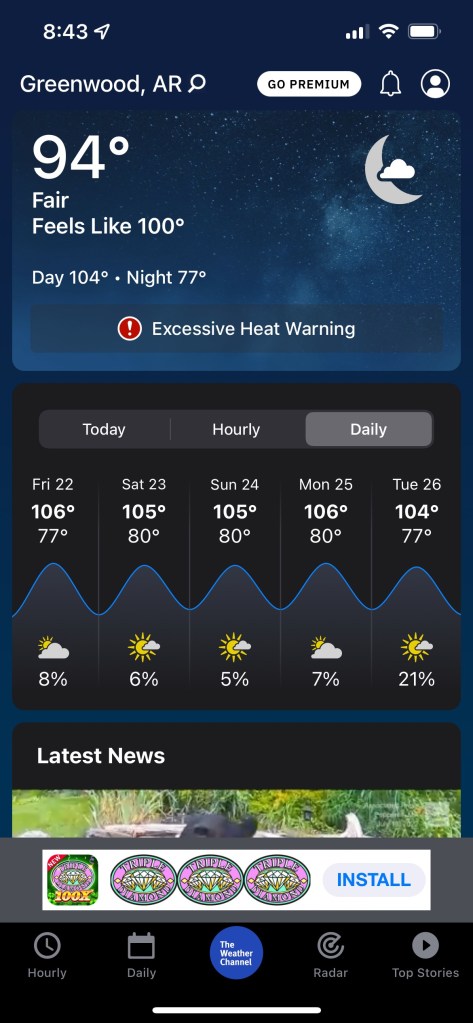
With the temperatures slated to be over 100F (37.7C) all this week, Melissa sent me a text from the city Fire Department asking dog owners to be aware of the effect of heat coming from asphalt roads on your dog’s paws.  As little as 77F (25C) could raise the asphalt to 125F (51.6C) and 87F (30.5C) to a scorching 143F (61.5C).  The suggestion was to put your hand on the roadway for 8 seconds to see what your dog will feel before you walk.  I dutifully felt the pavement before I took Zena on our walk.  I was surprised how much the heat had affected the neighborhood lawns.  Most of the residents cut their lawns short, and the heat had turned the beautiful green lawns of last week into dry dormant lawns this week.  Even the yard display I mentioned for the Fourth seemed to have been affected, as the inflatable Sam and Eagle were lying flat on the grass.  The heat advisories this week are not just from the high temperatures, but from the heat Index.

When I looked online, I found the heat index, or the “feels like” temperature is the way the human body feels the temperature in the air.  The index takes into consideration humidity and wind speed, then calculates the heat the human body “feels”.  On a windy day, you can feel cooler even if the temperature does not change.  During a humid summer day, you may feel more uncomfortable than on a hotter but drier day.  While forecasts state the temperature of the air, they are now likely to consider factors that influence what it feels like outside.  The heat index measures the comfort of the body during a hot day.  When the body is too hot, it perspires to get rid of excessive heat and cool itself off.  In a more humid environment, perspiration does not evaporate as quickly and cooling the body becomes complicated.  When the temperature tops 100F the humidity causes the heat index to rise, and we have a heat advisory.

Southern summers are notorious for high temperatures and 100F days are normal.  Like Zena’s paws you would not dare to walk outside without shoes, leading to the saying, “It is so hot you could fry an egg on the sidewalk!” According to the Library of Congress, it is possible to fry an egg on the sidewalk, but not probable.  Eggs need to reach a temperature of 158F (70C) to cook through, and sidewalks can usually only get up to 145F (62.7C).  That does not keep the city of Oatman, Arizona, from holding an annual Sidewalk Egg Frying Contest as part of their Fourth of July celebration since 1983.  The 150-person town usually has around 20 contestants vying to fry an egg in 15 minutes or less in front of 1,500 spectators.  Contestants use anything from aluminum foil to magnifying glasses to homegrown solar devices to create “the most edible egg.”  The rules are simple and include two eggs per team and the freedom to use any kind of utensil, or pan, or mechanism to see if they can cook the eggs with solar power in 15 minutes or less time.  The participants are also supposed to preserve their eggs from being eaten by the wild burros.  Prizes and medals are given for the youngest contestant, absolute showmanship or best costume, best cooking contraption, and the contestant who’s traveled the farthest.

THOUGHTS:  When I watched the weather last night I had to laugh as the forecaster told of the cold front that was going to come through over the weekend.  The temperatures are predicted to be over 100F (103F-104F) with a “feels like” temperature of 110F to 115F range through the end of the week.  When the cold front rolls in on Friday it is predicted to drop weekend temperatures down to 99F.  This did not strike me as much of a cold front.  Just as the heat index determines relative heat, the cold front is relative to the rest of the week.  Our view of the differences between the world’s peoples and cultures is also relative.  What is considered odd in Asia may be the norm in North America, and vice versa.  It is when we can experience those differences that makes life fun.  That requires us to participate with others.  Act for all.  Change is coming and it starts with you.

Trap

July 05, 2022

After I realized it was a raccoon that was getting into the bird feed on our back porch, I did take the steps I mentioned to keep the critter out.  I rearraigned the buckets to make them more difficult to knock over and taped up the lid the animal had broken when it had tipped over another bucket.  I even put the “Amish stove” space heater across the door to deter him from coming in.  I thought we were ready, but the next night the raccoon was back.  He crawled through the screen and squeezed past the heater to get to the seed.  Zena notified Melissa he was back and this time it was she who turned on the light to see the raccoon at work trying to open the seed buckets.  When we surveyed the damage the next morning, he had chewed a piece off one of the lids but had not been able to get inside.  The lid that had cracked the previous night was now completely split and I thought might be unusable (I salvaged it).  What I had done had not resolved the problem.  I wondered if I needed to get a trap.

When I looked online, I found the recommended way to get rid of raccoons is to use a live trap.  The Sherman trap is a box-style animal trap designed for the live capture of small mammals.  It was invented by Dr. H. B. Sherman in the 1920’s and became commercially available in 1955.  The Sherman trap has been used by biological science researchers to capture animals like mice, voles, shrews, and chipmunks.  The trap consists of eight hinged pieces of sheet metal (galvanized steel or aluminum) that allow the trap to collapse for storage or transport.  Other animal traps have been built along the same design but use metal wire mesh for the hinged pieces.  People like using traps for animal control because they are a humane and safe solution to getting rid of animal pests.  Both ends of the trap are hinged, but in normal operation the rear end is closed and the front folds inwards and latches the treadle, or trigger plate, in place.  When an animal enters far enough to be clear of the front door, their weight releases the latch, and the door closes behind them.  The lure is usually a paste bait placed at the far end of the trap that can be dropped in place through the rear hinged door.  It was suggested for faster results, place the paste on an apple slice or ear of corn.  Apparently, raccoons do not live on past alone.

While the live trap would have been an effective solution, it would have cost around $100 to purchase and time to procure.  I decided to do what I should have done in the first place, fix the screens on the porch.  When we first brought Zena home, she had heard the dogs barking next door and had run through the lower screen.  Several of the window screen had also been pushed in by other critters (the raccoon?).  I had purchased a screening tool several weeks ago but had not gotten around to fixing the screens.  I put new screws in the windows which had been breached and re-set the screens in the outside door.  I finally re-attached the lower portion of the door to the hinge (Zena is rough) and placed plastic over the bottom half of the door thinking it might provide a visible deterrent to both Zena and the raccoon.  Zena no longer tries to run through the screen and the raccoon has not been inside, at least not for three nights.

THOUGHTS:  The conference center where I worked in Kansas was in a rural setting, and one summer we had a skunk decide to have her kits (babies) under the back porch.  I thought it was fitting as it was during the Women’s Weekend, but the other women did not welcome her presence.  I called animal control and they brought out a wire mesh version of the live trap.  We never caught the skunk but several days later they were gone.  I was glad we did not catch the skunk.  I was not looking forward to having the mom or one of the four kits decide they needed to spray.  One of the harder lessons for humans has been learning to cohabit with other animals.  We have destroyed or encroached on their natural habitat and seem to use extermination as the first choice to remove the “pests”.  Cohabitation requires us to understand the wants and needs of others so we can cooperate.  That is true among humans as well.  Act for all.  Change is coming and it starts with you.
Fourth

July 04, 2022

While Zena and I were walking our neighborhood I was surprised by the number of yards decorated for Fourth of July.  Our subdivision has always had proliferations of displays for Halloween and Christmas, and even a few displays for Thanksgiving.  We also have quite a few houses which fly American flags on holidays and special occasions.  Even permanent flag displays and flag poles have become more prevalent over the last several years.  However, this is the first year I have noticed the yard displays for the Fourth.  Most of these displays are small and consist of small flags lining the walls or driveways, but one house went all out.  The display had 3 foot (1 m) high blowup letters spelling freedom along the walkway to the house, a 40 inch (1 m) inflatable Uncle Sam, and a 7 foot (2 m) inflatable bald eagle with red and white stripped wings and a blue vest full of stars.  This was accompanied by the flags and flag bunting around the yard and windows-white-and blue wings set with stars.  I am sure many of these same yards will contribute to the neighborhood fireworks demonstrations that mark the day in our community.

When I looked online, I found the Boston Pops Fireworks Spectacular will be back at The Hatch Memorial Shell for the first time since 2019.  The Boston tradition has been sidelined during the pandemic but will return to Boston’s Charles River Esplanade on the fourth of July.  The usual rehearsal by The Boston Pops on Sunday, July 3 will happen, but the rehearsal “will be closed to the public to focus on the return of the Fourth of July holiday celebration,” according to Pops.  The July 3rd show does not include fireworks but has always been popular because it is less crowded than the show on the 4th.  The program on the fourth runs from 8 pm – 11 pm and includes a world-renowned fireworks display.  The 2022 Fireworks Spectacular will include a special moment in memory of David Mugar, who died this past January.  Mugar’s support of Boston’s Independence Day celebration began in 1974 and transformed the event into one of the most recognized Independence Day celebrations in the country.  Melissa and I attended the fourth concert several years ago along with 3 million of our closest friends.  Melissa checked off another item on her bucket list.

While the fireworks are returning to Boston, they are still absent in other locals.  When my son was small, we usually spent the Fourth at his grandparent’s house in Colorado.  The town is named for the landmark mesa that jutted out of the prairie in the foothills of the Rocky Mountains that appeared from a distance to look like a castle.  Every Fourth the Castle Rock Fire and Rescue would hold a display that was visible for miles around.  I recall attending two years in a row where the display never made it to the finale due to falling debris igniting the dry grass and sagebrush surrounding the rock outcrop.   The third year the Fire Department gave up and called off the event because of dry conditions.  I saw the town’s officials decided to proactively cancel the Fourth of July fireworks show again this year.  The community has been under Stage 1 fire restrictions since April 21.  Conditions are not expected to improve before July 4 and may get worse.  Stage 1 fire restrictions permit the sale of fireworks, but not the use of the private fireworks you just bought.  You can buy them; you just cannot shoot them.  I wonder how well that goes.

THOUGHTS:  Boston Pops Conductor Keith Lockhart said, “The past three years have given us profound lessons on the importance of not taking things for granted and appreciating the many everyday gifts of our lives, as well as caring and looking out for each other.  I am so grateful that we can come together once again to celebrate Independence Day and all that we aspire to be as citizens of this great country and the city we’re proud to call home.”  Appreciating the people and things of our past (and present) is part of the celebration of life we all experience.  It is not about us; it is about us.  Act for all.  Change is coming and it starts with you.