Tomato

September 24, 2022

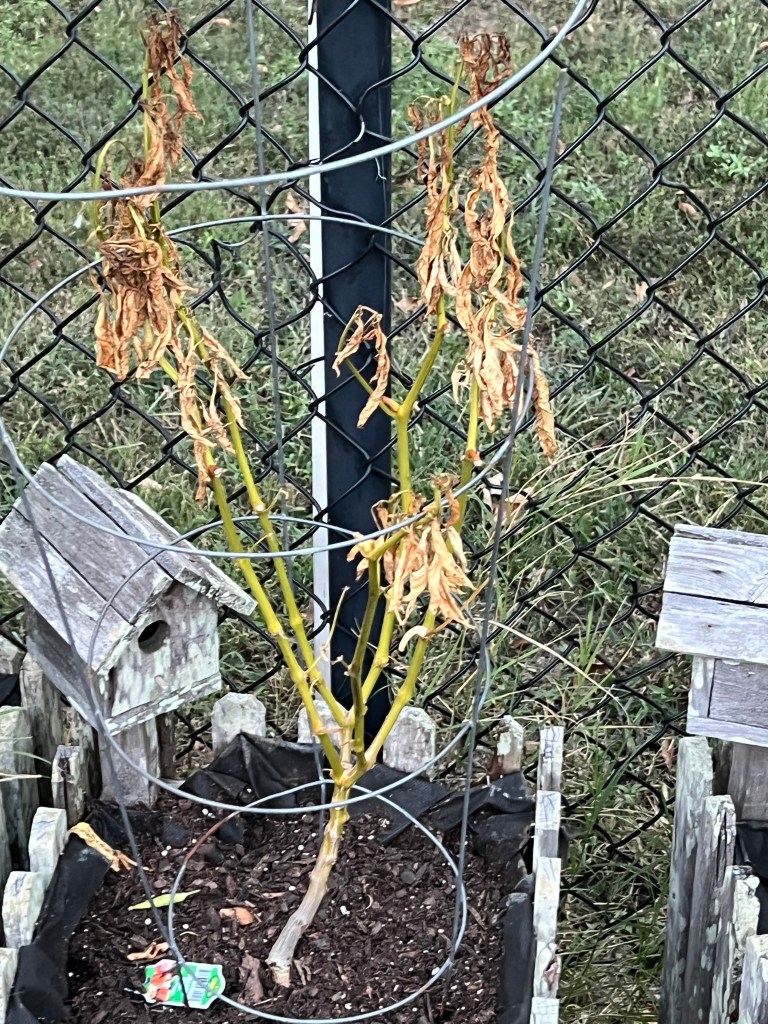
This year’s warm summer really decimated the tomato plants I put in the containers.  They did not produce much fruit and then all the lower stems withered and died and all six of the plants are looking bad.  When I researched how to prune a tomato two years ago it suggested not to prune at all if they were a determinate (stops at certain height) but pruning an indeterminant will cause the plant to quit producing stems and start producing flowers.  I knew the tomato plants I have put in the containers over the last three years were indeterminants. I had never pruned them, and they had never grown much above the tall cages (4 feet/1.2 meter) I use to support them.  This year the plants were short on production but had all outgrown the cages by several feet.  Since it is getting cooler, I decided to prune the dead stems and see if they would make a final push at production before the frost.  As I worked, I pondered why the tomato is referred to as both a fruit and a vegetable.

When I looked online, I found it the double reference for the tomato is based on context.  The Encyclopedia Britannica states a tomato is a fruit but is labeled in grocery stores as a vegetable because of their taste and nutritional purposes.  Botanically, a tomato is a fruit (a berry), consisting of the ovary and its seeds, of a flowering plant.  The tomato is considered a culinary vegetable because it has a much lower sugar content than culinary fruits.  The tomato is also more savory in taste than sweet and is typically served as part of a salad or main course of a meal rather than as a dessert.  Tomatoes are not the only food source with this ambiguity.  It turns out bell peppers, cucumbers, eggplants, avocados, green beans, and all kinds of squashes (such as zucchini and pumpkins) are all botanically fruit yet cooked as vegetables. 

The confusion over culinary verses botanical difference of tomatoes as fruits or vegetables led to a legal dispute in 1887.  Nix v. Hedden, 149 U.S. 304 (1893), was a landmark decision by the US Supreme Court that, under US customs regulations, the tomato should be classified as a vegetable rather than fruit.  John Nix founded the John Nix & Co. fruit commission in New York City in 1839 and became one of the largest sellers of produce in New York City at the time.  Nix & Co. was also one of the first companies to ship produce from Virginia, Florida, and Bermuda to New York.  Edward Hedden was Collector of the Port of New York who applied the tariff.  In a unanimous decision, the Court’s opinion held that the Tariff Act of 1883 used the ordinary meaning of “fruit” and “vegetable”, instead of the technical botanical meaning.  The holding of this case was said to apply only to the interpretation of the Tariff of 1883, and the court did not claim to reclassify the tomato for botanical or other purposes.

THOUGHTS:  While the tomato may generally be served with dinner and not as a dessert, there are many recipes for tomato cakes, pies, and especially gelati and ices.  Likewise, the only way I have ever eaten pumpkin is in a pie.  Does this mean both are culinary fruits as well as botanical fruits?  Words and their definitions are an important part of communication and culture and what we intend to mean can be understood differently by others.  Communication requires people to speaker and listen in a way others understand.  Otherwise, it is just noise.  Act for all.  Change is coming and it starts with you.

Center

September 23, 2022

Inside my local newspaper was an AP article on a shift in the population center of the US.  This calculation is preformed every ten years after completion of the survey by the US Census Bureau.  For the next ten years this honor belongs to the town of Hartville with a population of 594 residents (as of 2020).  Missouri has been the population center of America since 1980.  Since the 2010 census identified Plato, Missouri, as the population center it means this decades’ shift was 11.8 miles (19 km).  This is the smallest distance shift in 100 years and the second smallest in US census history.  Dignitaries from the National Oceanic and Atmospheric Administration and the US Census Bureau were present to officially debut the red granite marker topped with a tripod.  According to the Census Bureau this “spot would be the ‘balance point’ if the 50 states were located on an imaginary flat surface with weights of identical size – each resenting the location of one person – placed on it.”  Sounds like someone has a lot of time on their hands waiting ten years for the next census.   

When I looked online, I found the center of the US has also been calculated geographically as well as by population.  The geographic center of the US is northeast of Belle Fourche in Butte County, South Dakota (with coordinates: 44°58′N 103°46′W).  The geographic center of the contiguous 48 states (minus Alaska and Hawaii) is near Lebanon in Smith County, Kansas (with coordinates: 39°50′N 98°35′W).  Although the designation has no official status, the geographic center of North America is in the US and was thought to lie near Rugby, North Dakota (with coordinates: 48°10′N 100°10′W).  In 2017, a new calculation of the geographic center of North America placed it near the town of Center, North Dakota.  The change occurred because of rising sea levels because of climate change and from a shift in the calculation measure itself.

For years the cities of Center and Rugby have contested which is the actual geographical center of North America.  Different scientists have used various methods to determine the geographical center of the continent.  Now, changes in sea level due to glacial melt have resulted in a shifting in its position.  The lack of a clear definition of what constitutes a geographic center also contributes to its varied identification.  The debate between the two cities officially ended recently with the accurate calculation of the exact geographic center of North America by University of Buffalo professor Peter Rogerson.  Appropriately, Center, located in Oliver County, North Dakota, is the new geographical center of North America.  Rogerson used the azimuthal equidistant projection method to determine the geographical center.  Based on his calculations he concluded the geographical center was in the middle of the city of Center, 145 miles from the previous geographical center in Rugby.  The findings are more accurate as the azimuthal equidistant projection method considers the Earth’s curvature.  Both have commemorative markers and still claim the title of North America’s center.

THOUGHTS:  Although my memories are vague, I still recall our family visit to the geographical center located near Lebanon in Smith County, Kansas.  I believe this was on the same trip where we visited the Farm and Ranch Museum in Gering, in western Nebraska.  The mission of the museum is, “To preserve and interpret the agricultural heritage of the High Plains.”  The wonder of these odd trips was passed on to me as an adult.  Our first vacation (after the honeymoon) as a tour of the small towns and attractions of western Kansas.  The common “wonders” in rural areas still hold an appeal.  How we lived and survived the rigors of the past are a road map for the future.  Hopefully, we will learn from the pandemic as well.  Act for all.  Change is coming and it starts with you.

Esoteric

September 22, 2022

While coming back through town from the recycling center yesterday I was on the side street waiting to pull onto the main drag when a car with a large AEL emblem emblazoned on the side door drove past.  I pulled into traffic and noticed a smaller version of the emblem was also on the rear panel.  I had never seen the acronym before and wondered what it stood for.  When we stopped at a traffic light, I got close enough to read the small print beneath the emblem.  It said, American Esoteric Laboratories.  I did not know what that meant but thought that either someone had a good sense of humor or medicine was finally being honest.  It was neither and was not as esoteric as I thought.

When I looked online, I found esoteric testing is the analysis of ‘rare’ substances or molecules that are not performed in a routine clinical laboratory.  Esoteric tests are “niche” assays and often require specialized personnel.  Some of these tests have been or are currently being analyzed using RIA (radioimmunoassay) technique which is both costly and time-consuming.  Esoteric laboratories are beginning to benefit as test volume increases due to population growth and the aging population, an increase in the number of tests per patient, and an increase in esoteric and genomic tests which are part of the trend to customize treatments.  Esoteric tests are generally considered to include Biochemical Genetics, Cytogenetics/FISH, Flow Cytometry, Microbiology, Molecular Genetic Pathology, RBC, Special Studies, Special Coagulation, and Virology.  The tests do seem esoteric.

American Esoteric Laboratories (AEL) is a regional provider of esoteric and clinical laboratory services.  The laboratory offers an extensive test menu of both routine and esoteric testing.  AEL testing locations in Tennessee include the core laboratory in Memphis and AEL East in Knoxville.  Additional AEL laboratories are in Mississippi, Alabama, Missouri, and Arkansas.  AEL also operates convenient patient service centers throughout Alabama, Arkansas, the Florida panhandle, Kentucky, Mississippi, Missouri, and Tennessee.  AEL is the MidSouth Division of Sonic Healthcare USA.  Sonic Healthcare is a global healthcare company with headquarters in Sydney, Australia, that has grown to become one of the world’s leading healthcare providers.  Sonic has operations in Australia, the US, Germany, Switzerland, the United Kingdom, Belgium, Ireland, and New Zealand.  This is truly a globalized medical operation.  Like much of big medicine, I had never heard of it.

THOUGHTS:  When the pandemic began spreading early in 2020 virus testing was done by sending the sample off to an esoteric laboratory.  The word esoteric means obscure or puzzling, and at the onset that was what the virus was.  These specialized laboratories analyzed the rare substances or molecules associated with it.  As testing became more common local labs began to perform the tests, and now over the counter self-tests are readily available.  While there is still much to discover, the virus is no longer seen as obscure and puzzling.  It is something to be tracked, studied, and ever more understood.  Now the esoteric part is why there are still those who deny it exists.  Act for all. Change is coming and it starts with you.

Cardboard

September 21, 2022

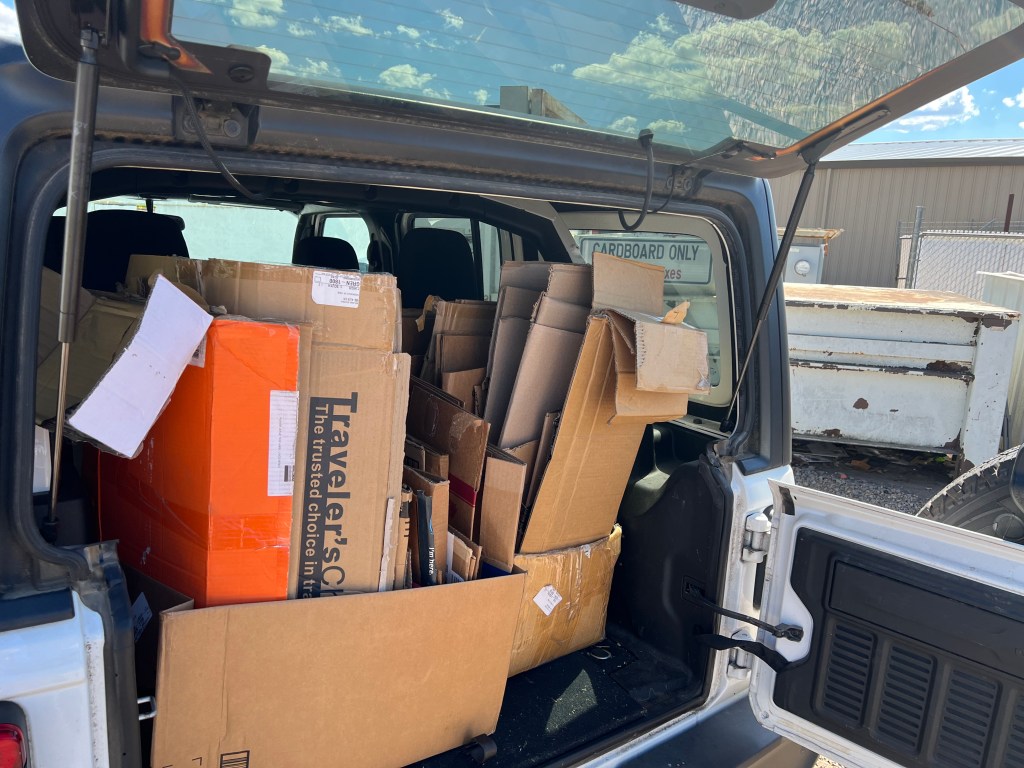
I have mentioned when the pandemic hit in early 2020 and operations shut down, so did my local recycling center.  When the center finally opened 10 weeks later, I stuffed my recyclables in the jeep filling it completely.  This included newspaper, glass, plastic bottles (drink and milk), tin cans, and cardboard.  I have continued to take my recyclables to the center but have found it harder to know when it is open.  The hours have changed at least three times over the last two years, and that does not include times it has just been closed (presumably virus related).  Over the last two weeks I faced several setbacks in my quest to unload recyclables.  I did not know they had changed hours (and days) and when I first showed up the center was closed.  When I returned the following week, the truck had not arrived to remove the cardboard bin.  I was able to deposit my other items, but the cardboard stayed in the jeep.  I drove the broken down boxes around another week, then loaded the additional cardboard I had and went back to the center.  They had again changed their hours.

When I looked online, I found Cardboard is a generic term for heavy paper-based products.  The term “cardboard” has general use in English and French, but the term is frowned on in commerce and industry as not defining a specific product and they tend to use more specific terminology.  The construction can range from a thick paper known as paperboard to corrugated fiberboard which is made of multiple plies of material.  Natural cardboards range from grey to light brown in color, depending on the specific product, but dyes, pigments, printing, and coatings are available to change the color and look of the cardboard.  Cardboard was first made in France in 1751 and was used to reinforce playing cards.  The term cardboard has been used since at least 1848, when Anne Brontë mentioned it in her novel, The Tenant of Wildfell Hall.  The Kellogg brothers first used paperboard cartons to hold their corn flaked cereal, and when they marketed it to the public included a heat-sealed bag of wax paper wrapped around the outside of the box along with their printed brand name.  In modern times this bag is plastic and is kept inside the box.

During 2020 the US hit a record high for the manufacture of cardboard.  Around 80% of all the products sold in the United States are packaged in cardboard and over 120 billion pieces were used that year.  That same year, over 13,000 separate pieces of consumer cardboard packaging was thrown away by American households, which combined with all paper products constitutes almost 42% of solid waste generated by the US annually.  Most types of cardboard are recyclable, but boards that are laminates, wax coated, or treated for wet strength are more difficult to recycle.  Clean cardboard (not subject to chemical coatings) is usually worth recovering, although the difference between its value and the cost of recovery is marginal.  Cardboard can be recycled for industrial or domestic use, and like newspaper, cardboard can be composted or shredded for animal bedding.

THOUGHTS:  Some will ask why I did not check the website before I packed my items for recycling.  The answer is I did but the site had not been updated.  I checked again as I sat in front of the locked gate and found the hours had been changed in May.  The new hours included (most of) the hours I was accustomed to use, but not all.  Many stores and businesses have taken to including a disclaimer saying, “Hours may vary due to restrictions”, and you are asked to call for confirmation.  Like blaming supply chain issues, and the signs on semi mud flaps warning you to “stay back”, this is another way of saying, “It is not my fault.”  Someone must be accountable, right?  I took my cardboard to recycling today.  Act for all. Change is coming and it starts with you.

Huckleberries

September 19, 2022

I came across a story in the back section of today’s newspaper addressing the difficulty of locating huckleberries in northern Idaho and eastern Washington this year.  Even when pickers encountered healthy bushes, they had few berries or none.  While that may be discouraging for human pickers, grizzly bears and other wildlife depend on the berries as a key food source.  Tabitah Graves, a US Geological Survey (USGS) scientist, said she started tracking huckleberries because they are a very large part of bear diets, comprising over 50% of their diet in the peak of summer as they bulk up to hibernate.  Huckleberries have also been found in scats of coyotes, martens, and weasels, and wildlife cameras have recorded pictures of all kinds of birds and small mammals eating huckleberries.  Janet Prevey, another USGS scientist, says the plants may become less prevalent at some lower elevation and drier sites.  That could mean huckleberries recede from some of the plant’s southern range and advance in northern latitudes. 

When I looked online, I found Huckleberry is a name used in North America for several plants in the family Ericaceae, in two closely related genera: Vaccinium and Gaylussacia.  Huckleberry is a North American variation of the English dialectal name variously called ‘hurtleberry’ or ‘whortleberry’ for the bilberry.  In North America the name was applied to numerous plant variations all bearing small berries with colors that may be red, blue, or black.  It is the common name for various Gaylussacia species, and some Vaccinium species, such as Vaccinium parvifolium, the red huckleberry, and is also applied to other Vaccinium species which may also be called blueberries depending upon local custom, as in New England and parts of Appalachia.  Four species of huckleberries in the genus Gaylussacia are common in eastern North America, especially the black huckleberry (G. baccata).  The huckleberry is the state fruit of Idaho.

Native American tribes intentionally used fire to regenerate shrub fields and make them produce more huckleberries but those were low intensity burns.  Huckleberries need ample sun and tend to like the types of openings that fires often create.  When forest canopies close in because of plant succession, berries are often shaded out.  Many of today’s fires are high intensity, driven in part by higher temperatures (climate change) and a buildup of biomass (fire suppression).   It is unclear what kind of impact more severe fires would have on the distribution of the berries. Huckleberry habitat may be reduced by 5% to 40% in the Northwest and that it could expand 5% to 60% in northern British Columbia, Canada.  The timing of flowering and fruit could change by as much as 50 days.  Not so good for the grizz.

THOUGHTS:  As mentioned, huckleberries in Maine are called blueberries.  One of the favorite books for my sister’s children growing up was called Blueberries for Sal.  This charming story has been loved by readers since its first publication in 1948.  This follows the story of two mothers who think their child is following them, only to discover the cub and child have switched (spoiler alert: both go home with the right mother).  As huckleberries become scarce or move locations humans and animals are going to find it harder to locate this important food source.  Act for all. Change is coming and it starts with you.

Beer

September 17, 2022

The middle of the front section of my local newspaper carried an article on Thursday about a University of Mississippi student who came up with an innovative use of beer boxes.  During March 2020 Ryan Lubker saw a cardboard deer head and wanted to spice it up.  Being a college student and locked down by the pandemic he had plenty of beer boxes and decided to put the ideas together.  The prototype used real beer boxes and cut them out with a laser cutter.  Rather than a two dimensional picture of a deer, this used slotted pieces that are assembled into a three dimensional model looking like a deer head.  Lubker has since graduated, but at the time he was studying business management and manufacturing at the school’s Haley Barbour Center for Manufacturing Excellence.

When I looked online, I found the Haley Barbour Center for Manufacturing Excellence (CME) at the University of Mississippi is advertised as an exercise in contrasts: a factory floor in an academic setting and a future-focused technology center on an historic university campus.  CME was designed by the firm CDFL to be a cutting-edge experiential teaching environment where students immerse themselves in the manufacturing process.  The building integrates a 12,000 sf manufacturing floor into its design.  Other innovations are a photovoltaic system and the state’s largest solar panel array to help power the CME.  The site includes natural day lighting on the manufacturing floor, low-flow restroom fixtures, flexible power and utility infrastructure, and roof insulation that increases mechanical efficiency by 30%.  This is the perfect location to spawn the innovative Beer Deer.

Lubker posted the original beer box labeled model on TikTok with no intention of starting a business, but the idea went viral and 1000’s of orders started pouring in.  He set up a pre-order page and used the money collected to finance the business.  Since he was a student, he did not have time to market, manufacture, and fulfill orders so he outsourced most of the duties.  The beer cartons were too flimsy for the final model and the die is now cut from corrugated cardboard.  More than 50,000 Beer Deer have been sold, and different varieties are now offered.  The deer can be made from different beer brands, and other animals are available (Booze Moose, hook-line-and drinker/fish).  As the website confirms, “no deers were killed or beers chugged for these familiar wall mounts.”

THOUGHTS:  Last April I blogged on how strict taxidermy laws are.  Proper hunting tags, permits, or other documents are required to determine the animal was lawfully acquired and it is a crime to be in possession of animals unlawfully obtained, or to transport, ship, or receive an unlawful carcass.  Once stuffed you cannot discard the taxidermy in the garbage or sell it without committing a felony.  Buying a Beer Deer gives you all the ambiance (?) of a mounted head, but none of the “head”aches.  While “no beers were chugged” in the manufacture of these mounts, that may be a stretch for the invention.  Act for all. Change is coming and it starts with you.
Perennial

September 16, 2022

During the hot months of summer, I tried to keep my container vegetables watered to save them from the heat.  Like most gardeners in my area this kept my plants alive but only sporadically resulted in fruit.  When it began to cool off and we received a period of rain I backed off and let nature do its work.  I got a few small peppers (sweet and hot) and an occasional tomato, but they plants seemed to be giving up.  While we have not gone back to the extreme heat of the summer, we are still predicted to get into the high 90’sF (35+C) through next week.  I continue to get few blooms and even less fruit and the bottom leaves of all my plants have wilted and several plants have died.  Since peppers are classified as a perennial, I wondered how long they could continue to produce.

When I looked online, I found the jalapeño is a medium-sized chili pepper pod type cultivar of the species Capsicum annuum.  A mature jalapeño chile is 2 to 4 inches (5–10 cm) long and hangs down with a round, firm, smooth flesh of 1 to 1½ inches (25–38 mm) wide.  It can have a range of pungency, with Scoville heat units of 4,000 to 8,500.  Although commonly picked and eaten green, if allowed to fully ripen they will turn red, orange, or yellow.  The growing period is 70–80 days. When mature, the plant stands 2 ½ to 3 feet (70–90 cm) tall.  During a growing period, the plant can be picked multiple times and will produce 25 to 35 pods.  The plants will crop continuously from the start of July through to the end of September when the first frost hits.  During this period, it is recommended that you regularly harvest the fruits as this will encourage the plant to continue to produce flowers.  Once picked, individual peppers may turn to red of their own accord. The peppers can be eaten green or red.  Although usually grown as an annual, peppers are a perennial and if protected from frost can produce for multiple years, as with all Capsicum annuum.

When I checked my notes, they indicated the vegetables in my containers began to wilt and die last year (especially the tomatoes) by mid-September and even the peppers were gone by the first week of November.  While the plants had continued through these times, they had stopped producing flowers before they began to wilt.  I realize if I want them to continue producing, I really need to continue to actively water the plants and reapply fertilizer.  As the season drags on and little fruit is being produced, I wear down and no longer check them as often as I do early in the season.  I do not treat these vegetables as perennial, and even welcome the break after the frost.  Once again, if I were going to rely on the plants as a subsistence food source, I would need to be more attentive.

THOUGHTS:  I have mentioned that I had grown 15 tomato plants for my horticulture arrow as a cub scout.  These were grown inground and flourished.  They produced more fruit than our family could use or than I knew what to do with.  I started the spring plant strong but was tired of taking care of tomatoes by mid-summer.  They still refused to die, and I was made to continue to harvest and distribute them.  I think I would have been devastated to find out they were a perennial.  I know to effectively use the vegetables I grow now, means deciding how to save (can, dry, freeze) them for later.  Last year I chopped and froze jalapeños, peaches, and strawberries, and there are remains of all three in my freezer.  While I have not thrown this food out, I do not seem to use it either.  Despite over 42 million Americans living in food-insecure households, collectively we manage to throw out an estimated 80 billion pounds of food.  The average household throws out $640 of food or almost 16% of the food we buy each year.  The country buffets where I used to dine always had a sign that said, “Take all you want, but eat all you take.”  Those may still be words to live by.  Act for all. Change is coming and it starts with you.
Amputated

September 15, 2022

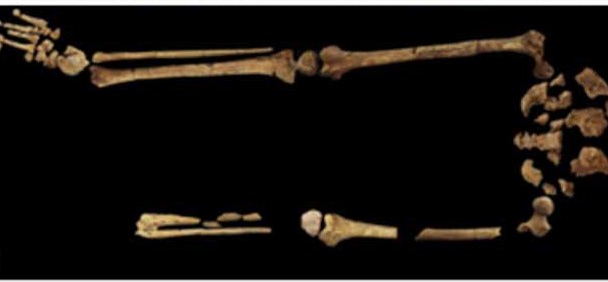
Located toward the back of the front section of Sunday’s newspaper was a story about an archeological excavation that was changing the way we interpret history.  A team of Indonesian and Australian researchers were working in the Liang Tebo cave in eastern Kalimantan province in Borneo when they found the bones of a young individual buried in a shallow grave.  Scientists used radiocarbon dating to estimate the date of burial at 31,000 years ago.  The most striking aspect of the discovery was that the young person was missing their lower left leg.  Signs indicated it had been carefully amputated as a pre-teen or early teen before their death from unknown causes between 19 and 21.  The otherwise remarkably intact skeleton was found in 2020 by the archaeologists, who say the amputated limb indicates considerable surgical skill.  This is the earliest example of such surgery in the archeological record and shakes our understanding of the sophistication of Stone Age humans. 

When I looked online, I found the archaeologists who uncovered the burial indicated the surgeon or surgeons who performed the operation (with stone knives and scalpels) must have had a detailed knowledge of anatomy and muscular and vascular systems to negotiate the veins, vessels, and nerves, and to prevent fatal blood loss and infection.  Experts had thought humans lacked the expertise to perform procedures like amputation until the emergence of agriculture and permanent settlements transformed human society within the last 10,000 years (Neolithic).  Prior to this discovery, the oldest known amputee was an elderly farmer whose left forearm had been removed just above the elbow 7,000 years ago in what is now France.  It was only 100 years ago that surgical amputation became a norm in Western medicine, and before the development of antibiotics most people would have died at the time of amputation from blood loss, shock, or subsequent infection.  There was no trace of infection and new bone growth had formed over the amputated area.

While the rest of the skeleton was adult sized, the amputated bones stopped growing and retained their child size.  The child had survived six to nine years after the surgery.  After the amputation, intensive nursing and care would have been vital, and the wound would have had to have been regularly cleaned and disinfected.  To live for years with an amputated leg in mountainous terrain, the individual would have needed a lot of ongoing help and care from the community.  The burial was also the oldest known deliberate burial in the islands of Southeast Asia, with limestone markers placed on top of the burial, the body placed in a flexed, fetal position, and a large ball of mineral pigment used in Stone Age cave art (ocher) as a grave good.  Liang Tebo cave also has human hand stencils on the walls. 

THOUGHTS:  The world’s oldest rock art figures (not just handprints) have been found in caves elsewhere in Indonesia.  This is the area that humans departed by boat to cross Island South Asia to reach the mainland of Papua and Australia, making the first successful major maritime voyage.  The amputated limb was only one of the advanced discoveries made by the peoples of Borneo.  They were advanced artists, had advanced medical knowledge, and navigated the ocean, all at a time when humans in Europe were struggling to survive the ice age.  It was not until 30,000 years later that Europeans “discovered” their descendants and provided civilization.  Act for all. Change is coming and it starts with you.
Hibiscus

September 14, 2022

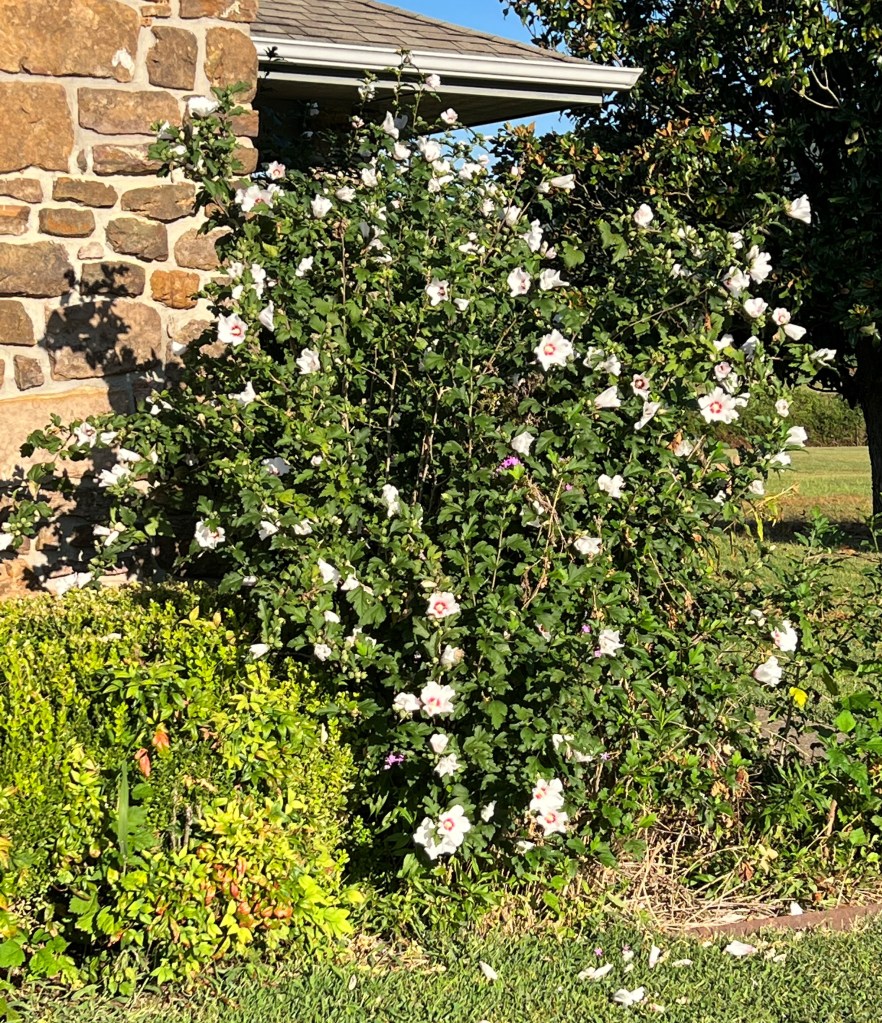
Located on the northern corner of the building where I work are two large plants that are now in full flower.  I began noticing them last week and have been amazed that the flowers have continued in full bloom and in such large numbers.  Since they were placed on the corner, the flowers provide a stark contrast to the plant’s own dark green leaves, the light olive hedge below, and with the dark stonework and white mortar of the building providing a backdrop.  When I pointed the bushes out to Melissa, she told me this was a hibiscus, and probably the Rose of Sharon variety.

When I looked online, I found the Rose of Sharon (Hibiscus syriacus) is a species of flowering plant in the mallow family (Malvaceae).  While it is native to Korea, and south-central and southeast China, it is widely introduced elsewhere, including much of Asia.  The name syriacus is given as it was originally collected by Western botanists from gardens in Syria.  Common names include the Rose of Sharon, (especially North America) and rose mallow (United Kingdom).  The name Rose of Sharon for Hibiscus syriacus is derived from the Bible (Song of Solomon 2:1) as these are among the beautiful flowers brought by the groom for his bride, but scholars are unsure which plant the name identifies as other species are called Rose of Sharon.  Hibiscus syriacus is a hardy deciduous shrub reaching 7 to 13 feet (2 to 4 m) in height, bearing large trumpet-shaped flowers with prominent, yellow-tipped white stamens.  The flowers are often pink in color but can range from almost purple to white.  The individual flowers last only a day but the numerous buds produced provide prolific flowers from July through September, usually blooming at night.  As the plant matures the flexible stems are weighted by the abundant flowers and can bend halfway to the ground.

Hibiscus syriacus was indigenous to China and was brought to Japan in the 8th century, then introduced to the Korean Peninsula around the 15th or 16th century. The species was introduced for horticulture as its leaves were brewed for an herbal tea and its flowers eaten.  It was first grown in European gardens as early as the 16th century.  Initially the species was thought to be tender, and care was taken to shelter it during the winter, but by the end of the 17th century it was labeled hardy.  By the 18th century the shrub was common in English gardens and the North American colonies.  Hibiscus syriacus is also known as the Korean rose and is the national flower of South Korea.  The flower’s name in Korean is mugunghwa and its symbolic significance stems from the Korean word mugung, meaning “eternity” or “inexhaustible abundance”.  Korea is poetically compared to the flower in the South Korean national anthem, it appears in national emblems, and is generally considered by South Koreans to be a traditional symbol of the Korean people and culture.

THOUGHTS:  Hibiscus syriacus is highly tolerant of air pollution, heat, humidity, poor soil, and drought which has allowed the shrub to become naturalized in suburban areas of the US.  Some call it slightly invasive as it readily self-seeds and you will need to remove the seedlings if you do not want additional hibiscus in your landscape.  Like many immigrants (my German ancestors included), the hibiscus has flourished on arrival to America.  Harsh conditions (smog and drought vs. poverty and intolerance) were overcome, and they spread throughout the land.  Immigrants are not an invasion but a strengthening of our national spirit.  Act for all. Change is coming and it starts with you.
Vampire

September 13, 2022

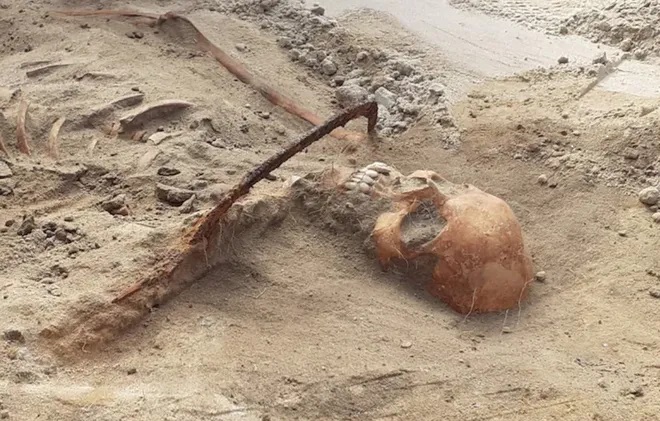
The top story of the inside News page of today’s local paper described a “vampire” unearthed in Poland.  Vampires were feared and loathed throughout Central and Eastern Europe during the Middle Ages and apparently by the residents of a small Polish village of Pień.  The burial was found by archaeologists from Nicholas Copernicus University in Torun, Poland, during recent excavations near Pień as they unearthed the skeletal remains of a 17th century woman who was evidently thought to be a vampire.  The woman’s burial was consistent with ancient vampire lore as well as other medieval vampire burials in Polish territory.  The female had a padlock attached to the big toe of her left foot and a sickle placed across her throat to prevent her from returning from the dead.  One of the burial’s physical features was protruding front teeth that stuck out enough to have been quite noticeable.  This may have been interpreted as evidence of her vampire tendencies.

When I looked online, I found a vampire is a creature from folklore that subsists by feeding on the vital essence (generally blood) of the living.  Vampire tales are normally linked with Transylvania, the Romanian home of the mythical Count Dracula and actual home of the 15th century prince Vlad Dracul or Vlad the Impaler, the inspiration for the Dracula legend.  In European folklore, vampires are undead that visited loved ones and caused mischief or deaths in the neighborhoods they used to inhabit.  They wore shrouds and were often described as bloated and of ruddy or dark appearance.  This is markedly different from today’s image of a gaunt, pale vampire which dates from the early 19th century.  Stories of vampires have been recorded in cultures around the world, but the term vampire was spread in Western Europe after reports of an 18th century mass hysteria around a pre-existing folk belief in the Balkans and Eastern Europe that in some cases resulted in corpses being staked and people being accused as a vampire.  Local variants were known by different names, such as shtriga in Albania, vrykolakas in Greece and strigoi in Romania.

While the vampire burial was unusual it is far from unprecedented as hundreds of vampire burials have been discovered throughout Eastern Europe.  In 2015, archaeologists digging in the Polish village of Drawsko found five skeletons that had been pinned to the ground in a similar or identical manner.  Four of the skeletons, two women in their thirties, a man in his thirties or forties, and an adolescent girl, were buried with sickles tightly anchored across their throats.  An older woman of at least 50 was pinned by a sickle placed across her hips.  She also had a stone lain over her throat and a coin inside her mouth.  Each action was presumably deemed necessary to prevent the burial from returning as a vampire.  As for the latest vampire burial discovered on Polish soil, her remains will be taken to Nicholas Copernicus University in Torun, where archaeologists and technicians will subject them to a more thorough examination.

𝗧𝗛𝗢𝗨𝗚𝗛𝗧𝗦:  Bram Stoker’s 1897 novel Dracula is remembered as the quintessential vampire novel and provides the basis of the modern vampire legend.  The success of this book spawned a vampire genre that is still popular in the horror genre.  Researchers tell us the horror genre is popular for the elements of adrenaline and morality, and for linking us to the dark unknown within our psyche.  Humans are composites of both light and darkness, and psychoanalysts tell us it is healthy to explore the darker parts of our minds, like the fear of death.  While exploration may be healthy, the actual fear of death brought by the pandemic has adversely affected many with depression and suicide.  The research is clear that isolation and loneliness is bad for our physical and mental health.  We are social animals who struggle in isolation.  Act for all. Change is coming and it starts with you.