Roseate

June 28, 2022

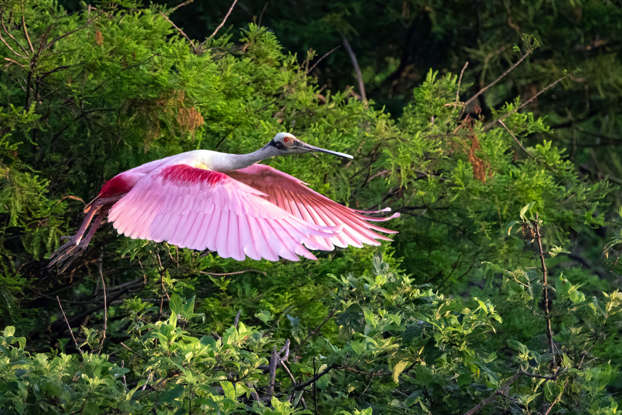
Last week the front page of my local newspaper carried a USA Today article concerning how the warmer climate was affecting the Roseate spoonbill population.  It began with a sighing of a flock of birds in the southwestern corner of Arkansas.  Photographer Jami Linder had photographed the big, pink birds living in a remote swamp on land near the Mississippi River.  The birds were known to live along the marshy coast lines, but the coast was over 200 miles to the south.  Spoonbill expert Jerry Lorenz, state director of research for Audubon Florida, attributes this remarkable expansion of the birds’ range to three things: they are recovering after being nearly wiped out more than a century ago; they are being pushed out of their shallow coastal water habitats by rising sea levels; and they are finding warmer temperatures to the north.  One of the photos taken by Linder proved to be groundbreaking as it was the first evidence of a roseate nest in Arkansas.  She continued to take phots and not only captured the roseate chicks, but also documented the first Arkansas nest of a white-faced ibis, another wading bird on the move.

When I looked online, I found the roseate spoonbill (Platalea ajaja) is a social wading bird of the ibis and spoonbill family, Threskiornithidae, who breeds in both South and North America.  The roseate spoonbill is 28–34 inches (71–86 cm) long, with a 47–52 inch (120–133 cm) wingspan, and a body mass of 2.6–4.0 pounds (1.2–1.8 kg).  The legs, bill, neck and spatulate bill all appear elongated.  Adults have a bare greenish head and a white neck, back, and breast and are otherwise a deep pink.  The adults’ heads turn “golden buff” and a tuft of pink feathers occur in the center of the breast when breeding.  Their pink color is diet-derived and is caused by two carotenoid pigments (canthaxanthin and astaxanthin).  The colors can range from pale pink to bright magenta, depending on age, whether breeding or not, and location.  Unlike herons, spoonbills fly with their necks outstretched.  The species feeds in shallow fresh or coastal waters by swinging its bill from side to side as it steadily walks through the water, feeding on the aquatic insects, crustaceans, frogs, newts, and very small fish.

The roseate spoonbill is yet another example that climate change is now and is not just coming.  While the roseate spoonbill’s habitat is vulnerable to even a moderate amount of sea level rise, the species has the advantage of mobility to move away from habitat destroyed by changing climate.  A large amount of the mangrove habitat predicted to be inundated by rising sea levels is expected to expand to new areas within the state, potentially creating areas of new habitat for the birds, but human land use patterns may conflict with natural mangrove expansion.  Between 25-50% of the roseate spoonbill’s range is expected to be impacted by a 15-32 inch (0.41 – 0.82 m) sea level rise, causing substantial loss to current sites.  New habitat may be created as marshes and large islands are fragmented.  Saltwater intrusion, management practices that affect the hydrologic regime, and tropical storm activity could change salinity levels in foraging sites and the roseate could suffer a decrease in nesting success due to less efficient foraging.  The species is highly mobile and can possibly move from the threats, but whether the new sites will serve in the long-term is yet to be seen.

THOUGHTS:  The roseate spoonbill was nearly hunted to extinction a 100 years ago to provide the colorful feathers for women’s hats, but the species has made a comeback.  Thirty years ago, 90% of Florida’s roseate nested in Florida Bay, but today it is less than 10% and continues to fall.  Pollution and rising sea levels forced the roseate to move but higher temperatures have allowed them to move north.  Lorenz said, “We’ve destroyed our coastal habitats and these birds have to go someplace else, but it also shows that these birds are resilient—Unlike us humans.  It’s good because spoonbills can adapt, but it’s not so good for us who live on the coast.”  Since the diet will change, will the distinctive plumage tied to diet also change?  Will it still be called roseate?  Act for all.  Change is coming and it starts with you.

Speed

June 25, 2022

Yesterday I noticed a traffic stop on the state road that goes past my work.  While we are located on the edge of town, the stopped vehicles were all moving toward the city limits, and not entering a reduced speed limit in town.  What surprised me was the police department only has one full-time and one part-time officer, and this was happening on a Sunday.  In the 2 ½ years I have worked in this town I have only seen a city police car four times, and twice was when I stopped by city hall.  Several people gathered with me, and we watched as one vehicle after another was pulled over.  While the officer may have been issuing tickets, he did not seem to spend much time with any of the people stopped and may have just been issuing warnings.  Regardless, it appeared we were watching some sort of speed trap.

When I looked online, I found speed traps are a section of a road where police, radar, or speed cameras check vehicles’ speeds and then strictly enforce traffic regulations for appropriate speed limits or average speed.  These traps are often distinguished by hard-to-see speed limit signs and concealed traffic signs.  When most people talk of speed traps, they think of small-town police hiding behind billboards, or officers waiting to pick up drivers where the speed limit varies.  A speed trap is established to focus on collecting money rather than maximizing safety.  Most traps are made possible by speed limits below the current traffic flow.  The speed trap is then set at a point where the speed limit changes quickly, like at the edge of town where it drops from 55 mph down to 45 mph.  The trap can be watched by officers or mechanized traffic enforcement like speed cameras or red-light cameras.  An actual speed trap is when something genuinely illicit is going on.  Speed traps in the US cover about 4,000,000 miles of roadways, and there are an estimated 55,000 speed traps across the country.

The state of Arkansas has a very strict law prohibiting cities from running speed traps but there are still instances of the practice being used.  Act 364 was amended in 2019 to dissuade police departments from using their power to write citations for revenue over public safety.  A simple mathematic equation is used to see if a city is using citations for revenue and the Arkansas Speed Trap Law can be violated in two ways.  Either a police department’s fines exceed 30% of the city’s total revenue, or more than 50% of the speeding tickets are written for drivers going less than 10 miles per hour than the posted limit.  There have been two Arkansas cities investigated for operating speed traps since 2019.  If the State Police investigation reveals a violation of the Arkansas Speed Trap Law, the department faces sanctions.  Either the police department will no longer be able to write tickets, or the revenue from speeders goes straight to the schools.  Both departments were found guilty of the traps.  My town was not one of them.

THOUGHTS:  When I lived in Kansas, I traveled the interstate between my house and where my mom lived.  I would periodically see a sign posted along the highway warning “Drug Check Point Ahead”, but there was never one there.  I asked the Chief in my town if the check was real and was told it was illegal to set up a drug checkpoint on the highway, although DUI checkpoints were legal on less traveled roads and streets.  The signs were used to get illicit drivers to pull off the highway to avoid the check, and those vehicles were stopped for other traffic violations.  The debate regarding driver safety and speed limits is a polarizing issue, with those who believe in them and those who do not.  Police traffic stops are at best confrontational and can potentially be deadly for the driver and officer.  There are other ways to manage traffic control without putting either at risk.  Act for all.  Change is coming and it starts with you.
Swallowtail

June 25, 2022

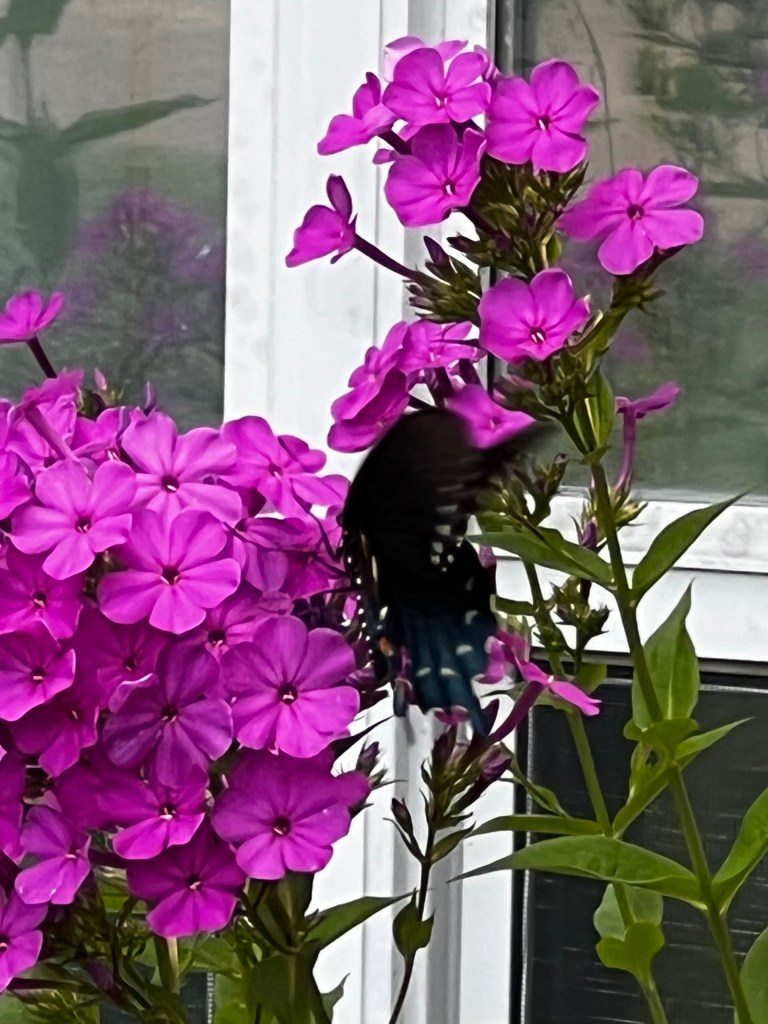
Yesterday I decided it was time to clean the front flower beds again.  I had hoped that by putting twice as much mulch on them than usual I would not have to do this, but I guess I still do not put enough on as the grass and weeds were again poking through.  Zena was getting antsy so I decided to stake her in the front yard on her long leash so she could play in a new area.  She has taken to lying in the shade under the snowball bush (Hydrangea arborescens) at the end of our morning walks, so I made sure she had access to the shade, her water, and where I was working.  It did not take Zena too long to get her leash wrapped around the bush.  I got up to help but she figured out how to unwrap herself before I got there.  I took this as an excuse to take a break and sat in the chair I had moved into the shade at the edge of the front entry.  As I sat down, I noticed a swallowtail butterfly working on the Garden Phlox (Phlox paniculata) flowers.

When I looked online, I found the (eastern) black swallowtail (Papilio polyxenes), also called the American swallowtail or parsnip swallowtail, is a butterfly found throughout much of North America and is the state butterfly of Oklahoma and New Jersey.  The species is named after Polyxena, a figure in Greek mythology who was the youngest daughter of King Priam of Troy.  The body of the butterfly is black with rows of small white dots running down its length.  The dorsal (back) view displays black forewings edged in two rows of white dots with two larger spots close to the edge.  The smaller, black hindwings also have two rows of white dots, but an iridescent blue is sandwiched between them, and each hindwing has a bright orange and black eyespot at the bottom near the body.  Long extensions form a ‘tail’ on each wing.  The black swallowtail ranges from southern Canada to South America but are more common east of the Rockies.  They are usually found in open areas like fields, parks, marshes, or deserts, and prefer tropical or temperate habitats.  Black Swallowtails can be found in gardens, meadows, forests, and other habitats.  Adults drink flower nectar and are attracted to fennel plants (like phlox) and flowering herbs like dill.  A similar-appearing species (Papilio joanae) occurs in the Ozark Mountains region.

I was excited when I first identified the butterfly on our phlox because I thought it was an Ozark swallowtail.  The Ozark was once considered an alternative expression of the black swallowtail and the two are almost identical.  This butterfly is indigenous to the Ozark Mountains in the US but is considered uncommon to rare in the region.  The Ozark may be seen from April to September and is usually found in cedar glades and woodland habitats.  The caterpillar is also morphologically like the black swallowtail caterpillar.  The two species are more easily distinguished by the different habitat and host plants on which the caterpillar feeds.  Despite the similarity, analysis of the Ozark’s DNA suggests it is more closely related to the Old World swallowtail (Papilio machaon) than the black.  One site suggested the only sure way to tell the difference was from a DNA test in the lab.  That did not happen.  Given the rarity of the Ozark and the fact I was not in a secluded forest glade, I am sticking with the black swallowtail.

THOUGHTS:  The Black Swallowtail looks almost identical to the pungent-tasting Pipevine Swallowtail and uses this mimicry as a defense against predators.  Mimicry is an adaptation in which one animal evolves to look like another.  Animals use mimicry to avoid predators, but some predators use mimicry to obtain food, and some parasites use mimicry to help them escape detection.  Mimicry is a very effective adaptation, and it is crucial to the survival of many species.  Humans have adapted mimicry in our clothing styles, speech, and actions to allow us to blend in with groups.  Long hair and cowboy hats used to be markers of opposite ideologies, but now that is not always the case.  It is time to move beyond first impression dismissal and get to know each other.  Act for all.  Change is coming and it starts with you.
Copi

June 24, 2022

I came across a news release this week that said the state of Illinois had poartnered with others to kick off a campaign on Wednesday to rechristen four species of fish known collectively as Asian carp as “copi”.  The hope is this new label will make the fish more attractive to US consumers.  Turning carp into a popular household and restaurant menu item is one way officials hope to rein in a decades-old invasion threatening native fish, mussels and aquatic plants in the Mississippi Basin, as well as the Great Lakes.  The Great Lakes Restoration Initiative is funding the five-year, $600,000 project to rebrand the carp and make them widely available.  More than two dozen distributors, processors, restaurants, and retailers have signed on.  Most of the distributors are in Illinois, but some deliver to multiple states or nationwide.

When I looked online, I found several species of heavy-bodied cyprinid (carp) fishes are collectively known in the US as Asian carp.  Ten species of Asian carp have been significantly introduced outside their native range, and nine of those have been cultivated in Chinese aquaculture for over 1,000 years.  The Grass carp (Ctenopharyngodon idella), silver carp (Hypophthalmichthys molitrix), bighead carp (Hypophthalmichthys nobilis), and black carp (Mylopharyngodon piceus) are known as the “Four Domesticated Fish” in China and are the important freshwater food fish there.  Bighead and silver carp are the most important food fish worldwide in terms of total aquaculture production.  The Common carp (Cyprinus carpio), amur carp (Cyprinus rubrofuscus), and crucian carp (Carassius carassius) are also common food fishes in China and elsewhere.  Goldfish (Carassius auratus) are mainly cultivated as pet fish.  The Common carp are native to both Eastern Europe and Western Asia and are sometimes called a “Eurasian” carp.  Although they are an important food fish throughout Asia, they are rarely eaten and considered invasive species in the US.  Illinois is hoping being called copi will help.

These carp species were imported in the 1960’s-70’s to gobble algae from Southern sewage lagoons and fish farms.  They escaped and have infested most of the Mississippi River and many of its tributaries.  The fish are crowding out native species like bass and crappie and regulators have spent more than $600 million to keep them from the Great Lakes.  Officials estimate up to 50 million pounds (22.7 million kilograms) could be netted annually in the Illinois River, and even more are available between the Midwest and the Gulf Coast.  In the US carp are primarily known as muddy-tasting bottom feeders, but the targeted species live higher in the water column, feeding on algae, wetland plants, and small mollusks.  They are high in omega-3 fatty acids and low in mercury and other contaminants.  The fish is adaptable to a variety of cuisines including Cajun, Asian, and Latin, but this could be a hard sell.  The fish is notorious for its y-shaped bones that are harder to remove than fish with pin-shaped bones, and the boniness makes it harder to produce the fillets diners expect.  Many of the best recipe’s use chopped or ground “copi”.

THOUGHTS:  A Chicago communications design company called Span came up with “copi” as a wordplay on “copious”, referring to booming populations of these carp in the US.  Researchers considered several names but thought copi sounded catchy.  The next step is to get approval from the federal Food and Drug Administration, which says “coined or fanciful” fish labels can be used if they’re not misleading or confusing.  Similar examples are the “slimehead” ( Hoplostethus atlanticus) which it now marketed as orange roughy, and the Patagonian Tooth Fish (Dissostichus eleginoides) which is renamed the Chilean sea bass.  It seems that while a rose by any other name may still smell as sweet, Americans will not eat carp unless it is renamed, if even then.  Act for all.  Change is coming and it starts with you.
Invasive

June 23, 2022

Today’s NY Times morning feed referenced how invasive species were taking over the forests of Ohio. 

A new botanical survey of southwest Ohio found invasive species introduced to the US over the past century are crowding out many native plants.  Biologists from the University of Cincinnati are retracing two exhaustive surveys conducted 100 years apart to see how the areas plant diversity has changed over the past two centuries.  They focused their attention on undeveloped parts of cemeteries, banks of the Mill Creek, and public parks that have remained protected from development over the last 200 years.  The study was published in June in the open-access journal Ecological Restoration.  Horticulturists introduced most of the nonnative plants from Europe and Asia as ornamentals and their seeds spread in the wild.  The biggest culprit appears to be the Amur honeysuckle.

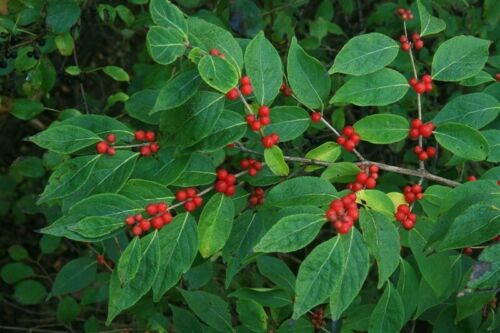
When I looked online, I found the Amur honeysuckle (Lonicera maackii) is a species of honeysuckle in the family Caprifoliaceae that is native to temperate western Asia.  The species name “maackii” is derived from Richard Maack, a Russian naturalist of the 19th century.  While the Amur is an endangered species in Japan, it escaped from cultivation and naturalized in New Zealand and the eastern US.  The plant is a large, deciduous shrub that grows to a maximum of 20 feet (6 m) tall with stems up to 4 inches (10 cm) in diameter.  The leaves are oppositely arranged and 2 to 3+1⁄2 inches (5–9 cm) long and 3⁄4 to 1 5⁄8 inches (2–4 cm) broad.  The flowers are produced in pairs, and commonly several pairs are produced together in clusters.  They bloom from middle of spring to early summer, beginning as a white color and later turning yellow or pale orange.  The fruit is a bright red to black, semi-translucent berry that contains numerous small seeds.  They ripen in the autumn and are eaten by birds, which disperse the seeds in their droppings.

The original survey on the area’s plant diversity was conducted by University of Cincinnati botanist Thomas G. Lea between 1834 and 1844.  Lea identified 714 species before he died in 1844and his work was published posthumously.  A century later the famed UC botanist E. Lucy Braun retraced Lea’s path and conducted a second plant survey in Cincinnati during 1934, finding more than 1,400 species.  Braun followed Lea’s meticulous notes to return to the places he visited, but many of the sites had been turned into roads, homes, or apartments.  The current study by UC biologist Denis Conover and Robert Bergstein retraced the steps of Braun and Lea in places where development did not pave the natural areas.  They found that many species purposely introduced as landscaping were flourishing in the wild.  Conover was quoted, “Native plants just don’t have a chance.  Everything that depends on the native plants — insects, birds — can be lost.”  Park managers and volunteers’ efforts to control invasive species has become a major part of their duties.  The study concluded the effort to control invasive species will be required in perpetuity and at great expense of both time and money.   

THOUGHTS:  Because of the invasive proficiency of the Amur honeysuckle growing the plant is illegal or controlled in parts of the US.  The species is named “invasive, banned” in Connecticut, “prohibited” in Massachusetts, as an invasive species in Tennessee, as an invasive species in Ohio, as a “Class B noxious weed” in Vermont, and as an invasive species in Wisconsin.  It has been suggested that plants growing outside their native range (eastern Asia) should be removed and replaced by non-invasive alternatives.  Talk about being unloved!  In the same vein, scientists are now concerned the first life we find on mars will come from the space junk we dump as spacecraft land on Mars after NASA’s small robotic helicopter Ingenuity captured images of mysterious wreckage last month.  You would think/hope we would learn.  Act for all.  Change is coming and it starts with you.
𝗘𝗰𝗵𝗲𝘃𝗲𝗿𝗶𝗮

June 22, 2022

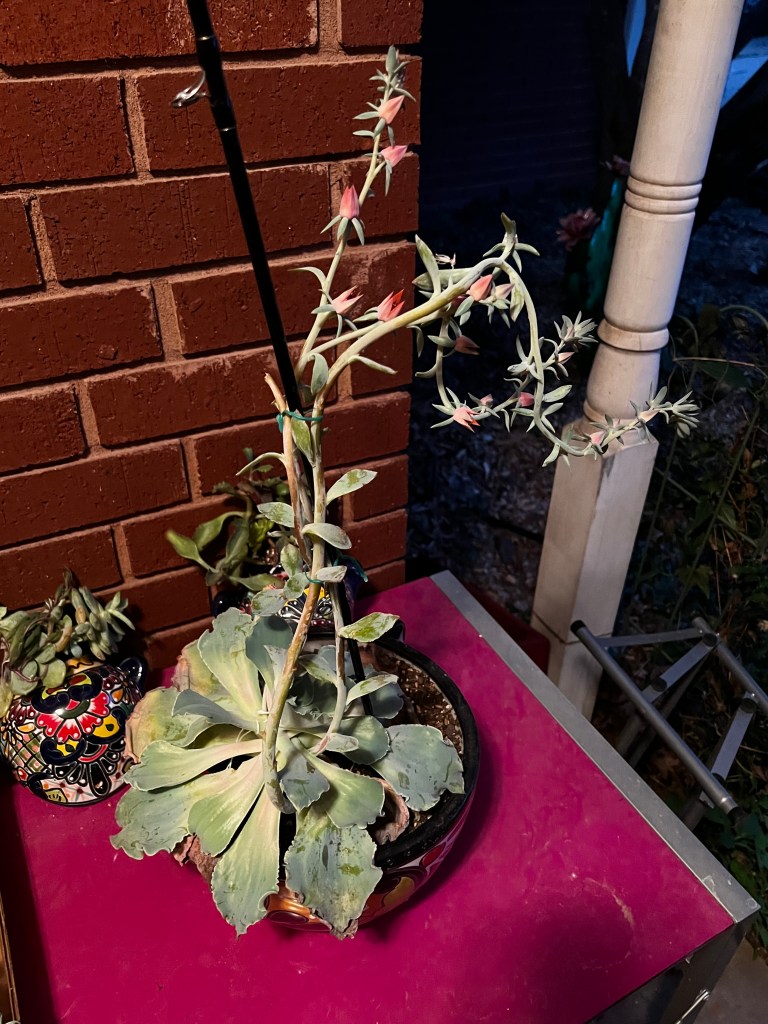
One of the succulents we took to the last Farmer’s market was an echeveria plant Melissa had been tending for the last two years.  The plant had slowly grown to expand into the brightly colored 8-inch (20 cm) pot Melissa had purchased from Mexico.  As the plant matured it sent out two 24-inch (60 cm) stems.  Since we were worried about the stems getting knocked over in transit, I propped them up with a section of fly rod I had closed in the car door and broken the tip off last year.  While I was disappointed the echeveria did not sale, perhaps it was for the best.  When I took Zena for a walk last night, I noticed the stems were now covered with bright orange flowers.

When I looked online, I found Echeveria “Curly Locks” is a succulent belonging to the Crassulaceae botanical family.  The plant is a rare hybrid and has a nursery origin, being artificially generated by Harry Butterfield starting from two specimens of Echeveria ‘Ruffles’ and Echeveria ‘Ripples’.  The curly locks are stemless and spineless and have a rosette of leaves which can grow up to 10 inches (25 cm) in diameter.  Leaves are fleshy, flat, elongated obovate, wavy at the apex, blue green in color, and when exposed to bright sunlight the ruffled edges turn pinkish red.  At maturity the rosette grows a tall bare stem to support the flowers.  Blooming occurs in late spring and early summer and blossoms are borne by the long stalks.  The flowers are bell-shaped, thin, bright yellow inside and pale pink outside.  All echeveria need bright sunlight to maintain their colors and compact rosette form.  They will not survive a hard frost, and if they are grown in areas where temperatures drop below 50F (10C) it will need to be placed indoors on a sunny windowsill or under a grow light.  That would be Arkansas.

The name Echeveria comes from Atanasio Echeverria y Godoy, a naturalist, botanist, and Mexican artist of the late 1700’s who painted and assisted on the discovery and cataloging of Mexico’s natural flora.  The genus Echeveria was named in his honor by Augustin Pyramus de Candolle.  Echeverría joined Martin de Sessé y Lacasta and Mariano Mociño Suárez de Figueroa in Mexico City in 1787 on their Royal Botanical Expedition to New Spain.  The goal of the venture was to compile an inventory of the flora and fauna of New Spain.  In 1791, Echeverria continued onto the California portion of the expedition, where he made images of 200 different plant species.  In 1794, Echeverría traveled to the Caribbean with Sessé and botanist Jaime Senseve.  The group landed in Havana, Cuba, and later traveled to Puerto Rico, but the political instability caused by the Napoleonic Wars meant the project was not completed and Echeverría left the expedition in 1797.  Echeverría joined the Guantanamo Commission under Conte de Mopox y Jaruco and traveled across Cuba collecting 3,700 specimens and describing 27 new species.  Later, Echeverría briefly traveled to Madrid before returning to Mexico to become art director at the Academy of San Carlos.  His descriptions and images of the echeveria were invaluable.

THOUGHTS:  Echeveria is also known as “Mexican Hens & Chicks” and can produce new offsets or “chicks” around the base of the mother plant.  These chicks can be left to form a tidy cluster or removed and transplanted.  While Echeveria are one of the easiest succulents to propagate, curly locks is a hybrid and propagation can only be done by cutting.  Cutting is best done in spring as the plant begins to come out of winter dormancy.  One of the pleasures we have had this year is seeing the different succulents bloom after the hardships they went through last year.  While I was disappointed the curly locks did not sell, I was rewarded by the blooms that would have occurred at someone else’s house if it had.  The pandemic has produced major hardships and disappointment for a vast number of people.  It also forced many to step back and re-evaluate their priorities.  Even disappointment can lead to other joys.  It is about attitude and being willing to look.  Act for all.  Change is coming and it starts with you.
Midsummer

June 21, 2022

Today at 09:13 Universal Time (5:13 am EDT) the Sun was directly above the Tropic of Cancer in the northern hemisphere, marking the summer solstice.  I have written several times about the winter solstice, but never about the opposite event that occurs in the summer.  Since prehistory, the summer solstice has been seen as a significant time of year in many cultures marked by festivals and rituals.  Traditionally, in many temperate regions (especially Europe), the summer solstice is seen as the middle of summer and referred to as “midsummer”.  In some countries and calendars today, it is seen as the beginning of summer.  While midsummer celebrations exist around the world, in the US they are largely derived from the cultures of European immigrants who arrived since the 19th century.

When I looked online, I found the summer solstice, also known as estival solstice or midsummer, occurs when one of Earth’s poles has its maximum tilt toward the Sun.  This event happens twice a year, once in each hemisphere (Northern and Southern).  At summer solstice the Sun reaches its highest position in the sky and is the day with the longest period of daylight.  In the Arctic circle (northern hemisphere) or Antarctic circle (southern hemisphere), there is continuous daylight around the summer solstice.  The date shifts of the calendar but occurs sometime between June 20 and June 22 in the Northern Hemisphere and between December 20 and December 23 in the Southern Hemisphere.  The same dates in the opposite hemisphere are referred to as the winter solstice.  Celebration of midsummer in the Arctic now centers around the 24-hour presence of the Sun.  In Sweden, the Midsummer is such an important festivity that there have been proposals to make the Midsummer’s Eve the National Day of Sweden, instead of June 6.  In Fairbanks, Alaska, the Midnight Sun Game is an annual tradition where a regulation game of baseball is played at 10:30 pm local time and through the midnight hour with no artificial lighting.

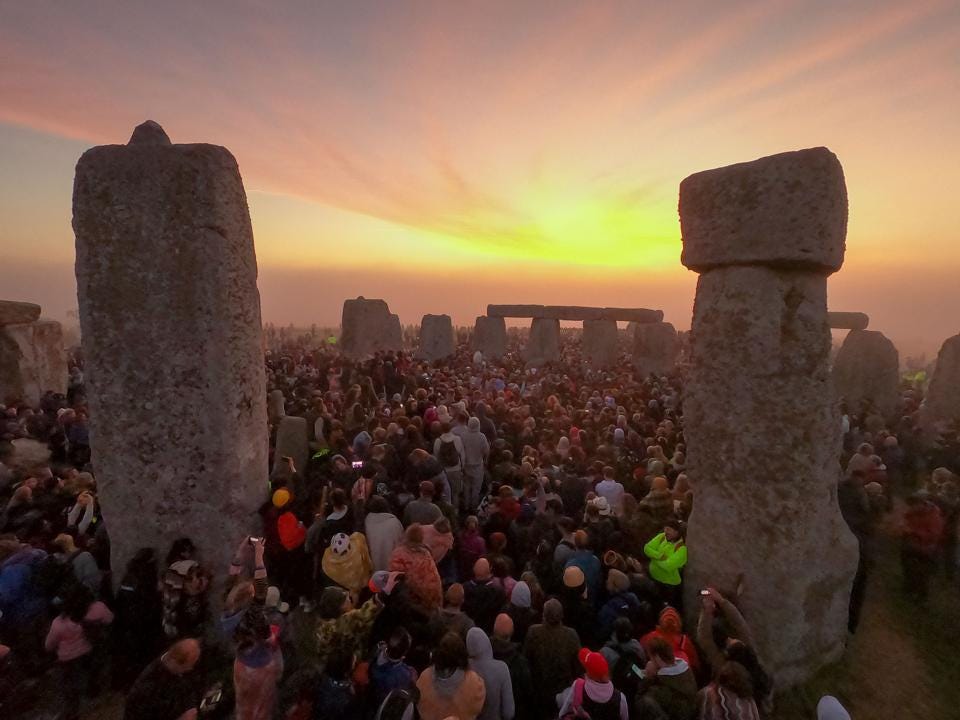
As the longest day of the year and the first day of meteorological summer in the northern hemisphere, midsummer is most famously marker by early-risers at Stonehenge on Salisbury Plain, Wiltshire, UK.  Stonehenge was produced by a culture that left no written records and many aspects of Stonehenge (how built and why) remain subject to debate.  The great trilithon at the site the encompasses the horseshoe arrangement of the five central trilithons, the heel stone, and the embanked avenue.  These are aligned to the sunset of the winter solstice and the opposing sunrise of the summer solstice.  Proposed functions for the site include usage as an astronomical observatory or as a religious site.  Recent theories speculate this was a place of healing, although they concede the site was probably multifunctional and used for ancestor worship.  Whatever religious, mystical, or spiritual elements were central to Stonehenge, the design includes a celestial observatory which might have allowed prediction of eclipse, solstice, equinox, and other celestial events important to a contemporary religion.

THOUGHTS:  Midsummer is marked most famously by early-risers at Stonehenge where the event is known as Midsummer’s Eve.  The 5,000-year-old Neolithic monument is famed for its alignment with the midsummer sunrise and this year saw about 6,000 people at the monument to witness the sunrise for the first since the pandemic began.  The revelers got a bonus in the form of a rare planetary alignment.  In the east before the sunrise a First Quarter Moon shone close to Jupiter while all five naked-eye planets in the solar system were visible.  If this is the reaction in our day of science and telescopes, I can only imagine the wonder experienced by the Neolithic gatherers.  Perhaps a quote from Michel Legrand, a French composer and musician, says it best, “The more I live, the more I learn.  The more I learn, the more I realize, the less I know.”  C’est la vie!  Act for all.  Change is coming and it starts with you.

RAWR

June 20, 2022

Black rhino (Diceros bicornis) sitting in the grass. Africa

One of the opinions on the NY Times Morning feed spoke of a bipartisan bill that passed the Senate to protect endangered species.  US Senators Susan Collins (R-ME) and Jeff Merkley (D-OR) announced the Rescuing Animals With Rewards (RAWR) Act passed the Senate unanimously.  This bipartisan bill would help protect endangered animals by combatting wildlife trafficking and poaching.  Specifically, RAWR would authorize the State Department to offer financial rewards for information that leads to the disruption of wildlife trafficking networks.  Senator Collins called wildlife trafficking a “transnational crime that requires a coordinated and sustained global effort.”  The RAWR allows the State Department to offer rewards for information about wildlife traffickers.  Senator Merkley added, “When wildlife traffickers, poachers, and profiteers kill magnificent animals like elephants, giraffes, and rhinos, they risk causing irreparable destruction to critical ecosystems and rob the world of a piece of our humanity and shared history on this planet.”   

When I looked online, I found wildlife trafficking is the second-greatest threat to the survival of species around the globe.  The billion-dollar wildlife trade leads to the overexploitation of species to the point of extinctions, while providing an avenue for criminal enterprises and terrorist organizations to profit from an elusive market.  RAWR would enable the State Department to tackle the threat to both animal species and security around the world.  The act is supported by a wide range of environmental and animal welfare groups, including the International Fund for Animal Welfare, National Whistleblower Center, Humane Society Legislative Fund, Humane Society International, NRDC, African Wildlife Foundation, the Environmental Investigation Agency, Wildlife Conservation Society, the Association of Zoos and Aquariums, World Wildlife Fund, the Animal Welfare Institute, and the Oregon Zoo.  The act was bipartisan, multi-national, and found support of zoos and wildlife federations.  This was a rare win/win.

The bill had already passed the US House of Representatives when they voted 231 to 190 to pass the bipartisan bill to conserve wildlife on Tuesday.  RAWR will send $1.3 billion each year to states, territories, and tribal wildlife management agencies.  Fifteen percent of that money would be earmarked for protecting 1,673 species already listed as threatened or endangered, while the rest could be spent on protecting thousands of other species the states say are in jeopardy.  The legislation comes at a time of increasing concern over the decline of global biodiversity.  According to a landmark report released by the United Nations in 2019, climate change, pollution, human encroachment, and other factors threaten an “unprecedented” 1 million species with extinction.  Scientists warn that losing so many species could cause irreparable damage to ecosystems, climate stability, food security, and human health.  In the US, Fish and Wildlife Service data say saving all federally listed threatened and endangered species would cost $1.6 to $2.3 billion every year, or more than funds allocated by the Endangered Species Act.

THOUGHTS:  While RAWR is an important step in protecting endangered wildlife, congress is close to passing another bipartisan bill meant to protect human life.  According to Senator Pat Toomey (R-Pa), the compromise gun control bill crafted by 10 Republicans and several Democrats is “more likely than not” to pass the Senate.  The plan would fund school safety and trauma programs, make for more rigorous background checks for buyers under 21, and add convicted domestic abusers and people under restraining orders to the National Instant Criminal Background Check System.  This will help states create or enforce “red-flag” laws to authorize removing guns from those who pose a risk to others or themselves.  The bill is something Congress has not done since the 1990’s.  Laws to protect people should be as important as laws to protect wildlife.  Act for all.  Change is coming and it starts with you.

Father’s

June 18, 2022

I mentioned earlier that tomorrow is Father’s Day.  Melissa and I beat the crowd and went out on Thursday to celebrate the occasion.  The weekend got even better when a package arrived from my son and his family on Friday.  I had gotten notice it was coming but Melissa had not.  Since she routinely receives packages of succulents from her suppliers, she assumed the package was for her and opened it.  When she brought it into my office, she mentioned that it was still wrapped, and she had left it in the box.  She cautioned me not to open it until Sunday and even checked today to make sure I had not opened it early.  I guess I can open it tomorrow while I am outside grilling.

When I looked online, I found Father’s Day was first celebrated in Spokane, Washington on June 19, 1910.  This celebration was sparked by Sonora Smart Dodd in honor of her father.  William Jackson Smart was an American Civil War veteran and a single parent who raised his six children in Spokane.  Dodd heard a sermon about Anna Jarvis’s Mother’s Day at Central Methodist Episcopal Church in 1909 and told her pastor that fathers should have a similar holiday honoring them.  She initially suggested June 5 as this was her father’s birthday, but the pastors of the Spokane Ministerial Alliance did not have enough time to prepare their sermons, and the celebration was deferred to the third Sunday of June.  Seems to me you need to come up with a different sermon every week.  It makes me wonder how much time the pastors needed to prepare.

The Father’s Day idea did not meet with as much success as Mother’s Day.  In the 1920’s Dodd stopped promoting the celebration while attending the Art Institute of Chicago and the day faded into obscurity.  Dodd returned to Spokane in the 1930’s and started promoting the celebration again, raising awareness to a national level.  She received help from the trade groups that would benefit from the holiday, like makers of ties and tobacco pipes.  Then in 1938 she began to receive help from the Father’s Day Council, a group founded by the New York Associated Men’s Wear Retailers to consolidate and systematize the promotion commercially.  Americans still resisted the holiday and saw it as an attempt by merchants to replicate the commercial success of Mother’s Day.  Newspapers frequently featured cynical and sarcastic attacks and jokes about the day.  The trade groups did not give up and even incorporated the jokes into their ads.  The advertisers eventually succeeded and by the mid-1980’s the Father’s Council wrote that ” [Father’s Day] has become a Second Christmas for all the men’s gift-oriented industries.”  It seems the papers were right.  While Dodd sought to honor her father’s memory the retailers were more into making a buck.

THOUGHTS:  Father’s Day had just as hard of a time in Congress after the first bill was introduced in 1913.  In 1916, President Woodrow Wilson went to Spokane to speak in a Father’s Day celebration and wanted to make it official, but Congress feared it would become commercialized.  In 1924, President Calvin Coolidge recommended the day be observed by the nation but stopped short of issuing a national proclamation.  It was not until 1966 that President Lyndon B. Johnson issued the first presidential proclamation honoring fathers and designating the third Sunday in June as Father’s Day.  The day was made a permanent national holiday when President Richard Nixon signed it into law in 1972.  I still think it is an excuse to sell ties and make dads grill outside in the heat.  Act for all.  Change is coming and it starts with you.

Boil

June 17, 2022

This coming weekend is Father’s Day.  While moms traditionally get breakfast in bed on their day, fathers grill outside.  I assume this was intended to give each of them a break from their usual routine, although changing lifestyles no longer necessarily support these roles.  Families will often generally go out to a restaurant for mom’s and father’s days and save the toil for both.  Since restaurants are usually packed on Sundays, Melissa suggested we go out to celebrate last night instead.  She told me to choose “any place I would like.”  She also knows I am lax when it comes to making these suggestions, so she began to look as well.  Interestingly, we both hit on the same restaurant.  One of our favorite oyster bars was having a ninth anniversary celebration and was running a crab boil special for the evening.  We decided to go.

When I looked online, I found crab boil is a spice mixture that is used to flavor the water in which crabs or other shellfish are boiled.  A crab boil is also a social event where boiled crabs are eaten, a kind of seafood boil.  Crab boils are known in the Ville Platte areas of Louisiana as “dome lobster boils,” which comes from the local term “dome lobster” for crabs.  The name derives from the shape and composition of crabs and their likeness to a domed lobster.  The largest of these gatherings is the Crayon d’Orange festival (French for ‘Orange Pencil’) in Evangeline Parish.  There are notable variations to the type of boil used.  Boiled seafood in southern Louisiana tends to be spicier than found in other parts of the country and uses Zatarain’s.  Maryland crabs are prepared by seasoning generously with Chesapeake Bay crab seasoning such as Old Bay and then steaming over, not in, vinegared water (often, beer is added to the steaming water).  The Lowcountry boil, Tidewater boil, and Frogmore Stew are variations on the same theme in North and South Carolina.  Here, recipes may go in either a Louisiana or Maryland direction.  Other regional crab boil companies are Tony Chachere’s, and Rex Crab Boil, and some chefs make their own boil.  Most shrimp and crawfish recipes also call for added crab boil as a seasoning.

We arrived at the restaurant early as it is always packed and knowing it would be even more so given the anniversary.  We were one of only a few who had arrived to eat, although the bar was completely full of revelers.  As we thought, the place was packed by the time we finished.  The crab boil was not on the menu, but when we asked about it the waitress told us it would easily feed the two of us.  We ordered raw oysters for an appetizer and went with the boil for the entrée.  When the massive tray arrived, we found it was a seafood boil set up for three.  There were three half lobster tails and three half snow crabs to go with the pile of shrimp, mussels, andouille sausage, potatoes, corn, and garlic bread.  We ate our fill and still took home two to go boxes.  It was a happy early Father’s Day.

THOUGHTS:  When we moved to Melissa’s house in Arkansas, I came down several weeks early to prep the house for her arrival.  One of my tasks was to clear out the cabinets and get rid of the duplicate items to make room for our cookware.   Melissa’s dad had lived in her house before moving to a care facility and had become forgetful.  He would often buy duplicates of items when he forgot where he had put them, and that was especially true for spices.  When I cleaned out the spice shelves, I found four cans of Old Bay crab boil stashed in different places.  That added to the one we already had.  Variations apply regionally for food, culture, and language.  While a dish may not taste “like mom made it”, the variation can provide variety.  The same it true with culture.  Different does not imply better or worse, it means different.  Since moving south I have found I do like grits, but I still draw the line at okra.  Act for all.  Change is coming and it starts with you.