Boil

June 17, 2022

This coming weekend is Father’s Day.  While moms traditionally get breakfast in bed on their day, fathers grill outside.  I assume this was intended to give each of them a break from their usual routine, although changing lifestyles no longer necessarily support these roles.  Families will often generally go out to a restaurant for mom’s and father’s days and save the toil for both.  Since restaurants are usually packed on Sundays, Melissa suggested we go out to celebrate last night instead.  She told me to choose “any place I would like.”  She also knows I am lax when it comes to making these suggestions, so she began to look as well.  Interestingly, we both hit on the same restaurant.  One of our favorite oyster bars was having a ninth anniversary celebration and was running a crab boil special for the evening.  We decided to go.

When I looked online, I found crab boil is a spice mixture that is used to flavor the water in which crabs or other shellfish are boiled.  A crab boil is also a social event where boiled crabs are eaten, a kind of seafood boil.  Crab boils are known in the Ville Platte areas of Louisiana as “dome lobster boils,” which comes from the local term “dome lobster” for crabs.  The name derives from the shape and composition of crabs and their likeness to a domed lobster.  The largest of these gatherings is the Crayon d’Orange festival (French for ‘Orange Pencil’) in Evangeline Parish.  There are notable variations to the type of boil used.  Boiled seafood in southern Louisiana tends to be spicier than found in other parts of the country and uses Zatarain’s.  Maryland crabs are prepared by seasoning generously with Chesapeake Bay crab seasoning such as Old Bay and then steaming over, not in, vinegared water (often, beer is added to the steaming water).  The Lowcountry boil, Tidewater boil, and Frogmore Stew are variations on the same theme in North and South Carolina.  Here, recipes may go in either a Louisiana or Maryland direction.  Other regional crab boil companies are Tony Chachere’s, and Rex Crab Boil, and some chefs make their own boil.  Most shrimp and crawfish recipes also call for added crab boil as a seasoning.

We arrived at the restaurant early as it is always packed and knowing it would be even more so given the anniversary.  We were one of only a few who had arrived to eat, although the bar was completely full of revelers.  As we thought, the place was packed by the time we finished.  The crab boil was not on the menu, but when we asked about it the waitress told us it would easily feed the two of us.  We ordered raw oysters for an appetizer and went with the boil for the entrée.  When the massive tray arrived, we found it was a seafood boil set up for three.  There were three half lobster tails and three half snow crabs to go with the pile of shrimp, mussels, andouille sausage, potatoes, corn, and garlic bread.  We ate our fill and still took home two to go boxes.  It was a happy early Father’s Day.

THOUGHTS:  When we moved to Melissa’s house in Arkansas, I came down several weeks early to prep the house for her arrival.  One of my tasks was to clear out the cabinets and get rid of the duplicate items to make room for our cookware.   Melissa’s dad had lived in her house before moving to a care facility and had become forgetful.  He would often buy duplicates of items when he forgot where he had put them, and that was especially true for spices.  When I cleaned out the spice shelves, I found four cans of Old Bay crab boil stashed in different places.  That added to the one we already had.  Variations apply regionally for food, culture, and language.  While a dish may not taste “like mom made it”, the variation can provide variety.  The same it true with culture.  Different does not imply better or worse, it means different.  Since moving south I have found I do like grits, but I still draw the line at okra.  Act for all.  Change is coming and it starts with you.

Breakfast

June 15, 2022

Several friends (and a mom) have extolled the virtue of having a good breakfast.  Breakfast is referred to as the “most important meal of the day,” and its proponents say with good reason.  Breakfast breaks the nighttime fast, replenishes your glucose stores to increase energy levels and alertness, and provides essential nutrients for good health.  On the other hand, I have always felt that no matter when I eat my first meal of the day, if it “breaks the fast” it is by definition “breakfast”.  Over the last 2 ½ years I have tried to follow intermittent fasting.  My definition for this fast was restricting food intake except between the hours of lunch (12:00 pm) and supper (8:00 pm).  While I have been good at sticking to this routine, I have been known to treat myself to the occasional breakfast.

When I looked online, I found intermittent fasting is any of various meal timing schedules that cycle between voluntary fasting (or reduced calorie intake) and non-fasting over a given period.  That includes alternate-day fasting, periodic fasting, and daily time-restricted feeding (like skipping breakfast hours).  In the 21st century this fast has been studied as a practice to reduce the risk of diet-related diseases, such as metabolic syndrome.  The American Heart Association states that intermittent fasting may produce weight loss, reduce insulin resistance, and lower the risk of cardiometabolic diseases, although its long-term sustainability is unknown.  A 2019 review concluded that intermittent fasting may help with obesity, insulin resistance, dyslipidemia, hypertension, and inflammation.  A 2022 review indicated intermittent fasting is generally safe, but adverse effects have not been comprehensively studied, leading some to call the fast a dietary fad.  The US National Institute on Aging states there is insufficient evidence to advise intermittent fasting and encourages speaking to one’s healthcare provider before making any significant changes to your eating pattern.

Melissa and I are planning a trip this fall and we decided to establish healthy patterns of diet and exercise.  While I have observed a breakfast fast, this is not possible for Melissa given her daily medication.  Today seemed like the perfect time to start a habit that included that “most important meal of the day.”  Several friends (and my son) have touted the variety of smoothies they drink as a breakfast substitute.  I have occasionally made smoothies and had a rough idea what went into this super drink.  Melissa purchased some additives that were recommended by a friend, we had frozen fruit in the freezer, and I bought bananas and plain Greek yogurt from the store.  Melissa warned me to not make it runny, so I use the frozen fruit and yogurt for thickening.  Smoothies are usually thick, creamy beverages blended from puréed fruits, vegetables, juices, yogurt, nuts, seeds, and milk.  Many include frozen produce or ice cubes to give the final product the cool, icy consistency of a milkshake.  The flavor varies tremendously depending on the ingredients.  The result I achieved was a glass of green gunk that tasted like yogurt mixed with whey.  I think I will try a different recipe for breakfast tomorrow.

THOUGHTS:  I tend to eat breakfast fare no matter what time of day when I am traveling.  My logic is the simplicity of the ingredients (meat, eggs, toast) usually found in this meal are hard to screw up.  One of my favorite road meals is chicken fried steak, but again the breakfast version (hashbrowns, chicken fry, eggs, and gravy).  During the school year over 14 million children in the US receive breakfast, but this appears to be underutilized.  There are 22 million kids who eat free or reduced-priced lunch at school, but only 12 million eat free or reduced-price breakfast.  Mornings can be a busy time for families and getting the child to school for breakfast can be challenging.  One solution is breakfast served as part of the school day, just like lunch.  No Kid Hungry has outlined successful state-level school breakfast initiatives, along with policy changes for states and localities.  We only need to implement them.  Act for all.  Change is coming and it starts with you.

OmaHogs 2022

June 14, 2022

This time last year I mentioned how the Arkansas Razorbacks baseball team has been dubbed the OmaHogs for their ability to get to the College World Series in Omaha, Nebraska.  I have held off writing about Arkansas’ baseball team this year due to their up and down season.  Last year’s team set the bar high as they lead the country in home runs while winning more than 50 games and the SEC Tournament championship.  The team edged out Nebraska in the Regional and then hosted North Carolina State in the Fayetteville Regional.  After crushing the Wolfpack 21-2 in the first game, the Hogs went on to lose the next two, ending their season.  This year started with high hopes and impressive results, then the team seemed to collapse at the end of the year, losing both their last two SEC series and getting blanked in the SEC Tournament.  Another trip to the World Series seemed a distant prospect for the OmaHogs.

While the Omahogs were floundering Arkansas women’s softball was on fire. The LadyBacks ended with the best season in program history.  The Razorbacks clinched back-to-back SEC regular season championships, including the program’s first outright title, along with their first SEC Tournament crown.  Along the way the Hogs captured the most wins in single season program history (48) highlighted by an impressive 19-5 record in conference play.  KB Sides was the first Hog ever to be named SEC Player of the Year, Chenise Delce became the second-straight Hog to be named SEC Pitcher of the Year (Mary Haff earned that honor in 2021), and head coach Courtney Deifel became only the second coach to be named SEC Coach of the Year in back-to-back years.  Arkansas hosted the Regional beating out Oregon and recorded their first ever win over Texas in the first game of the Fayetteville Super Regional before dropping the next two to end their run to Oklahoma City.

In his 20 years as Arkansas’ head coach, Dave Van Horn knows the postseason is a different game.  Last year’s team entered as the No. 1 overall seed but fell short in the super regionals.  This year’s team traveled to both the Regional (Oklahoma State, Stillwater) and the Super Regional (North Carolina, Chapel Hill).  The Razorbacks earned a 4-1 victory in the opening game of the Super Regional series, but the second game started dicey.  The first pitch was thrown at 12:06 pm CT, then stopped for a weather delay at 12:44 pm after two scoreless innings.  The game continued at 2:30 pm, and the Razorbacks struck first with a pair of runs in the fourth and fifth innings.  UNC answered with two runs in the seventh to tie the score before the second weather delay at 4:24 pm.  When the game resumed, Patrick Alvarez scored the go-ahead run for UNC with a two-out single to center field.  Brady Slavens then had a walk-off single through the right side as the Hogs scored two runs in the ninth to complete their first comeback victory of the season.  The OmaHogs are going back to Omaha.

THOUGHTS:  On Sunday an Arkansas baseball fan seated behind the Razorbacks’ dugout snuck a sign into North Carolina’s Boshamer Stadium that read: Omahog.  The sign was taken by UNC personnel in the top of the second inning, but the Razorbacks went on to complete the sweep over the Tar Heels.  This is the third College World Series in four years and the seventh time Van Horn has taken the Omahogs to the College World Series.  When asked about his success, Van Horne said, “What never gets old is the satisfaction and smiles on the players’ faces.  It’s something they’ll never forget.  That’s probably what I enjoy the most now.”  In a year focused on NIL (name, image, likeness) deals, it is nice to have a different focus.  Act for all.  Change is coming and it starts with you.
Ear

June 13, 2022

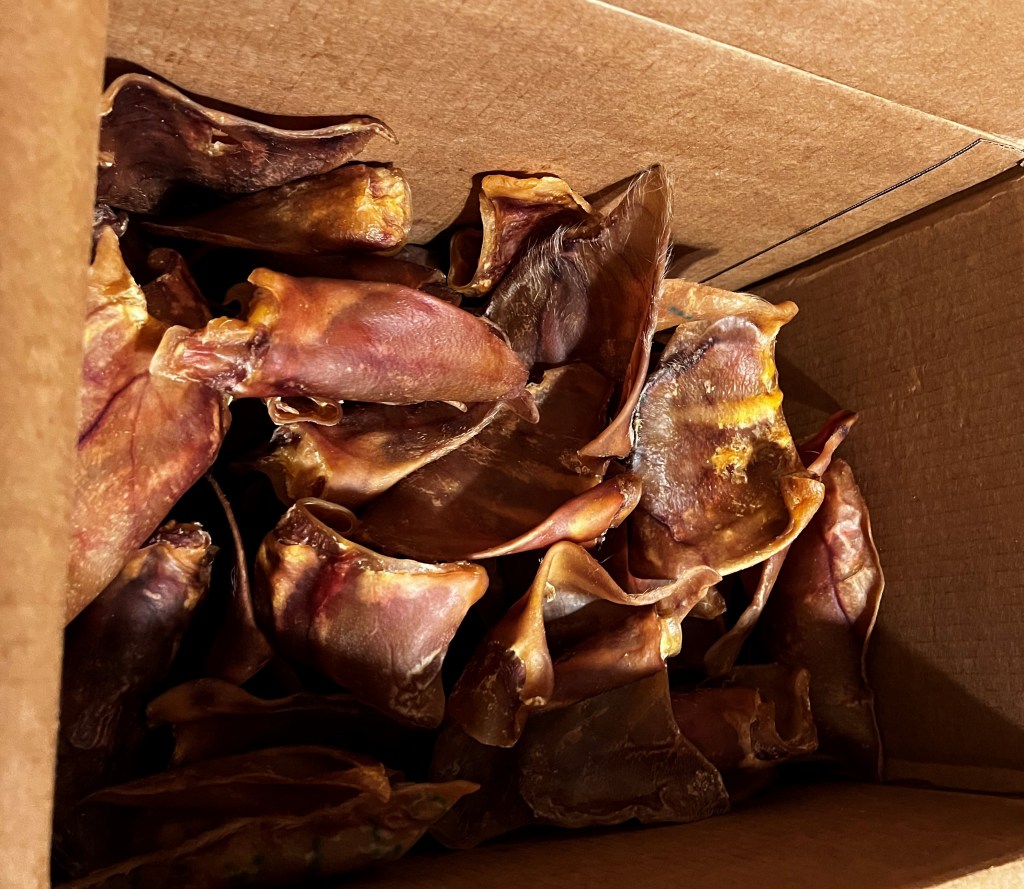
Melissa has been giving Zena several different treats to see it there is one she likes that will last more than a few minutes.  We used chicken jerky as the special treat when we had Bella and she loved it.  She would grab her treat and carry it around the house until she found just the right spot to eat.  We even got to the point where we would often give her half a jerky treat and she would munch on it happily for ten minutes.  We bought jerky strips for Zena and found while she will also take it to a special spot, it takes her about one minute to eat an entire strip.  The difference might be that Bella was a sheltie who at 14 years old weighed 27 pounds (12.25 kg) and Zena is a Great Pyrenees who at 14 weeks weighs 46 pounds (20.9 kg).  What Melissa found that seems to last longer is pig’s ear.  I have heard “in a pig’s ear” most of my life, but I do not think this is what they were talking about.

When I looked online, I found the phrase “pig’s ear” has three possible origins.  As “pig’s ear” it comes from Cockney rhyming slang for beer.  Cockney is an accent and dialect of English spoken mainly in and around London by working- and lower middle-class Londoners.  One of the earliest examples of this use appears in D. W. Barrett’s Life & Work among Navvies (1880), “Now, Jack, I’m goin’ to get a tiddley wink of pig’s ear.”  You would need a Cockney to explain why “tiddley wink of pig’s ear” was thought to be an improvement on “drink of beer”, but “pig’s ear” does rhyme with “beer” and that’s usually enough for rhyming slang.  “In a pig’s ear” is an expression of disbelief that originated in the US in the 1850’s as a variant of “in a pig’s eye”.  Both phrases were used to express incredulous skepticism and meant the person is not to be believed.  “Make a pig’s ear” is a mid-20th century phrase meaning to make a mess of something.  This is first found in print in a 1950 edition of Reader’s Digest and derives from the proverb “you can’t make a silk purse out of a sow’s ear”, which dates from the 16th century.  When Stephen Gosson published the story Ephemerides in 1579 it referred to people engaged in a hopeless task as, “Seekinge too make a silke purse of a Sowes eare.”  To “make a pig’s ear of” alludes to the same result of resulting in a complete mess.  Zena could rip through a silk purse too easily anyway.

Another site addressed the trouble finding a healthy and nutritious snack for your dog.  This was said to be tricky if the dog is a picky eater or has intolerances, or if the dog seems to inhale rather than chew their treats (can you say, Zena?).   The site suggested the answer might be pig’s ear.  These chewy treats can last for ages and the best ears are completely natural.  But, how do you know which pig ears are best?  Luckily, the site pointed me to the seven best brands of pig’s ear.  Criteria for the best pig’s ear is it should be thoroughly cleaned and blanched to remove impurities and excess hair.  They are then dried slowly at low temperatures to remove excess water and the risk of salmonella.  The labeling should state the preserving method and list little or no added ingredients.  The best and safest pig’s ear comes from countries with high animal care standards.  If you find FDA certification, it means the pig’s ear have been processed to human food standards.  Anyone who has ever dropped food on the floor know dogs prefer it to be processed to human standards.

THOUGHTS:  I found it appropriate that as I researched the pros and cons of giving your dog pig’s ear, Zena came back to my office asking to be let outside.  I have learned these requests should not be taken lightly, so I attached her leash, and we went outside.  Zena immediately went to a corner of the yard where she found another of her favorite chew toys, a rock, and proceeded to roll around on the ground and chew on her rock for the next 10 minutes.  Perhaps I should save money and not buy pig’s ear.  Zena finally abandoned her rock when our neighbor came home.  Being a puppy, she is curious and can be easily distracted.  Human curiosity and our craving to know and understand is the driving force behind our development as individuals and even our success as a species, but it can be dangerous.  Encouraging others to explore and providing safe spaces to retreat is what binds us together as a species.  Act for all.  Change is coming and it starts with you.

Convoy

June 11, 2022

On our way to Zena’s obedience training yesterday we passed a group of eight jeep wranglers traveling together.  It is not uncommon to see wranglers on the road, and I admit I do notice them more now that I own one.  Usually there may be one or two that just happen to be traveling along the same road when I come upon them.  I have even seen several small groups of two or three that appear to be traveling together.  When I approached the first of this group, I thought it was interesting.  As I passed, I noticed the two vehicles in front of this were also wranglers.  Then I noticed they all had Oklahoma license plates.  They were all traveling just below speed limit and were all 2-3 car lengths apart.  This kept the group close and discouraged others from breaking into their formation.  I realized we had us a convoy.

When I looked online, I found Convoy is a 1978 American road action-comedy film directed by Sam Peckinpah and starring Kris Kristofferson, Ali MacGraw, and Ernest Borgnine.  The film is based on the 1975 country and western novelty song “Convoy” by C. W. McCall.  The film was made when the CB radio/trucking craze was at its peak in the US and followed the similarly themed films White Line Fever (1975) and Smokey and the Bandit (1977).  The plot centers around a group of truckers who have a confrontation with the police.  The truckers prevail, and the Rubber Duck (Kristofferson’s handle) handcuffs Wallace (police chief – Borgnine) to a bar stool.  The truckers dismantle the police cars and head for the state line to avoid prosecution.  The truckers drive across Arizona and New Mexico, with Wallace in pursuit.  Additional independent truckers join them to form a mile-long convoy in support of Rubber Duck’s vendetta against the abusive Wallace.  The truckers communicate with each other via CB radio, and CB jargon is sprinkled throughout the film.  As the rebellious truckers try to evade the police, Rubber Duck becomes a reluctant hero.  Although the film received mixed reviews from critics, it was the most commercially successful film of Peckinpah’s career.

I also found 74 Meetups Jeep Clubs representing 54 cities and a total of 19,600 members when I was online.  While these clubs have shows and friendly competitions, the real draw is off roading together.  As one site proclaimed, “You Won’t See Any Bathroom Remodeling Or Candle Vendors At Our Show.  We Are Jeep People And This Event Is Dedicated To Nothing But Jeeps!”  I spent a lot of time around Moab when I lived in Utah.  This southeastern portion of the state is known for its slickrock trails and its jeep tours.  The Red Rock 4 Wheelers are based in Moab and was formed as a family club to have fun and promote responsible 4-wheeling.  In addition to the Easter Jeep Safari, the club sponsors the Labor Day Camp Out, trails of the month, do cleanup and mark trails, and participate in other club outings.  Much of the area is managed by the Bureau of Land Management (BLM) so any jeep convoy requires registration, insurance, and permits.

THOUGHTS:  While I never participated with the Red Rock club, I was able to follow some memorable trails, including an old oil and gas road down into Barrier Canyon.  I thought better of it when I turned the corner onto the slickrock, but the grade was so steep I could not back up even in 4-wheel low.  We camped several nights at the bottom before attempting to climb back out.  While we got out with no problem, I had visions of leaving my jeep in the wilderness.  The deserts of the American southwest are rugged, beautiful, and fragile.  The tours and clubs travel in a convoy on existing trails and off trail travel is prohibited by the BLM.  It is said a single wagon (jeep) track is still visible from the air over 100 years later.  Our natural resources can provide amazing thrills and views, but careless use will cause lasting damage that spoils the beauty for others.  Act for all.  Change is coming and it starts with you.
Glass

June 10, 2022

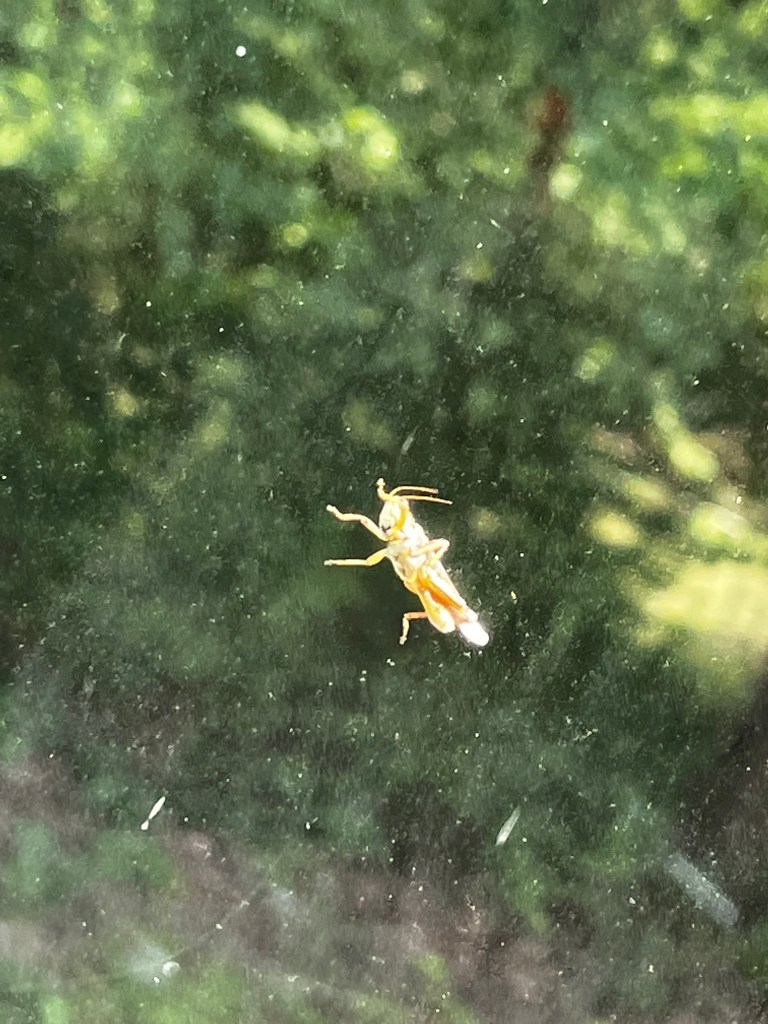
I made a quick run to the market yesterday and when I got back to the car, I noticed a grasshopper hanging onto the outside of the passenger side window.  This is hardly a rarity and I paid it no mind as I sped off for home.  When I got up to speed, I glanced over and even though the wind was blowing the hopper to one side, it was still clinging tenaciously to the glass.  The hopper held on for half a mile (0.8 km) as I drove through town.  It was not until I stopped to turn that the hopper finally jumped off the glass.  While I could not blow him off in the wind, I guess he decided the free ride was over.

When I looked online, I found glass is a non-crystalline, often transparent amorphous solid, that has widespread practical, technological, and decorative uses.  Glass is most often formed by rapid cooling (quenching) of the molten form.  While most glass is manufactured, volcanic glass occurs naturally.  The most familiar type of manufactured glass is “silicate glass”, which is based on the chemical compound silica (silicon dioxide, or quartz), which is the primary element of sand. Archaeological evidence suggests glass-making dates to at least 3,600 BCE in Mesopotamia, Egypt, or Syria.  The earliest known glass objects were beads.  Due to its ease of formability into any shape, glass has been traditionally used for bowls, vases, bottles, jars and drinking vessels.  Glass can be colored by adding metal salts or painted and printed as enameled glass.  The refractive, reflective and transmission properties make glass suitable for manufacturing optical lenses, prisms, and optoelectronics materials.  Extruded glass fibers have are employed as optical fibers in communications networks, thermal insulating material when matted as glass wool, or in glass-fiber reinforced plastic (fiberglass).  I have learned the hard way that glass wool cuts.

Numerous insects and certain amphibians and reptiles (tree frogs and geckos) can walk on and cling to smooth surfaces, including glass doors and windows.  In most insects, this is done by the large number of tiny bristles or hairs on the bottom of their feet.  Electron microscopes have shown “smooth” glass surfaces have microscopic bumps and fissures which serve as footholds for the tiny hairs.  The foot segments, or tarsi, at the end of insect legs also possess claw-like structures that help the insect hold on to different types of surfaces.  The tarsal claws grip the tiny irregularities of the surfaces.  Grasshoppers also make use of adhesion.  On a smooth glass, the insect hold on using the adhesive action of hairs located on sticky pads (known as the arolia or pulvilli) on the tarsi.  Grasshoppers have pads on each of their tarsal segments that contain numerous hairs that secrete an oily substance that causes the tips of the hairs to adhere to the surface.  The substance provides the traction and stickiness that allows hopper to hold on to the glass.  The combination of hairs, claws, sticky pads, and microscopic footholds let the hopper ride.

THOUGHTS:  While most see a window as a solid pane of glass, physicists looking at the glass on a molecular level have questioned whether glass is a solid or merely an extremely slow-moving liquid.  In physics, glass is a solid, but glass lacks the first order phase transition, meaning it does not have a volume (size), entropy (randomness), and enthalpy (heat content) throughout its transition range from sand to glass.  This sets glass apart from typical solids, and in this respect, glass resembles a liquid.  The atomic structure of glass is like that of a supercooled liquid and glass behaves like a solid when it is cooled below its glass transition temperature.  That means only the right questions can address (let alone find) the right answer.  When we deal with people, we often find the same is true.  We need to take time to learn the questions before we can expect to hear the answers.  Act for all.  Change is coming and it starts with you.
Goat

June 08, 2022

Farmer’s Markets seem to be the ideal spot to walk you dog.  I have noticed this at our local market and other famer’s markets I have attended around the US.  Most of the dogs have been small breeds and puppies but I have noticed some large dogs.  Thankfully, the owners have been courteous and kept the dogs on a leash although it may be obeying the law as most cities and states require a dog be “under the control” of the owner when they are in public.  While the produce has yet to arrive at our market, several of the venders identify themselves as “farms”.  I have mentioned seeing them selling eggs and honey, but another staple seems to be cheese.  While one vender sells packaged cheeses from a friend’s Wisconsin farm, another sells a soft goat cheese they make from their own livestock.  Melissa bought some of this goat cheese and said it was very good.

When I looked online, I found the domestic goat (Capra hircus) is a species of goat-antelope kept as livestock.  The goat is a member of the animal family Bovidae and the tribe Caprini, meaning it is closely related to domesticated sheep (Ovis aries).  Goats are among the earliest animals domesticated by humans and archaeological evidence shows its domestication occurred in Iran around 10,000 years ago.  The most recent genetic analysis confirms the archaeological evidence that the wild bezoar ibex (Capra aegagrus) of the Zagros Mountains (western Asia) is likely the original ancestor of all domestic goats.  There are now over 300 distinct breeds of goat.  Goat is used for milk, meat, fur, and skins across much of the world.  Female goats are referred to as does or nannies, intact males are called bucks or billies, castrated males are called wethers, and juvenile goats of both sexes are called kids.  According to the UN Food and Agriculture Organization, there were more than 924 million goats in the world in 2011.

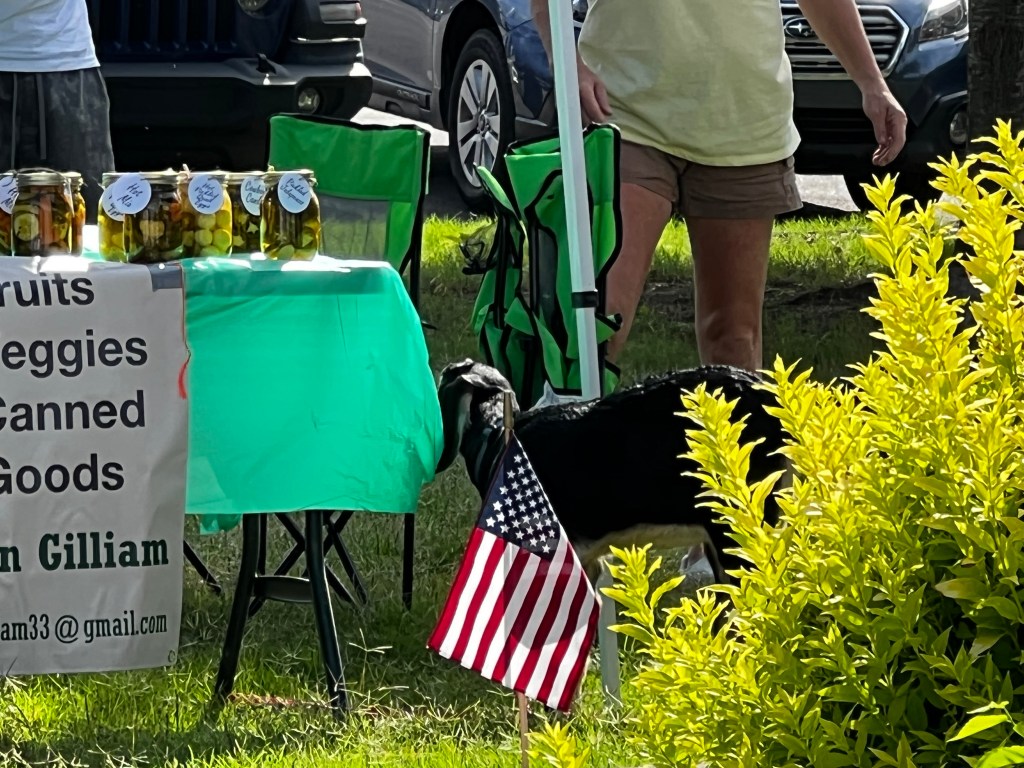
I was surprised when I noticed one of the farm venders walking what I thought was an ugly, skinny dog to their booth.  What I noticed first was that the animal walked with a limp and needed to be helped around.  Initially, the vender put the pet in one of the camp chairs they had brought to sit in.  It turned out the animal was quite agile as it was all over the three chairs, walking back and forth across them as they were lined in a row.  After they finished setting up, they put the animal on a leash and set it down in front of their tent.  When I took a good look, I realized it was not a skinny dog at all.  It was a goat.  The goat began to do what goats do and ate the grass in front of their booth.  While several children stopped to pet the goat, most paid it no mind.  Apparently, the goat became bored because when I looked over, it was eating the plastic tablecloth.  Again, that is what goats do.

THOUGHTS:  When I was at the archaeological site of Petra, Jordan, the Bedouin were still living in and around the abandoned city.  While they mainly sold drinks and trinkets to the tourists, the children spent most of their day raising small goats.  One day the boys noticed as I set off to hike to the top of one of the surrounding mountains.  It only took me 30 minutes to follow the path to the top, but when I arrived two of the boys had set up a stand selling cold drinks for my refreshment.  They not only beat me to the top by another route but had brought their goat herd with them.  Domestication of cereal gains (wheat, rice, and barley) and animals (sheep and goat) allowed the earlier hunter gathers of the Neolithic to settle down and form the beginnings of civilization.  While some now do not like the smell of domestic goat or the taste of goat milk and cheese, we might still be wandering nomads without them.  When other people are different it can take getting used to, but together we can change the world.  Act for all.  Change is coming and it starts with you.
Crescent

June 08, 2022

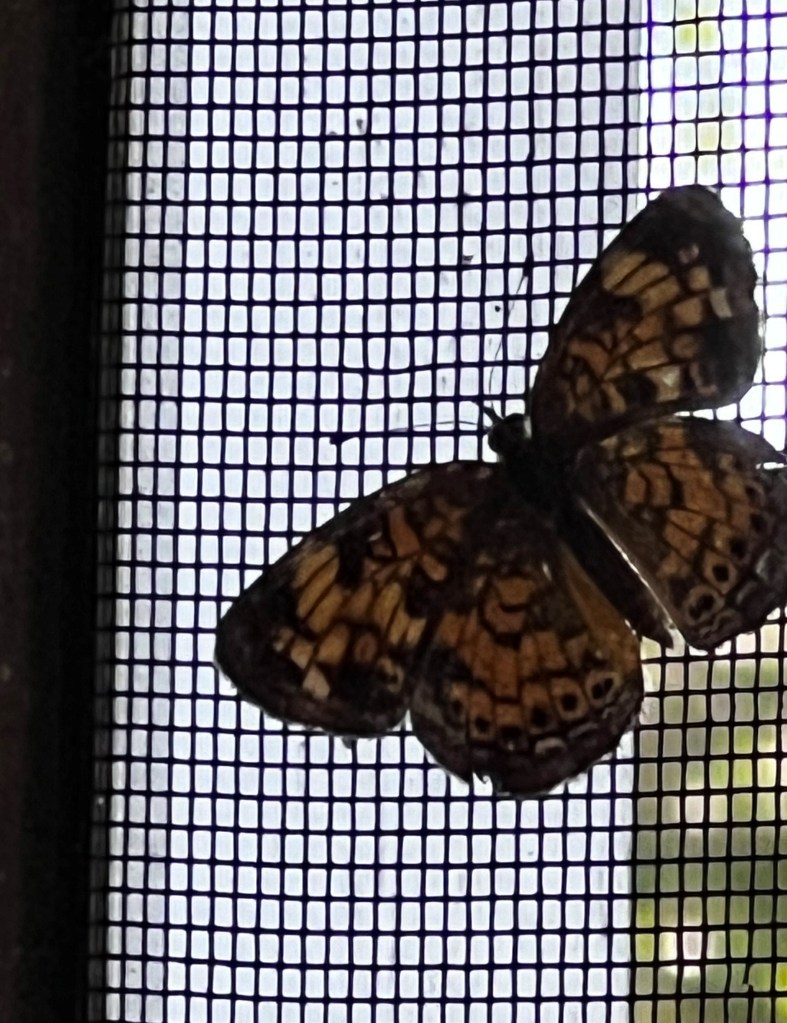
I got another invader on my porch over the weekend when a butterfly came and joined the moth I wrote of earlier.  This was again located in the upper corner of the screened porch.  After I researched the two species I began to wonder if they were not there to take advantage of the bramble (Rubus trifidus) that was not only thriving on the outside of the porch but had pushed its way through the top of the screen into the porch itself.  The plant has not only flowered but has produced the red berries that draw the birds and insects that feed on the nectar and fruit.  I had chosen to leave this “weed” in the flower bed for this purpose, and I hoped it was accomplishing this goal.  One of the interesting aspects of this butterfly was the crescent shaped markings that surrounded the ends of the hindwings.

When I looked online, I found the pearl crescent (Phyciodes tharos) is a North American butterfly found throughout the US except the west coast, and throughout Mexico and parts of southern Canada.  Its habitat is open areas such as pastures, road edges, vacant lots, fields, and open pine woods.  The wing pattern of the adult pearl crescent varies, but all have orange wings with black borders with fine black markings.  The common name comes from a crescent-shaped, light-colored spot surrounded by a darker patch on the outer edge of the hindwing.  The first pair of legs are short, hairy-looking, and useless for walking.  The wingspan is from 1–1½ inches (21 to 34 mm).  Adults find nectar from a great variety of flowers including dogbane, swamp milkweed, shepherd’s needle, asters, and winter cress.  The species has several broods throughout the year, from April to November in the north and throughout the year in the deep south and Mexico.  The eggs are laid in small batches on the underside of the leaves of the aster species (family Asteraceae).  Larvae are brownish black with light dots, yellow lateral stripes, yellowish-brown spines, and a black head with a pale spot in front.  Larvae that occur in late season hibernate until transforming into the adult butterfly the following spring.

While the pearl crescent is one of the most common and widespread butterflies in the eastern US, it is one of the hardest to identify with certainty because of the similarity to the northern and the tawny crescents.  The northern crescent (Phyciodes cocyta) was only separated from the pearl crescent in the last 25 years, and the distribution maps where the two overlap are suspect.  The females are very hard to distinguished in the field and it is best to check the males to determine whether the species is present.  While the male is like the female, the hind wing is more open and has a distinctive dark patch in the middle of the hindwing margin.  Tawny crescent (Phyciodes batesii) males and females are like the female pearl and northern crescents but are slightly darker because of the larger amounts of black markings.  The male of the tawny species is uniformly colored on the hindwing, with little or no darker spot near the middle wing margin as in the pearl and northern crescents.  The range is perhaps the best marker, as the tawny is found in Canada and the western US, but only occurs in the high mountains of North Carolina and Georgia in the East.  The northern crescent ranges from the Yukon Territory southeast across lower Canada to Newfoundland, and south into the US along the Rockies to Arizona and New Mexico, and along the Appalachians to Virginia.  Being in Arkansas, it is safe to say my sighting was the pearl crescent.

THOUGHTS:  Animal species like the crescents form and differentiate when breeding populations are separated by environmental factors and distance.  This may happen relatively fast as between the pearl and northern crescents, or it may occur over millennia.  Sapiens (modern humans) are said to have come from the Eden-like environment of the African Rift Valley.  From there they spread across Africa, into Europe, and Asia.  Finally, they took the boat or land bridge that brought them to Australia, the Americas, and Oceania.  Over time and distance humans began to developpe different traits and these have been used to distinguish races, yet we are all one species.  Humans like to think it is our intelligence that sets us apart.  Perhaps we should act like it.  Act for all.  Change is coming and it starts with you.

Tote

June 07, 2022

My desire to feed the birds caught up with me over the weekend.  I have had occasional days when something got on the porch and found the seed.  I re-bagged the seed sack with the hole in it and that seemed to take care of the problem.  Now it became a nightly raid on my seed stores.  The only bag that seemed to be chewed was the one with corn kernels.  This caused corn to be strewn across the floor and Zena thought this was a new treat.  The problem is, she cannot digest the corn and it comes back, one way or another.  Melissa cleaned up the corn mess again on Sunday and put the bag in a plastic tote with a closable lid.  Apparently, there was another bag we missed, and corn was strewn across the floor Monday.  I had enough and went to the hardware store to buy five-gallon buckets, lids, and a sealable plastic tote.

When I looked online, I found the plastic tote is one of the most common ways to store and ship items in manufacturing.  A bulk box, also known as a bulk bin, skid box, pallet box, bin box, gaylord, or octabin, is a pallet-size box used for storage and shipping of bulk quantities.  The term gaylord is sometimes used for the triple wall corrugated plastic pallet boxes in the US and Canada, as the first bulk bins were made by the Gaylord Container Company of St. Louis.  Bulk boxes are often made of corrugated fiberboard now and many of the corrugated bulk boxes have covers.  Additional corrugated liners and reinforcement are sometimes used to control bulging of the box.  Wooden boxes are also used for bulk packaging, as are aluminum and steel boxes in heavy industry.  Still, a reusable plastic tote is cheapest and most convenient for many products and logistics chains.

Apparently, I am not the only one who struggles to keep seed safe.  The Svalbard Global Seed Vault is a secure backup facility for the world’s crop diversity on the Norwegian island of Spitsbergen in the remote Arctic Svalbard archipelago.  The Seed Vault provides long-term storage of duplicates of seeds conserved in gene banks around the world.  This provides security of the world’s food supply against the loss of seeds in gene banks “due to mismanagement, accident, equipment failures, funding cuts, war, sabotage, disease, and natural disasters.”  The seeds are stored in sealed three-ply foil packages, placed into a plastic tote, and put off the floor on metal shelving racks.  The storage rooms are kept at -0.4F (-18C).  The low temperature and limited access to oxygen ensures low metabolic activity and delays seed ageing.  The permafrost surrounding the facility will help maintain the low temperature of the seeds if the electricity supply fails.  This might be overkill for my porch, but at least I have my tote.

THOUGHTS:  Using a tote to store my seed is not a new idea.  It became a necessity when I lived at the camp and stored seed for my bird feeders.  The problem was the mice who lived in the garage no matter how many traps and baits I set.  Since I did not have a lot of seed (two feeders) the lidded buckets worked great and kept any varmints out of the seed.  I now have more seed and larger bags and the tote was a good adjunct to the five-gallon buckets.  I have accommodated the squirrels getting into my feeders and even dedicated a feeder for them, but whatever is eating the seed on my porch is going too far.  Most people tolerate minor offenses against their property but will finally draw the line.  The secret is to weigh the impact of the offence against the needs of the other.  If that is true for squirrels, it ought to be true for other humans.  Act for all.  Change is coming and it starts with you.
Moth

June 06, 2022

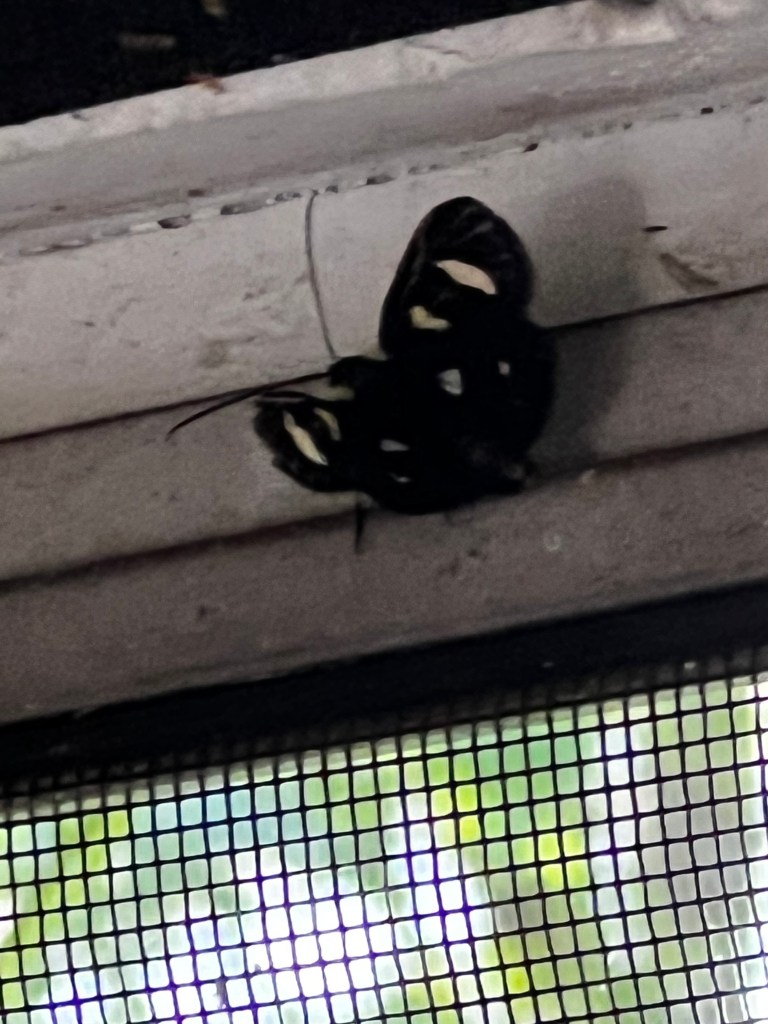
Melissa has the habit of keeping the door open to the back porch when she is working to allow Zena access to the deck.  This results in other visitors coming in as well as Zena going out.  Last week we had two House sparrows (Passer domesticus) that decided to check out the succulents that fill the porch.  I became aware of the birds when Zena became frantic and wanted outside.  When I walked out one of the birds flew out the door on its own, but the other franticly thrashed against the screen.  I went inside to get my butterfly net to coax the bird outside, but I did not close the door completely and it flew into the house.  I did get it back to the porch, but it flew behind some items stored in the corner and I could not get it to move.  I finally gave up knowing it would eventually get out on its own.  That was when I noticed an interesting moth near the ceiling that I do not recall having ever seen.

When I looked online, I found the eight-spotted forester (Alypia octomaculata), is a moth of the family Noctuidae found in the eastern part of the US and in parts of Canada and Mexico.  The wingspan of the adult moth is 1–1½ inches (30–37 mm).  Adult foresters have butterfly-like traits, meaning they fly during the day, drink from flowers, and have antennae that are thickened at the tips.  While the overall color is black, the forewings have two pale yellow spots, and the hindwings have two white spots.  The body is mostly black, but the front and middle pairs of legs have patches of bright orange hairs.  The flight is fast and darting and the black and white pattern creates a flickering effect like a strobe light.  Forester larvae are whitish lavender, with each segment having several narrow, black transverse lines and one wide orange band.  There are small black tubercles on the body, white spots in the abdominal area, and an orange head.  The moth flies from April to June in one generation in the north, while in the south it has two generations, one April to June and the other in August. 

The adult moth emerges in late spring to mate and the eggs are laid on grape shoots and leaves.  The larvae hatch and will feed until it reaches full growth in early summer.  The mature larvae drop to the ground and pupate in tunnels they construct just beneath the soil surface.  The next generation of moths emerge and lay eggs again in late summer.  There may be two generations, a partial second generation, or only one generation depending on the climate.  Both the wild grape (Vitis vinifera) and the Virginia creeper (Parthenocissus quinquefolia) serve as alternate hosts.  Although commercial vineyards do not generally suffer severe damage from the moth larvae, small areas of a vineyard may have concentrated infestations and defoliation.  Damage is most severe along the perimeters of vineyards and near bushes, woods, or weedy areas where the wild alternatives grow.  The moth resting on my porch was a long way from habitat or food.

THOUGHTS:  When I was young it was easy to differentiate between a butterfly and a moth.  A butterfly had smooth wings and bodies and a moth was fuzzy.  I also thought butterflies were good (pollination) and moths were bad (eat clothes).  Both butterflies and moths are important pollinators and are a plentiful food supply for birds and people.  Caterpillars are packed with protein and healthy fats, and research shows 100 grams of the insects provides more than 100% of daily requirements of vital minerals like potassium, calcium, zinc, and iron.  Both are members of order Lepidoptera, but butterflies belong to the suborder (Rhopalocera – “club-antennae”) while moth antennae are quite varied (Heterocera -“varied-antennae”) and lack the club.  My fuzzy classification was not even mentioned.  A butterfly and a moth are similar and provide the similar benefits, yet as a child I thought one was good and the other bad.  Like people, we need to understand who and what someone is, not just whether they make us feel fuzzy.  Act for all.  Change is coming and it starts with you.