Treats

November 01, 2021

I was able to participate in our Fall Festival last Saturday Night.  Due to continuing restrictions from covid this was different than previous Festivals.  We have held the event indoors and focused on a variety of games to provide treats to the children who attend.  While this still served as the basis for the celebration, this year we held the event outside and based most of the games out of the trunks of the decorated cars that lined the parking lot where I work.  We had a good turnout and gave out a lot of treats to the children (and adults?) who attended.  We had a much better turn out than last year when we were forced to cancel due to covid (ha-ha).

Fall Festival has become synonymous for Halloween over the last several decades.  When I looked online, the word “Halloween” comes from All Hallows’ Eve and means “hallowed (or sacred) evening.”  While we generally no longer celebrate November 1st, this day is known as All Saints Day.  The combination of Halloween and All Saints Day was celebrated as a time to remember the saints who have died.  Trick-or-Treating comes from hundreds of years ago when people dressed up as saints and went door-to-door.  This was the beginning of Halloween costumes and trick-or-treating in Europe.  The tradition of knocking on doors for treats did not begin for most of America until the mid-1940’s, or after the end of World War II.  Rather than a focus on the dead, it represented a return to prosperity.

The treats that were originally given were spiced cakes rather than candy.  These little cakes were called “soul cake,” and were a popular treat in Europe during the Middle Ages.  The cakes were made from saffron, currants, and other expensive spices and were given to honor the dead.  They eventually became a treat for poor beggars who would knock on the doors of wealthier folks, offering to pray for their household’s deceased in return for these tasty cakes.  Rather than saying trick-or-treat, the poor would instead say “A soul cake, a soul cake, have mercy on all Christian souls for a soul cake!”  Few today remember to say trick-or-treat without parental coaxing, as the tradition continues to evolve. 

Thoughts:  I have fond memories of going door to door for treats in the small town of my childhood.  I especially prized the home-made popcorn balls, cookies, and caramel apples.  We would remember those houses and make sure to get there early before they ran out.  As a child I could make my treats last for months, tiding me over into Christmas.  Home-made treats are now discouraged, and any found in a child’s sack are immediately thrown away to protect them from harm.  Safety is also the reason for Fall Festival and trunk-or-treat events.  They provide a safe place for children to put on costumes, have fun playing games, and still receive the treats they pursue.  During covid we have been forced to make many adaptations to long-held traditions.  This does not mean they are not as fun or enjoyable, it just means they are different.  Even I would be wary if someone put a soul cake in my sack.  Follow the science.  Do the work.  Change is coming and it starts with you.

Hiring

October 29, 2021

When Melissa and I pulled through the drive through of one of our local fast-food restaurants we were confronted by the marquee.  The sign declared in bold letters that the restaurant was hiring workers.  They were NOW HIRING NOW, RIGHT NOW, WE ARE HIRING NOW.  Apparently, the chain was not only hiring, but having a problem getting people to apply.  As covid cases decline and safety restrictions loosen, fast-food chains are looking to return to business as usual.  The problem is, they cannot find enough workers.  I had to resist the urge to go inside and ask the manager if they were hiring.  Luckily the restaurant was closed to indoor dining.

While some blame the hiring crisis on government programs that provide greater benefits and extended times for receiving them, a better reason may be the low wages paid and the working conditions workers face.  The current Federal Minimum Wage is $7.25, and the Arkansas state minimum wage is $11.00 per hour, and workers are entitled to be paid the higher state minimum wage.  The minimum wage applies to most employees in Arkansas, but there are exceptions, including tipped employees, some student workers, and other exempt occupations.  The Arkansas minimum wage was last changed in 2008, when it was raised from $6.25 to $11.00 per hour.  Tipped wages are set at $2.63 per hour.  That means working 40 hours a week for the non-tipped minimum provides $22,880 a year.  Working 40 hours a week for tipped wages provides $5470.40 a year.  Minimum wage increases are based on a voter approved initiative on November 4, 2014.  Previously, Arkansas had not updated their minimum wage since 2006, and the Federal Minimum Wage took precedence.

Credit Suisse analyst Lauren Silberman says fast-food industry struggled to find enough employees for years before the latest stimulus package.  Restaurants are an “exceptionally difficult business” to work in, Silberman said.  Employees face a high rate of sexual harassment and assault on the job, while Bureau of Labor and Statistics data shows that the median pay is $11.63 per hour.  Workers increasingly have more options outside the restaurant industry that offer a guaranteed $15 per hour, such as Amazon or Target, or more flexibility, like Uber or DoorDash.  And working in restaurants has only become more dangerous and difficult over the last year.  “These are still frontline workers, and we are still in the midst of a pandemic.”

Thoughts:  When I looked online, I found the definition of poverty in the US is an individual with income less than $34 per day ($12,410 per year) or a family of four with income less than $69 per day ($25,185 per year).  When you figure poverty rates in the US by racial classification, 31.9% of Blacks, 29.6% of Hispanics, 29.1% of Pacific Islanders, 23.5% of American Indians, 14.2% of Asian, and 14.1% of whites live in poverty.  Arkansas ranks 46th in Poverty Rate at 18.1%, which is meaningfully higher than the national average of 14.6%.  That means over half a million Arkansas residents (524,211) lived below the poverty line last year.  This includes 20.1% (1 in 5) children.  Systemic poverty is not the result of fast-food restaurants not hiring enough people or paying $15 and hour.  Neither is it the result of stimulus subsidies.  It is the result of an attitude of legislatures and individuals which deem poverty as individual failing, rather than a societal flaw.  Do the work.  Change is coming and it starts with you.

Salmon

October 29, 2021

My ESPN feed this week highlighted the Seattle Kraken who are in their inaugural year for the 2021-22 NHL season.  Like most new teams they are trying to adopt local traditions into their game.  One that hockey fans are loving is the Kraken postgame salmon toss.  The postgame salmon toss is awarded as an honor to the team’s three stars of the night.  The Kraken give the standout performers at a home game a distinction in a cool way beyond just putting them on the video board.  The toss consists of the Seattle players tossing salmon (rubber or stuffed, not real fish) over the glass and into the fans after the game.  The Pike Place Market is one of the biggest attractions in Seattle where you can see vendors and fishermen tossing fish to one another as they are being packaged and sold.

When I checked online, I found the Pike Place Market is a public market in Seattle, Washington.  The Market opened on August 17, 1907, and is one of the oldest continuously operated public farmers’ markets in the US.  Located on the Elliott Bay waterfront on Puget Sound, it serves as a place of business for many small farmers, craftspeople, and merchants.  It is named for its central street, Pike Place (yes, like the coffee), which runs northwest from Pike Street to Virginia Street on the western edge of Downtown Seattle.  Pike Place Market is Seattle’s most popular tourist destination and the 33rd most visited tourist attraction in the world, with more than 10 million annual visitors.

When Melissa and I visit our son and his family just outside of Seattle, we like to also browse through the Pike Place Market.  The street level of the Market contains fishmongers, fresh produce stands and craft stalls operating in the covered arcades.  Local farmers and craftspeople sell year-round in the arcades from tables they rent on a daily basis.  The Market is built on the edge of a steep hill and has several lower levels below the main level.  Each level features a variety of unique shops like antique dealers, comic book and collectible shops, small family-owned restaurants, and one of the oldest head shops in Seattle.  Pike Place Market is also home to nearly 500 residents who live in eight different buildings throughout the Market.  Most of these buildings have been low-income housing in the past. 

Thoughts:  The fish market at Pike Place sells a variety of locally caught fish and is a great place to buy fresh salmon.  The buyer will select their fish, the monger will grab it, throw it 20 feet (18.5 meters) to be caught by the person at the scale where it is weighted, wrapped, and priced.  I have never seen a fish dropped.  While I enjoy watching the mongers throw fish, it is more fun to watch the tourists.  The mongers rig certain fish with microphones and fishing line to make them move and talk to the tourists (ala, Billy Bass).  Even when you know it is going to happen, it still startles the unwary.  As we approach our second Halloween during the pandemic, we need to remember that even being startled by the events of the world, we do not have to be overcome by them.  Follow the science.  Do the work.  Change is coming and it starts with you.
Display

October 28, 2021

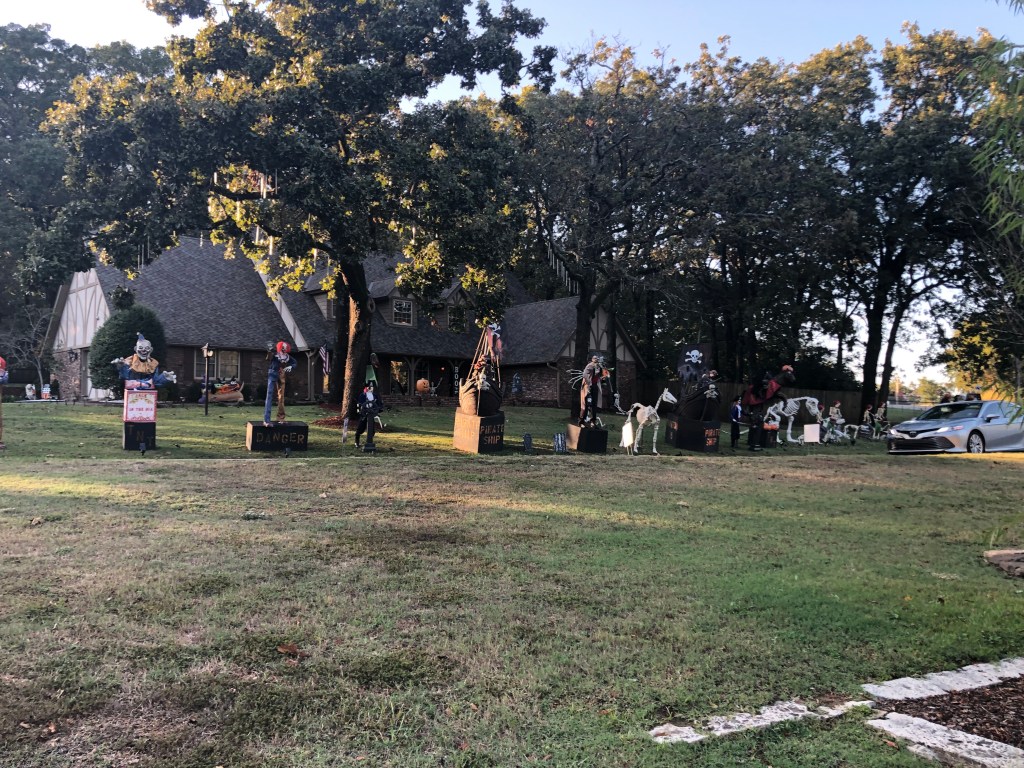
As Melissa and I were driving along one of the main streets of our nearby town we came across a yard filled with dozens of spooky figures arraigned in a display across the front of a residence.   I figured this was a photo op so I asked Melissa to pull over so I could get a shot.  She dutifully pulled off the main throughfare and onto the side street allowing me to get get the perfect shot of the Halloween display.  While we were trying to get the shot, a resident of the subdivision pulled up behind us and rather than going around, decided to honk to get us to move.  We took our photo and moved on.

I received a post on my ESPN feed concerning a similar display on the lawn of retired defensive lineman, Bruce Smith.  Smith spent nearly two decades terrorizing opposing quarterbacks in the NFL and now has a Halloween display to prove it.  The Hall of Fame defensive end put his career on display by decorating his front lawn with 76 tombstones, representing the 76 quarterbacks he sacked during his career with the Buffalo Bills and Washington Football Team.  Smith was inspired by Cleveland Browns defensive end Myles Garrett, who started the trend by putting tombstones and taking a shot of them on his front yard of the quarterbacks he sacked during the 2021 season.  During his time in the NFL, Smith became one of the most feared defenders to play the game as part of the Bills’ four AFC title teams in the early 1990’s.  Smith is the NFL’s all-time sacks leader with 200 during his 19-year career.  Smith and his impressive graveyard now reside in Virginia Beach, Virginia.

The annual fall ritual of Halloween and autumn decorating includes brightly colored pumpkins, dried corn stalks, hay bales, scarecrows and autumn leaves which are on display on porches, doorways, and yards throughout communities.  The scarier and more frightening Halloween decor comes along with fall decorations as well, and many people add their own personal vibe to the spooky flair of Halloween.  In Northeast Ohio they have even dedicated a webpage to identify local yards they believe to be “over the top” with their display.  These include inflatables, statues, lights set to musical scores, and scary scenes.  The page encourages visitors to drop by the various locations, and to share an additional display if you think it is worthy.  It seems Halloween is competing with Christmas.

Thoughts:  Thousands of years ago there was an end of the summer festival that was known as Samhain.  Samhain tradition had many deep supernatural practices that were an integral part of the annual festival.  The uneducated people of the time were fearful of the season and believed that the end of the harvest and the onset of winter created an opportunity for the spirits of the deceased to return and mingle with the living.  I am not sure if that could have been any worse than getting sacked by Bruce Smith.  Samhain and Smith represent two of humanities greatest fears, fear of the unknown and fear of the known.  We seem to be more frightened by the unknown we allow our minds to imagine all the “what if’s” that are possible.  When we know what our fear is we can face it.  We are at a point where we can face the pandemic and overcome the frightening aspects.  Now we just need to do it.  Follow the science.  Change is coming and it starts with you.

Creep

October 27, 2021

While I did not write about it, I was surprised (not shocked) when I saw the bird food I came in to buy in late September had been downsized and moved to interior shelves in the market I frequent.  The shelves were now empty, but they had all been labeled with the products that were expected to shortly fill them.  The bird food aisle had been designated to accept the new Christmas lights that will soon adorn the houses of our community.  I recalled this experience because last night I noticed the first of the Christmas commercials that will soon dominate our TV ads.  I am not saying they were the first, but at least they were the first to creep into my notice.

When I checked online, I found that a lot of people seem to have the feeling that Christmas marketing seems to get earlier every year.  It is still the beginning of fall and most of us are focused on Halloween, but there are already Christmas and holiday products hitting shelves.  This phenomenon is known as “Christmas Creep.”  Christmas creep refers to the sense that the holiday season is gradually lengthening, beginning earlier each year, typically in early fall.  The term was added to Merriam Webster’s “Words We’re Watching,” who commented: “It seems to never be employed in celebratory fashion but rather functions as a shorthand for the existential dread and disgust that many people feel at the apparent increasing commercialization and banality of the season.”  Ya think?

According to retail expert Andrew Smith, co-founder and managing partner for the Americas of Think Uncommon, the creep is more imagined than real.  “Over the last 20 years it has certainly been brought forward in stores slightly, but generally speaking it’s the same most years.”  However, he added that pressure on supply chains during the pandemic has sped up the shift to e-commerce, leading retailers to try to creep the Christmas period back to help boost sales.  During 2020, shoppers were concerned about potential lockdowns, and many began shopping for the holiday season even earlier.  During 2021 the concern has shifted from lockdowns to supply chain issues.  As I found recently, the merchant may sell the product, then caution they cannot guarantee when it will arrive.  Sitting in the port is not the same as on the shelf.  

Thoughts:  I found another interesting shift in holiday shopping that began in 2020 that will likely continue through at least 2021.  Many shoppers wanted to get gifts early but were unsure or even unable to find the items they wanted.  That gave rise to an increase in local gift cards.  The gift card allows the recipient to go to the store at their leisure and pick their choice of items that existed on the shelves.  This has pros and cons.  It is hard to get excited over my new bike on Christmas morning when it comes wrapped in an envelope holding a gift card.  Then again, you never worry about getting Bunny Suit Pajamas from Aunt Clara.  Whether the December holiday is Hanukah, Christmas, or Kwanza, the point is not about gifts but about the love included in sharing.   It may not be so bad to allow this gift to creep back into the rest of the year.  Do the work.  Change is coming and it starts with you.

Grid

October 26, 2021

Melissa had several appointments with the doctor last week and that generally entails my going along to listen to the results and lend support during the long hours of waiting.  I was not worried since I have the crossword game I play on my phone and the local newspaper that provides a crossword each morning.  I retrieved the paper from the driveway on Monday and as I sat, I began to work the puzzle.  I filled in the first across but when I got to the second set of letters the clue did not seem to meet the spaces available in the grid.  I am sometimes fooled by the obvious answer rather than the answer the puzzle intends, so I switched and tried to complete the down clues.  Again, none of my answers matched the number of letters on the grid.  I randomly tried several other clues and realized the grid and the clues did not match.  I put the puzzle aside and went back to my phone.

Crossword puzzles are said to be the most popular and widespread word game in the world, yet they have a short history.  The first crosswords appeared in England during the 19th century.  They were an elementary kind and derived from the word square, a group of words arranged so the letters read alike vertically and horizontally.  These were printed in children’s puzzle books and various periodicals.  In the US, the crossword developed into a serious adult pastime.  The first known published crossword puzzle in a Sunday newspaper was December 21, 1913, in the New York World.  During the early 1920’s other newspapers picked up the pastime and within a decade crossword puzzle grids were featured in most American newspapers.  This is also when the familiar crossword grid of today was formed.

When I tried to answer the crossword for Tuesday and Wednesday, I found the same problem with the grid.  I was wary when I picked up Thursday’s paper, and thinking I needed to call the publisher and complain.  The crossword grid gives me far more pleasure than the short news stories I glean from the other pages.  The second page of the front section is where the errata items are published.  You can imagine my joy when I found Monday’s clues and grid republished in the Thursday paper.  This happened again on Friday (Tuesday’s grid) and Saturday (Wednesday’s grid).  I was able to complete two puzzles on each of the three days.  It was not the same, but I was happy to complete my grid.

Thoughts:  Not being able to complete the morning crossword put the entire first part of my week askew.  I have a steady routine of getting up, starting my coffee while I go outside and retrieve the paper and the mail, taking my OTC vitamins, and then settling down to completing the crossword grid.  While I appreciated the double grid opportunities later in the week, I would have liked it more if I could have done them at the appointed time.  I sometimes marvel at how little things can throw me off, and at how happy I am when they are corrected.  During the pandemic all the little things we normally do have been thrown off.  Like most of us I was not happy.  With the rapid rise in vaccinations the country decided to go back to normal, resulting in a drop in vaccinations and a rise in covid cases.  There are times when it is more important to protect those around you (and yourself) than returning to a normal grid.  Follow the science.  Change is coming and it starts with you.

Smoke

October 23, 2021

I ran across a post by Audubon that noted weird migratory patterns being recorded by GPS tagged geese beginning September 2020.  The tule is one of a protected population of Greater White-fronted Geese (Anser albifrons elgasi) that nests in Alaska and winters in California marshes.  The US Geological Survey has been keeping tabs on the bird as part of a waterfowl-tracking project since 2015.  The tags allowed researchers to track the bird’s location by computer.  Rather than stopping at Summer Lake in central Oregon, one bird was 300 miles off course in the Idaho Panhandle.  This was the first time anyone had ever confirmed the Tule Goose in Idaho.  The other three tagged Tule also following offbeat migration routes.  The team realized the unusual flight paths lined up with areas of dense wildfire smoke during one of the worst US fire seasons in history.

When I looked online, I found that according to Brian Wolfer of the Oregon Department of Fish and Wildlife, wildfires can be both destructive and beneficial to local wildlife.  Essentially, the fires create, “a disturbance on the landscape that changes habitat.”  Species like raptors who hunt rodents running from the flames benefit from wildfire, as do beetles that move into dead wood and lay eggs, and woodpeckers that feed on the beetles and nest in hollow trees.  Fire exposes new grass, shrubs, and vegetation that feed elk and deer and plentiful food means more milk and fawns grow faster.  The flip side is animals that depend on old growth forests can struggle for decades trying to find suitable habitat and if the sagebrush burns, the sage grouse won’t have food in winter or a place to hide from predators and raise their young.  The hotter and faster the fires burn, the harder it is for less mobile animals to find suitable habitat.  Those caught in the flames often die.

Corey Overton of the Western Ecological Research Center published an analysis last week of the Tule Geese’s response to wildfire smoke.  The findings add nuance to the story of last year’s fall migration bird die-off in the Southwest and clarify the risk birds face from wildfires.  The wayward geese tried to avoid the smoke, and in the process doubled their migration time and wasted precious energy, and other migratory birds face similar or worse consequences.  Things went wrong for the Tule as they encountered smoke off the coast of Washington’s Olympic Peninsula and all four birds began deviating from their previous migratory paths.  Three of the birds touched down separately on the Pacific Ocean looking to conserve energy but unable to eat.  The fourth goose continued south over land but turned around when it reached the Oregon border to escape the thickening smoke.  The birds generally fly just a few hundred feet above the ground, but three of the geese climbed to more than 13,000 feet at various points trying to rise above columns of smoke.  There were additional pauses in farm fields and more turnarounds before the birds finally reached their stopover destination.

Thoughts:  Overton explained, “There’s three main options to avoid air pollution (smoke).  Go around it, go over it, and decrease your energetic use.  And these birds tried to do all three.”  They did not always succeed.  While the trek from Alaska to Summer Lake usually takes about 9 days, it took more than twice as long trying to evade the smoke.  Since the Tule fly in large flocks, the four birds tracked each likely represents hundreds of flock mates.  Like the geese, humans devise ways to avoid the pollution and smoke caused by climate change.  Unlike the geese, we could do something to resolve it.  Follow the science.  Change is coming and it starts with you.
Parakeet

October 22, 2021

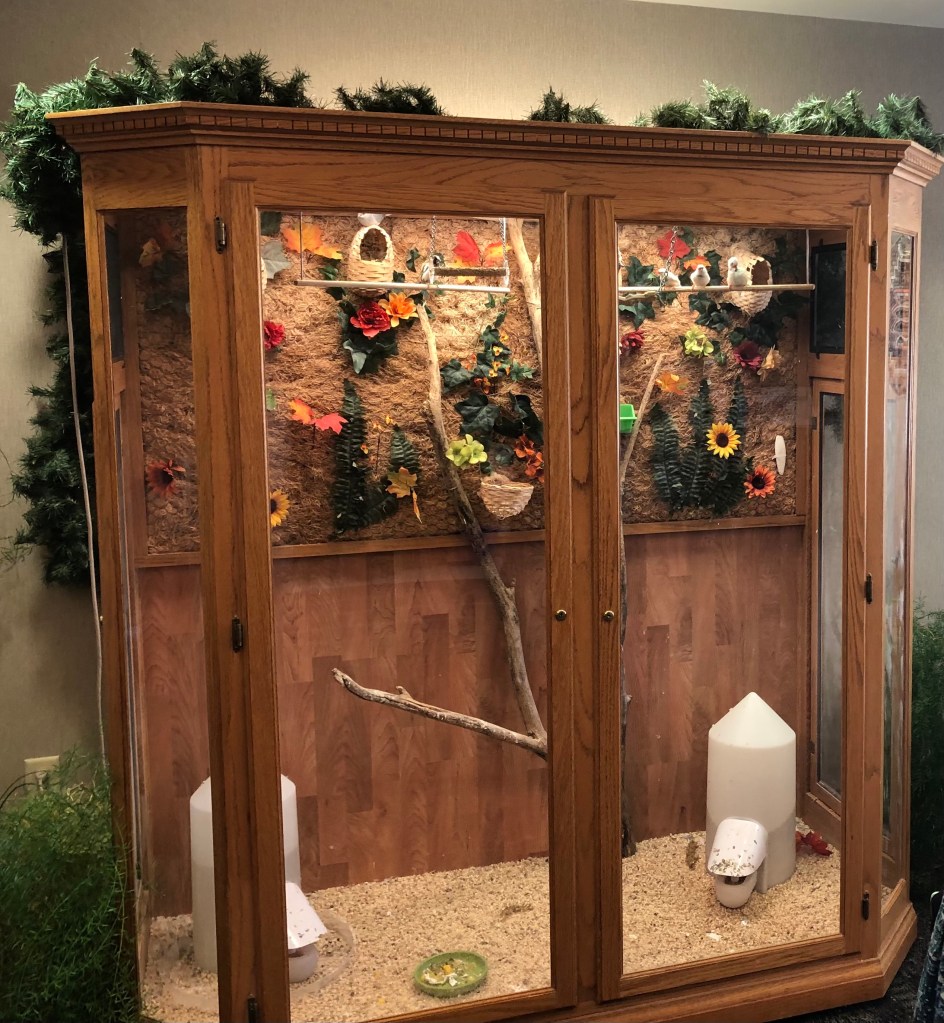
I mentioned how excited I was last week to be able to drive to Kansas for some vacation time.  I also had high expectations of scoring several new birds while I was there.  I mentioned the bust I encountered while visiting the wildlife refuge in Oklahoma.  The marshes were dry, and the birds scare, even though I was able to spot a Bald Eagle (Haliaeetus leucocephalus).  Having lived in Kansas I was confident I could identify an Eastern Meadowlark (Sturnella magna) since this is the Kansas state bird.  I also knew the pigeons are rampant in Wichita’s downtown section.  Even driving downtown and through the prairies I saw neither.  While I was able to id several different hawks, they were all too quick to get a picture.  At least I saw three different pair of parakeets at my mom’s new location.

When I looked online, I found that a parakeet is any one of many small to medium-sized species of parrot comprising multiple genera.  The name parakeet is derived from the French word perroquet, but is a pseudo-francism, as perroquet means parrot in French, while the French for parakeet is perruche.  The parakeet comprises about 115 species of birds that are seed-eating parrots of small size, slender build, and long, tapering tails.  The Australian budgerigar, also known as “budgie” (Melopsittacus undulatus), is the most common parakeet and was first described by zoologists in 1891.  It is the most popular species of parakeet kept as a pet in North America and Europe.  Budgies are the only species in the genus Melopsittacus.  In the wild, the species is green and yellow with black, scalloped markings on the nape, back, and wings.  Coloration varies in captive colonies. 

I was recently asked how many birds I had in my bird count.  The first year I was able to identify (and photograph) 32 different species.  This year I am up to 51 different species (with 2 ½ months left).  It is not that I have traveled more as much as I have been more attentive when I do travel and stop to photograph the birds.  Even though I saw three different variations of parakeet at mom’s, I knew I could not add them to my bird count.  The count is designed to identify the existence and range of wild birds, not captive birds. 

Thoughts:  Less than a century after being discovered by Europeans, parakeets were being kept as pets. British sailors returning from the east coast of Australia reported seeing huge flocks of small green birds, later identified as budgerigars.  According to legend, the merchants marketing parakeets in the early 20th century decided that the word “budgerigar” was too weird for Americans, so they marketed the bird as a “parakeet.”  The Carolina parakeet (Conuropsis carolinensis) was once a common bird known to people in in the East and Midwest America but had been hunted to extinction by 1918.  Extinction was the result of deforestation in the 18th and 19th centuries, combined with hunting for their feathers (women’s hats) and to reduce crop predation.  Much like the European beaver, the Carolina parakeet fell prey to the insatiable human need to “display.”  Do the work.  Follow the science.  Change is coming and it starts with you.
Wolf

October 21, 2021

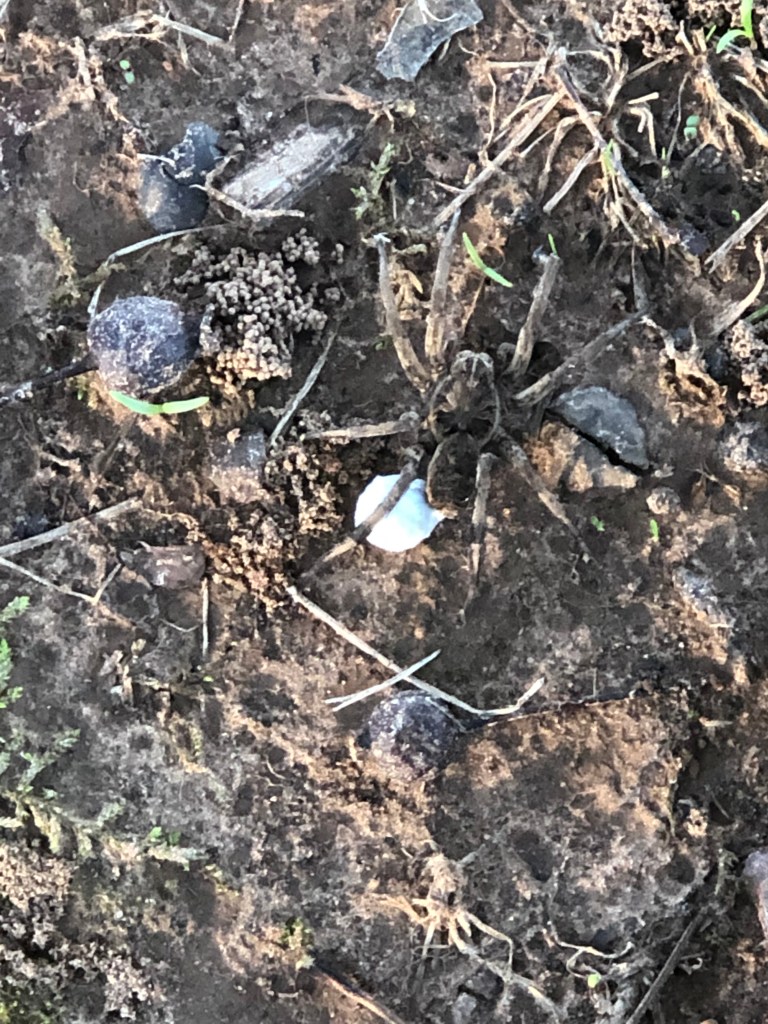
When I walked into the kitchen earlier this week, I noticed a large wolf spider on the floor.  While I realize it is the fall and the spiders are more active trying to get their egg sacs set before the winter, it still surprised me to see her indoors.  We spray our yard quarterly to keep down the ants and slugs that infest the green space (primarily for moles) and place a barrier around the exterior of the house.  I mentioned that while the black ants are still rampant in the yard, they have not been seen inside the house since we started spraying.  I know I brought the false widow from my mom’s yard last week.  I am certain Melissa brought the wolf when she began moving her succulents off the front porch and inside.  I put a glass over the wolf and moved it outside.

When I looked online, I found the Carolina Wolf Spider (Hogna carolinensis), is commonly found across North America.  It is the largest North American wolf spider, typically measuring .4-.8 inches (18–20 mm) for males and about 1-1.4 inches (22–35 mm) for females.  The wolf spider is mottled brown with a dark underside and males have orange coloration on their sides.  Wolf spiders live in either self-made burrows or ones they find.  Like all wolf spiders, H. carolinensis does not make a web to catch prey but instead hunt by ambushing prey from their burrows.  These spiders are particularly known for the females carrying their egg sacs on their bodies during the incubation period (note the white sac in the picture).  The Carolina wolf spider also has a unique type of venom that both paralyzes their prey and helps prevent microbes from their prey from infecting them.  Unlike the insects it preys on, the wolf spider can thermoregulate, which is important for animals that inhabit desert ecosystems or locations with large temperature swings.  That would include Arkansas.

When I was researching the False widow, one of the sites had suggested the way to capture and release a spider was to put a glass over them, then slide a ridged piece of paper under the glass, and then pick the captured spider up for release.  I had read this previously, and even practiced it on occasion.  I have always liked wolf spiders and thought this would be a good way to preserve the wolf.  Since we spray and granulate the yard, I thought it would be best to move the wolf to another location to help ensure its survival.  I placed it on the ground just off our spray boundary.  I noted there were already two small spider borrows in the bare ground I set it on.  I did not know what was in them but assumed it was other wolf spiders.  I hope this female and her brood will make it until next year.

Thoughts:  After I picked the wolf spider up in the glass, I offered to show it to Melissa.  Oddly, Melissa did not want to see the spider when I offered.   While Melissa may not have been impressed, others have been.   Hogna carolinensis was voted as the state spider of South Carolina in 2000 after an initial suggestion by a third-grade student.  While there is not a significant difference in the sprint speed of the Carolina wolf spider between males and females, there is a difference in chances a male or a female will flee from a threat.  Researchers believe that this is because male spiders do not own burrows as often as females, so they are not able to find a safe escape in their burrows as their female counterparts.  In humans this is known as the fight or flight response.  The response is triggered by the release of the hormones that prepare your body to either stay and deal with a threat or run away to safety.  There are some threats that we cannot run from.  That is why we develop vaccines.  Follow the science.  Change is coming and it starts with you.
Aster

October 20, 2021

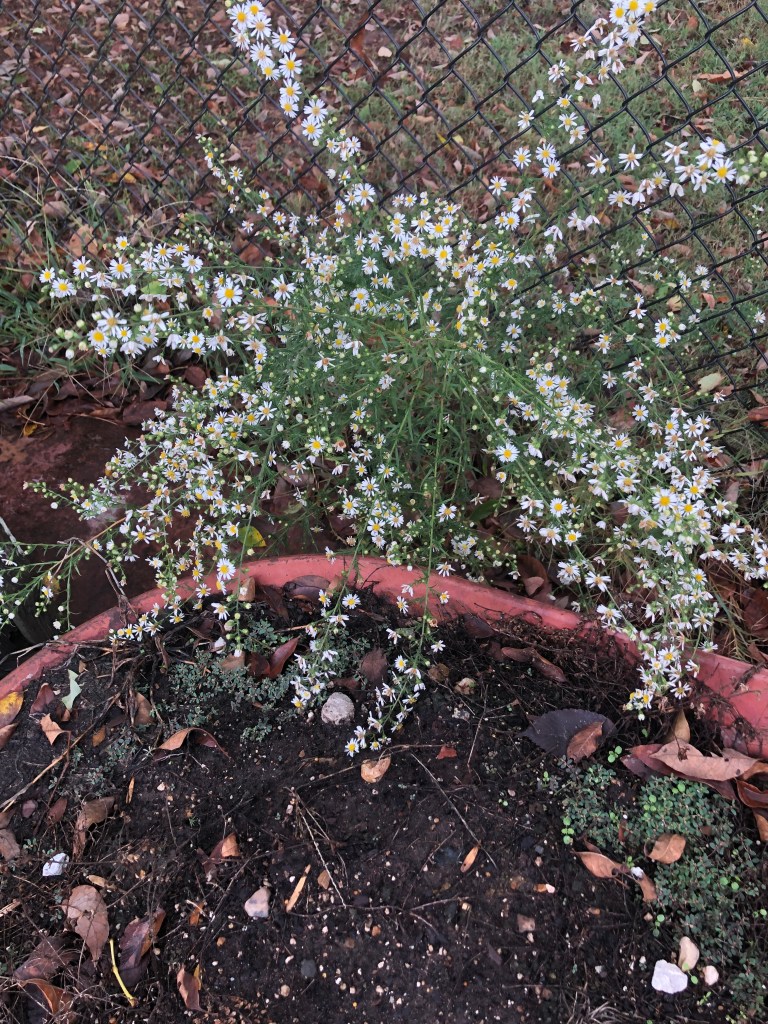
Over the weekend Melissa and I decided to do some fall cleaning on our yard.  The cool temperatures meant the grass was slowing down, but the leaves had begun to fall.  I am not a raker, and instead prefer to mulch the leaves into the ground.  This is not a gardening thing but is based on pure laziness.  Melissa set to weeding her succulent beds while I tackled the rose bush bed.  Since it was late in the year, I took the weed eater to the bed and then spread the last three bags of mulch that I had purchased last summer on the bed.  When I went to the back patio, I noticed there were several wildflowers growing through the fence.  I have not been as diligent in weed eating the back of the house as I have the front (no one sees the back, right?).  As I grabbed the invasive aster Melissa told me to stop.  She had enjoyed seeing this plant as she worked from her office nook.  I left it alone.

When I looked online, I found the Frost Aster (Symphyotrichum pilosum), is a flowering plant in the family Asteraceae that is native to central and eastern North America in both Canada and the US.  The aster is a perennial, herbaceous plant that may reach 8 to 47 inches (20 to 120 centimeters) tall.  Its flowers have white ray florets and yellow disk florets.  It is widespread and common throughout its range, and its natural habitat includes prairies, open woodlands, and outcrops.  In general, asters respond positively to disturbance, and often occupy sunny, weedy habitats.  The Frost Aster can be used to extend the floral season in gardens, as it blooms for about six weeks in autumn.  The common name derives from the tiny white hairs that sometimes lend its leaves a hoary appearance.  Frost Aster is aggressive, spreading by seeds and rhizomes.  Apparently, it also likes yards that are not weeded.

Members of the Symphyotrichum genus were originally classified in the genus Aster, which contained over six hundred species.  All 600 have all been reclassified into ten different genera.  The genus name Symphyotrichum is from the Greek sýmphysis, meaning “growing together,” and thríx, or “hair.”  The scientific naming of plants (botanical nomenclature) gives every plant a two-part name called a binomial.  The first name is the genus, and the second name is the species (taxonomy).  Since both names are (usually) derived from Latin roots, they are italicized to indicate a foreign origin.  Taxonomic systems were initially based on superficial relationships like similar reproductive features and other easily visible traits and did not take evolutionary ancestry into account.  As DNA technology advances botanists are reclassifying plants by their genetic relationships.  This has resulted in a flurry of recent name changes that have caused gardeners headaches as they try and keep up with the scientific names.  I find it a struggle to remember the common names.

Thoughts:  It is interesting to note that an Aster is identified as a perennial weed and a wildflower.  The Oxford Dictionary defines a weed as “a wild plant growing where it is not wanted and in competition with cultivated plants.”  Weeding then is “removing unwanted plants from an area of ground.”  The various Aster/Symphyotrichum species grow wild throughout North America.  In pastures they are called wildflowers.  In cultivated fields, they are called weeds.  When the same species is found in a flower garden, they are called perennial flowers.  Our understanding of the species is based on how it relates to our wants and needs.  While this may work for plants, we cannot allow this to be how we relate to people.  People need to be understood on their own merit and sense of place, not what is convenient to us.  Do the work.  Change is coming and it starts with you.