Surprised

September 25, 2021

After I commented on the Naked Ladies that were withering in the mailbox planter several days ago, I was surprised by new growth this morning.  The two Naked Lady lilies that had sprouted last week were now joined by eight new shoots poking almost a foot (30 centimeters) out of the ground.  When I went back and checked last year’s post (Naked, August 26, 2020) on the flower I found that it had followed a similar pattern.  Two shoots had grown up, blossomed, and had begun to wither only to be followed by the other eight.  The difference this year is that it happened in late September, a month later than last year’s late August blooms. 

When I rechecked the plants online, I found they were called Surprise lily (Lycoris squamigera), as well as naked lady and resurrection lily.  Its common names come from its habit of growing leafless flower stalks and blooming after a brief period of summer dormancy.  In this case it was nearly three months of dormancy.  This was probably due to the extended heat spell, with temps finally falling into the high 50’sF at night this last week.  The plants are called “resurrection” as the lush leaves die and wither prior to summer dormancy.  They are called “naked” as the stalks (called scapes) shoot up months later without any accompanying leaves, but just bare stocks.  They are called “surprise” because of the rapid growth as the 1-inch-thick, leafless stems suddenly pop from the ground.  All three names are apt.

I was pleasantly surprised to see the shoots emerge from the ground.  I had uncovered several of these waiting in the ground when I prepared the soil for the mum planting but had not recognized them to be the Ladies.  I seem to forget about these flowers every year.  Last year I got too close with my weed eater and cut two of the flowers down.  I will try and be more careful this year.  I learned another important fact online as well.  If you repeatedly mow or cut it back the lush clumps of surprise lily’s springtime foliage, you will prevent the flowers and eventually kill the bulbs.  Since they are in the planter, I avoid mowing them and although I pull the dead foliage, it usually takes a couple of weeks to happen.  So far, this approach has worked.

Thoughts:  I was not surprised to learn the plants need virtually no water after their foliage dies and they go dormant during the summer.  I rarely water the mailbox planter.  I allow the spring rains to work and then the plants are on their own.  The hen and chick succulents do not care but the hibiscus has died back this year.  The pruning guide suggests you cut any dead stems or branches down to about 8 to 12 inches (20-30 cm.) in the fall and then apply a protective cover of mulch.  I may try that as now it is hanging dead on its trellis.  I am continually being surprised by the growth habits of all our plants.  Each is unique and often quite specific.  My ICU nurse friends tell me their covid patients constantly act surprised.  They have gone from believing it to be a hoax, to refusing to be a sheep (vaccinate), to a hospital ventilator.  While cases seem to again be on the decline, it is too late to be surprised for over 690,000 people in the US.  Follow the science.  Change is coming and it starts with you.

Injuries

September 24, 2021

I have mentioned that I had two tremendous picks in the Fantasy Football Draft four weeks ago.  My first pick was the number one overall pick Christian McCaffrey and my second was Patrick Mahomes.  Both have put up amazing stats for the first two games, despite Mahomes and the Chiefs losing to the Ravens 35-36 on Sunday night.  Both players had suffered injuries last season, with McCaffrey limited to only three games while Mahomes sustained a concussion and torn plantar plate (turf toe) in his left foot during the playoffs.  I was hoping for their sakes they could play the season without injuries, as well as letting me ride their production into the Fantasy Playoffs.  That hope is now questionable as McCaffery suffered a hamstring injury in last night’s game.

The game commentators mentioned how many Panthers were already injured prior to the start of the game.  When I checked online, I found that as of today there were already 16 injured Panthers three weeks into the season.   Of these 4 are on injured reserve, 5 were listed as questionable for Week 4 (including McCaffrey), and 7 were inactive during last night’s Week 3 game.  The panthers are not the only team who appear to be suffering from a rash of injuries.  Every team in the National Football League has been plagued with injuries this 2021 season, and many took place before the season officially started.  Some say it may be because of the pandemic that a lot more injuries happen. 

A similar situation with injuries occurred in Major League Baseball this season, and covid and the response is again blamed.  The 2020 season saw players ramp up during spring training in February or March, then return home for four months as the pandemic interceded, followed by an abbreviated “summer camp” in July and then a 60-game season.  While the winter should have provided a reset, the 12-month rhythms many have lived for more than a decade (physically, mentally, and emotionally) were disrupted.  James Gladstone, head of sports medicine at New York’s Mount Sinai Health System said, “The whole last year really threw people off; in part, injuries may be a result of that . . . The psyche of pretty much everyone in the world was affected by this covid pandemic.  It’s hard to directly correlate the two sometimes, but I think there’s some kind of connection.”

Thoughts:  The covid protocols over the last two years have disrupted sports on all levels.  Last year youth traveling teams tried to proceed as if there was no pandemic, only to find themselves struggling with travel restrictions and rising case numbers.  Some high impact college players sat out for a year to avoid any worst-case scenario.  Now that vaccines are available stands are full of screaming unmasked fans, and players at all levels are increasingly facing injuries.  It is interesting how every problem in life now seems to be blamed on covid.  When injuries increase, it is blamed on covid.  When supply chains do not work, it is blamed on covid.  When the takeout food order is messed up, it is blamed on covid.  It may be that “there’s some kind of connection,” but at times the connection seems to come from a loss of effort.  The pandemic is the new reality, but it can only defeat us if we quit adapting.  Or trying.  Follow the science.  Do the work.  Change is coming and it starts with you.
Mums

September 23, 2021

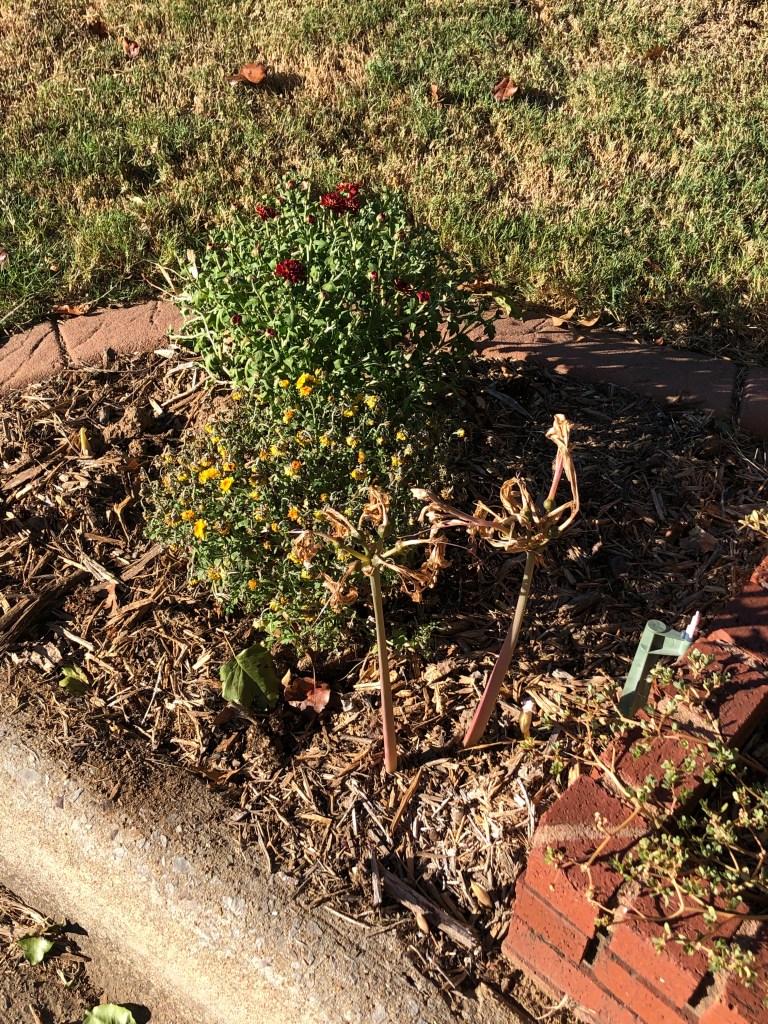
Several weeks ago, I finally gave up hoping the dehydrated mums in the mailbox planter were ever going to come back.  I pulled them out and threw them in the trash.  Not long after, the naked ladies that had sprouted leaves in the spring decided it was time to raise their flower stalks.  While these are pretty, they only bloom about a week and now they are on the decline.  Even though it has been hot there are predictions of cooler weather ahead, and that prompted Melissa to make a run to the local market to see what was left in the outdoor flower section.  When we arrived most of the flowers and all the vegetables were gone.  They did have a display of tiny succulents (Melissa already had them), a few varieties of pansies, and several sizes of different mums.   I would not have bought anything, but Melissa wanted some color in the planter.  We came home with four pansies and two mums.

When I looked mums up online, I found that the hardy mum (Chrysanthemum morifolium) is valued in landscaping because they primarily bloom in the fall, adding to a four-season interest in your yard.  The varieties of mums come in a wide array of colors, as well as different flower forms, growth habits, and petal arrangements.  Mums generally hit their stride in late summer.  Like poinsettias, they are photoperiodic, meaning they rely on specific amounts of light to send the signal that it is time to start blooming.  Though technically perennials, mums are often grown as annuals, being planted in the fall already in bloom and then discarded once the cold weather starts.  They have a shallow root system and tend to heave out of the ground during the winter freeze-thaw cycles.  That happened to my mums.

Between work and the prediction of 90F’s temps next week Melissa was reluctant to plant the pansies.  They were careful placed on the screen porch where Melissa could care for them until they could safely go in the ground.  The Mums had been placed on the front walk with the expectation they would be planted and were beginning to dry out in the heat.  I decided it was time to get the mums in the ground before it was too late.  This mailbox bed has a variety of bulbs that produce new flowers and leaves in the spring and early fall.  As I carefully extricated the Bermuda grass that grows through the mulch, I came across several bulbs that I tried not to disturb.  Then I dug up the soil in the corner where it was safe to plant and placed the mums in the ground.  A last drench of water and they were officially planted.  They were scraggly, but it least there was a little color.

Thoughts:  When I directed camp our main meeting was in October.  One year I found two mums about three feet across the local nursery was trying to get rid of at the end of season.  These made the perfect splash of color to frame the entrance of the building.  Several years ago, horticulturists at the University of Minnesota developed a new chrysanthemum hybrid described by breeder Neil Anderson, as a “hardy shrub mum.”  The Mammoth Series mums can measure 2 to 3 feet (.6 to .9 meters) tall and 4 to 5 feet (1.2 to 1.5 meters) across by their third season and sport a massive canopy of flowers with up to 5,000 per plant.  Mums, like people, seem to flourish best when they are in their own niche.  The barrios or Spanish speaking neighborhoods in the southwest US have counterparts in the Chinese, Japanese, or Korean towns of larger US coastal cities.  There is a difference between settling together to feel comfortable and being red-lined and/or forced to only live in specific areas.  A variety of locations with affordable housing should be available to all.  Do the work.  Change is coming and it starts with you.
Plants

September 22, 2021

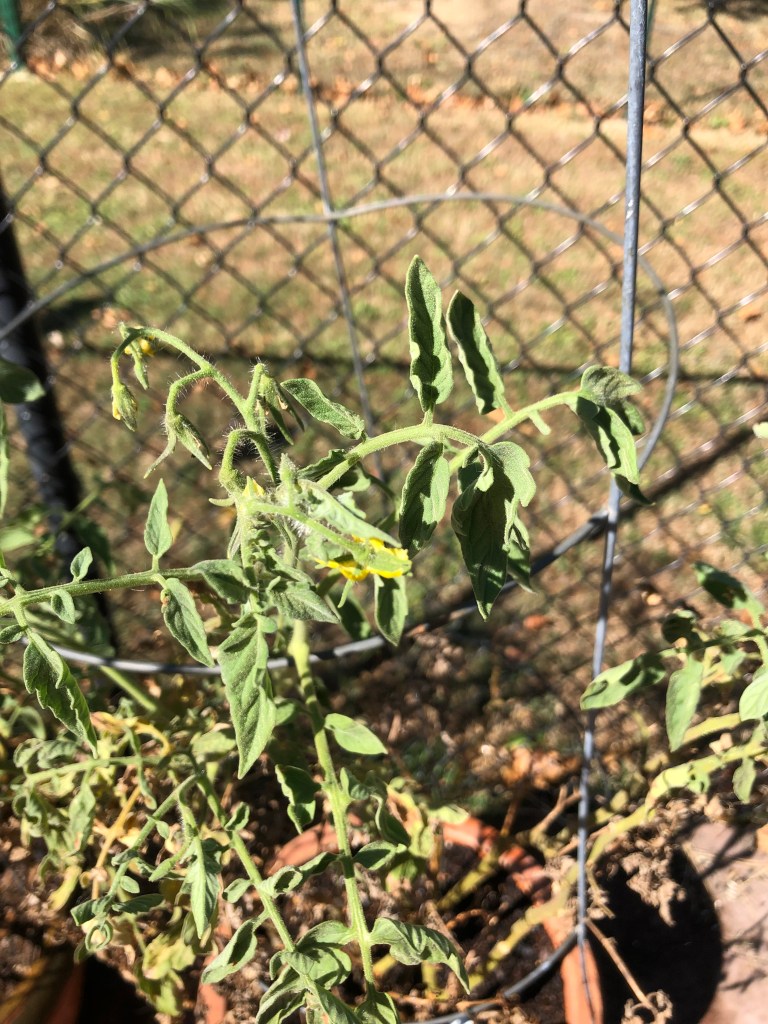
I had been thinking about tearing out the withered plants I had put in my containers this spring for the last several weeks.  While the bell peppers are all doing okay (but small!), the poblano and tomatoes seemed to no longer produce.  Even the cherry tomatoes have begun to decline, and I was not noticing new flowers.  Cleaning out the containers is an annual event, but last year it did not occur so early in the season.  Over the last week the temps have dropped from the 90F’s to the 80F’s and even the humidity has been lower.  The weather people who had bemoaned the ravages of summer still with us are now worrying about the early onset of fall.  While it is their job to report, and commiserate, the coming trends for us on air it always seems there is no pleasing them.  Rather than making a move on my container plants, I choose to ignore them.

When I looked online to refresh myself on the area’s growing season in the Farmer’s Almanac, I instead came across information on the best plants for a fall garden.  Putting plants in the ground during late summer for a fall harvest has many benefits but the challenge is getting your crops harvested before the winter frosts.  I have already missed the optimal dates for most “fall” plants, which are August to early September.  Our Almanac predicted first frost is October 31, which is only 39 days away.  When you calculate fall plant dates you need to account for both the time to harvest the mature crop and whether the crop is tender or hardy when it comes to frost.  As a rule of thumb, Broccoli, Brussels sprouts, cabbage, cauliflower, carrots, and celery need 10-12 weeks before first frost (missed).  Arugula, Chinese cabbage, collards, kale, lettuce, mustard greens, spinach, Swiss chard, and turnips need 8-10 weeks (close, so maybe).  Beets and radishes need 6-8 weeks before first frost (doable).  This can be extended 2-3 weeks if you plan to protect your plants with cold frames or row covers.

The birds that had been availing themselves to my feeders seemed to be taking the summer off to forage naturally for the last two months.  Since all I was doing was feeding squirrels, I became lax on keeping the feeders full.  Melissa noticed several of the larger birds (Cardinals and Jays) have begun to return and check out the (usually) empty feeders.  When I went out to refill the seed, I also noticed the plants I had given up on were again starting to produce.  I had flowers on the three tomatoes and even the poblano.  The jalapenos were both covered with small (2 inch/ 5 centimeter) fruit.  Maybe I should just keep tending these regrowth plants and put some beets in the onion bed.  Whatever, it will need to be done fast.

Thoughts:  When my older brother was in high school there was a short kid who always tried out for the basketball team.  Throughout Junior High his coaches had not discouraged him, but neither was he encouraged.  During his sophomore year he finally got his growth spurt and shot up eight inches.  By his Junior and Senior years, he played as the team’s star center.  Whether it is a coach giving up on a small boy or me giving up on my withered plants, it is often done too quickly.  All things seem to age and mature at their own rates, and at different times.  When we encourage others to try and do their best at whatever they enjoy, we give them a chance to excel.  Even if they never become the superstar they dreamed of as a child, they can find enjoyment at whatever level they obtain.  Our job is to encourage and support others in whatever their endeavors.  Do the work.  Change is coming and it starts with you.

Tip

September 21, 2021

Melissa and I are going out to eat tonight and this will raise the issue of how much to tip.  Prior to the pandemic I tried to tip at least 15% of the tab.  I have noticed in fancier restaurants that for larger parties a tip of 15% may be included in the actual bill.  This happens because often much smaller tips are given to the wait staff.  I often notice that a $1 tip will be put on the table in small restaurants and cafes regardless of what the tab might be.  For me, if I cannot afford to pay for my food, and my service, I should not be eating in a restaurant.

Most people we tip in America are in the Service Industry and represent people who are often not valued for their work, and who are not being paid compared to the services they provide.  The American Hotel and Lodging Association recommends certain amounts to tip based on what the employee does.  The housekeeping staff are tipped $1 to $5 a night, and the same for the valet, while an extra $2 is recommended for extra items brought to your room (blankets).  Room service, bartenders, and wait staff the tip is 15-20% of your bill, and the same holds for servers in restaurants. 

Professor Michael Lynn of Cornell University’s School of Hotel Administration paid his way through school by waiting tables and bartending.  Since that time, he has published more than 50 papers on the topic.  These papers examine everything from racial bias in how we tip to whether giving after-dinner candy increases a server’s tips (it does).  Lynn describes five basic motives for the tip.  Some people tip to show off.  Some people tip to help the server by supplementing their income and make them happy.  Some people tip to get future service.  Other people tip to avoid disapproval from the wait staff or other diners.  And some people tip out of a sense of duty.  The amount of the tip may be seen as a reward to the servers for their service.  If the server does a great job, I want to express my gratitude, but Lynn found less than four percent of the differences in tips left by different dining parties can be explained by their ratings of service quality.

Thoughts:  In the movie, My Blue Heaven, Steve Martin plays a Mob informant who tips everyone.  As he says when asked why he tips, his response is. “I don’t just tip, I practice grossly over tipping.”  This was done to both win the favor of others and as a recognition they were being undervalued in the first place.  During the pandemic people working in the Service Industry were hard hit as restaurants and hotels were forced to close.  Even after they began to reopen it was often at reduced capacity.  While owners made decisions of closure or paying less, staff decided if they were willing to work in the new conditions or stay safe at home.  Melissa and I now tip 18-20%, and more depending on service.  To me, the workers who bring my food are essential.  Do the work.  Change is coming and it starts with you.
Trash

September 20, 2021

When I went to start our convertible last week, the battery had gone dead.  This was not a total surprise as we do not drive it very often.  Even though I realized I need to start it and drive around to keep it charged I allowed other things to take priority.  What worried me was the starter was frozen as well.  When I called a repair shop about the starter, I was informed the key fobs on the vehicle will not turn if the battery is completely dead.  If the switch had gone out, I would need to tow the car to a dealership 70 miles away to get it replaced and calibrated.  That meant I needed to get a tow truck to either jump my battery or give me a tow.  I did find it interesting that even though I had not been driving the vehicle, there was still trash from a takeout meal in the passenger seat.  I threw it in the trash container.

When I looked for trash online, I found a reference to Mr. Trash Wheel.  This device is officially called the Inner Harbor Water Wheel and is designed as a trash interceptor to remove trash from the Jones Falls River as it empties into the Inner Harbor in Baltimore, Maryland.  Mr. Trash is powered by water wheels and solar cells, and places trash from the harbor onto an onboard conveyor belt which routes it into dumpsters on the vessel.   Mr. Trash Wheel was invented by John Kellett in 2008, who launched a pilot vessel which was replaced by this larger vessel launched in May 2014.  After the first significant storm on April 20, 2015, Mr. Trash Wheel removed 19 tons of trash from Baltimore’s waterfront on that one day.  Over a million pounds of trash has been pulled out of the water by Mr. Trash Wheel since it was installed.  A second water wheel has since been constructed for use at the Harris Creek outfall near Baltimore.  This second trash wheel is nicknamed Professor Trash Wheel.

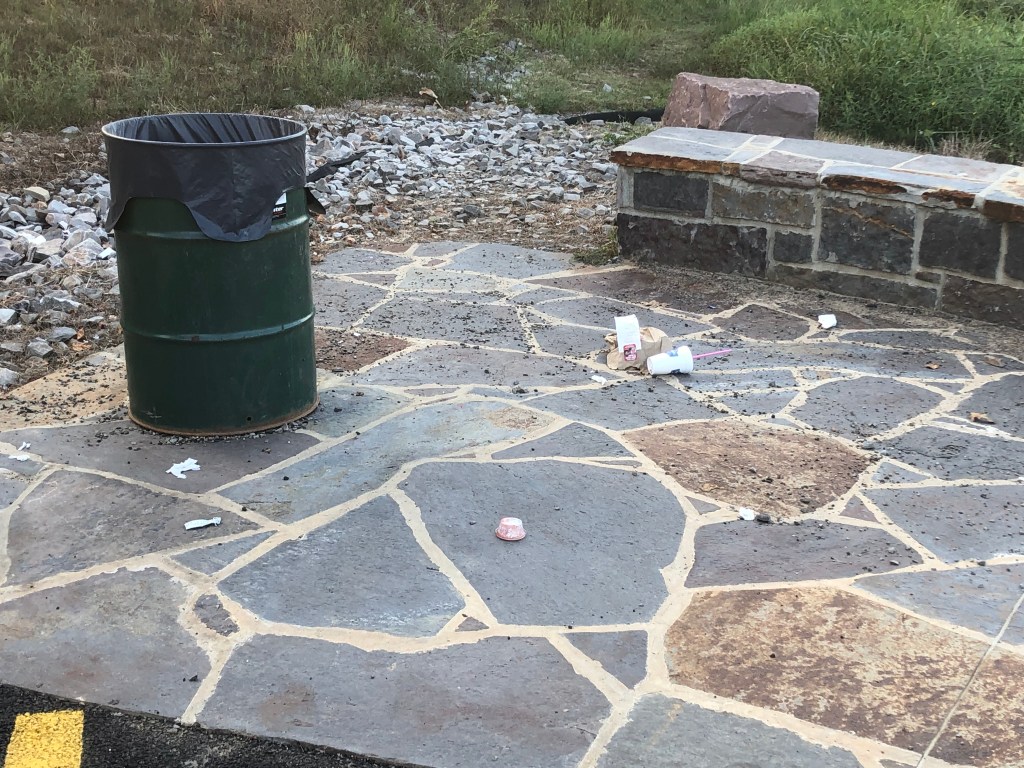
When the tow truck arrived, the driver did not know how to get under the hood.  I popped the latch, showed him where the battery was (under the air intake), and watched as he attached the cables to my car.  This was obviously not a mechanic.  When I got in the key fob turned and the car turned right over.  When the driver checked however, the battery was bad, so I drove to the store and purchased a new one.  On Sunday we did take the car out for a drive.  We toured the lake and I showed Melissa the new improvements.  As we drove into the parking lot, I noticed the trash can next to the sitting bench.  Someone had obviously eaten a takeout meal on the bench six feet from the can and thrown their trash on the ground at their feet.  It is no wonder the Native American cried in the 1970’s promotion asking us to keep our country clean.  I picked it up and put it in the trash.

Thoughts:  Keep America Beautiful found in a 2020 study that there are an estimated 26 billion pieces of litter along the banks of the nearly 11 million miles of US waterways. The National Resource Defense Council states that, “Around 80% of marine litter actually originates on land – either swept in from the coastline or carried to rivers from the streets during heavy rain via storm drains and sewer overflows.” The large plastic drink cup thrown out the window could now be in the Mississippi River and on its way to the Gulf of Mexico.  It is hard to get trash to the landfill when it does not even make it six feet to the trash can.  Do the work.  Follow the science.  Change is coming and it starts with you.

Fast

September 18, 2021

I have been practicing an intermittent fast almost two years.  This was originally Melissa’s idea for us to do together, but she dropped off when she became sick last year.  While we began our fast as a form of diet, it is more correctly described as an eating pattern that cycles between periods of fasting and eating.  The fast doesn’t specify which foods you should eat but rather when you should eat them. Common intermittent fast methods involve daily 16-hour fasts or fasting for 24 hours twice per week, but other intervals of fast are also used.  We chose the 16-hour fast and decided our fast would be from 8 pm to noon the following day.  The initial problem I had with the fast was that it cut out my favorite meal of the day, breakfast.

When I looked online, I found breakfast is the first meal of the day eaten in the morning after waking from the night’s sleep.  The word in English refers to breaking the fast period of the previous night.  While there are “typical”, or “traditional”, breakfast menus in different countries, their composition varies widely from place to place, and this has also varied over time.  While breakfast is commonly referred to as “the most important meal of the day”, some contest the positive implication breakfast’s “most important” status.  Some epidemiological research indicates that having breakfast high in rapidly available carbohydrates increases the risk of metabolic syndrome.  While professional opinion is largely in favor of eating breakfast, skipping breakfast might be better than eating unhealthy foods.  The influence of breakfast on managing body weight is unclear.

Even though I have practiced the intermittent fast for nearly two years, I am not always strict in my adherence.  In part, this is due to my love of breakfast.  I often eat breakfast when I go out to eat, especially when I travel and choose one of the roadside dives to grab a meal.  My thought has been that breakfast is the hardest meal to screw up.  Melissa and I also have a tradition of making Saturday morning breakfast since we first got married.  This involves bacon (or sausage), eggs (me over easy and Melissa scrambled), potatoes (preferably home fried), and toast.  Occasionally I will break down and fix a meal to break the fast on a Saturday morning.  That is what I did today.

Thoughts:  The fast has been a practice throughout human evolution.  Ancient hunter-gatherers did not have supermarkets or even available year-round food, and sometimes they could not find anything to eat.  This allowed humans to evolve to be able to function without food for extended periods of time.  Scientists tell us that fasting from time to time is more natural than always eating 3 or 4 (or more?) meals per day.  The fast is also done for religious or spiritual reasons by practitioners of the worlds four major religions: Islam, Judaism, Christianity, and Buddhism.  While dieters or religious practitioners may practice the fast, many with food insecurities fast because of a lack of food.  Around 811 million people in the world still go hungry.  After a steady decline for a decade, world hunger again affects 9.9% of people globally.  This resurging crisis is driven by conflict, climate change, and the pandemic.  Humans have the ability to make a positive change in all three areas.  If we want to.  Do the work.  Follow the science.  Change is coming and it starts with you.

Boar

September 17, 2021

One of the teasers as you browse the big outdoors store is the maze of specialty foods and candies you need to traverse to get out the door.  While I generally do not pay them much attention, we had eaten an early lunch and were killing time before going for dinner.  I found this like going to the grocery story on an empty stomach.  All the junk food you usually resist somehow ends up in your basket.  We started looking at the different types of jerkies, but I resisted.   Then came the old-fashioned candies, including a variety of licorice sticks, but I resisted.  Then Melissa came to the checkout with a chunk of peanut butter fudge and a Payday bar in the basket, and that made me waiver.  The last hurdle was the checkout itself.  They had Cherry Mash bars I had not seen in years and Sugar Daddy bars on a stick that we both used to love, and that is where we folded.  I added one of each and Melissa got a Snickers bar for measure.  By that time, I was lost and went back to retrieve a package of Wild Boar jerky.

When I looked online, I found the wild boar (Sus scrofa), or wild pig, is a Suidae native to much of Eurasia and North Africa and has been introduced to the Americas and Oceania.  The species is now one of the widest-ranging mammals in the world.  It has been assessed as least concern on the IUCN Red List due to its wide range, high numbers, and adaptability to a diversity of habitats and has become an invasive species in part of its introduced range.  Wild boars probably originated in Southeast Asia during the Early Pleistocene and then spread throughout the Old World.  The species lives in matriarchal societies consisting of interrelated females and their young (male and female), while full grown males are solitary outside the breeding season.  The wild boar has a long history of association with humans and is the ancestor of most domestic pig breeds.  Boars have also re-hybridized in recent decades with feral pigs.  These hybrids have become a serious wild animal pest in the Americas and Australia.

The wild boar and boar-pig hybrids of America cause problems as they out-compete native species for food, destroy the nests of ground-nesting species, kill fawns and young domestic livestock, destroy agricultural crops, and eat tree seeds and seedlings (is that all?).  Boars also destroy native vegetation and wetlands through wallowing, damaging water quality.  They are known to come into violent conflict with humans and pets and carry both pig and human diseases which may be transmitted.  While both captive and feral (“razorbacks”) domestic pigs have been in North America since the earliest European colonization, pure wild boars were not introduced into the New World until the 19th century.  The suids were released into the wild by wealthy landowners as big game animals and were contained in fenced enclosures.  Escapes occurred and the escapees intermixed with established feral pig populations.  This seems to be a consistent pattern.

Thoughts:  The boar jerky I purchased was produced by a ranch in New Mexico.  They are a sport hunting ranch that raises Elk, Bison, Deer, and Cattle.  Each meat is also turned into their specialized (read expensive) jerky.  The boar jerky package assured me this was made from the meat of feral hogs (not wild boar).  The meat of the feral hogs was like other wild meats, and the jerky was greasy.  I have seen several documentary series on TV that feature the capture and elimination of feral hogs in Texas and Louisiana.  Feral hogs (razorbacks) are even considered a pest in Arkansas and the AR Game and Fish Commission do not consider the hogs wildlife.  This is another species released by humans that we cannot control.  Perhaps we should learn a lesson.  Follow the science.  Change is coming and it starts with you.

Granddaddy

September 16, 2021

When we were up at the reservoir fishing last week, I stopped by the “facilities” and was surprised by the number of granddaddy longlegs there were in the open building.  I grew up in an older house that had a variety of bugs all over the outside.  I recall times where literally thousands of boxelder bugs (Boisea trivittata) would cluster to sun themselves on the south facing wall of the building.  I have since learned they may have also been seeking an entry point to overwinter behind the clapboard siding.  What I considered the back porch was a wraparound sitting porch originally intended as the front porch of the house.  This was secluded and rarely used and accumulated the paper wasp (Polistes gallicus) nests I spoke of previously.  The other species I recall were the granddaddy longlegs.  My younger brother and I used to try and get them to crawl onto our hands and arms to feel them tickle.

When I looked online, I found that my beloved little spiders are not spiders at all.  The Opiliones (formerly Phalangida) are an order of arachnids colloquially known as harvestmen or granddaddy longlegs. To date there are over 6,650 granddaddy species worldwide, although the total number of extant species may exceed 10,000.  Representatives of each of the five extant suborders can be found on all continents except Antarctica.  While granddaddy longlegs do not have fangs and do not make venom, they do have chelicerae (tiny claws used to hold and tear food), that allow them to eat small pieces of solid food while spiders subsist on a liquid diet.  They are easily distinguished from long-legged spiders by their fused body regions and single pair of eyes in the middle of the cephalothorax.  Spiders have a distinct abdomen that is separated from the cephalothorax by a constriction, and they have three to four pairs of eyes around the margins of the cephalothorax.  Mine were not spiders.

According to entomologists at the University of California, Riverside, the term granddaddy longlegs is commonly used to refer to two distinct types of creatures: opilionids arachnids with pill-shape bodies and eight long legs that are not spiders, and pholcids, which have eight long legs and small bodies, that resemble opilionids but are true spiders.  Unlike spiders, granddaddy longlegs cannot spin silk.  They are beneficial in your home and garden.  They are omnivores with a varied diet.  The granddaddy will eat everything from spiders, insects, worms, snails, bird droppings, and fungus. The granddaddy is like a natural pest control for your yard and garden.  They are mostly nocturnal and like to hang out in dark moist locations (like the bathroom at the lake and our back porch).

Thoughts:  A widespread myth holds that the granddaddy longlegs are the most venomous spiders in the world.  The myth tells us we are only safe from their bite because their fangs are too small and weak to break through human skin.  Because the Pholcid’s (long-legged spiders) rarely bite, scientists have never bothered to conduct research to determine their venom’s toxicity to humans.  In 2004, the show “Mythbusters” set out to coax a granddaddy longlegs spider into biting the arm of the show’s co-host, Adam Savage.  The spider was able to penetrate Savage’s skin, and he reported nothing more than a very mild burning sensation from the venom that lasted just a few seconds.  The myth was busted.  While most myths are based on some facts or actual events, others like the granddaddy are retold without any factual basis.  This is true with most of the myths around the covid vaccine.  It does not contain tracking chips or make males sterile.  What it does do is save lives.  Follow the science.  Change is coming and it starts with you.

Critter

September 15, 2021

Melissa sent me a link to an article by John Green for The Hutchinson News.  It seems Kansas State Fair officials judging 4-H entomology entries last week discovered one display included a Spotted Lanternfly.  A specimen of the invasive species was found pinned on a 4-H student entomology display at the state fair.  The student had properly identified it as a spotted lanternfly but was unaware the bug was an invasive species that has prompted quarantines in at least 45 counties in Pennsylvania and New Jersey to stop its spread.  “We had one entomology issue,” Fair Board member Gregg Hadley, Director for Extension at K-State Research and Extension, advised the rest of the board Friday morning. “It was a dead one, but it was in a critter box.”  That triggered a federal investigation.

When I looked online, I found the Spotted Lanternfly (Lycorma delicatula) is a planthopper indigenous to parts of China, India, and Vietnam.  It has spread invasively to Japan, South Korea, and the United States.  Although it has two pairs of wings, it jumps more than it flies.  The critter cannot harm humans or pets, but they cause massive damage to plants and are known to feed on over 70 different types of trees and plants.  The insect deposits sticky honeydew excretions that then grow mold which prevents plants from photosynthesizing and causing the plants to die.  The critter feeds on some 70 different plant species and has spread widely since showing up in Pennsylvania in September 2014.  By 2020 was an invasive species throughout the Delaware River Valley (Eastern US).  It is believed it arrived on cargo from China.  In its native habitat, it is kept in check by natural predators or pathogens.  Neither exist in the US.

I was intrigued by the word critter associated with the entomology display (critter box) and did some research to find out where the term came from.  The Free Dictionary defines crit·ter (krĭt′ər) n. Informal, as, 1. A living creature, 2. A domestic animal, especially a cow, horse, or mule, 3. A person.  A word history was also provided for critter.  It seems many regional dialects considered the word bull (adult male bovine) to be highly taboo.  When speaking in mixed company, people would substitute another word, calling the bull a booman, brute, gentleman cow, or surly.  In the Northeast, critter was a common word used to avoid saying bull, both by itself and in combinations like beef critter and cross critter.  The most common meaning of critter is “a living creature,” whether wild or domestic.  It also can mean “a child” when used as a term of sympathetic endearment, or it can mean “an unfortunate person.”  Critter originates as a dialectal variant of creature, but owing to the pronunciation spelling critter, the term has taken on something of a life of its own as a separate word.

Thoughts:  Residents in quarantine areas for the spotted lanternfly are asked to follow a checklist before moving vehicles or other outdoor items out of the quarantine areas to ensure they aren’t transporting the bug or its eggs.  As an entomology judge Hadley was familiar with the critter and the requirement for reporting it to the USDA’s Animal and Plant Health Inspection Service.  The USDA will investigate to trace how the insect moved 1,100 miles to Kansas.  “They think it came in on a camper,” Hadley said.  Since the insect was dead, the student was allowed to enter the exhibit.  This critter was able to travel from China to Pennsylvania on a cargo ship and from Pennsylvania to Kansas on a camper.  The advantage of globalization is it allows rapid movement of goods over vast distances.  The disadvantage is it allows rapid movement of invasive species and pathogens over vast distances.  This has been true since the beginning of human interaction and resulted in the demise of Indigenous peoples around the globe during colonialization.  Humans need to constantly monitor the baggage we bring with us.  Follow the science.  Change is coming and it starts with you.