Reserves

November 30, 2021

One week after President Biden tapped into US oil reserves to help with a global shortage, a Canadian group has announced that it will dip into its emergency reserves of maple syrup to try to keep up with global demand.  The Canadian leading trade group, Quebec Maple Syrup Producers, is releasing nearly 50 million pounds of its reserve, which is about half of the stockpile, according to CNN Business.  The trade group is backed by the Canadian government and is at times dubbed the “OPEC of Maple Syrup.”  As of 2020, Quebec produced 73 percent of the world’s supply of maple syrup.  The US is by far the largest buyer of Canadian Maple Syrup.  The reserve was created to prepare for situations when there are poor harvest seasons or a spike in demand for maple syrup.  This year saw uncharacteristic warmth in a short spring, which gave maple syrup harvesters little to work with.  An additional 7 million trees will be tapped for maple syrup this season to replenish the group’s supply to ensure demand is met, and to allow people to continue enjoying maple syrup without delay.

When I looked online, I found Maple syrup is usually made from the xylem sap of sugar maple (Acer saccharum), red maple (Acer rubrum), or black maple (Acer nigrum) trees, although it can also be made from other maple species  In cold climates, these trees store starch in their trunks and roots before winter, and the starch is then converted to sugar that rises in the sap in late winter and early spring.  Maple trees are tapped by drilling holes into their trunks and collecting the sap, which is processed by heating to evaporate much of the water, leaving the concentrated syrup.  Most trees can produce 5 to 15 US gallons (20 to 60 liters) of sap per season.  Maple syrup was first made and used by the Indigenous peoples of North America and was adopted by European settlers, who gradually refined production. Virtually all the world’s maple syrup is produced in Canada and the US, and the Canadian province of Quebec is responsible for 70 percent of the world’s output.

Maple syrup is graded according to the Canada, US, or Vermont scales based on its density and translucency.  Sucrose is the most prevalent sugar in maple syrup.  In Canada, syrups must be made exclusively from maple sap to qualify as maple syrup and must also be at least 66 percent sugar.  In the US, a syrup must be made “almost entirely” from maple sap to be labelled “maple”.  The states of Vermont and New York have more restrictive definitions.  Maple syrup is often used as a condiment for pancakes, waffles, French toast, oatmeal, or porridge.  It is also used as an ingredient in baking and as a sweetener or flavoring agent.  Culinary experts have praised its unique flavor, but the chemistry that produces the flavor is not fully understood.  I have found that “Maple flavored” is not the same.

Thoughts:  The Canadian maple syrup supply has faced issues in the past.  In the 2011-2012 harvest, C$18.7M worth of maple syrup (3,000 long tons; 3,300 short tons), was stolen in what has come to be known as “The Great Canadian Maple Syrup Heist”.  Over the course of several months the contents of 9,571 barrels were stolen from a storage facility in Saint-Louis-de-Blandford, Quebec.  At first the thieves refilled the barrels with water, but as the operation progressed, they stopped refilling them.  When an annual inventory occurred in July 2012, the Inspector inventorying the barrels found them empty.  In December 2012, police arrested 17 men related to the theft.  Humans have been creating reserves of commodities since our inception, and many count the ability to produce and store grain as the advent of civilization.  In our globalized world, what to store as reserves and when to release it becomes critical.  Reserves are to be shared not hoarded.  Follow the science.  Change is coming and it starts with you.

Coffee

𝘕𝘰𝘷𝘦𝘮𝘣𝘦𝘳 29, 2021

My parents lived among the hill tribes of Northern Thailand during the early 1990’s.  While subsistence farming fed the people, the only cash crop was poppies.  A cooperative venture was started between the Karen people and a large coffee chain to sell Thai coffee in the US.  The excess coffee not purchased was then marketed under their own brand as Tobeebay Coffee.  The Karen had cultivated coffee for decades in the foggy mountains of Northern Thailand.  By turning the coffee into a cash crop the people were able to find income without the connection to the drug trade that was destroying their culture.  According to their packaging, the project initiatives are three-fold.  “To give the Karen a source of income . . . To advocate for the well-being of the ethnic minorities, . . . and to elevate the tribal people economically, socially, intellectually, and spiritually.”

I was forwarded an article on the Quapaw tribe in the US and their quest to become self-sufficient.  This effort means everything served in their Down Stream Casino comes from their own farms and businesses.   One of these efforts is roasting the coffee used by the Quapaw businesses.  The tribe owns two smoke shops and motor fuel outlets, known as the Quapaw C-Store and Downstream Q-Store, and own and operate the Eagle Creek Golf Course and resort in Loma Linda, Missouri.  The primary economic drivers have been their gaming casinos. Two are in Quapaw, the Quapaw Casino and the Downstream Casino Resort, and a third casino, the Saracen Casino Resort, is in Pine Bluff, Arkansas.  These generate most of the revenue for the tribe, and are used to support welfare, health, and education of tribal members.

When I looked online, I found an article from earlier this year in Barista Magazine talking about the growing number of Indigenous coffee roasters and featuring two of them, Ekowah Coffee of the Osage Nation, and O-Gah-Pah Coffee of the Quapaw Nation.  Ekowah means “friend” in the Osage language, and their values of respect, equity, and the goodwill of friendship are extended at every level of business.  This year O-Gah-Pah’s commitment to sourcing fair trade and organic coffees led them to work with the Montero family in Costa Rica.  The overhaul of the Montero’s coffee program is part of an expanded agriculture program by the Quapaw.  “Indigenous Sovereignty is strengthened through our food,” say Ben Parker and Lauren Cousatte, members of the Quapaw Nation.  “We started by returning Bison to our homeland … we have greenhouses that produce vegetables and herbs and have started a seed bank.”  There are over 15 Native-owned coffee roasters in the US.

𝗧𝗵𝗼𝘂𝗴𝗵𝘁𝘀:  Fair trade is an arrangement designed to help producers in growing countries achieve sustainable and equitable trade relationships.  Members of the fair-trade movement add the payment of higher prices to exporters, as well as improve social and environmental standards.  The movement focuses particularly on products that are typically exported from the developing countries but includes use in domestic markets.  This includes handicrafts, coffee, cocoa, wine, sugar, fruit, flowers, and gold.  Fair Trade is a big business with labeling organizations monitoring what defines and what can be called fair trade.  The organizations are backed by consumers, and are actively engaged in supporting producers, raising awareness, and campaigning for changes in the rules and practice of international trade.  Another positive aspect of globalization.  Do the work.  Change is coming and it starts with you.
Crush

𝘕𝘰𝘷𝘦𝘮𝘣𝘦𝘳 27, 2021

Yesterday was the first Black Friday since the covid-19 pandemic shut businesses in 2020.  While the stores did not witness the crush of pre-pandemic shoppers, thousands of people did flock to stores searching for deals.  Malls and stores reported decent-sized crowds yesterday, even if not the floods of people that used to fight over the latest toys and electronics.  This year’s shopping experience has been damaged by supply-chain bottlenecks that have led to short supplies of merchandise.  The biggest draw of discounts were disappointing as rising prices driven by a 30-year high inflation constrained deals.  Online shopping is common now and retailers have spread discounts out over the weeks leading up to Christmas on websites and in stores.  Overall Christmas holiday sales are still expected to grow this year.

Most shoppers have heard stories of the crowd crush associated with Black Friday in the past.  After camping out all night a coveted place in line can be erased by the crush that occurs when the doors are opened and crowds rush to the back of the store to retrieve the best electronics or toys.  This became a source of pride for retailers until the crush became dangerous.  During the last pre-pandemic years retailers began to handout coupons allowing shoppers to take a more leisurely stroll to the prized discounts.  The National Retail Federation says holiday sales in 2020 increased about 8% despite the lack of Friday crush as locked down shoppers spent their money online on pajamas and home goods.  In spite of the short checkout lines, the Federation predicts sales will increase between 8.5-10.5% this year.

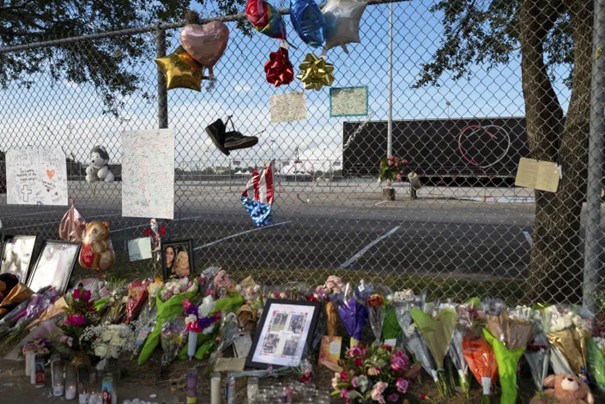
Shoppers are not the only people who get caught in crowd crush.  At least 10 people were killed and hundreds more were injured at a concert in Houston on November 5th.  The large crowd began pushing toward the front of the stage during a performance by the hometown rapper Travis Scott.  The concert was part of the Astroworld music festival, a two-day event that was later canceled.  About 50,000 people were assembled when the injuries occurred, according to the Houston Fire Department.  It is one of the deadliest crowd-control disasters at a concert in the US since the 1979 crush outside the doors of a show by the Who in Cincinnati that left 11 people dead.  The most common cause of injury and death in crowd crush is compressive asphyxia when people are pushed against one another so tightly that their airways become constricted.  The cause of the surge remains under investigation.

𝗧𝗵𝗼𝘂𝗴𝗵𝘁𝘀:  When I flew in the Middle East during the early 1980’s I had two experiences with crowd crush.  The first came trying to get my ticket as workers pushed and shoved around the airline’s desk hoping to secure a seat to find work.  We finally threw our passports over the crowd and were able to get a seat on the plane.  The second came on my return flight as the airline was boarding the plane.  There were no assigned seats and the crowd surged forward when the doors opened.  I looked down and saw a small boy being crushed by the crowd and yelled out in Arabic, “Seghir walid henna” (small boy here).  Despite my warning the crush continued as I struggled to keep from running over the child.  Large crowds take on a life of their own and can be sparked by the slightest provocation.  Some have used words to inflame crowds and then act surprised when the mob reacts.  Once the crowd begins to move the crush of people will continue until it just as inexplicably stops.  Do the work.  Change is coming and it starts with you.
Gathered

𝘕𝘰𝘷𝘦𝘮𝘣𝘦𝘳 26, 2021

Sometimes the hardest workday is the one before a holiday vacation.  Many of your coworkers have already bugged out, which means any work that does need to be done is left to the one not fast enough to call dibs on the days just before and right after the holiday.  That is what happened to Melissa this Thanksgiving week.  By noon she was starting to feel overwhelmed and suggested we make a lunch and go sit at the town reservoir.  I finished what I was doing, put together some quick sandwiches, and we took off.  When we arrived, we noticed 12-15 vultures circling in the sky.  We never figured why they gathered here, but they were fun to watch as they soared in and out of view.

When I looked online, I found the Black Vulture (Coragyps atratus) is an abundant species of broad-winged scavenger in the southeast, although scarce in the southwestern US.  In low flight, the vulture proceeds with several quick flaps followed by a flat-winged glide.  When rising thermals provide good lift, it soars high above the ground.  The birds are usually gathered in flocks.  Although the shorter wings and tail make it appear smaller than the Turkey Vulture (Cathartes aura), the body size is about the same.  Black vultures are also more aggressive and often drive Turkey Vultures away from food.  During the day, Black Vultures soar in flocks, often gathered with Turkey Vultures and hawks.  They roost in groups in trees and transmission towers, waiting through the early morning for the air to warm up and thermals to develop.  Then once more they are gathered in the sky to soar the thermals. 

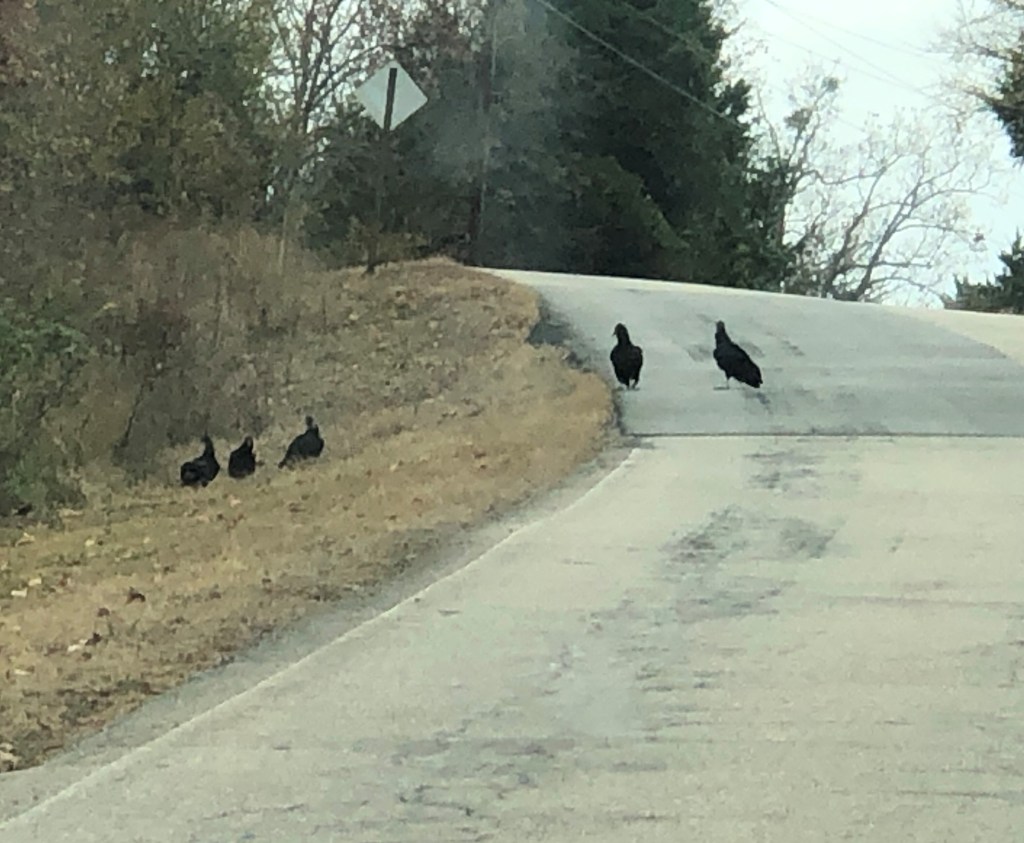
After eating lunch and enjoying the vultures gathered in the sky, I convinced Melissa we should at least try dropping a line since we were already at the reservoir.  I previously mentioned how I carry my fishing poles in the back of the jeep “just in case”, and today the worms had somehow managed to sneak in as well.  I set up Melissa’s line then broke out my fly rod.  My trusty trout magnet quickly caught one of the biggest bluegills of the day.  After several fish I decided to join Melissa sitting on the edge of the patio that had been built this summer.  When it comes to bluegills it is hard for me to keep up with Melissa’s prowess and she out fished me.  It seems the fish had all gathered around the boat ramp and were feeding voraciously, fattening up for the winter.  Since they had gathered, we were able to catch 35 fish in just over an hour.  Melissa mentioned while it was nice to catch so many bluegills, she would have liked some variety.  The last fish she caught was a large crappie.  As we left for home, we came across a group of vultures gathered beside the road.  Now that is a way to relieve stress. 

𝗧𝗵𝗼𝘂𝗴𝗵𝘁𝘀:  Like many in America yesterday, we gathered with our close family for a Thanksgiving meal.  While we had chosen to not be gathered last year, we have been vaccinated (even boosted) this year.  The CDC said prior to the holiday the most critical way of protecting you and those around you is to get vaccinated.  Dr. Anthony Fauci implored people to enjoy the Thanksgiving holiday safely.  As Thanksgiving and the December holidays draw near, some experts fear that being gathered and increased travel could lead to a new surge in covid cases.  It is predicted that Thanksgiving travel will return to pre-pandemic levels as flight bookings were just 1% lower in 2021 than they had been in 2019.  It is safe to be gathered, but we need to do so wisely.  Follow the science.  Change is coming and it starts with you.
Ocellated

𝘕𝘰𝘷𝘦𝘮𝘣𝘦𝘳 25, 2021

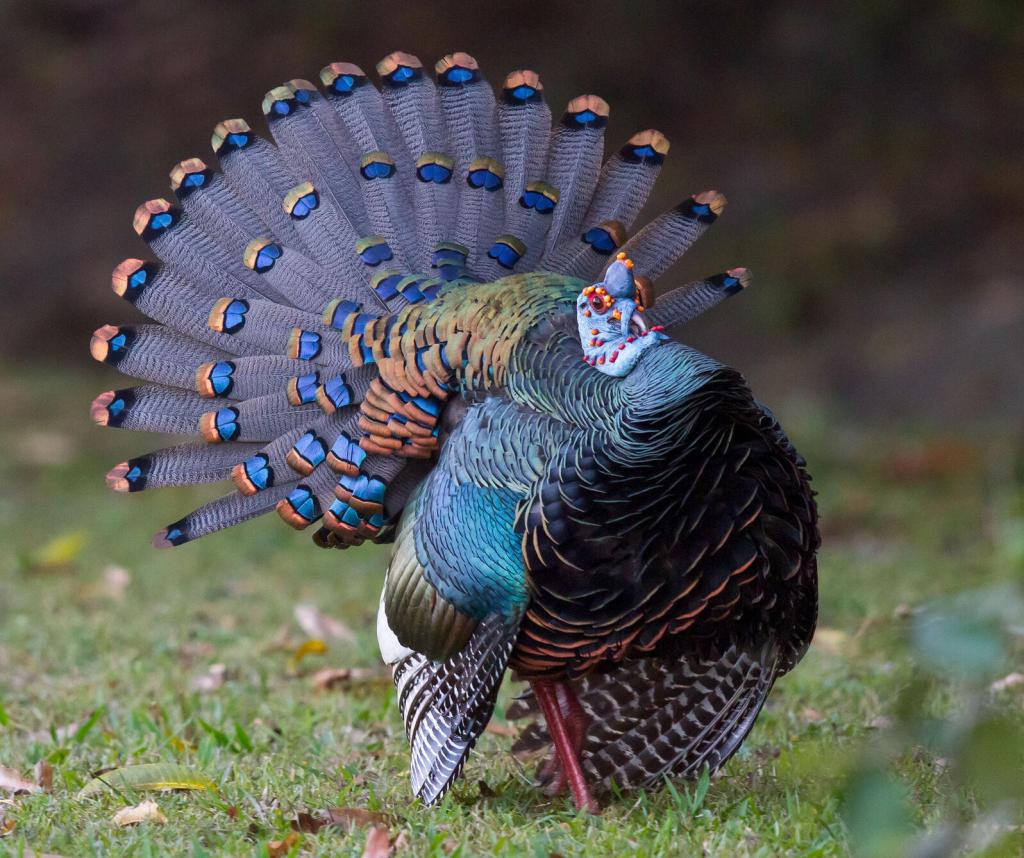
Last Friday the president participated in what has become an annual tradition celebrating Thanksgiving, the pardoning of two turkeys.  This year’s turkeys were named Peanut Butter and Jelly.  Biden quipped, “Instead of getting basted, these two turkeys are getting boosted.”  Peanut Butter and Jelly both weigh about 40 pounds and were raised in Jasper, Indiana.  The tradition is usually credited to President Harry Truman, who did a photo-op with a turkey in 1947.  In 2003 however, Truman’s presidential library said they could find no evidence of Truman pardoning a turkey that he received as a gift in 1947, or at any other time.  The first official turkey pardoning was held in 1989 by President George H.W. Bush, and it became an annual tradition.  This year the president joked Peanut Butter and Jelly were chosen on their temperament, appearance, and he suspects, their vaccination status.  Neither was as spectacular in appearance as the Ocellated Turkey.

While the administration was pushing vaccines with its post, a post from Audubon was touting bird conservation.  There are only two species of turkey in the world.  Most are familiar with the North American Wild Turkey (Meleagris gallopavo), which was first domesticated by the Aztecs and later by American Indigenous Tribes.  While the domesticated form graces many US tables today, the wild flocks continue their decades-long recovery from overhunting and habitat loss across the eastern US.  The Ocellated Turkey (Meleagris ocellata) is less well known.  This iridescent blue relative is only found on the Yucatan Peninsula, or a small part of Mexico, Belize, and Guatemala.  Despite its size and eye-popping plumage, this bird lurks mostly unseen amid thick foliage.   Aside from having picturesque plumage, it is not that different from the bird roaming the eastern forests of America.

When I checked online, I found Ocellated Turkeys breed starting in March.  A displaying male will stride through a group of females, tail spread wide, and head tilted back, resting on his fluffed back feathers.  His wings will shake and occasionally rap the ground.  The male then suddenly bursts into a rapid series of gobbles shallower than his larger American relative.  A dominant male will mate with as many females as he can, while thwarting attempts by other males to mate with them.  Nesting starts in April when the hen lays 8-15 eggs in a scrape on the ground, then incubates the clutch for four weeks.  The young are precocial, meaning that they can scamper off as soon as they hatch, but the chicks stay with the hen until the start of the next breeding season.

𝗧𝗵𝗼𝘂𝗴𝗵𝘁𝘀:  The International Union for Conservation of Nature ranks the Ocellated Turkey as Near Threatened because populations are in decline.  Healthy populations are protected in Guatemala’s Tikal, in private and national reserves in Belize, and in some large Mexican reserves.  The reduction of the Ocellated Turkey has been caused by overhunting and destruction of natural habitat, as was once true for the Wild Turkey.  Most hunting of Ocellated Turkeys is for subsistence (food), but some areas allow sport hunters to buy permits and hire guides.  This provides another source of income for the locals.  Eco-tourists and birders come to the area for the Ocellated Turkey and other varied species, bringing conservation dollars with them.  Some communities report increasing turkey populations kept in balance by a mixture of conservation, cultivation, and sustainable game management.  As with most ventures, education and cooperation are going to be the key for the Ocellated survival.  Follow the science.  Change is coming and it starts with you.
Warning

𝘕𝘰𝘷𝘦𝘮𝘣𝘦𝘳 24, 2021

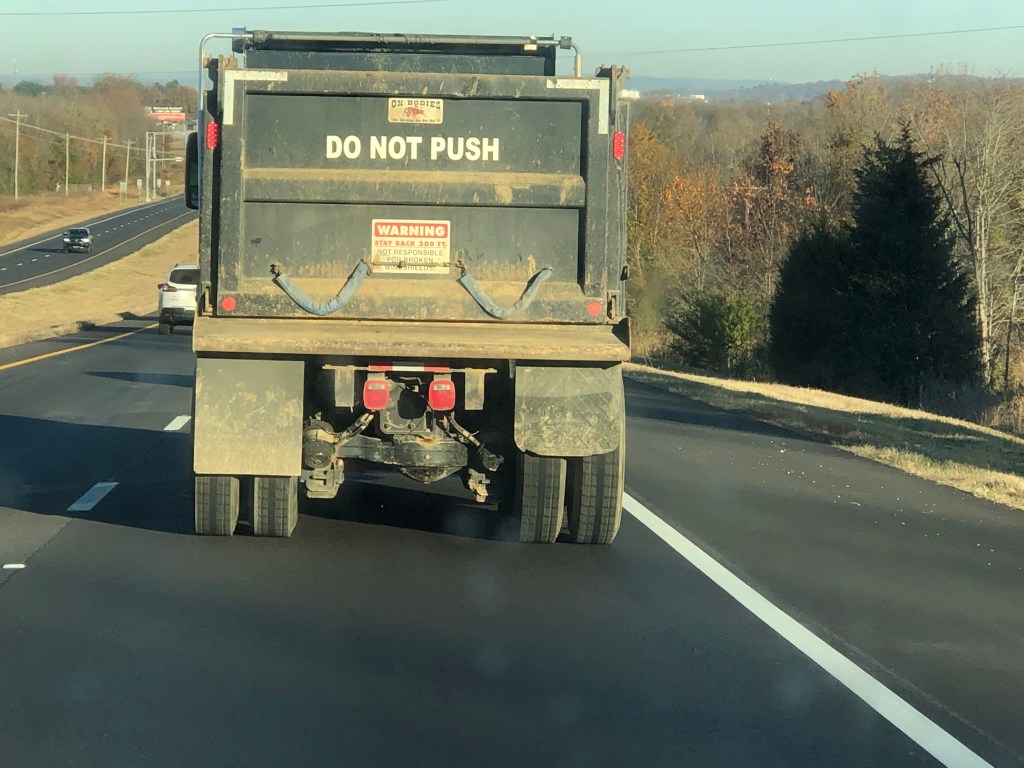
We have both road and housing construction going on near our house and the highway is constantly traveled by large dump trucks hauling dirt from one location to another.  I have noticed the trucks all have two warning signs on the tailgate.  The first is written in large letters and declares, “Do Not Push.”  Having no desire to push a dump truck, I tend to ignore these warning signs.  The other warning tells me to “Stay Back”, and then in smaller letter declares the owner is not responsible for any damage from rocks thrown by the truck.  While the dump trucks have not thrown any rocks my way, I mentioned earlier how the semis on the interstate were a constant nemesis for the windows of our small sports car.

When I looked online, I found the warning about pushing is a reminder for construction workers.  It is common for dump trucks to operate in mud, snow, and icy conditions.  That means construction vehicles get stuck.  Despite the semis pulled on the Strongest Man shows, construction vehicles are not unstuck by people pushing on the bumper.  They need a stronger push and that means another construction vehicle.  A dump truck is made from two main parts, the chassis (the truck part) and the bed (the dumping part).  The connections between these two parts are designed to be strong when supporting the weight of the load and while lifting the bed to dump the load.  The parts are not designed to withstand a horizontal force applied by a push and the connections could break or bend if the truck is pushed from behind.  The warning is a reminder to pull the truck out of the mud rather than push it.

The other warning sign says, “Warning!  Stay Back 200 feet,” and then declares “NOT responsible for broken windshields!” Again, looking online I found that legally you can ignore the second sign, but it is still good advice if you do not want a broken windshield.  Truckers are required to secure their loads and are heavily regulated by both state and federal laws.  They are required to load their trucks in such a way that the contents do not fly off and hurt cars or drivers who share the road.  The problem may be trying to litigate the owner of the truck in small claims court.  If the rock was on the road and did not fall from the truck, the trucker is not liable.  You need to prove the rock was from a specific truck and fell off the truck rather than being thrown by the tires.  My comprehensive insurance covers small chips, and the frequency of events is why insurance companies have a $100 deductible to replace the windshield.

𝗧𝗵𝗼𝘂𝗴𝗵𝘁𝘀:  We rented a car when Melissa and I were in Maui.  I usually consider the insurance a hassle as my personal policy provides the same coverage.  This time I took the insurance without thinking.  One of the sights was driving Hana Road to view the rain forest and waterfalls, but this came with a warning.  The narrow, winding, switchback road is barely wide enough for cars to traverse.  It is also a main road frequented by large dump trucks.  I happened to slow down as we approached a sharp turn and a pair of dump trucks cut the corner and took out my mirror and the side of the car.  They did not stop.  When we arrived in Hana, I reported the incident and was told it happened all the time.  The insurance I had purchased by chance covered the damage.  Insurance is something we buy hoping to never use, but when we do need it makes a difference as we are protected.  The same could be said about vaccines.  Follow the science.  Change is coming and it starts with you.
Cobalt

𝘕𝘰𝘷𝘦𝘮𝘣𝘦𝘳 23, 2021

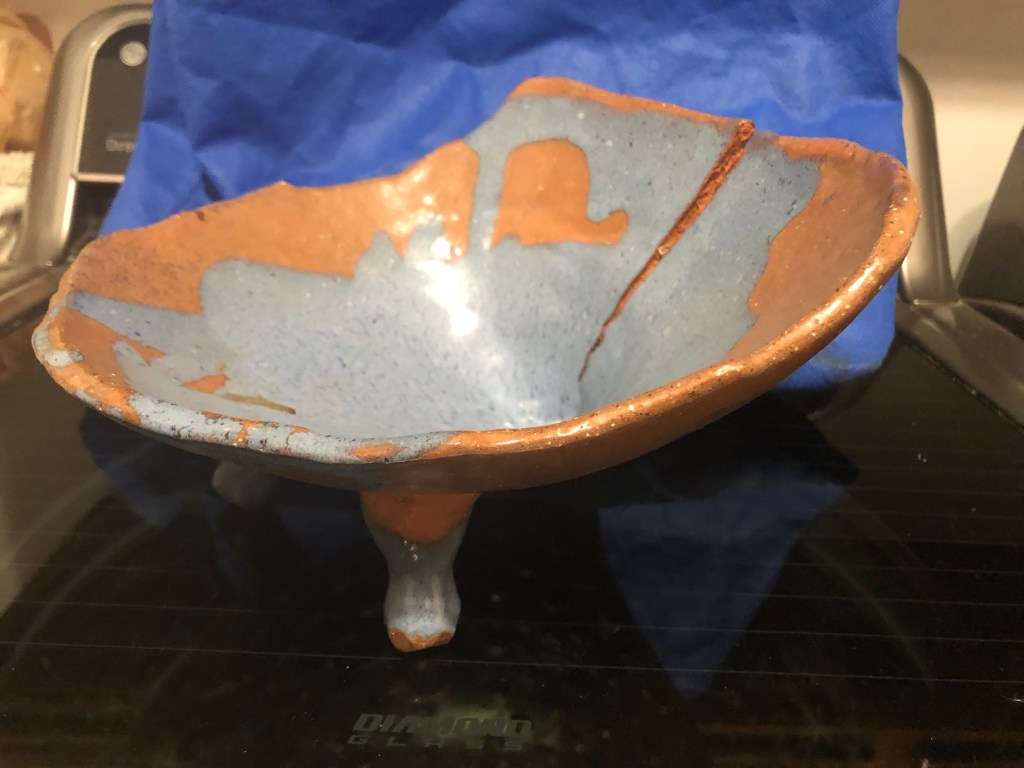
On a whim during my senior year in High School I took a pottery course to fill an “arts” requirement.  To my pleasant surprise it became one of my favorite classes.  During the semester we were taught to make slab pots, coil pots, and finally wheel thrown pots.  I received praise from the teacher for my innate ability to throw a pot on the wheel on my very first attempt.  Praise gets you every time and I was hooked.  I made most of that that year’s Christmas presents out of pottery and ended up spending most of my time the rest of the year working in his pottery class.  When I helped my sister with mom’s final downsizing last month, I noticed several pots I made were being passed along to me, including a failed slab pot that had split during firing.  The pot was fired with one of my favorite glazes, a cobalt blue.  When I unpacked it, Melissa wanted it, so it now adorns our house.

One of the trending stories on my NY Times news feeds told how cobalt is going to be a key for our eco-friendly future.  Cobalt is used in medicine for imaging, cancer radiotherapy and sterilizing medical equipment.  It is in the rechargeable batteries in smartphones and laptops, and it is a component of the lithium-ion batteries that power electric vehicles and store energy from solar, wind and other renewable sources.  This gives cobalt an essential role in the transition from fossil fuels to green energy.  One report predicts the global demand for cobalt will increase 60% above 2017 levels by 2025.  It is projected that batteries will make up more than half of that use.

When I looked online for information on cobalt, I came across an article by Bianca Nogrady for the online news source ENSIA written on May 14, 2020.  Nogrady reported that as interest in cobalt has grown, so has interest in ensuring that it is ethically produced, minimizing harm to the people who mine it and the environment from which it’s removed.  The problem is people die for this mineral.  Some 60% of the world’s cobalt supply comes from the Democratic Republic of Congo (DRC), where nearly three-quarters of citizens live in extreme poverty.  Around one-fifth of cobalt mined in the DRC comes from small-scale artisanal mines worked by children as young as seven years old.  The miners work without gloves to protect them from contact dermatitis while breathing cobalt-laden dust that is associated with a potentially fatal lung disease.  Most mines have unsafe tunnels that are liable to collapse and bury the miners.  All this occurs in settings that are prone to violence and sexual exploitation.  The mines are also the sole livelihood of the hundreds of families who work them.

𝗧𝗵𝗼𝘂𝗴𝗵𝘁𝘀:  Alternatives to cobalt have been explored to curtail the human rights abuses associated with mining.  Several companies are looking at ways to recycle the cobalt from batteries to reduce the amount of new material needed.  Others have used expended car batteries as viable storage cells for other forms of renewable energy like wind and solar.  A third alternative is to stop using cobalt all together.  Research has found that no transition mineral is perfect; lithium, manganese, nickel, and zinc are all associated with human rights violations.  And to shun cobalt altogether would mean denying a valuable source of income to people who desperately need it.  What we need to do is acknowledged the existing environmental and human rights concerns, and then find ways to work toward an amicable solution.  Do the work.  Follow the science.  Change is coming and it starts with you.
Season

𝘕𝘰𝘷𝘦𝘮𝘣𝘦𝘳 22, 2021

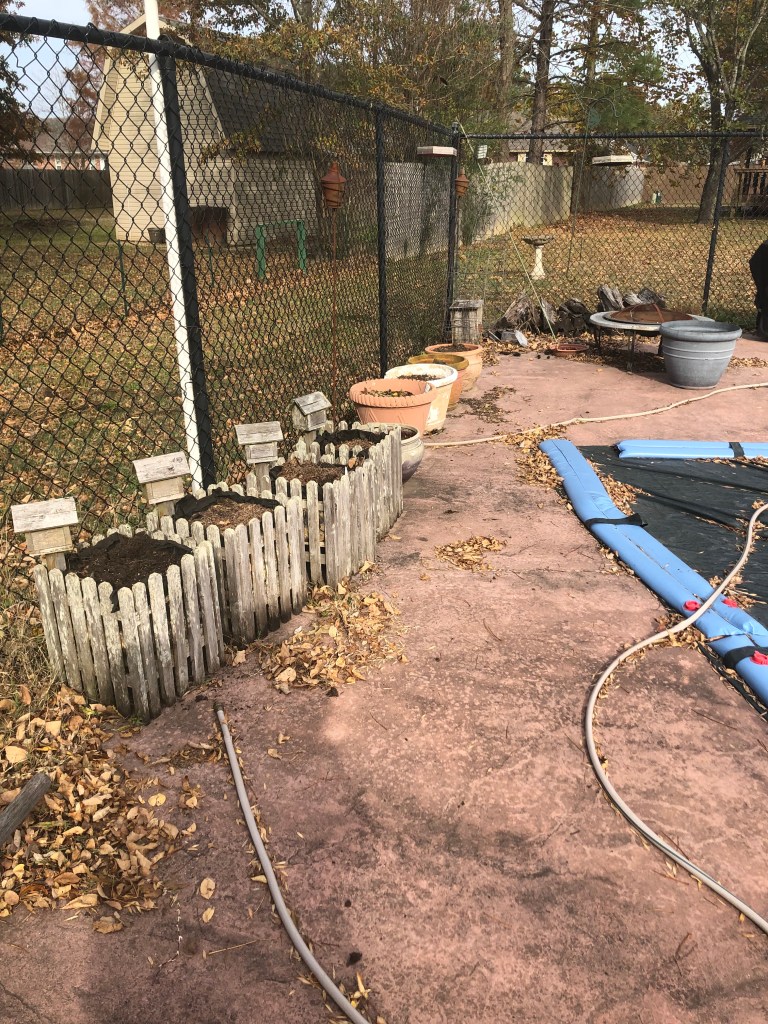
Over the weekend I had to finally admit my vegetables were no longer going to produce more fruit.  I mentioned I removed the tomato plants several weeks ago, but I was still holding out the peppers would give one last push.  The last few cherry tomatoes had finally ripened, and I got a regrowth spurt from both my poblano and jalapeno pepper plants.  With the freezing weather at nights the small peppers had turned soft, and the tomatoes had begun to drop to the ground.  I reclaimed as much of the crop as I could and then pulled the plants out of the ground, knocked off the adhering soil, and threw them unceremoniously over the fence and into the yard.  I was done for the season.

When I looked online, I found the growing season in Arkansas is approximately 200 days.  On average the last Spring frost is around April 14th and the first Fall frost is around October 18, with a 10% chance for frost to occur either before or after those dates.  Knowing the season to plant flowers and gardens has long been the purview of the Farmers’ Almanac.  This annual American periodical has been in continuous publication by Geiger of Lewiston, Maine, since 1818.  The Almanac provides long-range weather predictions for both the US and Canada, and provides calendars, articles on folk lore, natural remedies, and the best days for various outdoor activities.  Predictions for each edition are made as far as two years in advance.  Scientific analyses of the Farmers’ Almanac forecasts have found a 50% rate of accuracy, which is higher than Punxsutawney Phil’s groundhog prognostication.  

Publishers of the Farmer’s Almanac point to the fact that “many longtime Almanac followers claim that their forecasts are 80% to 85% accurate” on their website.  Their website also contains a list of the many more “famous” weather predictions they have accurately forewarned of, and it points out that they have been predicting the weather longer than the National Weather Service.  The publishers will only state publicly that their method is an “exclusive mathematical and astronomical formula, that relies on sunspot activity, tidal action, planetary position (astrology) and many other factors”.  The Almanac’s forecaster is referred to by the pseudonym Caleb Weatherbee.  I guess it is better than flipping a coin . . . oh, wait?

𝗧𝗵𝗼𝘂𝗴𝗵𝘁𝘀:  When Melissa’s succulents faced their first winter season, I got a new perception on the difference between a frost and a freeze.  A frost is visible frozen condensed water droplets, and a freeze is when the air temperature drops below freezing (32F/0C).  There are times when we get frost when the temperatures are above freezing, and we often have a freeze without a frost.  Persi Diaconis is a statistician who grew up in the circus and became interested in analyzing the perception of randomness.  Diaconis states the carnival coin flip is not random.  People, and himself one, can control the coin depending on the way you flip it.  Which side comes up depends on the physics of the toss.  Apparently, probability is not a fact about the world, but a fact about an observer’s knowledge.  Observation can predict our perception of the world.  When we only see or hear a single point of view, we are controlling the outcome of the decisions we make “based on the flip of a coin”.  Do the work.  Follow the science.  Change is coming and it starts with you.

Fantastic

𝘕𝘰𝘷𝘦𝘮𝘣𝘦𝘳 20, 2021

I seem to have difficulty tracking dialogue on movies due to the background music and extraneous noise associated with the sets.  This is compounded by the dialogue and background music often being set at drastically different levels.  To get the words without being blown out by the music is a constant battle.  After being with my mom I realized I could adapt the same way she does, by using closed caption.  When we were scrolling movie apps this last week, I came across one of my favorite movies that I had not seen in quite a while, Fantastic Planet.  The info stated this was remastered in 2016 from the original film.  When I brought the movie up, I could not get closed caption to work.  After several attempts I gave up.  When the movie started to play, I found out why.  It was in French and had English subtitles.

Fantastic Planet (French: La Planète sauvage, Czech: Divoká planeta, literally “The Wild Planet”) is a 1973 experimental adult animated science fiction film, directed by René Laloux and written by Laloux and Roland Topor, the latter of whom also completed the film’s production design.  The film was animated at Jiří Trnka Studio in Prague.  The film was an international co-production between companies from France and Czechoslovakia.  The film is an allegorical story about humans living on a strange planet dominated by giant humanoid aliens who consider them animals.  The film is based on the 1957 novel Oms en série by French writer Stefan Wul.  A working title in development was Sur la planète Ygam (On the Planet Ygam), which is where most of the story takes place.  The final title (The Fantastic/Savage Planet) is the name of Ygam’s moon.  Fantastic Planet was awarded the Grand Prix special jury prize at the 1973 Cannes Film Festival, and in 2016, it was ranked the 36th greatest animated movie ever by Rolling Stone.  This no doubt led to the remastered version I watched last week.

Fantastic Planet has generally received positive reviews.  Rotten Tomatoes gave the film an approval rating of 91% based on 32 reviews with an average rating of 7.24/10.  The site’s critical consensus reads “Fantastic Planet is an animated epic that is by turns surreal and lovely, fantastic and graceful”.  The release date and acclaim for the film happened during a time when I was coming of age concerned with the environment and questioning the definition of what humans considered “sentient beings”.  The film’s narrative has been considered an allegory on both animal rights and human rights, as well as racism.  Sean Axmaker of Turner Classic Movies referred to the film as “nothing if not allegorical”, writing that “it’s not a stretch to see the fight against oppression reflected in the civil rights struggle in the United States, the French in Algeria, apartheid in South Africa, and (when injustice takes a turn to wholesale annihilation of the ‘inferior’ race) the Holocaust itself”.

𝗧𝗵𝗼𝘂𝗴𝗵𝘁𝘀:  Melissa has never been big on either animated film or subtitles.  She concedes to closed captions because she knows it helps me understand the dialogue and admits it is handy when the characters drop their voices amid the furious action on the screen.  I noticed while I watched Fantastic Planet, Melissa spent most of her time playing a game on her phone.  At the end of the film Melissa said, “I do not get it.  What was that about?”  When I explained my understanding of the film’s allegory for the ethical treatment of animals, it still did not make sense to her.  Our conversation reminded me that how we present the message is sometimes more important than the message presented.  If we want others to listen, hear, and understand the importance, we need to clearly present the message in a way relevant to them.  That means we also need to take the time to listen, hear, and understand what they believe to be important.  Do the work.  Follow the science.  Change is coming and it starts with you.

Hawk

𝘕𝘰𝘷𝘦𝘮𝘣𝘦𝘳 19, 2021

One of the news feeds from my weather app this morning concerned a hawk that had wandered outside of its normal range.  While the bird is generally found in Central and South America, it can be found as far north as northern Mexico.  The article said this spring a single bird had been sighted in Texas and that over the last two weeks the rare hawk sighting has been verified in two different locations around Portland, Maine.  While the hawk usually feeds on small reptiles, it was seen eating a squirrel.  The local ornithologist cautioned birders and the curious to avoid getting too close and disturbing the bird.  That means staying back at least 200 feet.  Good luck with that.

When I looked online, I found the Common Black Hawk (Buteogallus anthracinus) is a bird of prey in the family Accipitridae, which includes the eagles, hawks, and Old-World vultures.  The adult common black hawk is 17–21 inches (43–53 cm) long and weighs 33 ounces (930 grams) on average.  It has very broad wings and is mainly black or dark gray.  The short tail is black with a single broad white band and a white tip.  The bill is black and the legs and cere are yellow.  The adults resemble zone-tailed hawks but have fewer white bars on their tail and are larger in size.  Sexes are similar, but immature birds are dark brown above with spotting and streaks.  Their underparts are buff to whitish with dark blotches, and the tail has several black and white bars.  The article noted this was an immature bird, which probably also accounted for the hawk straying far from its normal range.

I am not sure why, but most of the news feeds automatically sent to my phone by my weather app early in the morning are old news.  When I open the app, I generally cannot find the story I just read, and the news on the app itself is up to date.  That was again the case today.  After reading the story about the rare black hawk sighting, the articles I found online were all dated from 2018-2019, or two years ago.  I had initially fleetingly considered going to my sister’s house outside of Portland, Maine, to see the bird.  I am glad I did not.  Two years later, the hawk is no longer there.

𝗧𝗵𝗼𝘂𝗴𝗵𝘁𝘀:  When I continued to follow the story concerning Maine’s black hawk, I learned it had been taken to a rehabilitation facility after being found on the ground in Deering Oaks Park during a January 2019 cold snap and snowstorm.  Avian Haven confirmed the bird had frostbite.  The long, bare legs are ideal for chasing prey but are not made to protect the bird from the cold.  Temperatures in Portland had dipped to the low single digits, and even lower with the wind chill.  A final story was posted by Maine Audubon in July of 2020 stating the hawk did not survive.  A bronze statue had been placed near its favorite tree in the park.  The bird is depicted chasing after a tasty squirrel (in bronze on the statue pedestal).  Audubon commented, “This is the only known statue of a vagrant bird in existence, and a fitting tribute to a beloved visitor.”  The year 2020 took so many things from us.  We need to remember these as well, and not just with a bronze statue.  Do the work.  Follow the science.  Change is coming and it starts with you.