Mandates

July 29, 2021

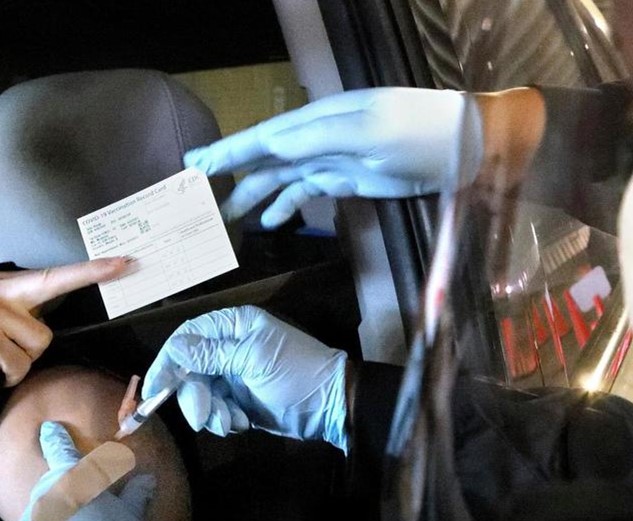
The US has struggled to get half of our country to take the covid-19 virus seriously.  Mask mandates seemed almost universal earlier this year, even though they were disliked and were met with growing opposition.  When the CDC dropped the mandate for vaccinated people, the masks (for everyone) quickly dropped to the floor.  With cases again surging, masks are again recommended, but no longer mandated.  With approval of the vaccine the focus shifted to how to get people vaccinated.  While the vaccine seems to be generally accepted and received in urban and Democratic areas, it is generally viewed with suspicion in rural and Republican areas of the country.  The mandate divide has shifted from masks to the vaccine.

My NT Times feed this morning reported on the possibility of using mandates to require people to be vaccinated or lose access to goods and services.  Mandates are obviously controversial, and many Republican officials oppose them.  The National Conference of State Legislatures report at least 32 bills have been introduced across 25 states that “would limit mandatory COVID-19 vaccines for students, employees or generally.”  Arkansas’ (Republican) governor signed into law various measures that prevent state and local governments from requiring proof of vaccination as a condition of employment or to access goods and services.  With the surge of the Delta variant mandates could become more common.  Several weeks ago, covid appeared to be receding as vaccinations were rising and cases were plunging.  The combination of lingering vaccine skepticism and the contagiousness of Delta has caused cases to again surge.  Given the opposition, vaccine mandates are never going to be national.

Many Americans are now realizing a return to normal life is months away (if ever).  The CDC now says some people should put their masks back on, even when outdoors.  Businesses like Google are delaying bringing workers back to the office.  Parents are anxious that schools will not fully reopen this fall, and even more worried about children too young to be vaccinated being vulnerable to “long Covid.”  Experts say the primary cause of all these problems is the one third of Americans who remain unvaccinated despite being eligible.  It appears they will not get vaccinated without a mandate.  While the biggest cost of refusal is risking their own lives, it also affects vaccinated people with restrictions on daily life.  So far, none of the mutations have been vaccine-resistant variants.  It will continue to mutate.

Thoughts:  While businesses are posting their own vaccination mandates, state legislatures are trying to make them illegal.  This has led to another area of growing frustration as inoculated Americans are losing patience with the vaccine holdouts.  Alabama’s Republican governor said it was, “Time to start blaming the unvaccinated.”  Vaccine mandates effectively tell the unvaccinated they can refuse, but they will pay a price in lost access to a job, a college campus, or other shared experiences.  I am constantly amazed when individuals demand their “right to choose,” yet refuse responsibility for their choices.  Living in a free society means we need to allow the freedom to choose, but freedom also has its price.  Follow the science.  Change is coming and it starts with you.
Peppers

July 28, 2021

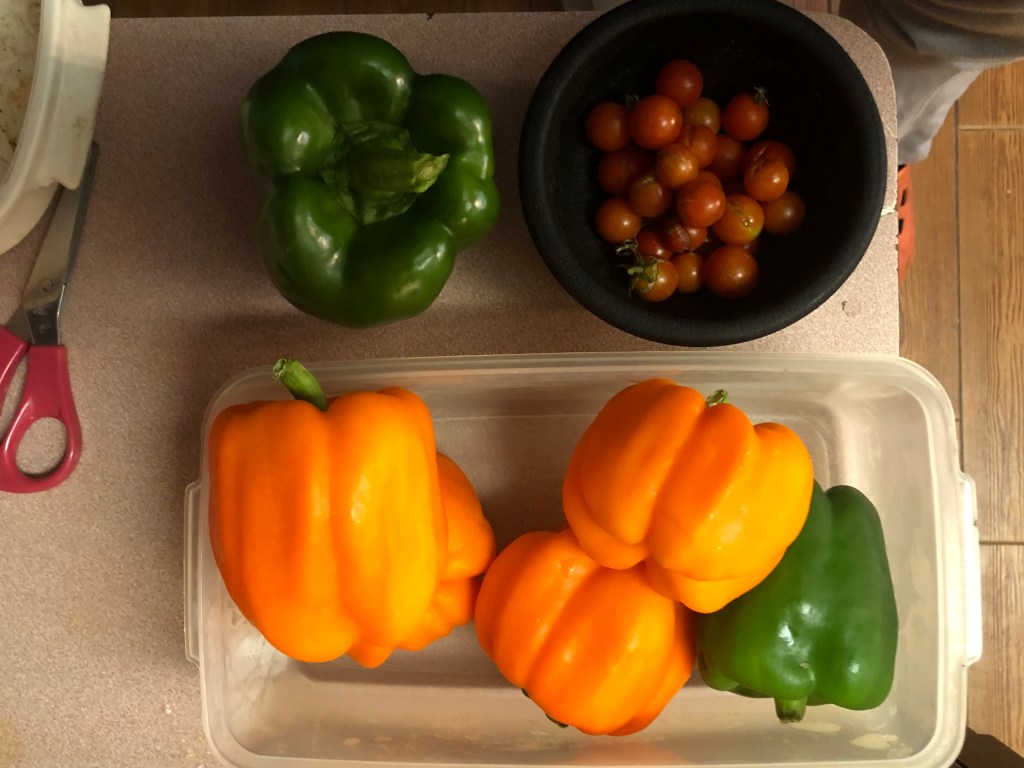
When I make stir fry or pasta salad, I like to use different types of sweet peppers to add color to the dish.  The problem is the red, yellow, and orange peppers are usually about a dollar more per pound than the green peppers.  I used to buy them anyway, but when Melissa and I started shopping together she would comment on how much I was paying just for the color.  Honestly, the varieties of store peppers never tasted any different and I knew she was right.  This year I resolved the issue by growing my own red, orange, and green peppers, along with the jalapeno and poblano.  I got all of them in the ground late because of cold weather, but the heat we are getting has begun to make them produce.

When I looked online, I found that sweet peppers and chilies are both derived from the same species, Capsicum annuum.  The pepper plant is a member of the Solanaceae or “nightshade” family, which also includes tomatoes and potatoes. It is originally from South and Central America and was introduced into Europe for the first time at the beginning of the 16th century.  Botanically, peppers are a fruit of the Capsicum plant, but in the culinary world people recognize peppers as a vegetable.   There are nearly 2,000 varieties of peppers cultivated worldwide.   These are generally grouped into two categories: the hot (chili) peppers and the sweet peppers.  The various forms of peppers are the most widely used condiment all over the world.  It is consumed fresh, dried, or processed.  I admit, I like them all in all three different forms.

The sweet peppers I decided on last spring were the Green Bonny Bell, the Orange Bell, and the Red Bell varieties.  When I purchase peppers from the market, I have noticed there is a difference in both the sweetness and the number of seeds.  What I found was that while the male pepper contains much fewer seeds than its female counterpart, the female pepper is sweeter.  You can recognize the difference between pepper sexes by the bumps on the bottom.  The male variant has three bumps, and the female has four.  I have always gravitated toward female peppers, especially when I make stuffed peppers.  The four bumps are larger (more stuffing) and sit upright better in the pan.  Now that I know they are also sweeter, I will try to only buy female peppers.  I get rid of the seeds regardless.

Thoughts:  One of the maladies of the early mariners was scurvy, which was caused by a lack of vitamin C (ascorbic acid).  Current researchers have discovered that high consumption of fresh vegetables and fruits also have a link to minimized chances for various types of cancer.  Research has shown that increased consumption of vitamin C rich foods like sweet pepper is related to a reduced chance of cancers of the lungs, mouth, vocal cords, throat, colon, rectum, stomach, and esophagus.  Sweet pepper has 119.8 mg of Vitamin C, or 133.11% of the daily recommended value.  Researchers are constantly finding new cures for old (and new!) diseases.  Just because this is a new discovery, does not mean it is experimental.  Follow the science.  Change is coming and it starts with you.
Gutters

July 27, 2021

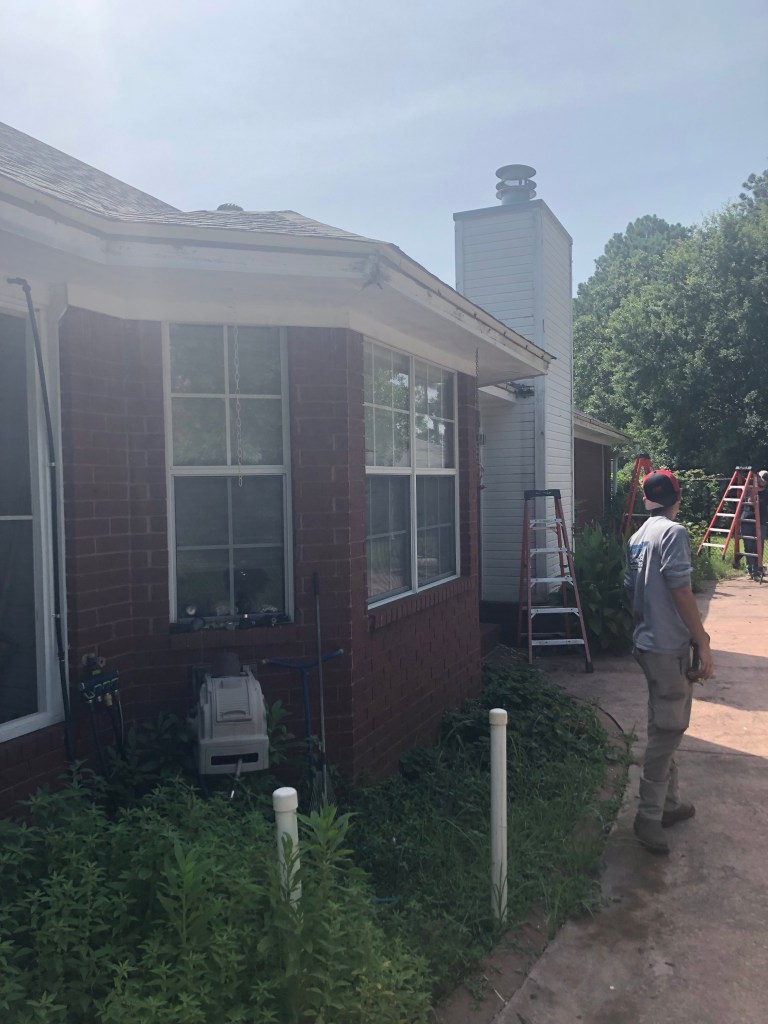
We got the next phase of roofing at our house yesterday as the crew showed up to install the new gutters.  They began by removing the old gutters and the brackets that held them in place.  After the gutters were installed, they attached a new leaf guard system to replace the old one.  The leaf guards were black rather than the silver we had previously, and the gutters were a stark white which (luckily?) matched the existing trim.  While the gutter crew did not arrive as early nor stay as late, they were able to get most of the work done in one day.  I needed to have repairs done on two of my soffit joints and the wood needed to be purchased from the lumber yard and they had to return.  While the new system looks good, it also pointed out that I need to paint the eaves of our house.

Rain gutters are known as a crucial part and necessary investment of modern homes.  The gutters and down spouts funnel water away from the home to avoid water-related damage to the roof and foundation.  Although there are many types of drainage systems on the market, gutters have a long history.  The first gutters were in place as early as 3,000 BCE, as ancient civilizations started draining water using systems made of stone, brick, and wood.  The main objective of ancient gutters was to move water from one location to another, and often the gutters moved water into cisterns for storage.  Ancient civilizations also used waterspouts perched on roofs to drain water to the ground.  During the Middle Ages the European architects used waterspouts in the form of gargoyles on large structures like cathedrals and palaces.  Our installer did not think a gargoyle would work on my house.

I noticed on the side of the installation truck they offered seamless gutters.  When I checked online, I found seamless gutters are exactly that, seamless.  Rather than coming in standard 10-foot lengths, which are pieced together, seamless gutters are formed and cut to any length required by the roof line.  That meant the long runs had a single gutter, with the only seams at the roof angles.  While each seam is sealed, there is a possibility of leaks as the gutter ages.  Seamless gutters are made of galvanized steel, rather than the aluminum or vinal used in standard gutters.  That makes them heavier and stronger and more resistant to damage from the weight of snow and ice.  Seamless also means this is not a DIY project, unless you have a gutter forming machine and know how to operate it.  I have neither.

Thoughts:  After graduating from High School, I attended college on a hit or miss basis, working a semester and then retuning to school.  During one of my summer hiatuses, I worked at a meat processing plant.  I would arrive at 6 am with outside temperatures at 80F and enter a building kept at 35F.  I only lasted a couple of weeks.  When the owner returned to finish the gutters, he said his new worker quit after his first day.  He had decided it was too hot to hang gutters.  Perhaps he should have learned from the roofers and taken his lunch sleeping in the shade under a tree.  When I worked manual labor, the first few days on a new job were the hardest.  While you begin to get used to the labor, you also devise ways to adapt to the job.  If you cannot, you quit.  It seems many have decided to treat the pandemic the same way.  They did not like the restrictions and refused to adapt, and now refuse the vaccine that could save the lives of countless others.  With the pandemic, quitting is not an option.  Follow the science.  Change is coming and it starts with you.
Bindweed

July 26, 2021

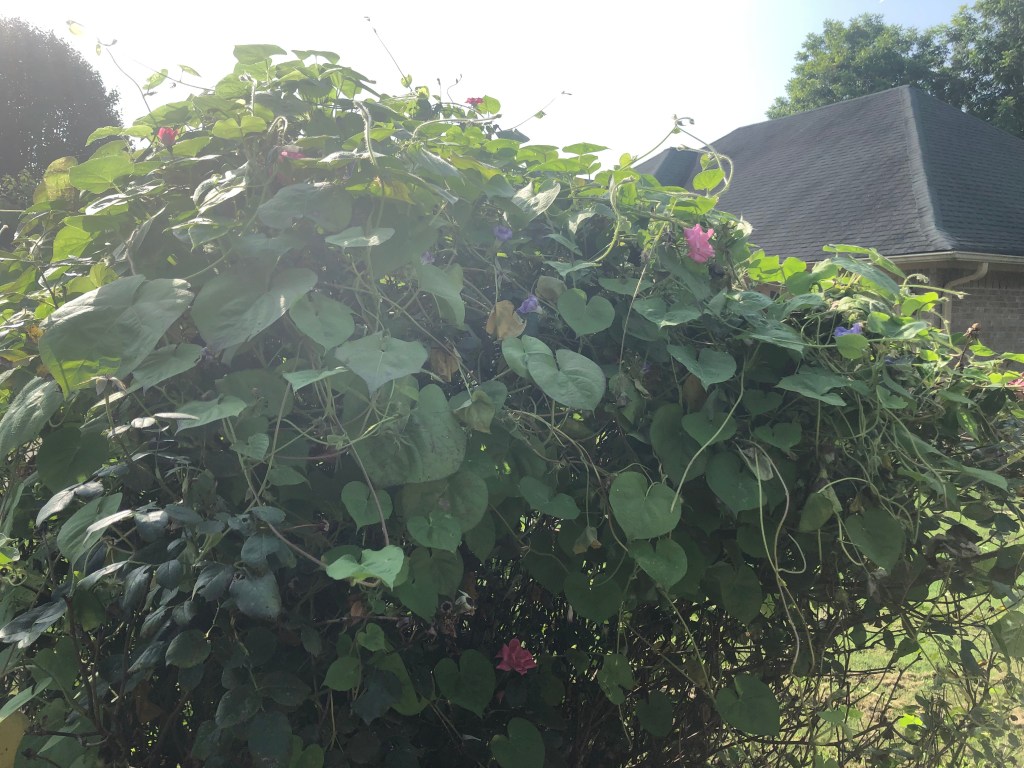
When I checked my rose bush last week, I noticed it had been completely enveloped in bindweed.  I was surprised by how quickly it had overgrown my plant.  I have seen the invasive effect of bindweed driving along the turnpike across Oklahoma.  In some places it has completely covered the trees and fences on both sides of the highway.  It appears I have two types of bindweed on my roses (lucky me!), as I have both pink flowers and bluish-purple flowers.  I have marveled at the extent of the growth along the road and have wondered how long it had taken to be so widespread.  If my rose bush was any indication, it did not take long.

When I looked online, I found that Bindweed (Convolvus arvensis) is considered the bane of gardeners.  The species is related to the morning glory and is also known as the perennial morning glory and small flower morning glory.  Other common names include creeping Jenny and possession vine (rightly named).  There are two forms of the plant.  The Convolvulus arvensis (var. arvensis) has broader leaves and Convolvulus arvensis (var. linearfolius) has narrower leaves.  It has medium-green, arrow-shaped leaves and white-pinkish flowers that look like those of morning glories.  Bindweed can grow four feet or more in length and has deep, strong roots.  It is considered invasive for its rapid and persistent grow that allows it to choke out native species.

As with most invasive species, I was not surprised to see most of the information on bindweed was designed to let me know how to get rid of it.  The best way is to remember that you need to be just as vigilant and persistent as the weed itself.  When you find bindweed in your garden you need to begin by cutting it off at the soil line.  If you try and pull it up it will just grow from wherever you tore the roots, and it is virtually impossible to get all the root.  Bindweed thrives in cultivated soil that is rich in nitrogen (i.e., cultivated fields and gardens).  Since you cannot stop the seeds from germinating, you need to be patient and wait for it to grow so you can see it.  By constantly cutting it off you may be able to eventually starve the plant (from a lack of photosynthesis) and cause it to die.  Maybe.

Thoughts:  Another thing I found about bindweed is that it can stay dormant in the ground for up to 50 years.  All it takes is the right conditions and it will spring to life.  While bindweed is not a parasite, it can overwhelm the host it attaches to as it climbs toward the sun.  This can in turn cut off light for the tree or bush and cause it to struggle to survive.  Humans are known to take the same approach.  Many of the big corporations today began as small partnerships.  As they grew the dominant partner took over direction and often even forced/bought the weaker partner out of the business.  Several of these corporations are now so large they completely dominate the market, chocking out all the competition that allowed them to grow in the first place.  Apparently, humans can be noxious as well.  Do the work.  Change is coming and it starts with you.
Blessing

July 24, 2021

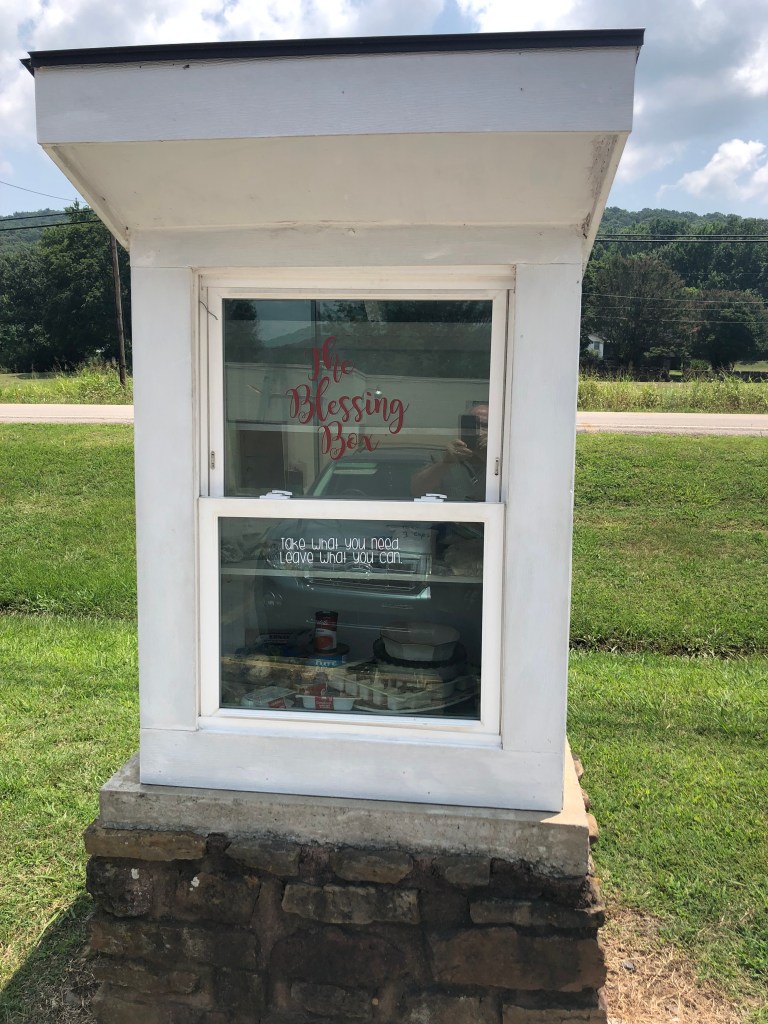
I thought it was appropriate after yesterday’s blog on the despair felt by the working class to end the week on a positive note.  When I visited city hall last week, I noticed they had set up a Blessing Box along the front sidewalk.  I had seen similar boxes in front of several churches and was intrigued that this one was in front of a public facility.  When I asked about the box, I was told the mayor had placed it and that her office primarily keeps it stocked, although others donate as well.  The weatherproof box has a clear plastic front window to allow donors and recipients to see what is available inside. 

When I looked online, I found similar Blessing Boxes have been popping up across America since at least 2016 and have become somewhat of a movement.  These neighborhood boxes contain things like food, soap, diapers, and other necessities.  People who have items to donate fill (and refill) the boxes, while people who need items take them.  Many of the boxes are emblazoned with the slogan, “Take what you need, give what you can . . . above all, be blessed!”  These boxes are another way to provide a blessing to those in need.  

The idea seems to have originated with Jessica McClard of Fayetteville, Arizona, who started her Little Free Pantry in March 2016.  She often passed, and borrowed from, the Little Free Library in her neighborhood.  She realized addressing the social issue of literacy was only secondary to allowing people to practice neighborliness.  That is when she decided to use the idea to address another social issue, food insecurity.  Later that year the idea was picked up by a church in Oklahoma and the women who organized the project dubbed it a “Blessing Box.”  The church created the Blessing Box Facebook page a few weeks later and the concept spread, with more than 150 Blessing Boxes being erected that first year.  It is estimated that as many as one thousand boxes have been erected by churches and neighborhoods under various names. 

Thoughts:  The Blessing Boxes have become a tangible way for communities to practice neighborliness.  While the unrest of 2020 brought fear to some, it also brought a feeling of togetherness to those who marched arm in arm in the streets.  While the pandemic brought nations to a standstill, it also forged innovative ways to come together.    The evening singing in Italy and the repeated displays of thanks to first responders and hospital workers are representative of more community acts than can be counted.  All of these are ways of serving as a blessing and giving back to our communities.  While it often takes a tragedy to bring people together, we need to always count the blessings we both give and receive.  Do the work.  Change is coming and it starts with you.

Despair

July 23, 2021

Several days ago, my NY Times feed reported covid-19 has caused the largest decline in US life expectancy since World War II.  However, the virus is not the only reason life expectancy fell to its lowest level in almost two decades.  The US was already struggling with rising mortality resulting from what is called “deaths of despair” (from drugs, alcohol, and suicide).  This despair results in other health problems like diabetes and strokes as well, and it is especially hitting the working class.  During the second half of the 2010’s, life expectancy fell on a sustained basis for the first time since World War II (1941 to 1945).  From 2019 to 2020, Hispanics experienced the greatest drop in life expectancy (3 years), while Blacks decreased 2.9 years, and White Americans 1.2 years.

The recent increases in mortality are concentrated among working-class Americans, especially those without a four-year college degree.  Princeton University economists Anne Case and Angus Deaton blamed the deaths on the sense of despair felt by the working class.  For many, daily life lacks the structure, status, and meaning that it once had.   People feel less connected to an employer, a labor union, a church, or to community groups.  They are less likely to be married.  They are more likely to endure chronic pain and to report being unhappy.  The class gap in life expectancy seems starker in the US than in most wealthy countries.  We are indeed caught in the grip of despair.

Case and Deaton also noted that covid has killed more men than women.  This has increased the mortality gap between the sexes that had been shrinking.  Life expectancy was 5.7 years longer for women last year, up from 5.1 years in 2019, while the gap had fallen to a low of 4.8 years in the early 2010’s.  There are many reasons for the working class being affected greater by covid.  At first, the working class were more likely to contract severe versions of covid, in part because they were not able to work from home.  The working class also tended to receive lower-quality medical care after getting sick.  Now that vaccines are readily available, vaccine skepticism is the dominant explanation for getting sick.  Overall life expectancy was at 78.7 years in 2015.  By 2020 it had fallen 1.4 years to 77.3 years.

Thoughts:  The sense of despair felt by the working class has been aggravated by covid and the health inequalities that pervade the US.  This has created a one-two punch that brought life expectancy down by 1 ½ to three years over the last half decade.  This in turn leads to more despair.  The US has a systemic problem that devalues workers, provides abundant access to drugs that contribute to more depression, and then gives messages saying it is your fault.  We have created a vicious cycle of spiraling depression.  We need to send a message that all work is valuable, find ways to provide adequate compensation, and support efforts to improve mental health services.  Do the work.  Follow the science.  Change is coming and it starts with you.
Snake

July 22, 2021

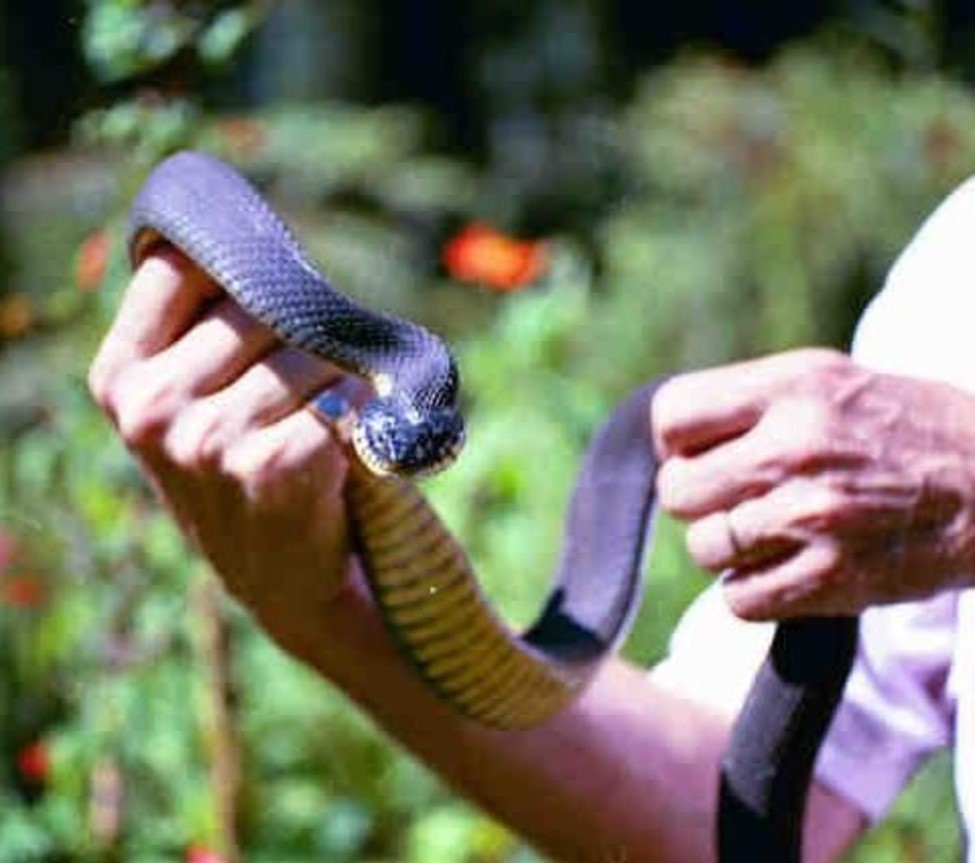
When Melissa walked into our garage last night to get more ice, she was surprised by a snake stretched out on the floor.  I mentioned the earlier false scare caused by the long earth worms and I assumed we had an even bigger one in the garage.  When I looked at the “snake”, I realized this was not a worm.  This was a 2 ½ foot long snake with a black dorsal and a yellow belly.  Since I did not recognize what it was, I decided to take the safe route, and got the reach assist tool Melissa’s dad had used to pick things up from the floor from his wheelchair.  The snake coiled and even struck at the stick as it got near it.  I was glad I had not just picked it up.

After the immediate “crisis” was passed, I went online to find out what type of snake it was.  While the various images of Arkansas snakes illustrate their color variation in nature, I finally decided this must have been a non-venomous water snake.  The yellow-bellied water snake (Nerodia erythrogaster yellow) is found throughout east Texas and eastward throughout much of Louisiana, Arkansas, Mississippi, and Alabama.  It is an aquatic species generally found near larger and more permanent bodies of water, such as marshes, swamps, and the edges of lakes or ponds.  It is also found in floodplains, swamps, marshes, ponds, and other quiet waters.  With all the rain we are having it was apparently on the move.

The yellow-bellied water snake is found to occasionally travel far overland in search of a new home or a mate.  Tadpoles, frogs, and fish are the principal food items (i.e., my pool?).  It made me wonder if this was the “snake” (that I never saw) that Melissa believed was pestering the frogs in our pond several days ago.  Regardless of whether it was venomous or where it came from, I was glad I no longer had a snake waiting in my garage to pop out and see what I was up to when I walked in.  Just saying.

Thoughts:  I remember having a clog in our sewer line when I was a boy.  When the plumber came, he found a four-foot rattlesnake curled up in the pipe to the septic tank.  While I have heard of snakes coming in through the plumbing and poking up through the toilet, I have never seen it happen.  Still, I do sometimes check at night.  While snakes are beneficial to control rodents and amphibians, many see them with trepidation and assume they are poisonous.  Even when they are not venomous, they are unwelcome house guests.  There are many beneficial plants and animals found in nature that humans prefer to exclude from our daily life.  I pull the weeds from my garden and occasionally scoop the frogs out of our pool.  The problem arises when we encroach on previously used habitat and these nuisances are forced to cohabitate with us.  Being the top of the food chain has perks, but also responsibility.  We need to find innovative ways to create space.  If we do not, we can expect the critters to come into our house.  Follow the science.  Change is coming and it starts with you.
Senior

July 21, 2021

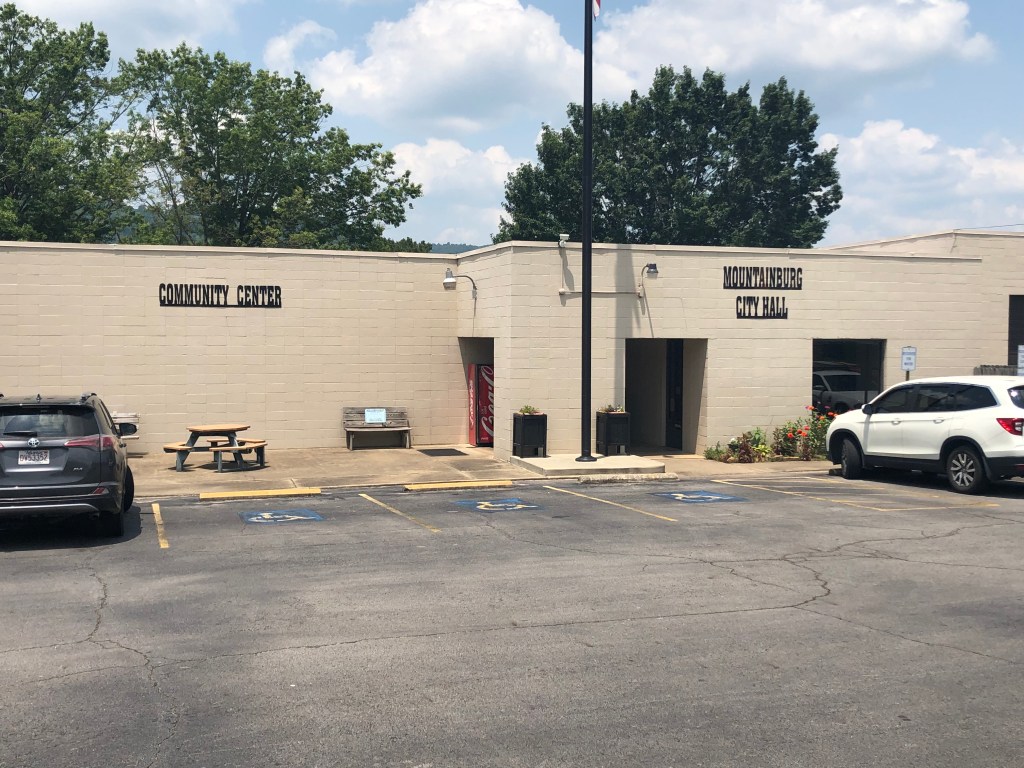
I had a meeting with the mayor and the city offices are in the same building as the community center.  The community center holds around 40 people with different groups using the building throughout the week.  The Senior Center operates in the building during the mornings, Monday through Friday, and ends with lunch.   There are usually anywhere from 15 to 30 people who eat at the senior center, and another 200 in the surrounding community who have lunch brought to them.  Since I was seeing the mayor at 11:30, she invited me to join her for lunch.  These centers are one of the many lifelines that have been created to make sure older adults receive the nutrition, activity, and interaction they need. 

The impetus for the creation for both the National Retired Teachers Association in 1947 (NRTA) and the Association of American Retired Persons in 1958 (AARP) came from a meeting between a retired teacher and Dr. Ethel Percy Andrus.  The teacher had lost her dream during the depression and was living in a chicken coop on her $40 a month retirement.  Andrus believed people deserved better.  According to the website, the goal of AARP is to help older Americans lead lives of independence, dignity, and purpose.  The organization has been active in elder rights and has achieved significant legislation supporting the rights of older Americans.  The AARP expanded its reach in 1984 when it lowered the membership age from 55 to 50.  You can join whether you are retired or not.  If you are younger, the quarterly invitations to join is something you can look forward to receiving in the mail.

When I lived in Wichita I worked across the street from the Senior Center.  This was outside of the central business district yet was still located near the center of town.  The center offered lunch, drove meals-on-wheels, and provided a variety of interactive classes.  The best attended event was the Thursday pickleball games.  They also held occasional weekend pickleball tournaments.  The center advertised they were there for adults 60+, but I noticed most of the clientele were 70+.  I admit I am a boomer, and one thing boomers refuse to do is admit that we are all getting old.  After I made friends with the director of the Senior Center, I suggested they might consider changing the name.  Getting Boomers to admit they were “seniors” was going to be a hard sell.

Thoughts:  Different generations have different attitudes toward what is right and comfortable.  The Baby Boomers were born during the post-World War II baby boom (1946 to 1964).  This is the generation that experienced the explosive growth as the economy shifted from war time to commercial production.  The earlier generation is called the Silent Generation (1925 to 1945).  This is the generation who experienced the devastation of both the Great Depression and World War II.  The following is the Baby Busters, or Generation X (1965 to 1979).  These have been followed by the Xennials, Millennials,

Gen Z, and finally Gen Alpha (2113 to 2125).  These later generations have shifted from 20-year spans to 10-year spans and include overlaps.  The inconsistencies seem to come from the rapidly changing dynamics of our increasingly globalized society.  It appears it is becoming much harder to tell the US from the THEM, even as some work harder to create a difference.  Do the work.  Change is coming and it starts with you.

Blemished

July 20, 2021

After another rough start, my containers are producing fruit.  My Big Boys and Lemon Boys are now producing, as are my Red and Orange Sweet Peppers.  These are even getting large, although some of the fruit is blemished.  My crop began with my two cherry tomatoes (var. Super Sweet 100) about a month ago.  While they are not as large as the varieties found in the local stores (about dime size), they have an amazing taste.  The vines are covered with clusters of tomatoes that I have been picking every day or two.  I am interested to see how long they can continue to provide this amount of fruit.

When I looked online, it confirmed that homegrown tomatoes are more flavorful than store-bought tomatoes.  The store tomatoes (and vegetables) are grown to be uniform in size for pack-ability, durable to ship, and to stay fresh for a long time.  Any blemished produce is excluded from shipment because they do not sell well in the store.  The article mentioned differences you may find in your homegrown varieties.  Your vegetables will not have a consistent appearance, even if they come from the same seed packet.  You can also grow different varieties of vegetables that are not grown commercially.  Your vegetables will not store as long, but you have the advantage of “pick and use.”  While your vegetables may not get as big, they do have more flavor and crunch.  The biggest advantage of home grown is you can decide what plants, how many, and when you want to grow.  I tend to concentrate on tomatoes and peppers because that is what I buy most in the store.  The word is still out on my onions.

When I began my container garden last year I struggled with the proper amount of soil, food, and water to get the best results.  One of my problems was blossom rot.  I discovered there were two causes, either too much water, or too little water.  I seem to have overcome that difficulty this year, in part by rubbing the vestigial blossom off the fruit before it can cause rot.  While my cherry plants are growing well, the intense rain over the last weeks has caused another malady, the fruit has begun to split.  Tomatoes split due to fluctuations in the amount of water they receive.  When tomatoes grow in drought conditions with little supplemental water, a heavy rain can cause the insides of the tomatoes to grow faster than the outer skin, resulting in the tomatoes cracking.  This may also happen with too little water, as the skin may dry out and crack.  Again, this means the plant is getting either too much or too little water.  I need to be vigilant in monitoring my containers.

Thoughts:  I came across an article several weeks ago that touted the advantage of community gardens.  Not only did these gardens provide needed vegetables, but they also illustrated how blemished fruit is a natural occurrence.  When you grow your own, you pick the blemished fruit, perhaps cut around the flaw, and serve it anyway, only to be amazed that the blemished fruit still has the same great taste.  Like vegetables in the store, much of our acceptance of people is based on appearance.  We often choose our friends, co-workers, and even acquaintances based on outward attributes.  When we take the time to look beyond whatever we may define as blemished, we often find people can be amazing as well.  Do the work.  Change is coming and it starts with you.
NO

July 19, 2021

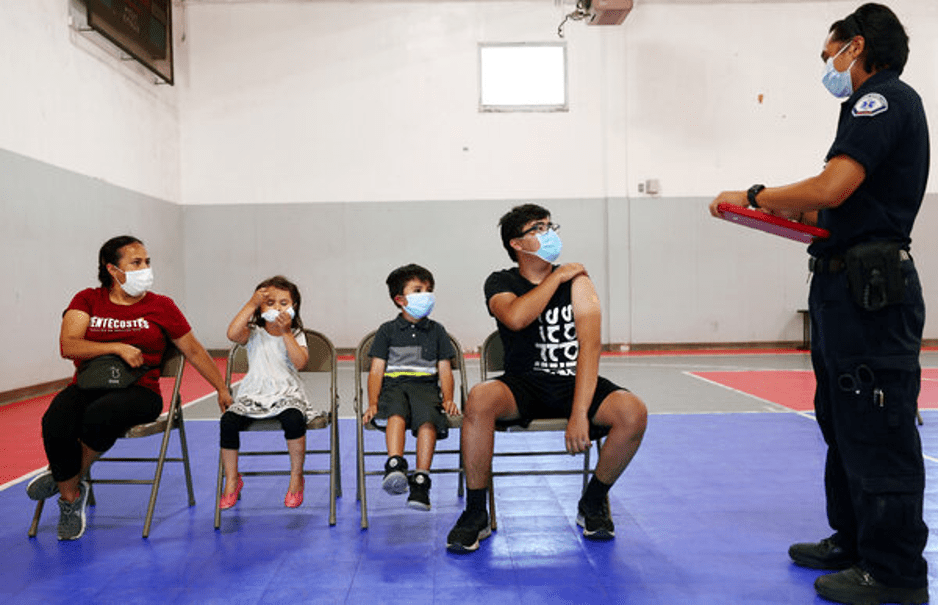
My NY Times news feed this morning lead with an article on the beginnings of a shift in people getting the virus vaccine.  It noted that while a few weeks ago it seemed the virus might be in permanent retreat, the Delta variant has changed the situation, and cases are rising in all 50 states.  While vaccinated people remain almost guaranteed to avoid serious symptoms, the variant has put unvaccinated people at a greater risk of hospitalization and death.  According to the CDC, more than 99 percent of recent deaths and more than 97 percent of recent hospitalizations have occurred among the unvaccinated in the US.  On Friday, Biden commented, “Now, the only pandemic we have is among the unvaccinated.”  Saying no appears to have consequences.

When I checked online, I found that all 50 states reported more covid-19 cases over the last week than the week before.  According to the CDC, this represents a nearly 70% spike overall in the average number of daily cases.  Arkansas continues to be the nation’s top state for new cases per capita.  Only 35% of the state’s population has been fully vaccinated, a number that has remained constant for the last month.  Arkansas has a history of a lax response to the pandemic and was one of only seven states that did not issue a stay-at-home order for nonessential activities in March and April 2020.   As the return to school approaches, Arkansas joined six other states in restricting public schools from requiring coronavirus vaccinations or documentation of vaccination status.  Saying no is now a legal matter.

The focus of the Times article was on a poll conducted by the Kaiser Family Foundation in January, which asked whether Adults in America planned to get vaccinated.  The survey found 23% of those polled said no.  When Kaiser recently followed up on the poll, they found about one quarter of those who said no had decided to get the shot.  The article pointed to three main themes for their rethinking.  The first was seeing millions of other Americans safely vaccinated.  This suggests emphasizing the safety of the vaccines, rather than just the danger of Covid, may help persuade more people to get a shot.  The second was hearing pro-vaccine messages from doctors, friends, and relatives.   Many Americans, and especially those without a college degree, do not trust mainstream institutions and hearing from people they know has a greater impact.  The third was learning that not being vaccinated will prevent people from doing some things they want to do.  While mandates may be unpopular, the requirements can influence skeptics to get shots.  Saying no is being reevaluated.

Thoughts:  I developed a habit in High School of saying no whenever my mom asked me to do something.  She understood my passive aggressive nature, but also knew that if I said no, I had heard the request and I would do what she had asked.  I acted the same way with my dad . . . once.  He asked me to do something, and I said no.  His response was, “Excuse Me?”  Apparently, this was not a request, it was a mandate.  I quickly accomplished the task.  The US has tried many ways to get people to take the covid-19 vaccine (lottery tickets, college tuition, million-dollar raffles, and even staying alive).  Still the response of many has been no.  I hope for their sakes they are only being passive aggressive, and they will get the shot.  Follow the science.  Change is coming and it starts with you.