Return

June 2, 2021

With everything that has been going on health and the weather wise I have been neglecting my garden.  The rains seem to be in a lull this week and the temperatures are overcast and cool.  While this is not normal June weather, it is perfect for a return to my garden.  The first thing I decided to tackle was my vegetables.  The peppers are not liking the cool and rain and have barely changed since they were planted three weeks ago.  The tomatoes are a different story.  They have all sprouted to around three feet and are sporting flowers.  Last year I got caught in the determinant/indeterminant debate about how to prune my tomatoes and they did not produce well.  I have again caged the plants and return periodically to brush the foliage up to the next level of the cage.  Today I cut the bottom stems and leaves off the main trunks.  They had started turning yellow, and when they lie on the soil, they become susceptible to fungus and rot.  This year I have a more minimalist approach toward pruning. 

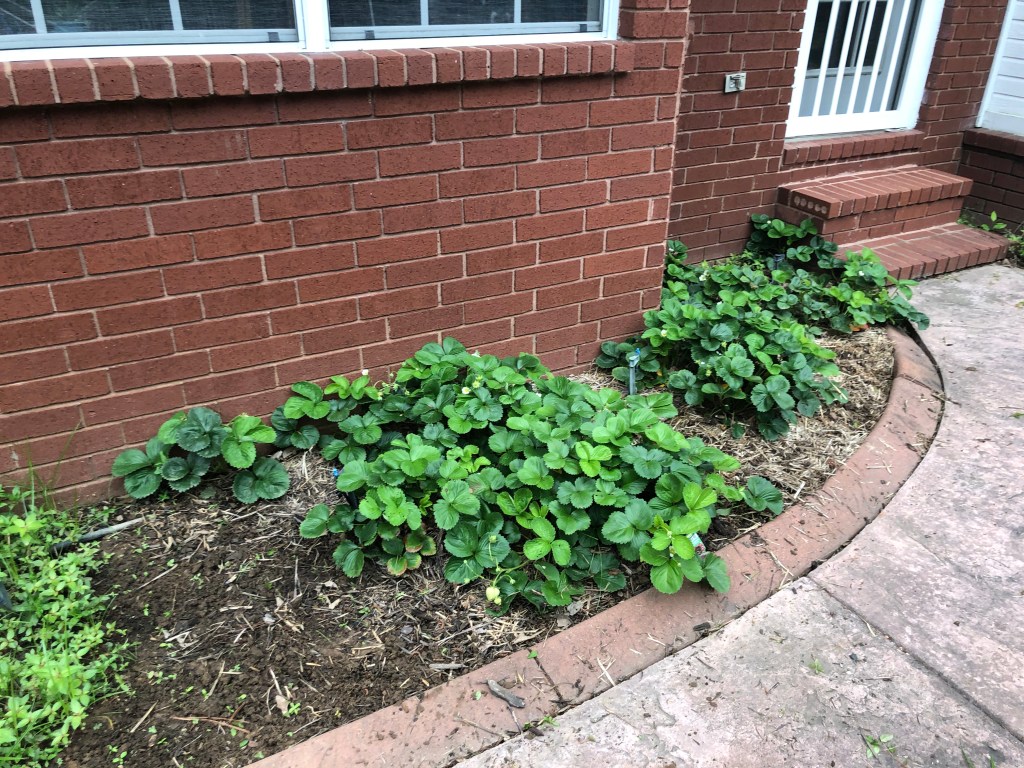
When I checked online it said strawberries (Fragaria spp.) grow as a perennial in US Department of Agriculture plant hardiness zones 3 through 10 (we are in zone 7) and as annuals elsewhere.  It further mentioned they do not usually require much care to produce tasty fruit.  That was good as I have been neglecting mine.   However, the plants and the fruit are susceptible to damage from several sources, including neglect (oops!).  The ripe fruit needs to get off the vine before it starts to rot.  That means picking the ripe ones every two to three days.  The harvest season for June-bearing plants lasts about three weeks and the ever-bearing plants that I have should produce until it frosts.  When in season, you must get the ripe fruit off the vine (oops!) before it starts to rot so it does not spread disease throughout the plants.  You should also pick the berries by snapping them off at the stem instead of pinching the berries below their green leafy caps.  Any pieces of berry left on the plant will again rot, and the rot can spread to other parts of the plant.  I use a pair of garden scissors which does the same.

With the tomatoes prepped I turned my full attention to the strawberries.  Two weeks ago, there were a dozen or more of the berries on the vines along with flowers.  I had seen flashes of red and knew they needed to be picked, but never got around to doing so.  When I tackled the weeding today, I found few ripe berries.  There were some that had been eaten by the birds, but most had shriveled up and died on the vine.  Despite my plants suffering this disaster (according to the online site), they seemed to be doing well.  I discarded the shriveled berries and weeded around the plants to give them better access to the nutrients of the soil.  I am going to get some fruit yet.

Thoughts:  What amazed me while weeding my strawberries were the number of earthworms that came out of the soil along with the weeds.  I had mulched the plants with straw last year and dozens of worms were living just beneath the mulch layer.  While I returned the worms back to the soil, I began to realize I may not have to buy worms this year.  I could just go to my strawberry patch, collect what I needed, and then return any unused worms to keep them alive.  I like the idea of creating sustainable bait along with perennial strawberries.  Like my worm supply, when we are forced to look at life in new ways during the pandemic, we have found new opportunities.  We need to hold onto these sustainable patterns even as we try to innovatively make new ones.  Finding and producing sustainable resources is a necessity, not a luxury.  Follow the science.  Change is coming and it starts with you.

Topless

June 1, 2021

Memorial Day I got Melissa out of the house for the first time since she came home.  I guess technically that is not true.  She came outside while I was weeding out front several days ago to see her succulents and we took a short walk through our cul-de-sac yesterday.  That strikes me as more along the line of what happened during the pandemic when people would poke their heads outside and then run back indoors.  Today was a real trip.  Although we did not have a specific destination, we were able to drive through the Boston Mountains and enjoy the scenery.  And we went topless.

When I say topless, I do not mean without shirts.  The Wrangler has a three-section roof that allows you to either take the two sections off the front seats or remove the entire roof.  In fact, you can not only take off the top, but you can also take off the doors.  Sadly, we have owned the vehicle for three years and this is the first time we went topless, and we have yet to remove the doors.  I had noticed how easy it could have been to remove the top.  It was held on with pins that slid through holes and eight levers that locked the roof in place.  I found being easy does not necessarily correlate to doing something.

It was supposed to rain in the afternoon so rather than putting the roof sections in the cool cover that was provided at purchase, I just put down the rear seats and laid the two sections in the back so I could bring them along, just in case.  After our topless drive north, we decided it was time to head home.  We had planning on cooking my (famous?) ribs and they need four hours to slow cook.  I had also seen the rains might be coming in around three.  We headed home and sure enough, the sprinkles started right on time.  Being topless in the rain was not something I was looking forward to.  We were only a few miles from home and the storms were coming from the west and we were traveling southeast.  I made the calculated decision to drive on.  Thankfully, it worked.

Thoughts:  Driving topless in the Jeep is just as fun as driving with the top down in the Benz.  You get the wind in your hair and the sun on you head.  After we got home, I realized while we had been driving topless, I had gotten a sun burn.  While this was not a first, it was the first for the summer and this seemed appropriate on the unofficial start of summer.   It was a little cold to go topless yesterday, but since Melissa had suggested it, I followed through.  We were sprinkled on, and I got sunburned.  Then I had to put the top back on once we got home.  Even though going topless was easy, it did not come without risks, still we both thought it was worth it.  Being easy does not necessarily correlate into doing something.  It was easy to wear a mask during the height of the pandemic just as it is now easy to get fully vaccinated.  Apparently, some think the risk of getting sick is better than doing what is best for others.  Follow the science.  Change is coming and it starts with you.

Remember

May 31, 2021

Memorial Day is an American holiday observed on the last Monday of May honoring the men and women who died while serving in the US military to remember their service.  This was originally known as Decoration Day and originated in the years following the Civil War.  It became a federal holiday in 1971.  While the day has officially been set aside to honor veterans, many Americans observe Memorial Day by visiting cemeteries or memorials to also remember family members.  This day unofficially marks the beginning of the summer season.  With the opening of most events this will be welcomed by many.

While established events are reopening the Remember and Rise event in Tulsa, Oklahoma has been canceled.  This year’s Memorial Day falls on the 100th anniversary of the Tulsa Race Massacre (May 31-June 1, 1921).  Remember and Rise was scheduled to feature a performance from John Legend and a speech by Stacey Abrams.  The event was organized by the Tulsa Race Massacre Centennial Commission (TRMCC), which was founded and is chaired by Oklahoma state Sen. Kevin Matthews (D).  The mostly Black commission is dedicated to commemorating the event and raised $30 million for a new history museum at the site of the massacre and a cultural center and art projects around the neighborhood of Greenwood.  At the time of the massacre this was known as the “Black Wall Street.”

The TRMCC said it was canceling the Remember and Rise event on Monday “due to unexpected circumstances with entertainers and speakers, the Centennial Commission is unable to fulfill our high expectations for Monday afternoon’s commemoration event and has determined not to move forward with the event.”  The event fell apart over disagreement on using a portion of the money raised as reparations for massacre survivors.  Lawyers representing the three known survivors in a lawsuit argued money from the commission should be used as reparations for the survivors.  Last Friday the lawyers requested $100,000 each and a $2 million donation toward a reparations fund.  After agreeing to the terms, the commission was informed Sunday the stakes had been raised to $1 million for each survivor and $50 million for the fund.  It seems to remember has a price.

Thoughts:  While the official centennial event will not happen, other actions will.  The president has agreed in a separate effort to remember the massacre by visiting Tulsa on Tuesday.  I found a footnote at the bottom of the online article concerning the dispute over reparations.  “Our goal is to create a safe and engaging place for users to connect over interests and passions.  In order to improve our community experience, we are temporarily suspending article commenting.”  This appears to be another way to say the issue is too controversial so we are not going to open this can of worms.  History is generally written by the victors, or at least the survivors.  The history we remember is always biased and sometimes painful.  If we do not remember, both the good and the bad, we are doomed to repeat the past.  Do the work.  Change is coming and it starts with you.

Magnolia

May 29, 2021

As I came out of work last week, I noticed the two magnolia trees on the north side of the building had several flowers on them.  While the beautiful array of flowers covering the trees had not yet happened, the display had begun.  Magnolias are a popular ornamental tree that has a long history in the southern United States.  Many large and incredibly old specimens can be found in the subtropical port cities of the Gulf and Southern Atlantic coast.  The species is cultivated north into the coastal areas of the Maryland and up to Connecticut.  On the West Coast the trees will grow north into Vancouver, Canada, but the cooler West Coast summers do slow growth compared to the East Coast.  There are few known long term specimens found in the Midwest due to severe winters and lack of sufficient summer heat.

The Southern Magnolia (magnolia grandiflora), commonly known as the bull bay, is a tree of the family Magnoliaceae.  The trees are native to the southeastern United States.  This striking evergreen tree reaches 90’ (27.5 m) tall.  It has large dark green leaves up to 7 3⁄4” (20 cm) long and 4 3⁄4” (12 cm) wide.  The trees produce large, fragrant, white flowers up to 12” (30 cm) in diameter.  Although they are native to the lowland subtropical forests on the Gulf and south Atlantic coastal plain, magnolia trees are widely cultivated in warm areas around the world.  Obviously, that includes Northwest Arkansas.

An iconic Southern Magnolia planted by President Andrew Jackson nearly 200 years ago grew near the South Portico of the White House.  It was said to be planted as a seedling from Jackson’s plantation, The Hermitage, in Tennessee.  It was the oldest tree on the White House grounds and between 1928 and 1998 it was featured on the back of the $20 bill.  Jackson is still pictured on the face of the bill.  There was a tradition of gifting cuttings or seedlings grown from the tree.  Among others, Ronald Reagan gifted a cutting to his Chief of Staff Howard Baker upon his retirement and Michelle Obama donated a seedling to the “people’s garden” of the US Department of Agriculture.  During the 1940’s the tree suffered a gash that caused a large section of its trunk to rot, the tree had been supported by metal poles and cables.  Due to its deteriorating condition and on the advice of the National Arboretum the Magnolia was removed on December 27, 2017.

Thoughts:  When I checked online, I found the average lifespan of the Southern Magnolia is around 80 years, but there are some that live to 120 years.  What is odd is the cause of this tree’s demise is a gash received in the 1940’s (120+ years old) and being clipped by a small plane in 1994 (170+ years old).  Fortunately, White House groundskeepers have long been preparing for the loss and healthy offshoots of the tree were being grown at “an undisclosed greenhouse-like location.”  Just as the tree thrived in cultivation, a study of more than 50 mammal species found that in over 80 per cent of cases, zoo animals also live longer than their wild counterparts.  It seems the protection zoos offer against predators, disease, and the elements outweigh the social and behavioral problems of captivity.  Still, larger species with few predators (like elephants) live longer in the wild.  The greatest threat to most species is human encroachment.  We destroy habits and then use crop and livestock depredation as an excuse to kill or confine animals to a zoo.  We need to make an effort to find ways to live together.  Follow the science.  Change is coming and it starts with you.
Pride

May 28, 2021

Several days ago, I poked fun at the caretaker who was mowing the lawn for the church behind our house.  He had gotten the mower stuck twice and rather than learning the ground was too wet to mow, he instead learned what he needed to do to pull the mower out of the mud.  You may be familiar with the adage “pride comes before a fall.”  My grass has been going crazy since my friend’s lawn service had mowed it last week and I knew I needed to get out and mow before the showers moved in later last night.  My pride told me that everyone else had mowed their lawns, right?

The local weather indicated there would be a lull in the rains we have been getting.  It had rained last night but it would not rain again until the evening.  The problem with mowing is not sitting on the mower, it is the preparation that needs to go on before you are able to mow.  I felt like I needed to prune the rose bush and weed the front beds before I was able to mow.  I got the two side beds along the driveway weeded and even installed new edging to keep the pea gravel from washing onto the driveway.  While I still needed to complete weeding the other beds, I decided on just pruning the rose bush.  I cut it back as much as I thought I could without sending it into shock.  This bush had been the pride of Melissa’s mother, but as I have mentioned, it has not been well cared for lately.

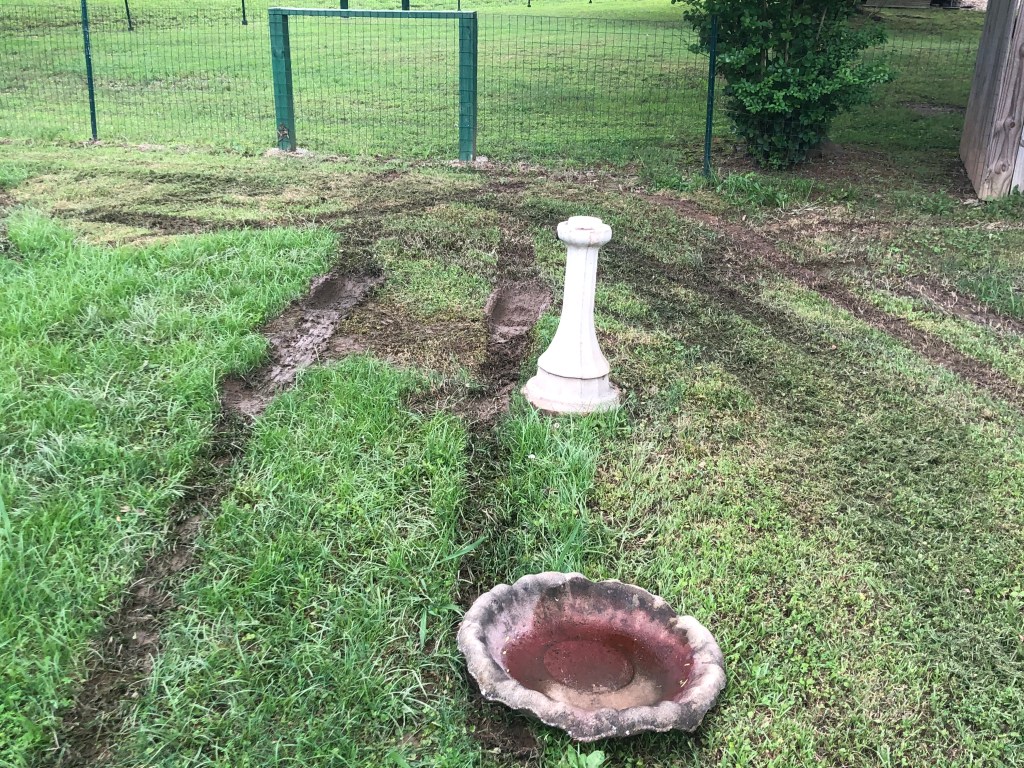
After picking up four loads of rose trimmings, I decided it was time to mow.  I poured the last of the gas can into the mower and then needed to jump the mower battery to get it started.  I took off along the back fence and immediately ran into trouble.  There was standing water in the back strip and I could see skid marks from the neighbor’s mow earlier in the day.  While he had decided against finishing, I decided to power ahead.  I quickly mired down in the wet lawn and was unable to move forward or back.  I needed to get my truck to pull the mower out of the muck (sound familiar?).  Perhaps my lawn did not need to be as nice as my neighbors, even if my pride said it did. 

Thoughts:  Pride is an emotion that can work for or against you.  It was my pride in caring for my lawn that caused me to get stuck in the muck of the back yard.  Other things have given me a good source of pride.  Some are things I have worked for, like my book and advanced degrees.  Other things have given me pride even though I had nothing to do with them, like the Royals winning the World Series or the state championships earned by our local sports teams.  Then there are things where I got the ball rolling and let others continue the journey, like the accomplishments of my son and his family.  We need to take pride in the accomplishments of the last year.  Collectively we have developed vaccines, focused on becoming antiracist, and shown compassion for those stricken during the pandemic.  However, we cannot isolate ourselves and have pride in our achievements while the world struggles with food insecurity, lack of access to water, and basic health care.  To coin a phrase from Starship Troopers, “We are in it for the species.”  Do the work.  Change is coming and it starts with you.
Rest

May 27, 2021

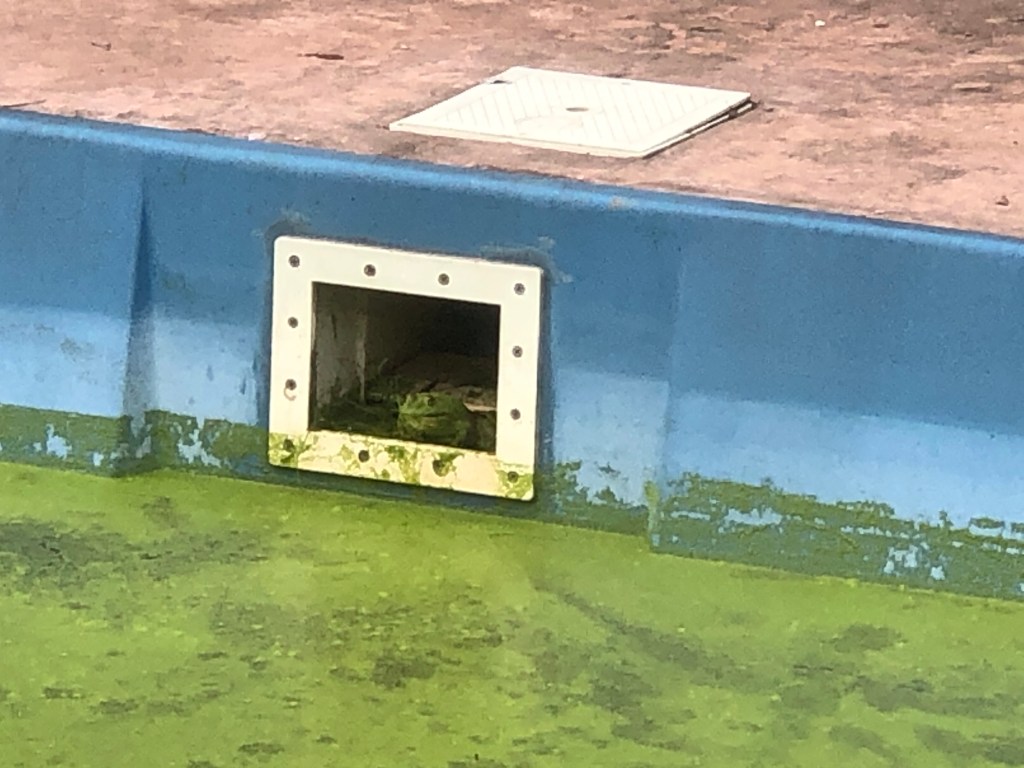
The green heron has been raiding my pool voraciously over the last several days.  This has caused the tadpoles to scatter and the frogs to be wary.  One of the large frogs has been out of the pool next to the steps, but even he does not go too far and sits staring at the bird.  When I checked this morning, the heron was nowhere to be seen.  I remember last year he only stayed around three or four days before moving on.  Even then he would go back and forth from wherever he was staying.  While he may be back later, the frogs have taken the opportunity to get out of the pool and get some rest.  A big frog had decided to rest in the return vent, just two inches above the water line.  A smaller frog was on the top step trying to jump onto the side of the pool.  I watched as he made several attempts, barely missing the edge.  He finally gave up and decided to rest on the step.

One of Aesop’s fables involved a frog who fell into a pail of milk.  The pail was filled halfway with fresh milk.  The level of the milk was too low for him to reach the top, and the sides were too steep and slippery for him to climb out.  The frog kicked and swam in circles until he became tired.  The frog tried to close his eyes just to rest for a few seconds, but he sank to the bottom of the pail where his nostrils filled with milk.  He pushed off the bottom and kicked with all his might until he came to the surface.  The frog was afraid and tired and just wanted to rest.  Every time he quit kicking, he sank into the milk and started to drown.  The frog did not give in to his fear or his tired legs, and instead kicked and kicked and kicked.  Then, something strange happened, the milk began to turn thicker.  Finally, the milk was thick enough the frog could stand on top of it.  The milk had been turned into butter by the frog’s kicking and churning, and the frog was able to climb to safety.

When I looked online, I found this Greek fable was widespread and had folk lore status in several cultures.  Most involved fat frog who gave up and drowned and a skinny frog who persevered and was saved.  In Russia this even morphed into the folk belief that putting a frog in your milk will keep it fresh.  In 2012, scientists in Moscow announced that among the 76 peptides in secretions of common frogs (Rana temporaria), many have antibacterial properties.  The announcement and resulting media from the discovery was overwhelming.  Discovery of any antibacterial is important, but the study sparked excitement for another reason.  The finding propped up the Russian folk belief that putting a frog in milk can keep it from spoiling.  I guess they were not concerned with finding butter or a dead frog at rest on the bottom of the pail.

Thoughts:  Aesop always concluded his anthropomorphic (animals with human reactions) stories with a moral.  The moral for the frog is this: “When your life gets really tough.  When you think you’ve had enough.  When the world works you to death.  Just try to take a big deep breath.  Try so hard before you rest.  Keep on working, do your best.  Do not give until you are done.  Do not give up until you have won.  Never Give Up!”  This seems a good lesson as we continue to struggle with the perfect storm of extreme weather caused by climate change, death and fear from the pandemic, economic insecurity among the working class, and the social unrest that pits the disenfranchised against each other.  Do not give up but keep kicking against the storm.  Do the work.  Change is coming and it starts with you.

Divide

May 26, 2021

I received an article by David Leonhardt about the growing “class gap” in the ongoing vaccinations in my NY Times daily ticker.  We hear about two different demographics that are hesitant to receive the Covid-19 vaccine:  Republican voters and racial minorities, and especially Black and Latino Americans.  The two groups seem to have different motivation.  The Republican attitude is connected to a general skepticism of government and science.  The Black and Hispanic attitude stems from the US legacy of providing substandard medical treatment, and outright harm, to minorities.  Leonhardt noted while these ideas have some truth, they also obscure the fact that many unvaccinated Republicans and minorities are also working-class families.  There is a huge divide based on the class gap in vaccination behavior.

I worked for two different agencies in California at the turn of the millennium who explored this same phenomenon.  Both were trying to connect with the “other side” on current issues.  One was more liberal and the other more conservative, but they both came to the same conclusion.  The divide that separated people had less and less to do with race and ethnicity and more from differences in education and wealth.  This was a trend sociologist had been tracking for the last decade (at that time).  It always amazes me when “new” discoveries are shared that have been around for 20 years. 

The story here is bigger than Covid-19.  Anne Case and Angus Deaton published a book in 2020 called Deaths of Despair and the Future of Capitalism, that documented the growing class divide in many areas of American life.  Income and wealth have grown more quickly over recent decades for people with a college degree than for people without one.  Marriage, church attendance, and self-reported happiness have declined more for the working class than the professional class, while chronic pain, obesity, and alcohol consumption have increased.  Case and Deaton argue that behind these trends is a “coming apart” of the working-class experience.  For many workers, life lacks the structure, status and meaning it once had.  While the divide continues, education has become more important than race.

Thoughts:  Leonhardt’s article ended with possible strategies to convince people to get vaccinated.  It also stated the illness and death that occurs in coming months is likely to aggravate the extreme inequality in the US.  This misses the bigger issue of the widening divide between the haves and have-nots.  During the pandemic, the working class has struggled to survive and seen many of the jobs they previously held disappear.  Large corporations and persons in the top 10% of income have seen record profits and fluid job markets.  While capitalism can offer a solution, it is only achievable if government makes it profitable to do the right thing.  There is money to be made in climate, infrastructure, and health care.  Those are also the areas of greatest divide.  Until we decide to make equal opportunity a reality, we will continue to divide.  Do the work.  Change is coming and it starts with you.
Crossword

May 25, 2021

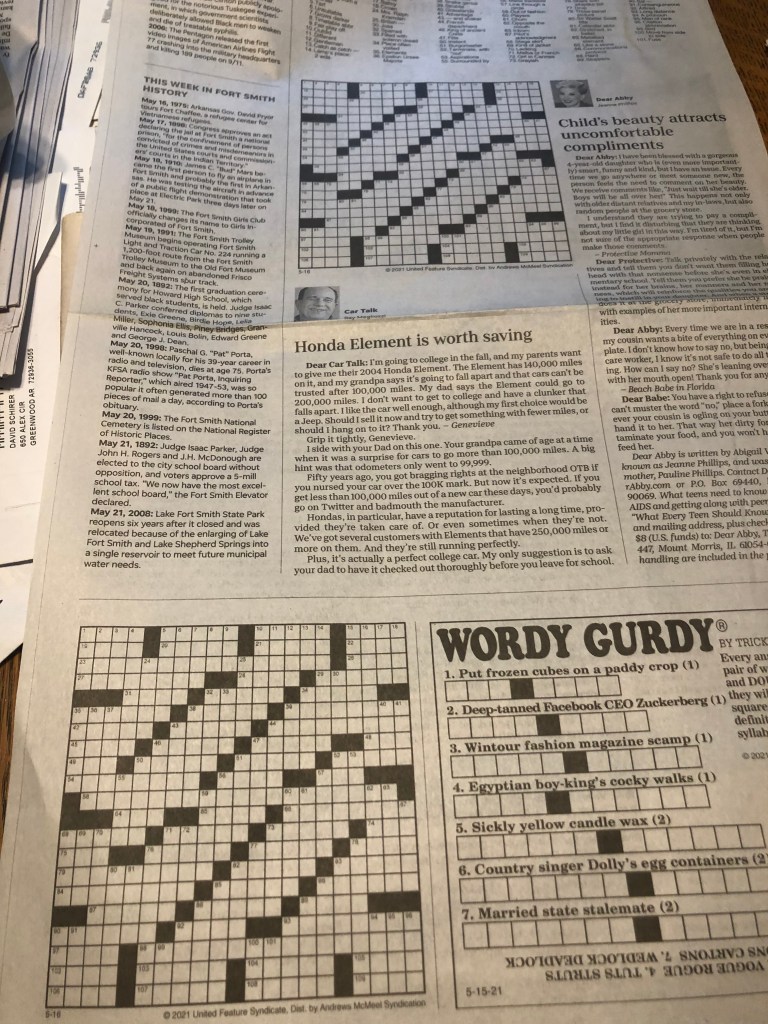
I have been diligently filling out crossword puzzles for the last 25 years.  I have taken the newspaper as one of my work expenses to keep abreast of the local news.  As I have moved from town to town and state to state the two constants of the newspaper have been the comics and the crossword.  While the comic section of the various papers tends to vary depending on which conglomerate is printing the news, the crossword does not seem to change (at least I do not recognize it).  That similarity has allowed me to become very good at “doing” this daily task.

I used to be proud of my ability to complete the crossword.  Several people have watched me complete the puzzle and commented on how I fill it out in pen.  I have never been that fond of pencils.  When I did work in several archives, I knew they were essential as the graphite is “acid free” and will not damage the aging paper.  The other advantage is you can erase any unwanted marks left by careless researchers.  The pens I prefer are more precise and easier to read, and my papers are on their way to recycling anyway.  While you cannot erase an ink mistake, I rarely make one.  I have found that when I do make a mistake, the pen allows me to overwrite the correct letter into the grid.  My sister-in-law commented on my use of a pen the other day and I responded, “Yes, and while the puzzle is usually rated at over 23 minutes to complete, I generally finish in just over 10.”  I hope I did not sound too smug.

The Sunday paper has a bonus with additional crossword puzzles.  One of these is from the New York Times.   These are more difficult and often use words that I do not recognize even when I complete them.  The crossword is on the top half of the page and the answers are on the bottom half.  Melissa thinks I am cheating, but after wracking my brain as long as I can, I will flip the page to find the answer.  My thought is this allows me to know the answers when they are repeated in another crossword.  When I finally began work on last Sunday’s crossword, I flipped the page as usual to find the answer grid was blank, just like the puzzle itself.  That meant there were not answers.  I did not fill the crossword out.

Thoughts:  The reason I said I used to be proud of my ability is I have come to realize this is an antiquated skill.  I tell myself completing the crossword is keeping my mind sharp (and it may be), but the reality is rapidly completing the crossword only means that I am good at recalling the answers for the clues I have encountered over the last 25 years.  Being good at doing my crossword is like my ability to remember trivia.  It is great for party games but has little utility for life.  I have heard despair over the loss of ability to tell time on a clock face or read cursive writing.  While these were essential learning in my Grade School, they are no longer being taught.  Cursive writing was developed to ease fatigue of the writer’s hands and wrist as well as conserve ink when using the pens prior to invention of the ballpoint.  Now most people have digital clocks and write with keyboards.  While we no longer use Olde English, there are still those who can understand and read the texts.  The same will become true with cursive writing.  Things change.  Follow the science.  Change is coming and it starts with you.

Temporary

May 24, 2021

When I was driving north last week, I took the side route into town.  This is part of the Scenic Byway through the Boston Mountains that I occasionally take to see if I can locate any new birds.  I have noticed several species of hawks, but they always seem to fast or wary for me to get a picture.  This time I noticed a trailer house that had slid off the road and into the ditch.  The house did not appear to be damaged, but neither was it going anywhere until some moving equipment pulled it out.  The authorities had obviously been notified as there were orange cones placed to keep people from accidently running into the house.  Apparently, someone had taken up temporary residence in the house.  As I drove by today it had caught fire (from inside) and the house had burned to the ground.

I was forwarded an article by Vicky Collins of NBC News that reported the dilemma for the homeless in the Denver area.  Advocates said unsheltered people were being left behind in Covid-19 mitigation, and they devised a plan to provide temporary safe outdoor spaces where people could access shelter, meals, medical care, and other services.  Two collaborative camps have already been set up downtown and were well received.  Surveys of residents in the Denver area have all been supportive.  When the pastor of a church in the suburbs announced it would create a temporary camp in their parking lot for about 40 unsheltered people, many community residents objected.  “When I bought in Park Hill, it wasn’t because there was a homeless encampment one block from my front door,” said a man who lives near the church. “If I wanted to live in downtown Denver and near homelessness in my face every day, having people sleep on my patio or go to the bathroom on my garage, I would live downtown.”

Collins described Park Hill as “full of flowering trees, stately brick homes and cozy bungalows.  Black Lives Matter signs adorn front lawns in the largely white neighborhood surrounding the church, and in the 2020 election, about 67 percent of voters in Park Hill cast ballots for Joe Biden.”  Five Park Hill residents filed a lawsuit earlier this month in Denver District Court to stop the encampment and seeking a temporary restraining order to prevent the project from moving forward.  The lawsuit said the camp “pose[s] a real danger to minors and school-aged children.”  The lawsuit was dismissed by the court Wednesday, and the Colorado Village Collaborative is on track to open the camp June 14 after securing a city permit.  Some seem to think temporary is too long.

Thoughts:  When I lived in Berkeley, California, I was literally across the street from People’s Park.  On April 20, 1969, the blighted, empty lot next to (and owned by) the university campus was seized by a diverse ground of people and turned into a public park.  This temporary venture has now gone on for 52 years.  The Free Speech Stage on the west side of the Park has been a focal point for anyone to stand and deliver whatever significant oration they deem worthy.  It has since become a magnet for homeless people, and a longstanding tradition of feeding people at the park by East Bay Food Not Bombs continues to this day.  I find it interesting have many temporary ventures become permanent.  Like the Park Hill community, helping the disenfranchised is a great idea, if you do it somewhere else.  That means these temporary sites have nowhere else to go but are still desperately needed.  Do the work.  Change is coming and it starts with you.
Standoff

May 22, 2021

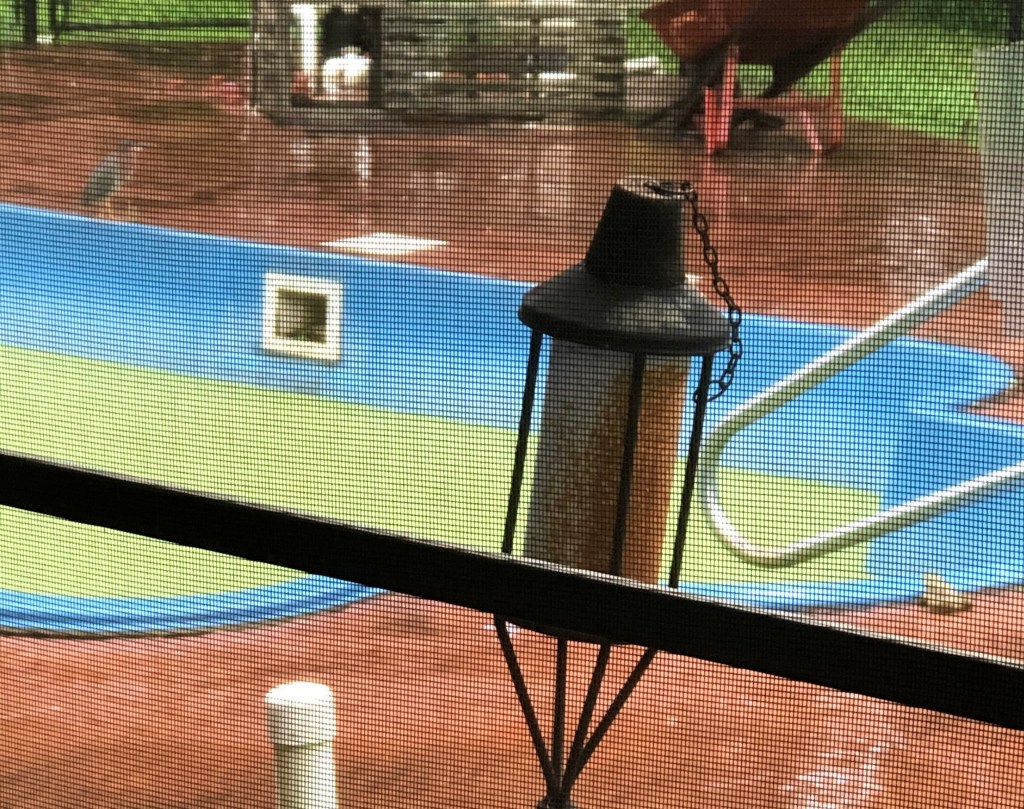
As I began to read my paper yesterday, I looked outside to see the return of the Green Heron (Butorides virescens) who had visited last year, or at least I assume the same one.  He was up on the fence ruffling his feathers in the light rain.  The Gackle on the ground and the Cardinal on the other side of the squirrel feeder were not happy about him being there, but the Heron merely stared at them.  They were caught in a standoff.  After a few minutes, the two smaller birds flew off.  As if to acknowledge his dominance, the heron began to preen his feathers.  After making sure he looked good, the bird glided down to the side of the pool and began to look for the reason he was there, tadpoles.

I continued to read my paper but glanced up now and again to see if the heron was still there.  He would hop from one side of the pool to the other, staring intently into the algae covered water.  By now it had started to rain earnestly, but he remained unfazed.  As I looked at the whole pool, I saw one of the large frogs had hopped out of the pool and was sitting next to the steps.  The frog was large enough to not be afraid of being eaten whole, but the heron still could have easily stabbed him and taken his time on the meal.  The two obviously knew the other was there and stood deathly still facing each other for nearly thirty minutes.  Neither flinched as they held another standoff. 

The heron finally hopped to the other side of the pool and the frog disappeared back into the pool.  I had some work to do but when I came back to the kitchen, I saw the heron was still vigilant.  The small frogs and tadpoles that he had feasted on for several days last year were now doing a good job of staying hidden.  After nearly an hour and a half the heron-tadpole standoff was finally broken.  The heron hopped into the pool and came up with a tadpole in its beak.  It flapped back out of the pool, gave the tadpole a couple of flips, and swallowed it down.  I saw two more go down in quick succession.  Apparently, his Cajun diet quota of frogs had been met and he flew back to the fence.  He strutted along the fence for a while, then flew off.  I hope he comes back tomorrow.

Thoughts:  When I lived in the Bay Area there was a Crawdad Festival held out in the Sacramento River Delta.  This featured food and music and the town of 650 swelled to over 300,000 people during the three days.  The main draw was crawfish served up in two or five-pound baskets.  Another delicacy offered were frog legs.  They were expensive (even for fair food) and I only tried them once to say I had.  They had the consistency and taste of dark meat chicken (go figure).  There were always first-timers at the festival.  They would order the crawdads and then sit and stare at them, unsure what to do.  The standoff did not last too long before someone would yell a suggestion, “twist the tail and suck the heads.”  The tail popped off when twisted and contained most of the meat.  The head and body were where the juice and Cajun spices lodged in the boiled crawdad.  Like many new foods, whether a delicacy or anathema depends on the one eating.  As Andrew Zimmern always says, “If it looks good, eat it!”  Do the work.  Follow the science.  Change is coming and it starts with you.