Blackberry

May 21, 2021

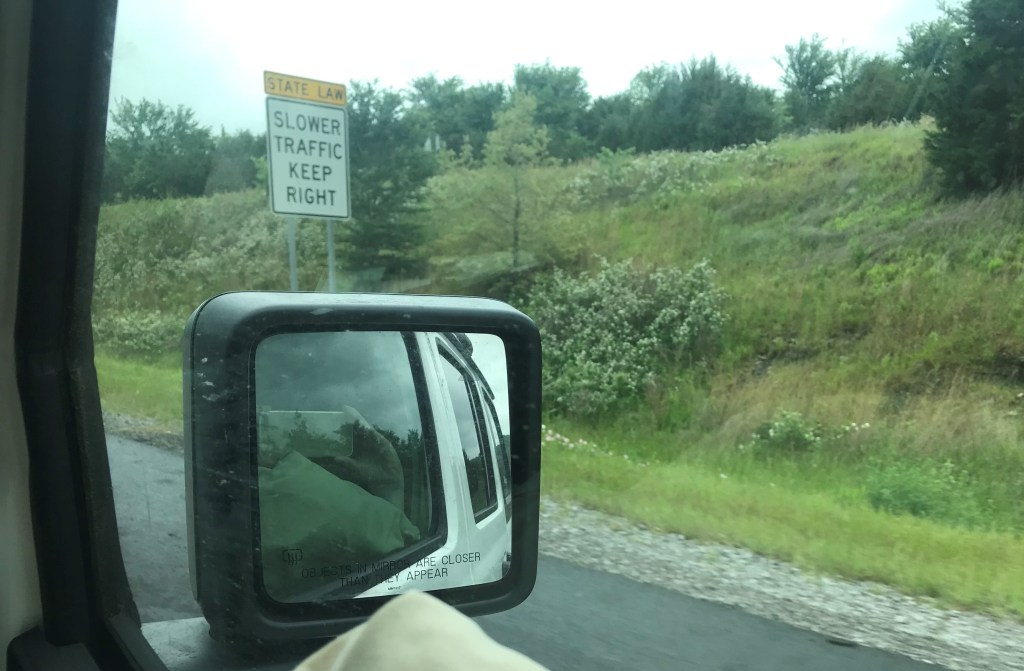
I had to comment as we drove through the mountains yesterday how beautiful the landscape was.  It had rained earlier in the day and even now we were passing through an on and off sprinkle.  It was still overcast but the day was clear even if not bright.  What made the biggest difference though was the weather we have been having.  The persistent rain has been accompanied by cool temperatures.  The trees had all filled out and the wildflowers and shrubs were in full bloom.  That left a fresh clean look in the mountain greenery.  Even the wild blackberries were in full bloom.

As we neared the crest of the mountain Melissa mentioned how much of the flowering ground cover was wild blackberry.  Wild blackberries are a diverse group of species and hybrids in the genus Rubus.  They are members of the Rosaceae family and are closely related to the strawberry.  Rubus is one of the most diverse genera of flowering plants in the world, consisting of 12 subgenera, some with hundreds of species.  Wild blackberries (Rubus fruticosus) are also referred to as brambles because of the tangled, thorny growth they create.   There are 11 species that grow in the wild throughout the US, and four species are considered weeds because of their invasive growth.  Blackberries are a source of food to both humans and animals as well as a source of cover for birds and animals.

Cultivated species of blackberry are well-behaved plants that need only a little pruning to keep them manageable, but invasive species are a terrible menace that can be difficult to control.  Weedy blackberries spread underground and take root wherever the long, arching vines touch the ground. Animals eat the berries and spread the seeds to distant locations through their digestive tract.  One seedling can eventually form a massive thicket.  These thickets were what I was seeing along the road.  This impenetrable thicket can overrun more desirable native plants and block access by livestock, wildlife, and humans.  While invasive blackberries are difficult to eradicate, they are pretty when they flower and provide protection for the small critters and birds who hang out in the thicket.   

Thoughts:  While these wild blackberries were not accessible to most humans (stopping on the Interstate is discouraged), all the blackberry growing along the roadway must produce a ton of food.  Several years ago, I worked with an urban gardener to create my first container garden at work.  The idea was to grow vegetables in areas that were accessible to the local population.  When the plants ripened, people could just walk along and pick the ripe fruit.  I grew grapes along one side of the building in an alley and over 30 containers in our enclosed courtyard.  While I thought this was a great idea, I found it a difficult to catch on.  Few fellow workers were willing to cultivate a crop grown for others, and Melissa and I ended up doing most of the work.  Picking fruit from someone else’s garden it not the common way of harvesting.  People needed to be retrained on how to think about ownership of the garden.  While we are opening businesses and restaurants, we are being told people will “know to do what is right.”  The problem is many never paid attention during closure.  People need to be retrained (and pay attention) going forward.  Follow the science.  Change is coming and it starts with you.

Swallow

May 20, 2021

As I entered the office door at work for the last week, I have been madly dive bombed by a barn swallow.  I am usually in a hurry as they whizz by and I did not pay them any attention.  Last Monday was different since I had to go in early.  I had left both computers at work, and I was not going to get anything done without them.  I knew once I got my essential work done, I would have extra time, so I had brought my camera to see if I could get a photo of a new bird.  I had forgotten about the swallow, but as I approached the door, he made his presence known.  While the barn swallow is an open country bird, they normally use man-made structures to breed and consequently spread with human expansion.  It builds a cup nest from mud pellets in barns or similar structures and feeds on insects caught in flight.  If you do not mind the nests and the droppings, they are a win/win.

When I looked the swallow up online, I found the Barn Swallow (Hirundo rustica) is the most widespread species of swallow in the world.  It is a distinctive passerine bird with blue upperparts and a long, deeply forked tail.  It is found in Europe, Asia, Africa, and the Americas.  There are six subspecies of barn swallow, which breed across the Northern Hemisphere.  Four are strongly migratory, and their wintering grounds cover much of the Southern Hemisphere as far south as central Argentina, the Cape Province of South Africa, and northern Australia.  Its huge range means that the barn swallow is not endangered and is the most widely distributed and abundant swallow in the world.  This makes it familiar to birders and nonbirders alike.

Since I had brought my camera to capture pictures of birds, I thought this would be a good try.  The problem was the swallow was so fast I could not get a picture.  I switched to my phone to give me a greater range of view, but still I struggled.  The swallow was just too fast.  I started focusing on one spot and snapping the picture every time the swallow seemed to come into my viewfinder.  I probably took 20 shots and could never be sure I got one that showed the bird.  By then, I had run out of time and needed to go to work.  When I checked later, I found I had gotten a photo of this speedy swallow.

Thoughts:  I began to wonder about the bird divebombing me around the entrance of the office.  I know the swallow is territorial, so I began to look around the roof overhang on our front door portico.  Sure, enough, there was a mud nest wedged between the roof line and the light.  There are frequent cultural references to the barn swallow in literary and religious works since swallows live near humans and have an impressive annual migration.  The main myths concern the weather.  I always find it interesting how humans attribute mystical powers to animals to make predictions.  We have used them to predict the weather (Punxsutawney Phil?) and the future (scapulimancy?).  Perhaps we should just enjoy the wonder of nature and realize it rarely is about us.  Do the work.  Follow the science.  Change is coming and it starts with you.
Mushrooms

May 19, 2021

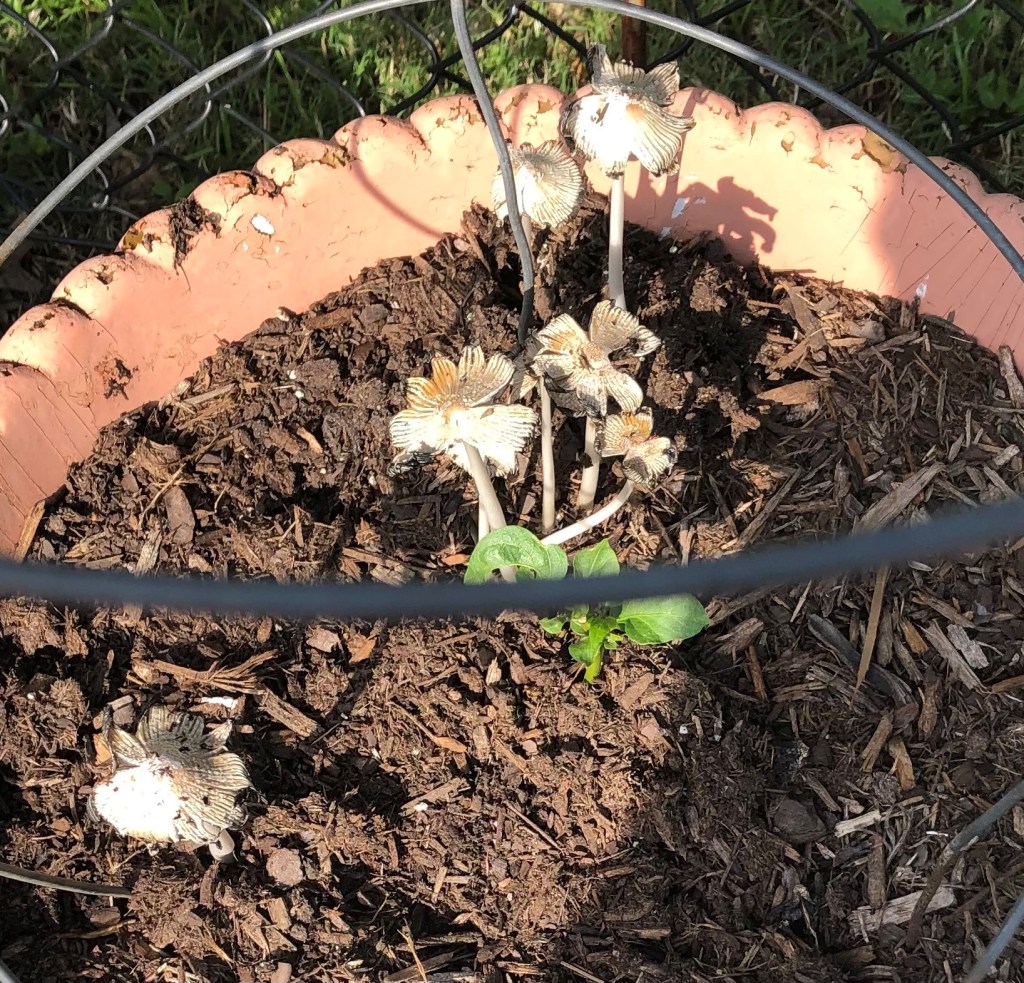
When I went out to check my containers, I was surprised to see five or six mushrooms growing out of the pot where the pepper had restarted itself.  These had seemingly grown overnight and now stood about five inches high.  The wet and humid weather often causes mushrooms to grow in our yard, but I had not previously had mushrooms in any of my containers.  I noticed several days ago that the portion of the container which now had mushrooms had undergone some digging activity by a rodent (squirrel?) of some sort.  I quickly removed the mushrooms and thew them into the yard.

The more I thought about the mushrooms the more I wondered what they were, and why they were there.  When I looked online, I found that mushrooms are a sign that your garden has organic-rich soil.    I had taken a picture of the mushrooms, so I looked them up to see what they were.  While all my apps struggled to identify the species of mushroom in my container, I settled on the White Dunce Cap.  Conocybe apala is a basidiomycete fungus and a member of the genus Conocybe.  It is common in both North America and Europe and is often found growing in short green grass.  Until recently, the species was also commonly called Conocybe lactea or Conocybe albipes.  I also read I had no need to panic finding the mushrooms in my container.  Most species are not toxic, and they do not to hinder the growth of your plants.  I still threw them out.

For a while in California, I lived in a dilapidated house that had a dormer attached to one side.  What I did not know at the time was that the roof of the dormer leaked.  I did not pay too much attention as the only thing it housed was a small walk-in closet.  The entire house had hardwood floors, except for the plywood floor of the dormer which had an indoor-outdoor rug placed over it.  As I walked into the closet during the rainy season, I looked down to see four or five large Laetiporus sulphureus on the floor and wall.  Many people think that the mushroom tastes like crab or lobster, leading to the nickname lobster-of-the-woods (also chicken-of-the-woods).  The authors of Mushrooms in Color said that the mushroom tastes good sauteed in butter or prepared in a cream sauce served on toast or rice.  I did not know this.  Neither did I think it important to eat whatever grew in my closet.

Thoughts:  The house I lived in was in the middle of Berkeley, California.  Most people I knew lived in small apartments while I lived in this one-bedroom house.  I admit, the closet did have mushrooms, the bedroom barely contained my bed, and the front porch fell off while I lived there, but it was a space by myself.  The only rub was I paid $600 a month in rent for something the owner would not have been legally able to rent to anyone else.  I have seen rental property from both sides.  There are renters who do not care and leave the apartment with $1000’s in damages on departure.  There are landowner’s who do not care and refuse to fix anything and blame the renter for breaking it.  During the pandemic, some renters are being subsidized and others are being protected from eviction.  While there are two sides to every story, both lessor and lessee treating the other with respect and humanity is a good place to start.  Do the work.  Change is coming and it starts with you.
Finally

May 18, 2021

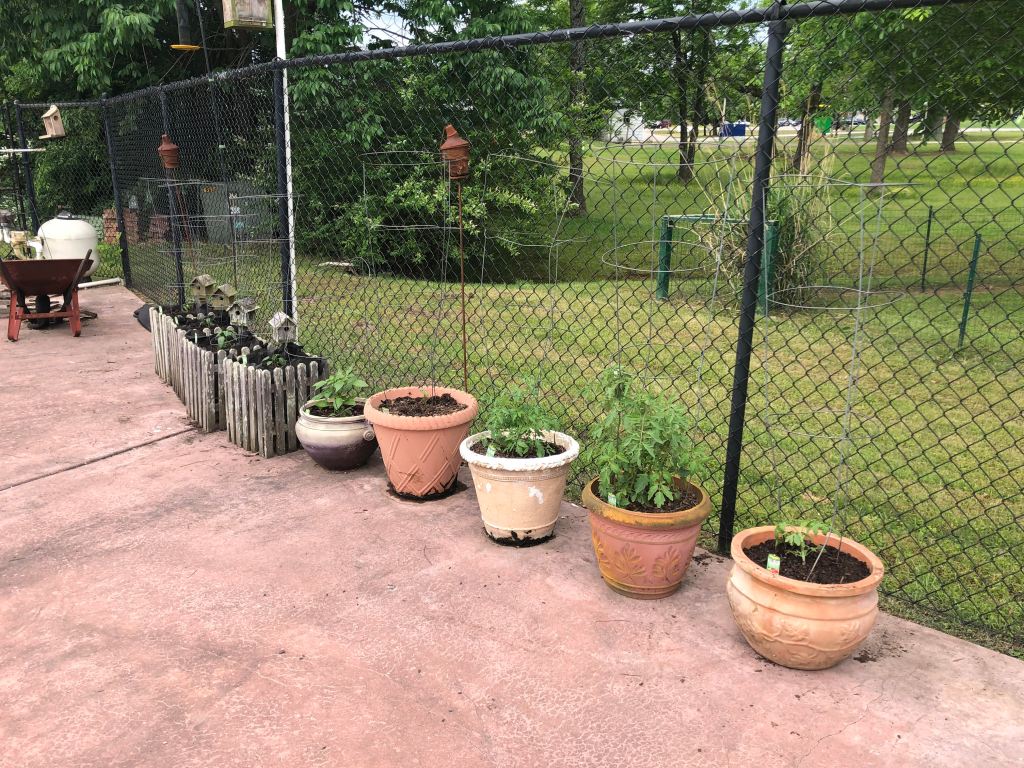
It was nice outside last Friday evening, and I decided it might be time to finally get my vegetable plants into the ground.  I had purchased them before the freeze and ensuing wind and torrential rain and had been reluctant to put them outside in the elements.  The problem was, they were not doing well inside either.  I never really know how much to water, and with all that that has been going on I have not paid a lot of attention to their health.  No time like the present, right?

Another problem that kept me from planting was I needed to rebuild the planters.  Melissa’s dad had built four small standing planters with small bird houses on one side.  While they were cute, they were not functional.  The bird houses were too small for birds and the soil containers seemed too shallow for vegetables.  They worked fine for flowers, but last year’s vegetables proved they did not have enough soil to allow the vegetables to thrive.  All the produce was tiny.  I also had the extra tomato I had purchased thinking the one in the planter was dead.  I found another container pot I could use and set about my business.  I was finally moving ahead.

Rebuilding the containers was not hard, just time consuming.  I first removed the ground cloth and soil from each pot.  I was surprised how shallow the soil was.  It was no wonder I got little production.  I relined each pot with new cloth, taking it all the way to the top.  I replaced the existing soil into the containers as a base, added fertilizer, and then put on an additional layer of soil.  That let me put the plants on top of the new level and then fill soil around each plant.  That added three times more soil and a healthy dose of vegetable starter to each pot.  Lastly, I did a similar fill for the new pot I had located and planted the new tomato.  I was finally done.

Thoughts:  I mentioned last year that gardening is not my best forte.  I tend to get the plants into the ground, get sidetracked, and then scramble to try and get them to revive.  This time they did not even get into the ground.  Now they are finally in their pots and I have a sense of satisfaction knowing this part of the task is complete.  What I was reminded last year, is this is only the first stage.  The plants need both ongoing oversight and to be left alone to give them the optimal growth pattern.  As many parents have children graduating from High School at this time of year, they have been taught a similar lesson.  You cannot allow the child to pass through these early stages of life without any protection.  At the same time, you cannot over protect the child, or they will not learn to grow on their own.  Now they have become adults and need to be treated as such.  I have found my plants need a little stress to make them thrive.  I think the same is true with our children.  Do the work.  Follow the science.  Change is coming and it starts with you.
Lawn

May 17, 2021

As I watched the news last weekend one of the lead stories was about a woman who had become irritated while her neighbor was using a leaf blower on her lawn.  Rather than asking her to stop using the blower, she chose to go inside, get her gun, and take a shot at the woman.  While she did not hit the other woman, she was later arrested by the police.  Apparently, it is against the law to shoot a firearm within the city limits.  Especially if you are shooting at another person.  Who would have thought?

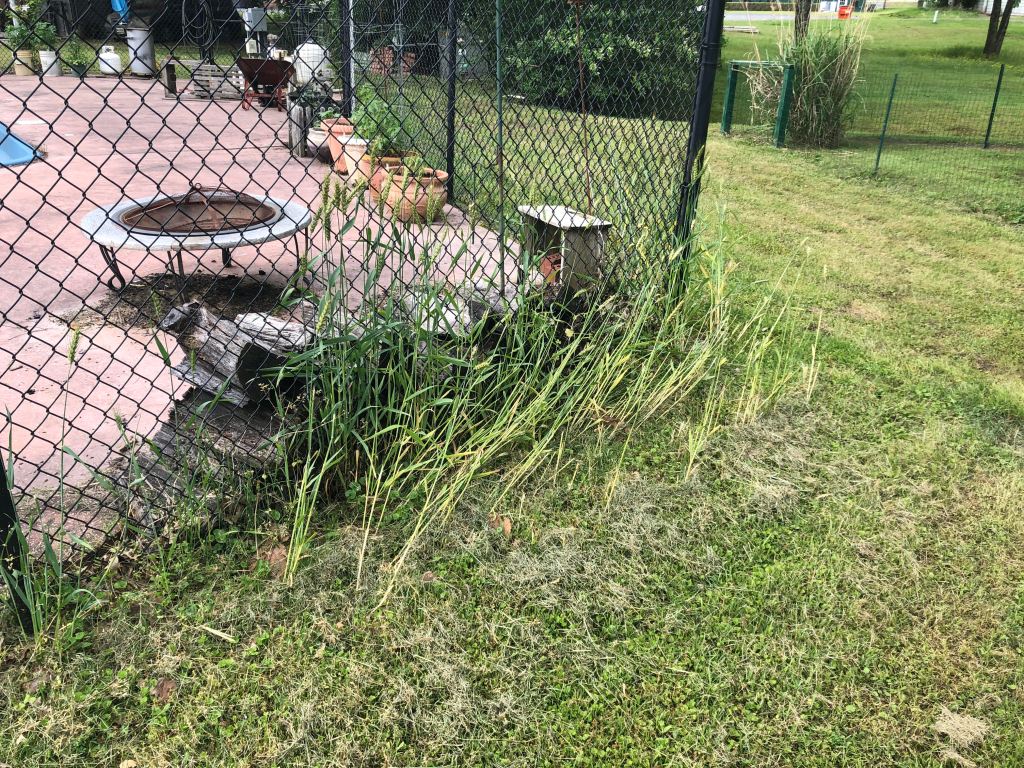
I bring this up because I faced my own irritation last week as well.  I had mentioned how I had decided to let the stalks of grain grow along the corner of my pool fence.  I had dreams of letting them ripen and then harvesting the grain and feeding it to my birds.  It seemed like a win-win scenario.  A friend knew the difficulty we were going through and offered to have her person come over and mow our lawn.  I admit, I felt sheepish accepting, but frankly the lawn was nearing the point of out of control.  I also knew the offer was made from a desire to help.  I agreed and she arranged for him to come over on Friday.  Sometimes it is harder to accept help than to offer it. 

When I learned the mower was coming over, I tried to be vigilant to catch them.  I placed a sign on the back fence saying not to cut the grain, but I have personal experience of not paying attention to the needs of the homeowner.  Mowing the yard is mowing the yard, and there are few variations.  I was in my office when I heard the mower fire up.  I went outside as quick as I could and got to the side of the house to see him mulching through the lawn along the back fence.  I started yelling to stop and he did turn around, but it was too late.  He had already mowed half of my grain field.  When I talked with him about my loss, I mentioned it was not all loss.  His lawn work was going to make my blog.

Thoughts:  The grain had grown in the lawn along my fence by no effort of my own (the birds did it).  Still, I was prepared to use this happenstance as a windfall and get a free supply of grain.  It would not have been a lot, but there was at least a peck or more in the heads.  It was my way of repaying the birds and to also give me the experience of hand harvesting (sounded cool as an ethnoarchaeologist).  I looked forward to both.  Much of what we do becomes routine, and we do not think about our actions, we just do them.  That is what happened when the mower cut my lawn.  He did not stop to read the sign.  He did not notice that the “weeds” had grown nearly three feet high and had to have been left for some purpose.  Instead, he just mowed the lawn.  I realize that what I was doing was not normal lawn care, but that did not make it bad.  Many habits of other cultures are different than those we are used to seeing.  When they are also accompanied by foreign words it can make them suspect.  Again, being different does not make it bad.  You may want to talk with people about what they are doing and why.  Who knows, you may want to try it as well.  Do the work.  Change is coming and it starts with you.

Overloaded

May 15, 2021

When I was driving back from the north, I came upon a truck that looked suspiciously overloaded.  When I first saw the vehicle, it appeared to be loaded with bales of hay.  I could not for the life of me figure out how they got the pile to stick out so far to one side.  Even more, I could not believe they thought the stress of this load would not send the entire pile toppling onto the highway.  When I finally caught up to the truck and passed, I realized rather than bales of hay, the truck was carrying roof trusses.  I had no idea what was on the truck, so my mind moved it into a known category.  Perception is often based on what is familiar.

When I looked online, I found an ongoing debate on whether it is better to use trusses or rafters in building construction.  The discussion seemed to come down to the size of the roof being built.  A truss is a prefabricated unit built off site and then shipped to the building location.  The truss is then lifted into place to form the roof.  The cost of a prefabricated truss package as compared to the material and labor costs to build rafters on site is 30% to 50% less, and since it is built in a controlled environment there are fewer mistakes.  Once the trusses arrive, they can be placed on the structure in little time.  Depending on the size, the rafters take about a week to build.  It was also mentioned that unless the truss is more than 40 feet long it might be quicker and better to build raters.  The ones I saw were on the back of a flat-bed semi and were around 40 feet long.  Even though they overloaded the truck, they were prepared to get the job done.

When I was in college, I worked for a friend who was a stone mason and custom builder.  One day he asked me to pick up a load of stone at a quarry about 50 miles from the job site.  I took his two-ton flatbed pickup to the quarry and they began loading the stone.  When they had loaded to capacity, there was just a few hundred pounds of stone that needed to be transported.  When they asked me what I wanted to do, I said go ahead and load it.  As I drove home, every time I hit a bump the load would force the bed down onto the wheels.  I ended up driving really slow to avoid an accident.  It would have been better to have made two trips rather than just making one overloaded.

Thoughts:  When I made the one overloaded trip, I thought I was saving my friend time and money.  What I did not realize was the potential damage to his truck and my life had one of the springs snapped from the weight.  There are times when we ignore overloaded warnings.  This can happen like me because I was not aware of the risks involved.  This may also happen because we have followed the warnings in the past and never had any problems.  We become complacent and decide to take the risk and drive overloaded.  While taking risks can come from ignorance or complacency, it can also be the result of self-interest.  I often find claiming your rights has little to do with the constitution.  Instead, what is being “violated” are one’s personal preference.  Do the work.  Follow the science.  Change is coming and it starts with you.
Nurses

May 14, 2021

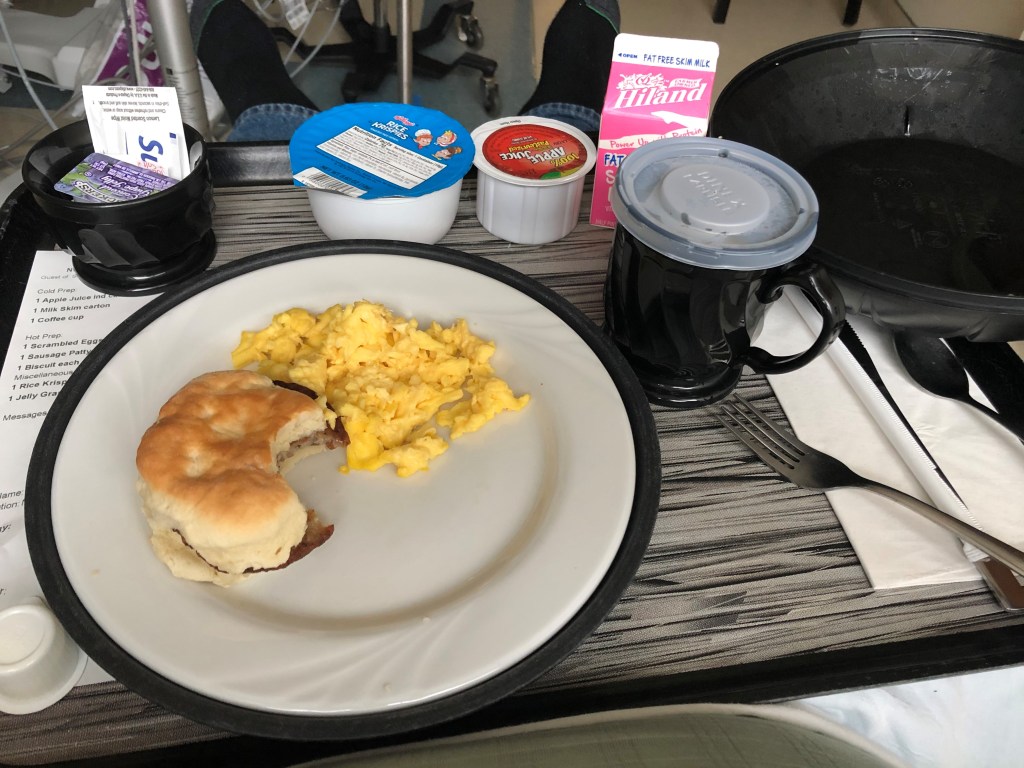
I spent several nights in the hospital with Melissa this last week.  What struck me most throughout the entire experience was the incredible compassion of all her nurses.  The tight restrictions that had been in place have been relaxed, but there are still guidelines that are in force.  They have specific visiting hours and limit the number of visitors per day for each person.  Despite the restrictions, the nurses allowed me to spend the night before the procedure with her in the room.  I went home after the procedure, but things did not go well that first night, and she asked if I could stay with her the next night in ICU.  The nurses told me this was about Melissa and anything they could do to make her feel safe was OK.  She had another long night, but things went better the following day.  The nurses even asked to have a curtesy tray brought to me, so I had meals while I was in the room.  I was grateful.

One thing I noticed during my stay was the relatively young age of the nurses.  When I looked online, I found that was generally true for the night staff.  The day shift usually has more experienced nurses because they had worked nights as new hires and have waited to get a position on days.  That is not to say that there are not experienced nurses who work nights by choice.  Nights are generally not as hectic as days, but you also only have about 2/3 the staff than the day shift.  That means more patients and less staff.  The patients do not get the same level of care as they do on days (hourly checks during the day and every two hours at night), and the staff is less experienced.  That puts enormous responsibility on the young nurses who have not had any exposure to the different scenarios that can happen at night, and often do not have experienced nurses as a resource.  These are what gives them “experience.”  That makes their level of compassion even more amazing.

In our case, it was true for both day and night.  None of the nurses I saw were older than 30 somethings.  During the day there were what appeared to be trainees (early 20’s) who were shadowing experienced nurses (early 30’s).  When I asked my sister (Nurse Practitioner, Public Health) if this was true across the board, she confirmed it was.  As nurses gain experience, some move into administrative positions and others decide to take less stressful and/or less strenuous jobs.  Registered nursing is the largest occupation in the US health care industry, with more than 3 million employed as of May 2019, and most of those jobs were in hospital environments.  A hospital nurse’s wages vary depending on the type of hospital where they are employed and the region of the country where they work.  Along with teaching, this is another one of those jobs where no matter what they make, it is not enough.

Thoughts:  My sister mentioned that her daughter who works as an ICU nurse is taking a strength building course.  Overweight people tend to be sicker, and the percentage of our country is moving closer toward obesity every year.  It takes strength to muscle people around in their beds.  Like many jobs, this is not taught in school.  It is something nurses learn through experience.  Being essential and on the front lines rarely translates into being well paid.  We leave that to those who are the CEO’s and administrators who do not have contact with patients.  Perhaps we should redefine who the essential workers are and pay them accordingly.  Do the work.  Follow the science.  Change is coming and it starts with you.
Wait

May 12, 2021

Melissa went into the hospital to undergo a procedure last week.  As is normal, it involved the typical hurry up and wait.  Arriving just before the weekend we needed to wait until Monday before it could happen.  I was just thankful they had opened the area for visitors.  As little as two months ago none were allowed due to restriction caused by the covid-19 pandemic.  While I understood the need for the precautions, I was also touched by the additional trauma this placed on both the patient and their loved ones.  It is hard enough to wait, but even harder to wait alone.

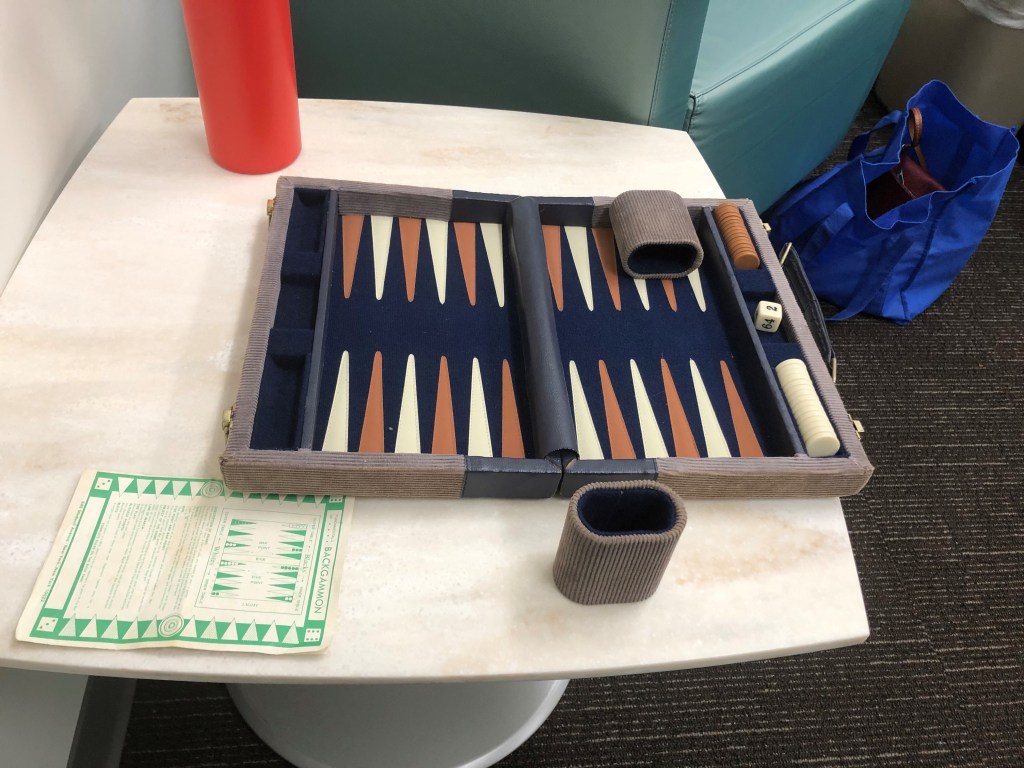
On Monday, the wait was over, and the doctors were ready to begin.  Melissa was whisked off and I was told where to go to wait.  A friend had already arrived and been shown to a private room to wait.  When I arrived from upstairs, I was directed to the same consultation room.  As we began to wait, she asked if I had ever played Backgammon.  When I mentioned I had never played, she told me she had brought the game if I wanted to play.  As the wait went on, I decided to give it a try.  She had never taught anyone to play but had brought the rule book that came with the board.  I read through the book, asked a few questions, and we began to play.

The game of backgammon is more than 5,000 years old and is one of the world’s oldest games.  The checkers are set up on one of the board’s four quadrants, each with six landing spots.  Each player rolls dice in turn to determine how far to move any of their checkers.  The aim is to get all your checkers past those of the opposing player and then off the board.  If you are first to move all your checkers off the board, you win.  Backgammon is not hard to learn to play, but the strategy and luck of the roll means it never stops posing a different challenge.  Initially, my wait partner was easily winning. Then I was able to roll doubles on multiple turns, allowing me to pull ahead and win by one checker.  Since the game took about 30 minutes to complete, this was a good way to wait. 

Thoughts:  I have been in several situations where I needed to wait on both sides of this process.  While I had to wait as a patient, I have been anxious about the procedure, but once it started my wait was essentially over.  As a loved one the real wait comes as the procedure is being done.  You wait during the procedure, during the recovery, and then as the patient is moved to the ICU.  I have noticed different ways how either I or a wait partner have responded.  Some think it is important to maintain an ongoing conversation to keep each other occupied (distracts me).  Others sit in silence and turn to their own thoughts (isolates me).  Thankfully, my wait partner used a mix of both approaches.  She talked when I wanted to talk and left me to my thoughts when I needed to be left.  This form of communication is a good rule to follow in all situations.  It means you also need to pay attention to the needs of the other.  Do the work.  Change is coming and it starts with you.
Mower

May 11, 2021

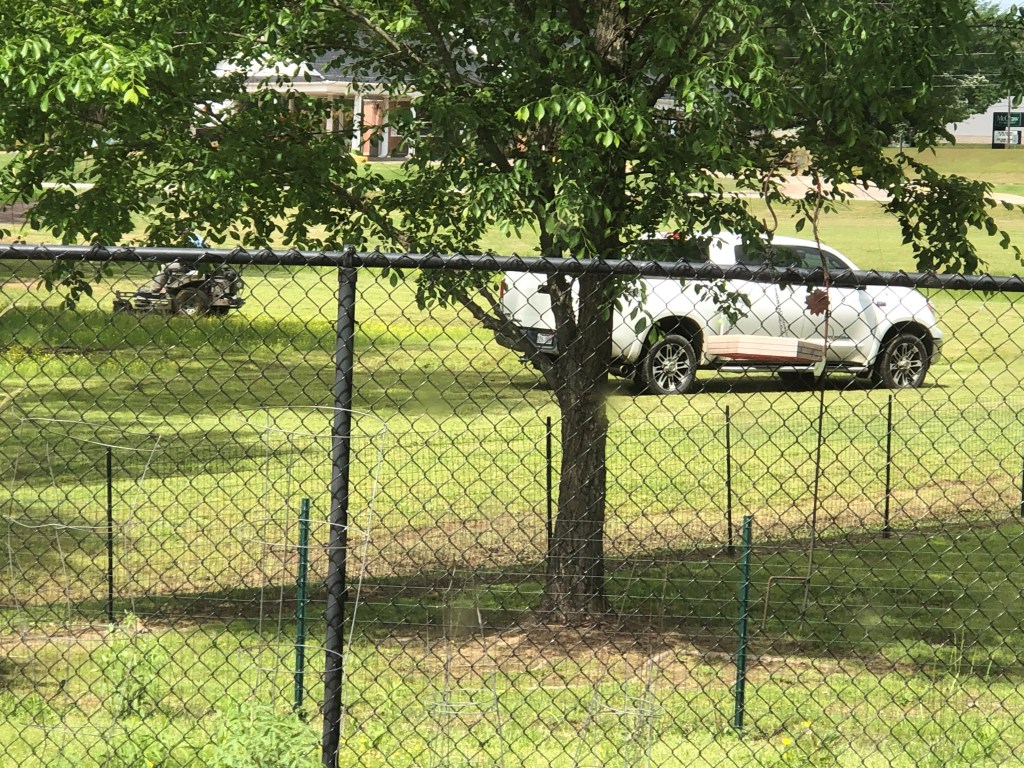
As I was reading my paper on Saturday, I was watching the caretaker for the church who owns the property behind us.  He often rides his mower the day before services to make sure the area looks nice for worshipers.  While the front of the church is on higher ground, this back field is lower and tends to collect water.  Prior to the church buying the property the grass often reached one or two feet before the owner would bring out his mower.  Now it is done more often.

One of my “other duties as assigned” when I was director of a conference center in Kansas was mowing the grass.  I did not have to do this, but I found it relaxing to get on the mower, plug in my headphones, and escape the office by mowing into the evening.  Since we had 61 acres, there was always something that needed to be mowed.  One area always caused me concern.  This was a thin strip of ground situated between a sharp rise and a small creek.  Most days this was just tricky, but when the grass was damp it become precarious.  I admit, I had to pull the mower out of the creek on two occasions.  Maybe it would have been smarter to let someone else ride the mower in this area.

I thought of my experiences when I noticed the caretaker had gotten the mower stuck in the wet mud in the field.  He tried for several minutes to first rock the mower and then try to push it out.  He finally gave up and got his truck.  He pulled the mower free and returned the truck to the parking lot.  He came back to the freed mower and went back to mowing the wet patch of field.  It did not take more than five minutes before he was stuck again.  Apparently, he did not learn from his mistake.  He had learned something, however.  He immediately went to get his truck, pulled the mower out of the mud, and this time left his truck in the field.  This time he was ready in case he got stuck.  He jumped back on the mower and tried to complete the job. 

Thoughts:  As I thought about the caretaker and his mower it struck me how often we only learn what we want to learn.  The field was too wet to mow.  This was evidenced by his mower getting stuck not once but twice.  The obvious learning was the ground was too wet and to wait for another day.   Rather than learning the obvious, he first learned he needed to pull the mower out with his truck, and then to leave the truck in the field in case it got stuck again.  We sometimes find ourselves in similar situations.  The obvious solution for the pandemic was to immediately wear a mask, wash your hands, and maintain social distancing.  Most choose to ignore this obvious learning and instead banked on creation of a vaccine or reaching “herd immunity”.  While this solution seems to be working, the cost is 33.5 million cases and 595,000 deaths in the US alone.  Follow the science.  Change is coming and it starts with you.

Mothers

May 10, 2021

Yesterday was Mother’s Day and I thought I would give a shout out to all the mothers.  When I looked online, I found the celebration of mothers and motherhood can be traced back to the ancient Greeks and Romans as they held festivals in honor of the mother goddesses Rhea and Cybele.  The modern precedent for Mother’s Day is the early Christian festival known as “Mothering Sunday.”  This was once a major tradition in the United Kingdom and parts of Europe, and the celebration fell on the fourth Sunday in Lent and was originally seen as a time when the faithful would return to their “mother church”, or the main church in the vicinity of their home, for a special service.

Mother’s Day is a holiday honoring motherhood that is observed in different forms throughout the world.  In the US, the day originated in 1908 and became an official holiday in 1914.  While the dates and celebrations vary, Mother’s Day traditionally involves presenting mother with flowers, cards, and gifts.  Melissa and I decided to give my mother a special treat by going to see her with a trip to Kansas (really?).  Since the pandemic struck, we have not seen my mother in over a year.  Sadly, that did not work out.

The official Mother’s Day holiday in the US rose in the 1900’s because of the efforts of Anna Jarvis. Following her mother’s death in 1905, Jarvis conceived of Mother’s Day as a way of honoring the sacrifices mothers made for their children.  Over time, the Mothering Sunday tradition shifted into a more secular holiday, and children would present their mothers with flowers and other tokens of appreciation.  The custom eventually faded in popularity before merging with the American Mother’s Day in the 1930’s and 1940’s.  Jarvis remained unmarried and childless throughout her life but resolved to see the holiday added to the national calendar.  She argued that American holidays were biased toward male achievements and started a massive letter writing campaign to newspapers and prominent politicians urging the adoption of a special day honoring motherhood.  Rightly so, we now honor our mother with a special day.

Thoughts:  While we now honor mothers on the second Sunday of May, we need to remember to honor our mother on every day of the year.  Just like Father’s Day, which honors or fathers, honoring those mothers who went before and gave rise to us is an important celebration.  We are not just progeny; we are future generations.  We need to remember and celebrate the memory of those who came before.   We honor them for what they taught, but also for what they sacrificed for us.  Do the work.  Change is coming and it starts with you.