Greeting

May 08, 2021

Photo by Pixabay on Pexels.com

We have a running conversation on messenger between my siblings, our spouses, and mom.  Melissa is preparing for a procedure and when she talked about it on the feed my brother wrote back saying, “Shalom.”  Melissa immediately responded, “Shalom u vracha.”  Shalom is a Hebrew word meaning “peace”, while shalom u’vracha is translated as “peace and blessings”.  My brothers’ response was that Melissa knew two more Hebrew words than he did, and he would have to look it up (I did as well).  When he did, he responded, “Shalom u Vracha indeed.”  A little bit of friendly one up man ship.

I have mentioned that I worked on an archaeological excavation in Jordan one summer when I was in school.  The director of the excavation had been coming to the site for several years and had gotten to know many of the Bedouin who lived there.  When they greeted each other, one would provide a greeting and the other would counter with a different greeting.  The greeting “as-salaam ‘alaykum” literally means “peace be upon you,” and is a traditional greeting among Muslims.  Since most Arabs are Muslims, it is also the most common Arabic greeting.  The response to this greeting is “wa ‘alaykum as-salaam,” which essentially means “and also with you.”  While this may have been common, the director and the Bedouins would continue the greeting, using several different forms.  This would take the greeting and stretch it out over several minutes.  Again, I thought, a little bit of one up man ship.

When I checked online about Arabic greetings it mentioned several common practices.  If you do not feel comfortable with the religious greeting, “Ahlan” is the basic way to say “hello” in Arabic.  “Ahlan wa sahlan” is the more formal version of “ahlan,” and is used with people older than you or in a position of authority.  Again, the response is “ahlan bik” (if you are male) or “ahlan biki” (if you are female).  Like Spanish, politeness calls for different endings to indicate gender.  “Ma’a Salama” is another greeting, although it literally means “With peace” and was formerly used to say goodbye.  Now it is used by many for both greeting and departure.  It is not surprising how much is said by how we greet others.

Thoughts:  I made a phone call when I was in Jordan to the American Embassy.  I picked up the phone and the operator came on and said, “Hello.”  I was relieved to hear she spoke English because my Arabic was broken at best.  I began to rattle off the information I needed to convey until again I heard, “Hello.”  That was when I realized this greeting was the only English she understood.  American English usage has stripped much of the politeness from greeting and conversation.  We do not change address based on gender or social position.  While we have made our language more democratic, we have also lost the respect deserved by those with whom we speak.  This respect is not confined to age or gender; it is basic human decency.  Do the work.  Change is coming and it starts with you.
OUT

May 07, 2021

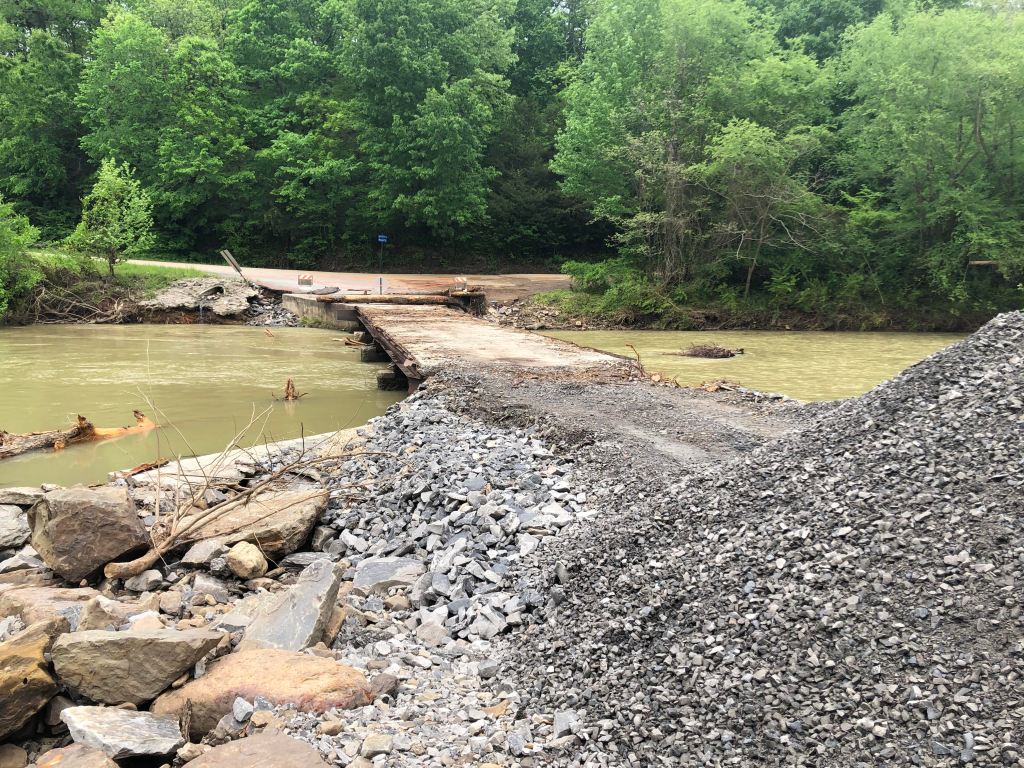
When I went to work Monday a friend showed me a picture of some of the damage caused by the extreme rains over the weekend.  While some were buffeted with high winds and even a small tornado, most of the damage in our county was caused by flooding.  That included several low water bridges, including the bridge across the river on the west side of town where I work.  The waters had been so fast that it took out the bridge. While this only serves a few families, it was the only access they had across the river and into town.  I was told there was a one lane dirt road that could serve as a go around.  The bridge being out meant a huge inconvenience for those on the other side.  It will also take a while to fix.

When I worked as director for a conference center in Kansas the state decided they needed to replace the bridge that provided access to the camp.  When they first brought the proposal to me, I was told the bridge would be out for four months during the summer, the main camping season.  While I had little clout to change the date, delays for materials and a major business located further down the road meant it was delayed until the fall.  We also had a go around, but it was four miles out of the way along dirt roads the few knew existed.  I received constant calls for directions while the bridge was out.

The fast-moving storm passed through west-central Arkansas Monday night.   Winds up to 90 mph hit Van Buren around 10 pm.  The storm and resulting EF-1 tornado moved through mostly rural county but also left damage in Alma.  Arkansas Valley Electric reported that they had approximately 14,500 members where the power was out after the storm.  The outage stretched across Crawford, Franklin, Johnson, Pope, Sebastian, Logan, and Scott counties.  Damage to the Crawford County Court House was centralized on the roof of the building as well as the many fallen limbs across the property.  Debris from the building was blown across the lawn of the courthouse and across the street to neighboring parking lots.  The local school districts shifted to virtual learning, but the power was out in many areas.    Rather than snow day schools now need to have virtual out days.

Thoughts:  By Thursday evening the power had been restore to all but about 100 customers.  While that is good for most, it means it is still out for 100 families.  The administrations $2 trillion infrastructure proposal includes $100 billion to give every American access to affordable, reliable, and high-speed broadband.  Virtual schooling during the pandemic has highlighted the disparity between wealthy urban areas and poor and rural area’s access to broadband.  Some in congress are decrying the proposal, saying Wi-Fi is not infrastructure.  I guess you can say that if you have access.  Having been on the other side, it seems more essential when it is out.  Do the work.  Change is coming and it starts with you.

Treefrog

May 06, 2021

I mentioned how the bullfrogs have begun to flourish with the addition of our accidental pond.  There has also been a plethora of treefrogs at the house since Melissa had it built in 1995.  That is in part because of the poorly drained field behind and house providing standing water for at least part of the spring-summer breading season.  This is accompanied by the belt of trees that divide our property from the businesses next door.   That means the conditions are right for the amphibious frogs to live and breed in the trees and then lay their eggs in the standing water.  Except for the constant calls, the frogs keep the mosquito population in check.

When I looked online the Cope’s Gray Treefrog (Dryophytes chrysoscelis) is also called the southern gray treefrog.  It is almost indistinguishable from the Gray Treefrog (Dryophytes versicolor) and shares much of the same geographic range.  Both species are variable in color, ranging from mottled gray to gray-green and therefore resembling the bark of trees.  These are treefrogs of woodland habitats, though they will sometimes travel into more open areas to reach a breeding pond.  The only readily noticeable difference between the two species is the mating call.  The Cope’s has a faster-paced and slightly higher-pitched call than the Gray.  In addition, the Cope’s is reported to be slightly smaller, more arboreal, and more tolerant of dry conditions than D. versicolor.

After the storms we got some water damage on our kitchen ceiling.  I called the insurance agent, and he provided a roofer to check the damage.  When the roofer went up on the roof, he found a PVC vent pipe had come loose and dropped into the attic, as well as other damage that is still being researched.  The interesting thing was, when he looked down the vent pipe, he saw a treefrog had decided this was the perfect place for his new home.  He took pictures for me and all you can make out are the two eyes looking up from about a foot into the pipe (it did not reproduce).  When I asked him about the treefrog, he said it happens all the time.  Good thing this pipe did not vent the furnace.

Thoughts:  After finding how difficult it is to determine between the two treefrogs common in Arkansas, I checked around for more identification possibilities.  I found a secondary site online which identified the mating calls of the frogs and toads of Arkansas.  The Cope’s Gray and the Gray do have different mating calls.  The calls begin the same, but the Gray has a secondary trill that makes it distinguishable.  That is how I know ours are the Cope’s Gray Treefrog.  I have found when trying to identify treefrogs, when identifying my birds, that even subtle differences begin to stand out when you take the time to learn the differences.  I have also found the same is true with people.  Once you take the time to get to know people the similarities fade into the background.  Instead, each person’s uniqueness is readily evident.  That is when them can become us.  Do the work.  Change is coming and it starts with you.
Revived

May 05, 2021

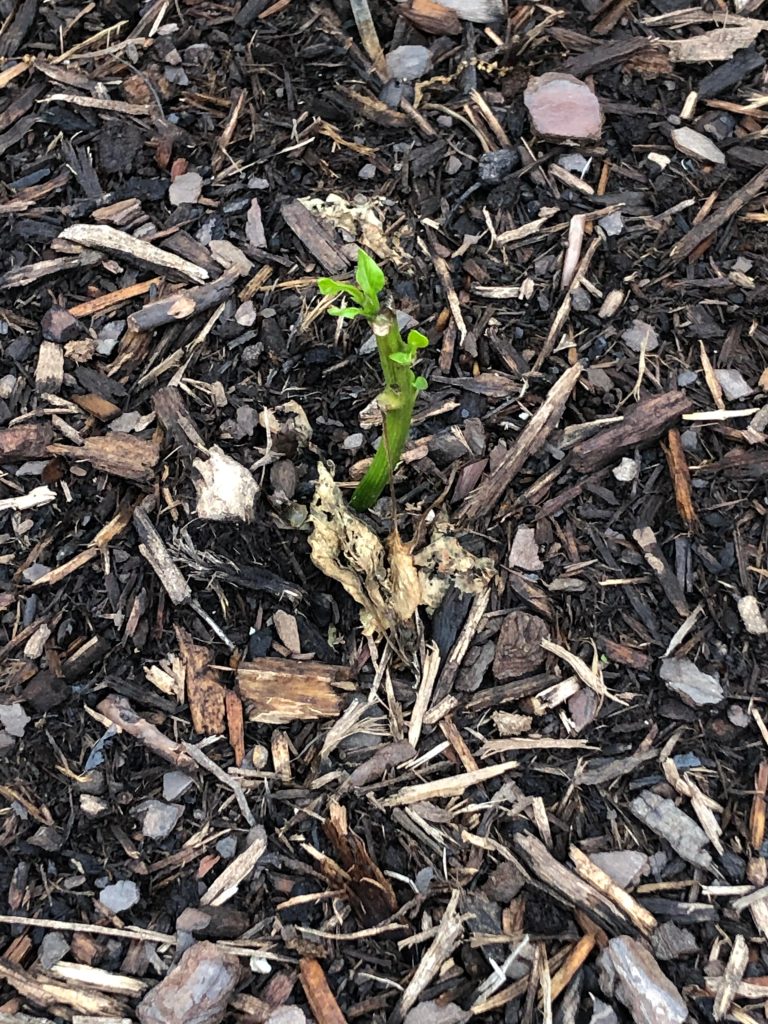
I had mentioned that while most of my plants survived the hard freeze we had two weeks ago, one of the peppers did not appear to make it.  Not only did all the leaves turn brown and fall off, so did the branches, leaving only a stub of a stem.  It took several days of procrastination before I finally bought another plant.  I believed the dead plant to be a tomato plant so that was what I bought.  I left the new plant inside since we have had severe storms and tornado warning the last days.  The last thing I wanted was to put the plant in the container and have it wiped out by a hailstorm.  When I went out to plant the tomato yesterday, I found two things.  One, the plant that froze was a pepper and not a tomato.  Two, the stem now had leaves beginning to grow off the end of the stub.  It seems to have revived.

I came across an article online that addressed how the American economy could be revived.  It had three points that need to be taken into consideration, and all revolve around learning from crises we have overcome in the past.  Successful government responses to previous crises have worked when they first prioritize people.  We need to focus on human welfare and human capital.  Second, a crisis tends to accelerate preexisting economic trends, and government responses are effective when they take that into account and plan long-term policy accordingly.  Third, the most effective planning for long-term economic recovery starts early, often alongside acute crisis-relief efforts.  We denied the crisis existed and then delayed any response and missed the early intervention window.  I guess that means plan B.

One of the problems faced during a crisis is the pressure on policy makers to focus on the short term rather than long term solutions that could create real change.  A long-term solution would be to begin to build and expand public and private sector innovation through education, research and development grants, and providing publicly available data.  This also means taking steps to facilitate transition to the post-pandemic economy by investing in programs that including job matching and reskilling that would be crucial for building the workforce of the future.  As always, for our economy to be revived it will rely on a combination of past action and present response based on the result of those actions.     

Thoughts:  When I looked up “revived” in the online Free Dictionary it stated this was a variant of the word “re·vive (rĭ-vīv′)”.  As most know, revived means “to bring back to life or consciousness, or to resuscitate.”  It can also mean “to restore” or “to return to use” or “to regain health, vigor, or good spirits.”  Certainly, that is what happened to my pepper plant.  We are told this is also what is needed for our economy.  Several types of service and industry jobs will likely never return.  This is an opportunity to retrain and retool for a new workforce.  The old ways do not be revived.  What they need is to be transformed.  Do the work.  Follow the science.  Change is coming and it starts with you.
Hydro

May 04, 2021

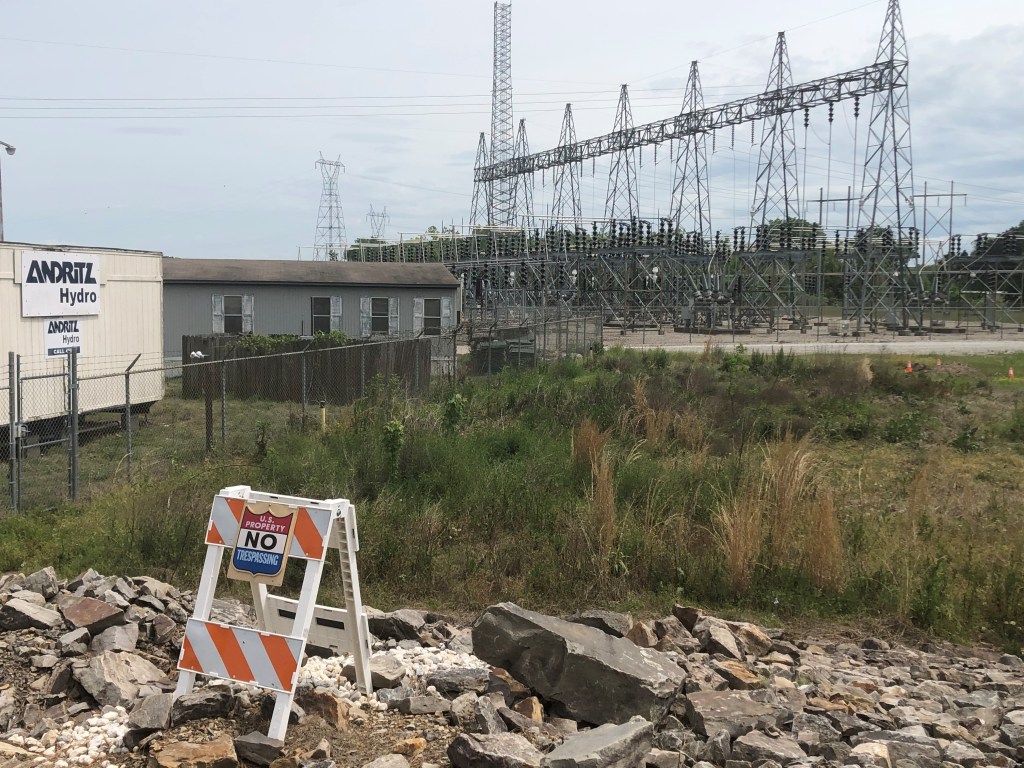
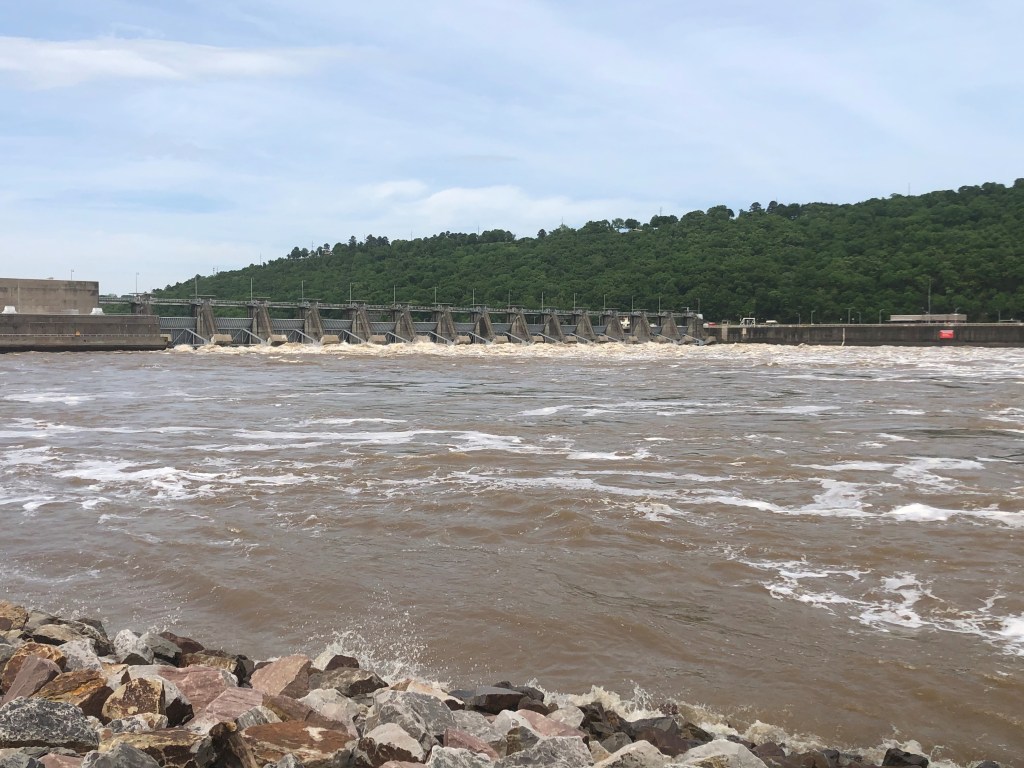
When I was out looking for a place to fish on Saturday, I drove by the Aux Arc Campground.  This is a Corps of Engineers park associated with a hydro plant along the Arkansas River.  I almost drove by, but I have found potential fishing holes at the Ellis hydro plant near Fort Smith.  I pulled in at the last minute to see what the park was like.  I entered the park and drove slowly (truck in front going 5 miles per hour) by a continuous series of campsites.  It was a weekend but still I was amazed to see nearly every spot filled with an RV and usually an additional tent.  The playground had nearly twenty children and their parents, and a birthday party for forty was taking place in the shelter.  There must have been over 300 people crammed along the narrow bank of the river.  This was one of the many parks and campsites that were closed this time last year.  We seem to be back open in full swing.

The Ozark hydroelectric plant is one of six plants along the Arkansas River in our state.  There are an additional five Hydro plants on the White River and a total of 19 plant throughout the state. These are operated by six different power agencies.  In 2018, Arkansas’ electricity-generating facilities had a summer capacity of 14,763 megawatts, and a net generation of 67,999 gigawatt-hours.  The Hydro plant at Ozark was completed in 1973.  It has five turbines that produce a net generation of 89,547 megawatts of power.  In 2020, Arkansas’ electrical power generation mix was 39% coal, 28% natural gas, 22% nuclear, 8% hydroelectric and 3% renewables.  We are still a long way from clean renewable energy.

The Ozark hydro plant marks the beginning of the Ozark Lake.  The associated park created by the Corps is named Aux Arc based on the name given to the area by the early French explorers who mapped the territory.  “Aux Arc” means “the big bend” in French and described the bend in the Arkansas River noted by the mappers.  Over time, the name was simplified to “Ozark,” thus the name for Ozark Lake and the town located nearby.  Some suggest the whole area was called the big bend by the French, and the later English explorers applied the name to the nearby mountains as well.  The Ozark Mountains cover a significant portion of northern Arkansas and most of the southern half of Missouri.  This is a big bend.

Thoughts:  Hydro was once the main source to power for early industry of America.  Most mills and factories were located along rivers or streams that used the flowing water to turn the machines that drove early industry.  It was not until September 30, 1882, that the world’s first hydroelectric power plant began operation in Appleton, Wisconsin.  The plant was initiated by Appleton paper manufacturer H.J. Rogers and was inspired by Thomas Edison’s plans for an electricity-producing station in New York.  Hydro is one of several non-carbon renewable sources available to produce the electricity needed to drive today’s manufacturing and light our nation’s cities.  While the dams associated with the plants often serve as flood control, they can also block the migration and spawn of species of fish.  We cannot choose human needs over nature’s but need to find a way to allow both to thrive.  Otherwise, nature will win.  Follow the science.  Change is coming and it starts with you.
Silo

May 03, 2021

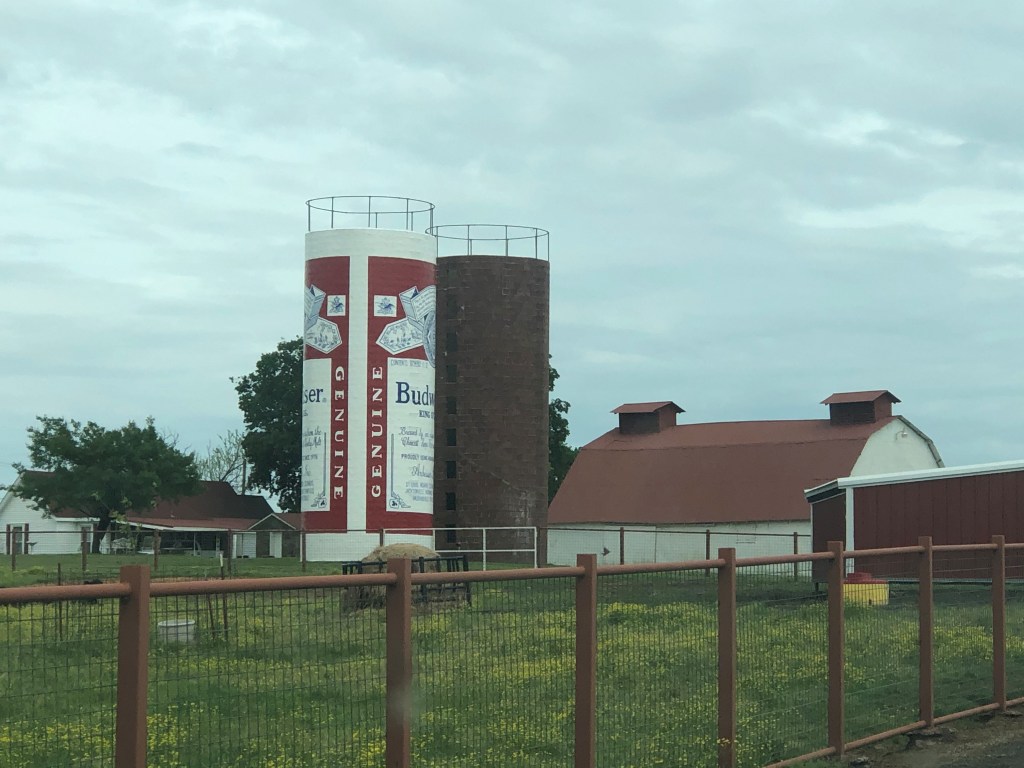
Saturday Melissa’s sister and niece came to visit, and I took some time to go for a drive and get in some fishing.  I had been given directions for a guaranteed fishin’ hole several months ago by a friend but had not yet been able to check it out.  I was not sure this was where I was going to go, but as I drove the car took me in that direction, so I followed along (even without AI).  The route took me across the river and then east along the interstate.  The further I drove the more I realized these were directions from his house up north.  A closer route would have been to head east from my town and then bend slightly north.  I was out to get away and the drive was through some beautiful scenery, so I did not mind.  While I was on my way back home, I passed the (locally) famous Budweiser Silo outside of Lavaca.

When I worked for the Kansas State Forestry Department in the 1970’s (yes, a real thing) we took care of the trees and grounds of the state park areas at two of the local reservoirs.  We mostly planted trees, pruned, and cut grass to keep the areas looking nice.  A couple of years earlier the high-water level from rains had resulted in the loss of trees along the reservoir, and that meant we also cut up the wood and transported it to a ground silo located on the other side of the lake.  The ground silo was previously used by the rancher who owned the land around the river the dam had transformed into a reservoir.  They would store silage as feed for their cattle.  Since it now belonged to the State, we filled it with limbs.

The silo I passed Saturday was located on a ranch that raised Certified Angus Beef.  They used this upright silo to store grain they used to feed the cattle during the lean winter months.  It seems the original owner was also the local beer distributor.  He had painted the Budweiser logo replica on the silo years ago, but it had faded over time.   After he died, his daughters ran the beer distributor business, along with the ranch.  They met artist Troy Freeman of Freesky Studios when he was painting a logo on their barn for Certified Angus Beef.  Since the original paint on the silo required frequent touching up, they hired Freeman in 2018 to redo the silo with a more durable paint.  Freeman located a beer can from the 1974-78 era, completely sandblasted the silo, and recreated the original to exact scale and specs.  The interesting part is the silo sits in a dry county.

Thoughts:  I remember one day when another worker and I brought limbs to the ground silo in Kansas.   I backed the truck up to the edge and got out to push the limbs into the slit.  My co-worker decided I was not close enough and got in to move the truck closer.  Every time he put his foot on the clutch it inched closer to the silo.  Finally, he revved the engine and threw it into gear.  Regrettably, it was in reverse.  The truck unloaded all right, but it now sat in the bottom of the silo.  Life can often be like unloading our truck into the silo.  We can try and tweak what we are doing to make everything perfect before we start.  When things get off kilter, we can become frustrate and just throw it in gear and hit the gas.  Often this causes us to end up in the bottom of the silo.  Sometimes it is better to accept that even though things are not perfect we will never make any progress until we start.  Perfection will never be achieved without first beginning the work.  Do the work.  Change is coming and it starts with you.
Trafficking

May 1, 2021

The nightly news yesterday reported that 90 people had been found crammed into a single two-story house in a Houston neighborhood in an apparent incident of human trafficking.  Assistant Chief Daryn Edwards of the Houston PD said Investigators had worked overnight to track down the location in southwest Houston after receiving a call about a potential kidnapping late Thursday.  The police were investigating the reported kidnapping Friday when they came upon the alleged smugglers’ house holding the 90 migrants.  None of the people were in particularly ill health, but they remained inside the two-story home Friday because some showed signs of COVID-19.  They will all be tested for the virus.

The US has created a lucrative trade for smugglers of both drugs and humans by declaring war on both. Unfortunately, those being smuggled are at risk for engagement with law enforcement.  Whether it is through prostitution, illicit drugs, or illegal immigration, these individuals are on the law enforcement’s radar.  In most cases, the aim of law enforcement is to protect the trafficked individual while targeting the traffickers.  While the prosecutors are not targeting them, these vulnerable people are still at significant risk for deportation if they are retained and undocumented.

The threat of deportation has substantial consequences for victims of trafficking.  It can be a deterrent to victims reporting their traffickers, making them even more reliant on their captors for perceived protection.  Many traffickers use the threat of deportation to control their victims, and the widespread enforcement of immigration policy reinforces that fear.  There is also the fear of retaliation, as the traffickers threaten to harm victims and their families to maintain control.  It is not yet clear who was behind the alleged smuggling operation in Houston, and no one had been arrested.  The youngest in the group was in his early 20’s and many appeared to be in their 30’s.  Only five were women.

Thoughts:  There are an estimated 57,000 people believed to be victims of human trafficking in the US. Woman account for about 80 percent of individuals involved in sex-trafficking, with some estimates stating that a quarter of these cases involve minor children.  What Houston illuminates is the growing number of immigrants who are being brought into the country and forced into unpaid labor.  Many of the trafficking victims are lured into the system with the promise of legitimate jobs, while others are kidnapped or entrapped in a myriad of ways, only to be enslaved and faced with violence and torture, including threats of death.  Their lives are then bought and sold as a commodity.  We need to be less concerned with punishing immigrants and more with protecting them.  Do the work.  Change is coming and it starts with you.
Berries

April 30, 2021

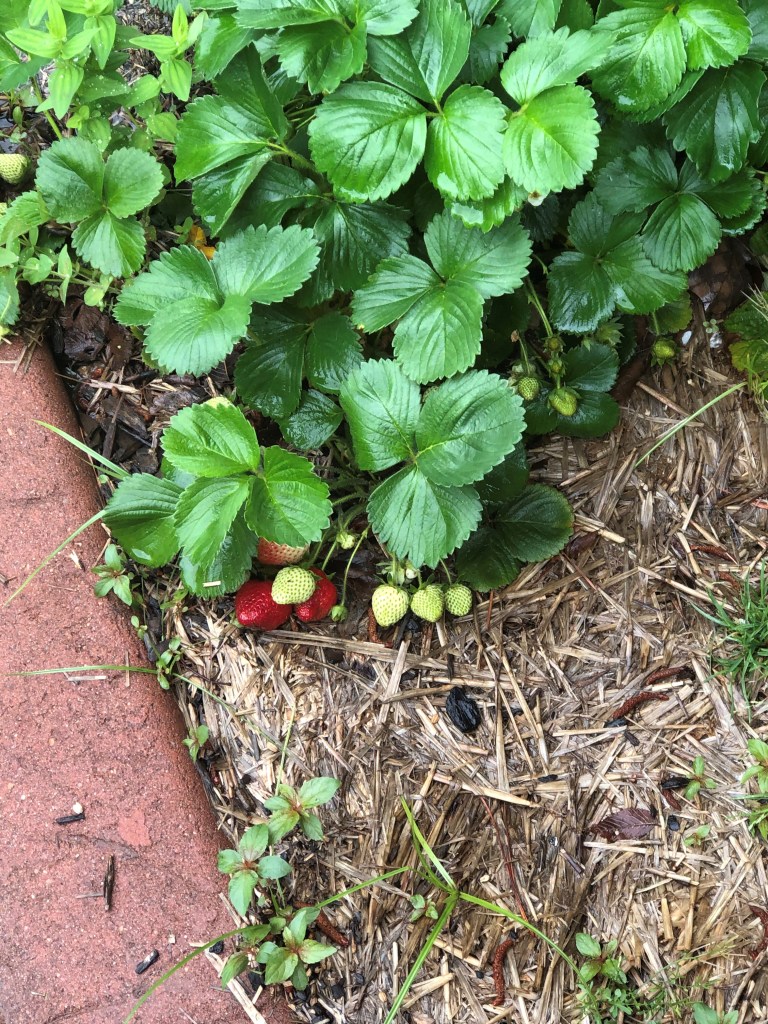
Yesterday I harvested the first of what I hope to be a long season of strawberries from the bed along my back patio.  I mentioned how the plants only produced three or four berries last year and the birds got to them before I could.  I had dozens of flowers and even unripe berries before the hard freeze a couple of weeks ago.  That was followed by the torrential rains we got this week that completely flooded the bed and left the plants in standing water.  While near perfect conditions last year failed to provide a crop, the terrible conditions this year are (so far) creating an abundance.  Go figure.

When I purchased the plants last year, I knew there were two basic types of berries, June-bearing, and ever-bearing.  I went with the ever-bearing hopping to have strawberries throughout the summer.  When I looked online, I found that these types are just the beginning of the varieties of berries.  There are a lot of different climates and growing conditions, and each state has its own unique general soil composition, rainfall, and weather patterns.  That means different varieties do better in one region than in another.  While some can adapt to a variety of environments, others have been bred to be highly productive in a relatively narrow climate range.  The recommended varieties for Arkansas are Cardinal, Camarosa, Chandler, Delmarvel, Earliglow, Lateglow, Noreaster, Sweet Charlie, Tribute, and Tristar.  Being naive, I just got what was at the store, Ozark Beauty (Fragaria x ananassa).  They seem to work.

I noticed yesterday that several of my berries were getting ripe, and that others had already become bird food and were going bad.  I decided it was time to pick the ripe ones, as the birds already get enough from my feeders.  The water had subsided and the straw I had covered the plants with last year was still in place.  I gave no second thought as I stepped into the bed to get at several berries in the back.  My foot immediately sunk four inches into the mud, causing me to lurch forward into the house, breaking several nails and cutting my hand on the bricks.  Since that was not going to get me to the back of the bed, I leaned against the house and used a pair of scissors to cut the berries off the plant.  Even given the bird depredation, I still reaped a dozen berries.  I am hopping for a good year.

Thoughts:  My berries reminded me how nature can be both fragile and resilient.  The fragility was displayed last year as the plants needed time to adapt to new conditions before being able to produce berries.  The resilience is evident in the ability to thrive over winter, and then withstand both the freeze and the torrential rains.  It hammered home the point that conditions do not have to be perfect to produce a good result.  Stepping into the bed also reminded me that you need to be aware of context as well as present conditions.  The bed looked fine, but the recent rain meant the soil beneath the straw was mud.  American society can be viewed through a similar understanding.  We are both resilient and fragile and must understand context as well as present conditions.  The decade of the 2020’s will be shaped by the past 500 years of colonial and American expansion.  These conditions have been far from perfect, but that does not mean we cannot have good results.  It is time to put away our fragility and embrace our resilience.  Do the work.  Change is coming and it starts with you.
Severe

April 29, 2021

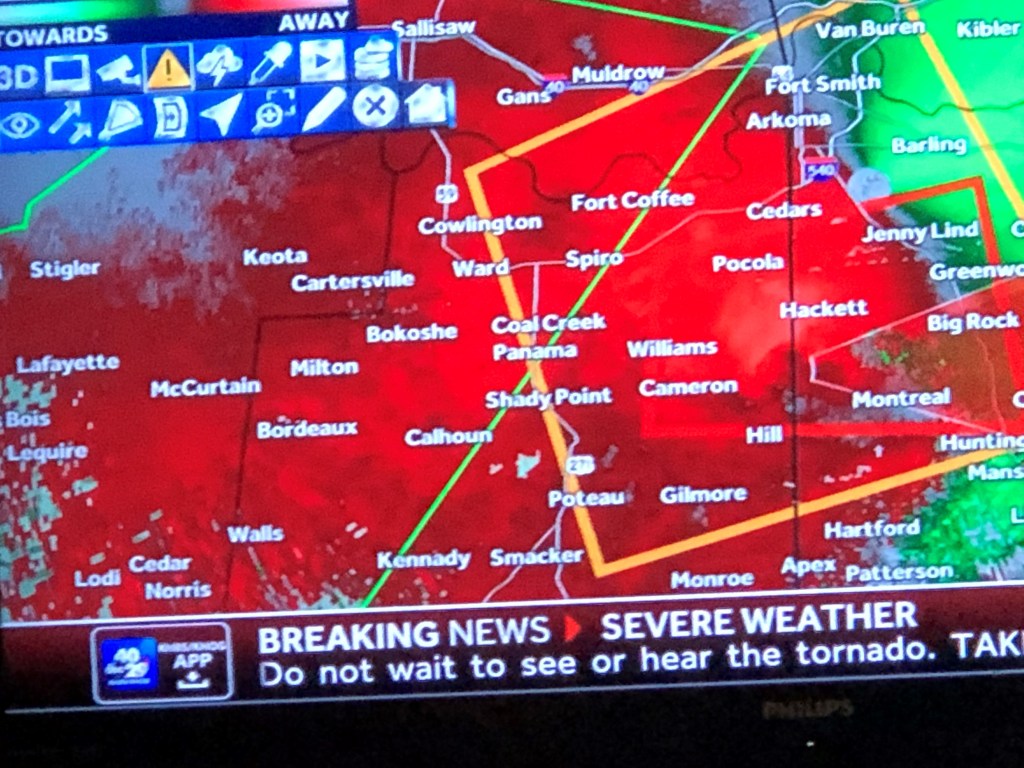
I signed up for weather alerts on my phone and email.  Frankly, this was more because I thought I “should” than wanting to be in the know.  I have found what the weather service calls a severe storm is rarely what I consider to be one.  I realize lightning strikes can cause damage but knowing there was a strike 12 miles away does not go high on my severe list.  We were watching the Royals last night and my phone began to ping a severe weather emergency.  I ignored the ping and continued watching.  Five minutes later I got another ping which I also ignored.  Then the tornado sirens went off.  While I do not pay much attention to the alerts, I take notice when the sirens sound.  Melissa decided to switch to a local channel (the Royals broadcast out of KC) to see what was happening.

Several days ago, I saw a feature on our local channel about how advanced weather forecasting has become since our last tornado.  On April 21, 1996, a severe weather outbreak stretched from Northwest Texas to the River Valley.  The F3 rated tornado was estimated to be about half a mile wide with a ten-mile-long path.  Two people died and multiple others were injured.  People have formally attempted to predict the weather since the 19th century.  These forecasts are made by collecting quantitative data about the current state of the atmosphere at a given place and using meteorology to project how the atmosphere will change.  Weather forecasting now relies on computer-based models that take many atmospheric factors into account, but human input is still required to pick the best forecast model to base the forecast on.  Weather forecasting is also big business.  In 2009, the US spent approximately $5.1 billion on weather forecasting.  That amount has risen over the last 12 years.

The rotating funnel clouds do not become a tornado until they touch down.  While we did not get a tornado last night, we did have back-to-back warnings as two rotating cloud systems swept over our town.  When I lived in Kansas the tornado sirens and the severe weather that prompted them were common.  I have even experienced several tornados.  The most severe took place when I was very young and even killed a friend of my sister’s.  I only remember that storm from family stories.  The severe tornado I really remember was on my grandfather’s farm.  This storm went right by the house with grandma and us kids down in the basement.  It was severe enough to flatten every building on the property, except the house where we were hiding.  

Thoughts:  What fascinates me about severe storms is the amazing power they release.  When I lived in Kansas I loved to watch as the storms rolled across the flat prairie and then crashed over my location.  When I lived in California I would try to come back to Kansas around the 4th of July.  Most times I would be welcomed by a severe thunderstorm.  The last one came as I was leaving the airport in my rental car just before sunset.  I pulled into a stop and watched the storm’s power until the sun went down.  While weather forecasting cannot mitigate severe storms and the damage they produce, it can make people aware of the danger and allow time to respond and save lives.  The same might be said for the recommendations of the CDC.  Despite changes to the recommendations over the past year, the severe result of not paying attention have been proven.  Follow the science.  Change is coming and it starts with you.
Bullfrogs

April 28, 2021

I have mentioned how the pool in our backyard was left to sit for several years before we arrived in Arkansas.  Since we returned, we have yet to repair the pool.  This was supposed to be the summer when it was repaired but when the heater and air conditioner units went out last winter, we put our pool money toward replacement.  This is a saltwater pool and we rarely had trouble with critters.  It has since become more like a freshwater pond.  We are next to a low-lying lot and have always been blessed with bullfrogs.  Several have decided that our pond is the perfect place for courtship.  They have been kind enough to serenade us well into the night since we have returned.

The American bullfrog (Lithobates catesbeianus) is a large true frog native to eastern North America.  It typically inhabits large permanent water bodies such as swamps, ponds, and lakes.  Bullfrogs can also be found in manmade habitats such as pools (like mine), koi ponds, canals, ditches, and culverts.  The bullfrog gets its name from the sound the male makes during the breeding season, which sounds like a bull bellowing.  The bullfrog is large and is commonly eaten throughout its range, especially in the southern United States.  As a food source, they have been distributed outside their normal range, and are found in the Western US, South America, Western Europe, China, Japan, and southeast Asia.  By transplanting the bullfrogs, they are invasive species.  The have a voracious appetite and produce a lot of eggs, negatively effecting native amphibians and other fauna.  Humans never seem to learn.

Aside from food, the other use for bullfrogs is for dissection in science class.  I remember doing this when I was in High School.  The bullfrog is first pithed to prevent pain to the animal yet keep it immobile while the organs still work.  This is the method of inserting a sharp probe quickly through the base of the frog’s skull, into its brain and dispatching the frog without damaging any of the organs a biology student would be learning to identify.  If done correctly, pithing is the fastest and least painful death for the frog.  Pithing a frog is not something most people are good at the first time, and many instructors prefer to use frogs preserved in formalin rather than live ones for dissection.

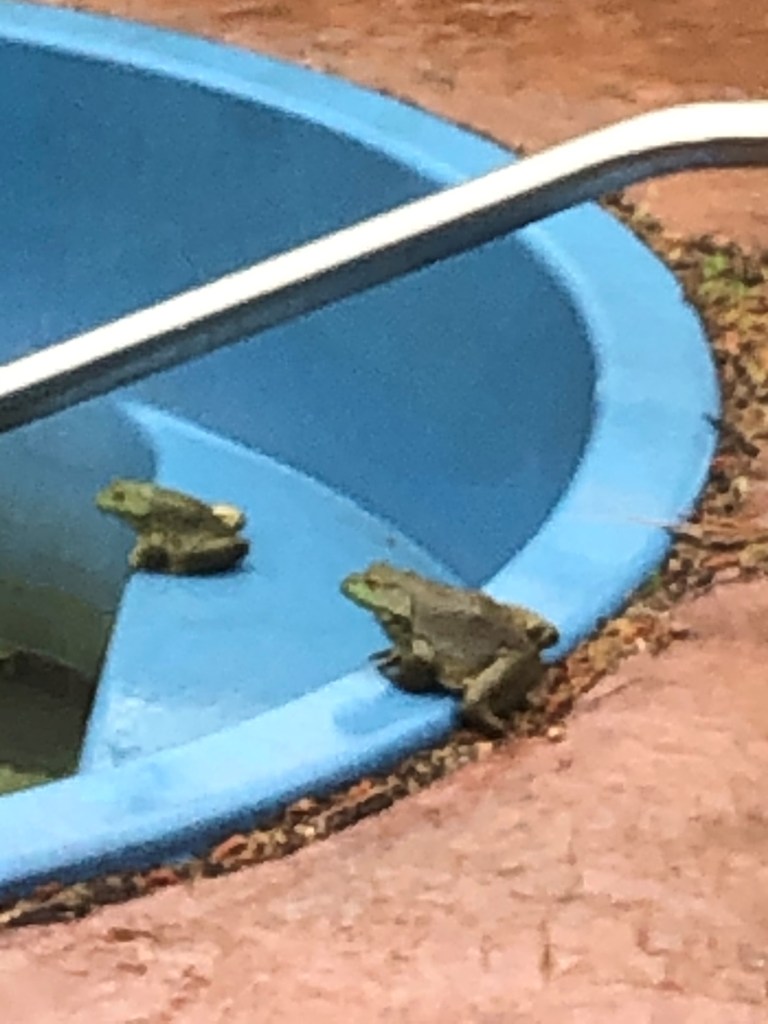
Thoughts:  I always felt bad for the bullfrogs in my pool.  Every year I scoop several out of the water after I find them belly up in the water.  The water level fluctuates with the rains and I did not think they had a way to get out over the tall sides of the pool.  That was until I saw the two frogs sitting at the side of the pool this morning.  They had obviously got on the lower step and then jumped to the next and then out of the pool.  They were waiting patiently, but ever ready to jump back into the water.  While these two bullfrogs had escaped the pool trap, they were reluctant to leave and even willing to jump back in.  Humans seem to do the same thing in our lives.  We get in harmful situations and work hard to get out.  Then at the first sign of trial we jump back into the trap we just escaped.  The number of cases, hospitalizations, and death toll from the virus began to decline.  That is when we loosened restrictions and jumped back into the pool.  Follow the science.  Change is coming and it starts with you.