Monitoring

August 01, 2024

When we were in Maine, we were amused with stories of the odd behaviors caught on the video cameras surrounding our niece and nephew’s house.  They purchased an abandoned restaurant situated on a lake and for the first several years they were constantly visited by folks thinking the restaurant was still open.  Since the property is on a secluded dead end road anyone who makes it past the fence and onto their yard has no business being there.  Still, there have been several visitors (mostly intoxicated) who have arrived while they have been at work.  That prompted my nephew to install video cameras on the property to alert them if anything happens while they are both gone.  Since their monitoring service records and saves the activity, we were able to watch the antics.

When I looked online, I found the smart home monitoring and security market is one of the most important smart home market segments and was expected to reach approximately US$32.5 billion in 2024 in the US, before nearly doubling in size by 2029.  In 2023, smart home monitoring and security devices constituted the second largest segment of the smart home market in terms of shipments, estimated at around 252 million units.  Connected cameras and doorbells are the most common home security products.  These products are usually designed as part of an integrated smart home ecosystem and are able to generate ongoing revenues for the manufacturer in the form of a subscription fee to access saved recordings.  In 2023, the market for smart doorbells worldwide was valued at around US$16 billion.  In 2024, global spending on information technology is forecast to exceed US$200 billion, with the largest segments being security services, infrastructure protection, and network security equipment.  Artificial intelligence (AI), particularly generative AI, presents an immense potential to improve analytic accuracy, reduce processing in the cloud, and make the system more reliable.

It was somewhat ironic that after we returned home, we had our own home incident.  Melissa had noticed a man lurking around the shop in our back yard and asked me to go see what he was up to.  Our yard backs up onto a large fee space that is lightly forested on one side.  I let the dogs our back and then went with them to see if I could find anything.  I did not.  The next day Melissa heard the front door rattling and went to check.  She opened the door just as the same man was reaching to open the screen.  By this time the kids had arrived and were providing a “friendly” greeting.  She asked if she could help him, and he mumbled something and left.  Melissa began to research camera monitoring systems and reached out to our nephew to see what he recommended.  We now own four cameras for monitoring our two entrance doors, my raised beds and the shop, and our living room.  The living room is for monitoring the kids when we leave them on their own.  A pig’s ear will only keep them occupied for so long.

THOUGHTS:  Between the kids and our new monitoring system we both feel safer, but some warn about how the stored information from the cameras is potentially used.  Shoshana Zuboff, the author of “The Age of Surveillance Capitalism,” warned passing laws that allow police to access stored video creates an environment that fuses government power and private power.  As long as the government depends on the tech companies for access, there will be no laws to stop unwanted data collection.  A security camera can act as a useful deterrent to prevent property crime (break-ins and porch thefts), but will do little to prevent violent crime, although it could help a police investigation.  Both the cameras and the audio alerts can be turned off or set for specific hours.  This allows you to choose when you want to be online and how you are monitoring.  Every advance in technology can be both a bane and a blessing.  Act for all.  Change is coming and it starts with you.

Immersion

July 25, 2024

I have tried to learn (and struggled) a number of different languages during my academic career.  It started with German as an undergrad in an attempt to pursue a Bachelor of Arts degree.  I took German 101 three times over the next three years and got no higher than a C.  I ended up taking Statistics and settled for a Bachelor of Science.  As a graduate student I took Spanish (several times) to fulfill the language requirement for my Master of Arts.  After getting a D on the mid-term during my second try I threw myself at the mercy of the TA (a fellow grad student) and asked what I had to do to pass.  He saw my pain and suggested if I came to class every day, turned in my homework, and tried to interact as best I could, I “might be able to pass”.  While I will never know how well I actually did, I received the required B to pass my language requirement.  My Doctorate required a second language “proficiency”, and this time I struggle through French.  The only time I did passably well was when I studied Arabic during a semester in the Middle East.  That was when I realized as many do, immersion creates a necessity to survive.   

When I looked online, I found language immersion is a technique used in language education where two languages are used for instruction in a variety of topics, such as math, science, or social studies.  The languages used are referred to as the L1 and the L2 for each student, with L1 being the student’s native language and L2 being the second language to be acquired through the immersion program.  The type of immersion will depend on the age of the students, the class time spent in L2, the subjects that are taught, and the level of participation by the speakers of L1.  While these programs differ by country and context, most language immersion programs have the goal of promoting bilingualism between the two different sets of language-speakers.  Biculturalism is often another goal for speakers of the majority language (spoken by the surrounding population) and the minority language (not the main language).  Research has shown that bilingual education gives students greater comprehension and teaches the secondary language in a native-like manner.

I still periodically dabble in learning another language, especially when I am considering a trip to another part of the world.  When we went to Europe several years ago, I attempted to learn French (again).  I gave up after a month when I realized my hearing kept me from comprehending what the on-line tutorial was saying.  Now that we are considering a trip to Greece, I was again bitten by the language bug.  Knowing that immersion is the best way for me to learn, I decided to see if I could use my iPhone to help.  I went to Settings and found one of the features would allow me to change the language of the phone.  Without (careful) thought, I changed the phone settings to Greek.  Everything on the phone shifted to Greek as the primary language.  It was not even transliterated but used the Greek alphabet.  I did not know what the settings on the phone were or how to change them back, especially as my phone had Latin alphabet symbols while the instructions were now in the Euclide alphabet.  I was finally able to switch back by comparing Melissa’s settings placement to mine.

THOUGHTS:  Another language course I took was English as a Second language (ESL).  This was offered to teach English speakers how to work with non-English speakers to help them with their language proficiency.  I did complete this course, but it was probably good that I was transferred from California to Kansas.  Who knows what damage I might have done to the students (lol).  It is said once you learn a second language it is easier to learn another.  That is not the case when you fail to learn the first one.  Language is central to understanding the ethos and culture of others.  Without knowing the underlying vocabulary of another, you will never truly communicate with them.  Act for all.  Change is coming and it starts with you.

Vines

July 24, 2024

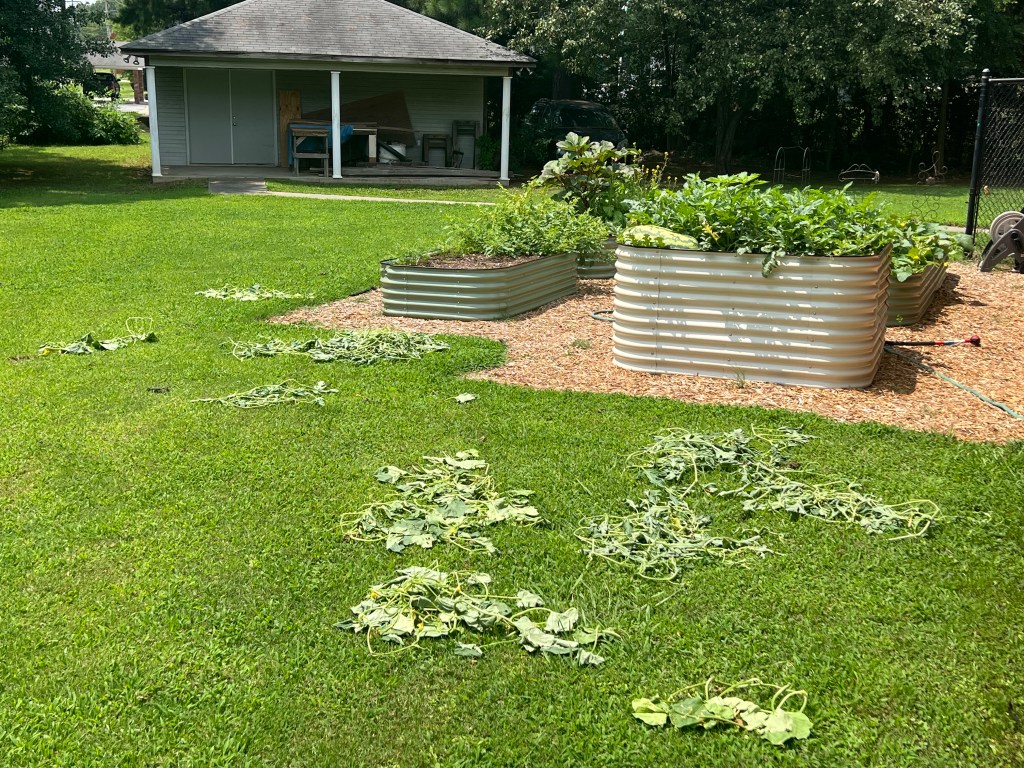
The weather has been perfect for the vegetables growing in my raised beds.  It has been cooler (10F/5.5C) than normal for the last week along with several soaking rains.  The vines have taken off and overflowed their raised beds.  I tried to plan ahead concerning the placement of the vines in my beds.  The taller raised bed is dedicated to the three rattlesnake watermelon seeds and one wing of the u-shaped bed is dedicated to the three cantaloupe seeds (both as suggested).  I had not been as discriminating with the cucumbers, but I had planted them the suggested 2 feet (0.6 m) apart.  The   vines have grown beyond my expectation.  I had already scooped the vines of all three overspilling on the ground and placed them back in the bed.  The overflow has also enticed a small eastern cottontail rabbit (Sylvilagus floridanus) to visit my beds, and I see it scurrying away most mornings when I water.  Today I decided I would prune the vines to help keep them in the beds. 

When I looked online, I found watermelons (Citrullus lanatus) require significant space not only for the vines but also for the fruit.  The vines reach 30 feet (9 m) and the fruit itself can weigh as much as 200 pounds (91 kg).  To curtail the size of both the vine and the fruit, the vines can be trimmed.  Pruning watermelons promotes healthier vines and may increase fruit size.  Irregular or rotting fruit should be pruned to enable the plant to focus energy towards growing bigger, healthier melons.  The downside to watermelon trimming is that it may affect pollination as the plant needs both male and female flowers to set the fruit and cutting back the vines may reduce the female flowers, which are fewer than the male in a 1:7 ratio.  Cutting back cantaloupe (Cucumis melo) plants is generally not necessary, and the more leaves that remain on the vine the sweeter the fruit.  Still, pruning cantaloupe plants has some benefits and results in fewer fruit which enables the plant to put all of its energy into fewer fruits which will become larger melons.  Another reason to prune cantaloupe vines is to make them easier to trellis, either using a net trellis or string and vine clips.  Although I did not trellis my melons, it seems like my decision to prune was (possibly) a good one.

The next question was the best way to prune the different vines.  Pruning watermelons can be done simply with a good pair of gardening shears to remove any dead, diseased, yellowing, or infested leaves or shoots at the joint where they connect to the main stem.  Also, remove any secondary vines that are not bearing blooms or look scrawny.  Do not prune the vines while wet as watermelons are prone to parasites and diseases and damp pruning will encourage their growth and spread.  If you prune your cantaloupe to produce larger melons, you should retain the primary stem.  The idea is to retain the primary vine, remove the first lateral, and reduce the size of all the additional secondary branches.  This probably would have been good information to have before I pruned.  I just cut off the vines that were overhanging and pushed the others back onto the beds.  Unknowingly, that also meant I cut off several large cucumbers that were close to being ripe.  We will see.

THOUGHTS:  While I knew the vines of the different melons and cucumbers would spread, I was not prepared for the extent of their spread.  I had tried to grow both types of melons in the ground bed where I now have the three sisters and neither of them took off to the extent of the raised beds.  That is probably because I had amended the soil before planting rather than just placing them in the ground and seeing what happens.  Every year I find raising vegetables is a combination of what I know and reaching out to others to augment what I do not.  Pushing ahead to “see what happens” rarely creates a positive result.  The same is true when interacting with different groups of humans.  Listening to find common ground is always the best way to achieve positive results.  Act for all.  Change is coming and it starts with you.
Black Widow

July 22, 2024

We have had enough rain the last two days that I have not needed to water my vegetables.  I still go check on the beds to make sure the plants are doing ok and to harvest whatever is ripe.  That was mainly tomatoes (Solanum lycopersicum), but I have also picked two cantaloupes (Cucumis melo).  We ate one and took the other to our elderly neighbor.  We have shared my fruits with her in the past and she has always seemed appreciative.  For the last two weeks every time I go out, I thump the two large watermelons (Citrullus lanatus) to see if they are ripe enough to pick.  While they should be ripe, I have never been good at selecting a ripe melon, either in the store or on the vine.  My other task this morning was to take the reduced compost from my kitchen composter to place in the in-ground composter in my raised bed.  Yesterday I noticed spider egg sacs on top of the compost and did not think too much about it.  Today when I opened the box there was a large (1 inch/2.5 cm) spider guarding her egg sacs.  It was a black widow spider.   

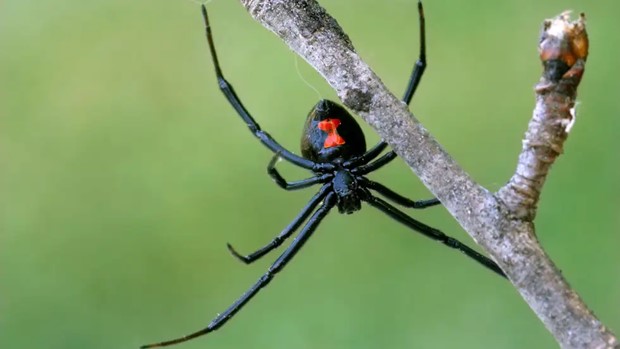
When I looked online, I found there are several species of Black widow spider (Latrodectus species) found in Arkansas, but the most common is the southern black widow (Latrodectus mactans).  The defining characteristic of the widow is the shiny black color of the adult female’s body.  Females also have a distinctive red hourglass-shaped mark on the underside of their abdomen, which serves as a warning sign to potential predators. The males, on the other hand, are smaller and have lighter color. Black widow females measure around 0.5 to 1.5 inches (12 to 38 mm) in length while the males are significantly smaller at 0.25 to 0.75 inches (6 to 19 mm).  The black widow is a venomous spider, and the female’s neurotoxic venom is potent enough to pose a significant threat to humans.  They do not generally bite humans unless they feel threatened or provoked.  These spiders are most active during the night and prefer to stay hidden during the day.  Black widow spiders play an important role in controlling the population of small insects, with a preference for fire ants (Solenopsis Invicta).

Female black widow spiders are notoriously known for their tendency to eat their mates after mating, but this behavior is not always (or usually) observed.  The name “black widow” has been used to describe the spider for over a century.  It is unclear who first coined the term, but it is believed to have originated in the US.  These spiders are cannibalistic, and the females will sometimes eat the males after mating.  This behavior gives rise to their name, and it was once believed that the females always killed and devoured their mates after copulation.  However, this behavior is not observed in all situations and is relatively uncommon.  The male, who is less than half the size of the female, will spin a small “sperm web” and then deposit some semen into the web.  He then coats two appendages near the mouth (palps) which resemble tiny claws or thick antennae with sperm.  On occasion these palps will become lodged in the female and will tear off as the male retreats, often killing the male.  He is later eaten by the female of his species.  More often the male will scurry away unscathed.

THOUGHTS:  A new study has found a proposed reason for the black widow’s red hourglass marking.  Duke University researchers showed the iconic hourglass on the abdomen of the black widow can only be seen by potential predators but remains invisible to the spiders’ prey.  Birds can more easily identify the wavelength of red than insects.  Black widows also hang upside down, heightening the effect of the warning to aerial predators.  Birds would see a spider model with red markings and get startled and jump back.  I had a similar reaction when I opened the compost bin.  Humans tend to react based on “what is known” more than what is fact.  This is compounded by an unwillingness to take time to find the truth.  Act for all.  Change is coming and it starts with you.
Roadrunner

July 19, 2024

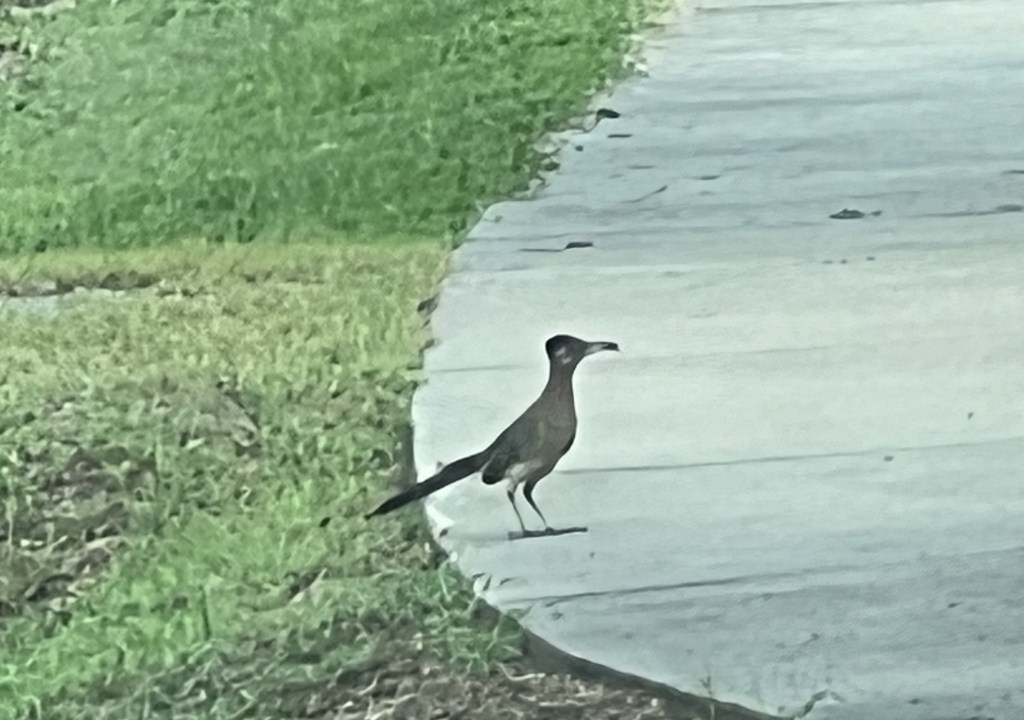
As I approached the park for the kids walk in May a bird ran across the road in front of my Jeep.  I had seen this species running in the brush in 2020 when I had stopped at Fort Smith Reservoir for some fishing and birding.  I returned several times and in different seasons but never saw the bird again.  When I started walking the two dogs together, I switched the walk to a lake outside of town rather than the park.  After we returned from vacation it was too hot (100F+/37.7C+ heat index) to walk them comfortably on the treeless lake path.  It has been cooler this week (90F/33.2C) and I decided to try walking in the park again.  The park has trees for shade and a walking trail for my convenience.  The first day was when the bird ran across the road as we neared the park.  The next day I tried to get a picture, but it was too fast and scurried out of sight.  Yesterday, the roadrunner decided to stop as we approached and allowed me to take its picture.

When I looked online, I found roadrunners (genus Geococcyx), also known as chaparral birds or chaparral cocks, are two species of fast-running ground cuckoos with long tails and crests.  The bird I saw was a greater roadrunner (Geococcyx californianus) which ranges from central California to southeastern Missouri and south to central Mexico.  The lesser roadrunner (Geococcyx velox) is indigenous to Mexico and central America.  Both species live in arid lowland or mountainous shrubland or woodland.  The roadrunner generally ranges in size from 22 to 24 inches (56 to 61 cm) from tail to beak. With an average weight of 8 to 15 ounces (230 to 430 g).  They are large, slender, black-brown and white-streaked ground birds with a distinctive head crest, long legs, strong feet, and an oversized dark bill.  The tail is broad with white tips on the three outer tail feathers.  The bird has a bare patch of skin behind each eye that is shaded blue anterior to red posterior. The lesser is similar to the greater roadrunner but is slightly smaller, not as streaky, and has a smaller bill.  Roadrunners are non-migratory and stay in their breeding area year-round.  The greater roadrunner is not currently considered threatened in the US but is habitat limited.

Roadrunners and other members of the cuckoo family have zygodactyl feet, meaning two toes face forward and two face backwards.  This leaves distinctive “X” track marks appearing as if they are travelling in both directions.  The Hopi and other Pueblo tribes believed roadrunners were medicine birds, capable of warding off evil spirits, and the X-shaped footprints were seen as sacred symbols, believed to confuse evil spirits by concealing the bird’s direction of travel.  Stylized roadrunner tracks have been found in the rock art of ancestral Southwestern tribes.  Roadrunner feathers were used to decorate Pueblo cradleboards for spiritual protection.  The roadrunner is considered good luck by the indigenous tribes of its range.  While some revered the roadrunner and never killed it, most used its meat as a folk remedy for illness or to boost stamina and strength.  The word for roadrunner in the O’odham language (an Uto-Aztecan language of southern Arizona and northern Sonora, Mexico) is taḏai, and the O’odham tradition credited the roadrunner with bringing fire to the people.

THOUGHTS:  Although capable of flight, the roadrunner generally runs away from predators.  The bird was made popular by the Warner Bros. cartoon characters Wile E. Coyote and the Road Runner, created in 1949.  In each episode, the cunning Wile E. Coyote unsuccessfully tries to catch the Road Runner but is never successful.  The cartoons rely on a misconception that a roadrunner is faster than a coyote.  In fact, a coyote can sprint 40 mph (64 km/h), which is twice the roadrunner at 20 mph (32 km/h).  I always felt bad that for Wile E. and hoped he would catch him.  Seems nature was on my side.  Act for all.  Change is coming and it starts with you.
Ground Cherry

July 18, 2024

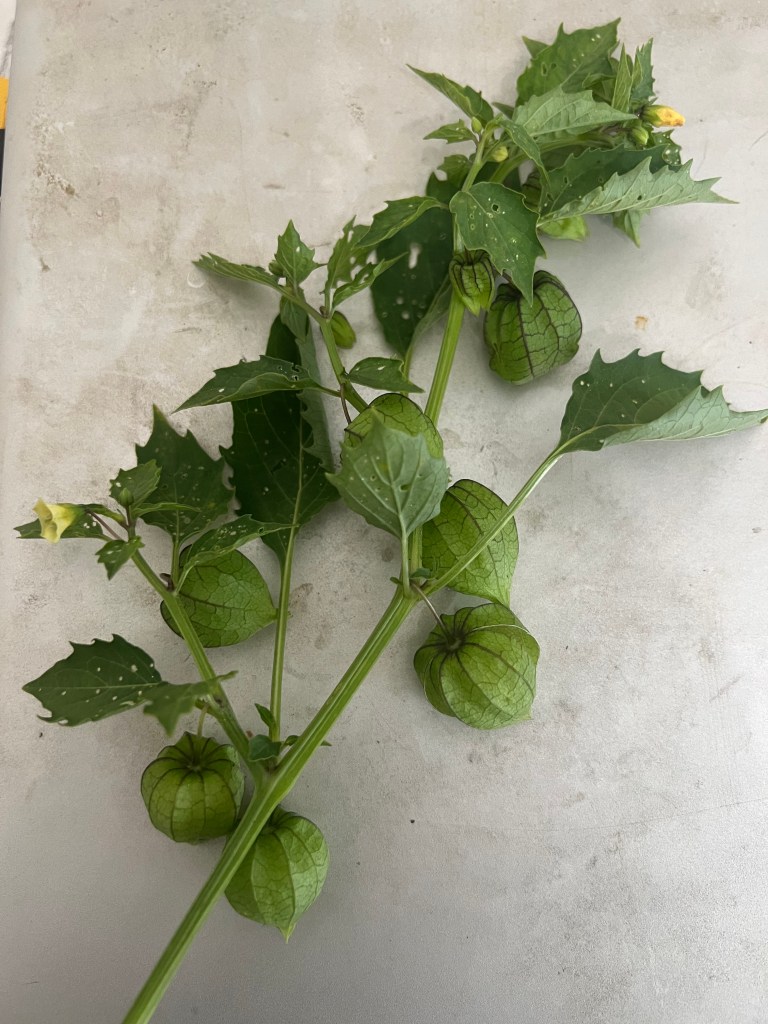
I have been baffled for weeks concerning what bush I had growing in my raised beds.  I have three of these bushes that took off in the location where I had planted Brussel sprouts (Brassica oleracea).  As the plants began to mature, they overtook whatever I had planted next to them, growing to over 2 feet (60 cm) high and bushing out over 2-1/2 feet (76 cm).  When the fruit began to appear, I saw it was wrapped in a thin papery husk much like a tomatillo (Physalis ixocarpa).  The problem was, I had not planted any tomatillo and now I had three of these large plants growing in my beds.  I tried several plant identification methods, and none got me any closer to identifying the plant.  I was desperate and reached out to my Arkansas Gardening Facebook group.  The immediate response was for a tomatillo or variety of gooseberry (Physalis peruviana), but again I had planted neither.  This morning Melissa went out to harvest some of the okra (Abelmoschus esculentus) I had planted for her and on return told me she had identified my unknown plant as a variety of ground cherry.      

When I looked online, I found the cutleaf ground cherry (Physalis angulata) is a member of the Physalis genus, which includes the tomatillo that is commonly grown in Arkansas.  Both tomatillos and ground cherries originated in Central and South America.  The cultivar is now widely distributed and naturalized in tropical and subtropical regions worldwide.  The ground cherry fruit is encased in a thin, papery husk just like a tomatillo that splits when ripe, then falls to the ground.  Ground cherries have been grown in North America since the mid 1800’s and were popular additions in Pennsylvania Dutch cuisine.  The plant’s edible fruit can be eaten raw, cooked, or jammed, but all other parts of the plant are poisonous.  Unripe raw fruits, flowers, leaves, and stems of the plant contain solanine and solanidine alkaloids that may cause poisoning if ingested by humans, cattle (bovine) or horses (equine).  The typical ground cherry fruit is similar to a firm tomato in texture, and like a sweet, tangy grape in flavor.  I picked one of the ripe berries and it was quite tasty.

Having found the ground cherry, tomatillo, and gooseberry are all similar, I looked to find out how they are different.  Ground cherries and tomatillos have similar features, and the nomenclature can be confusing because tomatillos are often referred to as Mexican husk tomatoes whereas ground cherries are called husk tomatoes.  They are both part of the same genus, and their fruits both grow in papery husks, but ground cherries are typically smaller than tomatillos.  They are also yellow or orange when mature while tomatillos remain green.  Another member of the Physalis genus is the cape gooseberry, also known as the goldenberry.  The botanical name indicates their origin, and like ground cherries they are native to the Americas.  Cape gooseberries are unrelated to European gooseberries (Ribes uva-crispa) but are very similar to ground cherries (the names are often used interchangeably).  The stems of the plant are stiffer than those of the ground cherry and are not prostrate and sprawling but instead more upright.

THOUGHTS:  I found several sites that spoke of the conditions of temperature, light, soil, and water that allow ground cherry plants thrive.  I chuckled as my ground cherry had been propagated by birds and without any special attention.  Several times I came close to throwing them on the mulch pile, but I wanted to find out what these intruders were.  Ground cherry is often propagated by birds who drop the seeds in disturbed soil where it takes off on its own.  Even though it is not native to the US it was widely embraced after migrating to America.  Human immigrants bring the same diversity and have sparked cultural adaptations earlier European immigrants now claim as their own.  Embracing immigrants along with their foods and culture provides the diversity that can keep America strong.  Act for all.  Change is coming and it starts with you.
Leak

July 17, 2024

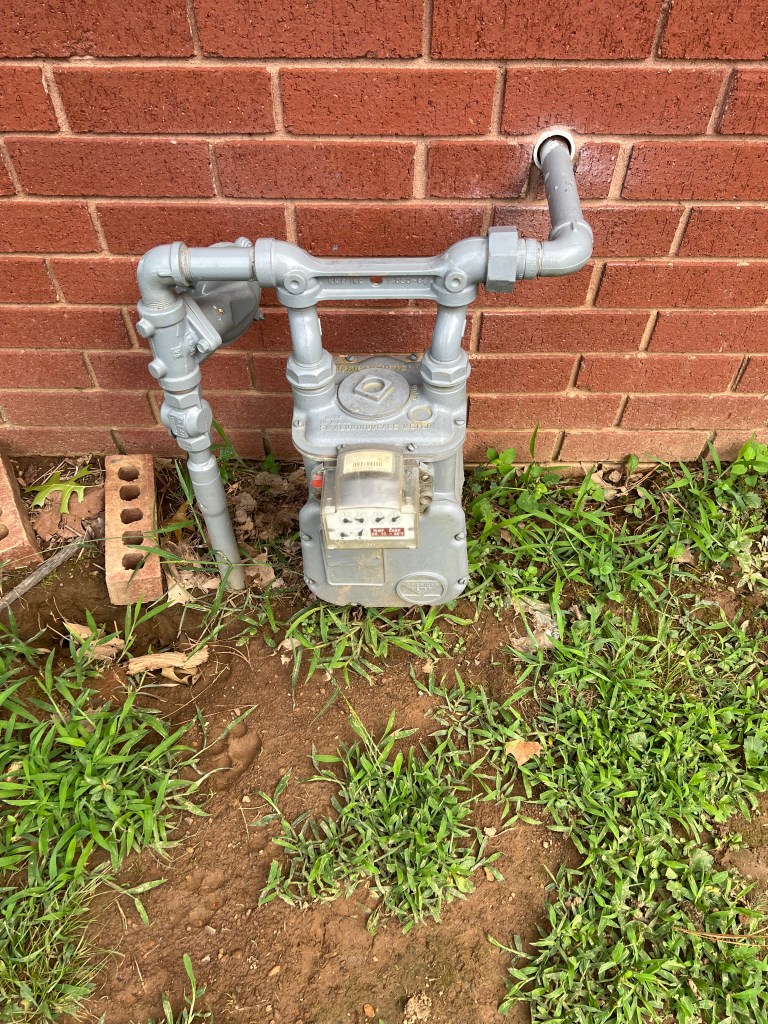
I had taken the kids to the park for a walk and when I got home, I was met by an obvious odor.  I had smelled the odor before when I accidentally left the burner on our gas stove partially on.  I had also noticed the smell when I was working in my office earlier in the day and the air conditioner kicked on.  I had gone to the garage and checked the furnace and water heater closet but had not smelled anything out of the ordinary, so I did not worry.  On my return from the park the smell seemed to be stronger.  I rechecked the stove to make sure the burners were off and asked Melissa about the smell.  She mentioned how she had had a headache all day and wondered if that was not the problem.  She had worked for the local gas distribution company and suggested I should call them and see what we ought to do.  I was sure we must have a gas leak.   

When I looked online, I found methanethiol (also known as methyl mercaptan) is an organosulfur compound with the chemical formula CH3SH that many gas companies add to natural gases and propane to help homeowners detect a dangerous leak.  The safety data sheet (SDS) is a document that lists information relating to occupational safety and health for the use of various substances and products in commercial settings.  The SDS lists methanethiol as a colorless, flammable gas with an extremely strong and repulsive smell (similar to rotten eggs).  At very high concentrations it is highly toxic and affects the central nervous system.  Its strong odor serves as a warning when the gas is in dangerous concentrations.  An odor threshold of 1 ppb has been reported, but the OSHA Ceiling Limit in the US is listed as 10 ppm.  This gas is a natural substance found in the blood, brain, and feces of animals (including humans), in plant tissues, and occurs naturally in foods like some nuts and cheese.  It is one of the chemical compounds responsible for bad breath and the smell of flatus.  

There are more than 77 million natural gas customers (residential, commercial, and industrial) in the US according to the American Gas Association, accounting for 32.2% of all energy consumption in 2021 (the latest year with full data).  The majority of times gas is used without incident but when a gas leak occurs it can be hazardous.  When I called the gas company, they told us to avoid open flames or vapes, open our windows, and immediately get out of the house and wait for the technician to arrive.  They assured me he was already in our neighborhood, and it would not take long for him to be here.  We opened the house and then corralled the kids and went outside to wait on the back patio.  It took less than 10 minutes for the technician to arrive.  He told me they had opened a new storage well at 10 am that morning and the smell and complaints had been coming ever since.  He Immediately registered the presence of gas on his meter when he entered the house.  He then checked our furnace and water heater compartment, along with the gas stove, and said there was not a leak.  He recommended we continue to keep the windows open to allow the smell to dissipate and call if we still had concerns.  I was glad today’s temperature had dropped back to 90F (32C).

THOUGHTS:  During the 1990’s I was trained as a 2nd responder emergency person while I lived in California’s Bay Area.  Part of our training concerned checking for a gas leak after a catastrophic event like an earthquake.  Due to the danger posed by natural gas, only trained professionals should attempt to diagnose the location or correct a leak.  Our job was to make sure the gas was turned off in buildings that had been impacted by the event.  We were told that several years ago the 2nd responder groups in the LA area (California) had responded following an earthquake.  They had dutifully gone out and turned off the gas lines for 1000’s of homes in the affected area, whether there was a leak or not.  It took the gas company weeks to get their customers back online.  At times a little knowledge can be worse than no at all knowledge.  Act for all.  Change is coming and it starts with you.
False Mermaid

July 16, 2024

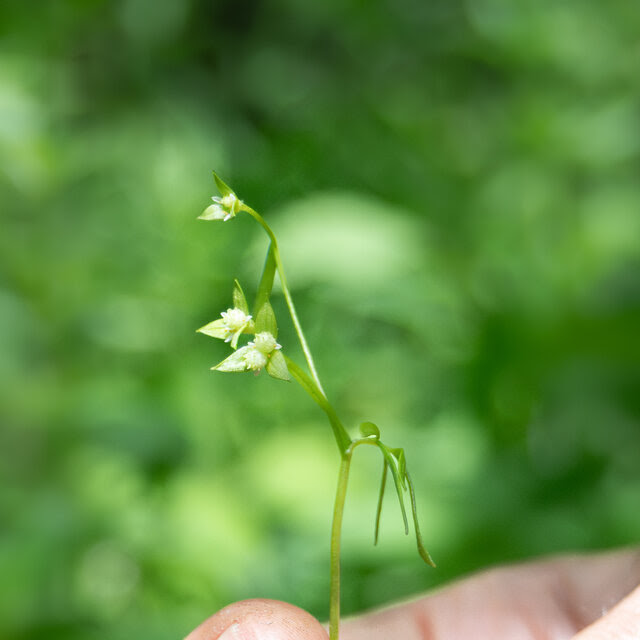
Last month my NY Times online feed reported on the discovery of a species of plant thought to have been extinct in Vermont since 1916.  Vermont state botanist Grace Glynn has been searching for the species for years but the spring-blooming herb with dainty flowers has always eluded her.  That changed on May 7th when Glynn was surveying turtle habitat and was sent a picture.  When she opened the photo. she saw the elusive flower in the corner of the frame.  Glynn then visited the site where the photo was taken in the state’s rural Addison County and found hundreds of false mermaid-weed sprigs on both public and private land.  Vermont Department of Fish and Wildlife (VDFW) called the discovery “BOTANICAL BREAKING NEWS,” in a Facebook post announcing the find.  The Department said it was not surprising that the flower had gone undetected for over a century as each individual plant is “absolutely tiny” with flowers that are “as small as the head of a pin”.  Even when trained experts are searching for the plant can be easily overlooked.

When I looked online, I found false mermaid (Floerkea proserpinacoides) is a monotypic genus of plants in the meadowfoam family containing a single species.  Other common names are false mermaid-weed and floerkea.  This tiny wildflower is native to many parts of North America, where it is found in moist areas, such as shady forests.  It is a fleshy, annual herb which grows short stems which may lie flat on the ground, tangle into a clump, or grow somewhat erect.  The foliage is hairless and shiny.  The leaves are divided into many oval-shaped, pointed leaflets up to 0.79 inches (2 cm) long.  The flower is a cup of pointed green sepals containing three tiny white spoon-shaped petals and a bunch of stamens with yellow anthers.  Growing in the center of the flower are the two to three fruits, which are bumpy, spherical nutlets.  False mermaid only emerges for a short time from late April to early June and is referred to by botanists as an “ephemeral” plant.

Botanists suspect false mermaid-weed populations have suffered because of extreme flooding, invasive species, and human development.  This rediscovery is “a sign that good stewardship by landowners and conservation organizations really can make a difference,” according to the VDFW.  The last botanist to document false mermaid-weed in Vermont was a woman named Nellie Flynn, who collected 22,700 plants from around the world during her lifetime.  Glenn found herself reflecting on the past.  “Nellie Flynn was probably the last person to ever touch this species in Vermont back in 1916.  And I always think about how there are just these threads through history that kind of tie you to other botanists, and it just adds depth and richness, I think, to an already rich story.”  The plant’s state rank in Vermont has now been updated from possibly extinct and missing to “very rare and critically imperiled”.  Glynn plans to send some of the plant’s seeds to a seed bank in Massachusetts that preserves native New England species.  The work of Vermont botanists is far from finished as they still have another 600 or so rare and uncommon native plants to search for (and conserve) throughout the state.

THOUGHTS:  The 2024 discovery of false mermaid-weed is not the first time an unusual plant has been found in Vermont.  In May 2022, a citizen scientist discovered nine specimens of a federally threatened orchid, known as the small whorled pogonia (Isotria medeoloides), in Chittenden County. This was the first time anyone had seen the plant since 1902.  Life has a remarkable ability to survive amid the worst of human conditions.  How much more could survive if we would take concerted steps to preserve it.  Act for all.  Change is coming and it starts with you.
Starfish

July 14, 2024

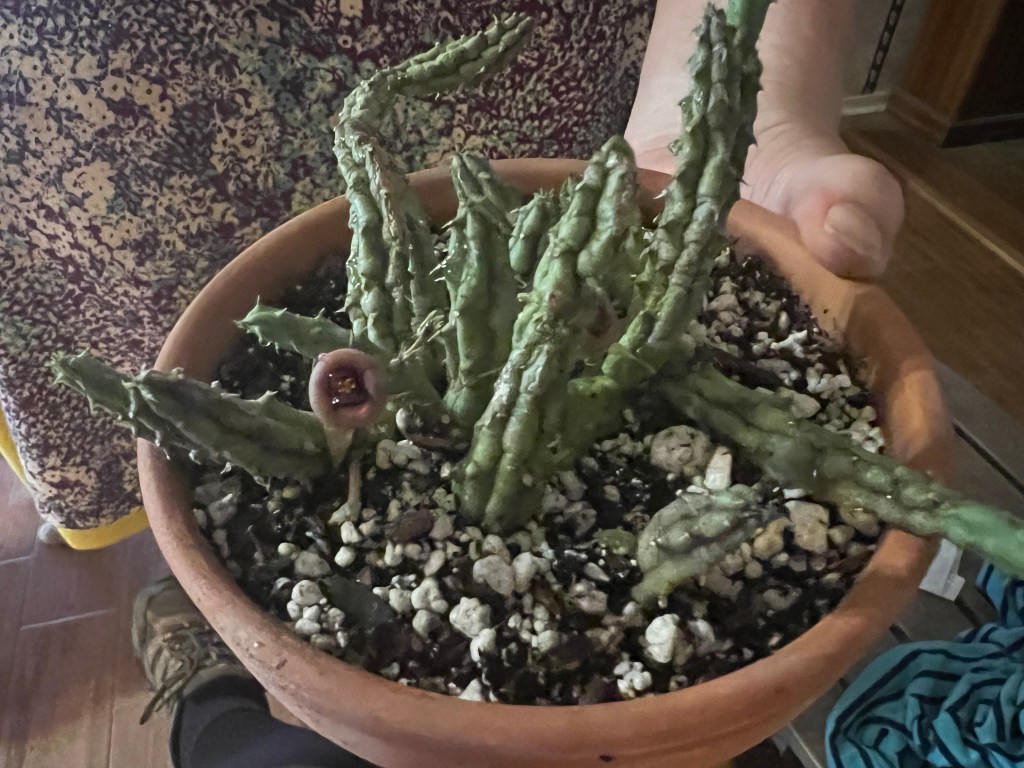
I was working in my office yesterday when Melissa brought in one of her succulents.  This was from a stem cutting she had obtained from a grower friend in California two years ago.  She had replanted and cared for it, moving it from the house to the porch to shield it from the extremes of Arkansas’ heat and cold.  Melissa was excited because it had a star-shaped bloom on one of the new stems that had grown from the original cutting.  She mentioned it usually takes two to three years for flowers to form on cuttings from the original.  The friend’s plant had grown to a large amorphous mass.  The succulent is easy to grow but is not common in the US as it is native to Africa.  The common name for this succulent is the African starfish flower.

When I looked online, I found the African starfish flower (Piaranthus decipiens), also known as carrion flowers locally, is a succulent native to Namibia, Botswana, and South Africa.  The plant gets its common name from the flower that grows in the appearance of a marine starfish (class, Asteroidea).  The plant grows in sandy and rocky soil, and usually under small bushes around the northern and eastern edges of the driest parts of the Kalahari Desert.  The starfish has horizontal (decumbent) stems with tubercles mainly joined into four angles along the stems and forms diffuse mats that may reach a diameter of 3.3 feet (1 m).  The stems are dull green to grey and are often mottled with purple.  They have a distinctly narrow base and grow up to 6 inches (15 cm) long and 0.8 inches (2 cm) thick.  Each tubercle is initially tipped with a small, narrowly deltoid (triangular) leaf rudiment that dries out and persists for a while as a whitish husk.  Flowers are produced in small numbers towards the tips of the younger stems and open simultaneously or with long intervals in late summer or fall.  They are up to 1.2 inches (3 cm) in diameter, usually brown becoming paler in the tube and with low rounded nipple-like structure (papillae), each with a small bristle.  The scientific name for the starfish flower was formerly Huerniopsis decipiens after the genus (Huerniopsis) was created with this flower as the single species by N. E. Brown in 1878.  Another species was later transferred to Huerniopsis in 1937, and both were distinguished by their absence of an outer corona on the flowers.  Both species were revised in 1994 as part of the genus Piaranthus.

More interesting than the scientific back and forth naming of the starfish flower is the origin of the locally (southern Africa) common name of carrion flower.  The flowers emit a very sweetish-nauseous odor that locals describe as having the smell of rotting meat.  The corona-lobes secrete a sweet fluid copiously upon their backs and sides.  The cultivators of the flower found this smell is strongest during the evening, and by the next morning it had almost disappeared, leading to the assumption the plant is fertilized by a late evening flying insect in the wild.  The flowers may open at the same time or with long intervals in late Summer or Autumn.  The starfish on our porch found the right conditions in the heat of mid-summer, but that might resemble the cool of the Kalahari.   

THOUGHTS:  The starfish flower lives on the edge of one of the driest deserts in the world.  The harsh desert environment has resulted in adaptation by the plants that thrive there.  Plants use a lot of energy and reserves producing flowers for pollination and in a desert environment where water is scarce.  Pollinating insects (bees, ants, moths) are in short supply, so plants produce colorful flowers to attract the scarce pollinators.  The starfish flower blooms and then quickly dies to reserve energy.  The carrion smell entices flies not normally associated with pollination.  Everything in nature is designed to propagate the species and not the individual.  While that is also the design for humans, it is sometimes ignored.  Act for all.  Change is coming and it starts with you.
Leaning

July 11, 2024

I was heartsick when I came out to water my three sisters beds yesterday.  I have mentioned how few of the corn seeds I initially planted had sprouted (@40%).  I replanted additional seed and allowed it to (mostly) resprout before moving on to planting the pole beans (Phaseolus vulgaris) as the second sister, and then a week later adding the winter squash (Cucurbita moschata) to provide ground cover as the third sister.  These combination beds had been progressing nicely, even surviving the excessive heat in my absence.  The corn was producing ears, the beans were climbing, and the squash was spilling out across the four beds.  That came crashing to a halt when I came out to find most of the corn stalks lying on the ground.  My first thought was it was the work of my arch enemy, the nine-banded armadillo (Dasypus novemcinctus) that had helped itself to the melons I had tried to grow in the same bed for the last two years.  I have fenced the beds this year (for Loki) and I could not find any sign of invasion other than the downed corn stalks.  That left the other conclusion that the corn had suffered from lodging.

When I looked online, I found leaning (or lodging) of the corn plant occurs when the plant essentially bends or ‘lays down’ without the stalk breaking.  Although this symptom looks devastating, it often causes only minimal damage.  The majority of plants will re-orient themselves upright, and if this recovery occurs prior to corn pollination, little impact on pollination success will be observed.  Corn plants have been shown to upright themselves fairly quickly (in 3 to 4 days) after an initial wind event when they are in the rapid growth phase. However, if a plant cannot reorient itself properly, some leaves can become shaded and a reduction in photosynthesis can occur.  If the damage occurs near the beginning of pollination, the leaves of any neighboring, lodged plants may shade some of the exposed silks and cause poor pollination.  “Root lodging” can occur with strong winds and high soil moisture levels that results in corn roots being pulled out of the soil.  Root-lodged corn plants that are still in the vegetative phase of growth and within the process of stalk elongation can recover by bending or “goose-necking” to become upright again. However, the later in the vegetative growth period lodging occurs, the less flexibility the stalks have to reorient themselves properly, and the greater chance that pollination and yield will be impacted.

I had never heard of lodging, even though I have seen it in some of the corn fields in Kansas after a high wind event.  Not knowing it “might” spring back up on its own, I tried to right the stalks and prop dirt around them for added support.  When I came back out to water this morning, several of the stalks were down again and others were again leaning.  This time I placed rebar stakes next to the plants and tied them off with plant tape.  I hope that between their natural urge to right themselves and the assistance provided by the stakes they will continue to grow and produce.  They all have ears, although none are near to being ripe.  We will see.

THOUGHTS:  As I thought about the leaning event, I am glad this did not happen while the neighbor girls were watering.  I am sure they would have thought it was because of something they had (or had not) done.  Since I did not know of the syndrome, I probably would have thought to blame them as well.  We appear to be living in a time of chaos and when destructive events happen the urge is there to “blame someone”.  There is no one to blame for my leaning corn.  It is a normal part of nature and the shifting climate.  While blaming may make us feel better, it does not resolve the problem.  And it can have negative impacts on our feelings and treatment of “the other”.  Act for all.  Change is coming and it starts with you.