
Barking

June 20, 2024

Zena is a bit of a scaredy baby when she comes across new items in what she defines as her space.  I put her outside last year and she went into a fit of continuous barking.  I looked out the window and did not see anything unusual, but the barking continued.  I finally went out to see what had gotten her into such a tizzy.  I had placed a 40 pound (18 kg) bag of compost up against the fence.  Zena knew it was not there the last time she had gone out and believed it should not be there now.  She continued barking until I went with her and let her sniff the strange object.  On the other hand, Loki is very adventurous and loves to check out any unknown critters that ramble into our yard.  Several weeks ago, I had come across a three-toed box turtle (Terrapene triunguis) crawling along the ditch next to the neighbor’s fence.  The turtle sent both Zena and Loki into a barking frenzy, but for different reasons.  Zena was barking to let the intruder know it was not welcome, while Loki was barking because he wanted to investigate this new presence in his territory.

When I looked online, I found according to Dr. Stanley Coren’s, “How to Speak Dog: Mastering the Art of Dog-Human Communication,” there is far more complexity to a barking dog than you may realize.  Barks are not a one-size-fits-all vocalization.  The sounds made in different situations not only sound different but likely have different meanings.  While dogs may bark when they are excited and trying to get your attention, they also bark when frightened, lonely, surprised, irritated, and other reasons.  A dog can vary the pitch of their barking, the number of barks in a row, and the space between barks to change the bark’s meaning.  The lower the barking pitch the more serious the dog.  During playtime a dog will tend to have a higher-pitched bark than one designed to warn off intruders or discipline a rude companion.  A lonely dog makes higher-pitched barks to request attention, and sometimes this can rise to a plaintive yelp.  The more barks in a row, the more aroused the dog is.  A single bark may sound when a dog is surprised or annoyed, but a long string of barks indicates the dog is more worked up.  The space between barks is also telling, and the quicker the succession of barks, the more aggressive the dog is feeling.

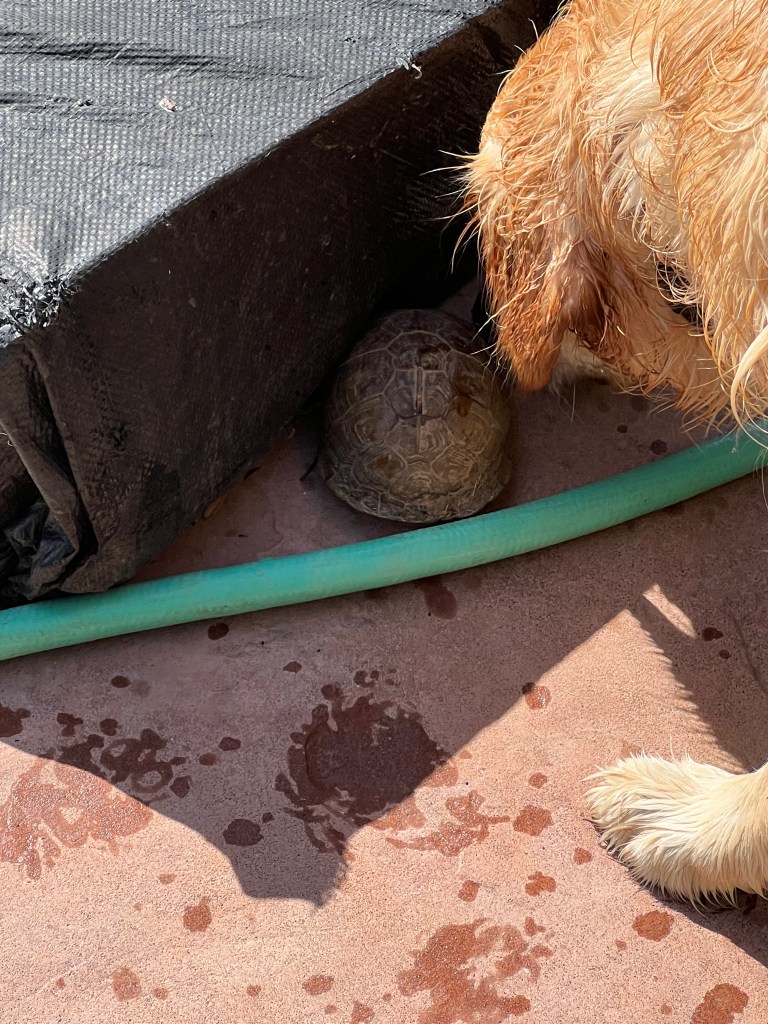
When I first let the kids outside, they are always on high alert.  If the birds (or squirrels) are in the feeders, they will run to the fence.  Their next move is to the back of the fenced yard to see if the German Shepherd next door is in the yard.  Zena will then take a prance around the fenced yard to see if anything is unusual.  Loki is less predictable, but often comes back to the patio area to see if anything new catches his eye.  Yesterday I let the kids out and they took their normal stroll, but this time there was a new player on the patio deck.  The turtle that had caused a commotion last week had crawled onto the deck and hidden up against one of the concrete blocks used to hold down the pool cover.  Zena pranced right past the hidden turtle, but Loki stopped to sniff and check it out.  The turtle immediately tightly closed its shell.  Interestingly neither began barking at this new intrusion.  I picked the turtle up and put it outside the fence to keep it safe from any unwanted nips.

THOUGHTS:  Research has found that humans are good at classifying barking dogs, even if they do not own one.  Prerecorded dog barks were played to human listeners who were asked to categorize the barks given a list of possible situations.  They also rated the emotion the barking dog was feeling.  The results showed people can match the bark to the situation with a far higher accuracy than chance and can identify the dog’s emotion using the pitch of the bark and the pause between barks.  While humans may be good at identifying barking, we appear less so paying attention to the words of other humans.  Perhaps barking dogs are identified as a threat.  Perhaps we just choose not to listen to others who hold different views than we do.  Act for all.  Change is coming and it starts with you.

Greens

June 19, 2024

You may recall when I built my hügelkultur beds I promised some of my “first fruits” for the use of our friends trailer to haul the compost and soil.  Even though technically the real first fruits were the radishes, they did not seem like an appropriate gesture.   I now have red beets that are ready to harvest, and they sounded more appropriate.  Melissa mentioned our friends’ garden was not planted until several weeks after mine and their tomatoes (Solanum lycopersicum) have yet to start producing.  I threw in some ripe San Marzano and smaller Grape tomatoes (both plum varieties) and added four large green bell peppers and two small yellow banana peppers (varieties of Capsicum annuum).  I plucked the beets and brought them inside to wash and remove the stems and bottom roots from the bulbus tuber I have always eaten.  As I was about to cut off the stems for disposal in my composter, I remembered we are in the South.  When I asked Melissa if people ate beet tops, she assured me they did.  I left the beet greens intact to let our friend decide what she wanted to do.

When I looked online, I found beetroot is the taproot portion of a beet plant (Beta vulgaris) known in North America as beets, while the vegetable is referred to as beetroot in British English.  Beets can be roasted or boiled, canned (whole or cut up), and are often pickled, spiced, or served in a sweet-and-sour sauce.  The domestication of beetroot can be traced to the emergence of a variant of the order of nucleotides on a DNA molecule (an allele) which enables biennial harvesting of leaves and taproot.  Beets were domesticated in the ancient Middle East, mostly for their greens, and were grown by the Egyptians, Greeks, and Romans.  By the Roman era they were also thought to have been cultivated for their roots.  From the Middle Ages, beetroot was used to treat various illnesses, especially those relating to digestion and the blood.  It is one of several cultivated varieties of Beta vulgaris grown for their edible taproots and leaves (called beet greens).

Kemp Minifie is a top-level food editor, writer, and recipe developer for premier national food and travel magazines who spent 32 years writing about food for Gourmet magazine.  Minifie posted an article in 2019 about how the stems of beets are far more delicious than those of kale and collards.  Beet greens are also some of the most nutrient-rich greens, containing more antioxidants and other phytonutrients than the bulbous roots themselves.  The problem comes in trying to find them in order to cook a batch of greens.  Beet greens are now standard fare at (most) farmers’ markets, and beets are increasingly available with their greens in (some) supermarkets.  Minifie recalled her “shock and disdain” when she found her local grocery chopping the bushy greens from bunches of beets and, “no joke, stuffing them in the trash!”  Supermarkets are not alone in tossing the greens.  Farmers often lop off the tops at the customers’ request.  The hacked-off greens leave people wondering if you can even eat beet greens.

THOUGHTS:  Michael Twitty is a food historian who cooks the meals slaves would have eaten at places like Monticello, Thomas Jefferson’s grand estate in Charlottesville, Virginia.  Root vegetables like turnips (Brassica rapa) and beets were often fed to livestock, while their leaves (greens) became a quintessentially Southern dish.  Our local market carries turnip (Brassica rapa) greens, but not the roots.  I have yet to find beet tops anywhere other than my garden.  My Central Plains upbringing taught me to eat the roots of both and throw away the tops.  I may have to cook up a “mess of greens” and find out what (or if) I have been missing.  Cultural preferences dictate what is good and proper to eat, and how to eat it.  I am even growing okra (Abelmoschus esculentus) for Melissa.  We will see if I dare go that far.  Act for all.  Change is coming and it starts with you.
Wetlands

June 17, 2024

Inside the back section of my local newspaper, I found a USA Today article on a new bill intended to protect the wetlands of Delaware.  Delaware is the only Mid-Atlantic state that does not have state protection for its wetlands and relies solely on the federal “Waters of the United States” protected under the Clean Water Act.  Last year’s Supreme Court decision (Sackett v. EPA) limited the definition of what constituted these US waters, leaving millions of acres of wetlands unprotected from dredging, development, or other harmful activities.  Wetlands make up over 25% of the state’s total area and an estimated 75,000 acres (30,351 ha) of non-tidal wetlands are no longer protected under federal jurisdiction.  Senate Bill 290 amends the portion of the code relating to wetlands and broadens the procedures to include protection of both tidal and non-tidal wetlands.

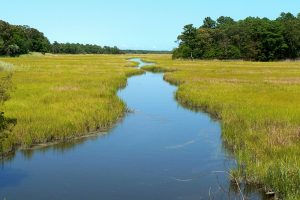
When I looked online, I found wetlands are a distinct ecosystem that is flooded or saturated by water, either permanently, for years or decades, or seasonally for shorter periods.  Wetlands can be tidal (inundated by tides) or non-tidal and the water held can be freshwater, brackish, saline, or alkaline.  Flooding results in the occurrence of oxygen-poor (anoxic) processes, especially in the soil.  All true wetlands have three characteristics: typical wetland plants, wetland soils, and evidence that water is or can be at or near the surface.  Wetlands are different from other landforms or bodies of water as their aquatic plants have adapted to oxygen-poor waterlogged soils.  Wetlands are considered among the most biologically diverse of all ecosystems and provide habitat for a wide range of plant and animal species.  There are four main kinds of wetlands.  A marsh is a wetland that is dominated by herbaceous (no woody stem) plants rather than by woody (hard stem) plants.  A swamp is a forested wetland that is a transition zone where both land and water play a role in creating the environment.  A bog is a wetland that accumulates peat as a deposit of dead plant materials (typically sphagnum moss).  A fen is a type of peat-accumulating wetland fed by mineral-rich ground or surface water.  Some experts also recognize wet meadows and aquatic ecosystems as additional types of wetlands.

Despite nearly half of Delaware’s original wetlands having been lost over the last two centuries, wetlands still make up nearly 25% of land in Delaware, and 75% of these wetlands are non-tidal.  The vast majority of the wetlands are privately owned, with only 20% owned by the state or federal governments.  Delaware’s Department of Natural Resources and Environmental Control (DNREC) assesses these lands regularly, but only non-tidal wetlands of 400 acres (162 ha) or more are regulated by the state.  Rep. Debra Heffernan, chair of the House Health & Human Development Committee and sponsor of SB290, said “As our communities continue to deal with increased flooding, drainage issues and habitat loss, protecting our remaining wetlands, one of our state’s most valuable ecosystems and assets, is more important now than ever.”  This bill will require a permit issued by the DNREC prior to activities that might impact these ecosystems. 

THOUGHTS:  The proximity of wetlands to lakes and rivers puts them at risk for development and human settlement.  Wetlands are often converted to dry land by constructing dykes and drains and used for agricultural purposes.  Once settlements are constructed and protected by dykes and levees, they are more at risk for land subsidence and increased flooding.  The flooding and subsidence of the Mississippi River Delta around New Orleans, Louisiana is a well-known example.  Wetlands offer safety for plants and animals (including humans) and need to be protected, not drained and leveled.  Act for all.  Change is coming and it starts with you.

Hot Dog

June 13, 2024

I am not sure whether it was a slow news day but one of the lead stories on my local news was the “controversy” surrounding the banning of Joey Chestnut from Nathan’s 4th of July Hot Dog Eating Contest by Major League Eating (MLE).  On Tuesday, June 11, it was announced that Chestnut was not allowed to compete because of a deal he has with Nathan’s competitor, Impossible Foods, which recently released a plant-based hot dog.  MLE released a statement saying, “For nearly two decades we have worked under the same basic hot dog exclusivity provisions.  However, it seems that Joey and his managers have prioritized a new partnership with a different brand over our long-time relationship.”  Chestnut responded to the statement claiming the rules were changed this year.  “To set the record straight, I do not have a contract with MLE or Nathan’s and they are looking to change the rules from past years as it relates to other partners I can work with.”  Chestnut has won Nathan’s hot dog eating competition 16 times.

When I looked online, I found Nathan’s Famous International Hot Dog Eating Contest is an annual hot dog competitive eating competition held on July 4 at Nathan’s Famous’ original restaurant in Coney Island, New York City, since 1972.  During the 1990’s and 2000’s the event was dominated by Japanese contestants and gained public attention since the mid-2000’s with the stardom of Takeru “The Tsunami” Kobayashi and Joey Chestnut.  Chestnut is the defending men’s champion who ate 62 hot dogs in the 2023 contest.  Miki Sudo is the defending women’s champion who ate 39.5 hot dogs in 2023.  MLE has sanctioned the event since 1997, and today, only entrants under contract with MLE can compete.  The field of about 20 contestants are selected by invitation or from qualifying events.  The event draws spectators and worldwide press coverage, with an estimated 50,000 on site in 2007.  ESPN has enjoyed solid ratings from its broadcast of the Hot Dog Eating Contest and on July 1, 2014, announced it extended its agreement with MLE to broadcast the contest through 2024.

Another twist was an offer by Paige Spiranac to fill Joey Chestnut’s shoes.  Spiranac is described as golf’s top social media influencer and as of October 2023 has 3.9 million Instagram followers, 359,000 YouTube subscribers, and a subscription-based website (OnlyPaige) which features golf instructional videos, livestreams, and vlogs.  Spiranac has also been cyberbullied for “sexualizing women’s golf” after appearing in the Sports Illustrated Swimsuit Issue and for her provocative outfits.  The LPGA introduced a stricter dress code in July 2017 to restrict plunging necklines, leggings, and short skirts.  After Chestnut was barred from Nathan’s contest, Spiranac volunteered for the event saying, “I’m available to fill in for him.  My record is 6.5 hotdogs in 10 minutes.”  Spiranac shared a video saying, “I found the video proof.  And I lied, it was only 6 hot dogs and not 6.5.”  Many viewers commented on Spiranac’s unorthodox way of eating hot dogs while others thought her enthusiasm for the contest could provide a new dynamic to the annual competition.  It is not about winning, but providing a good show even if you lose.

THOUGHTS:  While the history of advertising can be traced back to ancient civilizations, modern advertising began with the advent of newspapers and magazines in the 1840’s, and ads on social media are the latest permeation.  Social media influencers build a reputation for their knowledge and expertise on a specific topic and their posts generate large followings of people who pay attention to their views.  Brands love social media influencers because they can create trends and encourage their followers to buy products they promote.  While the medium has changed, selling from a “trusted source” is the same, only now it reaches millions of customers in milliseconds.  The Romans coined the phrase “Caveat Emptor” (buyer beware).  Act for all.  Change is coming and it starts with you.
Fruit Flies

June 11, 2024

At the beginning of June, I mentioned how we were being inundated by house flies (Musca domestica) and fruit flies (Drosophila melanogaster).  Melissa mentioned how her work mates and friends have also been complaining about the same infestation.  I have been trying different approaches to get rid of the flies and have been relatively successful with the house flies (keep the door shut).  I cannot say the same about fruit flies.  We have cleaned the counters and flushed the sink drains.  I keep the kitchen composter closed and regularly run the processed remains outside to my inground composting bin.  I have tried glue strips and apple cider vinegar traps.  These have worked but do not seem to be keeping up with the growing number of fruit flies that are making my kitchen sink and counters home.  This morning, I reached my limit when Melissa called me into the kitchen to find around 30 fruit flies covering our sink.  I swatted them with a towel, went to my office to research the best ways to get rid of the fruit flies, and then took off for the market to buy a more effective ways of getting rid of the pests.  

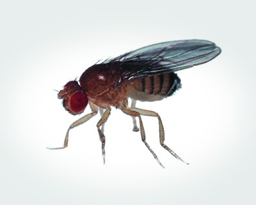
When I looked online, I found the common fruit fly (Drosophila melanogaster) is among the common types of flies in Arkansas and the US, but they are also found around the world.  These flies are about 0.12 inches (3 mm) in body length with the females are generally larger in size compared to males and have a more rounded abdomen.  Both have brick-red eyes and a yellow-brown body.  The fruit fly has a lifecycle of 10 to 14 days.  They are commonly found near decaying fruits and vegetables where they feed on the yeast and bacteria that thrive in those environments.  Fruit fly eggs are only visible under a microscope, measuring 0.04 inches (1/2 mm) in length.  The eggs are oblong (like a piece of rice) and pale yellow in color.  The female can lay up to 500 eggs at a time, primarily in the fermenting or decaying, sweet, organic material found in the fruits and vegetables that attract the adults.  The fruit fly is usually attracted to moisture and light.

Many of the remedies I found online to combat my fruit flies involve using the fly’s attraction of moisture and light.  Several of these involved a combination of ultraviolet blue light and sticky traps.  The theory is the light will attract the flies who then settle on the scented sticky trap and are unable to get off.  I also renewed my effort of placing a cider trap to provide the liquid they find appealing.  Jody Green, a contributor to the journals of the Entomological Society of America, specializes in urban and industrial entomology or “the bugs that people love to hate the most.”  Green said, “They don’t just magically appear like most people think they do, but you can find them inside when you have fermenting foods.”  If you want to get rid of fruit flies, all you need to do is remove the rotten fruits or any rotten organic matter from your home.  Cleaning habits are an important step in getting rid of fruit flies.  My cleaning habits will never receive the Good Housekeeping seal of approval.

THOUGHTS:  I discovered while researching how to get rid of fruit flies that I was making my apple cider trap wrong.  I poured the cider into a trap and watched as dozens of fruit flies swarm the trap in the morning, but there were only a few dead ones inside the trap.  Then I read you need to add a few drops of dish soap in the vinegar to break up the surface tension of the liquid and allow the flies to sink rather than float on top.  So much for the person who refuses to take STEM classes in school because they “will never be useful in real life”.  I am banking on biology and surface dynamics to resolve the problem with my fruit flies.  Act for all.  Change is coming and it starts with you.

Bridge Housing

June 07, 2024

The back page of the front section of my local newspaper ran a USA Today article on a new US$40 million housing campus that just opened in Detroit, Michigan.  The complex broke ground in 2022 and officially opened on Monday, but the planning for the center has taken place over the last nine years.  Rev. Tim McCabe, president and CEO of the Pope Francis Center (PFC) toured 27 other shelters from around the US to gain insights and ideas for the facility.  The site includes a specialty “hot room” for disinfecting blankets and clothing upon arrival or heat lamps that warm a covered patio designed for people seeking shelter from the cold but who are just not ready to come inside.  McCabe said, “We’re going to change the conversation around what it means to be homeless . . . and we do that with radical compassion and love.”  In Detroit, this radical compassion is on display at the Bridge Housing Campus.

When I looked online, I found PFC’s Bridge Housing Campus is a 60,000 foot2 (5574 m2) campus that sits on 5.3 acres (2.1 ha) of once vacant land.  Residents are greeted by a building with gable roofs and contrasting exterior bricks to convey a sense of residence.  Each of the 40 residents (men for now) will be assigned a separate studio apartment connected by wide inside hallways painted in calming neutral blue and green colors so nobody feels closed in.  The 336 feet2 (31.2 m2) units feature a bathroom and living area, bed, television, kitchenette, and bright windows.  Three of the units are designated as anti-ligature rooms (cannot be used by someone to harm self by bind or tie) equipped with fixtures to keep residents safe such as sinks with no knobs.  Bridge Housing not only provides residents with a place to live for 90-120 days but services to promote their independence and well-being such as a medical and dental clinic along with a team of social workers, addiction specialists, and psychiatrists.  Other amenities are an 8-bed respite center for those discharged from the hospital but needing time to recover, a full kitchen for meals and culinary training, classrooms to provide for job preparation and financial literacy, a library, computer lab, art room, meditation space, barber shop, and a gymnasium for fitness or social activities.  The PFC’s regular services at the nonprofit’s downtown location will continue once the campus opens.  The downtown day center provides two meals, laundry and shower facilities, medical and dental clinics, and legal clinics to help people to find housing. 

A major difference of the Bridge Housing Campus than other facilities designed to address chronic homelessness is a partnership with the surrounding community.  McCabe said the campus will not only benefit its residing guests but their neighbors who consented to have the project built.  The neighborhood will also have full free access to the campus’ health clinic, classrooms, cafeteria, and gymnasium.  “I can’t wait for the kids in the neighborhood to see this and to come and throw a basketball around,” McCabe said, “The community needs to see these people, not as scary”.  The interaction between residents and the community will help tear down the stereotypes that add to the trauma already experienced by the homeless and allow the community to see them as people.

THOUGHTS:  The potential success of Bridge Housing comes from the willingness of the community to act as a partner in the project.  We have had several attempts to build housing communities (tiny houses and community center) on vacant land in the city near us that have been shot down by residents near (not in) the areas suggested.  They decried the bad element that would be brought to live in these communities even more than any potential loss of property values.  Both reflect the stereotype Bridge Housing was able to overcome through cooperation.  People in crisis need a hand up, not a push down.  Act for all.  Change is coming and it starts with you.
Noodling

June 06, 2024

My sister-in-law dropped by today for some good conversation and since we have a thriving Food Truck court in town (8 separate trucks) we decided to go there for lunch, so we could each pick the food (bar-b-que to Cajun to Asian to American) of our choosing.  On the way to her car, I stopped to pick up the free local newspaper that had been thrown into our driveway.  Once int the car, both Melissa and her sister mentioned how this paper had been a staple when they were growing up.  It had carried stories of local interest and notes and pictures on school events (it still does today).  I later opened the newspaper, and the Outdoor News section had a full page article with stories and pictures of local anglers participating in the southern tradition of noodling.

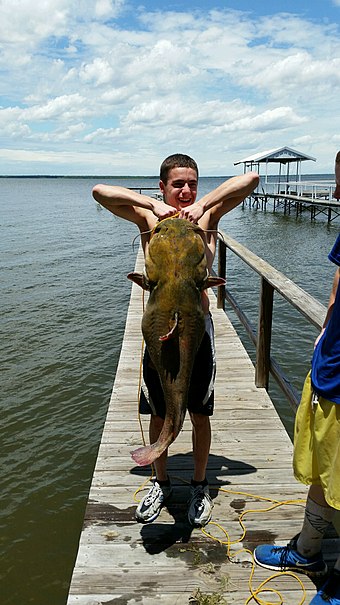
When I looked online, I found noodling is fishing for catfish using bare hands or feet and is practiced primarily in the southern US.  Other names for the method are used in different regions (South and Midwest) and include hogging, dogging, grappling, grabbling, and tickling.  The method requires the noodler to place their hand or foot inside a discovered catfish hole in order to catch the fish.  While the term noodling is primarily used for the capture of flathead catfish, it can and has been applied to all hand fishing methods, regardless of the method or species of fish sought.  Noodling has also been applied to various unconventional methods of fishing which do not use bait, rod and reel, but this is less common.  Noodling has also been applied to the hand capture of snapping turtles.  Due to concerns over the safety of noodlers and sustainability of fish populations, the technique is illegal in some states where it was once traditionally practiced but is legal in some form in sixteen states, but with restrictions on the species or sizes of fish, of the specific methods used (Arkansas is one). 

Other than drowning, or being injured by underwater hazards, noodling has other physical threats, including the potential for fatal injury caused by other forms of aquatic life that may be residing in the abandoned holes of cavity spawning catfish, such as snapping turtles, snakes, beavers, and alligators.  Loose fitting clothes may get tangled or snagged on roots or rocks, and various physical injuries may be incurred while underwater, ranging anywhere from superficial wounds to losing fingers.  Several articles suggest precautionary measures, such as using the buddy system, wearing tight clothing that hugs the skin, and inspecting potential holes with a stick.  Other recommendations include noodling shirtless or while wearing a short sleeve shirt, to wear gloves that offer some level of protection for one’s hands, and to not wear any jewelry.  The mortality rate per capita for noodling indicates it is extremely dangerous in comparison to other forms of fishing and noodling related deaths have been reported.  The Oklahoma lake record catfish that was caught by noodling and weighed 87.85 pounds (39.85 kg), was 53-3⁄4 inches (137 cm) long, and 38-1⁄4 inches (97 cm) in girth.  A typical weight for a flathead catfish caught by noodling is 40 pounds (18 kg). 

THOUGHTS:  I always wanted to try noodling when I was younger but never liked the idea of being bitten by a large catfish.  I found a 2020 master’s thesis on noodling mortality in Oklahoma.  The study states, “Human fatalities occur while noodling every year in our state, with the most common cause of death being drowning.”  Noodling deaths are difficult to gauge, as most are listed merely as underwater drowning.  Other Noodling deaths are recorded as “missing” as the bodies are swept away by the current and never found.  The overwhelming pattern for a noodling mortality is a white male in their mid-30’s.  The other constant is a blood alcohol content of over 0.1%.  Young males fishing for cats with coolers of beer seems to be another tradition throughout the South and Midwest for this demographic, so it is not surprising that would hold for noodling.  I guess you have to find courage somewhere.  “Don’t Drink & Noodle”.  Act for all.  Change is coming and it starts with you.

Brazilian Pepper

June 05, 2024

In the middle of the back section of my local newspaper I found a USA Today article reporting how Artificial Intelligence (AI) is being used to fight invasive plants in the Florida Everglades.  The changing climate has produced stronger and more frequent hurricanes which can open areas of the dense everglades foliage and allows invaders to take control.  Researchers at the University of Florida are using AI to gather data combining ground-level research with hyperspectral sensing.  The study is focused on two of the Everglades worst invaders, the Old World climbing fern (Lygodium microphyllum) and the Brazilian pepper.  The pepper is particularly abundant along the fringes of the Mangrove swamps (biome associated with various salt-water tolerant species).  The team plans to examine post-hurricane conditions with remotely sensed data and map the distribution of invasive plants in an effort to help identify and eradicate them. 

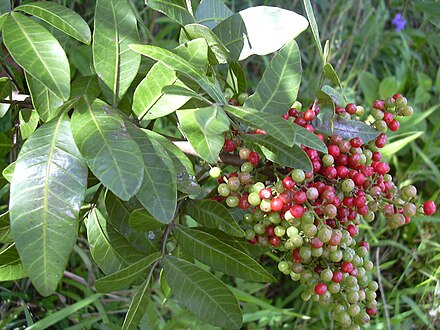
When I looked online, I found the Brazilian pepper (Schinus terebinthifolia) is a species of flowering plant in the cashew family (Anacardiaceae) that is native to subtropical and tropical South America.  The plant is a sprawling shrub or small tree with a shallow root system that may reach heights of 23 to 33 feet (7 to 10 m).  The branches can be upright, reclining, or nearly vine-like, all on the same plant, and its plastic morphology allows it to thrive in all kinds of ecosystems.  In swamps the pepper grows as a semi-aquatic plant.  The leaves are alternate, 3.9 to 8.7 inches (10 to 22 cm) long, pinnately compound with 5 to 15 roughly oval leaflets that are 1.2 to 2.4 inches (3 to 6 cm) long and 0.79 to 1.38 inches (2 to 3.5 cm) broad.  The leaflets have finely toothed margins, an acute to rounded apex and yellowish veins.  The plant has separate male and female reproductive organs in different individuals (dioecious) and produces abundant small white flowers in clusters.  The seeds are a stone fruit (drupe) 0.16 to 0.20 inches (4 to 5 mm) in diameter and carried in dense clusters of hundreds.  The pepper tree was introduced as an ornamental outside its native range and is now considered an invasive species, including the US states of California, Texas, Hawaii, Arizona, Nevada, Louisiana, and Florida.  It is another one that got away.

Violent storms can shape plant invasions in two ways.  The storms can make the landscape more receptive to invasion by killing native plants communities and allowing more sunlight for invaders to capitalize on.  Storms can also spread invasive seeds and spores to new areas.  If resources can be allocated before or right after a storm the invasions can be managed more efficiently, and that is where AI comes to play.  According to researcher Susan Meerdink, a method called “multitarget multiple-instance spectral match filter” (MTMI-SMF) is a machine learning approach that can detect invaders using multispectral imagery.  “Our study demonstrates that remote sensing technologies and multiple-instance learning algorithms can provide managers with critical tools.”  Data is collected using a remote flyover, like a drone, helicopter, or satellite.  Some invasive species give off a unique and detectable spectral (light) signal different than native species.  AI can in turn plot their presence.

THOUGHTS:  The researchers describing the use of AI to detect the presence of Brazilian Pepper appear caught in technospeak.  Technospeak is an informal term for a prose style used by high-technology industries, their associated media, and the marketing and publicity groups around them.  Many outsiders consider it a nonsense language consisting of buzzwords, esoteric words, and technical jargon.  The style does give clear meaning while reducing the words otherwise needed to make your point.  While this can make communication concise, it creates also US vs THEM.  If you do not understand, I am not talking to you anyway.  If you want to be understood, you need to speak to others in a way they can understand.  Act for all.  Change is coming and it starts with you.
DG

June 04, 2024

You can imagine my surprise when I was driving the kids back from the lake and came across a “new” store on the outskirts of our town.  It was prominently placed at the grade school crosswalk that led to a growing new subdivision.  Although the market front had a new look, it felt familiar.  It surprised me I had not noticed new construction at the site, although I had not been to the lake for several weeks.  I was even more confounded when I saw a large “Clearance” sign attached to the building.  How could you have a clearance sale at the new store?  I went home without thinking much more about it, but when I returned to walk the kids the next day, I realized what was going on.  This was not new construction or even a new store.  The building had been a Dollar General the last time I had seen it.  The clearance was possible as the store liquidated its sundry inventory to make way for the meat and fresh produce that comprised a portion of the refurbished DG Market.

When I looked online, I found that although the DG Markets are built (or refurbished) as modestly sized buildings, the inside looks more spacious because of its new, clean, and organized arraignment.   The sections of the store are labeled and there are visual zones to create the illusion of more space.  DG still uses the practice of making sure their markets are strategically located to ensure each location will continue to meet “their customers’ price, value, and selection needs.”  According to their publicist, DG’s offers the top 20 items typically sold in traditional grocery stores and covers approximately 80% of produce categories of most other grocery stores.  While the fresh meat section does not stack up to the local butcher shop, they do carry some staples (even baby back ribs!).  The Health and Beauty isles provide ample (name brand) items that are not marked up over the local box markets.  Even if you are not after groceries, the DG Market still carries a lot of the same items you bought from the regular Dollar General, like home decor to trash bags to party supplies.

Over the last two years Dollar General has opened new DG Markets and replaced several regular Dollar General locations (like mine) with this updated store concept.  Matthew Simonsen, Dollar General’s senior vice president of real estate and store development said the company is aiming to provide communities with “closer access to fresh foods” through its DG Market stores.  While the exact number of DG Markets opened is not clear, there are well over 100 locations listed on Google as of June 2023.  These markets are not the only spinoffs under the Dollar General brand, either.  The company also has DGX stores in a few urban locations that are laid out more like a convenience store.  Then there is “popshelf” that debuted in 2021 in response to the pandemic and had 30 locations by the end of the year.  Popshelf sells beauty products, home decor, party supplies, and other discretionary items, with products mostly for $5 or less.  The chain’s target audience initially skewed female, with the outlets located in suburban markets with household incomes ranging from US$50,000 to US$125,000.  DG has received criticism for exploiting lower income food deserts (and even causing them), but they are one of the few ventures that is willing to provide access to these underserved communities.

THOUGHTS:  Melissa and I had a game of guessing how many cars would be parked at the DG at the entrance to the small town we visited each Sunday.  It was always between 7 to 9 vehicles.  As I pass the new DG Market in our town, it is usually the same even with our two chain supermarkets.  Food deserts are a serious problem for rural and low income consumers, especially when there are limited transportation options.  Underserved communities need to be supported with access to inexpensive quality goods and services.  Act for all.  Change is coming and it starts with you.
Robber

June 03, 2024

With the overcast days filled with intermittent rains we have been inundated by house flies (Musca domestica) and lately fruit flies (Drosophila melanogaster).  Melissa likes to keep the patio windows open along with the kitchen door to take advantage of the breeze.  While this still provides a barrier from the outside, the kids put a kink in the system.  Melissa works in our bay window to watch the action as the birds (and squirrels) come to the feeders.  During the morning the kids tend to run in and out the door between the kitchen and outside fence where Melissa is working.  That means Melissa must either keep the patio door open (allowing flies), keep the kitchen door shut (depriving of breeze), or get up and down every time the kids decide they want to go outside after coming in 5 minutes ago.  That means the doors are often open and inviting the flies to enter.  We occasionally get other visitors who take advantage of the open doors, like the paper wasps (Polistes fuscatus) and black and yellow mud daubers (Sceliphron caementarium).  Melissa is highly allergic to bee and wasp stings, so when she saw something that looked like a wasp land on the windowsill next to her head, she called me into the kitchen to investigate.  I later found out this was actually a robber fly.    

When I looked online, I found the Fan-bristled robber fly (Dysmachus trigonus), or assassin fly, are part of the larger robber fly family.  They are powerfully built, bristly flies with a stout proboscis enclosing the sharp, sucking mouth parts (hypopharynx).  The name “robber flies” reflects their predatory habits as they feed on other insects by waiting in ambush to catch their prey in flight.  The Asilidae are a family in the order Diptera (true flies) and are cosmopolitan (around the world) with over 7000 described species.  French zoologists Pierre Andre Latreille established the family in 1802.  Robber flies have stout, spiny legs and three simple eyes (ocelli) in a characteristic depression on the tops of their head between two large compound eyes.  They also usually have a dense moustache of stiff bristles on the face (mystax).  The mystax is suggested to afford protection for the head and face when the robber fly deals with struggling prey.  The family of flies attack a wide range of prey, including other flies, beetles, butterflies and moths, various bees, ants, dragonflies and damselflies, ichneumon wasps, grasshoppers, and some spiders.  Many Asilidae when attacked do not hesitate to defend themselves and may deliver intensely painful bites to humans if handled.

When I saw the robber fly sitting on the sill, I was at a loss for how to deal with it.  I could tell this was not a wasp, so that danger was alleviated.  Still, I did not know what it was, and I am not too fond of large insects (or spiders) having free range of my house.  With all of the succulents, pots, and potting material there are too many places for such critters to hide and thrive.  I could see the large mouth parts (probosces) on the fly and knew even the bite of the common house fly hurt if it chose to bite.  I finally just gave in and whacked it with a fly swatter.  It was only after I researched the photo of the fly that I learned one of the robber fly preys is the house flies we were trying to get rid of.  I felt a little better when I learned the robber fly was also aggressive and would bite humans if handled.  I had no idea how I could have gotten it outside the house.

THOUGHTS:  My whacking the robber fly is typical of most human reaction to an unknown.  If something is unfamiliar and appears threatening, it is best to “whack now and ask questions later”.  I would have been better off trying to move the robber fly outside and allow it to control its prey (and my pests).  Human evolution created an innate tendence to practice “fight or flight” when facing the unknown, but neither is always the best approach.  Positive interactions with the environment (and other humans) often require “stop, wait, and learn” before proceeding.  This does well for us, and for whatever we were going to whack.  Act for all.  Change is coming and it starts with you.