Jewel

October 04, 2023

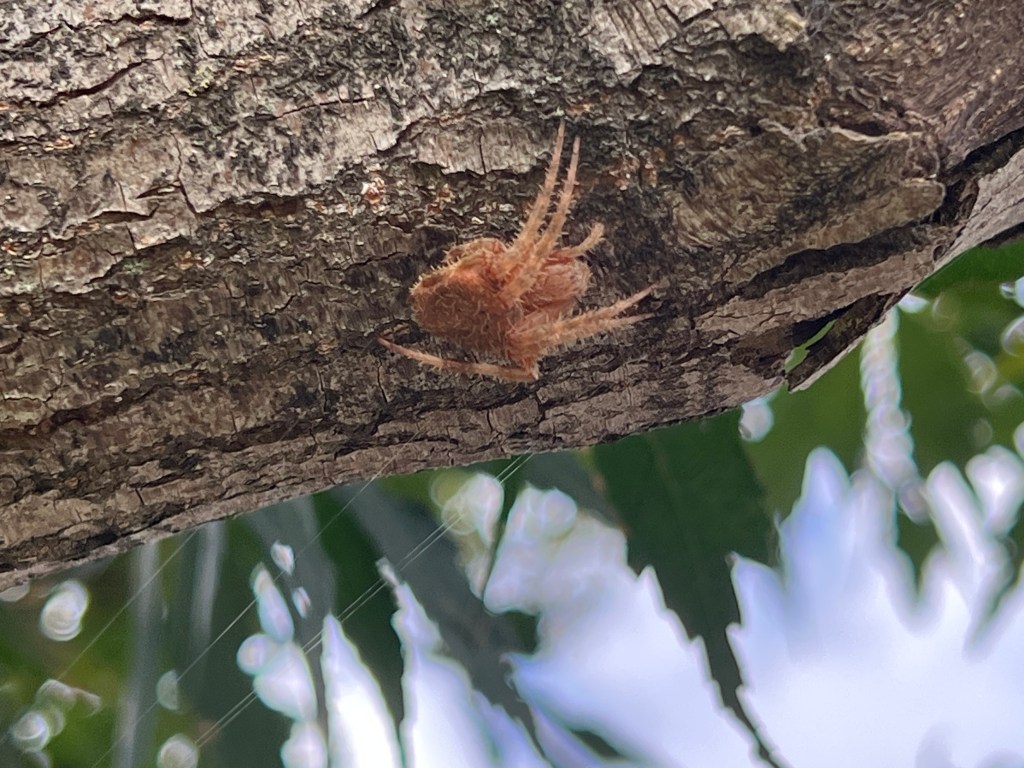
When my annual newspaper subscription expired in July, I switched to an online only subscription.  This was not only cheaper, but I hoped to save the mounds of newsprint I periodically place in city recycling.  My subscription was changed but the paper kept coming (obviously supply chain issues).  I tried to contact the newspaper office but could not get around the automated system that took me overseas to people who told me it had been changed.  I gave up, and now still go out each morning to pick up my paper (except Saturday and holidays when they do not deliver).  As I was coming back to the house, I noticed a large bug sitting on a branch of the Japanese maple (Acer palmatum) in our front flower bed.  At first, I thought it was one of the destructive aphids (superfamily Aphidoideas) that suck the sap out of trees.  As I looked closer, I realized it was an orb-weaver spider sitting on the beginning of its web.  It looked like a golden jewel as it sat motionless waiting for me to pass.

When I looked online, I found the Jewel spider (Araneus gemmoides), also known as the cat-faced spider, is a common outdoor, orb-weaver spider found in the US and Canada.  Both common names reflect the special traits of the body of the spider.  The abdomen is large and if seen from the front, resembles the face of a cat.  Others consider the shape of the spider’s body diamond- or jewel-shaped. Hence, its two common names.  The color of the spider can range from almost completely white to bright orange (like mine) and dark brown, and its color varies and changes from summer to winter.  The jewel usually grows between 0.2 and 1 inch long (5 to 25 mm), with comparably short legs and a large-sized abdomen.  The jewel usually makes its webs near lights, closed spaces, and on the sides of buildings, but can be found under wood, overhangs, or guarded places such as animal burrows (or perhaps in trees?).  The species is easily identified by the two horn-shaped growths on its relatively large abdomen.  Females have a larger abdomen and head, while males have much smaller abdomens and longer bodies.

The female dies within days of laying a single egg sac with hundreds of eggs.  The egg sacs can survive through the winter.  The emerging spiderlings eat their siblings, but the ones who get away ride strands of silk in warm air currents which can transport them miles away.  Like all orb-weavers, the jewel spider is considered harmless.  Jewel spiders are extremely timid and will always try to get away rather than fight.  The spider is clumsy moving outside their webs.  Even if they do bite, their venom has low toxicity and will only cause a small blemish that will fade.  At their worst, they may cause a slight welt.  The spider is a natural predator for insects and eat a variety of food, ranging from fish flies, house flies, and mosquitoes to other small spiders (including siblings).  I left my solitary female on her web, wishing her good hunting and a favorable mating outcome as the fall is here.

Thoughts:  I can tell fall is approaching as the spiders are on the move in my yard.  Various species have turned up sporting babies on their backs like the rabid wolf spider (Rabidosa rabida) or egg sacs in their web like the triangulate cobweb spider (Steatoda triangulosa).  The Jewel spider was just another spider species trying to prepare for winter.  Many species of insects lay eggs which can survive, even if the adult will die.  Many plants go dormant over the winter, and some have developed to need to become dormant to germinate as the weather warms.  Birds will fly south to warmer climes.  Mammals instead adapt.  While some hibernate, others use their warm blood and external hair for warmth.  Humans tend to alter nature (clothes and housing) to survive the cold.  While this is a preservation advantage, we can be more vulnerable to extreme changes in climate.  We need to accommodate nature to ensure the survival of the ecosystem, not just ourselves.  Act for all.  Change is coming and it starts with you.

Onondaga

October 02, 2023

Today’s local newspaper reposted an article from the AP addressing the case by the Onondaga Nation to reclaim a portion of the lands taken from them.  The Onondaga have protested these illegal land grabs for centuries.  The initial appeal was to President George Washington, then to Congress, and then to a US court.  All the appeals failed.  Onondaga territory once stretched nearly 4,000 square miles (10,000 square km).  Today, the federally recognized territory is 7,500 acres (3,000 hectares) with about 2,000 people living mainly in single-family homes on wooded lots.  A tax-free smoke shop sits just off the interstate and a wooden longhouse used for meetings sits deeper in the territory.  Now the Nation has taken their appeal to an international panel.  The Inter-American Commission on Human Rights recently allowed the Onondaga to pursue claims their land was taken unjustly by the state of New York.  This provides a unique venue for a land rights case against the US by a Native American nation.

When I looked online, I found the Onondaga people (“People of the Hills”) are one of the five original nations of the Haudenosaunee (Iroquois) Confederacy in the Northeastern Woodlands of the US.  Their historical homelands are in and around present-day Onondaga County, New York.  Oral tradition says the Great Peacemaker approached the Onondaga and other tribes to establish the Haudenosaunee.  The Seneca nation was debating joining the Haudenosaunee as a solar eclipse took place, most likely the eclipse in 1142 CE which was visible in the land of the Seneca.  It was seen as a sign from the Great Peacemaker, and they joined.  The Onondaga are centrally located among the Five Nations and are considered the “Keepers of the Fire” (Iroquoian language: Kayečisnakwe’nì·yu) which is housed in the figurative longhouse of the Five Nations.  The Cayuga and Seneca territory is to the west and the Oneida and Mohawk to the east.  The League of the Iroquois historically met at the Iroquois government’s capital at Onondaga, just as the traditional chiefs still do today.

The Onondaga Nation’s case centers on a roughly 40-mile-wide (65-kilometer-wide) strip of land running down the center of upstate New York from Canada to Pennsylvania.  Their claim is that ancestral land was appropriated over decades by the state of New York, starting in 1788, through deceit that violated treaties and federal law.  The Onondaga again filed a federal lawsuit in 2005 claiming the illegally acquired land was still theirs.  A judge dismissed the claim five years later, ruling it came too late and “would be disruptive to people settled on the land”.  After the court loss, the Onondaga and the Haudenosaunee petitioned the commission in 2014, alleging violations of provisions of the American Declaration of the Rights and Duties of Man and two claims were ruled admissible in May.  Now the commission can consider the merits of whether the nation’s rights to equality under the law and judicial protection were violated.  This is the first land rights case admitted by the commission from a Native American nation against the US, though it has heard other Indigenous cases against the United States.  The US government is not expected to abide by any opinion by the commission, which is part of the Organization of American States.

Thoughts:  The US has a long history of signing and breaking treaties with Native Americans.  There were 368 treaties signed from 1778 to 1871, acknowledging the tribes as independent, self-governing nations.  The Indian Appropriations Act of 1871 changed that and gutted previous treaties and eliminated Native tribes’ self-governance.  A July 2020 ruling by the US Supreme Court paves the way to address many of the points made by the Onondaga and other tribes: things like land reform and judicial treatment.  They are still waiting for the US to keep its word.  Act for all.  Change is coming and it starts with you.
Farms

October 01, 2023

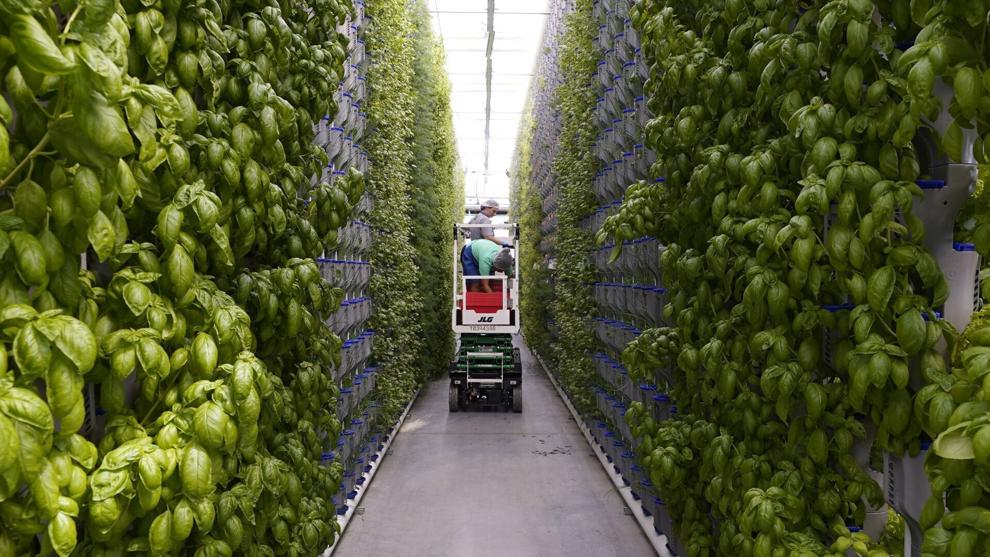
I came across an AP article in my local newspaper that discussed the plight of indoor farms.  These green factories are meant to provide harvests of fresh produce all year long and can be built close to the urban markets.  This enables the farms to pick, package, and ship to markets within 48 hours.  Indoor facilities are meant to shelter their produce from climate change while using less water and land.  Eden Green Technology in California operates two greenhouses and has broken ground on two more at its Cleburne campus.  Players in the industry are betting big even as rivals wobble and fail.  California-based Plenty Unlimited broke ground on a $300 million facility this summer, while Kroger announced that it will be expanding its availability of vertically farmed produce.  Meanwhile, two indoor farming companies that attracted strong startup money filed for bankruptcy reorganization and a 5-year-old company in Detroit shut its doors this summer.  Many of the farms are proving to be unsustainable and are forced to close due to the high cost of electricity to operate the indoor grow lights.

When I looked online, I found controlled-environment agriculture (CEA), including indoor agriculture and vertical farming, is a technology-based approach toward food production.  The aim is to protect plants from the outdoor elements and maintain optimal growing conditions throughout development of the crop.  Production takes place within an enclosed growing structure such as a greenhouse or plant factory.  Plants are often grown in a soilless medium to ensure the proper amounts of nutrients and water to the root zone, along with supplemental lighting to ensure sufficient daily light.  Indoor farms optimize the use of resources such as water, energy, space, capital, and labor.  CEA technologies include hydroponics, aeroponics, aquaculture, and aquaponics.  Greenhouse production is currently the largest component of the CEA industry but another quickly growing segment is the vertical farming industry.  As a form of urban agriculture, CEA can exist inside repurposed structures, built to purpose structures, or in basements and subterranean spaces.  The trend is growing as entrepreneurs and households seek to meet the demand for fresh food products.

Skeptics question the sustainability of operations that can require energy-intensive artificial light, saying paying for that light can make profitability impossible.  The industry has acknowledged those high costs.  Some companies are seeking to cut costs by relying on solar, which also supports sustainability.  Those that rely on artificial light that does not come from renewables maintain they can still be profitable by producing a high volume of produce year-round.  Evan Lucas, associate professor at Northern Michigan University who teaches infrastructure design for indoor farms, said he is not concerned about the instability of the industry.  Some companies may be struggling to scale up due to problems that come from launching in spaces that are not built specifically as indoor farms.  “My guess, based on what’s happening, is everyone saw the opportunity and started to try to do a lot really quickly.”  Farmers and farms seem to struggle whether they are inside or out.

Thoughts:  Indoor farms have the potential to change the way we grow and access food.  These farms operate in smaller locations (saving land), use less water (drought resistant), and are not subject to heat and cold extremes (climate change).  While artificial light is expensive, solar panels are becoming less expensive and fiber optics could be used to channel sunlight to indoor farms.  My grandfather was successful at farming because he shifted what he produced (crops and animals) depending on the market.  The problem may come from the types of produce that can be grown in these environments.  We may need to change the way we eat to accommodate what we can produce.  Act for all.  Change is coming and it starts with you.

Cobweb

September 30, 2023

We have a laundry room between the garage and the front hall that also serves as our storage pantry.  We have shelves along one side with cans and boxes of food items, as well as laundry and cleaning items on the bottom shelf.  The other side of the narrow room has a washout sink located next to the washer and dryer.  We no longer use this sink cabinet as it has become a storage site for dog snacks.  Many of these treats are bought from the big box store which means some of those treats are in a large box.  Loki’s smaller dog biscuit box sits on top the dryer, but Zena’s larger box of biscuits is stored in the garage.  When I stuck my hand in Zena’s biscuit box several weeks ago, I felt the beginning of a cobweb.  This week the cobweb was more pronounced, and I opened the box to see what was happening inside.  There was a small spider and a prodigious cobweb that stretched around most of the top of the box.

When I looked online, I found the triangulate cobweb spider (Steatoda triangulosa), also called the triangulate bud spider, is a common spider in the genus Steatoda.  Its name derives from the triangle-shaped pattern on the dorsal side of its abdomen.  The species was first described as Aranea triangulosa, by Charles Walckenaer in 1802 but was transferred to the genus Steatoda by Tamerlan Thorell in 1873.  The adult female is 1/8 to 1/4 inch (3 to 6 mm) long, with a brownish-orange cephalothorax (fused head and thorax of spiders), spindly, yellowish legs, and tiny hairs.  The round, bulbous abdomen is creamy in color, with parallel purply-brown zigzag lines running front to back.  This distinctive pattern sets it apart from other theridiids in its habitat.  The triangulate is known as a “useful spider”, as it preys on other types of arthropods, ants (including fire ants), other spiders, pill bugs, and ticks.  It also preys on several spiders believed to be harmful to humans, including the brown recluse (Loxosceles reclusa).  The egg sac of the triangulate is made from loosely woven silk.  It is about the same size as the spider itself and contains approximately 30 eggs.

Like other members of the family Theridiidae, the cobweb of the triangulate is an irregular tangle of sticky silken fibers.  The spider will usually eat for a period but spends most hours developing their sturdy cobweb.  Like other web-weavers, these spiders have very poor eyesight and depend mostly on vibrations reaching them through their webs to orient themselves to prey or to warn them of larger animals that could injure or kill them.  They are not aggressive and only one known case of a human being bitten (envenomation) is recorded.  Their bite will not kill a human unless there is an allergic reaction.  The triangulate is a cosmopolitan species and can be found in many parts of the world, including North America, southern Russia, New Zealand, and Europe.  It is believed the spider is native to Eurasia and has been introduced elsewhere.  The species is primarily a house spider and builds webs in dark corners of buildings and other man-made structures (like Zena’s treat box).

Thoughts:  Ever since a tarantula landed on my ear at Boy Scout camp when I was 12 years old, I have been squeamish about the possibility of spiders unknowingly crawling on me.  That means while I am not scared by seeing a spider I do not like running into cobwebs when I do not know where the spider is.  There were four egg sacs in the cobweb in Zena’s box.  I did not kill the spider but did remove the egg sacs as I did not want another 120 spider babies lurking “somewhere” in my garage building cobwebs.  Fear is often tied to the unknown rather than a known threat, and when we take the time to investigate the cause of our fear it will go away.  This is also true with our fear of other people.  When we take time to get to know and even understand others, we find they no longer make us afraid.  Act for all.  Change is coming and it starts with you.

Microtransit

September 29, 2023

Milton Barnes via AP

Earlier this week I came across an AP article in the Business Section of my local newspaper about an innovative way to operate public transit.  The small town of Wilson, North Carolina (less than 50,000) had seen its transit riders plummet when the pandemic hit in 2020.  The city decided to switch from fixed-route buses to on-demand vans powered by a smartphone app that offered service anywhere in town for US$1.50.  Wilson obtained federal and state grants to support the ride that usually arrived within 15 minutes.  While the grants are gone, riders still only pay US$2.50 for the door-to-door service.  Wilson’s transition to vans came out of necessity as in some parts of the city as many as 3 in 10 residents lacked access to a car to get to work.  Now more than half of riders use the vans to maintain or get employment.  This smaller-scale, tech-based solution to public transport is known as microtransit and has become the great equalizer to the trains, subway, and buses of denser urban areas.

When I looked online, I found microtransit is a form of bus demand responsive transport vehicle for hire.  This transit service offers a highly flexible routing and/or highly flexible scheduling of minibus vehicles shared with other passengers.  Microtransit providers build routes ad-hoc exclusively to match only each demand (trip) and supply (driven vehicle) and to extend the efficiency and accessibility of the transit service.  Possible pick-up/drop-off stops are generally restricted (usually within a geofenced area like the city of Wilson), and transit can be provided as a stop-to-stop service or a curb-to-curb service.  It is said microtransit conceptually fits somewhere between private individual transportation (cars, taxicabs, or ridesharing) and public mass transit (bus).  Microtransit can be privately or publicly operated and mainly targets children, teens, and customers looking to connect residential areas and downtown.

When I worked in downtown Salt Lake City, I lived in a suburb 8 miles (12.8 km) away.  We only had one car, and while microtransit did not exist in our area, one of the main bus lines ran just outside our housing complex so I decided to ride the bus to work.  I would walk the quarter mile to the stop, wait for the bus that arrived two times an hour, and then walk the half mile from the last stop to my office.  While this was not inconvenient, it did take over an hour to complete the trip, which I would do again on my way home.  I was on a fitness kick at the time and decided to ride my bike rather than the bus.  I found that I could get to work faster on my bike, including a quick shower on arrival, than by riding the bus.  I was lucky I was on the main line and did not have to wait for a transfer as I had done when I attended the university or if would have been a longer wait.  Inclement weather still forced me to ride the bus on occasion, but most days I would race the bus on my way to and from work.  I rarely lost.

Thoughts:  Autonomous electric vehicles are much more cost effective and efficient for microtransit than other vehicle types, mainly from the elimination of a driver.  A study in Singapore said microtransit services using autonomous electric vehicles can reduce the total cost of ownership by 70% compared to other microtransit vehicles and by 80% compared to buses.  These vehicles also offer less noise and carbon emission pollution than a normal bus.  Effective solutions are rarely one-size-fits-all.  Rather than seeking a perfect fix we need to be willing to being open to innovative solutions involving a collage of approaches.  That will reduce pollution and get people where they need to go, and on time.  Act for all.  Change is coming and it starts with you.
Dapperling

September 28, 2023

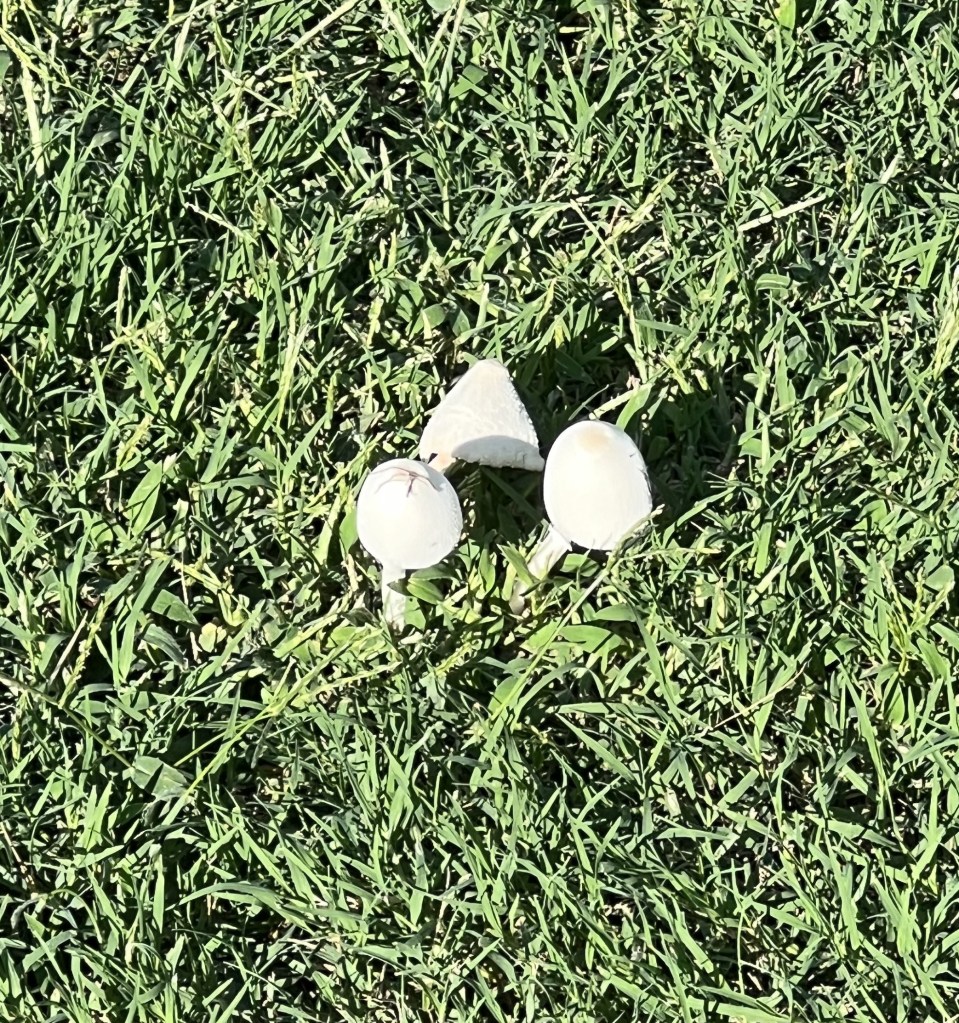
I have mentioned how when I take my dogs for a walk, I need to take each dog separately.  While Loki is used to his harness and even excitedly “helps” me get it on, he has not mastered the art of walking.  He strains at the leash or will stop to investigate some smell and then run full bore back to the end of the leash.  I tried earlier to take both dogs, but Loki spent more time roughing with Zena than walking.  This makes it a concentrated effort to train Loki to walk as we patrol the neighborhood.  Zena instead likes to go to the park where she can see the sights, sniff the smells, and do her business (yes, I bring bags).  After the rains and cooler temperatures last week, I noticed several sections of the park were sporting white dapperling mushrooms.

When I looked online, I found the white dapperling lawn mushroom (Leucoagaricus leucothites), is commonly known as the smooth parasol, woman on motorcycle, or white agaricus mushroom, and is a species of agaric (mushroom or toadstool) fungus.  Archaically, agaric meant ‘tree-fungus’ (Latin; agaricum) but that classification changed with the Linnaean interpretation in 1753 when Linnaeus used the generic name Agaricus for gilled mushrooms.  The species was originally described as Agaricus leucothites by Carlo Vittadini in 1835 and bears a similarity to species of that genus.  Solomon Wasser transferred it to Leucoagaricus in 1977.  The mushroom’s cap is 1 1/2 to 5 1/4 inches (4 to 15 cm) wide, granular, usually white, or grayish brown in color, but sometimes gray or pink.  The flesh may bruise yellow and the gills red.  The stipe (stem) is 2 to 4 1/2 inches (5 to 12 cm) long, commonly with a wide base, and bruising yellow or brown.  A ring is usually present on the stem.  The spores are white, smooth, and elliptical.  The dapperling generally appears in human made areas such as gardens and parks but may sometimes be found in forests.  The dapperling I saw were in a park.

There are many types of mushrooms that look similar to the dapperling, with white domed caps, brown or white gills, and grow in small groups in your lawn.  Types of common garden mushrooms include the false parasol mushroom (Chlorophyllum molybdites), field mushrooms (Agaricus campestris), giant puffball mushroom (Calvatia gigantea), and white dunce caps (Conocybe apala).  Other varieties of mushrooms that grow on lawns are orange, tan, or brown.  This includes the fairy ring mushrooms, weeping widow mushrooms (Lacrymaria velutina), Agaricus placomyces, and scruffy twiglets (Tubaria furfuracea).  While the dapperling is sometimes regarded as edible, the species is suspected of being poisonous due to gastric-upset-causing toxins.  It may also be confused with the deadly death angel mushroom (Amanita ocreata).  Correctly identifying species of mushrooms in your yard is vital as some types of mushrooms in gardens are highly poisonous and can cause severe health consequences.  Never eat any type of mushroom from your garden without identifying the species with 100 percent certainty.

Thoughts:  Mushrooms like the dapperling appear in your yard in late summer or early fall and usually along with plenty of rain, high humidity, warm weather, and shaded conditions.  Yard mushrooms are a sign of decomposing organic matter in the soil and boost the nutrient content of your lawn.  You can leave them, run over them with the mower, or throw them in the compost pile.  One house I lived in in California had a leaky roof in the closet dormer.  During a rainy period, I found a large mass of Chicken of the Woods Mushrooms (Laetiporus sulphureus) had taken over a damp spot on the rotting floor.  This species emits a strong earthy aroma (let alone it was inside my house!), so I removed them.  While mushrooms indicate the healthiness of your lawn soil, these are not good conditions inside your house.  I left the mushrooms outside alone.  Act for all.  Change is coming and it starts with you.

Beekeepers

September 27, 2023

One of the side stories in my New York Times feed addressed the widespread belief that honeybees are in danger.  Even though the honeybee is not on the endangered list, many are under the impression they will soon go extinct.  Since the honeybee (and other bee species) is known for its role in agriculture, the blame for Colony Collapse Disorder (CCD) is often placed on the agriculture industry and the use of pesticides.  An analysis by The Washington Post (published in 2017) showed bee numbers are sitting at close to historical highs.  The research showed that since CCD was identified the number of honeybee colonies has risen from 2.4 million to 2.7 million between 2006 and 2014.  The Post’s report came after another major announcement that the rate of loss among honeybee colonies due to CCD had reached its lowest point in years.  While some loss in individual bee numbers over the winter months is expected, beekeepers are not seeing the dramatic loss of hives that were suggested.

When I looked online, I found beekeepers are also called honey farmers, apiarists, or less commonly, apiculturists (Latin apis, bee; compare apiary).  The term beekeeper refers to a person who owns hives, or boxes and associated equipment for the honeybees but does not control the bees.  The bees are free to forage or leave (swarm) as they desire.  Bees will usually return to the beekeeper’s hive as this provides a clean, dark, sheltered home.  Honeybees produce honey, beeswax, pollen, propolis, and royal jelly which can all be sold.  Some beekeepers also raise queens and other bees to sell to other farmers.  These honeybees provide pollination services to fruit and vegetable growers.  Many people keep bees as a hobby while others keep them for income either as a sideline or as a commercial operator.  All these factors can affect the number of colonies maintained by beekeepers.

Sideline beekeepers attempt to make a profit keeping bees but rely on another source of income.  A sideliner may operate up to 300 colonies of bees, producing 10–20 metric tons of honey worth tens of thousands of US dollars each year.  Commercial beekeepers control hundreds or thousands of colonies of bees.  The most extensive operations own and manage up to 50,000 colonies of bees and produce millions of pounds of honey.  The first major commercial beekeeper was Petro Prokopovych from Ukraine who operated 6600 colonies in the early 19th century.  Moses Quinby was the first commercial beekeeper in the US, with 1200 colonies by the 1840’s.  During the 1960’s and 1970’s, Jim Powers of Idaho had 30,000 honey producing hives.  Miel Carlota operated by partners Arturo Wulfrath and Juan Speck of Mexico operated over 50,000 hives of honeybees from 1920 to 1960.  Today, Adee Honey Farm in South Dakota operates 80,000 colonies and Comvita in New Zealand operates over 30,000 colonies, making them among the world’s largest beekeepers.  Commercial beekeepers only number about 5% of the individuals with bees but produce about 60% of the world’s honey crop.  Despite the reports, commercial beekeepers are on the rise, especially in high-value markets such as pollination in North America and New Zealand.

Thoughts:  Honeybees are not native to the Americas, so beekeepers and farmers help preserve the honeybee population, despite other wild bee species experiencing loss.  My son considered putting several hives in his back yard.  While this was admirable, I cautioned him as he had two small children.  A friend kept hives and while this may not be the norm, I was stung every time I was there.  You can also grow native plants to attract many species of bees, butterflies, and other pollinators and you should monitor your insecticide use closely and follow all label instructions.  Most of all, educate children (and others) about the importance of bees and other pollinators to make better stewards of the next generation.  Act for all.  Change is coming and it starts with you.
Yucca

September 26, 2023

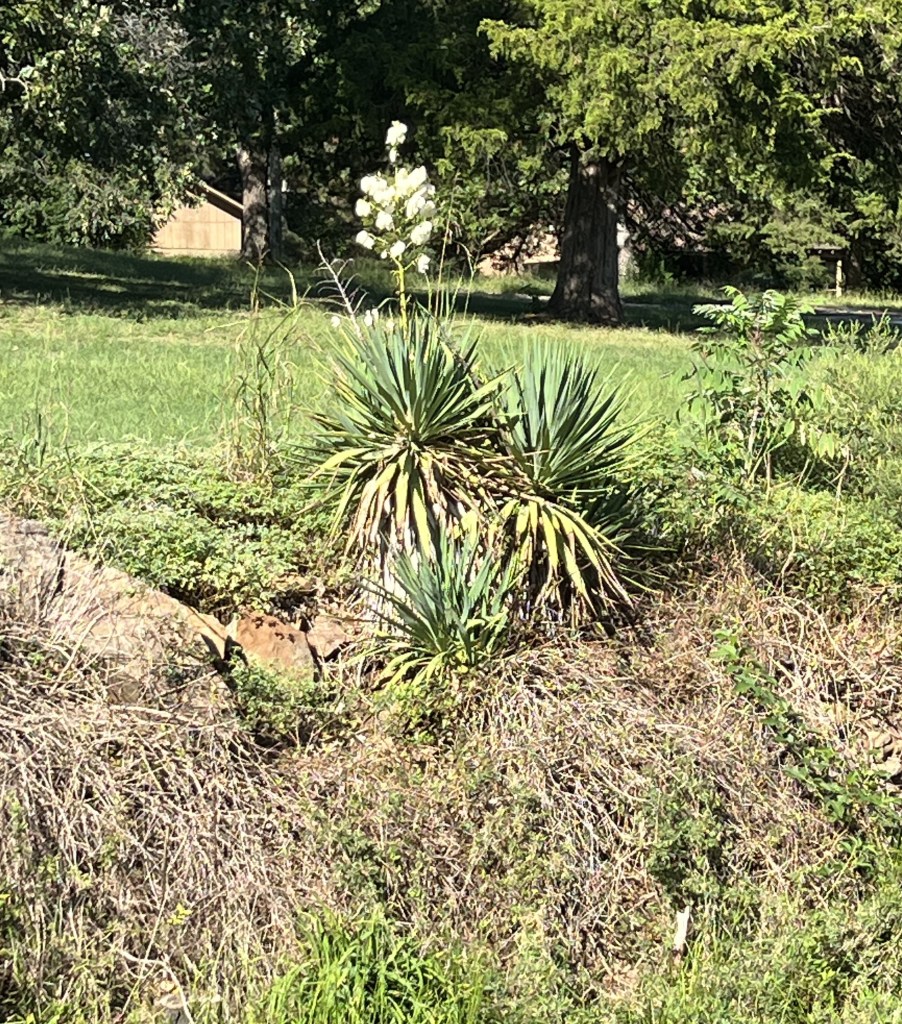
I have been researching how to amend my garden beds in preparation for winter.  In the past I have basically pulled the dead plants and let the ground fallow until the following spring.  I have begun to think this is why (in part) I am getting decreasing yields.  I watched several YouTube videos explaining what I needed to do and why.  They all began saying I needed to get my soil tested at the local county extension to tell me if I needed more lime (alkaline) or sulfur (acid) in my soil, and whether to add more nutrients.  I was not worried about my containers as I had filled them with new potting soil earlier in the spring.  I decided I needed to amend the ground soil with vermiculite (soil conditioner to allow air channels so the soil can breathe), compost (improve the soil fertility), and peat moss (improve soil capacity to withhold water).  I went to both a plant nursery and our local box market and neither had any of this in stock.  I had seen all three earlier at the hardware store but since I bought food at the market I decided to go home.  As I was driving home, I noticed a large yacca plant in full bloom.        

When I looked online, I found the Yucca gloriosa, commonly known as the Spanish-dagger, is a species of flowering plant in the Asparagaceae family native to the southeastern US.  Yucca can grow to 8 feet (2.5 m) tall and is categorized as an evergreen shrub.  Yucca gloriosa has a well-developed stem above ground (caulescent), usually with several stems arising from the base.  The base will thicken in adult specimens.  The cluster of flowers are arranged on a stem composed of a main branch (inflorescence) that is up to 8 feet (2.5 m) long.  The bell-shaped flowers are white, but sometimes tinged purple or red.  The fruit is a leathery, elongated berry up to 3 inches (8 cm) long.  The long narrow leaves are straight and very stiff, growing to 12 to 20 inches (30 to 50 cm) long and 3⁄4 to 1+1⁄2 inches (2 to 3.5 cm) wide.  The leaves are dark green with entire margins, smooth, rarely finely denticulate, acuminate, with a sharp brown terminal spine.  Yucca gloriosa has been known to cause skin irritation and even allergic reactions upon contact and the leaf points are sharp enough to break the skin.  Hence the name dagger. 

The Yucca plant is widely cultivated in warm temperate and subtropical climates and is valued as an architectural focal point.  Yucca requires little maintenance other than the removal of dead leaves when the shrub nears its ultimate height.  The plant is very hardy and sustains temperatures of -4F (-20C) without leaf damage (except ours which all rotted and died) and can handle brief snow and freezing temperatures, as well as long periods of drought.  The species has reportedly escaped from cultivation and naturalized in Italy, Turkey, Mauritius, Réunion, Guam, the Northern Mariana Islands, Puerto Rico, Argentina, Chile, and Uruguay (yet it will not escape into our front bed).  Yucca gloriosa and several cultivars (‘Variegata’ and ‘Bright Star‘) have gained the Royal Horticultural Society’s Award of Garden Merit.

Thoughts:  I found it interesting after having lost two successive years of the yucca Melissa planted in our front bed to read about the plant’s durability and resistance to cold.  We had covered the plants to protect them and yet seven different plants of varying size all appeared to freeze over the winter.  In contrast, the large yucca I saw was completely exposed on a rocky bank next to the road.  The yucca appears to be like most other cacti and succulents which adhere to the adage, “leave it alone and it will thrive.”  My covering the plants may have provided too much humidity which led to their demise.  Just as (I say . . .) I have given up on planting onions, Melissa says the same of outdoor yucca.  Humans may give up on trying to manipulate the environment when faced with failure.  Nature keeps trying and allows the species to eventually thrive on their own.  Perhaps we could learn something from nature’s example.  Act for all.  Change is coming and it starts with you.
Mate

September 25, 2023

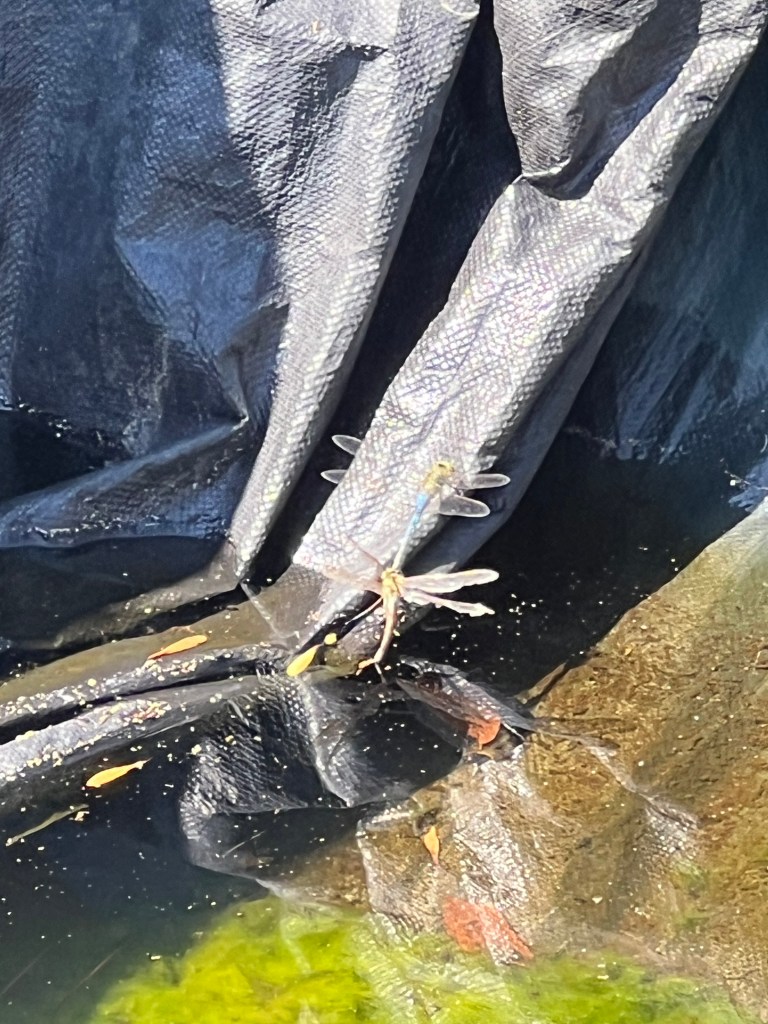
When I took the kids outside for a break over the weekend, we witnessed the mating ritual of three large dragonflies (2 males and 1 female).  The pair had already coupled and were flying around our pool/pond while the other male was circling and darting around the mated pair.  All three seemed disturbed by my presence (or perhaps more so Loki’s) and skittered around, diving back and forth above the water.  I decided to back away from the pond to see what would happen.  When I moved back, the mated pair settled on the tarp just above the water line.  The female then proceeded to dip her tail into the water, apparently laying one egg after another.  The two stayed together until the female completed laying her eggs.  The second suiter had continued to harass the original male hoping to dislodge it from the female but when the mated pair landed near the water he flew off.  He had lost his chance, and no doubt went off in search of another mate.

When I looked online, I found the common green darner (Anax junius) is a species of dragonfly in the family Aeshnidae.  The dragonfly gets its common name from its resemblance to a darning needle.  Both sexes have unmarked green thoraces, bull’s eye marks on their faces, and clear wings that often become amber-tinted with age.  Males have bluish-purple abdomens with a black stripe down the middle while females may appear like the males or have reddish-brown abdomens (as mine did).  The darner is one of the largest extant dragonflies and males grow to 3 inches (76 mm) in length with a wingspan up to 3.1 inches (80 mm).  Females use a tube-like organ to lay eggs beneath the surface of the water (oviposit) in aquatic vegetation.  The nymphs (naiads) are aquatic carnivores, feeding on insects, tadpoles, and small fish.  Adult darners catch insects on the wing, including ant alates, moths, mosquitoes, and flies.  The species is well known for its great migration distance from the northern US and south into Texas and Mexico.  The species also occurs in the Caribbean, Tahiti, and Asia from Japan to mainland China.  It is the official insect for the state of Washington in the US and is a common dragonfly to Arkansas.

Unlike many dragonflies, some populations of Common Green Darners migrate and during winter may fly as far south as Panama.  Darner migration is complex and challenging to study.  Researchers suspect a full migration takes place over at least three generations.  The first generation emerges in spring in the southern part of the range and travels north in the summer to mate.  The second generation emerges in the northern part of their range in summer and migrates south during the fall to mate.  The third generation emerges in the southern part of the range during the winter and does not migrate but will mate.  The cycle begins again with the next generation.  When researchers equipped the green darners with micro radio transmitters (one tiny transmitter), they found that the dragonflies traveled about 10 miles (16 km) per hour and up to 87 miles (140 km) in a single day.

Thoughts:  Not all dragonflies stay connected after they mate.  In some other species another male will capture the female and scoop out the deposit by a previous male to ensure their own progeny.  That is why the darners stay coupled until the eggs have been laid.  Francis Bacon has one of the earliest references to the name ‘dragonfly’ in Naturall Historie: In Ten Centuries.  It is widely believed Bacon picked up the name from folklore of the time where it was believed the insects were once dragons shrunk in size.  This may have been aided by the voracious appetite of both nymphs and adults and their darting movement as they hunt winged prey.  Folklore also associated these tiny dragons with the devil.  While they are not harmful to humans, this association made many wary of their presence.  What we call animals (and people) does have an impact on have we see and treat them.  Act for all.  Change is coming and it starts with you.
Move

September 22, 2023

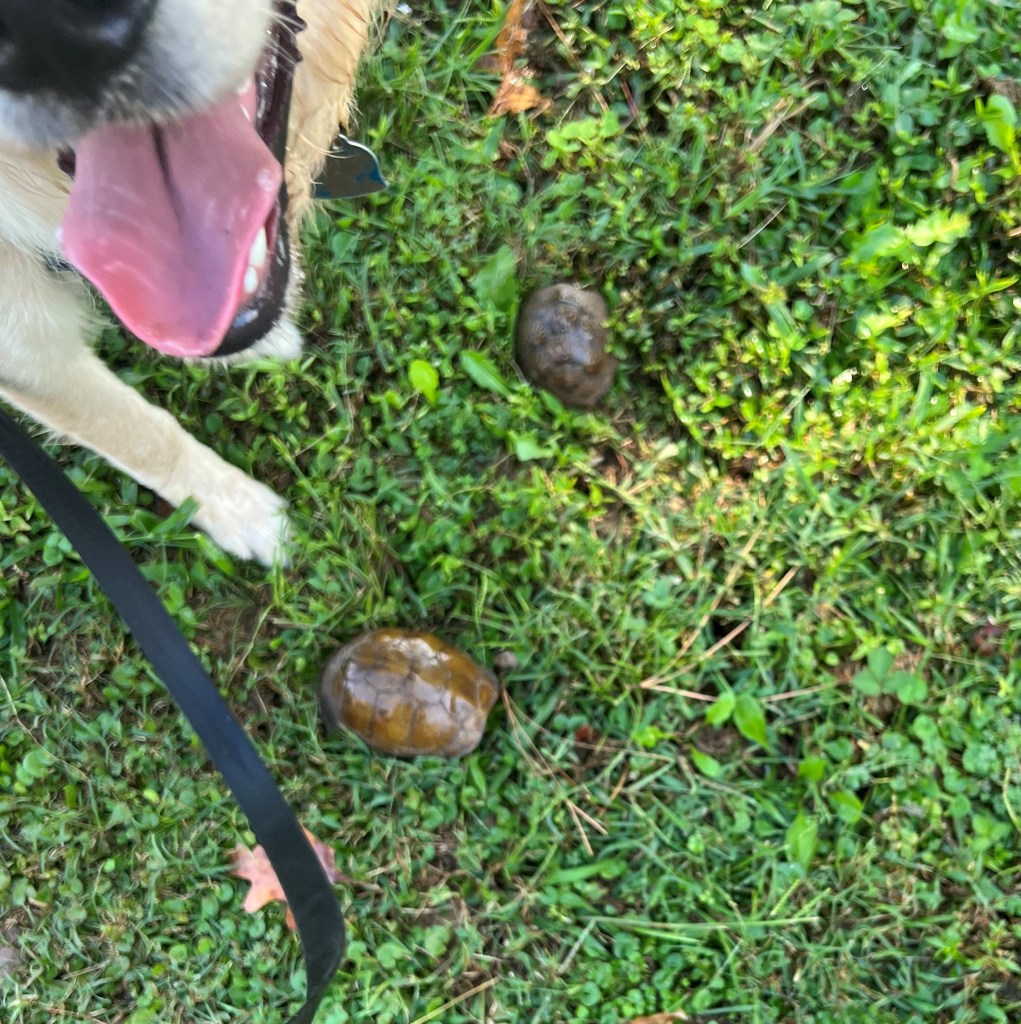
I have been trying to train Loki to take a walk.  We have gotten beyond biting the leash and even to the point where he will excitedly stand and wait for me to put his harness on him.  Once he gets outside however, it is jump and strain.  That means I take Zena for a walk at the city park and when we return, I harness Loki and take a shorter walk through the neighborhood.  Most of this loop is on streets but the last two blocks cut through a green space that comes out behind our house.  While we were walking through this grassy tree-lined section we came across what looked like two rocks.  Loki was interested so I took another look and realized these were two small turtles that had tightly closed their shells.  The weather has been cool, and damp and I was not surprised to see the two in the grass.  This is a prime time for box turtles to be on the move.

When I looked online, I found the three-toed box turtle (Terrapene triunguis) is a species within the genus of hinge-shelled turtles commonly referred to as box turtles.  The species is native to the south-central part of the United States and is the official state reptile of Missouri.  Three-toed box turtles got their name from the number of toes on their back feet.  Some think there are four-toed examples, but others speculate the four-toed individuals are eastern box turtle (Terrapene carolina carolina)/three-toed box turtle hybrids.  The three-toed have a domed shell which grows to 5 to 7inches (13 to 18 cm) in length and the highest part of its upper shell (carapace) is more posteriorly positioned than in any of the other box turtle subspecies. The dorsal and limb coloration is often completely absent, although some dark blotches are common in adults.  These areas are more often a uniform olive green or tan color (like my turtles) but sometimes, faint yellow dots or lines are visible in the center of each large bony external plate (scute: Latin “shield”).  In the males, the head and throat often display yellow, red, or orange spots.[6][8] Frequently, the bottom shell (plastron) is a yellow straw color and has far fewer dark markings than the plastrons of the other subspecies.  The species mates in the spring as they come out of hibernation and are on the move.

Three-toed box turtles are known to move and migrate seasonally to maintain their preferred humidity level.  In Arkansas, three-toed box turtles were observed in grasslands in late spring, while in early spring, summer, and late fall they were found in forested areas.  During dry times, they dig shallow burrows into leaf litter to conserve moisture.  When water is available, these turtles soak for longer periods of time than any of the other subspecies.  Three-toed box turtles are popular in the pet trade and are commonly moved outside their home range and released but it is not known whether these released captives have an impact on the local species.  The species is highly adaptive and is possibly the only box turtle who can live happily in an indoor enclosure.  Three-toed are omnivores (eat plants and meat) and their diet varies with availability of food sources and the seasons.  Box turtles prefer live foods to vegetation and their diet should consist of 50% plants and 50% animal protein.  They can be shy about being watched while eating and may stop and stare motionless when this happens.  With good care, three-toed box turtles can live at least 50 years.

Thoughts:  We almost missed the turtles on our walk as they were closed and did not move.  What gave them away was one had flipped over, exposing its yellow plastron.  I flipped the turtle right-side-up and we watched for a bit.  The turtles both remained tightly closed and did not want to play.  After a few sniffs, we left them alone.  Staying closed off is a good way to keep protected, but it comes at the expense of being able to eat or move.  When we isolate ourselves from the surrounding culture, we miss the diversity and joy that comes with being alive.  Act for all.  Change is coming and it starts with you.