Jalapeños

September 22, 2023

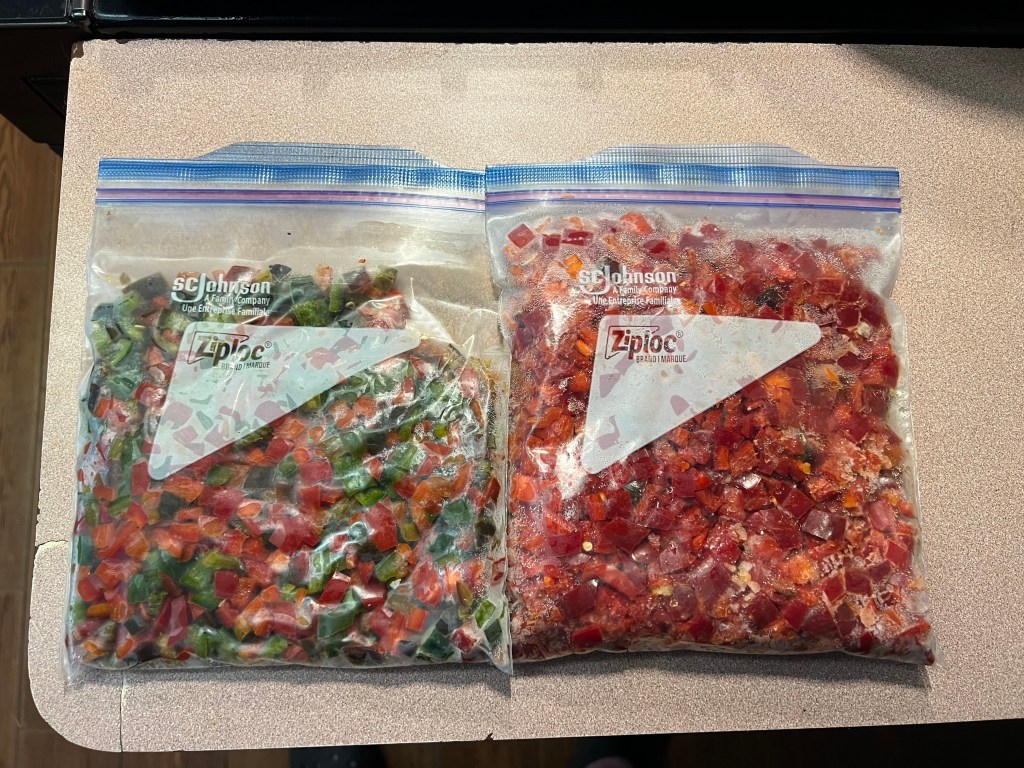
When I returned from my trip to Seattle, I was met with a profusion of jalapeños on my two vines.  Many of the pepper pods were ripe when I was leaving but I had no time to process them and decided to leave them on the vine.  On my return many of the peppers had turned bright crimson, indicating they were not only ripe, but had matured to the hot pepper stage.  I harvested the red peppers but left a few of the green jalapeños on the vine.  Along with the peppers I had previously picked I now had 30 jalapeños that needed to be processed.  When I chopped and froze my peppers last year, I made two mistakes.  I cut the peppers into large pieces, forcing me to re-cut them to use in food (defeating the process).  I had used latex gloves, but the number of peppers processed allowed the oil to get through the gloves and my hands burned for days.  This time I used two pairs of gloves to be safe.

When I looked online, I found jalapeños (Capsicum annuum) are a medium-sized pod type chili pepper cultivar.  Jalapeños are variously named huachinango (ripe red jalapeños) and chile gordo (“fat chili pepper”), also known as cuaresmeño.  The mature chili is 2 to 4 inches (5–10 cm) long and 1 to 1 1⁄2 inches (25 to 38 mm) wide.  Different jalapeños can range in pungency, with Scoville heat units of 4,000 to 8,500.  The fruit is commonly picked and eaten while green, but it is occasionally allowed to fully ripen and turns orange, yellow, or red (like mine).  The name jalapeño is Spanish for “from Xalapa” (the capital of Veracruz, Mexico), the area where pepper was traditionally cultivated.  Xalapa itself is of Nahuatl (Aztec language) origin, formed from roots xālli (“sand”) and āpan (“water place”).  Genetic analysis places jalapeños as a distinct genetic clade with no close relatives not directly derived from jalapeños.  The Aztecs’ use of jalapeños dates back thousands of years, including smoking some varieties to preserve them.  In Mexico, jalapeños are used in many forms such as in salsa, pico de gallo, or grilled jalapeños.  Jalapeños were included as food on the Space Shuttle as early as 1982. 

Compared with other chilies, the jalapeño heat level varies from mild to hot depending on cultivation and preparation and can have from a few thousand to over 10,000 Scoville heat units.  As the peppers ripen their heat increases, making red jalapeños hotter than green jalapeños, at least of the same variety.  If the plants are stressed (erratic watering and heat, i.e., me) it will increase their heat.  The number of scars on the pepper (brown lines called ‘corking’) have a positive correlation with heat level, as the growing conditions that increase heat cause the pepper to form scars.  US consumer markets find corking unattractive, but it is a favored trait in other markets, particularly in pickled or oil-preserved jalapeños.  The chemical irritants (capsaicin and related compounds) produce a sensation of burning in any tissue it contacts and these are concentrated in vesicles of the placenta membrane surrounding the seeds.  People who are sensitive to capsaicin will wear latex or vinyl gloves while handling the peppers.  When preparing jalapeños, it is recommended your hands not contact your eyes as “this leads to burning and irritation” (ya think?).

Thoughts:  Wearing double gloves kept me from the heat of the jalapeños, but Melissa was not so lucky.  I touched several items that Melissa later picked up and the oil moved from her hands to her eyes.  I was protecting myself and never considered the larger effect of the jalapeños.  Jalapeños are a Mexican chili but were designated by the Texas Legislature as the official “State Pepper of Texas” in 1995.  Texas seems to take the opposite view toward embracing other immigrants.  The oil on my jalapeños and the US attitude toward immigrants both caused us to make changes in our practices.  When we only think of our protection and concerns it has the potential to cause unintended and lasting effects on others.  Act for all.  Change is coming and it starts with you.

Appointment

September 20, 2023

The parameters for my recent trip to see my son’s family were set in part by my dentist appointment.  These dates are set at the time of the earlier appointment six months ago.  The hygienist is always polite and asks the question, “Is (date) good for you?”.  I invariably say “yes” as I rarely know what I am going to be doing six months in advance.  The only real choice I have is whether to make the appointment in the morning or the afternoon.  When I decided to go to Seattle I called to see if I could reschedule for a later date and was told that was no problem.  The next available appointment was January 2024, or time for my next regular appointment.  I kept the date and set my plane fare to allow me to get back to my brother’s house in Wichita the day before so I could drive to Arkansas (5 hours) for my appointment.  I guess it was lucky I had scheduled my appointment in the afternoon.  I scheduled an appointment with another health care provider and was informed if I was more than 15 minutes late, they would cancel my appointment and charge me for the visit.  I sat in their office for 25 minutes past the scheduled time.

When I looked online, I found patients are often frustrated when they make an appointment for a certain time, arrive on time, and are then kept sitting in the waiting room for a long period before they see the healthcare provider.  The reason we lose patience is because we believe appointments have not been scheduled well.  However, healthcare providers may not be sure what services they will provide for individual patients, and some patients require more time for their services than others.  An acceptable amount of time to wait will vary by healthcare provider and the type of practice they run.  Basically, the more specialized the healthcare provider, the more patient you may need to be.  The fewer healthcare providers in any specialty who practice in your geographical area will also cause you to wait more time.  If you are waiting on a dentist who consistently makes you wait for an hour you may want to find another dentist.  If your brain surgeon makes you wait an hour, that might seem more manageable.

Another way to make the wait for your appointment tolerable is to ask the person at the check-in desk how long they think you will be waiting and decide if you want to wait that long and if not, reschedule.  If you are told the wait will be 15 minutes, ask again at minute 16.  You do not have to be loud or rude but politely ask about the hold up and how much longer you will need to wait, and again decide whether the wait is acceptable.  This is possible for a primary healthcare provider or a specialist you see on a regular basis for a long-term or chronic condition, but it may not be possible for a sub-specialist or a healthcare provider who is in great demand.  If you know there will be a wait for the appointment there are things to make the wait less stressful.  Leave yourself plenty of time so this will not impact another appointment on your schedule.  Take a good book, knitting, or an entertaining phone app (earbuds).  If the time is shorter, you will be pleasantly surprised.  If it is longer, it will not be so frustrating to wait.

Thoughts:  When the hygienist called my name (10 minutes late for my appointment) I dutifully followed them back and sat in the chair.  Her first words were, “So, we are here for two fillings today?”  I was not sure if “we” meant she was going to have the fillings, but I knew I was there for a cleaning and checkup.  The hygienist rechecked my name and found I had answered the wrong call.  I was happy to wait for my appointment as I made my way back to the waiting room.  The result of waiting for an appointment can change based on the expectations and the attitude you bring.  That is true for most aspects of life.  We may not be able to change others, we can adjust our response.  Act for all.  Change is coming and it starts with you.
Humble

September 19, 2023

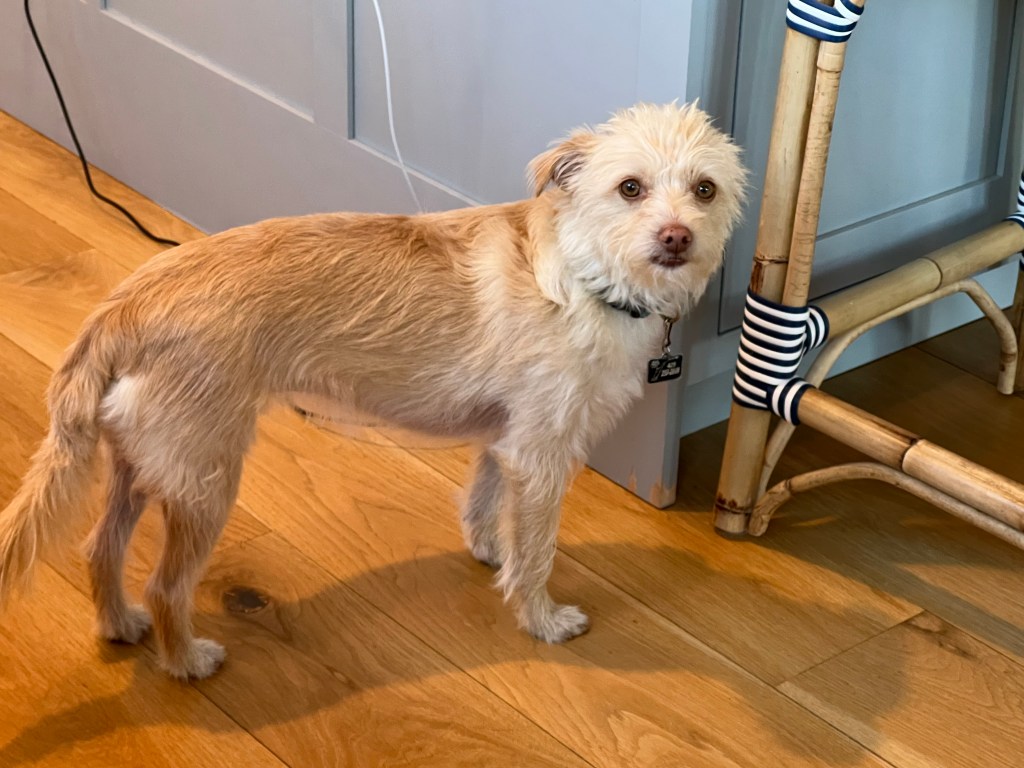
I was excited to finally get to see the grandkids after a long absence.  I was scheduled to catch a ride at the airport to get to their house, but as I turned my phone on after landing, I saw my son was coming to pick me up.  When I asked, Alex said he had decided to make the trek against traffic to give us some time to catch up on the drive back to the house.  Even though we had been talking and having Facetime sessions, it was nice to be able to talk in person.  When I arrived, everyone was glad to see me.  I was able to help take the kids to school the next day and their teachers told me the grands were excited and had been telling everyone I was coming.  When I went to both of their sports practices, they proudly introduced me to their friends as their Papa.  I was starting to get an ego, but Amelia kept me humble.  Amelia is a small terrier chihuahua mix who believes it is her job to keep people straight at the house.  Every time she saw me for the first three days she went into a barking fit.  I was a stranger and I needed to be humble and remember that fact.

When I looked online, I found the definition of humble is having or showing a modest or low estimate of one’s own importance.  Most scholarly discussions of humility provide descriptions of humble people, and many suggest humble people have an accurate view of themselves.  That means humble people acknowledge their mistakes and limitations, are open to other viewpoints and ideas, keep their accomplishments and abilities in perspective, have a low self-focus, and appreciate the value of all things, including other people.  One site offered a list of traits shared by humble people.  Foremost, they control their ego.  We all have brushes with others at some point, but a humble person will not let their ego take control.  A humble person puts a lot of effort into making sure people around them are happy and comfortable and will apologize if there is anything they say or do unintentionally hurts someone.  Humble people value their own self-worth and do not waste time comparing themselves to others.  A humble person is confident, and their confidence will even allow them to question themselves or their motives.  Lastly, a humble person does not take others for granted and avoids using stereotypes when talking about others.  Being humble is not easy and requires a person to go inward and learn how to treat others from the ground up.

While this is a good summary of what a humble person is, it does not get to the psychological core of being humble.  Being humble entails the belief that no matter how great one’s accomplishments or positive characteristics may be, they do not entitle one to special treatment as a person. This contrasts with areas of life where exceptional characteristics deserve special attention and even privilege.  Expecting to receive special treatment equal to one’s accomplishments is irrelevant to humility and even humble people think they deserve a promotion when they are an exceptional employee.  Humble people do not downplay their accomplishments or characteristics; they just do not think they should be treated specially because of them.

Thoughts:  While Amelia may have been trying her best to keep me humble, I received the opposite reaction from my own pups when I returned from my weeklong absence.  Both dogs were immediately all over me and would not leave me alone until they had given me the love that they felt I deserved.  Whether this adoration comes from a pet or another human, it will make you feel humble.  Act for all.  Change is coming and it starts with you.

Box

September 16, 2023

As I boarded the Alaska Air flight to Seattle I was asked if I would like “a water”.  It was a 4-hour flight, and I knew I would be thirsty at some point (even though not at the time), so I said yes and I was handed a small white box.  I was surprised as water is usually dispersed in single serving plastic bottles.  I was intrigued and began to read the information about the water on the box.  The box contained the usual info required by the Food and Drug Administration (FDA) along with the warning labels that are also required.  I have always thought the user should be aware that if you swallow the box top it could cause choking, but I realize if you do not put this on the box someone will say their own ineptitude (or lack of attention to their child) was the fault of the manufacturer.  The packaging went on to explain why this water was different than other containers of water.  The box contained renewable material (even the cap) and the water was purified.  The other difference was if you posted an image of the carton with #betterplanet the company would plant two trees in a national forest.  

When I looked online, I found the idea for boxed water began in 2009, when the company was the first manufacturer to offer a sustainable alternative to plastic water bottles, creating a new category of packaging and changing the way water is shipped, sold, and enjoyed.  The website suggests consumers use tap water whenever possible (preferably filtered), but if you cannot do so you should reach for their 92% plant-based box.  This percentage makes their product the most renewable package in the water aisle.  The water is also sourced close to where it is distributed to reduce the carbon footprint (instead of exotic and distant locations for water).  All the cartons are 100% recyclable, refillable, and BPA free.  The carton can be refilled and reused but the website stressed “standard warnings” apply.  Only refill the box with clean drinking water.  Be sure to thoroughly clean the box before each reuse to avoid accumulation of germs and bacteria over time.  Finally, watch for wear and tear on the packaging as it will deteriorate and break down over time (good for the environment but not your water).

Alaska Airlines became the first national airline to give up plastic water bottles in 2018 when they announced they were switching to Boxed Water™ cartons for their inflight service.  Alaska has since been flooded with social media posts from passengers who are delighted by the idea of a cleaner, less polluted planet.  The partnership has a three-fold focus.  First, they are removing 1.8 million pounds of single-use plastics from the waste stream.  Second, since the box is reusable, it can be refilled for later use.  Third, when you post a photo with a Boxed Water carton and #BetterPlanet two trees are planted in your honor.  That has already accounted for over 1.2 million trees with the NFF.  The belief is that small changes can make a lasting impact on our planet.  That same year Alaska became the first US airline to eliminate plastic straws and stir sticks from flights and lounges.  Alaska’s “Green Team” is dedicated to improving the environment through in-flight recycling and trash sorting programs that help reduce the amount of waste per guest that ends up in landfills.  Alaska is also strategically updating their fleet in hopes of achieving a goal of net-zero carbon emissions by 2040.  Replacing plastic bottles in their in-flight water service will effectively remove 22 million plastic cups and 32 million plastic bottles per year from Alaska flights, or the equivalent of eighteen 737 Boeing aircrafts.

Thoughts:  I am constantly amazed by the innovative ways being devised to address a reduced carbon footprint.  While governments bicker over issues of responsibility and payment, corporations (and some cities/states) are moving ahead on their own.  While this may be good for public relations, it is even better for the planet.  Reducing our carbon footprint is not waiting for governments to take the lead, but each person or entity taking small individual steps.  Act for all.  Change is coming and it starts with you.
Pumpkins

September 15, 2023

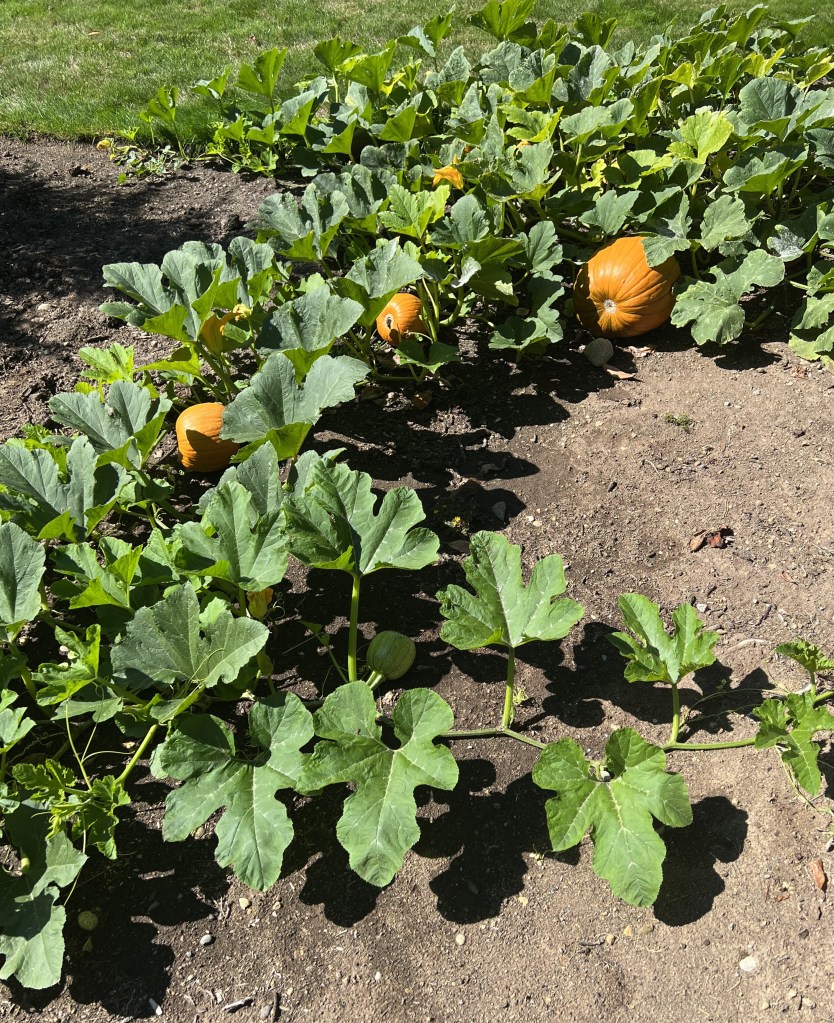
One of the first things I did when I arrived at my son’s house was to check out his garden.  He had placed three 48 x 18 x 24 inch (122 x 45.5 x 61 cm) galvanized containers in a mulched area behind his house.  He had holes drilled to allow the water to drain and the mulch kept the containers cool and not allowing the weeds (or grass) to grow around them.  The containers had been planted with red onions (Allium cepa), carrots (Daucus carota), cucumbers (Cucumis sativus), kale (Brassica oleracea), and two types of lettuce (Lactuca sativa), butter and romaine.  Most fared well, but as with any new venture, Alex found out the hard way that cucumber vines will take over everything in their path and lettuce easily wilts in the sun.  In another section of his yard, Alex had planted two pumpkin vines which were doing very well.  There were 6 or 7 pumpkins around 8 inches (20 cm) in diameter and one that had grown to 15 inches (38 cm).  It reminded me of my one 4-inch (10 cm) watermelon on my vine at home.  I think I need to give it more room next year if I want it to rival his pumpkins.     

When I looked online, I found pumpkin is a vernacular term for winter squash of species and varieties in the genus Cucurbita.  These pumpkins had culinary and cultural significance, but no agreed botanical or scientific meaning.  The term pumpkin is used interchangeably with “squash” or “winter squash” and is commonly used for cultivars of cushaw squash and silver-seed gourd (Cucurbita argyrosperma), Asian pumpkin or black seed squash (Cucurbita ficifolia), hubbard or delicious squash (Cucurbita maxima), winter crookneck squashes (Cucurbita moschata), and summer squash (Cucurbita pepo).  The pepo is native to northeastern Mexico and southern US and are one of the oldest domesticated plants in the world.  Today, a variety of pumpkins are grown for food, aesthetic, and recreational use.  Pumpkins have a thick shell and contain edible seeds and pulp.  The pepo pumpkin is a traditional part of Thanksgiving in the US and Canada as pie and are carved as Halloween jack-o’-lanterns.  Canned pumpkin purée and pie fillings are usually made of different varieties (sweet pumpkins) from those used for jack-o’-lanterns.

Cucurbita pepo is one of the oldest, if not the oldest domesticated species, with origins in southern Mexico in Oaxaca (8,000 to 10,000 BP) and Ocampo, Tamaulipas, Mexico (7,000 BP).  Pumpkins of both Cucurbita pepo and Cucurbita moschata had been carried throughout North America (where they could grow) long before the arrival of Europeans.  The ancient territory of C. pepo extended north into Texas and up the Greater Mississippi River Valley into Illinois and east to Florida, and possibly even to Maine.  It is one of several plants cultivated in prehistoric North America as part of the Eastern Agricultural Complex (focused on corn, beans, and squash).  Pepo is known to have appeared in Missouri at least 4,000 years ago (BP).  Some varieties grow in arid regions and some in moist regions.  Many of these Indigenous peoples, particularly in the west, still grow a diversity of hardy squashes and pumpkins not found in commercial markets.  Neither C. pepo nor C. moschata had been carried into South America along with beans, although all originated in the same general region.

Thoughts:  The Eastern Agricultural Complex refers to one of about 10 independent centers of plant domestication in eastern North America dating back to 5300 BCE.  By 1800 BCE woodlands people were cultivating several species of plants allowing them to transition from hunter-gatherers to agriculture.  Maize (Zea mays) was introduced from Mexico in 200 BCE and the eastern peoples slowly moved from indigenous plants to a maize-based agricultural.  The cultivation of local plants (except pumpkins and sunflower) was abandoned, and the formerly domesticated plants returned to wild forms.  This is another example saying when we leave nature alone, it will recreate itself to better serve the local ecosystem rather than humans.  Act for all.  Change is coming and it starts with you.
Yerba

September 14, 2023

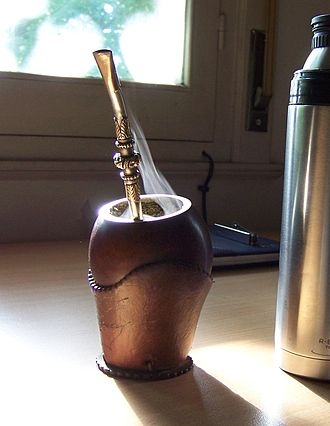
I flew into Seattle yesterday to visit the grand babies (and their parents).  This was an exciting time as we had not been able to get together for quite a while (covid and time constraints).  We spent last night catching up and enjoying the kids (not my dogs this time) talents for baseball and gymnastics that they have been honing.  After an early night and earlier wakeup (for me at least) I watched the orchestrated chaos as the kids ate breakfast and got ready for school.  After joining their dad to take them to school, we returned, and the parents went online for work.  I enjoyed a cup of coffee as Alex came into the kitchen to make himself a cup of Yerba Mate.  This became a new compassion for him, and he explained how the drink was made, where it came from, and the bioeconomic aspects of its production in the Amazon rain forest.  Since I had recently blogged on bioeconomy, I was intrigued to learn about Mate.

When I looked online, I found Mate or maté is a traditional South American caffeine-rich infused herbal drink also known as chimarrão or cimarrón.  The drink is made by soaking dried leaves of the yerba mate (Ilex paraguariensis) plant in hot water and is traditionally served with a metal straw (bombilla) in a container made from a calabash gourd (also called the mate).  In some areas the container can be made from a cattle horn (guampa).  A similar preparation (mate cocido) removes some of the plant material and sometimes comes in tea bags.  Yerba mate (ka’a in the Guarani language) contains the stimulant caffeine.  The leaves are dried and chopped or ground to make the coarse powdery preparation called yerba (‘herb’), which is then soaked in hot water.  Mate was traditionally consumed by the Guaraní and Tupí peoples and was exclusive to the natives of Paraguay.  It is now the national beverage of Argentina, Paraguay, and Uruguay.  It is also consumed in the Bolivian Chaco, Northern and Southern Chile, and southern Brazil.  It was brought to Syria (largest world importer) and Lebanon by immigrants from Paraguay and Argentina.  Today, mate is sold commercially as “yerba mate” in tea bags and as bottled iced tea.

Drinking mate is a common social practice in Paraguay, Uruguay, Argentina, and Southern Brazil among people of all ages, and is often a communal ritual following customary rules.  Friends and family share from the same mate container, and drink through the same wooden or metal straw.  The gourd is given by the brewer to each person in turns, and they often sit in a circle.  The recipient drinks the few mouthfuls in the container (denoted by the slurp as it is finished), and then returns the mate to the brewer where it is refilled and then passed to the next person in clockwise order.  The recipient is not supposed to say thanks until they have completed drinking the beverage.  If they do say thanks, they will not be served any more mates.  In warm weather the hot water may be replaced by lemonade.  Today the traditional gourds are also produced from a variety of other materials including wood, glass, bull horns, ceramic, and silicone.  Alex’s gourd is ceramic encased in leather. 

Thoughts:  Sitting and passing a cup is a traditional way to both acknowledge and build community.  Similar practice can be found with the shared pipe (Native American), hookah (India and the Middle East), or even the English practice of High Tea.  Community has not been lost, but we often bury its cohesion under a blanket of activity.  When we take time to step back from the orchestrated chaos that makes up so much of modern industrialized culture, we can reconnect with friends, family, or even any newcomers we welcome into our midst.  Act for all.  Change is coming and it starts with you.

Clear

September 12, 2023

I mentioned how I was wanting to clear the weeds from my three potato beds last weekend.  When I finally got around to removing the weeds, I found that while the vines still had some green, they had mostly withered and even become detached from the store of potatoes I anticipated underground.  I carefully removed the surface vegetation and then got my hand rake to scoop the potatoes out of the ground.  Last year’s potato harvest was not great, but each of the six hills yielded around 5 or 6 spuds of various sizes.  With 16 hills planted this year had high hopes, and this year’s harvest was disappointing.  The five hills in the first bed held very few potatoes, ranging from small to tiny.  The other two beds had no potatoes at all, although I did encounter several rotted tubers.  With the 100F (37.7C) temperatures we had just two weeks ago I was not sure I was ready to think about winter but since the weeds and potatoes were cleared out of the beds, I knew I needed to do something to keep the weeds from taking over again.  Once more (as I seem to do every year) I vowed that next year I would do better.   

When I looked online, I found several sites offering tips on how to clear your garden beds for the winter.  They spoke of the joy of a wonderful harvest (not so much) and the dying plants that come with the first frost of October.  Fall preparation begins with removal of the dead vegetation to keep pests from overwintering in the foliage and fruit left in the beds.  A light layer of compost and mulch will help keep down the weeds and protect the soil without insulating the beds (a ground freeze will kill most pests).  They recommend a soil test from your state extension office to see how much lime and fertilizer to add to the soil.  This is also the time to plan for what will be planted the following spring and to begin construction of any additional plots or beds.  The leaves that are about to fall are another good way to expand your compost pile.  This is the time to take notes as you prepare the beds for winter.  What did you grow, how did it fair, and what kind of pests did you face are good reminders for the coming planting season.  Your beds will soon be covered with snow or frozen until the coming spring.  Finally, take time to enjoy the fall. 

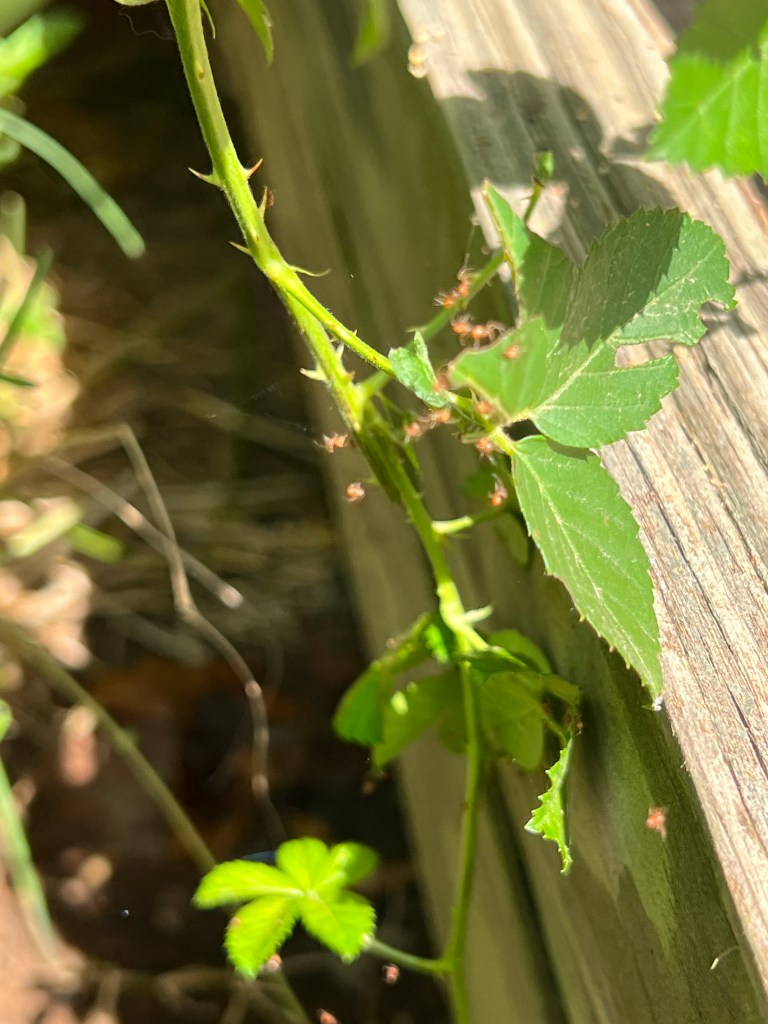
I mentioned I found a rabid wolf spider (Rabidosa rabida) in the third bed when I began to clear out the weeds and how the spider was carrying her young spiders on her back.  I also came across a cache of tiny baby spiders when I cleared the first bed.  I had not thought much about them at the time, and assumed they were the small red spider mites (Tetranychus urticae) that are known to attack potato plants.  After I researched the rabid wolf spider, I changed my mind.  The dozens of tiny critters had spider bodies and eight legs and were concentrated around a thin area of web.  While I do not know what species this was, I believe these were another form of wolf spider and that I had disturbed the nest that had been hidden by the debris.  If they are tiny spiders, they will clear out to find their own nesting and habitation.  If they are mites, the lack of cover and impending freeze will clear them for me.  Either way, I should be good by next year.

Thoughts:  While I was able to clear the potato beds, the tomatoes are again beginning to produce.  While now is the time for me to sit back and reap a second harvest I know I need to plan better for next year.  I ended up with lots of tomatoes and peppers, a few potatoes, and a single melon (two, but one was eaten by a critter).  Every year I learn a new skill and technique, but if I am going to rely on my garden, I need more diversity.  Diversity is essential for what we eat, but also adds to our quality of life.  Diverse ideas and perspectives can create a better outcome on any human project.  Act for all.  Change is coming and it starts with you.
Rabid

September 11, 2023

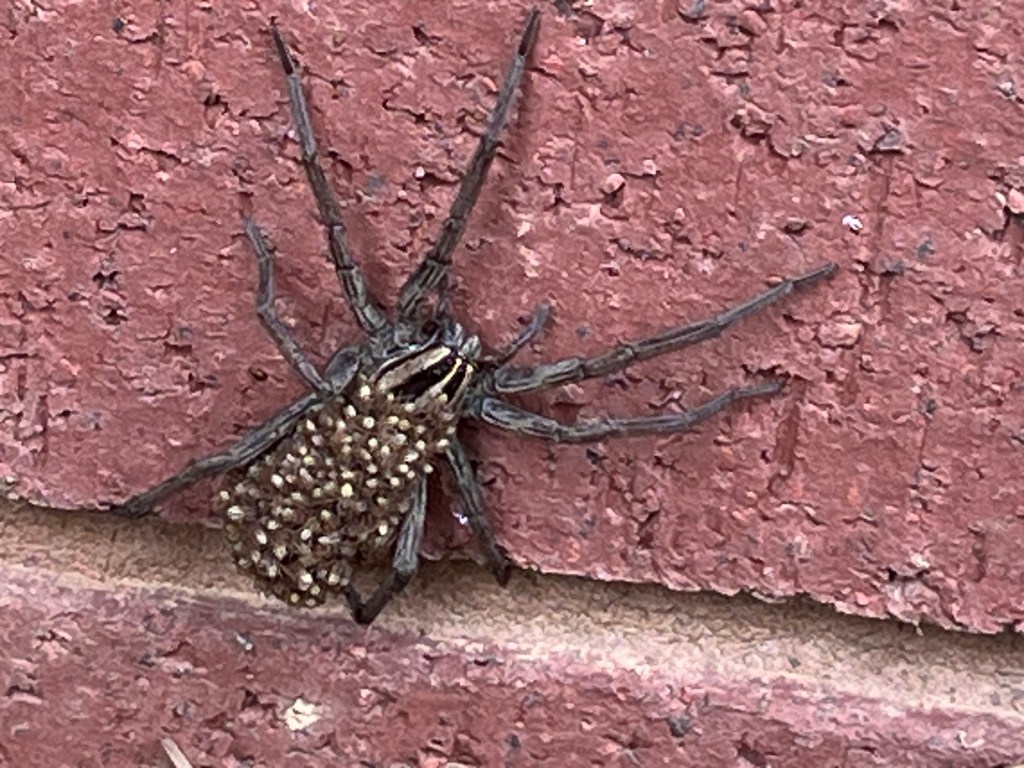
Over the weekend I decided I could no longer procrastinate and had to clear the weed out of the three beds where I was growing potatoes.  I cleared all three beds when I planted the 16 Yukon Gold (Solanum tuberosum) potato sets and placed cages on each mound to make sure I knew where they were.  I even took the step of placing a small (30 inch/.76 m) fence around the beds to keep Loki from trying to investigate.  The vines took off well and produced the flowers I had seen on my potatoes last year.  I had mulched the beds with straw to keep the weeds from growing, but apparently did not use enough mulch.  The weeds grew and the cages and fence did as much to discourage me from weeding as it did to keep Loki from investigating.  I removed the fencing (thinking I would put it back up after clearing the weeds) and began clearing the weeds.  When I got to the third bed, I noticed a large (3 inch/7.6 cm) spider crawl out of the weeds and onto the wall.  When I checked my identification app it said it was a rabid wolf spider.   

When I looked online, I found the rabid wolf spider (Rabidosa rabida) is a species of spider from the family Lycosidae.  The rabid is native to North America and can be found in the US from Maine to Florida and west to Texas.  The cephalothorax (head and the thorax fused together and distinct from the abdomen behind) has two dark stripes and the abdomen has one stripe of the same color.  The female rabid can grow to a body size of 1 inch (2.5 cm), while males measure slightly smaller around .5 inches (1.25 cm).  Their total leg span can take them to about 3 inches (7.5 cm).  The rabid has eight eyes (4 above and 4 below) which look like a spider’s moustache.  During the day, these spiders live in burrows or holes that they have created for themselves and cover it with debris or silk.  They do not create webs and instead come out at night to hunt where they use a combination of sheer speed, agility, and camouflage to hunt down or ambush their prey.  The common name (rabid wolf spider) is believed to derive from the erratic, rapid movement of this species.  The rabid will bite, if provoked, but it is not dangerous to humans and since spiders cannot contract rabies, they do not spread this disease to humans or other animals.

One of the things that threw me off in identifying the rabid spider was the large bumpy abdomen.  What I found was this was not the mother spider, but the large number of spiderlings she was carrying on her back.  During the spider’s mating ritual, the males perform a dance to seduce the female, along with creating sound through stridulation, or rubbing together their two stridulatory organs.  The female will create an egg sac around 1/3 inch (.84 cm) in diameter that is carried with them while they hunt.  As the eggs get ready to hatch, the egg sac turns from a bright white to a muddier brown color.  A single egg sac can produce between 150 and 350 spiderlings.  The newly hatched spiderlings stay with the female on her back until they are mature and strong enough to go off on their own.  I have often seen wolf spiders carrying their web sacs, but this is the first time I recall seeing the spiderlings on the mother.

Thoughts:  The rabid wolf spider is a frequent traveler and always on the move at night while they hunt.  They tend to stay in the brush and debris, which made my overgrown flower bed the ideal place to live.  Predators include cats, dogs, and snakes, as well as other wolf spiders.  The rabid I found likely crawled out of the weeds as I was removing them, and then stayed motionless on the wall above the bed.  Melissa did not want to hear about the rabid when I brought her the picture, saying she “did not like critters”.  While I do not like spiders crawling on me, I find their lives and nuances fascinating.  Humans struggle to take care of more than two offspring.  I cannot imagine living with 150 children riding on my back.  Act for all.  Change is coming and it starts with you.
Aluminum

September 08, 2023

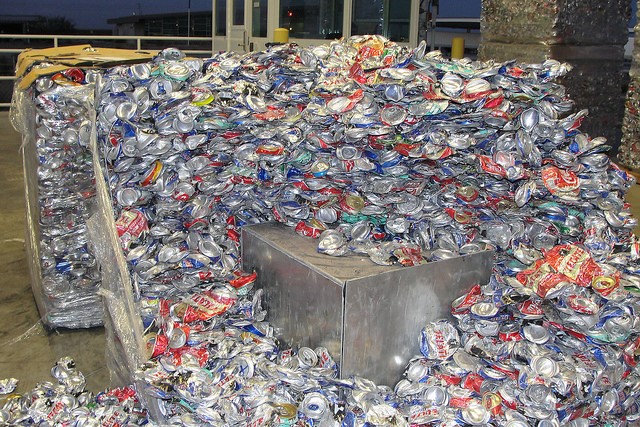
Today I did something I never thought I would do; I took my aluminum cans to the city recycling center rather than turning them into cash.  I had been in a conversation with my brother earlier this year and he told the story of saving his aluminum until he had several full bags and then taking them to the recycling center, only to be appalled by how little cash he received (US$.35 to .40 per pound).  Now he puts the aluminum cans in the city recycling and avoids the mess in his garage.  The last time I took my aluminum to recycling I had waited until I had collected eight 30 gallon (113.5 liter) trash bags.  They took up an entire side of my garage.  I received a higher price since my weight met the limit of 100 pounds (45 kg), for a total of US$40.  That covered my storage and 50 mile round trip to recycle my aluminum.  I still recycle my aluminum but have decided to let the city use the money to pay for their other recycling.

When I looked online, I found rumors that the pull tabs on cans are the only part of the can made from pure aluminum.  According to Alcoa, aluminum from recycled cans and tabs is identical to the aluminum smelted from ore, and the can is as valuable and recyclable as the tab.  One pound of aluminum equals 33 empty cans or 1,500 pull tabs.  Many national and local charities opt to only collect aluminum tabs, but the reason seems to be less storage and no messy beverage residue.  If you donate the aluminum tabs to a charity, you also need to recycle the rest of the can.  If you recycle for cash, you can donate what you are paid for recycling your aluminum cans.  According to the Environmental Protection Agency (EPA), making new aluminum cans from recycled ones saves 92 percent of the energy required when making cans from bauxite ore and recycling aluminum cans cuts down on the waste stream.

Aluminum is a pure or non-ferrous metal.  Non-ferrous metals are often flexible, do not contain iron, are resistant to corrosion and rust, and do not lose their chemical properties during the recycling process. There are seven different types of aluminum that are recycled.  Aluminum cans are the most common for recycling.  Aluminum is widely used in the manufacture of soda and food cans, but their high supply means a relatively low value.  Sheet aluminum includes things like lawn chairs, window frames, jacketing from MC cable, or light gauge pots or pans.  Cast aluminum has been poured into a mold and includes items like BBQ grills or larger light pole bases.  Aluminum wire is often mistaken for copper, but if the wires are silver and are not magnetic, they are likely aluminum.  Aluminum is not as valuable as copper wire but is still worth recycling.  Aluminum gutters or siding are common and are usually brought in by contractors or roofers.  Aluminum rims for automobiles and trucks are common, but be sure to remove rubber ties or lead wheel weights before bringing them in.  The last type of aluminum is called dirty aluminum and refers to any type of aluminum with steel, rubber, or plastic attached.  If there is any non-aluminum attached or mixed in with the “clean” aluminum, you will receive a reduced price as the aluminum must be cleaned by the scrapyard.  Aluminum recycling is more than cans.

Thoughts:  In 2018, the total recycling rate of aluminum containers and packaging was 34.9% with most recycled aluminum coming from beer and soft drink cans (50.4% or 0.67 million tons).  The landfills received another 2.7 million tons of aluminum, or 1.8% of total waste landfilled.  The total MSW in 2018 was 292.4 million US short tons, or 4.9 pounds (2.2 kg) per person per day.  Of that 69 million tons were recycled, and 25 million tons were composted.  Recycling aluminum could have reduced another two-thirds of aluminum produced and nearly 2% of excess landfill.  This would make a tremendous impact on the waste stream.  Act for all.  Change is coming and it starts with you.
Bridge

September 06, 2023

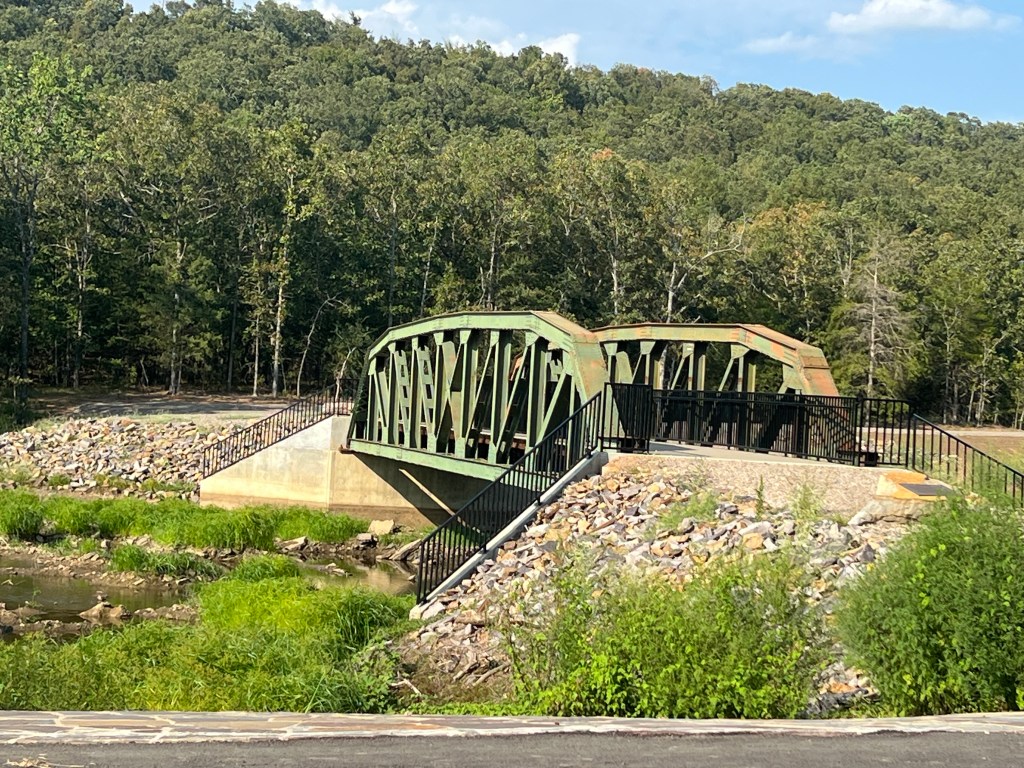
I fired up the battery and took the convertible out for a spin yesterday.  I have a bad habit of letting the car sit too long and the battery goes dead.  When the battery is completely gone it makes it impossible to turn the ignition key.  I called my mobile service the first two times this happened, but then learned what the issue was.  Now I know it is a matter of hooking up the jumper cables and allowing the battery to charge for a while.  Once it has enough juice the key will turn and (hopefully) the engine will fire up.  I let the car run for a bit longer and then persuaded Melissa to take a ride.  The first place we went was to the car wash and then decided to take a leisurely route back to our house.  We were almost home when Melissa said she wanted to see how much water was in the city reservoir.  As we neared the reservoir, we saw a sign specifying “local traffic only”.  I drove on wondering if we would get all the way to the water.  We did make it to the turnoff, but the road going beyond had another sign saying, “bridge out ahead”.  I also noticed a foot bridge had been installed across the inlet next to the dock.

When I looked online, I found the bridge had been dedicated June 10 in honor of Dr. Thomas R. Cuthbert Jr. and Ernestine Strang Cuthbert, who lived in lived in a home overlooking Greenwood Lake.  Cuthbert Bridge was built by the Virginia Bridge and Iron Co. in Roanoke, Virginia in 1931 to span across Terre Rouge Creek northeast of Hope, Arkansas.  The bridge was decommissioned in March 2009 and donated by the Arkansas Department of Transportation to the city of Greenwood.  The bridge was kept in storage, “awaiting a worthy cause and funding” until 2022, when a vision for its use was made possible by the dedication of donors.  The old car bridge is now used for foot or bicycle traffic by people who want to hike across or fish off it at the lake.  The bridge is open to the public.

The bridge was not the only new addition to the reservoir.  The trail that leads around the lake had been widened and a walkway built to traverse from the parking lot to the bridge.  The final addition was a large, elevated fishing pier that had been constructed next to the boat ramp.  I had noted two years ago how someone had purposefully rammed the stone wall/seating bench and broken off several pieces of stone.  Now there are three steel barriers set to keep people from “accidentally” running into the wall.  The city had cut through the wall and patio themselves to allow the access walkway to the bridge.  That meant the rock wall and patio that had been installed two summers ago was cut out to allow access. 

Thoughts:  The walkway leading to the bridge reminded me of how many times I have watched the construction/reconstruction that goes on with new streets in residential areas.  The crews never seem to be able to coordinate between the street and infrastructure.  The concrete will be poured, and the curbs formed, only to be torn out two weeks later when the storm drains and sidewalks are installed.  I understand how different contractors are on different schedules, but it seems like redundant work.  This is even worse when a highway is paved and then workers will cut out a section of the road to place new infrastructure, leaving a blemish in the newly paved highway.  Perhaps this is only my rant, but it speaks to a lack of communication in other areas of life as well.  If we do not talk to each other, there is no possibility for communication.  Act for all.  Change is coming and it starts with you.