Dakota

September 05, 2023

(AP Photo/Trisha Ahmed)

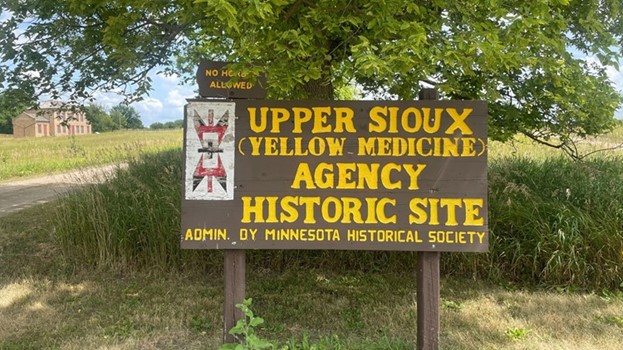
Inside the back section of my newspaper was a half-page AP article concerning the transfer of land back to the descendants of the Dakota Sioux tribe who once live (and secretly died) there.  Legislation adopted this year will lead to the transfer of Upper Sioux Agency State Park land to the Upper Sioux Community.  In three separate bills, the Minnesota Legislature approved around US$6.5 million to pay for the transfer of about 1,400 acres.  The last bill was adopted on August 28th, the final day of the 2023 session.  The transfer will not happen anytime soon, and Ann Pierce, Parks and Trails director for Minnesota Department of Natural Resources (DNR) said, “The park will be open this summer.”  More than 30,000 people visit the park each year.  The DNR will begin this year by reviewing any barriers to the land transfer and looking for areas to develop comparable recreational opportunities in the area.  Barriers could arise as state and federal funds were used to make improvements at the park, and these will need to either be repaid or forgiven.  Legislation requires state officials to identify the barriers and submit a report to legislative committee chairs by January 15, 2024.

When I looked online, I found the Upper Sioux Agency (or Yellow Medicine Agency), was a federal administrative center established in response to treaties with the Dakota people in what became Yellow Medicine County, Minnesota.  The government run campus located on the Minnesota River south of Granite Falls, Minnesota, included employee housing, warehouses, and a manual labor school which were destroyed in the Dakota War of 1862.  The grave of Chief Walking Iron Mazomani, a leader of the Wahpetonwan (Dwellers in the Leaves) Dakota tribes, who was killed during the 1862 Dakota War’s Battle of Wood Lake is buried here.  The site was established as a Minnesota state park during the 1960’s and listed on the National Register of Historic Places in 1970 for its significance under the themes of archaeology, architecture, education, and social history.  State Route 67 which traverses the park was closed after its collapse and the repairs to make it drivable would be expensive, as well as repairs to the bridge over the Yellow Medicine River that needs to be removed or replaced.

The US–Dakota War of 1862, also known as the Sioux Uprising or Little Crow’s War, was an armed conflict between the US and several bands of eastern Dakota.  It began on August 18, 1862, at the Lower Sioux Agency along the Minnesota River in southwest Minnesota.  The Dakota had been pressed into ceding large tracts of land in a series of treaties signed in 1837, 1851 and 1858 in return for cash annuities, debt payments, and other provisions.   All four bands of eastern Dakota were displaced and moved to a reservation 20 miles (32 km) wide, with 10 miles (16km) on each side of the Minnesota River where they were pushed to become farmers.  A crop failure in 1861, followed by a harsh winter and poor hunting due to depletion of game, led to starvation and severe hardship on the reservation.  Tension rose in the summer of 1862 when the US government annuity payments were late, and traders refused to extend credit for tribal members to buy food.  By the end of the war, 358 settlers, 77 soldiers, and 29 volunteer militia had been killed, along with an unknown number of Dakota casualties.  The Dakota released their 269 hostages on September 26, 1862, while around 2,000 Dakota surrendered or were taken into custody, including at least 1,658 non-combatants.  That included those who had opposed the war and helped free the hostages.

Thoughts:  One complaint voiced by the Dakota is they are forced to pay entrance fees to visit the graves of their loved one on land taken by force.  While the return falls short of reparations, it begins to acknowledge the government’s complicity in the past.  It is opposed to the residents around the park that profit from the tourists.  Act for all.  Change is coming and it starts with you.

Bioeconomy

September 04, 2023

Image © Ricardo Stuckert/PR/Planalto Palace.

The front of the Business Section of Sunday’s newspaper ran an article on the growing trend in the Amazon called Bioeconomy.  Bioeconomy became the new buzzword at the Amazon Summit held in Belem, Brazil in early August.  The concept offers a way to protect the rainforests while providing a livelihood for tens of thousands of Amazon residents.  Small to medium sized examples of this approach already exist throughout the Amazon Basin.  This includes the Brazil nuts, acai harvesters, chocolate makers, freshwater fish, and rubber tappers.  Para state Governor Helder Barbalho said, “the challenge is scale.”  One of the problems yet to be resolved is what exactly a bioeconomy should look like.  There are few success stories for sustainable enterprises on a large scale, except for the cosmetic company Nutura.  Residents were cutting the ucuuba (Virola sebifera) trees to make brooms, but now selling the seeds to Nutura has tripled residents’ income while leaving the trees standing. 

When I looked online, I found Bioeconomy (BE), Biobased economy (BBE), or biotechonomy is economic activity which involves the use of biotechnology and biomass in the production of goods, services, or energy.  All three terms are widely used by regional development agencies, national and international organizations, and biotechnology companies.  The terms are closely linked to the evolution of the biotechnology industry and the capacity to study, understand, and manipulate genetic material that has been possible due to scientific research and technological development.  This includes the application of scientific and technological developments to agriculture, health, chemical, and energy industries.  While the terms bioeconomy and biobased economy are sometimes used interchangeably there is value in distinguishing them.  The BBE economy takes into consideration the production of non-food goods, while BE covers both bio-based economy and the production and use of food and feed.  More than 60 countries and regions have bioeconomy or bioscience-related strategies, of which 20 have published dedicated bioeconomy strategies in Africa, Asia, Europe, Oceania, and the Americas.

A forest bioeconomy is based on forests and their natural resources and covers a variety of different industries and production processes.  Examples of forest bioeconomy include processing of forest biomass to provide products relating to energy, chemistry, or the food industry.  Forest bioeconomy covers a variety of different manufacturing processes based on wood material and the range of end products is wide.  Along with the different wood-based products, recreation, nature tourism, and wild game are a crucial part of forest bioeconomy.  Carbon sequestration and ecosystem services are also included in the concept.  Some argue public investment would be the tool governments should use to regulate and license cellular agriculture, but private firms and venture capital tend to try and maximize investor profit rather than social welfare, and radical innovation is considered risky.  The leaders and senior representatives of the strengthened Amazon Cooperation Treaty Organization who signed the Belém Declaration on August 8 took a first step.

Thoughts:  When governments establish supporting infrastructure for entrepreneurial ecosystems, they can create an environment beneficial to innovative bioeconomy startups.  Enabling these bioeconomy startups to act on the opportunities provided further contributes to their success.  A conservative estimate put US direct subsidies to the fossil fuel industry at roughly US$20 billion for 2019.  Twenty percent is allocated to coal and 80 percent to natural gas and crude oil.  European Union subsidies are estimated to total 55 billion euros annually.  We are subsidizing fossil fuel knowing it is destroying the planet.  We should be able to subsidize bioeconomy intended to save the planet.  Act for all.  Change is coming and it starts with you.
Mammillaria

September 01, 2023

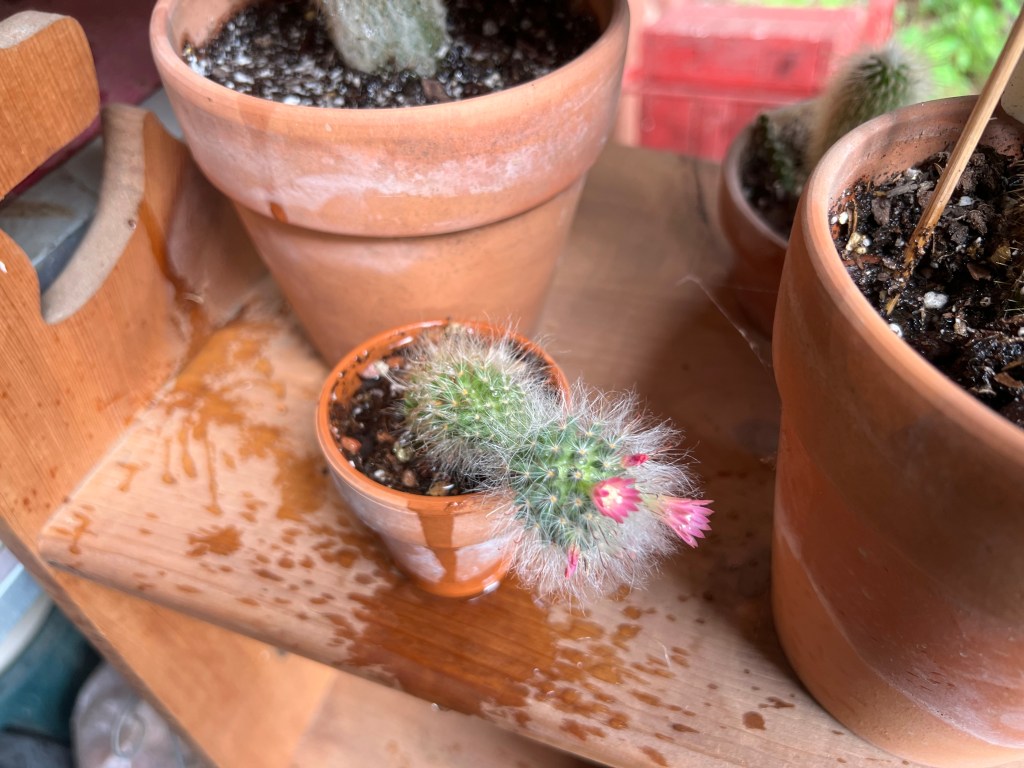
While I might not like the hot weather we have been having lately, several of the cacti Melissa has placed outside at the entrance area of our home do.  These are Melissa’s summer growing cacti that she migrates from the porch greenhouse to the front walkway to allow them to get more sunshine and a fresh breeze (when available).  Melissa was performing their monthly watering this last week and called me over to show me how they were doing.  One of the small cacti looked like a furry little pin cushion, with its numerous white spines.  The reason I had been called over was to see the beginning of a halo of flowers that had formed around the top of the plant.  Melissa mentioned this was of the Mammillaria genus of cacti.

When I looked online, I found Mammillaria bocasana is a species of cactus in the subfamily Cactoideae.  The cactus is often sold as a “powder puff” cactus, or as a “Powder Puff Pincushion.”  In its natural habitat of Northern central Mexico, it is found between 5,413 to 7,550 feet (1650 to 2300 m) above sea level.  The powder puff grows on canyon walls, in volcanic rock, and in semi-desert localities, and is often found under bushes of other native plants.  Bocasana is hemispherical in shape and has white, hair-like spines that cover its radial and hooked central spines.  During the spring and summer, the plant bears several cream-colored flowers, followed by a red cylindrical fruit that contains reddish-brown seeds which display partially lateral markings from where they attached to the seed pod (hilum).  Its form can be variable, with many different varieties or subspecies.  Although the powder puff has been listed as “Least Concern” on the IUCN Red List of Threatened Species since 2009, it is still protected from collecting in the wild in Mexico.  Luckily for growers, Mammillaria can be easily propagated from seed.

The Mammilloid clade (an organism and all its descendants) is one of many that have undergone reclassification as a result of recent analysis of the genetic and hereditary molecular differences (mainly DNA sequences) to gain information on the organism’s evolutionary relationships.  A 2021 study restructured the seven genera previously comprising the clade into four monophyletic groups.  Monophyletic groups are typically characterized by shared derived characteristics (synapomorphies), which distinguish organisms in the clade from other organisms.  The name of the genus comes from the Latin word ‘Mammilla’ which means ‘teat’ or ‘nipple’ and refers to the numerous, nipple-shaped tubercles of the stem that are the distinctive feature of the genus.  In 2021, Breslin, Wojciechowski and Majure placed the following species in the genus, some already placed there, and some moved from Mammillaria, Neolloydia, Neomammillaria and Ortegocactus.  As of December 2022, Plants of the World Online accepted in the genus the species moved by Breslin et al.  “Looks like” is not a valid criterion.

Thoughts:  The gene mapping that took place for Mammillaria had previously been done on humans.  Genetic studies in the late 20th century refuted the existence of biogenetically distinct races, and scholars now argue that “races” are cultural interventions reflecting specific attitudes and beliefs that were imposed on different populations in the wake of western European conquests beginning in the 15th century.  Race has been applied to linguistic groups (“Arab race” or “Latin race”), to religious groups (“Jewish race”), and even to political, national, or ethnic groups with little or no physical traits that distinguish them from their neighbors (“Irish race”, “Slavic race”, “Chinese race”, etc.).  As with plants, “looks like” is not a valid criterion to separate the human species.  Act for all.  Change is coming and it starts with you.
Abbreviations

August 31, 2023

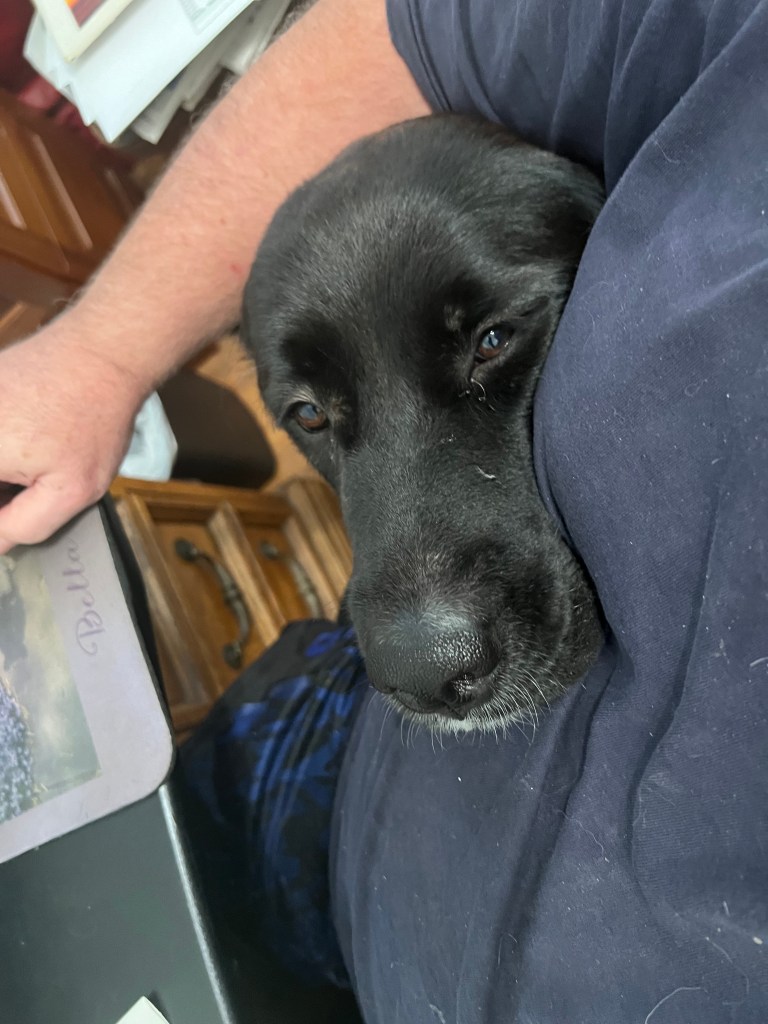
I was working in my office yesterday when I felt Zena stick her head under my arm.  Zena is generally patient when she wants something, but there are definite signs that let me know she wants something.  When Zena wants to go outside, she will stand in front of the door and stare at me.  When I am in my chair watching the nightly news and it nears supper time, Zena will come and lay her chin on my knee while looking up at me.  If I am back in my office where I cannot see her food bowl or the door, she will stick her head under my arm and snuggle close to my chest, all the while looking up at me with those sad eyes.  This gets my attention, but I usually put her off until I finish the immediate task I am working on.  When I get up Zena will prance toward the hall and look back to make sure I am going to follow.  When I do follow, Zena will take me wherever she wants me to go and shows me what she wants.  I have learned that sticking her head under my arm is Zena’s way of giving me the equivalent of the STAT abbreviations used in a hospital.

When I looked online, I found “stat” originated in pharmacology where the word would be written on a prescription to mean “immediately”.  Abbreviations are frequently used in medicine and can boost efficiency if they are used intelligently.  The advantage of brevity should be weighed against the possibility of making the communication harder for others to understand (obfuscation) and having more than one possible interpretation (ambiguity).  Certain medical abbreviations are avoided to prevent mistakes, according to best practices and in some cases regulatory requirements.  Examples of this avoidance are abbreviations for names of drugs, using apothecary’s units, and using trailing zeros or not using a leading zero.  Stat is part of a larger list of abbreviations used in medical prescriptions.  The Oxford English Dictionary gives two citations for this.  The first dates to 1875 where W. H. Griffith’s Lessons on Prescriptions (iv. 18) cites “Stat., immediately.”  The second comes from 1971 where Lancet 25 Sept. 700/2 cites “Stat., to be given at once.”  The word stat is an abbreviation of the Latin word statim, which means “instantly or immediately”.  This usage has generalized beyond the domain of prescriptions to refer to any medical action that needs to be taken immediately. 

The word abbreviation comes from the Latin brevis, meaning “short”, and refers to a shortened form of a word or phrase.  This may consist of a group of letters or words taken from the full version of the word or phrase, and an example would be for the word abbreviation itself, represented by the abbreviations abbr., abbrv., or abbrev.  NPO is another medical abbreviation for nil (or nothing) per (by) os (mouth) in medical instructions.  Abbreviations may also consist of just initials, a mixture of initials and words, or words or letters representing words in another language (for example, e.g., i.e., or RSVP).  Sometimes abbreviations are an acronym (some pronounceable, some initialisms), or grammatical contractions, or a contraction in which two vowels or diphthongs merge into one new vowel or diphthong, making one word out of two (crasis).  This paragraph is an example for why we will use abbreviations.

Thoughts:  Most have been caught in a situation listening to a conversation between specialists in a field where they reel off a series of acronyms and abbreviations as they discuss some issue.  The conversation makes it easier for the practitioners who know exactly what they are talking about, but the technical terms, acronyms, and abbreviations can exclude others who do not know the language.  This is another reason learning a different language can be difficult as this same type of word usage is embedded in our speech.  Language fluency can be used to differentiate between us and them, or we can take the time to explain what we mean in ways all will understand.  Act for all.  Change is coming and it starts with you.
Grasslands

August 30, 2023

Photograph: Education Images/Universal Images Group/Getty Images

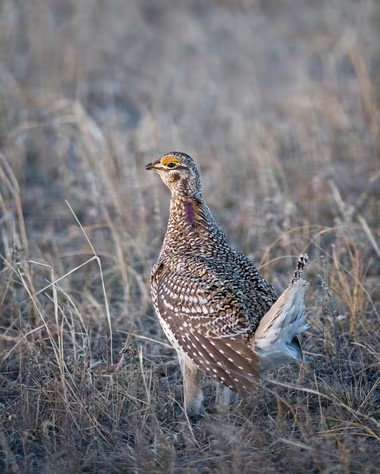
A side front page AP article in today’s newspaper noted the plight of birds in the North American grasslands.  Now 50 years after adoption of the Endangered Species Act numbers of North America’s grassland birds are plunging due to habitat loss, land degradation, and climate change.  Over half the grassland bird population has been lost since 1970, which is more than any other type of bird.  Some species have declined 75% or more, and a quarter are in extreme peril.  This comes as the 38% (293,000 miles2 or 760,000 km2) of historic North American grasslands that remain are threatened by intensive farming and urbanization, and as trees once held at bay by periodic fires spread rapidly.  Both are consuming vital rangeland and grassland bird habitat.  This has prompted a coalition of biologists, conservation groups, government agencies, along with farmers and ranchers, to work together to stem or reverse losses.  Scientists are intensifying efforts to tag birds and install radio telemetry towers to track the birds, and they are working with farmers and ranchers to implement best practices that ensure survival of their livelihoods and native birds.  Both are dependent on a healthy ecosystem.

When I looked online, I found grasslands used to cover a large swath of North America before European settlement.  When Europeans arrived, they plowed up about half of the grasslands on the continent and converted them to agricultural use, growing corn, soybeans, and wheat.  For a few years in the 2010’s the rate of grassland loss was decreasing but in 2018 and 2019, the number started to rise again.  A report in 2021 estimated that from 2018 to 2019 at least 2.6 million acres of grassland were plowed up, primarily to make way for row crop agriculture.  While there are many reasons grasslands are turned into croplands, farmers and ranchers make decisions based on global commodity prices, and there is an increased crop demand for human consumption, livestock feed, and biofuels.  Urban sprawl also plays a part as croplands are being turned into housing and crop production is being pushed into grasslands.  These marginal, less productive grasslands contain some of the highest-quality habitats for nesting birds and monarch butterflies.

As the vast grasslands of central North America were explored after acquisition by the US via the Louisiana Purchase (1803), they were referred to as the Great American Desert.  The term can be traced to Stephen H. Long’s 1820 scientific expedition which put the name Great American Desert on the map.  The grasslands are now usually referred to as the High Plains, and the original term is used to describe the arid regions of northwestern Mexico and the American southwest.  In the past, the term “desert” had two conflicting meanings.  Dessert was used to describe any uninhabited or treeless land whether it was arid or not, and dessert also referred specifically to hot and arid lands, or wastelands.  It was long thought that treeless lands were not good for agriculture, so the term “desert” held the idea of “unfit for farming”.  The High Plains are not a desert in the modern sense but were a dessert in the older sense of the word as the region is mostly semi-arid grasslands and steppe.  Today much of the region supports agriculture (crops and grazing) using aquifer water irrigation.

Thoughts:  People often think of forests as natural ecosystems that store huge amounts of carbon, but grasslands also store immense amounts of carbon underground.  Patrick Lendrum, of the World Wildlife Fund’s northern Great Plains program, says “When we plow ancient grasslands that storage capacity is lost, and it can take decades or centuries to restore the grasslands.”  Everyone knows about the destruction of the Amazon, but grasslands in the “flyover country” are off their radar.  It is just an open expanse.  The world’s ecosystems work in cooperation and support each other.  They all need to be saved and cared for.  Act for all.  Change is coming and it starts with you.

Dove

August 29, 2023

I have mentioned Melissa’s home office in the kitchen nook has a bay window looking onto the back patio/pool.  She usually has the blinds up to allow her to watch the bird and squirrel activity, but with the warm weather she has been keeping the blinds down to stave off the heating rays of the sun.  Since it has cooled the last few days, she has again opened the blinds.  While the pool is not usable, it still holds water that seeps through the tarp cover and creates a shallow pool.  During our long dry heat, one of the squirrels discovered this oasis and has taken to crawling down the sloping sides of the tarp to get a drink of water.  The squirrel drops down from an overhanging tree branch. Scurries along the top and then down the side of the fence, over the deck and then down the tarp for a drink.  The squirrel then reverses this same route to get back into his tree.  Yesterday, however, a collared dove perched on the fence blocking the squirrels return path and creating a standoff.  I watched as the squirrel and dove both stood their ground and refused to move.

When I looked online, I found the Eurasian collared dove (Streptopelia decaocto) is a species native to Europe and Asia, but that has been introduced to Japan, North America, and islands in the Caribbean.  The generic name is from the Ancient Greek streptos meaning “collar” and peleia meaning “dove”, and the epithet decaoct is Greek for “eighteen”.  The Eurasian collared dove is a medium-sized dove, is smaller than the wood pigeon (Columba palumbus), is similar in length to a rock or common pigeon (Columba liviabut) but slimmer and longer-tailed, and is slightly larger than the related European turtle dove (Streptopelia turtur).  The collared dove has an average length of 13 inches (32 cm) from tip of beak to tip of tail, a wingspan of 19 to 22 inches (47 to 55 cm), and a weight of 4.4 to 8.5 ounces (125–240 g).  This dove is grey-buff to pinkish grey in overall color, a little darker above than below, and with a blue-grey underwing patch.   The marking on its nape is the black half-collar edged with white which gives the dove its name.  The two sexes are virtually indistinguishable.

The Eurasian collared dove was introduced to the wild in North America when fewer than 50 birds escaped captivity in the Bahamas.  The species then spread to Florida and is now found in nearly every state in the US, as well as Mexico.  The dove was first sighted in my state of Arkansas in 1989, and its numbers have grown until it is now present in 42 of 75 of the state’s counties.  The dove spread from the southeastern corner of the state in 1997 to the northwestern corner in five years, covering 310 miles (500 km) at a rate of 62 miles (100 km) per year.  This is more than double the rate of 28 miles (45 km) per year observed in Europe.  Few negative impacts have been demonstrated in Florida, where the species is most prolific, but the species is known as an aggressive competitor and there is concern that as populations continue to grow, native birds will be outcompeted by the invaders.  At least one study found the Eurasian doves are no more aggressive or competitive than native mourning doves.

Thoughts:  The number in the species name of the dove comes from a Greek myth about a maid who worked hard and was unhappy she was only paid 18 coins a year.  She begged the gods to let the world know how little she was rewarded by her mistress causing Zeus to create this dove that calls out “Deca-octo”.  The dove is not wary and often feeds very close to human habitation, including visiting the bird feeders in my yard.  I watched as the dove stood its ground until joined by two blue jays (Cyanocitta cristata).  Together they proved too much for the squirrel and he scampered down the fence and back along the ground to his tree.  Like the girl in the myth and the birds on my fence, the vulnerable can beat great odds when we band together.  Act for all.  Change is coming and it starts with you.
Nokota

August 28, 2023

AP PHOTO/JACK DURA

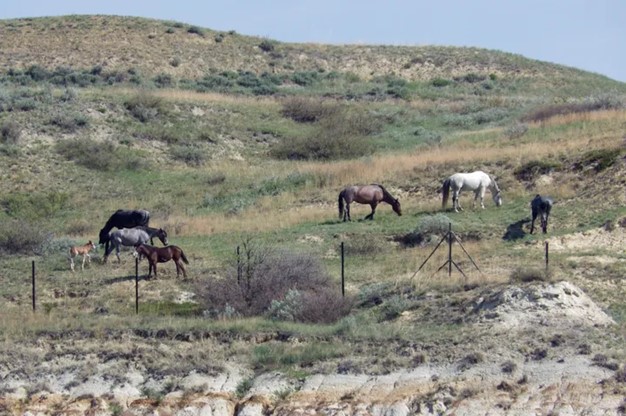
Inside the back section of my newspaper, I found an AP article on the potential removal of wild horses from the Badlands of North Dakota.   The wild horses roam freely in North Dakota’s Theodore Roosevelt National Park (TRNP) but could be removed under a National Park Service (NPS) proposal.  Advocates say the horses are a cultural link to the past and visitors who drive the scenic park road are often delighted to see the bands of horses, a symbol of the West.  While advocates want the horses to continue to roam the Badlands, park officials brand the horses “livestock.”  The NPS is revising its livestock plans and writing an environmental assessment on the impact of taking no action or removing the horses.  The horses have allies in government leaders and advocacy groups.  One advocate says the horses’ popularity will not stop park officials from removing them from North Dakota’s top tourist attraction.  “At the end of the day, that’s our national park paid for by our tax dollars, and those are our horses.  We have a right to say what happens in our park and to the animals that live there,” Chasing Horses Wild Horse Advocates President Chris Kman told The Associated Press.  The breed is registered as the Nokota horse.

When I looked online, I found Nokota is a feral and semi-feral horse breed located in the badlands of southwest North Dakota.  The breed developed in the 19th century from stock consisting of ranch-bred horses produced from the horses of local Native Americans and a mixture of Spanish, Thoroughbreds, harness horses, and related breeds. The Nokota was almost wiped out during the early 20th century when ranchers, along with state and federal agencies, worked to reduce competition with livestock.  When TRNP was created in the 1940’s, a few bands were inadvertently trapped inside, and the breed was preserved.  The Nokota has an angular frame, is commonly blue roan in color, and often exhibits an ambling gait called the “Indian shuffle”.  The breed is generally separated into two sections, traditional and ranch type, which differ slightly in shape and height.  The Nokota are used in many events, including endurance riding, western riding, and English disciplines.

In 1986, the park sold off many of these horses, including stallions, and released new stallions with outside bloodlines into the herds.  That prompted brothers Leo and Frank Kuntz to begin buying the horses to preserve the breed.  The TRNP continued thinning the herd, with roundups conducted during the 1990’s and 2000’s.  The Kuntz’ founded the Nokota Horse Conservancy in 1999, and later began a breed registry through the same organization.  In 2000, the last horses considered “traditional” Nokota were removed from the wild, with some purchased by supporters of the Nokota Horse Conservancy.  In 2009, the North Dakota Badlands Horse Registry was created, which registers the slightly different horses now being removed from the park.  The TRNP still conducts regular thinning of the herd to keep numbers between 70 and 110 individuals.  Excess horses are “sold off”. 

Thoughts:  Republican Governor Doug Burgum (presidential candidate) has offered the state to work with the Park Service to manage the horses, and North Dakota’s Republican-controlled Legislature passed a resolution to support preserving the Nokota.  North Dakota’s Republican US Senator John Hoeven included legislation in the US Interior Department’s appropriations bill that “would direct them (TRNP) to keep horses in the park in line with what was there at the time that Teddy Roosevelt was out in Medora.”  Hoeven is pressing the park to keep more than 35-60 horses for genetics reasons.  The final decision is unclear.  The Nokota represent a link between the Spanish conquistadors, Indigenous tribes, and cowboys which shaped the badlands over the last 500 years.  The Nokota are a link to our historic past, and not “livestock”.  Act for all.  Change is coming and it starts with you.

Glory

August 27, 2023

The excessive heat has dissipated, and I thought today might be a good day to get Zena back to the park for a walk.  I completed my watering early and then grabbed Zena’s harness.  Zena knows this means she is going for a ride and more importantly a walk.  When I sit in my chair Zena sits in front of me with lowered head to allow me to slip the harness on, then raises her left leg to go through the strap.  After I snap on the leash a Zena will run and sit in front of the door to wait.  She knows I will not open the door until she has settled down, so she sits until I get there.  When we get to the truck she eagerly jumps into the back seat, and we are off for the 5-minute ride to the park.  One of the reasons Zena likes the park is because she gets to explore all the smells.  This morning was no different, and as we made our rounds, Zena encountered a new patch of morning glory sprawled across the rock.

When I looked online, I found Morning glory is a common name that refers to over 1,000 species of flowering plants in the family Convolvulaceae.  The name comes from how most morning glory flowers unfurl into full bloom in the early morning.  The flowers usually start to fade a few hours before the corolla begins to display visible curling.  The plants prefer full solar exposure throughout the day, and a well-balanced supply of moisture throughout the growing season (mesic soil).  A few morning glory species are instead night-blooming flowers.  Species such as hedge bindweed (Calystegia sepium), common morning glory (Ipomoea purpurea), and blue morning glory (Ipomoea indica) are considered invasive in parts of the US.  As of 2021, most non-native species of Ipomoea are illegal to cultivate, possess, and sell in the US state of Arizona.  Before January 4, 2020, this ban applied to all native species as well.  The ban is in response to some species of Convolvulaceae causing problems in crops, especially cotton.  Ipomoea aquatica is considered a federal noxious weed, although Texas has acknowledged its status as a vegetable and allow it to be grown.

The species of Morning glory Zena encountered at the park appears to be Heavenly Blue (Ipomoea tricolor).  This is an herbaceous annual or perennial twining vine that uses trees to reach the sun (liana) that is native to Mexico and Central America.  The plant flourishes in full sun and grows to 7 to 13 feet (2 to 4 m) tall.  The Heavenly Blue flowers are trumpet-shaped, 2 to 4 inches (4 to 9 cm) in diameter and are a vivid sky blue with a white and yellow throat.  The heart shaped leaves are spirally arranged, and 1 to 3 inches (3 to 7 cm) long.  This is a fast-growing, self-seeding variety that blooms from early summer into fall in temperate zones.  The variety thrives best in warmer climates, but any location with full sun will allow the plant to reach its full potential.  The species is deer-resistant variety as well as pest and disease-resistant.  Along with the brightly colored flowers, this makes the low-maintenance perfect for “plant and forget” use at the park.  Heavenly blue, and many other species of morning glory, contain d-lysergic acid amide (LSA), also known as ergine.

Thoughts:  I was surprised to find the presence of ergine in morning glory can be toxic to dogs, cats, and humans.  This is a psycho active substance and the seeds of Heavenly blue and Christmas vine (Turbina corymbosa) are used as psychedelics, producing an effect like LSD when taken in large doses (100’s of seeds).  Though the chemical LSA is illegal in some countries, the seeds are found in gardening stores.  Some claim seeds from commercial sources can be coated in methylmercury (illegal in the US and UK) or a pesticide to keep humans from ingesting them for the high.  While this is sometimes considered an urban myth, I would not want to test that theory.  It may end up like the Candy Man legend.  Act for all.  Change is coming and it starts with you.
Bills

August 26, 2023

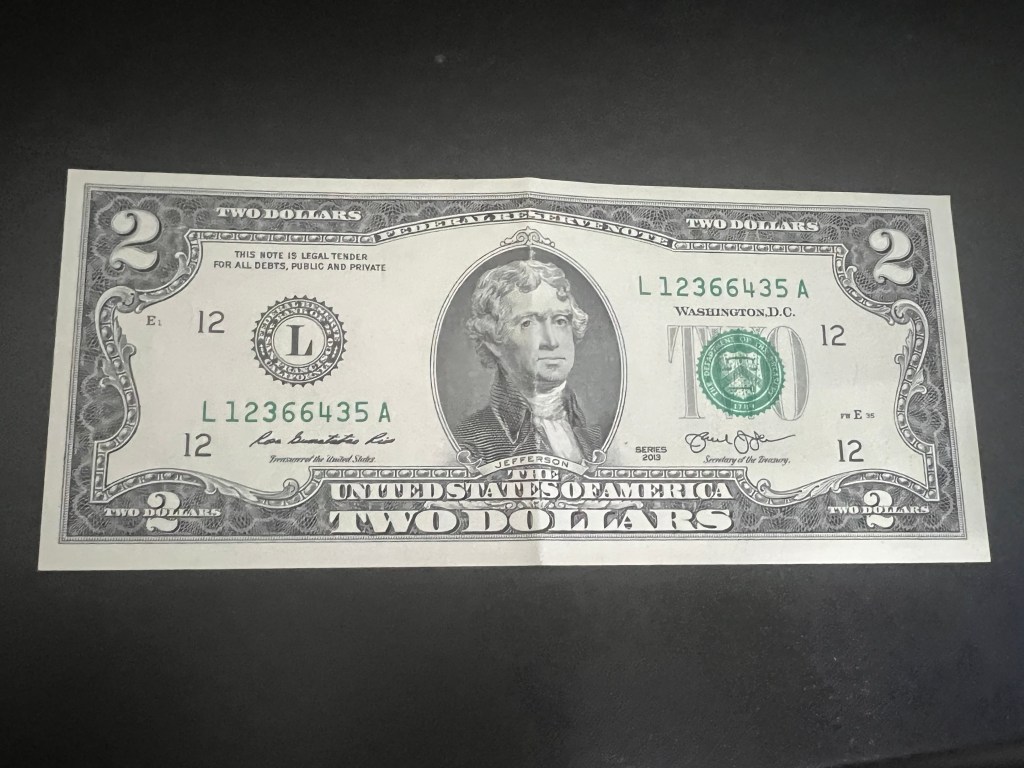
I have (once more) been cleaning my closet to downsize the stuff we boxed up and carried from one house to the next.  I had already cleared out all the clothes that no longer fit.  This purge was to get rid of (donate) office supplies we have accumulated from work and home offices over the last decade.  I dutifully began with boxes from my last home office as well as the keepsakes I used to decorate my work office.  I was amazed how many writing pads I accumulated, especially since I bought a new bundle for my home office recently thinking I was out.  After working through my boxes (and tossing most as trash), I tentatively began to go through Melissa’s work boxes.  Even as I consolidated the pens, pads, envelopes, and miscellaneous supplies I was smart enough to ask before I threw anything out.  One item I came across was a small red envelope.  I nearly threw it in the trash but decided to see if it contained anything.  It was lucky I checked as there was a US$2 bill inside.

When I looked online, I found a red envelope or red packet is a gift of bills given during holidays or for special occasions such as a wedding, graduation, or birth of a baby.  Although the red envelope is from Chinese traditions, other cultures share similar traditional customs.  The red packet is also called “money warding off old age” (yāsuì qián) for Chinese New Year.  The custom has been adopted across parts of Southeast Asia, and other countries that have a sizable ethnic Chinese population.  In the mid-2010’s, a digital equivalent to the practice emerged within messaging apps with mobile wallet systems localized for the Chinese New Year.  It is traditional to put brand-new bills inside the red envelopes and to avoid opening the envelopes in front of the relatives who provide them out of courtesy.  However, to get the money, the younger generation needs to show respect by prostration (kowtow) or kneeling and bowing so low as to have one’s head touching the ground.  In Eastern Asian (Sinospheric) culture, the kowtow is the highest sign of reverence.  This act has been reduced in modern times, but it had been widely used to show reverence for one’s elders, superiors, and especially the Emperor of China, as well as religious and cultural objects of worship.  The red envelope had been given to Melissa by a friend over ten years ago and saved as an office memento of their friendship, and my finding it proved it to be lucky.

While the US$2 bills Melissa’s friend had placed inside are a past and current denomination of US currency they have fallen into disuse.  The bills feature a portrait of Thomas Jefferson (1801–1809), the third US president, on the obverse and an engraving of John Trumbull’s painting (circa 1818) Declaration of Independence on the reverse.  Pre-1929 the larger sized bills were issued as a US Note, National Bank Note, Silver Certificate, Treasury or “Coin” Note, and Federal Reserve Bank Note.  When currency was changed to a standardized size in 1928, US$2 bills were redesigned and only issued as US Notes.  The production of these bills was phased out in 1966 but reissued in 1976 as a Federal Reserve Note with a new reverse design.  As a result of banking policies with businesses two-dollar bills do not circulate as widely as other US currency bills.  

Thoughts:  The comparative scarcity in circulation and a lack of public knowledge that the bills are still being printed has inspired several urban legends about its authenticity, rarity, and value, and can create problems for those trying to use the bills to make a purchase.  Scarcity also indicates significant numbers of the bills are removed from circulation and collected by people who believe the bill to be rarer and more valuable than it is.  Or perhaps being given on special occasions it is cherished and eventually lost.  Working as a cashier, I could never figure out where to put the bills in the change drawer.  The two-dollar bills are different and do not fit naturally into cash registers but that does not make them less valuable.  The same is idea true with people.  Act for all.  Change is coming and it starts with you.

Costume

August 24, 2023

I was (only) mildly surprised when I went to the big box store in town yesterday.  I needed to get smoked salmon for my version of the “tiny sandwiches” my sister-in-law makes for Christmas Eve.  I really like smoked salmon, so we tend to have this treat whenever they take my fancy.  Mine are not nearly as elaborate as the traditional ones her Danish mother taught her to make, but I still count them as an homage to the many times we have enjoyed the delicacies at her house.  As I wound my way through the snack aisles, I came across an endcap that had a large display of Halloween treats.  These snacks were on display with Halloween still two and a half months away.  Still, it was only tubs of individually wrapped cheese balls and pretzels.  When I came out on the main aisle, I was surprised by large racks of Halloween costumes and Halloween yard displays hanging from the ceiling.  This was a full scale rush that skipped right over Labor Day and into Halloween.  I guess Labor Day costumes are not a big sales item.

When I looked online, I found the site Emily Post Etiquette that addressed the summer traditions in the early 20th century.  While there are no official costumes, Labor Day did mark the end of wearing white clothing.  During the first three decades in the US northeast seaboard the summer season was bracketed by Memorial Day and Labor Day.  Society families left their city town house to a seaside “cottage” or mountain “cabin” to escape the heat.  City clothes were left behind in exchange for lighter, whiter, summer outfits.  With their return to the city after Labor Day, summer clothes were put away and replaced by formal city clothes.  This was an age when society had a dress code for practically every occasion, and the signal to mark the change between summer resort clothes and clothing worn for the rest of the year was encapsulated in the dictum, “No white after Labor Day.”  Today’s styles are more about fabric choice than color.  Etiquette says, “the true interpretation is ‘wear what’s appropriate—for the weather, the season, or the occasion.”

Wearing costumes is a big part of attending one of the many Comic-Con events, where it is called cosplay.  When you observe the variety of costumes it reveals the consideration, time, and toil that went into their creation.  That includes the accompanying props, makeup, headgear, and more.  For those wearing the costumes and playing the characters they often view their toil as the labor of love.  They know the “cultural capital” of a completed costume will be judged by overall quality and the amount of time and labor invested in their creation.  Some cosplayers enjoy the attention received while walking around in full costumes.  Others are uncomfortable with the attention, particularly when they are wearing revealing costumes which can prompt inappropriate behavior.  Some cons display signs warning that, “cosplay is not consent,” reminding attendees to ask permission before taking pictures, and to avoid unwanted touching.

Thoughts:  Living in California attended the annual Renaissance Faire with friends.  The Faire was in a large, wooded area which provided enough room for permanent enclaves for fantasy (elves and fairies), pirates, royalty (Queens and peasants), along with knights and ladies.  Each enclave featured the appropriate food and drink.  We would prepare our costumes for the event months in advance by searching the used clothing stores and specialty shops of the Bay Area.  Unlike the comic-cons there were no preset characters, and the costumes could reflect almost anything or one.  My character was usually built around whatever purchases I had made in the previous months.  Costumes are a good way to take on another role or persona for a little while.  In life we need to understand who we are, even as we grow into who we would like to be.  Act for all.  Change is coming and it starts with you.