
Stamps

July 20, 2023

Prior to mom moving to an assisted living center my sister came to help her downsize.   Mom was reluctant to donate over 90 years of memories and my sister came up with a way to make parting with the treasures more palatable.  All the sibs and grandchildren were connected to a group text called “who wants this”.  As the two of them worked through what would be kept and what was to be given away, photos were posted on the group, and we could respond if we would like to have the item.  The items ranged from pictures and nick-nacks to things obtained while mom and dad were on mission trips around the world (mom visited 92 different countries).  I arrived toward the end of the month long task to pick up items I had selected as well as the special items mom set aside for me.  Most of the “good stuff” had been selected, but there was a small steamer trunk filled with canceled stamps.  Since no one else wanted to mess with them I said I would take the stamps and find out what they were worth.

When I went online, I found stamp collecting is part of the field called philately, which is the study (or combined study and collection) of stamps.  Stamp collecting has been one of the world’s most popular hobbies since the late nineteenth century and the rapid growth of postal services around the world.   A philatelist may or may not collect stamps.  Most casual stamp collectors accumulate stamps for personal enjoyment and tend not to worry about the details.  A large comprehensive collection will require some philatelic knowledge and will usually require areas of philatelic study.  Postage stamps can be collected for their historic value, or for the wide range of ships, horses, birds, kings, queens, and presidents that are represented on the stamp.  Sales of stamps are an important source of income for some countries whose issues exceed their postal needs.  Their designs are made to appeal to collectors.

The Penny Black was the first postage stamp, issued by Britain in May 1840 and pictured a young Queen Victoria.  It was produced without perforations (imperforate) and had to be cut from the sheet with scissors.  While unused examples of Penny Black are scarce, used examples are common and depending on their condition may be purchased for US$20 to US$200.  It is suggested John Bourke, Receiver General of Stamp Dues in Ireland, was the first stamp collector.  Bourke assembled a book of the existing embossed revenue stamps, ranging in value from 6 pounds to half a penny, as well as the hand stamped charge marks that were used with them, in 1774.  His collection is preserved in the Royal Irish Academy, Dublin.  Stamp collecting began along with the first stamps issued and by 1860 thousands of collectors and dealers appeared around the world as this new study and hobby spread.  By the early 2000’s stamp collecting was in decline, but now seems to be making a revival among the millennial audience.  We have three stamp collecting outlets near me.  When I called only one bothered to call back.  They told me stamps no longer had value (except pre-civil War stamps) beyond their face issue.

Thoughts:   As I perused the stamps from mom, I noticed they were all canceled.  When I mentioned this, my brother told me how dad had gone through the case and retrieved all the unmarked stamps and used them to post letters.  Apparently, he had learned the same information when mom inherited them.  For several years dad had placed a variety of stamp values on the envelope adding up to the current cost to post a letter.  I noticed online there were many sites advertising stamps for sale, but I did not find any who offered to buy my collection.  Hobbies come and go and except for rare specimens’ collection is not a profitable investment.  Nothing is of real value until you sell it (including stocks) and like most things we collect, we do it for personal enjoyment.  That is true for stamps, buttons, thimbles, and spoons.  My son will someday consider what to do with my own collectables.  I wish him luck.  Act for all.  Change is coming and it starts with you.
Dixie

July 18, 2023

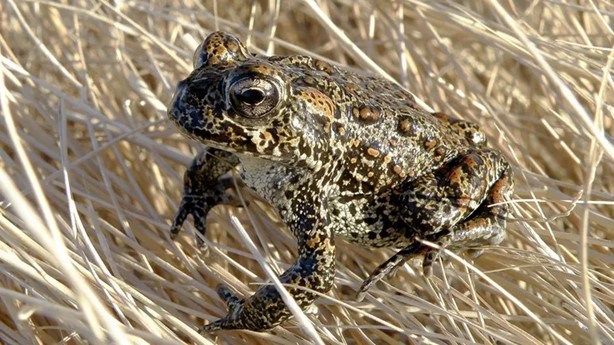
The back page article of yesterday’s newspaper reported on a conservationist victory as federal officials have decided to “revisit” the 2021 environmental review that cleared construction of a geothermal power plant in Nevada where an endangered toad lives.  Environmentalists and tribal leaders suing to block the project said the move will trigger a third review of the partially built power plant that the Bureau of Land Management (BLM) approved in December 2021.  The Center for Conservation Biology had joined the Fallon Paiute-Shoshone Tribe to sue the BLM in Reno’s federal court in January 2022.  The US Fish and Wildlife Service declared the Dixie Valley toad endangered on an emergency basis that April and then made the listing permanent in December.  The conflict underscores challenges faced by the current administration which has repeatedly vowed to protect fish and wildlife while also pushing development of green energy projects on federal lands to combat climate change.  The Justice Department represents the BLM and has yet to specify their next action.  At best, it will be several months before construction of the Dixie Meadows plant can resume.  So far, it is a win for the little toad.

When I went online, I found the Dixie Valley toad (Anaxyrus williamsi or Bufo williamsi) is a species of toad in the family Bufonidae indigenous to Churchill County, Nevada (US).   The toad was the first new toad species described in the US since description of the (now extinct in the wild) Wyoming toad (A. baxteri) in the 1970’s.  The Dixie Valley toad was originally considered an isolated population of the common western toad (A. boreas) until physical and genetic analyses found it to be a separate species in 2017.  The toad is descended from an ancestor that inhabited the large lakes and wetlands that covered the Great Basin in the Pleistocene until the receding water isolated the different populations, leading to speciation.  The toad is only found in a small complex of spring-fed marshlands in Dixie Valley.  The surrounding area is largely arid land with few aquatic resources, isolating the toad.  The spring complex in Dixie Valley is one of the hottest and most geothermally active systems in the region.

Dixie Valley (Paumu in Paiute) is a vast area spanning nearly 3,000 square miles near Fallon, Nevada, tucked between the Stillwater mountains to the west and the Clan Alpine mountains to the east.  The Fallon Paiute-Shoshone Tribe used the quiet valley to gather medicinal plants and other resources, put their dead to rest, and to find respite and healing among the mountains.  “When you’re out here, we ask people to be respectful because you just don’t know if you’re walking into one of the oldest churches in North America,” said Donna Cossette, a former tribal chairwoman.  Ancestors of the tribe have lived in the region for 10,000 years.  There are currently 1,562 enrolled members of the tribe, with 657 living in the tribe’s reservation.  In addition to the hot springs frequented by tribal members for ceremonies and healing, the area now includes a geothermal plant, a few scattered ranches, an endangered toad, and designated space for a Naval air station 68 miles (109 km) away.  In March 2022, leaders for the Fallon Paiute-Shoshone tribe traveled to Washington D.C. in a bid to protect their sacred valley by designating the area a national monument.  This would be Nevada’s fifth and the largest in the continental US.

Thoughts:   Indigenous tribes have been consistently moved or destroyed since European immigrants began to arrive in the Americas in the fifteenth century.  The moves were forced, and the locations deemed of little value to the invaders.  When gold, oil, or other resources were located on these lands they were again taken and the treaties “renegotiated”.  The sacred land of the Dixie Valley may not save it from exploitation, but that may change because of an endangered toad.  Act for all.  Change is coming and it starts with you.
Electric

July 15, 2023

I mentioned I had pruned the limbs hanging over our house and on the cars in the driveway last month.  This is an annual event that just keeps me ahead of the side limbs but does little to attack the height of both trees.  The Japanese Maple (Acer japonicum) is defined as “a small deciduous tree growing 16 to 32 feet (5 to 10 m).  Ours is getting close and since it is over the roof, I do not want it to fall in the wind.  The Bradford pear (Pyrus calleryana) has also survived the winds but is getting near its maximum height (16 to 26 ft or 5 to 8 m) at around 25 feet.  What I really need is a chainsaw to trim the tops and let them start over.  I have never liked the mess and bother of owning a chainsaw, especially when I have so few trees to take care of.  I have been seeing quite a few ads for electric power tools on TV and began to wonder if that might not be an easier and more ecological way to get the work done.  Luckily the two-day online sale included electric power tools.

When I went online, I found a power tool is a tool activated by an additional power source other than the manual labor used with hand tools.  The most common types of power tools use electric motors, but internal combustion engines and compressed air are also common.  Power tools are used in industry, construction, the garden, and around the home and are classified as stationary or portable.  Portable power tools are hand-held and have the advantage of mobility while stationary power tools have the advantage in speed and precision.  Early in the Industrial revolution factories had rows of power tools driven by belts from overhead shafts that first used a water wheel and later a steam engine.  The electric motor was introduced in the 1880’s and made the stationary and portable tools of today possible.  In 2022, the global market for power tools was estimated to be US$32.2 billion and is expected to grow to US$42.7 billion by 2030.

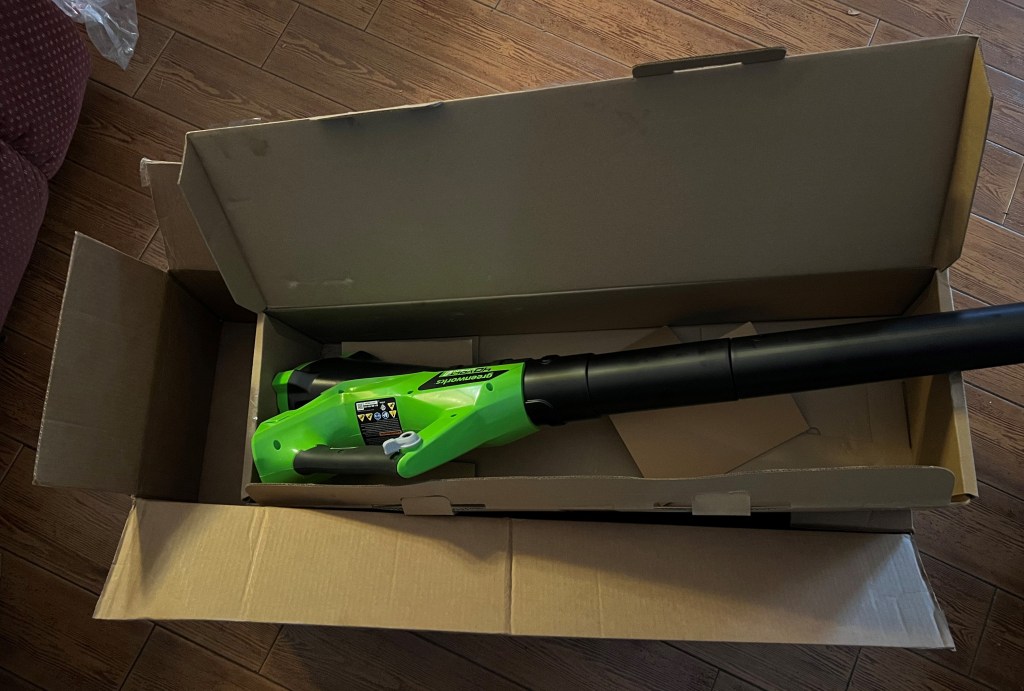
I was excited when Melissa told me we had received a delivery of a large package this morning.  I brought the large box inside and was pleased to feel the light weight.  I opened the box to find a slightly smaller box with writing identifying the contents as the dual electric weed eater and leaf blower.  I own two electric leaf blowers already, but they are corded and cumbersome.  I own three gas powered weed eaters but again I was trying to reduce my carbon impact.  Both tools needed to be assembled but that was an easy task.  I popped the battery into both the electric tools to make sure they worked.  Zena and Loki were afraid of the package when I brought it in, and even more so when I tested the tools indoors.  I was ready to tackle the yard and started weed eating along the maple bed.  I was 10 minutes into the job when the motor started to cut out and die.  I took the battery inside and plugged it into the charger.  It did not surprise me that there was not a full charge by the time it got to me from the factory.  I mowed the lawn to kill time until the battery had a full charge.  Hopefully it will last longer this time.

Thoughts:  I became accustomed to using a chainsaw when I worked at the camp.  The wooded areas and shade trees on the grounds were in constant need.  I did have the advantage of a full time caretaker who kept the saw in repair and sharpened the chains.  They even showed me how it was done so I was confident with the chains, but engines have never been my forte.  Electric power tools tend to be easier to maintain and have lower costs than combustion tools.  The big expense comes when you need to replace the batteries.  While I may be trying to reduce my personal carbon footprint, the US has the highest per capita carbon footprint in the world.  Transportation and household energy use make up the largest component of an individual’s carbon footprint with approximately 40 percent of total emissions in the first decade of the 21st century.  Electric power tools may be a small step, but it is a step (and an attitude).  Act for all.  Change is coming and it starts with you.
Giveaway

July 12, 2023

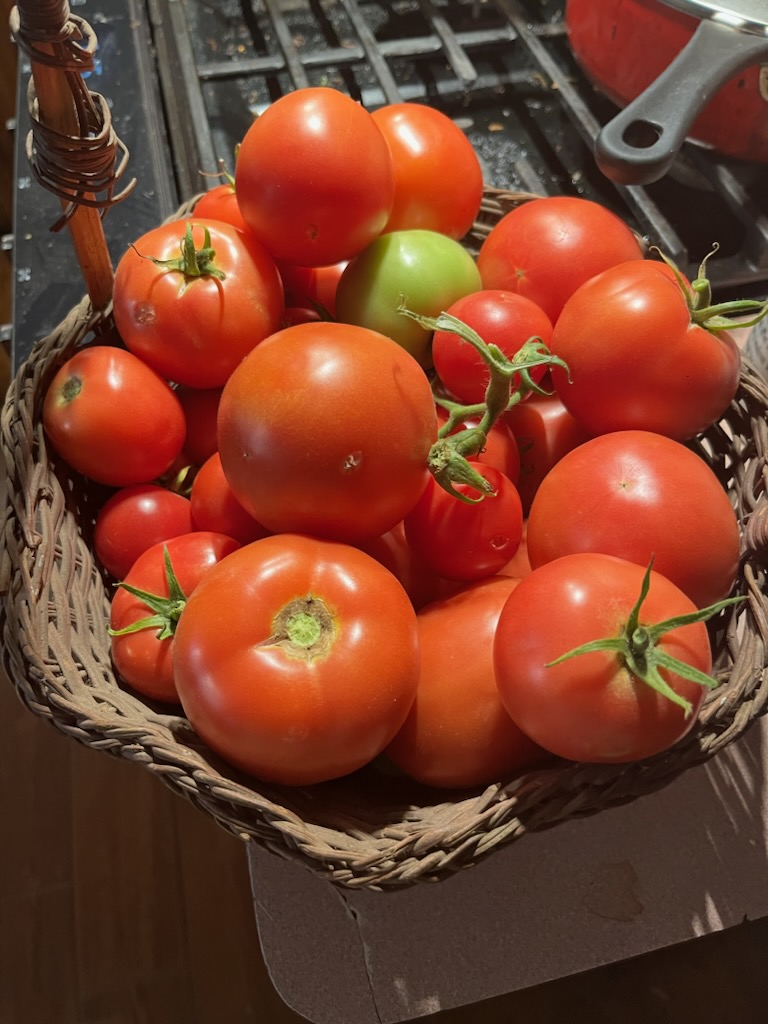
After the bad crop last year, I was determined for better production this year.  I planted a 6 pack of Aransas travelers, 2 sweet 100’s, and 2 beefsteaks’(all Solanum lycopersicum var.), along with 1 poblano and 2 jalapeno (both Capsicum annuum var.) peppers.   I knew part of last year’s problem was retaining water and insufficient growth medium, so I replaced several old 5-gallon (20 liter) bucket containers with five new 20 gallon (75 1/3 liter) grow bags.  While the weather has cooperated this year, I can also vouch for the grow bags.  My tomatoes have taken off and I harvest more fruit in a week than I did the entire season last year.  That has created another problem, what to do with the produce.  I started making Pico with the smaller or the bird pecked fruit.  While I still cannot grow an onion, I mix store bought onions along with the tomatoes and jalapenos from my containers.  We now have tomatoes mixed in with many of the dishes I make for dinner and have found myself eating sliced tomatoes as a snack.  That does not come close to using the tomatoes I produce.  When I went to Kansas last week, I took giveaway bags of peppers and tomatoes to my brothers.  Now, what to do with the rest. 

When I went online, I found giveaway bags are a popular promotional merchandise branded with a logo or slogan and distributed at little or no cost to promote a brand, corporate identity, or event used in sales and marketing.  The items are often distributed as handouts at trade shows, conferences, on sales calls, and as bonus items in shipped orders.   The first known promotional products in the United States were commemorative buttons dating back to the election of George Washington in 1789.  During the early 19th century there were a few advertising calendars, rulers, and wooden specialties, but there was no organized industry for promotional items until the late 19th century.  Jasper Meek, a printer in Coshocton, Ohio, is thought to be the originator of the industry when he convinced a local shoe store to supply book bags imprinted with the store name to local schools.  Henry Beach, another Coshocton printer, and competitor of Meek, picked up on the idea.  Soon the two men were selling and printing marble bags, buggy whips, card cases, fans, calendars, cloth caps, aprons, and even hats for horses.  Promotional products are defined as custom printed with a logo, company name, or message.  Since mine were delivered in a plain brown paper bag, they did not qualify as a promotional giveaway, but they did speak to the preponderance of fruit from this year’s garden.

I am not the only gardener to face the daunting task of what to do with an overabundance of tomatoes.  The Mama Natural website is touted as “the #1 natural parenting brand online.”  Over 2 million people visit the site each month for resources to help mothers and families lead healthier and more natural lives.  One of these healthy articles posted in October 2019 explained 28 ways to use extra tomatoes.  The suggestions included sauces (Pico, salsa, pizza, spaghetti, and marinade), juice or paste, cooked or fresh in food, and canning or freezing.  The last two suggestions were to barter or sell them and to give them away.  Melissa is not participating in the farmer’s market this year so there goes that opportunity.  During the pandemic we began a custom of providing giveaway treats for our cul-de-sac to stay in touch with our neighbors.   Giveaway bags of tomatoes is another way to build on the tradition.

Thoughts:  I wrote a previous blog on my attempt to grow tomatoes as a cub scout.  I planted 15 plants and was overcome by the fruit produced.  I provided giveaway bags to the entire community and vowed to never grow another garden.  My thoughts have changed, and now I grow vegetables, and again I have the same problem.  AmpleHarvest.org is another resource for growers to distribute produce from their garden.  This is a national database that links growers with food pantries.  There are three pantries nearby that could use a giveaway.  Act for all.  Change is coming and it starts with you.
Golf

July 05, 2023

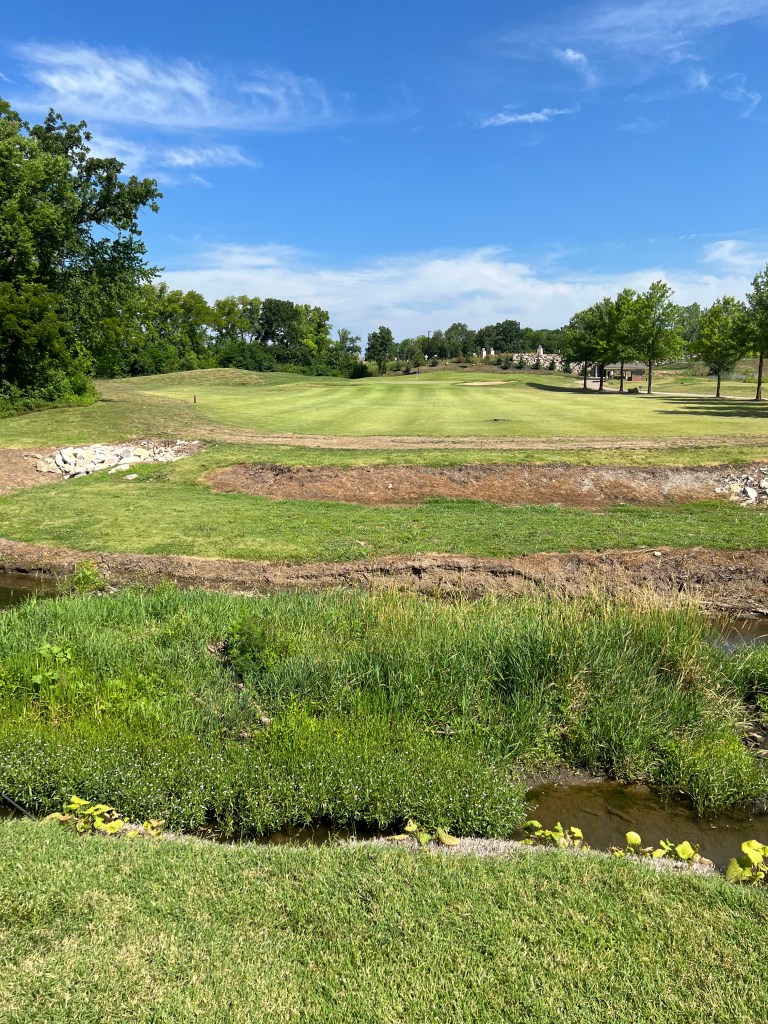
On Monday I had an 8:30 am tee time.  That meant I got up before the crack of noon for a round of golf with my brother and his son.  I had mentioned I had been reluctant to golf without first hitting a few balls.  After finding the range closed in Arkansas, I was never able to find time for another one.  My brother solved the problem as his house abuts the golf course where he is also a member.  This is a 27-hole course where the last nine holes are not often used.  I had seen couples walking the cart path earlier that Sunday evening.  He is a constant ball hawk while on the course and has retrieved literally 100’s of lost balls.  He grabbed a dozen balls, I grabbed my 7-iron, and we snuck out his back door and onto the adjacent fairway.  After a few duffed balls, I seemed to get my swing back.  I was ready to hit the golf course the following morning.

When I went online, I found golf is a club-and-ball sport where players use various clubs to hit balls into a series of holes on a course in as few strokes as possible.  Unlike most ball games, golf does not use a standardized playing area, and coping with the varied terrains found on different courses is a key part of the game.  Courses typically have either 18 (full course) or 9 holes.  Each hole varies in length, and they are designed to allow either 3, 4, or 5 strokes (par) to travel from the tee box to the cup on the green.  The terrain between the tee and the green also varies, with fairway (close cropped grass), rough (tall grass or brush), and hazards like water, rocks, or sand-filled bunkers. Each hole on a course is uniquely laid out in design.  The modern game of golf originated in 15th century Scotland. The 18-hole round was created at the Old Course at St Andrews in 1764.  The world’s oldest golf tournament, The Open Championship or British Open, which was first played in 1860 at the Prestwick Golf Club in Ayrshire, Scotland.  This is now one of the four major championships in men’s professional golf (PGA), with the other three played in the US.  These are The Masters, the U.S. Open, and the PGA Championship.

The Old Course at St Andrews is considered the oldest golf course in the world.  It is a public course over common land in St Andrews, Fife, Scotland and is held in trust by the St Andrews Links Trust under an act of Parliament.  The Royal and Ancient Golf Club of St Andrews clubhouse sits adjacent to the first tee, although it is one of many clubs that have playing privileges on the course, along with some non-clubhouse owning clubs and the public.  The course was originally known as the “golfing grounds” of St Andrews and did not acquire its current name until the New Course was opened in 1895.  The Old Course at St Andrews is considered the “home of golf” because the sport was first played at St Andrews in the early 15th century.  Golf became increasingly popular in Scotland until it was banned by James II of Scotland in 1457.  James thought the young men were playing too much golf instead of practicing archery.  The ban was upheld by James III, and remained in force until 1502, when James IV became a golfer himself and removed the ban.

Thoughts:  My brother told a story of his father-in-law reserving a tee time at the Old Course.  He showed up with a four-some and teed off on hole number one.  By the time they reached the third fairway they were approached by the Marshal (course controller) and were offered a full refund and access to another course if they would be willing to stop play.  Apparently, the Marshal did not think them capable of playing the course in the time allotted and they were holding up the other golfers.   While I was not asked to leave the golf course we played, we were constantly pressed by the foursome behind us even though we stayed close to the group in front of us and even waited on several tee boxes.  I considered completion of the course a moral victory, the trailing group may have had a different estimate of my efforts.  Act for all.  Change is coming and it starts with you.
Memorabilia

July 04, 2023

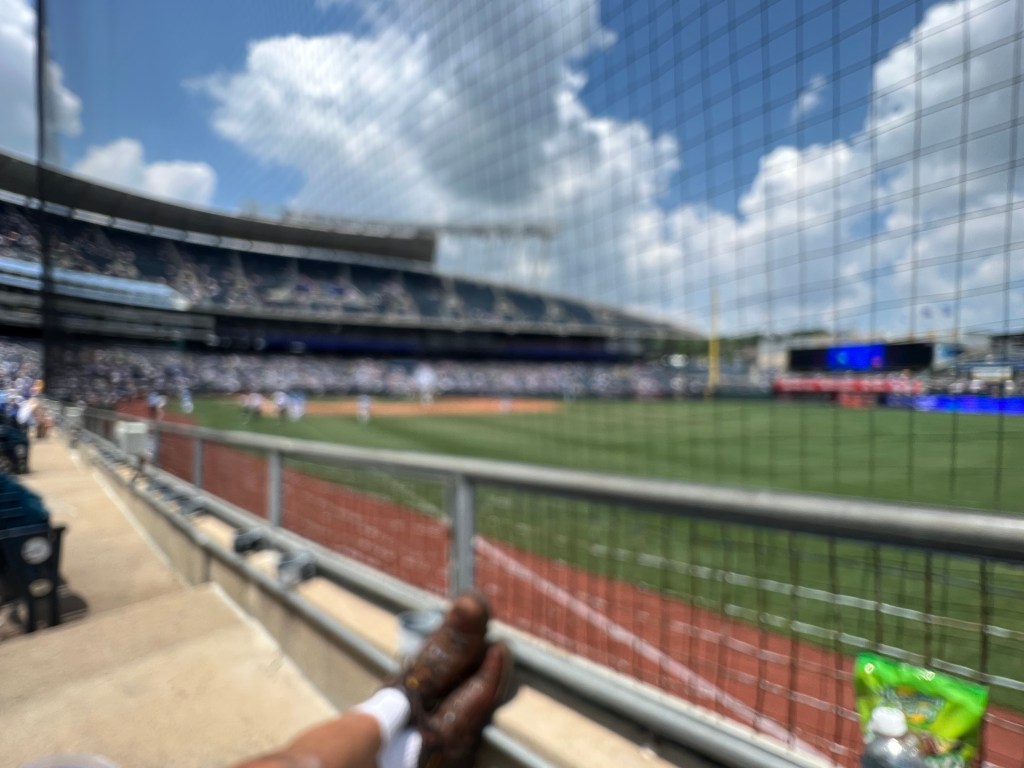
I decided to spend a few days with my brother and sister-in-law in Kansas City over the 4th of July.  I drove up Sunday and arrived in time to attend the Royals-Dodgers game in the afternoon.  I had bought tickets and the required parking pass online and loaded them to my phone.  I flashed my pass and then met my brother at the gate.  I flashed my tickets at the gate, and we went seamlessly into the stadium.  I had gift cards to the Royals store that were only accessible at the stadium, so we went into the gift shop hoping to purchase a tee shirt or some other small item.  The shop was full of autographed balls and rows of jerseys along the wall.  The jerseys were autographed and were from current players.  They started at US$500 so I moved on.  Another wall had signed jerseys of “discontinued” players that were discounted to only US$175.  The balls were more reasonable but started at US$75.  I decided I did not need anything from the shop after all.  We did not purchase any memorabilia and made our way down to our front row seats near the right field foul pole.

When I went online, I found sports memorabilia refers to collectables associated with sports including equipment, trophies, sports cards, autographs, photographs, or anything collectors are willing to buy.  A multi-billion-dollar industry has grown up around sports memorabilia and items can be valued at millions of dollars.  Collecting sports memorabilia goes back to the early 20th century when people began to collect baseballs from games.  Many took these balls and asked the most popular player of the day (Babe Ruth) for autographs.  Over the years and as other stars joined their sports, memorabilia collectors broadened their horizons.  When the NBA, MLB, NHL, and NFL began selling their jerseys in stores during the 1980’s, game used jerseys also became a hot memorabilia item.  Game used can refer to an item worn or used during a game or pregame and can include an athlete’s personal attire.  This can also refer to equipment and other items used by a player in a game.  With game used you must decide whether to wash the item or if it is more valuable to you soiled (to stink or not stink).

While I was not willing to spend large amounts for memorabilia, I was surprised there were none of the tee shirts or ball caps that were available online.  On our way to our seats, we decided to get something to eat.  On a whim I asked if I could use my gift cards for concessions.  The young server looked at my card and then asked his supervisor.  She assured him it would work.  He rang up my sale and then stood perplexed trying to figure out how to run the gift card.  Again, the supervisor showed him to just scan in the bar code.  It worked and I had lunch for the day.  There were only a few vendors in the stands during the game and my brother tried to buy something.  The vendor told him the stadium was cashless only.  I gave him one of my gift cards and he went off to concessions.  While I may not have purchased any memorabilia (cost), we were at least able to use our cards to secure food and drinks.

Thoughts:  As we watched the game, I noticed several people arriving near us with the shirts and caps I had intended to buy.  After the game (Royals won 9-1) I was one of the last to straggle back up the steps and found someone had left their memorabilia bag laying beneath the seat.  I looked around and no one was there.  I picked it up intending to give it to the person who would obviously return to retrieve their purchase, but no one ever came back.  As I walked toward the exit, I saw the gift shop I had missed that sold these less expensive items rather than expensive memorabilia.  When I got back to the car, I opened my valuable package.  Instead of any hoped-for memorabilia, the bag contained two tags, a sales receipt, and a woman’s top sporting the words, “Virginia Beach”.  Looks like the only winner will be the local thrift shop.  What do they say about ill-gotten gain?  Act for all.  Change is coming and it starts with you.

UAE

July 01, 2023

Inside my local newspaper last week, I found an article on the latest marine park opened by Sea World in the United Arab Emirates.  The US$1.2 billion venture partnered with state-owned developer Miral and features the world’s largest aquarium and a cylindrical LED screen.  There are no orcas at the park, but it does house dolphins and seals, whose captivity and training for entertainment are also criticized as unethical by animal rights groups.  The facility opened last month and gives the Orlando, Florida-based company a foothold in a fast-growing international tourism destination and the ability to continue its rebranding after years of criticism and allegations of animal cruelty.  SeaWorld and Miral declined multiple interview requests from The Associated Press, did not answer written questions, or grant AP journalists access to the park.  This is a typical response by SeaWorld and the UAE.

When I went online, I found the United Arab Emirates (UAE) is a country in the Middle East.  UAE is located at the eastern end of the Arabian Peninsula and shares borders with Oman and Saudi Arabia, while having maritime borders in the Persian Gulf with Qatar and Iran.  The nation’s capital is located at Abu Dhabi, but Dubai is the most populated city and an international hub.  The UAE has an elective monarchy formed from a federation of seven emirates (territories), consisting of Abu Dhabi, Ajman, Dubai, Fujairah, Ras Al Khaimah, Sharjah, and Umm Al Quwain.  Each emirate is governed by a ruler and together the rulers form the Federal Supreme Council.  The Federal Supreme Council then elects a president (from Abu Dhabi) and vice president (from Dubai) from among their members.  Islam is the official religion and Arabic is the official language. The UAE has the world’s 6th largest oil and 7th largest gas reserves.  In the 21st century, the UAE has become less reliant on oil and gas and is economically focusing on tourism and business.  The UAE is considered substandard by human rights organizations as critics are imprisoned, disappear, and individual rights like freedoms of assembly, association, the press, expression, and religion are repressed.  As of 2023, the United Arab Emirates has an estimated population of roughly 10.2 million.

The arrival of SeaWorld adds another major tourist attraction for the UAE, along with the futuristic city of Dubai, the world’s tallest skyscraper, and the Louvre Abu Dhabi.  Miral’s plan is to transform Yas Island into a theme park hub that will rival Orlando.  The island already has a Formula 1 circuit, a water park, and a Warner Bros. theme park.  The new SeaWorld pays homage to Abu Dhabi’s cultural heritage with a themed “realm” of traditional houses and sailboats depicting a simpler time before the discovery of oil, when the sparsely populated emirates largely relied on fishing and pearl-diving.  SeaWorld Abu Dhabi has an in-house research facility to study aquatic life in the Persian Gulf and support conservation of local species, including the manatee-like endangered dugong.  John Jett is a former orca trainer and acknowledges that companies like SeaWorld have a role to play in conservation and have done well on animal rescue and rehabilitation.  “I wish they would focus more of their energy, expertise, and finances on taking a lead role in moving global policy and helping animals in the wild, rather than figuring out ways to keep them alive in captivity.”

Thoughts:  The UAE and Sea World are both trying to rebrand their image.  They have chosen to do this by projecting a public persona that does not address the underlying oppression, human for UAE and animal for SeaWorld.  Both entities have money that is being used to mask oppression rather than deciding to make substantive changes.  While both have the right to govern or act as they will, the impression is, “I will change, as long as I do not have to change.”  This approach seemed to work for Saudi Arabia and the LIV.  Act for all.  Change is coming and it starts with you.
Mallalieu

June 29, 2023

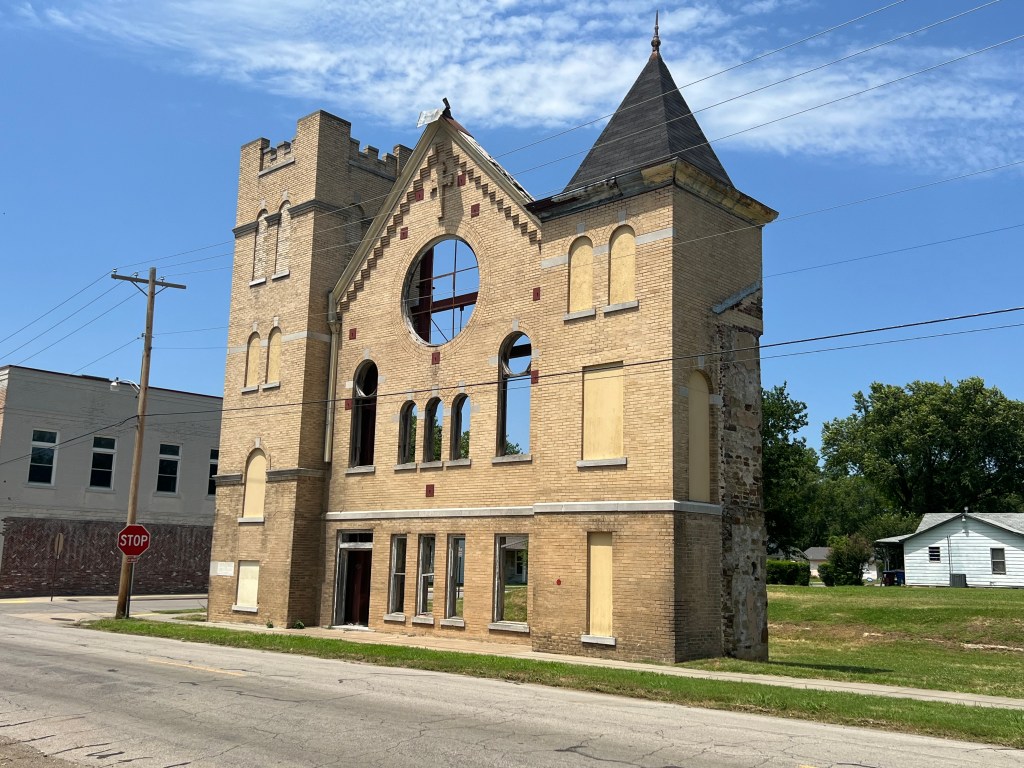
I am planning to play golf when I visit my brother next week for the 4th holiday.  I was an avid golfer (although never good) but lost the drive when I moved back to Kansas.  I injured my back on my last trip up North and am still recovering.  I decided if I it might be good to see if I could swing a club.  I knew of a driving range in the city and decided to see if I could swing a club.  I was glad to see the electronic sign flash “OPEN” despite the 100F (37.7C) temperature.  I saw the range was not covered but did have a tree with a chair beneath it as I walked in and asked for a bucket of balls.  The owner told me the range was closed because of construction next door which forced them to remove the netting that protected neighbors from errant balls.  The shop was open, just not the range.  I decided to drive across town to pick up some supplies.  I had never driven from this side of town but was sure I could find my way (is directions a male trait?).  I drove through an unfamiliar part of town and came across an abandoned brick facade.  When I got out to look, I found a cornerstone identified this as the Mallalieu M.E. Church.

When I went online, I found the Mallalieu Methodist Episcopal (M.E.) Church was established in 1885 as an African American congregation of the local Methodist Church.  The brick building was built in 1921 and according to the inset cornerstone was “cleared of all indebtedness” on October 15, 1947.  The building served the congregation until it relocated across the street as the Mission United Methodist Church in the late 1980’s.  The Mallalieu building remained vacant and was severely damaged by the elements and the stained glass windows were sold to an out of state collector.  The Howard Foundation was a non-profit started in 1988 to raise funds for the building’s rehabilitation.  The long-term goal was to develop the Mallalieu building as an outreach center for the youth on the north side of Fort Smith.  That did not happen, and by 2014 the rear of the building had been destroyed leaving the front facade and bracing support.  There is no signage to indicate the historic past or present plans for the impressive structure that remains.

It turns out Mallalieu is a popular name among early Black M.E. churches in the South.  The Rev. Willard Francis Mallalieu (1828-1911) spent 24 years in the as an M.E. beginning in 1858, including 2 years as presiding elder.  Although he declined several educational positions, Mallalieu became well known and liked by his denomination through contributions to Methodist periodicals and as a platform speaker at places like Chautauqua.  Mallalieu was a friend of Bishop Gilbert Haven and prepared Haven’s memorial for the General Conference of 1880.  Mallalieu was a delegate to the M.E. General Conferences of 1872 and 1884, and during the 1884 M.E. General Conference Mallalieu was elected to lead the episcopacy.  Mallalieu was thought of as “a practical wide-awake minister, [who] makes a good speech in a way that assures you he could preach a better sermon . . .”  He was apparently also well-known and liked by the founders of Black M.E. churches of the South.

Thoughts:  The national protestant denominations in the US all suffered a split during the decades prior to the American Civil War.  Southern M.E. churches were no different, forming the Methodist Episcopal Church South.  Following the war, many of these splits continued to maintain their own polity.  The M.E. churches who returned were mostly segregated and formed separate Black and white churches, like the Mallalieu M.E. Church.  Now denominations (including Methodist and Southern Baptist) are dividing over issues of sexuality and leadership roles.  These divisions center on the question of who is in control.  Heaven forbid we leave that call to God.  Act for all.  Change is coming and it starts with you.
Pokeweed

June 28, 2023

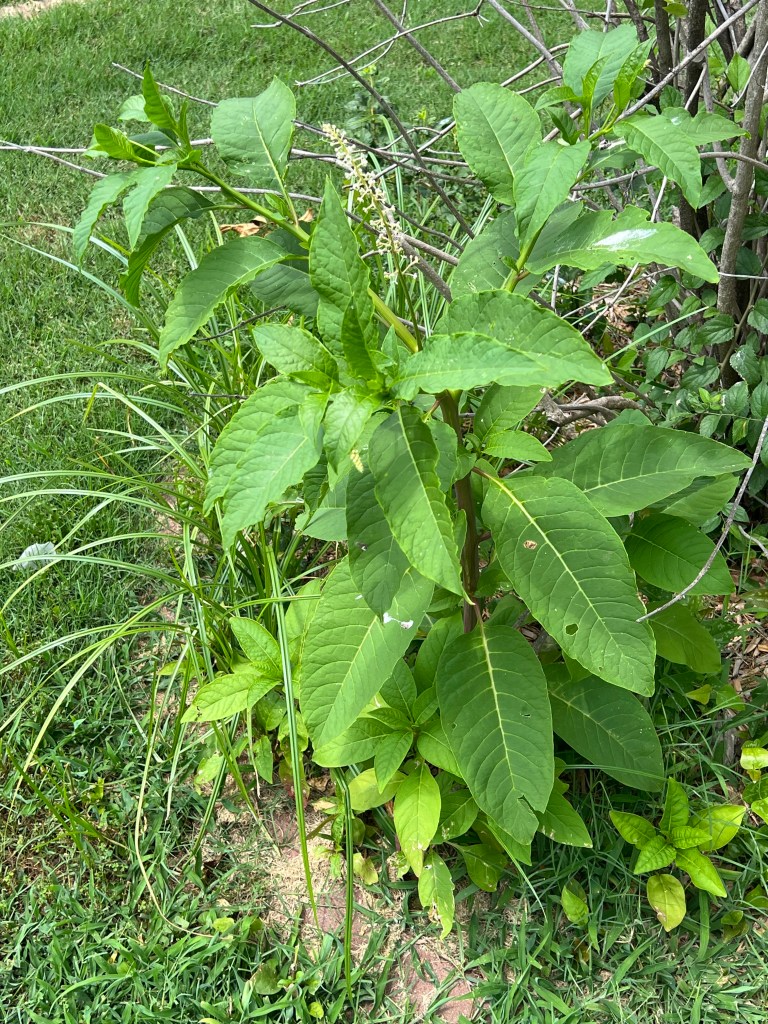
I have been lax caring for my front beds because of the extreme heat we have been under the last few weeks.  Since I am reluctant to go outside, I end up staying up late and getting up later.  By then the excessive heat danger alert has come up on my phone and it is too hot to do the work.  That means the beds I had cleared and mulched have all overgrown.  As I have gone back and forth to the car when forced outside on errands, I have noticed two weeds growing larger by the day, and one of the tall weeds has even begun to flower.  I did make it outside to mow yesterday knowing it was predicted to rain (it did) and was amazed by the thickness of the stems on these two plants.  I took a picture of the plants, googled it on my phone, and identified the plant as pokeweed.     

When I went online, I found pokeweed (Phytolacca americana), also known as American pokeweed, poke sallet, dragonberries, and inkberry, is an herbaceous perennial plant in the family Phytolaccaceae.  The first word in its scientific name comes from the Greek words phyton (plant) and lacca (crimson lake) and refers to its reddish-purple fruits.  The second word indicates it is native to America.  The common name “poke” is derived from an Algonquin (Native American tribe) name for the plant (puccoon) and the moniker “inkberry” comes as the berries were used to make ink.  Pokeweed is native to America in the East, the Midwest, and the South.  The species has been introduced as scattered populations in the far West and is naturalized in parts of Europe and Asia.  Pokeweed can grow from 4 to 10 feet (1 to 3 m) tall.  It has simple leaves on green to red or purplish stems and a large white taproot.  The flowers are green to white, followed by berries which ripen through red to purple to almost black.  The berries are a food source for songbirds such as gray catbird, northern mockingbird, northern cardinal, and brown thrasher, as well as other birds and some small mammals, but is a pest species for farmers as it is poisonous to humans, dogs, and livestock.

All parts of mature pokeweed are poisonous, but spring and early summer shoots and leaves are edible with proper cooking.  By late summer the shoots and leaves become deadly, and the root and berries (late summer) are always poisonous.  According to Michael Twitty, Southern food expert and author of The Cooking Gene, poke sallet was originally eaten as a potent tonic.  Twitty explains that most of the pre-depression Southerners walked barefoot and were full of worms.  Poke sallet acted to purge worms (vermifuge).  Memorial Sloan Kettering Cancer Center cites research that raw pokeweed has medicinal properties that can help cure herpes and HIV, but there are no clinical trials to support the cooked dish as a medicine.  Pokeweed is also used as a folk medicine.  According to Nicole Taylor, chef and author of The Up South Cookbook, poke sallet is a “stretch food”.  The plant was the first fresh vegetable to grow in early spring.  People who were poor or former slaves had to be innovative with what to eat and how to cook it and we can trace a variety of wild food dishes back to them.  “People who are looking for food to get by are more likely to eat poke sallet than someone who had means to eat other things.” 

Thoughts:  The term “poke salad” is a misnomer.  The true name for the most common pokeweed dish is poke sallet or poke salat.  The dish was eaten by the early English pioneers when they came to North America.  The word sallet comes from an older form of English and refers to something like a cooked salad.  Last year I allowed the bramble (Rubus trifidus) on my back patio to grow for the butterflies (flowers) and birds (fruit).  I have planted potatoes in that spot this year and removed the aggressive plant.  Now I must decide whether to allow the pokeweed to grow for the birds or cut it to protect my dogs.  Most ecological decisions present a tradeoff.  Act for all.  Change is coming and it starts with you.
Rock

June 27, 2023

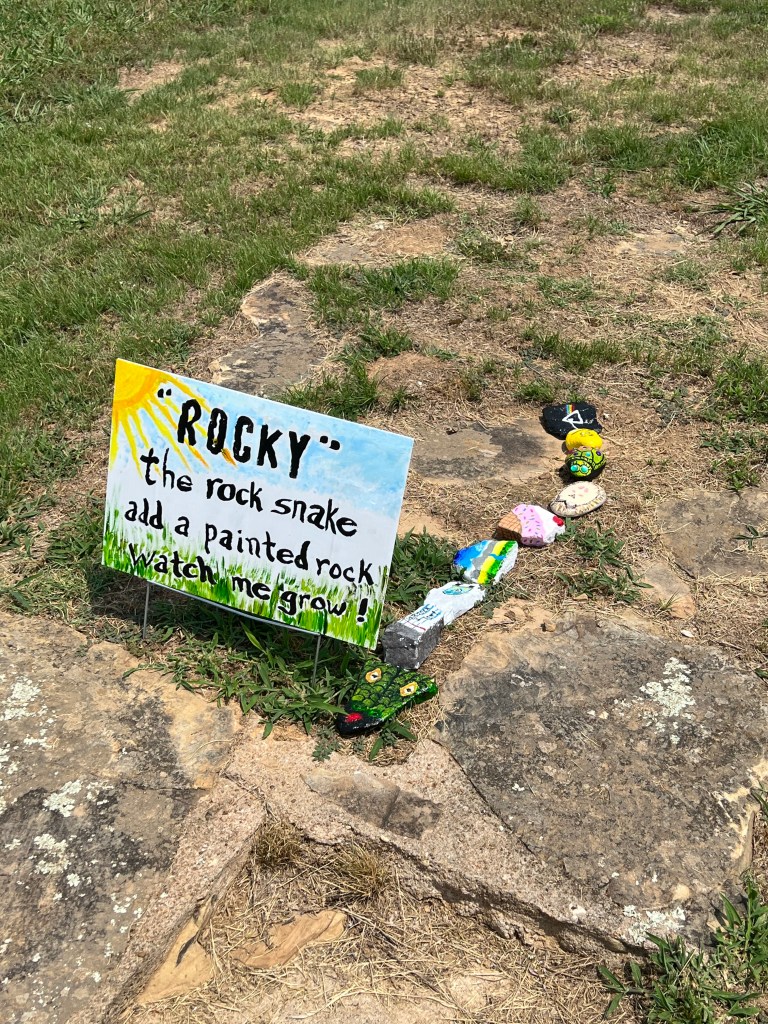
Melissa and I decided to take a drive last week after taking the dogs for a walk.  The dog park is close to a small park and fishing lake where I often try my luck.  This is one of the community fishing lakes that Arkansas Game and Fish stock with catfish in the summer and trout during the winter.  It also has a 1.2 mile (1.9 km) walking trail that winds around the lake.  As we entered the park, I noticed a brightly painted sign at the side of the road but did not pay much attention.  We went to the lake so I could check my fishing spots.  There were several people fishing, but the spots I frequent were all open.  I keep my poles in the back of the car “just in case” but because of the heat decided not to stop.  As we drove out of the park the bright sign again caught my eye, and this time I stopped.  Laying on the group, ground next to the sign was a line of painted rocks with the lead rock painted like the head of a snake.  The sign said, “Rocky” the rock snake add a painted rock and watch me grow!”

When I went online, I found that making a rock snake is one of the children’s activities that took hold during the isolation brought on by the pandemic.  One rock snake located in Atascadero, California, was reported by the local newspaper claiming to be the longest rock snake in America, if not the world.  The snake began in August of 2020 and by March 2021 it had grown to 1,200 feet (365 3/4 m) long.  The Rock Snake was started by Wanda Kohl who had collected interesting rocks of different shapes and sizes and turned them into art projects with her children.  Kohl made the sign to (help) ensure the rocks would not be taken, painted the snakehead and a few other rocks, and placed them at the lake.  Kohl said she follows a popular rock snake community Facebook group, “SLO Painted Rocks” (1.3 members), and a few other fun rock pages where people hide rocks around the neighborhood, but she had never seen a project that continued to grow.  There are rocks for sports teams, superheroes, favorite movies, declarations of love, messages of faith, advertisements for businesses, and even ways to get help if you are struggling through the pandemic.  There are rocks painted by professionals, amateurs, babies, and the elderly.  It is something that belongs to the City of Atascadero and all its residents.

The Atascadero News printed a follow-up concerning the dismantling of the rock snake September 15, 2022.  The original article mentioned the 1,200 foot snake wrapped a quarter of the way around the lake, and the goal was to wrap the entire distance, or nearly a mile at around 4800 feet (1,463 m).   

While pride for the rock snake was said to bring the city together, the snake was vandalized early in 2022 in a way that made it difficult to repair.  While the community was sad to see it go, safety concerns and the condition of the rocks had the city and Kohl admitting it is time to move on.  Many of the rocks had worn by the weather and returned to their natural state.  Those who donated a rock were invited to pick them up and then Kohl and a team came in October to collect the remaining rocks.  The next stage of the rock snake’s next life is uncertain.

Thoughts:  Painting a rock is not new and Atascadero is not the first place in the world to have an extensive collection of painted rocks.  The current record for the largest display of painted rocks is in the UK in memory of a young girl, Isla Tansey, with 8,500 “painted pebbles” but they are not positioned into a long trail but in a display.  The Facebook group “painting rocks!” has 343.7K members who enjoy painting on a rock.  We still have a painted rock on display in our front yard that dates to the pandemic.  The yellow “N” (or “Z” ?) was part of an alphabet challenge offered by our neighborhood.  Destroying art has a long human tradition.  The sign for the rock snake ultimately did not protect it from vandals.  The missing heads and arms of a stature was a way for conquers to debase their fallen foes.  Vandalism is just a way to be mean and take away other’s enjoyment.  Act for all.  Change is coming and it starts with you.