Crossword

April 24, 2023

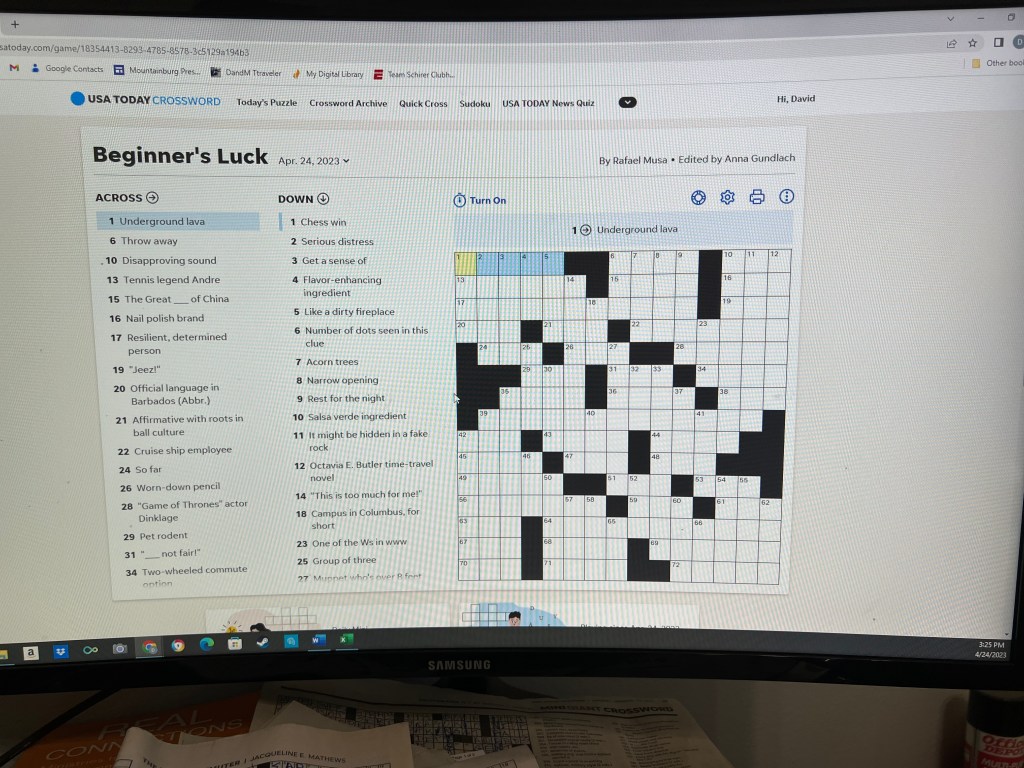
My sister knows I love to work the crossword puzzle in my newspaper, but she had to laugh when she noticed I was doing the Easter crossword while we were in Wichita.  I technically take the paper for the news it provides, and no matter how busy I think I am; I try to take time to read the paper.  The problem comes when I get caught up in other activities.  When Melissa and I went overseas I dutifully stopped the paper so they would not pile up.  When we got home, I found our neighbor had been collecting the papers that were still delivered daily.  It took several weeks to catch up on the news (read, crossword).  The print issues of my paper have also been cut back over the last two years, even while the price rose.  They have also stopped printing on Saturdays and major holidays.  I chalked this up to covid (this is the excuse for everything, right?).  The paper has informed me I can go online and get the paper, but I like the feel of holding the paper in my hands.  I have also been skeptical of how I could accomplish filling out the crossword, the real purpose of taking my paper.

When I looked online, I found the print newspaper industry is struggling to stay in business, causing the small town papers to cease publication or be taken over by large conglomerates.  Even those that have survived have suffered huge staff cuts.  The question raised by the website concerned the pros and cons of print verses online publication.  The pro for a print newspaper was it is physical (al la, me).  You can hold the warm newspaper in your hands (avoiding the fresh ink) and can save it to look back on at any time.  The con of a print newspaper is the cost.  Although this is comparatively small, it is perhaps one of the biggest reasons for decline.  The decline in circulation can lead to a decline in advertising, which supports the main cost of printing.  The pro for an online newspaper is it is immediately accessible and convenient.  You do not have to worry about a missed delivery or make a trip to the store and can look at the online edition immediately.  The con is the online version tends to not include everything in the print addition, and especially with the special editions released as a special print publication outside of the regular edition.  The article suggested you must experience both newspaper formats and determine for yourself which one is right for you.  This still did not address my crossword issue.

I had created an online account for my print subscription over a year ago but had not taken the time to look at the content offered.   I revisited the online subscription to see what was included as content (and if there was a crossword).  Once I found my login requirements (Melissa stores them), I was able to scroll through the various sections (news, sports, obituaries, etc.).  I did not see “crossword” listed, so I typed it in at the search field.  This brought up a new set of daily puzzles that could be filled out online.  There were several different puzzles offered, along with the advertisements that allowed them to open.   There was also a PDF version with all the content laid out by the print newspaper.  The PDF crossword was available, but I would need to print it to work the puzzle.  Since the daily crossword was different on the two formats (online and print), I may start doing both.  

Thoughts:  The online version of the paper was confusing at first.  While the regular format was offered, there were other articles at the bottom of the scroll.  I recognized these as the “news” offered when I open one of my browsers.  These are social and entertainment sites added as teasers to get me to follow rabbit holes that provide pop up ads, and little content.  While I am generally an old school historian and like the feel of papers and books I my hands, I recognize the advantage of being able to access these items digitally.  The greater issue is not how you access your news, but the source.  Fact checking and reputable media sources are crucial.  Every source has bias, but I trust those that state the bias upfront rather than hiding it in the content.  Act for all.  Change is coming and it starts with you.

Keeper

April 22, 2023

One night when I was in Wichita, I decided to go out to eat at one of the many haunts I had frequented during the 12 years I lived there.  We stayed in the Delano District near where I worked and lived while in the city, so I knew several possible eateries.  I had a dual mission as I also needed to pick up some items from the pharmacy.  I started west because I knew there were several favorites nearby.  I drove up and down and they were all burgers (lunch) or Mexican (last night) and I was unmoved.  That lead me to drive past several places in Delano, but by then I had decided on a great German restaurant in Old Town.   I arrived to find the restaurant was no longer in business (5 years and covid).  I took the scenic route back so I could go along the river.  As I passed, I noticed the bridge and Keeper statute were lit up in the park, so I stopped for a closer look at this impressive monument.

When I looked online, I found The Keeper of the Plains is one of the best-known sculptures in Kansas and stands at the confluence of the Arkansas and Little Arkansas rivers in Wichita.  The Keeper of the Plains is a dramatic 44-foot-tall (13.4 m) steel sculpture of an American Indian which was donated to the city by its creator, Francis (Blackbear) Bosin.  Bosin was born of Kiowa-Comanche heritage in Anadarko, Oklahoma in 1921, and came to his adopted city of Wichita in 1940.  He began his career as a color separator and plate maker for Western Lithograph and as an illustrator for Boeing Aircraft.  Although the “Keeper of the Plains”is undoubtedly his most widely recognized work, Bosin primarily expressed himself through his paintings.  Bosin was almost entirely self-taught, and his early paintings were depictions of Indian life.  Over the years his work became increasingly complex, with a spirit of Indian mysticism deeply influencing his work.  At his death at 59 years (1980), the inventiveness and imagination reflected in his paintings had earned Blackbear Bosin a prominent place among American artists.

After I left the Keeper, I continued my food journey.  Driving along I passed a drug store and pulled in.  They had a variety of hand cream, but not the one I had been recommended to buy.  I left and continued my journey, only to realize I had forgotten to buy the other item, deodorant.  Rather than go back I pulled into a dollar store and bought the stick.  I drove back through Delano and the restaurants were all closing.  I became frustrated.  I had been driving aimlessly for the last hour and had not accomplished anything I had intended.  I pulled into yet another dollar store and bought a bag of ice (none at our rental) and a bag of chips for later.   My big “night on the town” ended up with a taco left over from last night and the chips I had purchased.  I got home just as the Kansas wind started to howl.

Thoughts:  My night out difficulties were the result of two struggles.  One, I did not know what I wanted and two, my time away had made just enough changes to make the familiar different.  I also realized that most of my “go to” eateries had been burgers or Mexican.  My other favorite restaurants were scattered on the outskirts of town, and I did not feel like driving.  When I lived in the area, I had been part of a coalition that helped influence a national ice cream chain to rebuild their store to include a small grocery section.   This is still the only market in the food desert created by the neighborhood’s big market closing five years earlier.  I was glad this source was there and used it several times during my stay.  My night and stay reinforced how important it is to have accessible food resources.  Act for all.  Change is coming and it starts with you.
Star

April 19, 2023

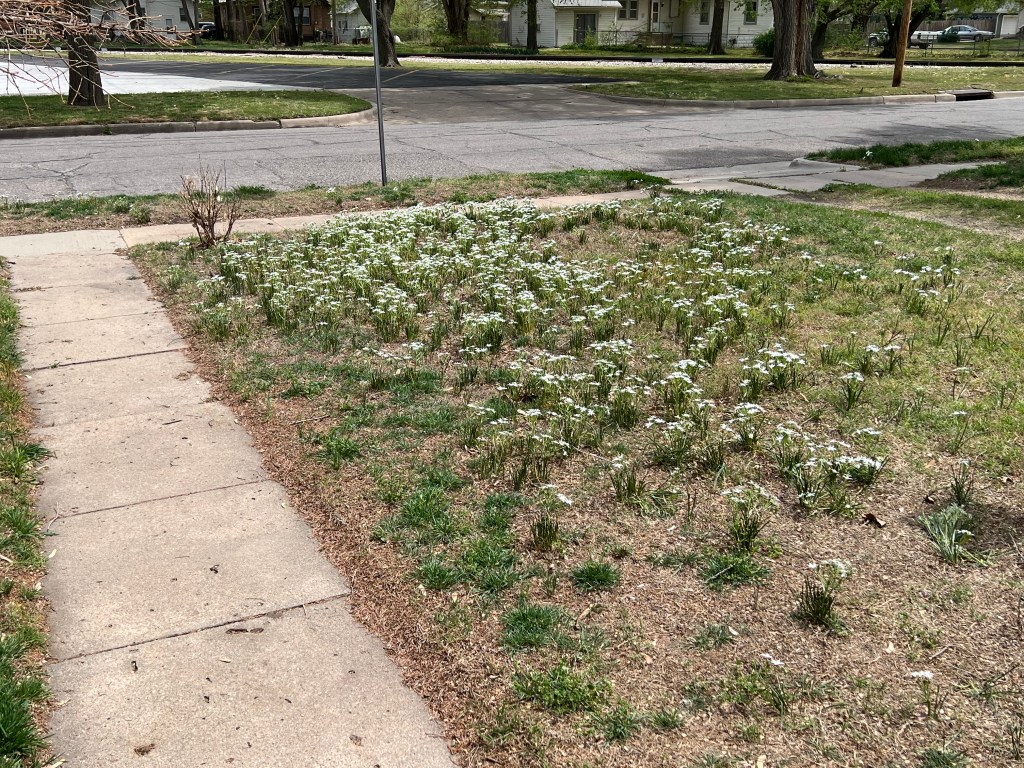
I had a vacation week after the crush of Easter and decided to use it to go see family in Wichita.  My sister was also coming out from Maine, so Melissa checked several options where we could stay.  The room at mom’s place was booked most of the time and my brother was just returning from an extended trip and we thought it might be good to give them some down time before crashing at their house.   I have stayed in local inns not far from mom.  These are nice but staying in a motel means cramped quarters and usually increased travel.  Melissa checked online and found a nice bungalow in a historic neighborhood close to mom.  It had two bedrooms with queen beds, a modern kitchen with laundry, and Wi-Fi.  While it did not come with breakfast, it was half the price of the motels we had previously used.  My sister and I both pulled into mom’s about the same time and visited before taking the short drive to the rental.  We arrived at the house at night, and I was amused to see the clumps of flowers that had taken over the lawn.  When I used my Google identification app the next morning, I found the flowers were called Star of Bethlehem.      

When I looked online, I found Star of Bethlehem (Ornithogalum umbellatum) is a flowering perennial bulb that grows in clumps with narrow, grass-like leaves about 1 foot (30 cm) long.  Star of Bethlehem is native to Europe but escaped from cultivation and is now naturalized in North America, including the eastern third of Kansas where it is identified as a wildflower.  Flower stems emerge from the plant’s foliage in the late spring, each bearing around 10 to 20 star-shaped blooms that are less than an inch across.  The flowers open in the late morning and close once the sun goes down or during cloudy weather.  Star of Bethlehem has a fast growth rate and will quickly spread.  When used by gardeners, the bulbs should be planted in the fall for spring flowers.  The plant is considered invasive in some regions due to rapid growth and expansion.  Perhaps this may also be because the plant is toxic to humans and animals and is known to kill the cattle that graze the Flint Hills of eastern Kansas.

After the Star of Bethlehem flowers finish blooming, the plant looks like a mass of tangled foliage and is not particularly attractive.  However, as long as the clump stays green it continues to feed the bulbs through photosynthesis.  Eventually the leaves turn brown, and the plant goes dormant during the summer.  This leaves gaps in the flower bed and people often remove the dead foliage.  Many gardeners plug these gaps with annual plants, while others grow perennials next to the Star of Bethlehem plants that fill in the space as summer progresses.  Deadheading the spent flowers does not prompt additional blooming, but it does limit the spread of the plant by eliminating the seeds that quickly volunteer new plants wherever they fall.  The bulbs also multiply prolifically, producing what are referred to as offsets or bulbils.  In many states, this plant earns a severe “Do Not Plant” warning against invasiveness, and you are advised to check with local experts before planting Star of Bethlehem in your garden.  I do not know if the species was planted by someone in this historic neighborhood, but it has taken hold of this and every front yard on the block.  They are no doubt removed by the residents with the first mowing.

Thoughts:  A folktale tells the species got its start as fragments of the biblical Star of Bethlehem fell from the sky and took root as Ornithogalum plants.  The random pattern of growth reminded me of the grape hyacinth that arrive in my own yard every spring until I finally mow them down.  They are also invasive and plentiful.  Even being invasive, I do not mind the color added by the flowers.  At least the hyacinth will not kill myself or my dogs.  Humans tend to justify and tolerate most anything, until they do not.  Act for all.  Change is coming and it starts with you.
Alert

April 04, 2023

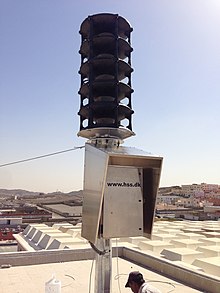
When Zena and I were walking in the park last month we saw a crew putting a large telephone-type pole along the road at one of the highest spots.  As they worked on setting the pole in, they seemed to be having difficulty straightening the 50 foot (15.25 m) long piece of wood.  When we came up the hill to the park the next day, they were attaching a large metal object to the top to the pole.  At first, I thought it was a cell tower, but those usually mount on metal towers.  Then I realized this was the newest siren for our town’s tornado alert system.  When we walked the next week I noticed the pole was beginning to lean, and like the tower of Pisa, the lean gradually got worse.  The next week the pole had been taken down (since it was not smashed) and was lying on the ground.  They removed the alert siren and have yet to reinstall another siren at that location. 

When I looked online, I found a civil defense siren, or tornado siren, is a siren used to provide an emergency alert to the general population of approaching danger.  It is sometimes sounded again to indicate the danger has passed.  Sirens in small municipalities can also be used to alert the fire department when they are needed.   These sirens were originally designed to warn city dwellers of air raids during World War II, were later used to warn of a nuclear attack, and are now primarily used for natural disasters, like a tornado.  Modern sirens can develop sound levels up to 135 decibels at 100 feet (30 m) and by varying tones or binary patterns of sound, different alert conditions can be called.  The generalized nature of sirens led to many of them being replaced with more specific warnings, such as the TV and radio broadcast-based Emergency Alert System and the Cell broadcast-based Wireless Emergency Alerts and EU-Alert mobile technologies. 

Where we live in Sebastian County, they have long used traditional tornado sirens as their primary source to alert residents of severe weather, but their time may be limited.  Sebastian recently purchased a mass messaging system, and the alert sirens may soon become a thing of the past.  As technology advances and cell phone use continues to rise the alert sirens are gradually being phased out.  That may be a good thing, as Melissa received an alert on her cell phone saying the alert sirens are down all across the county and to use alternative forms of alert (TV, cell phone, weather channel) to stay alert for a tornado.  I did not receive an alert.

THOUGHTS:  When I was growing up the small town where I lived would test their alert siren during the spring on every Monday at noon.  This served as a good way to make sure the alert still worked, and it helped me track the time on a lazy Monday morning.  I always wondered what would happen if we had a tornado at the time of the test.  I later found out the alert siren was not set to go off if the weather looked like there may be a tornado.  Apparently, this was “need to know info” that all the adults were aware of, and it was only the children who were kept in the dark.  This was also a time when we had a practice alert for “duck and cover”.  When the alert sounded we would all duck under our school desk to prepare for a nuclear attack.  While this may have been “need to know”, even as a child I knew my desk was no match for a nuclear attack.  Staying alert and practicing facing possible danger is just as important now as it has been in the past.  Sadly, that is true for schools, homes, and municipalities.  Act for all.  Change is coming and it starts with you.
Beethoven

March 28, 2023

Credit: Susanna Sabin

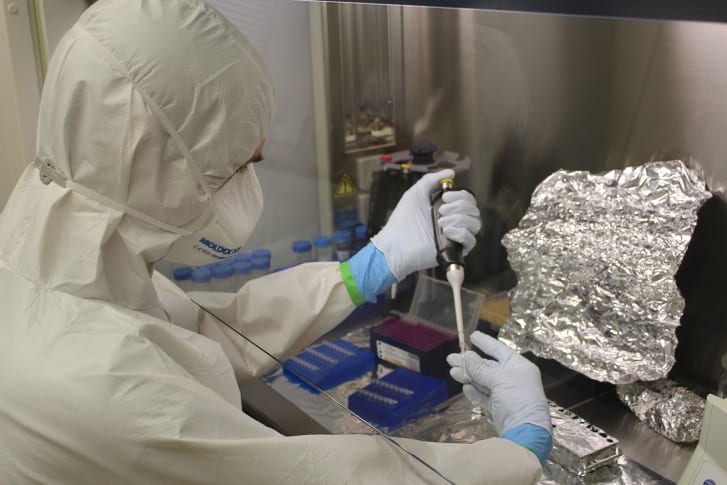
My NY Times feed directed me to a report published last Wednesday in the journal Current Biology on an analysis of locks of hair from Ludwig van Beethoven.  When Beethoven died (March 27, 1827) at the age of 56 it was his wish that his ailments be studied and shared so “as far as possible at least the world will be reconciled to me after my death.”  Beethoven had chronic health issues, including progressive hearing loss that began in his mid- to late-20s and left him functionally deaf by his mid-40s, recurring gastrointestinal complaints, and severe liver disease.  Beethoven wrote a letter to his brothers in 1802, the Heiligenstadt Testament, asking that his doctor, Johann Adam Schmidt, be allowed to determine and share the nature of his “illness” once Beethoven died.  Beethoven outlived the doctor by 18 years and the testament was discovered in a hidden compartment in his writing desk after he died.  Hair samples helped scientists discover insights about family history, chronic health problems, and what may have contributed to his death.  The wish has been partially honored by the sequencing of his genome. 

When I looked online, I found whole genome sequencing (WGS) is the process of determining the entirety, or near entirety, of the DNA sequence of an organism’s genome.  This entails sequencing an organism’s chromosomal DNA as well as DNA contained in the mitochondria.  Genome sequencing has largely been used as a research tool but was introduced to clinics in 2014.  Personalized medicine in the future may use this data as an important tool to guide possible treatments and may lay the foundation for predicting disease susceptibility and drug response.  WGS is different than DNA profiling, which only determines the likelihood that genetic material came from a specific individual or group, and does not contain information on genetic relationships, origin, or whether the person is susceptible to specific diseases.  Research on Beethoven’s hair samples used WGS.

There have been questions concerning what ailed Beethoven in life and cause d his death.  During the last seven years Beethoven experienced at least two attacks of jaundice from the liver disease that led to a general belief that he died from cirrhosis.  Medical biographers have combed Beethoven’s letters and diaries, his autopsy, notes from his physicians, and even notes taken by examiners when his body was twice exhumed (1863 and 1888), with hopes of piecing together his complicated medical history.  This new research took the study further by using eight samples of hair cut from his head in the seven years prior to his death.  While a definitive cause was not determined, there were several significant genetic risk factors for liver disease along with evidence of a hepatitis B infection in the last months before his final illness.  Letters written by Beethoven, and those of his friends, show that he regularly consumed alcohol, and at least a liter of wine with lunch each day.  Alcohol combined with genetic risk factors for liver disease and his hepatitis B infection might have created the perfect storm for his failing health.  The report ended with the disclaimer that additional research is needed.

THOUGHTS:  When genetic profile for Beethoven was determined the researchers compared it with the DNA of his living relatives in Belgium but did not find a complete match.  Some relatives shared a paternal ancestor in the late 1500’s and early 1600’s, but there was no Y-chromosome match.  This suggests an extramarital affair on Beethoven’s father’s side that resulted in a child sometime between the 1572 conception of Hendrik van Beethoven and the conception of Ludwig van Beethoven in 1770.  It is doubtful this is the finding Beethoven wanted to share with the world.  While inquiring minds may want to know, the findings are rarely what we expect.  Act for all.  Change is coming and it starts with you.

Madness

March 27, 2023

I filled out my brackets for the NCAA men’s basketball tournament again this year.  In fact, I filled out the hard copy I received in my local newspaper along with eight online versions.  I always fill out the hard copy first.  This bracket represents who I think will win the various games and ultimately the championship.  This allows me to play with the online brackets by picking different scenarios and winners.  One of those brackets is always dedicated to who I would like to win, without much care for whether they have any hope of doing so.  When I checked the brackets today, I found that all 20,056,273 brackets have fallen, and no perfect brackets remain.  I heard from my brother last week the reality is bleaker.  After the Thursday games on opening weekend only 70 brackets were intact.  These remaining perfect brackets fell with the loss by Perdue on Friday.  I guess there is a reason they call it March Madness.

When I looked online, I found March Madness is the trademark of the annual men’s college basketball tournament held by the NCAA from mid-March to early April.  The tournament began with eight teams playing against one another in 1939, with Oregon beating Ohio State to take the first title.  The tournament expanded from 8 to 16 teams in 1951, doubled to 32 teams in 1975, and doubled again to 64 in 1985.  There are now 68 teams who make the tournament, with eight participating in play-in games to make the official first-round field of 64.  March Madness was first used in 1939 when Illinois high school official Henry V. Porter referenced the state tournament in the magazine, Illinois High School Athlete.  The term did not become associated with the NCAA Tournament until 1982, when CBS broadcaster Brent Musburger used it during his coverage of the tournament.  Musburger claims that he got the term from car dealership commercials he saw while broadcasting the Illinois state high school basketball tournament.  He started using it during those High School games and eventually brought it over to CBS referring to the men’s tournament.

The NCAA’s March Madness strictly referred to the men’s basketball tournament through the 2021 tournament.  The NCAA expanded the brand’s use to the 2022 women’s tournament as part of an initiative to bring equity between the men’s and women’s tournaments.  During the 2021 NCAA basketball tournaments, women’s basketball coaches were among the leading voices criticizing the NCAA for gender inequality in its basketball championships.  The Women’s Basketball Coaches Association created a campaign that year called OurFairShot to publicize the NCAA’s favoritism toward the men’s tournament and to pressure the NCAA to make changes.  The OurFairShot website pointed out that the NCAA did not use the March Madness brand for the women’s tournament or on social media.  Although the NCAA’s trademark on March Madness has never had any limitations on its use for women’s basketball, it was never used.  In September 2021, the NCAA announced it would use March Madness branding for the women’s championship in 2022.

THOUGHTS:  While my brackets reflect the madness of this year’s men’s tournament, the three teams I root for all won the first round and two made the Sweet 16 (Arkansas and Kansas State).  Arkansas lost that game (Connecticut) while State pulled off an over-time win (Michigan State), before losing in the Elite Eight (Florida Atlantic University).  While all the top men’s seeds were eliminated, two of the women’s top seeds also fell the first weekend.   Part of the madness comes from the inevitable upsets and Cinderella teams that emerge.  Research shows we root for the underdog because of a phenomenon known as “schadenfreude”, or unconsciously experiencing pleasure at the misfortune of others.  It is thought this comes as we are unconsciously envious that they are doing well.  Now that is madness.  Act for all.  Change is coming and it starts with you.
Hydroplaning

March 24, 2023

We were forecast for rolling thunderstorms today that were predicted to bring heavy rain and possible flooding.  When I checked my weather app it suggested the rain would let up for an hour late in the morning.  I decided this would be a good break to take Zena for a walk before the rain got heavy again.  I put on my walking shoes and got Zena ready to go and then told Melissa we were going to the park.  Melissa’s home office sits in front of the bay window, and she warned me it had been breaking off and on and was interspersed with heavy rain.  I wavered as light rain started.  Since Zena was ready to go, I took her outside for a break, then hitched up Loki to go out.  By the time we got in the heavy rain had started.  I needed to go to the market and since I did not want to walk Zena in the rain (she does not care), I jumped in the jeep and took off.  The rain increased on the highway and I noticed I began to hydroplane in several spots.  That is when I passed a car that had slammed against the median ditch and fence.  The driver appeared to hit the same hydroplane conditions I had.

When I looked online, I found hydroplaning, or aquaplaning, is a dangerous driving condition that occurs when water causes your car’s tires to lose contact with the road surface.  The grooves in your tires are designed to act as miniature aqueducts.  They pump water away from the contact patch (where the rubber literally meets the road) at an amazing rate.  Continental Tire estimates at 50 mph (80 kph) the average new tire can disperse about eight gallons (30 L) of water per second.  When a tire cannot disperse water quick enough, the contact patch starts to ride on the surface of the water rather than the road, and that is called hydroplaning.  When the tires are hydroplaning the vehicle is out of control, and when the tires regain contact it can cause the vehicle to slip in other directions.  That is what happened to the driver in the ditch.

There are two things you can do to minimize the chance that your vehicle will be hydroplaning.  The first is to maintain proper tire pressure.  Underinflated tires can be more prone to hydroplaning, while badly overinflated tires can reduce grip in any situation.  The second is to keep your vehicle’s speed appropriate to conditions on wet roads.  Driving fast increases the rate at which your tires need to pump water.  When you slow down and avoid driving through every puddle of standing water you can drive safely.  No matter how good a driver you are, you are likely to find yourself hydroplaning at some point.  Modern vehicles are equipped with stability control which might detect the condition and may correct a skid by applying individual brakes or even cutting power.  However, once you lose contact with the road even the best electronics may not save you.  If your tire condition and speed are sensible, you will generally ride out a hydroplaning event for the seconds it takes to reach a section of the road without standing water.  Until you regain traction, you have no control.  If you panic and try to make corrections while you have no contact with the road it may not end well.

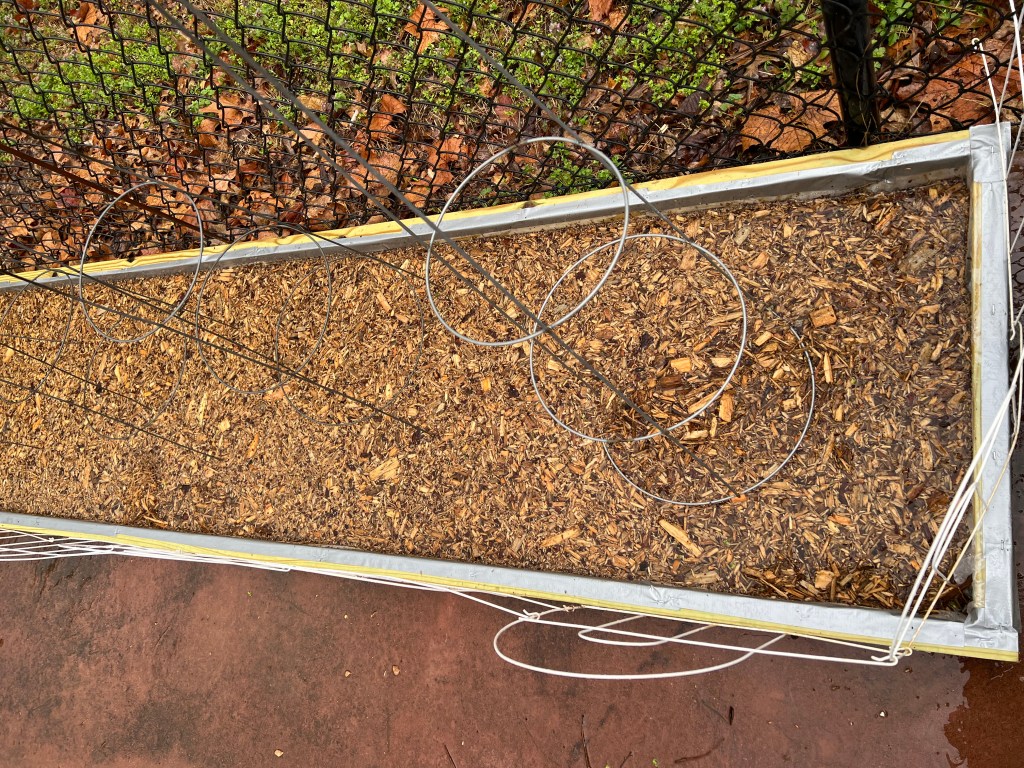
THOUGHTS:  While I did not enjoy hydroplaning on the highway, the good aspect of receiving so much water was it provided a test for the growbag bed I constructed.  When I checked the bed, it was holding water.  I had placed a bag of mulch in the bed to keep the growbags from sitting directly on the concrete and to allow for overwatering (or a big rain).  According to the YouTube videos I had watched, this water will be available to leach back up into the bag.  Many of life’s events carry positive and negative results.  The California snows have shut down transportation and trapped people in their homes, but the snowpack is a critical key for lessening the area’s three year drought.  The way to avoid hydroplaning is to prepare in advance and then to act sensibly.  The same is true water in the western US.  We need to make preparations in wet years and act sensibly every year to replenish critical groundwater.  Act for all.  Change is coming and it starts with you.
Growbag

March 23, 2023

I have been trying to grow vegetables in my back yard for the last three summers.  Every year I bemoan the lack of production from my plants and question whether or not to continue.  I have read that planting in containers tends to reduce the size of the fruit and assumed that was my problem.  Last year I tried larger pots and filled them higher to the top to increase the amount of dirt for the plants to use.  Last year I even put tomatoes directly in the ground to augment my pots.  Despite last year once more being a flop, I am still committed to container gardening as a way to grow vegetables without large tracts of land.  My online gardening group all said they had the same problem and blamed it on cold late Spring temperatures jumping immediately into a hot, dry summer.  The roots did not develop and could not save the plants from the heat.  Melissa told me a friend of hers had a good crop of tomatoes last year, although it was less than she usually grew.  She also used containers but had happened onto a form of container I had not heard of called a growbag.

When I looked online, I found a growbag is a planter filled with a growing medium and usually used for growing tomatoes or other salad crops. The bags were originally made of plastic, but modern growbags are also made from jute or fabric.  Prior to the introduction of growbags, greenhouse soil had to be replaced or sterilized each season between crops to prevent a buildup of pests and diseases in the ground.  Commercial growers could steam sterilize their ground, but this was not feasible for the amateur grower, so growbags were introduced.  Nutrients can be added to the soil (I used potting soil) so only planting and watering are required throughout the season.  Growbags were produced in the 1970’s for home use, but their use has since spread into market gardening and small farming.  The bags come in different sizes and designs suited to specific crops.  One of the sites I found advertised they had growbags ranging from 5 gallons to 400 gallons.  That might be a bit of overkill for my tomatoes.

Prior to committing to using growbags I researched them online for several days.  When it came to buying growbags, all the ads showed the bags set up on nice racks to make them easier to access.  When I watched YouTube videos on how to use the growbags they all said the same thing, this is not a good idea.  The growbags are porous which allows the air to circulate around the roots.  This provides oxygen and air pruning for the roots and discourages the roots from balling by wrapping around the bottom of the pot.  The porousness also allows water to run through the loosely packed soil in the pot.  Each video commented on wasting water or water based fertilizer if the growbags were not placed in some sort of low container.  If the container was too high, a big rain may fill it completely to the top, damaging or killing the roots.  If the growbag was placed on the ground or a rack, the water would quickly drain, and the pot’s soil would not be sufficiently moist.  Now I had another dilemma.

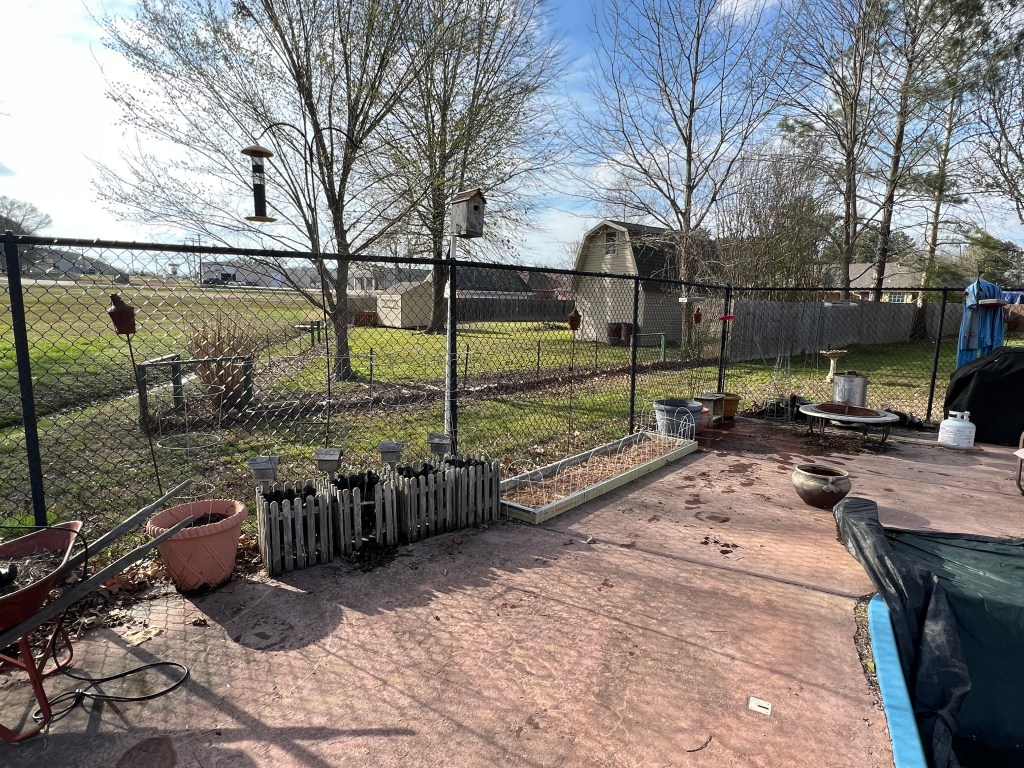
THOUGHTS:  It took me several days to try and find a suitable container for my growbag.  I decided on 20 gallon bags to ensure enough growing medium.  These were about 20 inches (50 cm) in diameter at the base and most of what I found was either too small or too expensive (3x more than the bags).  I decided to buy treated 2×4 boards screwed together in a 10×2 foot (3x.6 m) rectangle, line it with plastic (already had), and make my own.   It appears to work, but we will see when the five growbags arrive on Friday.  I guess I am committed to another year of container gardening.  With two dogs they have taken over any green space on the back patio anyway.  Humans have always been resilient and tend not to quit until we have resolved our problem.  We should use this trait to address our current tensions.  Act for all.  Change is coming and it starts with you.
Scale

March 22, 2023

Yesterday’s NY Time’s Morning feed addressed how scientists talk about climate change.  The latest United Nation’s report warned the Earth is on pace for severe climate change damage, but Americans may have a hard time understanding the report because the analysis talks about temperature shifts exclusively in degrees Celsius.  The US is among a few countries that still use a Fahrenheit scale.  Americans are a small global audience, but the US has historically emitted more greenhouse gases than any other country.  Improving Americans’ understanding could be crucial to any push for change.  For most Americans, scientists’ warning the Earth could warm by 1.5 C is a meaningless number.  When expressed as a 2.7 F equivalent it becomes clearer.  If your body temperature is raised 2.7 degrees you are running a fever, and that is an understandable analogy.  Exclusion of Fahrenheit in reports is not the main obstacle to more action on climate change, but including Fahrenheit figures could help push more action.

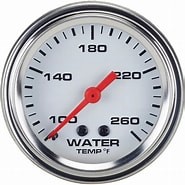
When I looked online, I found Celsius and Kelvin are the temperature scales used in the International System of Units.  The Celsius scale is named after the Swedish astronomer Anders Celsius (1701–1744) who developed a similar temperature scale in 1742.  This was called centigrade scale until being renamed in 1948 to honor Anders.  Centigrade comes from the Latin centum (100) and gradus (steps), and these 100 gradations are between water freezing (0 C) and boiling (100 C).  Fahrenheit scale is based on a proposal in 1724 by Daniel Gabriel Fahrenheit (1686–1736).  Fahrenheit’s paper suggests the lower defining point (0 F) was established as the freezing temperature of a solution of brine made from a mixture of water, ice, and salt.  For much of the 20th century, the Fahrenheit scale was defined by two fixed points, the temperature at which pure water freezes (32 F) and its boiling point (212 F).  While most countries use the Celsius scale, Fahrenheit is used in the US, some island territories, and Liberia.  The Kelvin scale is used in the sciences, with 0 K (−273.15 C) representing absolute zero, or the point when everything freezes.

A new synthesis of six previous reports by the United Nations’ climate group presents a mixed picture of the world’s climate change.  The world will likely hit what is considered safe levels of warming (1.5 C or 2.7 F) by the early 2030’s.  At the current rate, this means catastrophic flooding, deadly heat waves, crop-destroying droughts, and extreme weather.  The world has made progress.  Past climate reports warned that warming could surpass 4 C (7.2 F) by 2100 but we are now on a path toward 2 to 3 C (3.6 to 5.4 F).  This revision is based on increased use of cleaner energy and projections that coal use will continue to decline.  Despite progress, the world is still set to confront destructive change and scientists are calling for a massive effort from the world’s most powerful and richest countries.  This effort will require communicating the problem in a way relevant to all and excluding the temperature scale used by the US and some others hinders that mission.

THOUGHTS:  Language proficiency scales are indicators of how well you speak a language.  These scales provide a standardized measure of fluency as basic, conversational, business, and fluent.  We have all been baffled by instructions for the new product we are putting together and been stymied by the obvious mistranslation provided.  This is true with the English translation I receive and no doubt for the Spanish or Chinese translations read by others.  This also happens in conversation.  If you do not speak in a way relevant to another, they will not pay attention.  Talking past others with eloquent words or deep thoughts may indicate your scale of proficiency, but it is useless if they do not listen.  Act for all.  Change is coming and it starts with you.
Gregorian

March 21, 2023

©bigstockphoto.com/dubassy

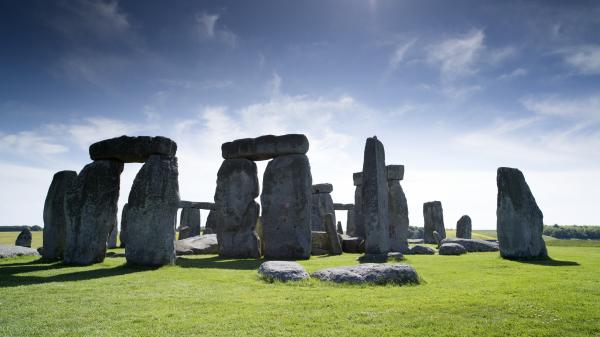
The March equinox occurred yesterday, March 20, at 5:24 pm EDT.  This marks the astronomical beginning of the spring season in the Northern Hemisphere and the autumn season in the Southern Hemisphere.  While I have always thought of this happening on March 21, the date of the equinox shifts every year.  In the Northern Hemisphere the spring equinox, or March equinox or vernal equinox, occurs when the Sun crosses the celestial equator going south to north.  It is called the “celestial” equator because it’s an imaginary line in the sky above the Earth’s equator.  On the March equinox, the Northern Hemisphere and Southern Hemisphere receive roughly equal amounts of sunlight as neither hemisphere is tilted more toward or away from the Sun than the other.  Spring arrived on the 21st of March during most of the 20th century, but the event slides earlier and earlier during the 400-year Gregorian calendar cycle, and the final March 21st equinox for this Gregorian cycle was in 2007.

When I looked online, I found when Julius Caesar established the Julian calendar in 45 BCE, he set March 25th as the date of the spring equinox as this was already the starting day of the year in the Persian and Indian calendars.  The Julian year is longer than the tropical year by about 11.3 minutes on average (1 day in 128 years), which caused the two equinoxes to “drift” on the calendar.  This drift induced Pope Gregory XIII to establish the modern Gregorian calendar in 1582 CE.  Gregory wanted to continue to conform with the edicts of the Council of Nicaea in 325 CE concerning the date of Easter, and wanted to move the vernal equinox to the date on which it fell at that time and maintain it at around that date in the future.  This was achieved by reducing the number of leap years from 100 to 97 every 400 years.  There was still a small residual variation in the date and time of the vernal equinox of about ±27 hours from its mean position.  While the variation is less, the equinox date still has some drift in the Gregorian calendar.

Today the Gregorian calendar is the internationally accepted civil calendar and is also known as the Western or Christian calendar.  It is a solar calendar based on a 365-day common year divided into 12 months of irregular lengths.  Eleven of the months have either 30 or 31 days, while the second month, February, has only 28 days during the common year.  However, (nearly) every four years is a leap year when one extra (intercalary) day, is added on February 29th, making the leap year in the Gregorian calendar 366 days long.  The days of the year in the Gregorian calendar are divided into 7-day weeks, and the weeks are numbered 1 to 52 or 53.  The international standard is to start the week on Monday, but several countries, including the US and Canada, count Sunday as the first day of the week.  The Gregorian calendar was first adopted in Italy, Poland, Portugal, and Spain in 1582 and included the new formula for calculating leap years.  Leap years occur when the year is evenly divisible by 4, unless it can be evenly divided by 100, then it is not a leap year.  But, if the year is also evenly divisible by 400, it is a still a leap year.  Who says time is not relative?

THOUGHTS:  Equatorial countries abide by the Gregorian Calendar based on differences in sunrise and sunset even though these do not make sense.  My sister was traveling in Bali located close to the equator and mentioned the sun comes up and goes down around 6 am/pm every day of the year.  The Western or Gregorian calendar is international despite other existing systems.  This reflects the dominance exerted by western Europe during the Age of Discovery, even while many did not think they needed to be discovered.  The globalization of our world over the last decades has made a single reference point (calendar) convenient, but we need to remember the calendar used reflects Western culture and thought.  Act for all.  Change is coming and it starts with you.