ChatGPT

December 10, 2022

My NYT The Morning news feed this week featured an article on how good artificial intelligence has become.  ChatGPT debuted last week and has already wowed users.  New York magazine journalists at asked it to write an article and got what they called a “pretty decent” story.  Other users got the AI to write solid academic essays on a variety of topics, and even to write some jokes.  German Lopez is the author of the article and said what is remarkable about these writings is their quality.  They could have been written by a human.  According to OpenAI, the company behind ChatGPT, they are now working on a better model that could be released next year.  This might improve the level of college English essays (Is it plagiarism if it is an original essay by an AI you own?).

When I looked online, I found ChatGPT is a large language model trained on a massive trove of information online to create its responses.  It comes from the same company behind DALL-E, which generates a seemingly limitless range of images in response to prompts from users and is the next iteration of text-generator GPT-3.  After signing up for ChatGPT, users can ask the AI system to field a range of questions, such as “Who was the president of the United States in 1955,” or summarize difficult concepts into something a second grader could understand.  It will even tackle open-ended questions, such as “What’s the meaning of life?” or “What should I wear if it’s 40 degrees outside today?”  Some users are getting more creative, with examples including asking for fairy-tale inspired home décor tips and giving it an AP English exam question (it responded with a 5 paragraph essay about Wuthering Heights). 

While some are in awe of ChatGPT, others are closer to the edge of fear.  This chatbot is so advanced it could render search engines and the countless jobs to maintain them obsolete.  ChatGPT already has more than 1 million users worldwide with its advanced functions in the first week.  These range from instantly composing complex essays and computer code to drafting marketing pitches and interior decorating schemes.  The AI’s ability to contrive poems and jokes was previously thought to only be relegated to humans.  ChatGPT’s capabilities have even sparked fears that Google may not have an online search monopoly for much longer.  Gmail developer Paul Buchheit tweeted on December 1st that, “AI will eliminate the search engine result page, which is where they (Google) make most of their money.”  Buchheit went on to say ChatGPT and similar AI will do to web search what Google did to the Yellow Pages.

THOUGHTS:  In a blog post last week, OpenAI said the “format makes it possible for the tool to answer follow-up questions, admit its mistakes, challenge incorrect premises, and reject (unsuitable) requests.”  As of Monday morning, the page to try ChatGPT was down, citing “exceptionally high demand,” and “Please hang tight as we work on scaling our systems.”  I guess there are still limits to the AI’s capability.  It is interesting that there were few complaints when Google did away with the printing and advertising jobs for the Yellow Pages (now in digital format), yet potential job loss for Google is touted as dreadful.  Every new technology replaces the “old ways” to be successful.  While this may be more rapid than before, it does not make it worse.  Jobs are rarely lost; the work is just changed to create different opportunities.  The trick is to be in the forefront of this progression rather than to resist and be left behind.  Act for all.  Change is coming and it starts with you.
Kosher

December 09, 2022

The lead story in the Living section of today’s local newspaper was about making bagel sandwiches for Jewish fans at the World Cup in Qatar.  The sandwiches are being made by Rabbi Eli Chitrik and sold out of his hotel room.  The kosher kitchen used is making more than 100 sandwiches a day.  Discussion to allow the kosher kitchen went on for five years prior to opening of the World Cup and included allowing Israelis in attendance at the Cup and direct flights from Tel Aviv, Israel, to Doha, Qatar.  Qatar has a history of public support for Palestinians and insisted this was merely to comply with FIFA hosting requirements and not a step toward normalizing relations with Israel, as happened in 2020 with Bahrain and the United Arab Emirates.  When Chitrik walks the streets of Doha he wears his religious garb, including a black hat and fringed undergarment (tzitzit).  Chitrik wants to show you can go anywhere in the world and live openly as a Jew, in the same way you should be able to live openly as a Muslim or a Christian. 

When I looked online, I found to function as a kosher kitchen there must be room to prepare meat and dairy products separately.  In modern kitchens this means separate counter space and some even have separate sinks, dishwashers, and ovens.  While prep space can theoretically be shared, it is essential to have separate sets of utensils, since the same pot or utensils cannot be used for both meat and dairy.  Before a kitchen can be used for kosher foods, all traces of non-kosher must be purged and utensils must be designated for meat, dairy, and parve (neither meat nor dairy).  A rule of thumb is that any non-kosher items must be removed in the same way it was absorbed.  A drinking glass can be rinsed thoroughly, but a cooking pot needs to be purged.  This requires waiting 24 hours and then being cleansed with boiling water (known as hagalah).  A skillet would need to be heated directly on the fire (known as libun) or run through a cleaning cycle in a self-cleaning oven.  Substances like pottery cannot be properly purged.  A porcelain sink cannot be made kosher, and the kosher user would need to not wash their dishes directly in a sink that had been used for milk and meat or parve.  Finally, any glass and metal utensils purchased from non-Jewish sources must be immersed in a mikvah (ritual bath).  The kosher kitchen in Qatar was also inspected by a rabbi prior to use.

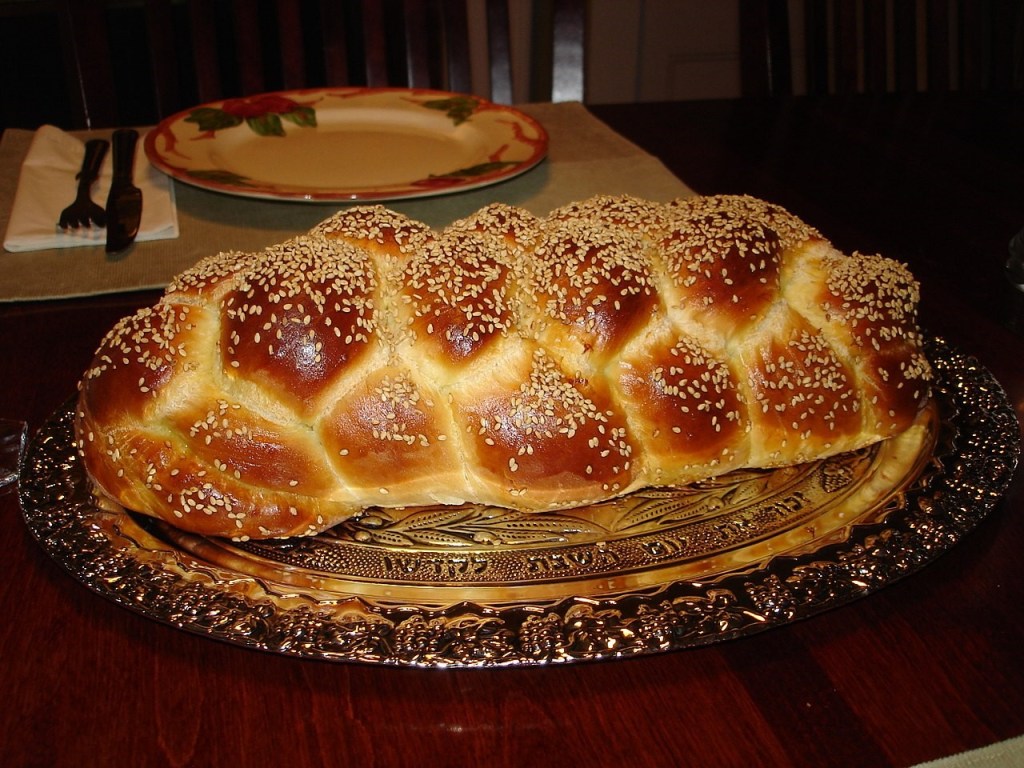
The kosher kitchen makes challah on Fridays.  Challah is a special bread of Ashkenazi Jewish origin, usually braided and typically eaten on ceremonial occasions such as Shabbat (Sabbath) and major Jewish holidays (other than Passover).  Kosher challah is made of dough that has a small portion set aside as an offering, and the term challah also refers to the dough offering.  The word is biblical in origin, though originally referred only to the dough offering.  Similar braided, egg-enriched breads are made in other traditions.  The Polish chałka is similar, though sweeter than challah.  The Czech and Slovak vánočka is very similar and traditionally eaten at Christmas.  In Bulgarian and Romanian cuisine there is a similar bread called cozonac, while tsoureki bread is popular in Armenian, Greek, and Turkish cuisines.  Brioche is another egg-enriched bread, but it is not braided.  Unlike challah, which by convention is parve, many of these breads also contain butter and milk.  One article commented that if you add more sugar, challah becomes cake.  Regardless, it appears Qatar is letting the kosher fans eat it.

THOUGHTS:  Rabbi Mendy Chitrik (Chitrik’s father), who inspected the kosher kitchen prior to its use, said, “Religious rights and freedoms of Jews, as well as any other religious group, are very, very important to be safeguarded.  Football and food bring people together.”  This is an important lesson in acceptance that goes beyond the World Cup.  Act for all.  Change is coming and it starts with you.
Hogs

December 08, 2022

The University of Arkansas hogs are again looking good in all fall sports this year.  The football team finished 6-6 and are off to the Liberty Bowl on December 28th.  Men’s Basketball is currently ranked 9th, and the women (a perfect 10-0) just cracked the rankings at 21st.  Women’s volleyball advanced to the second round of the NCAA Tournament before falling 3-1 to 3rd seeded Oregon.  Women’s Soccer has consistently been dominant and entered this season ranked 11th.  Both Women’s and Men’s Cross Country are coming off SEC championships last year and are set to make another “run”.  This is rounded out this by the Swimming and Diving teams.  Then there are the Club Sports, with the UofA Quidditch Club (yes, Harry Potter) and both Men’s and Women’s Rugby.  As I thought how the Hogs tearing up the sports fields, I opened my local newspaper to again find a front page article on how feral hogs were still tearing up real fields.

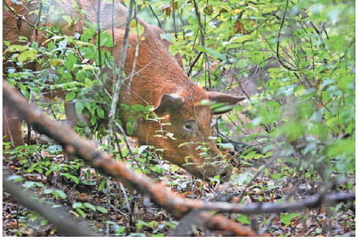
The AP article stated the war on feral hogs in the US is in its eighth year and the invasive animals are still a multibillion-dollar plague on farmers, wildlife, and the environment.  The federal program has succeeded in wiping out the hogs in 11 of the 41 states where they were reported in 2014 or 2015, and there are fewer hogs in parts of the other 30.  However, despite more than US$100 million in federal money, an estimated 6 million to 9 million feral hogs still ravage our landscape.  They tear up planted fields by wallowing out huge bare depressions.  They out-eat deer and turkeys, while eating turkey eggs and deer fawns.  The hogs carry parasites, disease, and pollute streams and rivers with their feces.  Total US damages are estimated at a minimum US$2.5 billion a year.

The four worst-hit states are California, Oklahoma, Texas, and Florida, all with more than 750,000 hogs.   Arkansas, Louisiana, Mississippi, Alabama, Georgia, North Carolina, and South Carolina put their populations at 100,000 to 750,000.  The Texas population overall has been ‘fairly stable’ at roughly 3 million since 2011, said Mike Bodenchuk, state director for USDA’s Animal and Plant Health Inspection Service.  However, statewide reduction (not eradication) is likely to be a long way off with tools and money now available.  Hogs are so prolific that 70% of those in a given area must be killed each year to keep numbers stable.  To reduce populations, you only need to kill more than are born each year, but growth rates vary in different environments and hogs can have two litters a year.  That means we need to do more monitoring.

THOUGHTS:  My nephew graduated from the University of Kansas who is the Arkansas Hogs bowl opponent this year.  When the news was announced I received a text saying, “I smell bacon.”  Research is ongoing for ways to poison feral hogs without killing other animals.  The poison used is sodium nitrite, which is a preservative in bacon, but keeps the blood of live hogs from carrying oxygen.  Currently, the two major control methods are aerial shooting and remote-controlled traps that send cellphone pictures when a hog is inside.  While the hogs seem to represent a potential food source, procuring the elusive hogs has always been a problem.   Hogs are also known to carry at least 24 diseases, including salmonella, hepatitis, E. coli, swine influenza, and trichinellosis.  Another concern is brucellosis, which is spread by bacteria.  You do not have to eat the meat to contract the desease and can be infected from contact with blood, tissue, and other bodily fluids of infected hogs.  When invasive species are introduced into other environments it rarely has a good outcome.  Act for all.  Change is coming and it starts with you.

Legend

December 03, 2022

After I posted on the poinsettia, I got a suggestion from my niece that I should follow up about the mistaken concept that the leaves are toxic.  This idea was originally spread by a 1919 urban legend of a two-year-old child dying after consuming a poinsettia leaf.  In 1944, the plant was included in H. R. Arnold’s book Poisonous Plants of Hawaii based on this premise.  Though Arnold later admitted that the story was hearsay (I heard the same thing growing up) and that poinsettias were not proven to be poisonous, the plant was still thought by many to be deadly.  The legend was revived in 1970 when the US Food and Drug Administration published a newsletter erroneously stating, “one poinsettia leaf can kill a child”.  In 1980 poinsettias were prohibited from nursing homes in a county in North Carolina due to this alleged toxicity.  This illustrates the power of the urban legend.

When I looked online, I found an urban legend (sometimes contemporary legend, modern legend, urban myth, or urban tale) is a genre of folklore comprising stories or fallacious claims circulated as true, especially as having happened to a “friend of a friend” or a family member, and often with horrifying, humorous, or cautionary elements.  These legends can be entertaining but often concern mysterious peril or troubling events, such as disappearances and strange objects or entities.  Urban legends may confirm moral standards, reflect prejudices, or be a way to make sense of societal anxieties.  Urban legends in the past were most often circulated orally, but now can also be spread by the media, including newspapers, mobile news apps, e-mail, and most often, social media.  Some urban legends have passed through the years and even decades with only minor changes, such as in where the time of the legend takes place.  Generic urban legends are often altered to suit regional variations, but the lesson or moral remains essentially the same.

I attended the University of Utah around the time Jan Harold Brunvand was professor emeritus of English.  Brunvand is best known for spreading the concept of urban legend, or modern folklore.  Before his work folk tales were thought to only be associated with ancient times or rural cultures.  Brunvand’s breakthrough was to take concepts developed in the academic study of traditional folktales and apply them to stories circulating in the modern world.  Brunvand published tales like The Vanishing Hitchhiker (1981), The Choking Doberman (1984), The Mexican Pet (1988), Curses! Broiled Again! (1990), and The Baby Train (1993), along with others. While the poison poinsettia may not have achieved the status of a book, it is an established urban legend.

THOUGHTS:  When I was exploring the process of urbanization at the turn of the 20th century one of the urban legends I found was “The Good Girl Gone Bad”.  This appeared as news articles that were always “copied” from another source and carried by small town and rural newspapers as fact.  The legend told of a small town girl who goes to the big city, falls in with the wrong crowd, and becomes either a drug addict or prostitute, all ending with the report of the girl’s death.  At first, I thought this was tragic.  Then I noticed an almost identical story in small newspapers across the West.  When I mentioned this, a friend gave me a copy of the Brunvand’s, The Mexican Pet.  Joseph Campbell was one of the foremost scholars of comparative mythology.  He likened the Star Wars franchise to the Hero’s Journey legends found around the world.  These stories challenge, guide, and even caution us.  We are still being led (misled?) by the legends that are passed on as “having really happened to my friend’s cousin”.  We can blindly accept these stories or attempt to understand the reason behind why they persist.  Act for all.  Change is coming and it starts with you.

Rosetta

December 02, 2022

Buried in the back of the front section of today’s local newspaper I found an article about a request to have the Rosetta Stone returned to Egypt.  The debate over who owns ancient artifacts has been an increasing challenge to museums across Europe and America.  It has grown increasingly common for museums and collectors to return artifacts to their country of origin.  This is often the result of a court ruling but, in some cases, it is voluntary and serves as an act of atonement for past wrongs.  Nicholas Donnell, an attorney specializing in cases concerning art and artifacts, said no common international legal framework exists for such disputes.  Unless there is clear evidence an artifact was acquired illegally, repatriation is largely at the discretion of the museum.  As Britain’s largest museum celebrates the 200-year anniversary of the decipherment of hieroglyphics, all eyes have turned to the question of the ownership of the Rosetta Stone.

When I looked online, I found the Rosetta Stone is a stele composed of granodiorite inscribed with three versions of a decree issued in Memphis, Egypt, in 196 BCE.  This was during the Ptolemaic dynasty and on behalf of King Ptolemy V Epiphanes.  The Rosetta Stone is 3 feet 8 inches (1,123 mm) high at its highest point, 2 feet 5.8 inches (757 mm) wide, 11 inches (284 mm) thick, and weighs 1,680 pounds (760 kg).  The front surface is polished, and the inscriptions are lightly incised on it.  The sides of the stone are smoothed, but the back is roughly worked, suggesting it would have not been visible when the stone was erected.  The stella bears three inscriptions: the top register in Ancient Egyptian hieroglyphs, the second in the Egyptian Demotic script, and the third in Ancient Greek.  The decree has only minor differences between the three versions, making the Rosetta Stone the key to deciphering ancient Egyptian hieroglyphics.

The stone was believed to have originally been displayed within a temple and was probably moved during the Mamluk period (13th or 14th centuries CE) and eventually used as building material in construction of Fort Julien near the town of Rashid (Rosetta in French) in the Nile Delta.  It was found in July 1799 by French officer Pierre-François Bouchard during the Napoleonic campaign in Egypt.  When the British defeated the French, they took the stone to London under the Capitulation of Alexandria treaty in 1801.  In a statement, the British Museum said the 1801 treaty includes the signature of a representative of Egypt, referring to an Ottoman admiral who fought alongside the British against the French.  The Ottoman sultan in Istanbul was nominally the ruler of Egypt at the time of Napoleon’s invasion.  The stele has been on public display at the British Museum since 1802.

THOUGHTS:  The Rosetta Stone was the first Ancient Egyptian bilingual text recovered in modern times, and it aroused widespread public interest with its potential to decipher the hieroglyphic script.  Since its discovery, three other copies of the same decree have been located, the Nubayrah Stele (limestone), the Elephantine Stele, and the Philae obelisk.  All three remain in Egypt.  The article suggested the reason for not repatriating the Rosetta is the vast popularity and tourist dollars it brings to the Museum.  This is also behind the reason for bringing it home.  Egypt’s antiquities along the Nile act as a tourist magnet that netted US$13 billion in 2021, a pandemic year.  The fact the stone was discovered in Egypt and removed as the result of war might also have something to do with the request.  Act for all.  Change is coming and it starts with you.

Whataburger

December 01, 2022

I have taken the back way into town the last two days and noticed a line of cars waiting to get into the parking lot at one of the major intersections.  The first day I went past I noticed there was a sheriff’s car parked in the road near the entrance and two uniformed officers standing at the driveway.  I tried to avoid being a “Looky Loo” and drove on by.  I was surprised to see the same situation (line, police car, and officers) again when I drove by the second day.  I could not figure out what was causing the traffic tie up.  Was this a covid test station I was not aware of?  Was it a free food giveaway popup for the holiday season?  I vowed to get to the bottom of the mystery when I got home, but before I did, I decided to read the newspaper.  The lead story on the front page concerned the new burger restaurant that just opened.  As I read the story it described the location and the precautions being taken to direct traffic in and out of the lot.  The story gave the address, and I realized the traffic jam was caused by the new Whataburger.

When I looked online, I found the Whataburger chain was started by Harmon Dobson in 1950 in Corpus Christi, Texas.  Dobson’s idea was to serve a burger so big it took two hands to hold, and so good that after a single bite customers could not help but exclaim, “What a burger!”  With this goal in mind, he named his humble burger stand, “Whataburger.”  By 1960, Whataburger had 17 restaurants and a year later the familiar orange and white striped A-frames housed the burger palace.  The chain doubled to over 200 restaurants during the 1970’s, along with the first drive-thru built in 1971.  This was the era when country music legend Mel Tillis started appearing in TV ads for the company, a role he continued through the 1980’s.  According to their website, Whataburger has continued to be owned and operated by the Dobson family and has grown to more than 890 locations across the country.  The newest one is blocking traffic in Fort Smith.

According to another website which ranked the fifteen best burgers in America, the Double Meat Whataburger ranks fourth on the list, just ahead of McDonald’s Quarter Pounder with Cheese (America’s bestselling burger) at fifth and Wendy’s Dave’s Double at sixth.  Burger King’s The Whopper fell to twelfth.  Culver’s Double Butterburger with Cheese topped the list.  Culver’s began in Wisconsin and features Wisconsin made cheese and a grilled Kaiser bun.  A 2015 survey by Franchise Business Review stated the “Culver Franchising System was rated No. 1 in franchisee satisfaction among restaurant franchises.”  There are 878 existing Culver’s locations (26 more planned) in 26 states throughout middle America.  Even though I have never heard of Culver’s, there is one existing location in Northwest Arkansas, with another planned for the same area.  I wonder if the new Culver’s will also feature a police escort.

THOUGHTS:  Sunday, September 18, was National Cheeseburger Day in 2022.  Determining the best burger in America has got to be subjective, but as I read the reviews it appeared to center around highest fat and calorie content (Whataburger’s Double ButterBurger with Cheese?).  Still, I envied the person who got the job of tasting burgers across the nation to determine which was “the best”.  Americans eat and drink about one third of their calories away from home, and in May 2017 the FDA established a statue on nutritional labeling for chain restaurants and similar establishments.  The compliance date was extended from May 5, 2017, to May 7, 2018, to allow “what opportunities there may be to reduce costs and enhance the flexibility of these requirements beyond those reflected in the final rule” (read, cut the calories).  I have since changed my order after seeing the calorie notices, and even walked out of one franchise.  Eating from a sack is convenient but is rarely based on nutrition.  Act for all.  Change is coming and it starts with you.

Party

November 30, 2022

One of the displays when I entered the big box store was rows of crock pots and it reminded me, we are entering what for many becomes the “party season” as we approach Christmas.  When I was growing up my parents hosted a party on different nights during the week to allow all the people where dad worked to attend.  This involved nearly 100 people and mom would prepare cookies for months in advance.  I continued this tradition at my own work until I retired.  At first the party consisted of finger foods, but as I aged, I became bolder with my offerings.  Each year I would select a different style for the food I prepared (Mexican, Asian, Seafood, etc.).  That also meant I needed to collect a variety of serving dishes (theme decorated, tiered displays, platters, etc.) and containers (crock pots, warmers, ice buckets, etc.) to display the dozen or more dishes I offered.  I now have two shelving units with the dozens of items that used to be on display at my Christmas party.

When I looked online, I found a variety of websites touting different ways you can create a unique theme for your Christmas party.  These ideas ranged from an ugly Christmas sweater party to kid-friendly Christmas crafts to classic winter wonderlands is on the table.  The perfect party begins with the invitations.  While invitations to a small party with family or close friends can be delivered orally, a more elegant approach is written invitations requesting RSVP (also available online).  While Christmas (and your decorations) can be the theme for the party, it was suggested you might get inspired by your favorite movie or transport your party (figuratively) to a whole new region of the world.  You can have a family-friendly party, an adults-only party, or a funny party.  The possibilities are as wide as your imagination, and your willingness to make the required preparations.

After my son graduated from college, he was able to join me several times at my annual Christmas party.  I recall one party I gave that had a seafood theme.  One of the buffet dishes was a smoked salmon fillet I had placed on a silver platter along with small serving forks.  One of the guests saw the dish and asked if it had been cooked.  I told them it had been smoked, so it did not need to be heated.  She spent the rest of the party telling other guests not to eat the salmon because it had not been cooked.  This concerned my son, and he went behind her letting the guests know the salmon was not raw but was smoked.  Difficulty can arise when you serve types of party food that are different than what your guests are accustomed to.  I served these dishes to provide something else than the meat and potato meals my guests normally ate.  Some tried the dishes, others did not.

THOUGHTS:  When I was in Paris, I took the opportunity to sample a dish I had often heard of but had never tried, escargot (snails).  They were served swimming in garlic and butter along with small forks to dig them out of their shell.  Once I got beyond the thought of eating what appeared to be a fat worm, I found them to be excellent (who could go wrong with garlic and butter, right?).  No one else at the table accepted my invitation to eat a snail.  Someone else’s party can be an occasion to try dishes that may be common to them but new to you, especially if it is a buffet.  A buffet means you can taste and eat the dish if it is good or leave it on your plate if you do not like it.  Regardless, you should remember the time and trouble your host has taken to provide you with this tasting occasion.  Being a gracious guest is every bit as important as being a gracious host.  Act for all.  Change is coming and it starts with you.

Poinsettia

November 29, 2022

Melissa was researching Christmas traditions and clicked on a site about the poinsettia.  We seem to end up with this flowering species every Christmas.  We have purchased them for ourselves, for others and had them revert to our house, and have occasionally been given a poinsettia by someone else.  When they first arrive, they are beautiful, most often bright red but occasionally ivory white.  The problem has always been they rarely last longer than the holiday season, no matter how late in the season we get them.  Melissa was perusing the site trying to discover why they seemed to die when she came across something completely unexpected.  The poinsettia is a type of succulent.

When I looked online, I found the poinsettia (Euphorbia pulcherrima) is a flowering species of the diverse family Euphorbiaceae (yes, it is related to the E. Ritcheie is just wrote about).  The species is indigenous to Mexico and Central America and was first described by Europeans in 1834.  It is particularly known for its red and green foliage and is widely used in Christmas floral displays.  The poinsettia derives its common English name from Joel Roberts Poinsett, the first US Minister to Mexico, who is credited with introducing the plant to the US in the 1830’s.  The Poinsettia is a shrub or small tree, with heights of 2 to 13 feet (0.6 to 4 m).  Wild poinsettia plants occur from Mexico to southern Guatemala, but their populations are highly fragmented due to unregulated deforestation.  The plant is often thought to be toxic, but it is not dangerous to pets or children, and exposure (even eating) usually has no effect.  Consumption has been known on occasion to cause nausea, vomiting, or diarrhea.  Unattended puppies and children will eat almost anything.

The Poinsettia is now associated with the Christmas holiday and are popular seasonal decorations.  The meaning of poinsettia at Christmas came about due to the Legend of Pepita and the Poinsettia during the 1800’s.  The legend goes that a little girl (Pepita) was going to her church’s Nativity but did not have money to buy the baby Jesus a gift.  She picked a few weeds from the roadside to create a bouquet but was disappointed with her gift.  Her cousin reminded her that a simple gift, given in love, is always appreciated by God.  When Pepita presented her bouquet, it bloomed into a bunch of vivid red poinsettia plants.  That is why the poinsettia is also called the ‘Flores de Noche Buena’ (Flowers of the Holy Night).  Others say people use a poinsettia at Christmas because it represents the Star of Bethlehem, the light that led the three wise men to the baby Jesus.  The US sells around 70 million poinsettia plants of many cultivated varieties during the six-week Christmas season.  Many of these are grown by Paul Ecke Ranch, which produces half the worldwide market and 70% of the US market.  They seem to be able to keep them alive, so there is hope.

THOUGHTS:  Prior to being known as the Christmas flower, the poinsettia plant was called the ‘cuetlaxochitl’ by the ancient Aztecs who cultivated the plant for use in traditional medicine.  As early as the 14th century, they used the plants as a type of medicine to lessen fever symptoms.  It is also utilized as red and purple dyes for clothing.  The wild plant was domesticated and has now been cultivated into over 200 varieties.  Now that Melissa knows this is a succulent, she is determined to keep ours alive (we already purchased two).  The wild poinsettia was striking enough to be noticed and preserved by the Aztecs and has been passed on to Western culture as the Christmas star.  As a domesticate they represent a US$250 million venture, yet wild cousins are in danger of eradication.  Deforestation destroys species that provide miracle drugs and economic value.  Ecosystems are worth more than the money they produce.  Act for all.  Change is coming and it starts with you.
Ritchiei

November 26, 2022

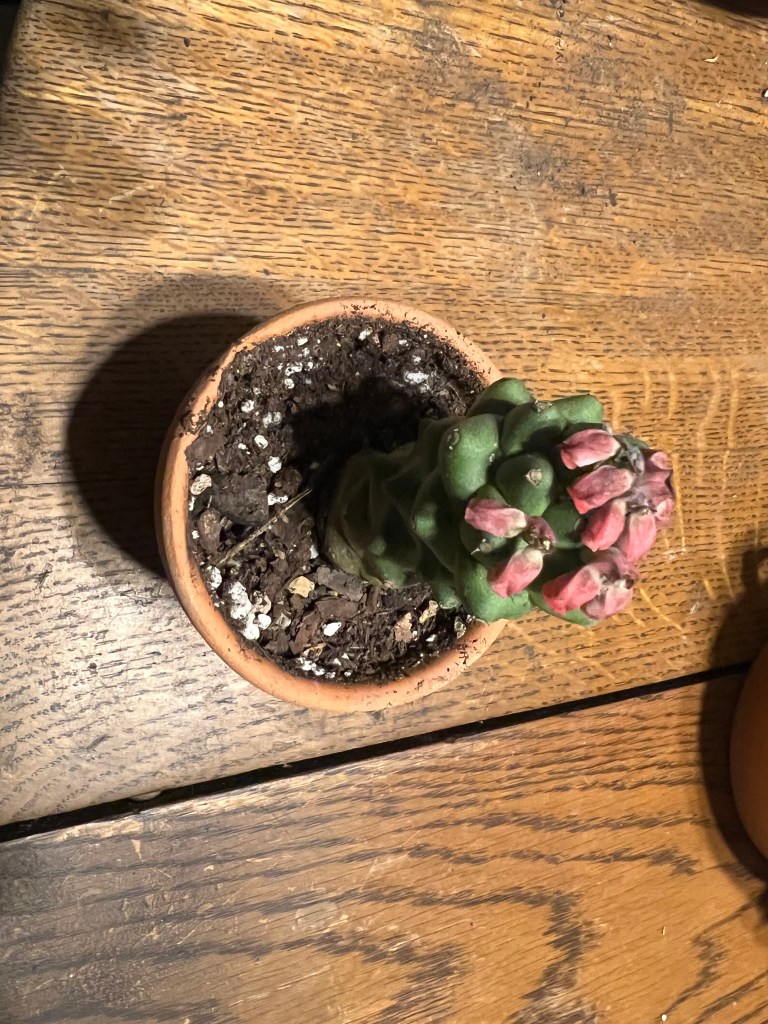
Melissa was prepping her succulents prior to our trip and came across a little oblong stub that had decided to bloom.  This was not too surprising as her succulents are transitioning from summer bloomers to winter bloomers.  During their dormant period of the year, the plants need very little care, with the minimum requirement being no water (I have mentioned this).  As they become active, their water needs are still sparse, but Melissa does like to spritz the soil and check the leaves and stems for rot or damage.  Several of the winter growers have become active this year.  They were planted two years ago, did little last year, but have now acclimated to the soil in their pots and the conditions of our greenhouse porch.  Melissa was pleasantly surprised by the number of flowers which bloomed this year.  One of these was the small red blossoms on the Ritchiei on Tuesday.

When I looked online, I found the Euphorbia Ritchiei, also known as Monadenium Ritchiei, is a succulent member of the Euphorbiaceae Family.  The species is native to Kenya and thrives around Meru, in the country’s Eastern region.  Ritchiei grows mainly on the rocky slopes of Mount Kenya at an elevation of 4250 feet (1300 m).  This dwarf clumping perennial blooms all year round and has a long life, “when the conditions are right”.  The species has a thick fleshy rootstock that forms a large clump over time.  The roots form thick tubers, which help the plant store food.  Ritchiei has a thick green, erect stem. The stems are horizontal with small spines which can grow up to 2 feet (60 cm) tall and 1.2 inches (3cm) in diameter.  These spines are a typical trait of all the Euphorbia genus.

I am always reluctant to leave Melissa’s succulents when we go on trips.  Even though we have replaced the greenhouse plastic, Melissa is constantly monitoring the temperature to keep the room hovering between 30F to 50F (-1C to 10C).  If it gets much cooler, the plants are in danger of going into shock.  If it gets much warmer, the plants can drop out of growth and revert to their dormant stage.  This is especially true if either condition exists for several days in a row.  We have lost dozens, if not hundreds, of small cuttings and shoots over the last two years.  That is one of the struggles with being a succulent grower.  I am glad melissa is monitoring the succulents as I think it would drive me crazy.  I have worried about the Ritchiei since we have been away.

THOUGHTS:  Succulents are amazingly resilient and yet extremely fragile.  Most come from tropical or semi-tropical environments, and our Ritchiei is a good example.  Kenya is situated at 1 degree longitude (equatorial).  These plants have been transported and are now being propagated in cooler climes.  They often only survive indoors, or if they are transported back and forth from inside to out and then back.  Humans spend tremendous time, energy, and money creating conditions that allow many plant species to survive.  We need to do the same to create the conditions necessary for other humans to do the same.  Act for all.  Change is coming and it starts with you.
Thanks

November 25, 2022

Yesterday was Thanksgiving and Melissa and I decided to make a quick trip to see family in Wichita.  Melissa put in her weekly hours and then logged off work around 1 pm CST on Wednesday.  We packed (yes, we should have done it the night before) and loaded the car.  I was surprised seeing we were taking more gear for our three days in Kansas than we had for our three weeks in Europe.  The air pressure in my tires had dropped due to the cold weather and I had not been able to find a place to get air.  I dropped by my regular service shop yesterday and they were already closed.  I went to three different air pumps and while I was charged US%2 at each location, the pumps did not work.  I dropped by my shop again Wednesday and they had closed for the holiday.  I finally found a station with a working pump, but it was so slow it took another US$4 to get the required 36 PSI into the tires.  It was 2:30 CST before we got off.  Still, we were going to family for the holiday, and I was able to give thanks for the expectation ahead.

We dreaded the drive because of the numbers of cars predicted to be on the road.  Since we had gotten a late start, it meant we would be passing though the only real city (Tulsa) along the way right at rush hour.  We got gas on the way out of town, and it had dropped another 10 cents (US) since Sunday.  This was well below the US$3 low it had reached earlier this month.  We filled up and began our 4 ½ hour drive to Wichita.  We drove through a light mist, but the predicted rain did not materialize.  The temperature stayed above 50F (10C) so the roads were not icy or slick.  Even the expected throng of cars did not materialize.  There was light rush hour around the city, but the roads were essentially clear.  We made good time and arrived in time to drop by mom’s residence before going to our hotel.  We were able to introduce her to Zena before the turmoil of the next day.  We were tired, but I was able to give thanks for the good day we had.  

We spent Thanksgiving at mom’s residence.  Zena was well behaved and happy to greet my uncle and aunt who drove in to eat with us.  Mom had reserved a place for the five of us for lunch.  The kitchen had set our table in the library, so we had a private dining room.  The meal was traditional, with turkey, stuffing and gravy, and green bean casserole.  There was a choice of pie (I got my new favorite, pecan) for dessert.  Mom led us in a “thanks giving” activity prior to eating, and each shared why we were thankful.  We visited and remembered the Thanksgivings at Grandma’s (their mom).  After they left, I was able to help get mom’s Christmas decorations set in her apartment.  When we returned to our hotel, I got a text thanking me for my help.  I mentioned it was good to get together with the Schirer Clan (now aunt, uncle, and mom).  Mom responded that our numbers had dwindled (there used to be nearly 30 for an all day dinner) and we had met in an assisted living facility rather than the farm, but it was still good.  I was able to give thanks for the good day we had.

THOUGHTS:  Thanksgiving is a national holiday celebrated on various dates in the US, Canada, Grenada, Saint Lucia, and Liberia.  It began as a day of giving thanks for the blessings of the harvest and of the preceding year.  Although Thanksgiving has historical roots in religious and cultural traditions, it has long been celebrated as a secular holiday as well.  Thanksgiving is more than just eating turkey and watching football.  It is about sharing with family and renewing relationships.  We had missed this time for the last years, and it was good to have the time again.  I was able to give thanks for the good day we had.  Act for all.  Change is coming and it starts with you.