Leash

May 28, 2022

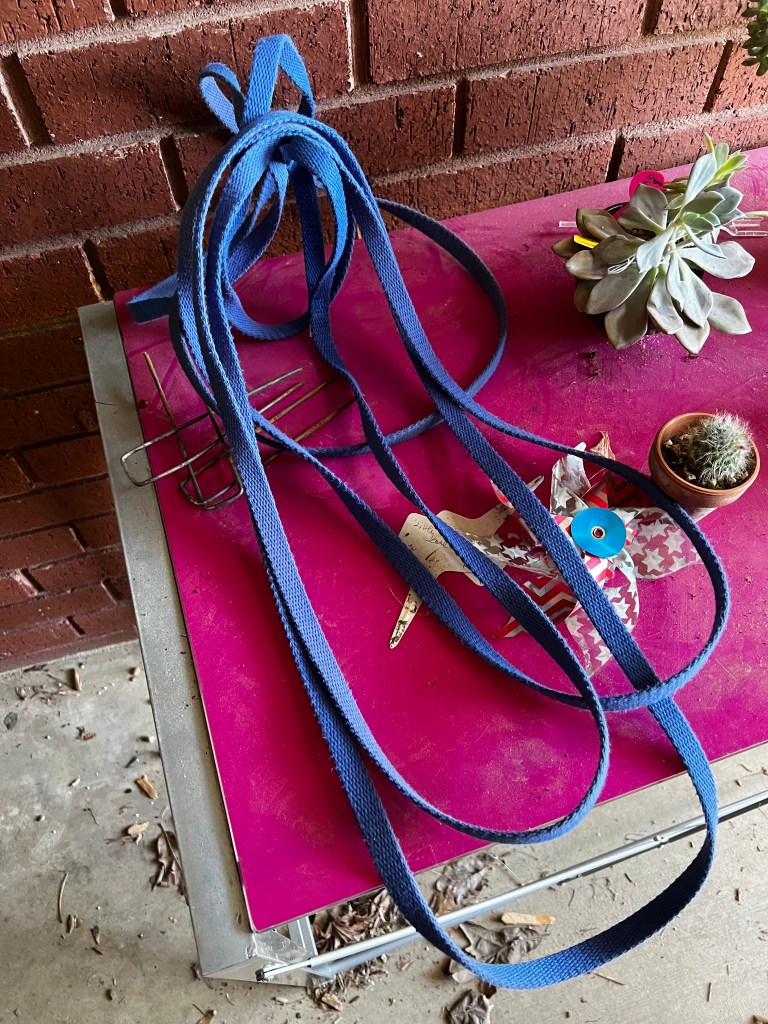
I took Zena on her first official walk today.  I had tried to take her for a walk when we first got her, but we did not get more than the end of the cul-de-sac before I gave up.  Over the last month we have gotten her used to being in her harness and have taken her outside on her leash to the vet, trainer, and when she gets the “running urge” during potty breaks.  Zena received her third series of shots yesterday which means she has been immunized and able to be around other dogs and people.  I looped her 20’ (6 m) leash in one hand and grabbed the bag of treats with the other.  Zena took off like a shot when I opened the front door (normal) and then came to an abrupt halt when she hit the end of the leash.  I let her snuffle the yard a bit, gave her a treat, and then we were off.

When I looked online, I found while several states do have state-wide dog leash requirements and laws, Arkansas does not.  These laws are usually referred to as “Running at Large Statutes.”  In states without these statutes, local governments and municipalities often enact their own leash laws, and four of the larger cities in our state require a dog to “be under physical control of a person” (i.e., on a leash).  Many other towns in Arkansas do not allow dogs to be “running at large” outside the presence of their owner, even though you often see dogs without a leash.  Many states require dangerous dogs to be on leashes and muzzled to protect public safety.  A “dangerous dog” usually refers to the act or actions of a dog that puts the public or other animals at risk for injury or death.  Again, Arkansas does not have this law.

We have had several confrontations with the pit bull that lives on the corner.  The dog is fenced, but when he barks Zena will take off to pay a visit if she is outside and not on a leash.  Today we walked by the house with no problem and continued our walk.  I was surprised how well Zena took to being on the leash.  I kept her close and she only occasionally strayed.  A few clicks and she would come back to walk the curb beside me.  On the way home we passed the corner house again, and this time the other dog was ready.  When he saw Zena he slammed into the fence gate, and in two seconds had squirmed his way under the fence and ran at us.  I stood my ground, held out my hand, and said “Stop!”  He did stop but continued to bark.  Zena sat down beside me as the owner franticly called for the dog to come back.  Not getting a reaction, the pit bull lost interest in us and started snuffling in the yard across the street.  Sensing this might be a good time, we went on toward the house.  Apparently, the “mean dog” just wanted to play.

𝗧𝗵𝗼𝘂𝗴𝗵𝘁𝘀:  We have another law that female dogs are required to be under physical control when they are in heat.  Rather than limiting the males with a leash it must be easier to require me to restrict access.  During her campaign ads our attorney general bragged about having the toughest restrictions on women in the nation, as she refused any funding to Planned Parenthood.  In other states, this group provides much of the health and reproductive care for the poor and low-income residents (male and female).  I guess it is easier to restrict access to health care than address the issue of unwanted children.  Act for all.  Change is coming and it starts with you.
Mud

May 27, 2022

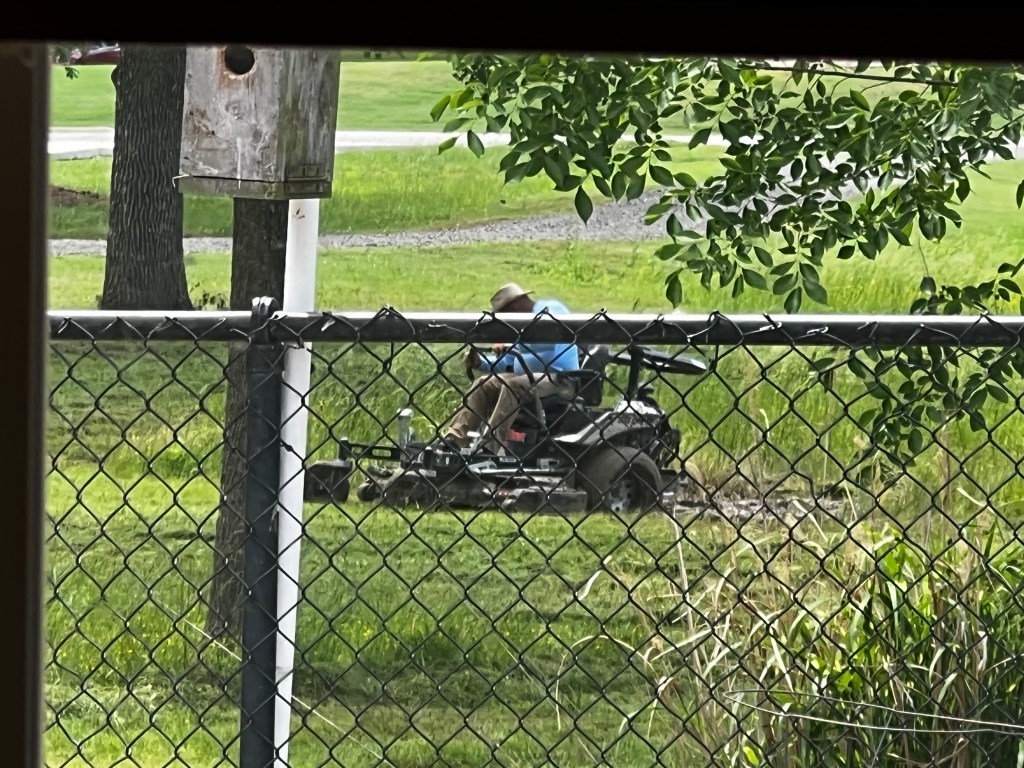
Last year I wrote about the caretaker for the church property behind us and how he would mow the grounds on Saturdays.  Part of the field he mows is a low-lying area that turns to mud every time it rains.  This did not seem to deter him, and he drove through the mud, gouging huge tracks until he got stuck.  This happened on several occasions and did not seem to improve his learning curve.  He has begun to mow again this year now that the grass is growing but has still not learned to avoid the mud.  Melissa made the comment this week that he had gotten stuck in the mud five of the last six weeks he has mowed.  The only time he did not get stuck was when another man came and mowed for him.  This younger man did not mow the low-lying area of the field. He instead avoided the mud and let the grass grow.  When the caretaker returned this week, he tried to mow this area and again got stuck in the mud.  It would be sad if it was not so funny watching him trying to get out of the mud.

When I looked online, I found the first lawn mower was created in 1830.  This was a manual reel type mower that is still in use today.  Reel mowers are environmentally friendly because they do not require gas, oil, or electricity, and instead rely on someone to push them to spin the blades.  The reels cut the grass like a pair of scissors rather than ripping the grass with blades.  Aside from the physical activity required to push the mower, the blades do not cut as close as other mowers and you may need to mow more often.  You also need to keep the blades sharp by using a sharpening tool every few months.  If you were ever frustrated trying to use dull scissors in preschool, mowing your lawn is no different.  One advantage is you will likely not get caught in the mud, and if you do it is easy to lift the mower out.

Last year the caretaker learned that getting the mower out of the mud was easier when he pulled it out with his truck.  This week he was back to square one, rocking the mower back and forth trying to dislodge it from the mud.  While he did eventually get out, he created a hole in the lawn that was 10 feet (3 m) by 5 feet (1.5 m) and a foot deep (1/3 m).  While I never got the opportunity to ask, I wondered if the church goers thought the giant mud hole in the back of the church looked better than the tall grass.  It rained again this week.  I can hardly wait until he starts to mow.

THOUGHTS: The mowing website I checked said mowing the lawn can be a gratifying and relaxing task when you have the right equipment, and at least gets you “out of doing the dishes.”  When I was growing up my older brother mowed the lawn while my sister did the dishes.  She complained that he only had to mow once a week, while she did seven days of dishes.  My brother offered to trade, and she happily agreed.  All was well until the day came to mow (our lawn was half a square block) and it took her a full morning of pushing the mower.  She never offered to trade again.  Whether it is doing the dishes or getting stuck in the mud, life is filled with trials.  The trick to overcome the trial is to have the right equipment.  A truck will easily pull a mower out of the mud, while rocking only creates a bigger mud hole.  Over the last years we seem to do more rocking about what is not allowed than pulling to get out.  We have the tools, but we need to use them.  Act for all.  Change is coming and it starts with you.

Pendens

May 26, 2022

We removed the green-house plastic from the screened in porch last month and the summer growing succulents have really responded.  We had several very hot, dry days that tricked the plants into thinking summer was here and then shifted to cooler weather that is sparking rain that seems to make them think it must be fall.  The result is many of our late summer bloomers are bursting into flower.  What makes this special is that none of the porch plants flowered last year.  We initially had trouble with Zena as she thought the funny looking plants were put on the lower shelves for her to play with.  It seems their only hindrance now is when Zena gets excited and knocks them off the shelf.  Last week Melissa called me out to the porch to see the flower on the pendens that is cascading out of its pot.

When I looked online, I found cliff cotyledons (Cotyledon pendens), are a succulent native to South Africa and Namibia.  The “cliff” designation is derived as they tend to live on rocks during summers and retreat into crevices of the same rocks in winters.  The “pendens” comes from its pendulum-like growth of leaves.  The plant has a thick, fleshy stem that can grow up to 18 inches (7.2 cm) tall. This stem then produces multiple branches which are filled with many thick, fleshy leaves used for storing water.  Each pistachio-colored leaf is about 1 inch (2.5 cm) in size with pointed ends.  The leaf edges are pinkish or reddish in color.  Instead of growing up, the plant first spreads across the pot and then hangs downward.  Flowers bloom on the tips of branches that hang down from the pot.  Flowering starts around midsummer and the bell-shaped flower ranges from orange to red, depending on the amount of light received (more light, darker flower).  It seems despite being on a Sun Porch, our pendens flower does not get a lot of light.

Like many succulents, the web site selling pendens mentioned they “can easily be cared for by beginners who have no prior experience of growing succulents.”  While that may be true, it is counterintuitive that you need to ignore them most of the year (dormant) and then watch them closely (growing season).  The species is susceptible to over-watering, and that is especially true during winter dormancy, when it is advised they only be watered monthly.  Pendens are also susceptible to frost and need to be protected during winter.  They need good drainage to protect from root rot and planted in soil that is specifically designed for succulents.  Easily cared for seems to have gotten harder when you add the specifics.

THOUGHTS:  The pendens flower is only one example of Melissa’s succulents taking hold.  After the shock of being uprooted and sent across the country in the mail they needed to adjust to a different climate, as most came from Florida or California.  We lost many of the outside aloes that first winter and then more of the inside plants when Melissa was unable to care for them last summer.  Now they have stabilized in their new environment and are producing flowers.  The attempt to grow succulents began at the same time as the pandemic began to take hold.  We have struggled with the stresses of the virus but now seem to be settling.  That does not mean there will not be times when we get knocked off the shelf, but at least now we know how to pick ourselves up, replant, and keep going.  Act for all.  Change is coming and it starts with you.
Prickly

May 25, 2022

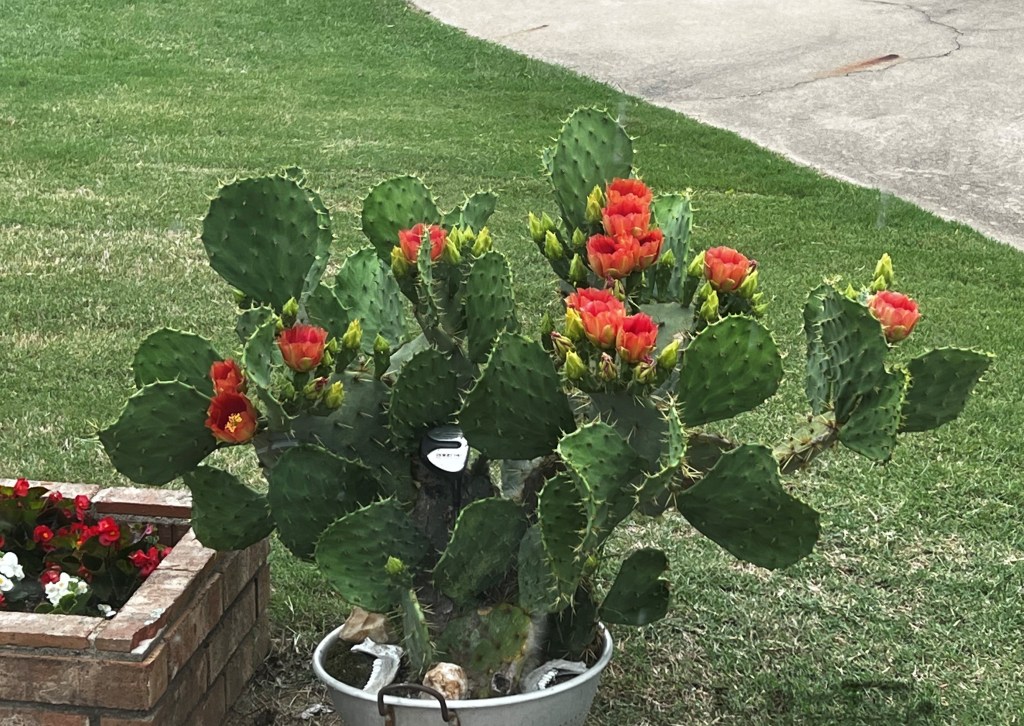
I have mentioned when I moved from California to Kansas, I brought six cacti in large terra cotta pots. They had flourished in the Bay Area climate and had grown to be quite large. I always kept them outside and knew it got cold and even snowed in the mountains of the southwestern deserts, so I thought nothing of it when the first winter approached. It may have been because they were in containers rather than the ground, but all six died. Now that I live in Arkansas, I have a neighbor who has several large prickly pears placed near their mailbox that appear to be about 15 years old (size). One is in the ground but the largest is in a container, and they are left outside year-round. This last week both prickly pears burst into brilliant flowers.

When I looked online, I found prickly pear cactus (Opuntia var.), is a genus of flowering plants in the family Cactaceae.  Prickly pear represents fifteen species of the Opuntia genus in the North American deserts.  Opuntia also hybridizes readily between species, which can make classification difficult.  The prickly originated in South America and migrated north into Mexico and the southern US.  Species of this genus flourish into Canada and are the most northern ranging cacti, and they are the only cacti in the far eastern states of the US.  The perennial plants are typically many-branched with distinctive jointed, fleshy, flattened, often rounded stem-segments known as cladodes or phylloclades (pads).  The pads are modified branches or stems that function for water storage, photosynthesis, and flower production.  The prickly pear blooms during the April-June and the species determines the color of the flower.  They can be yellow, orange, peach, cream, red, or a ‘mild’ combination of two colors.  A prickly can grow to a height of 5 feet (1.5 m) and can spread to a diameter of 15 feet (4.5 m).

Everything but the roots of the prickly pear are considered edible and can be eaten whole (boiled or grilled) or made into juice and jams.  The fruits are sold in stores as “tuna” and the pads are “nopalito”, from the Nahuatl (Aztec) word nōpalli.  The plant is high in fiber, antioxidants, and carotenoids, and is a popular food in Latin America.  The fruits are delicate and are harvested by hand.  The small spines are removed by rubbing them on an abrasive surface or sweeping them through grass, then they are peeled.  The pads are also harvested by hand and are either eaten or used for animal fodder.  Spineless cultivars are preferred, but wild types of the plants are often used after the spines burned off.  The most common culinary species is the Indian fig opuntia (Opuntia ficus-indica).  I have tried eating wild prickly in the desert.  Now if I could just get those spines out of my tongue.

THOUGHTS:  Prickly pear is said to treat diabetes, high cholesterol, obesity, enlarged prostate, lower cholesterol, prevent heart disease, and lessen hangovers, “but more research is needed.”  It is being studied for wound healing, a potential anti-cancer agent, antiviral, and anti-inflammatory properties.  Side effects may include “mild diarrhea, nausea, increased stool volume, increased stool frequency, and abdominal fullness.”  The article even said to check with my doctor before using.  This sounds much like the side effects and disclaimers provided by drug companies on my TV.  Act for all.  Change is coming and it starts with you.

Ants

May 24, 2022

Melissa had started our outside workday without me on Saturday.  She began clearing the weeds and overgrowth from the front bed under the Japanese Maple and sat on the pavement beside the bed to make it easier to work.  It did not take too long for her to call out and ask me to come outside.  The accumulated weeds and leaves had hidden a colony of black ants.  When Melissa disturbed them, they swarmed and became aggressive trying to protect the colony and were biting her hands and legs.  When I arrived, I saw she had gotten into the ant nest.  While some were busy biting her, most were scurrying around trying to protect the egg sacks that had been exposed.  These appeared to be pavement ants.

When I looked online, I found pavement ants (Tetramorium caespitum) are about 1/8 inch (0.32 cam) long with a brown or black body.  Pavement ants are an introduced species of soil-nesting ant believed to have been transported to the US in the holds of European merchant ships during the 1700’s to 1800’s.  The ships were filled with soil to provide weight (ballast) on the overseas voyage.  Once they arrived in port, the soil (along with the uninvited ants) was removed and replaced with goods to carry back across the Atlantic.  Pavement ants are one of the most common species in the US and are not often viewed as a nuisance, unless they invade your outdoor picnic (or your succulent bed).  Pavement ants earned their name for their tendency to burrow under sidewalks, driveways, and building slabs.  The little dirt mounds are often seen piled on top of the pavement.  They are rarely aggressive but can both sting and bite.  They were kind enough to do both to Melissa.

There are several other species of black ants that bite.  While these bites may cause a small welt and itching, they are not dangerous.  Acrobat ants (Crematogaster spp.) are 1/16 to 1/8 inch (0.16 to 0.32 cm) long and may be black to light brown in color.  Nests are usually outdoors under stones, in the soil, or in old trees.  Their name comes from their ability to raise their abdomens over their heads.  Carpenter ants (Camponotus spp.) are about 1/4 to 1/2 inch (0.64 to 1.28 cm) long and can be black, red, brown, or yellow.  They are the largest black ant found in homes and are often mistaken for termites.  Nests are found in rotten wood, both indoors and out.  The black imported fire ant (Solenopsis richteri) is nearly identical to the red imported fire ant (Solenopsis invicta).  Both are small ants, about 1/8 inch (0.32 cm) long, but the black fire ant is dark brown or black in color as opposed to reddish brown.  Black fire ants are the exception and may require medical treatment since some people are allergic to their venom.   Fire ants attack by biting their prey and injecting venom with a stinger.  The venom causes an intense burning sensation and creates a white pustule at the bite site.

𝗧HOUGHTS:  I never paid much attention to the ants in our yard when I was a boy, other than knowing not to mess with their nests.  That changed when I participated in an archeological survey in college.  We were retroactively surveying a reservoir that had been built several decades earlier.  The vegetation and grass were well established, and we needed to “shovel test” the grounds to see if there were any sign of human activity (chert flakes, etc.).  Of the 1000’s of shovels full of dirt unearthed, it was rare to not impact an ant colony.  There are 12,762 known species of ants and the estimated total of ant species is more than 22,000.  It is estimated the over 10 quadrillion ants on the planet comprise from 15% to 25% of the animal biomass and the estimated total weight is equal that of all humans.  Ants inhabit every continent on earth except Antarctica and a few islands.  Ants are successful because of their ability to organize and communicate with each other.  During the 1950’s ants were the protagonists of several horror B-movies.  Perhaps this was more predictive than we thought.  Act for all. Change is coming and it starts with you.
Puppies

May 23, 2022

Yesterday’s NY Times feed addressed the stress and anxiety faced by puppies adopted during the pandemic as their owners return to work.  A team from Auburn University found the “pandemic puppies” adopted in the US are fearful during encounters with other dogs and humans because they spent so much of their early lives cooped up inside.  They were also found to sometimes panic when exposed to an unfamiliar environment and are struggling to cope with being alone as their owners return to the office.  The first three months are extremely important to the puppies’ social development and even trips to the vet can be stressful as a new encounter.  

When I looked online, I found Dr. Christopher Lea of Auburn’s College of Veterinary Medicine said, “Primary socialization occurs during the first three to six weeks with a puppy’s littermates.  Then there is a secondary period of development from 6 to 12 weeks.  This is when a puppy learns to interact with humans.”  This is the time puppies learn to bond and communicate with other dogs and people properly, and how to interact and respond to different environments.  Like their owners, pandemic puppies were secluded from the world, and many were adopted by first-time owners who are more likely to make mistakes raising a young pet.  This produced what the researchers called, “a perfect storm of bad circumstances at a critical time” for the puppies and often results in separation anxiety.  This will likely get worse as owners return to the office.  The puppies have never been left alone and now the owners are returning to their normal routine.

One response to the social development issues of these puppies has been a doubling of pets returned to shelters.  What began as instant companionship during the pandemic has become an ongoing responsibility that many pet owners refuse to accept.  The American Kennel Club estimates 73% of first-time dog owners who adopted puppies during the pandemic have at least considered rehoming or turning them in to a shelter.  According to Aron Jones of Moms and Mutts Colorado Rescue in Englewood, Colorado, “the world is opening up, people are going back to work, they’re traveling.  People aren’t just lonely anymore, so the dogs are not necessarily fitting into their lifestyles, and they are returning them instead of trying to make adjustments to keep their dog.” 

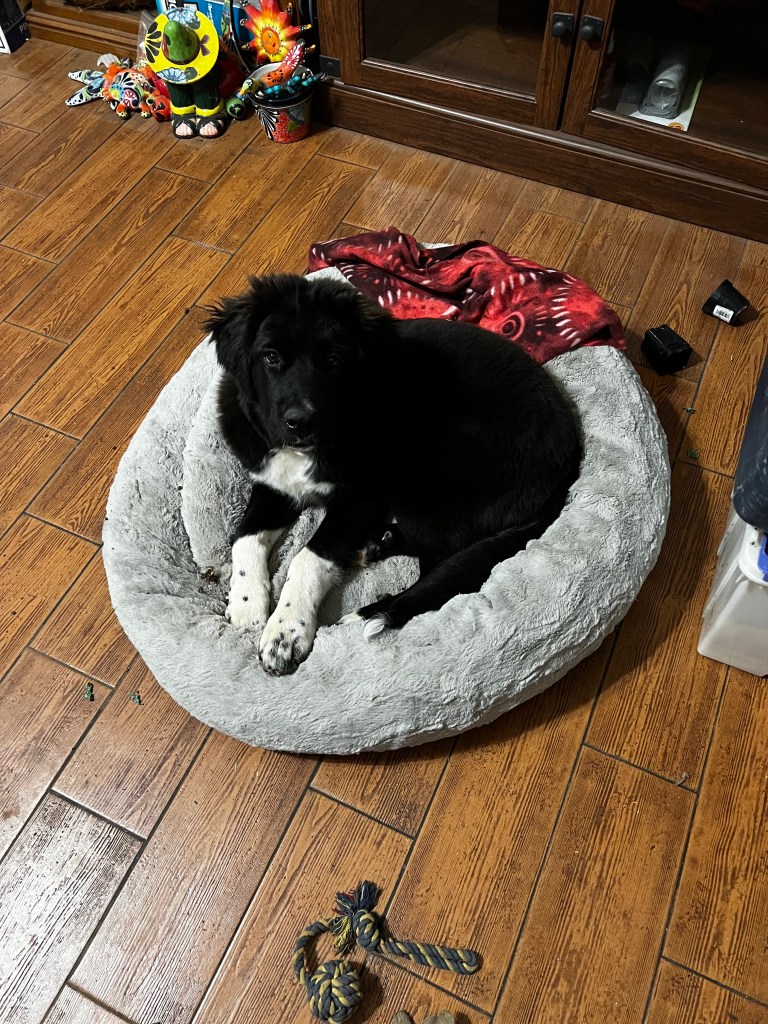
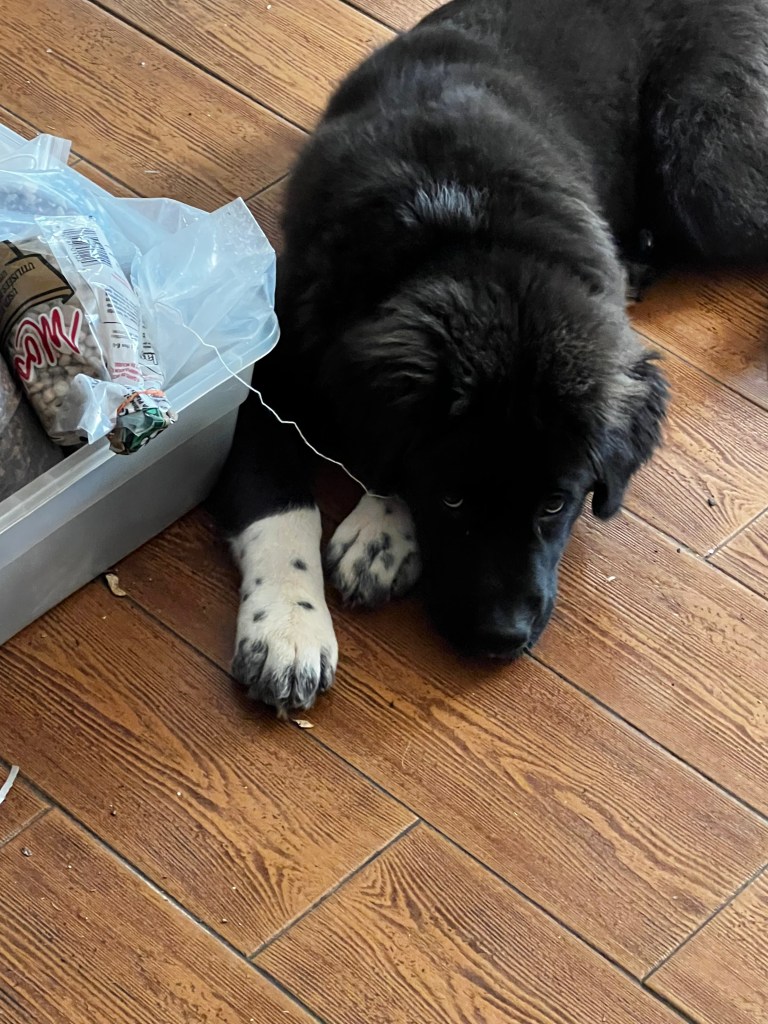
THOUGHTS:  While Zena was not adopted as one of the “pandemic puppies”, she still faces the same difficulty as we take more time away from the house.  Zena struggles with riding in a vehicle as she is still developing her inner ear and easily develops vertigo, with predictable results.  This caused Melissa to miss a scheduled trip to Kansas to stay home with the puppy.  Zena’s first hours alone resulted in an explosion in the small bathroom.  We now place her in the room where she sleeps at night along with water and a toy and she has adapted well.  Zena is in a Puppy Basics class to teach us (more than her) how to react and offer guidance.  And Zena has puppy dates with Eddie to continue the socialization began with her five littermates.  Puppies are instant companions, but like children, they are a long-term responsibility.  Like puppies, children benefit from early learning opportunities that last into adulthood.  Pre-K For All is not a slogan, it is a responsibility.  Act for all.  Change is coming and it starts with you.
Alone

May 21, 2022

I mentioned the front bed under the Bradford pear tree is usually neglected as it is just outside my normal walkway on most days.  I go out to check for the paper (they no longer deliver on Saturday) and the mail (they do not deliver on Sunday), but the bed rarely gets more than a glance.  By the time I park in the drive I am past the bed.  The bed did get attention last year when the pampas grass grew prolifically and even bloomed.  That was the first pampas bloom for as long as Melissa could remember.  I had cut it back earlier that spring and thought that might be why it grew, but I cut it this year and am not getting the same result.  Melissa had planted hen ‘n chicks in the bed, but they did not do well during the winter, and she removed them last fall.  The only thing left were the intrusive grape hyacinth and the sedum mentioned yesterday.  I had to smile when I thought about the sedum.  Like so many succulents, the secret is to make it happy, then leave it alone.

When I looked online, I found being alone became the norm during the pandemic as over 100 million American workers transitioned from in-person to remote work.  Over half of those workers hope to continue working remotely, at least part time.  That meant a lot of people were happy being left alone to accomplish their work, but that varies between groups.  The most enthusiastic group to return to work is white men, at about 30%.  That compares to 16% of Black men, while white and Black women are around 22% each.  Working remotely appears to help some demographic groups more than others.  This was particularly true for Black men, as 47% reported their sense of belonging at work is slightly or much better than in-person (30% said it has not changed).  Working remotely also helped anxiety about their work, as 64 % of Black men reported less work-related stress and anxiety in a remote setting. 

Remote work may be particularly beneficial for employees of color, who tend to experience microaggressions, harassment, and abuse more than their white colleagues in in-person settings.  Angelica Leigh, a professor at Duke University’s Fuqua School of Business said, “Dealing with racism, sexism and other forms of oppression is exhausting, and sometimes employees do need a break from just pushing through.  Remote work can provide employees with that time and space to escape.”  It is harder to be racist or sexist in a work environment of recorded meetings and easily forwarded emails.  For Leigh, a Black woman, working remotely has relieved her from having to endure comments on changes in her hairstyle from non-Black colleagues.  Being alone allows her the opportunity to concentrate on work.

THOUGHTS:  If there are disparities in who opts in (or out) of in-person work, physical offices run the risk of becoming whiter, more male-dominated, and more unfriendly to working mothers than before the pandemic.  Another report shows young males were more comfortable returning to the workplace as it afforded opportunities to meet other people, and potential dating partners.  This was not a concern for the women surveyed or for workers with a family who are not alone at home.  Humans evolved as social animals who thrive in groups, but at times we need to be alone.  During the pandemic there has been a temporary shift to the workers’ welfare rather than dictates of the company.  Business needs to adjust to the changing nature of work created by the pandemic, and a hybrid workplace may be the answer.  Act for all.  Change is coming and it starts with you.
Sedum

May 20, 2022

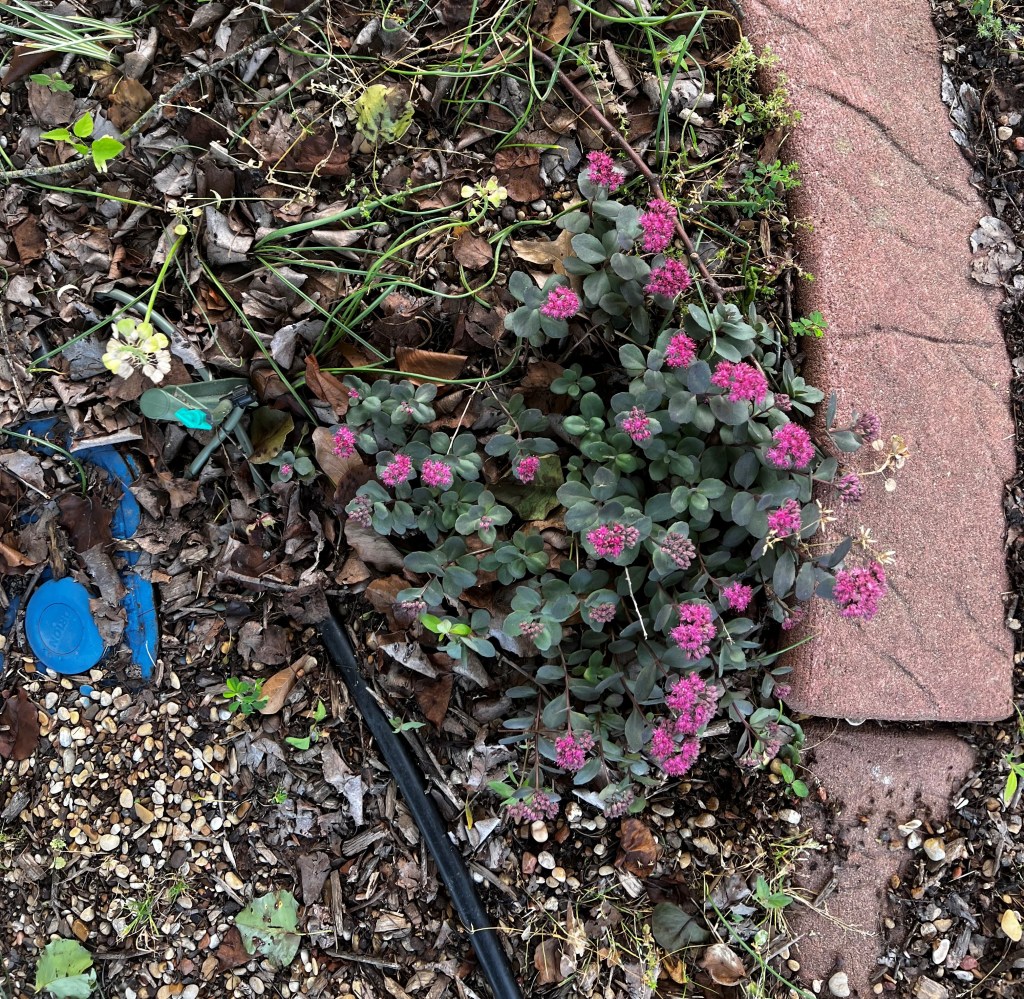
When I take Zena outside, I keep her in the main part of the yard to keep her from going “walkabout”.  When Melissa takes Zena out, she allows more latitude and lets her to go into the side yard near the front driveway bed.  Earlier this week she called for me to come and look at what was happening in the bed.  She proudly showed me how well the sedum plant was doing, noting it had also bloomed in the early summer rather than late summer.  To my credit I try to keep the bed weeded and get the twigs and leaves that fall from the Bradford pear out of the bed.  Still, the sedum always looked exhausted, and I assumed it would die like the other succulents we had planted in the bed.  Instead, it looked strong and healthy. 

Pink Mongolian Sedum (Sedum ewersii) or pink stonecrop, is a deciduous succulent that forms a low mound of decumbent stems that bear fleshy, pale green to gray-green leaves.  The scientific epithet “ewersii” honors Johann Phillip Gustav van Ewers, a German legal historian and promoter of Carl Friedrich van Ledebout’s botanical exploration in Siberia.  It grows up to 4 inches (10 cm) tall.  The stems are thin but wiry, woody, and branched at the base, and grow up to 10 inches (25 cm) long.  The leaves are rounded with margins entire or finely toothed and up to 0.8 inches (2 cm) in diameter.  The flowers are pink or pale purple and star shaped, and about 0.4 inches (1 cm) across.  It is suggested to place the sedum in a gravel scree, alpine trough, or mixed container.  The flowers are supposed to appear in late summer in clusters on short stems above the foliage.  For some reason, ours had bloomed in May.

Mongolian sedum is native to the Himalayas and the mountains of Central Asia and can thrive at elevations up to 14,000 feet (4,300 m).  In the US, it is used as an edging or rock garden plant, especially for hot, dry sites.  Melissa changed out the mulch that used to cover this bed for small pebble gravel.  In seems to have done much better since the change.  This sedum is also called Hylotelephium ewersii, yet another species that has undergone recent taxonomic change.  Hylotelephium is a genus of flowering plants in the stonecrop family Crassulaceae that includes about 33 species distributed in Asia, Europe, and North America.  Species in the genus were formerly included in Sedum and are popular garden plants.  They are still commonly known as ” sedum “, “stonecrop”, “live-for-ever” or “orpine”.

THOUGHTS:   Several front yard beds have waivered over the last years between flowers to succulents, and even back to bushes.  This is in part due to what will survive in the different shade and the Arkansas winters.  When we first put in flowers, I mulched the beds to keep the weeds down.  When Melissa wanted to grow succulents, we removed the mulch and the crepe myrtle in the side driveway beds and replaced it with pea gravel for drainage.  The big aloes we planted died from cold and the following year the myrtles self-generated.  The decision now is whether to proceed with more pea gravel (succulents) or replace the mulch (myrtle).  Many choices are dependent on nature verses human need.  When we fight nature, the ecosystem eventually wins.  Act for all.  Change is coming and it starts with you.

Circus

May 19, 2022

My NY Times news feed reported Ringling Brothers and Barnum & Bailey Circus announced yesterday that after a five-year hiatus they would resume touring in the fall of 2023.  This will not be the same old circus, as the exotic animal acts that were once the mainstay will not be included.  The revamped show will focus on human feats, like Cirque du Soleil.  Ringling even hired Giulio Scatola, a veteran of Cirque du Soleil, as a director for the new production.  Scatola said he was influenced by “America’s Got Talent,” where contestants’ stories are as significant as their acts.  The business model is also different.  Rather than touring cross-country with 500 people and 100 animals in mile-long trains, the performers will drive or fly from city to city and stay in hotels.  Logistics are easier when you do not need to check in Dumbo.

When I looked online, I found Ringling Bros. and Barnum & Bailey Circus is an American traveling circus company billed as The Greatest Show on Earth.  The predecessor shows began in 1871 and merged in 1919 when Barnum & Bailey’s Greatest Show on Earth joined with Ringling Bros. World’s Greatest Shows.  Ringling brothers purchased Barnum & Bailey Ltd. following Bailey’s death in 1906, but they continued to run the circuses separately until merging in 1919.  The iconic “big top” tents were discontinued in 1957 for permanent venues like sports stadiums and arenas.  The circus sold back and forth between the Feld brothers and Mattel toy company between 1967 and 1981.  Since the death of Irvin Feld in 1984, the circus was part of Feld Entertainment.  Weakening attendance, animal rights protests, and high operating costs resulted in the last performance on May 21, 2017, when the circus closed after 146 years.

Over the years animal rights groups criticized the circus for their treatment of animals, saying using them to perform is cruel and unnecessary.  The American Society for the Prevention of Cruelty to Animals (ASPCA) and other animal groups sued the circus in 2000, alleging that it violated the Endangered Species Act by its treatment of Asian elephants in its circus.  The US Department of Agriculture conducted inspections of the circus from 2007 to 2011, finding non-compliance with the agency’s regulations.  This led to complaints filed by PETA, and the circus agreed to pay a $270,000 fine, the largest civil penalty assessed against an exhibitor under the Animal Welfare Act.  Feld Entertainment announced in 2015 it would stop using elephants and retired them in 2016.  The 13 show elephants were sent to the circus’s Center for Elephant Conservation.  The circus said the action was not a result of animal rights allegations, but due to differences in local laws regarding whether elephants could be used in entertainment shows.  

THOUGHTS:  I recall attending a circus as a child growing up in rural Kansas.  This was not a large Ringling Brothers performance, but a small traveling circus held in the vacant field outside the nearest “big city”.  I was impressed by the eight row bleachers that lined the ring and the animal acts presented under the “Big Top”.  These were the first lions, tigers, and elephants I ever saw.  Now these exotic animals are common in zoos and wildlife parks where they roam large enclosures rather than small cages.  For many endangered species these are their only hope for reintroduction back into the wild.  Act for all.  Change is coming and it starts with you.
Hail

May 18, 2022

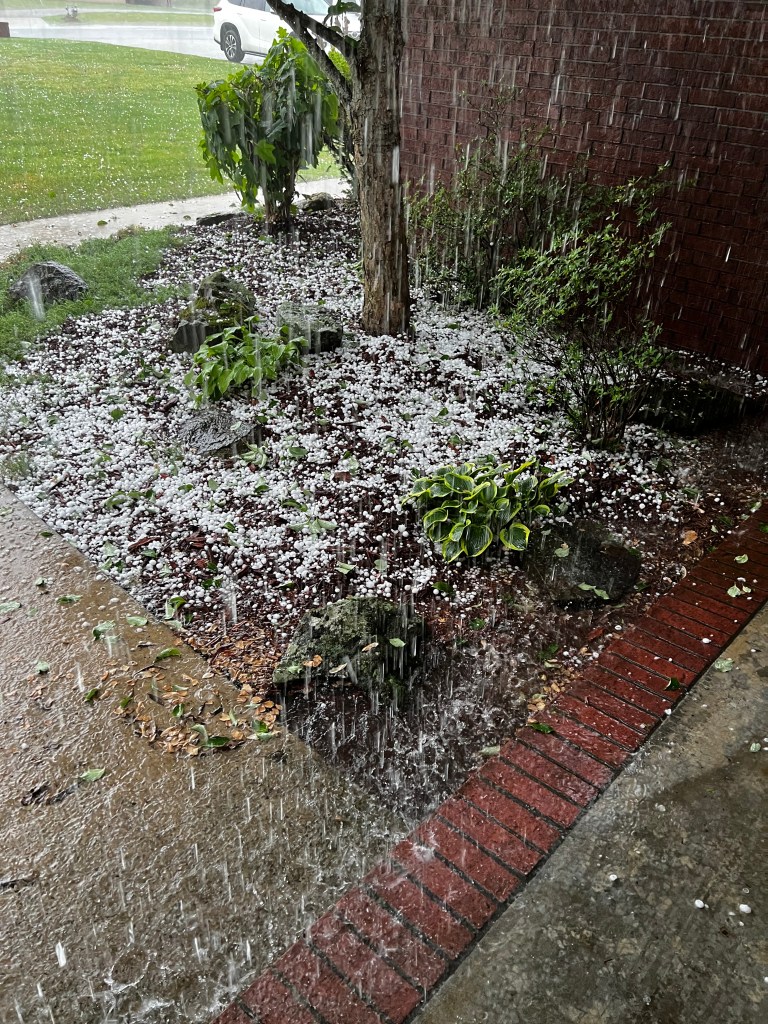
Last weekend I attended a graduation party for a friend who was transitioning from Law School to an out of state position as a lawyer.  The party favors were amusing as they had a “lawyer” bent, including M&Ms with a legal scale on the obverse of the usual M.  The sky was clouding up when I arrived, but I did not think about it too much.  I blended into the conversation until we heard a car alarm go off in the street.  When we looked outside the rain was coming down in torrents and hail had set off the alarm.  The host rushed to get his vehicle under the awning but there was nothing to do for the cars parked in the street and on the lawn. The hail was not large, but it came in buckets and bounced off the vehicles parked outside.

When I looked online, I found hail is defined as a solid form of precipitation that is distinct from ice pellets (sleet).  Hail consists of balls or irregular lumps of ice, with each called a hailstone.  Ice pellets fall in cold weather, but colder temperatures inhibit the accumulative growth of hail.  Hail stones are larger than other forms of water ice precipitation, such as graupel (rime ice), ice pellets (smaller and translucent), and snow (crystalline flakes), and measure between 0.2 inches (5 mm) and 6 inches (15 cm) in diameter.  Hail is possible during most thunderstorms and can be blown by winds as far as 2.3 miles (3.7 km) from the parent storm.  Formation requires a strong, upward motion of air within the thunderstorm (like tornadoes) and a lowered height of freezing level.  The size of hailstones is best determined by measuring their diameter with a ruler but is often estimated by comparing it to a known object, like a coin, a golf ball, or a baseball.

The hail we received ranged in size from a nickel to a quarter.  The terminal velocity of hail, or the speed when it strikes the ground, varies depending on the size of the stones.  It is estimated that a hailstone of 1 cm (0.39 in) in diameter falls at a rate of 9 m/s (20 mph), while stones the size of 8 cm (3.1 in) in diameter fall at a rate of 48 m/s (110 mph).  Hailstone velocity varies dependent on the drag coefficient, the motion of the wind it is falling through, collisions with raindrops or other hailstones, and melting as the stones fall through a warmer atmosphere.  It is difficult to accurately calculate drag coefficient as hailstones are not perfect spheres.  I later heard I was lucky.  Just a few blocks south they received baseball size hail on the Interstate.

THOUGHTS:  Hail can cause serious damage to vehicles, buildings, livestock, and crops.  Rare massive hailstones are known to cause concussions or fatal head trauma.  One of the earliest recorded incidents occurred in 9th century India, where 200 to 600 people died of injuries from hail the size of cricket balls.  The heaviest recorded hail stone was 2.25 lb (1.02 kg) in 1986, and the largest official diameter is 7.9 in (20 cm) diameter and 8.622 in (47.3 cm) in circumference in 2010.  Hail damage often goes unnoticed until another repair is required.  Melissa could not see the damage to my truck (I did) even though the estimate found extensive damage.  Words can cause similar unseen damage that can also be extensive.  We need to practice only saying words that we want others to say to us.  Act for all.  Change is coming and it starts with you.