Parodia

May 17, 2022

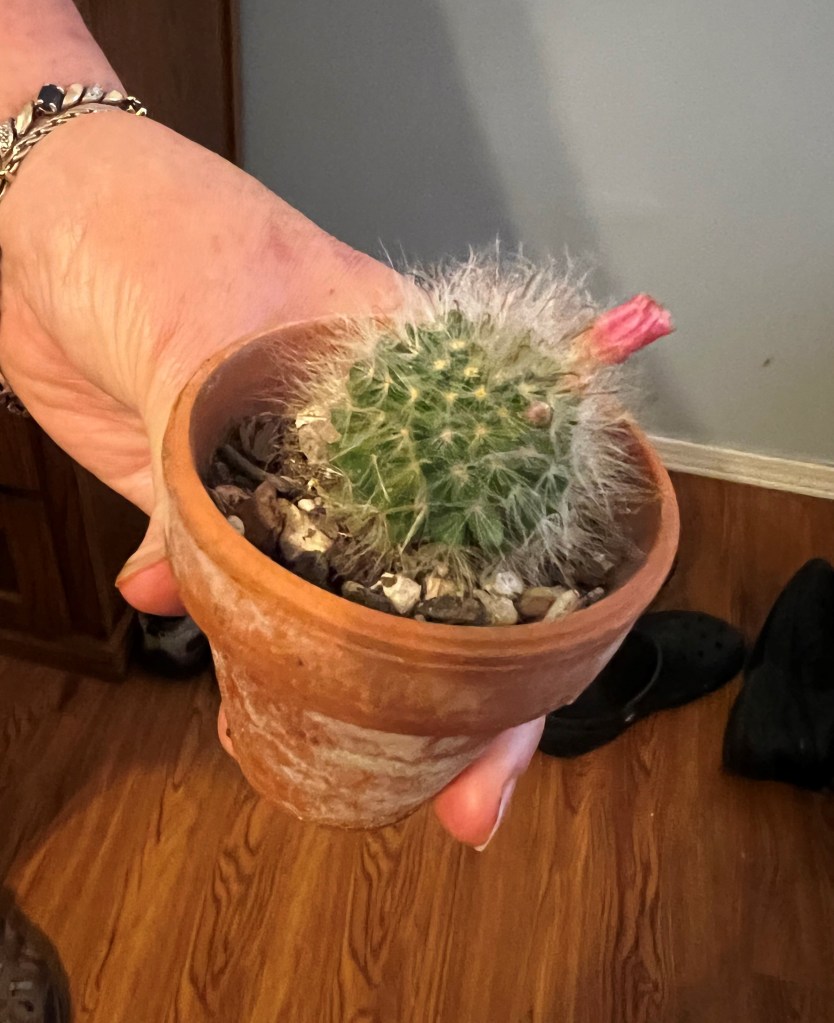
Over the weekend Melissa came in and excitedly showed me a very small cacti that had begun to flower.  She had purchased the small plant early last year and had alternately been providing the loving care and disregard all cactus seem to require.  She has impressed the succulent mantra on me, “When in doubt, cut it out,” (i.e., leave it alone).  The stress of being uprooted, shipped, and transplanted had been all the cacti could take.  Even now it was not too much bigger than it was when Melissa received it.  Another mantra is, “Go slow, it takes a long time to grow.”  Now, after having survived a year in the small pot where Melissa placed it, it was producing a bloom.  This appeared to be a small barrel (genus: Parodia) cactus but Melissa was unsure which species.  She suggested I google photo it.

When I looked online, I found the Parodia penicillata is usually a small growing, solitary cactus native to northern Argentina.  The pale green to bright green stem begins globose (spherical) and grows into a tall columnar (cylindrical) cactus.  The cactus may grow up to 18-20 inches (40-50 cm) tall and 3 ½ inches (9 cm) wide.  The spines are generally a glassy, bristly straw-color but may be pale yellow, or pale brown, and become dense on the plant.  The radial spines are thin and silky, while the central spines are longer, stiffer, and more colorful.  Funnel-shaped flowers bloom in summer in either orange-yellow or brilliant red, that form into a pointed (apical) circle.  The dried flowers will remain on the plant body for a long time after blooming.

The genus Parodia refers to flowering plants in the cactus family (Cactaceae) that are native to the uplands of Argentina, Peru, Bolivia, Brazil, Colombia, and Uruguay.  The genus has about 50 species, many of which have been transferred from what were once part of the Eriocactus, Notocactus, and Wigginsia genus.  This change has come about as botanist gain understanding on the relationship between species based on DNA research.  The concept that one species must be descended from another is known as cladistics.  Cladistics requires there can be only one line of lineage for each species, and that you cannot have two species of the same genus that are not genetically related.  The lineage must be simple and monophyletic (single ancestor).  Conversely, cladistics forbids multiple ancestors for different species in the same group (paraphyletic).  Since cladistics is the model now used to determine relationships between species and higher levels of groupings (genus, family, order, etc.), taxonomic reorganization has resulted as DNA evidence is gathered and analyzed.

THOUGHTS:  Parodia is an example for how DNA changes taxonomic classes.  Long-held beliefs about relatedness of species are thrown out because the DNA of the two are different, are not as closely related as previously thought, or the two species get assigned to different genus entirely.  Other times the recent names are thrown out and the older name restored based on the new evidence (the taxonomist had it right).  DNA has forced researchers to reevaluate the idea of race established in the late 19th and early 20th century.  Race is a visual classification that is not based on genetic difference.  Like the botanists, we need to throw it out.  Act for all.  Change is coming and it starts with you.
Subconscious

May 16, 2022

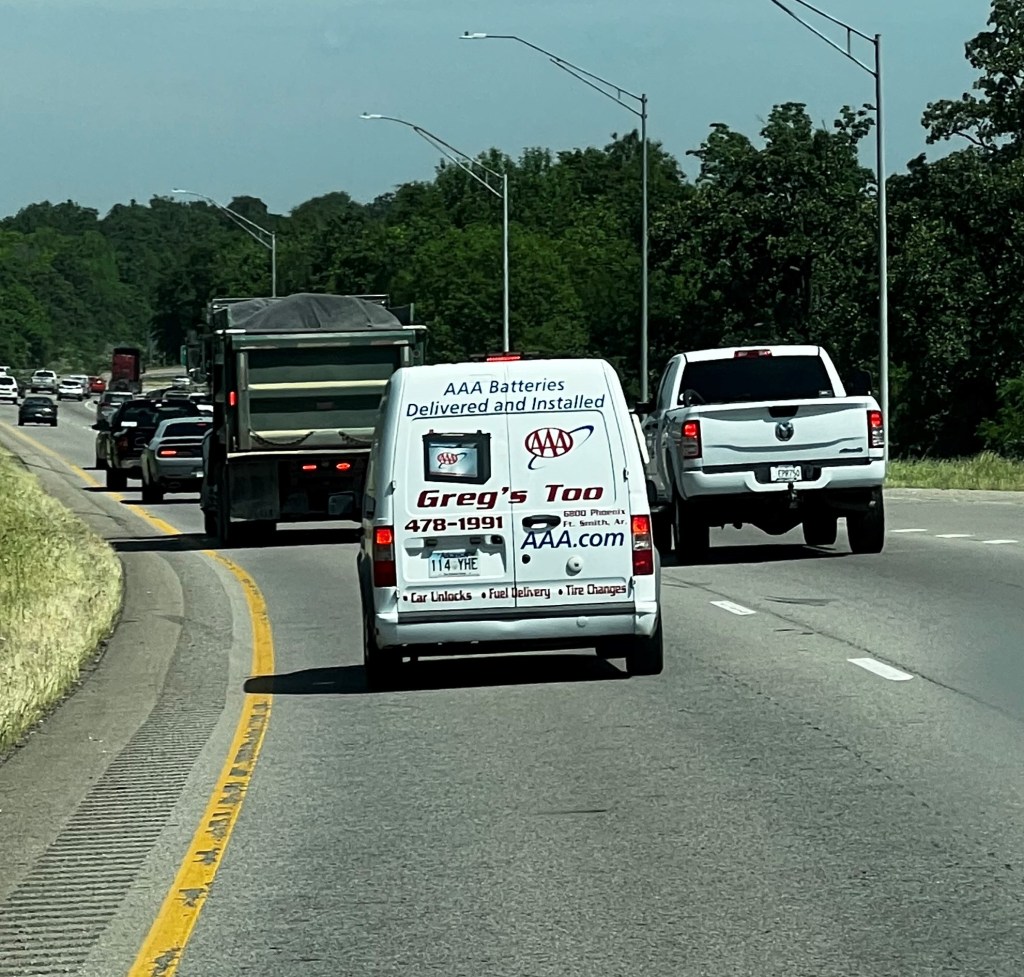
When we were driving to Zena’s obedience training last Friday a truck passed us with large lettering that said, “AAA Batteries Delivered and Installed”.  I was driving and my conscious mind did not take in the rest of the information on the back of the truck.  What immediately crossed my mind was how it could be profitable to deliver and install AAA batteries?  I buy AAA’s in bulk to have them on hand when the old batteries lose their juice.  It is easy to pop the back of my remote and replace the old batteries with fresh ones.  Why would I buy batteries individually and then paying someone to install them?  Then my mind processed the rest of the information on the truck.  These were AAA car batteries sold by the American Automobile Association (AAA).  My subconscious disregarded the most important part of the message.

When I looked online, I found the human brain can process 11 million bits of information every second, but our conscious minds can only handle 40 to 50 bits of information a second.  I only grasped “AAA batteries” rather that the entire message.  Identifying “relevant data” forces our brains to take cognitive shortcuts to determine what is important and what can be ignored, and this leads to bias.  Subconscious bias is a concealed prejudice and Harvard’s Implicit Association Test is a tool to understand how subconscious bias affect our beliefs and behavior.  Unconscious decision making allows us to judge a person or situation from a first impression, but the same biases may result in the wrong reaction.  Regardless of stated beliefs, the test found most have a subconscious bias toward males in the workplace.  Regardless of stated beliefs, the test found 80% of people have “pro-white associations”, meaning it takes longer to put positive words in the “African American” category than to put negative words in the same category.  Test results found 50% of more than 50,000 Black Americans tested have pro-white associations.

Statistics on how much our unconscious attitudes influence our actions are grim.  We cannot choose our unconscious attitudes and subconscious biases.  Our unconscious minds are highly suggestible and vulnerable to negative suggestions, but the mind is also available for positive suggestions, and one way is through “priming”.  Priming is a phenomenon where exposure to a stimulus influences how a person responds to a subsequent, related stimulus, and the stimuli are often tied to words or images.  Experiments indicate priming can have devastating effects on our unconscious attitudes, but if we can negatively influence our subconscious biases, we can also positively influence them.  We can change our subconscious bias by priming our subconscious with positive associations to replace or counteract negative ones.

THOUGHTS:  Unconscious discrimination is harder to see and harder to change than blatant discrimination.  We can make a conscious effort to change through repetition and habit which can become ingrained in our subconscious.  Subconscious biases are based on environment and accumulation of prior experiences.  To change your subconscious biases, you need to change your environment and experiences.  There are times when I only comprehend a portion of the information offered and miss the real meanings.  This is often caused by from not paying attention to the details.  How we act toward others and their differences is too important to leave to subconscious biases.  Act for all.  Change is coming and it starts with you.
Worry

May 14, 2022

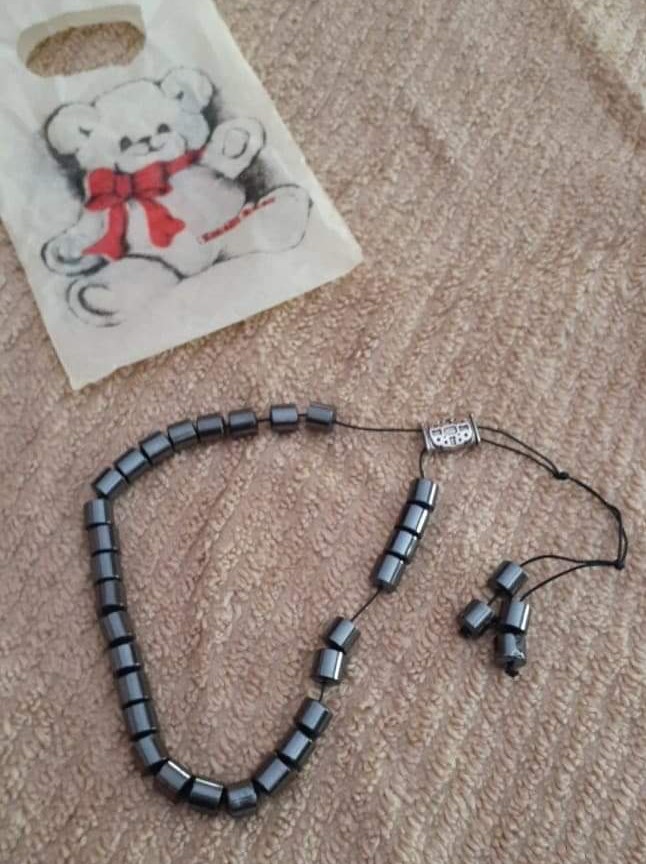
My sister sent a text to all our family wondering if anyone could identify the string of beads she found at her house.  She did not recall buying them and since she had just downsized our mom’s house, she thought they may have come from there.  When mom and dad traveled, they often bought a similar trinket for each of the kids, but none of the other sibs had one.  Several made suggestions and most thought they might be some sort of prayer beads (Buddhist? Tibetan?).   The family spent most of the day yesterday having to worry about the beads and what they might represent.  I finally looked them up on Google.

When I looked online, I found Greek Worry Beads (kombolói) are a string of beads meant to be manipulated with your hands that are used to pass time in Greek and Cypriot culture.  Unlike the prayer beads used in religious traditions, worry beads have no religious or ceremonial purpose.  Worry beads may be made from any type of bead, although amber, amber resin, and coral are preferred as they are thought to be more pleasant to handle than beads made from non-organic metal or minerals.  Worry beads have several uses in Greek culture.  They may be used as an amulet to guard against bad luck, to quit smoking, or to simply pass the time.  The beads usually have an odd number, which is often a multiple of four plus one bead, or a prime number.  A fixed bead and a shield serve as the head to separate the two threads and help the beads flow freely.  The beads end in a tassel about two palm lengths long.  This is what she had.

In Greek culture worry beads are usually handled in either the “quiet” or “loud” method.  The quiet method is to start at one end of the thread near the shield, and to pull the thread forward using that hand’s thumb and the side of the index finger until one of the beads is reached.  Then the cord is tipped so that the bead falls and hits the shield.  This is repeated until all the beads have been tipped and then the user starts over.  The loud method divides the beads into two groups with the shield and a small number of the beads on one end and the rest of the beads on the other.  The space between the beads is laid between the index and middle fingers with the palm facing the torso and the end behind the hand is swung up and forward, so it makes a noise when it hits the other beads.  Greek culture considers it polite to use the quiet method indoors, while the loud method is used outside, and especially in the cafes that line the streets.

THOUGHTS:  Once the worry beads were identified my sister remembered watching the men sitting in the cafes playing with their worry beads.  In modern Greek, kombolói is derived from kombol (knot) and loyio (collection), and is alluded to be short for the phrase, “in every knot I say a prayer.”  While worry beads no longer relate to prayer, the etymology indicates kombolói evolved from the Greek word for prayer rope.  Not knowing what the beads were caused worry among my family.  When we identified the beads, the worry was lessened.  At the beginning of the pandemic worry was the only way to deal with the unknown virus.  We now know what the virus is, and how to avoid or treat it.  Having less worry does not mean to not take precautions.  Act for all.  Change is coming and it starts with you.
Paint

May 13, 2022

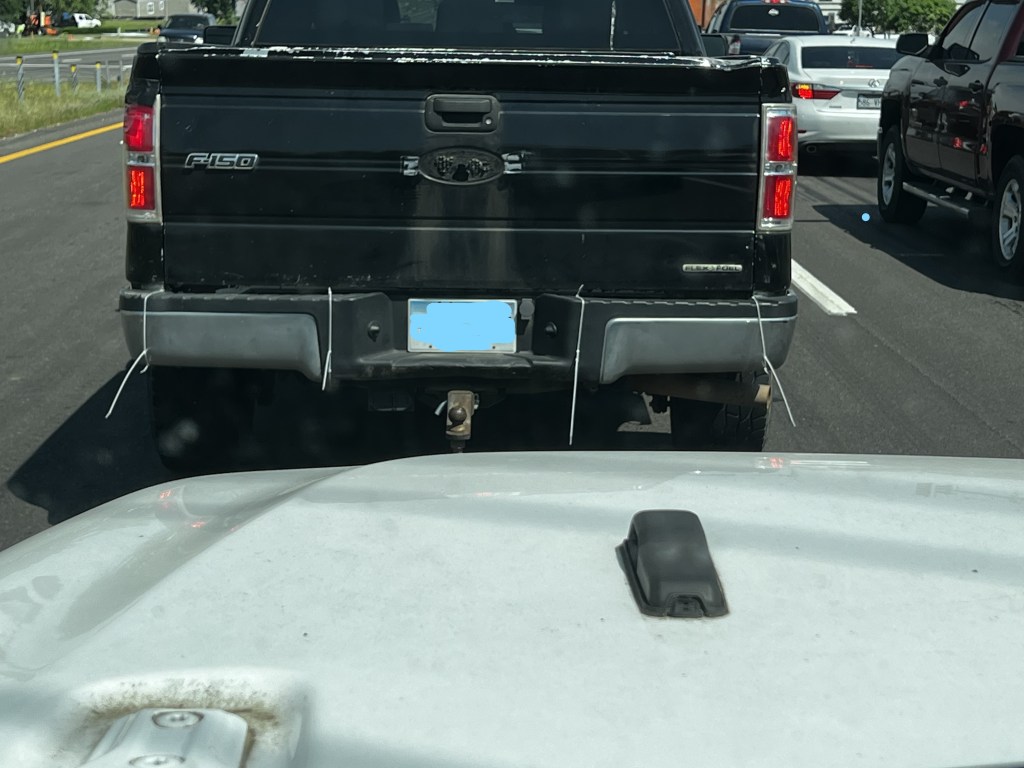
There was no one on the road when we drove Zena to obedience training this morning.  That is until we encountered several vehicles in quick succession that appeared to need some TLC.  The first was once a church van with a shoddy re-paint job.  The new owner had not removed the stenciled lettering on the rear panel, and it was still visible beneath the crusty white paint, which is how I knew it was a church van.  I passed and slid in behind a pickup truck that had the rear bumper attached with four large cable ties.  While I was trying to figure out how the ties were keeping the bumper attached, another car pulled alongside with paint peeling paint off the side and trunk and a large dent in the back.  The capper came as I passed the cable tie truck and noticed the paint not just peeling off the hood, but literally flapping in the breeze.  When I turned to look at Melissa, she said, “We must have missed the memo.” 

When I looked online, I found two primary causes for peeling paint on a modern automobile.  Vehicles are normally coated with three layers, the primer, the paint, and a clear coat.  The primer acts as a base layer for the paint and provides a smooth surface while protecting the underlying metal.  The paint is the color coat, and the clear coat provides a hard “shell” that protects the paint from oxidization and minor scratches while increasing the longevity of the colored paint.  Peeling (or de-lamination) occurs when one or more of these layers lose adhesion with the surface under it.  Primer may lose adhesion to the bare metal, paint may lose adhesion to the primer, or the clear coat can lose adhesion to the paint.  When any of this happens, flakes or even large sections of paint can slough off the vehicle.

The primary cause for peeling paint is improper preparation of the surface.  All three major domestic manufacturers had paint problems in the late-1980’s to mid-1990’s due to changes in the painting processes resulting in the failure of one or all the layers.  The second common cause is when the seal between the layers is compromised by a chip or scratch.  Once compromised, moisture and other contaminants can work their way under the coatings and begin de-lamination.  There are reported cases where a small chip in the clear coat caused catastrophic adhesion loss to the clear coat when the vehicle is being pressure washed.  The water got under the coating and literally blew off the hard, brittle clear coat shell.  This is said to be “rare”, but rare or not, I might get excited to see a large portion of my car’s paint blow off in the car wash.

THOUGHTS:  The vehicles I saw on the road reminded me of one of my less memorable cars.  The paint was fine, but the fake leather on the two-toned roof had come unglued.  Rather than cable ties, I used grey duct tape to adhere the dark brown vinal to the roof.  This invariably came loose, and the tape would end up flapping in the wind as I drove obliviously along.  My son sat beside me with the top half of his body tucked inside the case of the pillow he always brought.  It was years later he told me he did so hoping no one would recognize him.  Most of us encounter awkward situations at some point.  Some are oblivious, some hide, and others just roll with what it is.  Choosing how to react is what makes life interesting.  Act for all.  Change is coming and it starts with you.
Reef

May 12, 2022

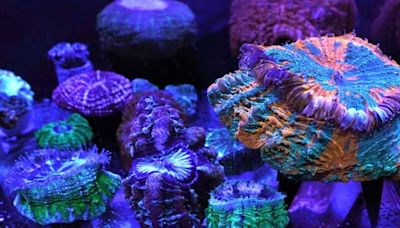
Hidden toward the back of yesterday’s paper was an interesting take on the perils facing a reef near Miami, Florida.  Colin Foord and J. D. McLay have partnered to form Coral Morphologic to bring the undersea world of the coral reef to light by posting stunning images and amazing closeups of underwater creatures on social media.  The images have set time-lapsed video of swaying, glowing coral to music and projected it onto buildings. They even sell a coral-themed beachwear line.  “We aren’t all art.  We aren’t all science.  We aren’t all tech.  We are an alchemy,” Foord said.  One of their most popular projects is the Coral City Camera, which just passed 2 million views and usually has about 100 viewers online at any given time.  The project has documented one year in the life of a coral reef, something that has never been done before.

When I looked online, I found coral reefs provide habitat for 25% of all known marine species, many of which provide sustenance and livelihood to half a billion people globally.  Reefs also protect coastal communities from extreme climate events like storm surges.  Despite the crucial environmental role, the world’s oceans have lost 50% of their living coral reef since 1950, and if action is not taken scientists estimate all coral reefs could be dead by 2050.  Destructive fishing practices and pollution take their toll, but the greatest impact comes from climate change.  The warming oceans prompt coral bleaching and raise the risk of diseases that can cause mass coral die-offs.  Stronger storms and changes in water chemistry can destroy reef structures, and altered currents sweep away food and larvae.  The global reefs are in peril.

The Coral City camera is located in Miami’s Government Cut.  The livestream has revealed that staghorn and other corals can adapt and thrive even in a highly urbanized undersea environment, and the reef supports 177 species of fish, dolphins, manatees, and other sea life.  McKay also films reef creatures in their Miami lab, growing coral in tanks to get them ready for closeups in glorious color.  These images are soundtracked with ambient sounds, or according to McKay, “something very oceanic.”  Their “Coral City Flourotour” will be shown on the New World Center Wallscape this week as the Aspen Institute hosts a climate conference in Miami Beach.  Foord is speaking on a panel about how the ocean’s natural systems can help humans learn to combat the impacts of climate change.  Together they are trying to make a positive impact.

THOUGHTS:  Climate change refers to last part of Coral Morphologic’s name, as morphologic means having to adapt because the environment is always changing.  “I think when we can recognize that we’re all this one family of life and everything is interconnected, that hopefully we can make meaningful changes now, so that future generations don’t have to live in a world of wildfires and melted ice caps and dead oceans,” Foord said.  While this should be a non-partisan issue, how to achieve the goal is not.  Without making tough decisions resulting in tough change, we will continue to destroy the reef that keeps us safe.  Act for all.  Change is coming and it starts with you.

Intent

May 11, 2022

I had mentioned several weeks ago that it was my intent to plant the Cherokee Purple (Solanum lycopersicum) tomato plants Melissa had purchased in the bed along the north side of the house.  Over the last years I never actually weeded this bed.  Instead, I took the weed eater several times and cut the area down to the ground, then cut out the small trees that seemed to love this side of the house.  When I went out to prep the bed it became apparent how much work it would take to get the bed read for planting.  I started looking for an alternative way to plant the tomatoes inside the patio fence.

My intent to plant the inground tomatoes outside the fence was to protect them from Zena.  When Eddie stayed with us several weeks ago the two of them took up the game of chase, where they tore around the pool and through the beds, finally ending by flopping down in the foliage of the Naked Ladies (Amaryllis belladonna) that proliferate the middle of the largest bed.  I did not pay much attention as the leaves were due to die anyway.  However, I was concerned when Zena began to romp through the Red Canna Lilies (Canna indica) I had transplanted last year and that come from Melissa’s grandmother’s yard.  My solution was to purchase 18-inch (45 cm) high fencing that I placed around the lilies, as well as the strawberries (Fragaria ananassa) that were beginning to flower.  I knew Zena could jump the fence if she wanted, but eventually she will be able to jump anything she wants so I thought I would try.  This did the trick as Zena now romps around the pool and avoids the fenced beds.

I knew my intent to plant the tomatoes inside the fence was now bolstered.  The cages around the container vegetables and the fencing around the inground beds were both working separately.  I re-prepped the bed by the bramble (Rubus fruticosus) and planted four of the purples and then caged the plants and fenced the bed.  Next, I expanded the strawberry fencing and caged the last two purples and the two Roma-like San Marzano (Lycopersicon esculentum.  Finally, I expanded the fencing around the lily and caged the beefsteak-like Delicious (Lycopersicon lycopersicum) and a Red Sweet 100 (Solanum lycopersicum) cherry tomato.  Maybe if I use a hoe, I might be able to prepare the north bed for the squash I had intended.

THOUGHTS:  When I purchased vegetables from the local market, they were all hybrid plants while the tomatoes Melissa purchased from the grower were heirlooms.  While heirlooms are grown from seed, hybrids are created by cross pollination using two different species.  Creating a hybrid version of a plant ensures genetic diversity, creates a stronger version of the two parent plants, and can create new vegetables and fruits.  Seedlings from heirloom seeds will replicate the parent, while seedlings from hybrid seeds could exhibit traits of one or both parents, may be something totally surprising, or it may be sterile and not grow at all.  First-generation hybrids make sense, but second-generation hybrids are iffier.  Humans do not have that problem.  The intent was we are all a single species.  Act for all.  Change is coming and it starts with you.
Childcare

May 10, 2022

Hidden next to the obituaries in the sports section of our local newspaper was an article on the strike by childcare workers in the US.  Hundreds of day care centers across America were closed Monday as workers in 27 states and the District of Columbia went on strike for better wages.  The workers called Monday, “A Day Without Childcare”.  The intent was to draw attention to an industry where these essential workers are not paid enough to cover their own essentials.  As many as 400 providers were on strike Monday, significantly disrupting childcare operations.  Despite the inconvenience, many parents support the fight for higher wages for care providers.

When I looked online, I found the lack of accessibility to childcare in the US places a burden on the economy and labor force.  The closures and mandates brought on by the pandemic cause increased hardship to find quality childcare.  Childcare statistics for the US indicate 58% of working parents (6.38 million parents), rely on childcare centers, and 57% of working families spent more than $10,000 on childcare in 2020.  That is an average of at least 10% of household income.  Center for American Progress reports in the US it costs $300 per week to send a child to a family care center, $340 per week to send a child to a childcare or daycare center, and $612 per week for a nanny.  Roughly half of Americans have trouble finding childcare, and 27% of those say it is because there are not enough open childcare slots.  While two-thirds of parents in the US have few childcare options, 51% live in communities classified as childcare deserts.

Organizers of the childcare rallies are demanding better wages and subsidies industry wide.  Meanwhile, few of the providers make a profit and many are in the red.  The demand for childcare is far greater than the supply and workers often earn poverty level wages with few benefits.  The median wage is $13.22 an hour and most childcare providers are women, with a disproportionate number being women of color.  Lawmakers on both sides of the aisle recognized the importance of childcare at the onset of the pandemic, but that realization has diminished with the failure of the administration’s Build Back Better plan.  BBB proposed federal investments in childcare and pre-K to set a cap on the amount families pay for services and establish minimum salary requirements for workers.  Now, that does not seem essential.

THOUGHTS:  As childcare workers demand higher wages the industry is dealing with a staff shortage, as many workers can find higher pay elsewhere.  “We’re competing with McDonald’s, a half-mile up the street,” said Meredith Burton, director of a childcare center.  Parents are squeezed as the cost of one child in childcare takes the first US$7.50 per hour out of your take home check.  The critical time for childhood education is preschool through 8 years old, and children lag their peers without support.  We need to find ways to pay workers and support the parents.  These children are our legacy.  Act for all.  Change is coming and it starts with you.

Reptiles

May 09, 2022

This morning I resurfaced an article from two weeks ago about the possible extinction of over one-fifth of the reptile species in the world.  The study examined 10,196 reptile species including turtles, crocodilians, lizards, snakes, and the tuatara (pig nosed turtle), the only surviving species of a line dating back more than 200 million years.  Researchers found 21% of species are either critically endangered, endangered, or vulnerable to extinction as defined by the International Union for Conservation of Nature (IUCN).  The study also identified 31 species that are already extinct.  Previous IUCN status reports found about 41% of amphibian species, 25% of mammal species, and 14% of bird species are threatened with extinction.  Reptiles face the same threats as other species, namely agricultural deforestation, logging and development, urban encroachment, and hunting by people.  Climate change and invasive species exacerbate the risk.

When I looked online, I found reptiles (class Reptilia) are a paraphyletic grouping comprising all sauropsid (lizard-faced) amniotes except Aves (birds), who are considered a separate class.  The earliest proto reptiles originated around 312 million years ago during the Carboniferous period and increasingly adapted to life on dry land.  In addition to the living reptiles, there are many diverse groups that are now extinct, in some cases due to mass extinction events.  Modern non-bird reptiles inhabit all the continents except Antarctica.  Reptiles either have four limbs or are descended from four-limbed ancestors (like snakes).  Most reptiles lay eggs, but several species are viviparous, meaning the fetus develops in the mother but in a non-mammalian placenta rather than being contained in a shell.  The key difference between reptiles and amphibians is their association with water for reproduction.  Reptile eggs are surrounded by membranes for both protection and transport, which adapt them to reproduction on dry land.  

I always found dinosaurs to be one of the most fascinating of reptiles.  Cultural depictions of dinosaurs have occurred since the word was coined in 1842 and range from realistic to the fantastic (monster movies).  There has been a Dinosaur Renaissance since the mid-twentieth century as science radically changed depictions of dinosaurs.  Cultural depictions have been used to reinforced misconceptions about dinosaurs and other prehistoric animals as a “prehistoric world” that portrays different periods of extinct animals (from the Dimetrodon to mammoths to cavemen) living together.  Other misconceptions that were once scientific consensus have also been overturned, such as dinosaurs being slow and unintelligent. 

THOUGHTS:  I grew up as the age of dinosaurs exploded in the last half of the 20th century.  I collected nearly 40 different types of plastic dinosaurs and could recite the length, weight, and period when each of them lived.  Other cultures have been fascinated with reptiles and have woven them into their creation stories.  My favorite is the World Turtle who carries the earth on its back or supports the heavens and is portrayed in several cultures.  When we take the time to research both living and extinct forms of reptiles, we find how fascinating and diverse they are, and we see the intricate role of reptiles is in our lives and the environment.  Both would be less without a fifth of these living species.  Act for all.  Change is coming and it starts with you.
Market

May 07, 2022

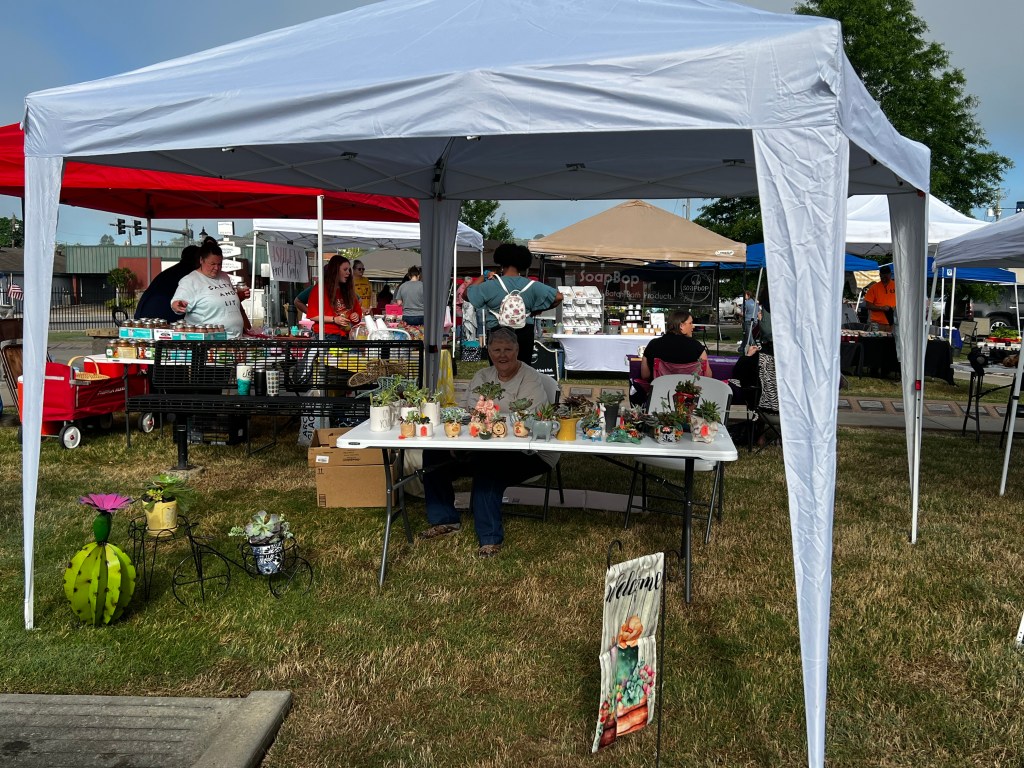
Melissa signed up this year for a stall at our local farmers’ market.  The market is open in the town center on the first Saturday of the month throughout the summer.  While several stores in the area sell individual succulents, they are rarely offered in an arraignment of different types.  Melissa thought this might provide an appealing niche.  Over the last month we have worked on gathering the necessary equipment to be a vendor at the market.  That meant the tent, table and chairs, and display stands, not to mention the succulent arraignments themselves.  The mayor of the city used some of the covid relief money provided the city to cover the vendor fees for the market (thank you!).  There were 20 different vendors, including three food trucks, crafts, fresh eggs, vegetable plants, and flowers, along with Melissa’s succulents.  As summer continues fresh fruit and vegetables will also be featured.

When I looked online, I found the USDA defines a farmer’s market as: “a multi-stall market at which farmer-producers sell agricultural products directly to the general public at a central or fixed location, particularly fresh fruits and vegetables.”  Vendors also sell prepared foods, plants, flowers, baked goods, and craft items. While there may be a requirement that all products sold must be “local”, the term is subject to interpretation.  Food is the most important commodity sold at a farmer’s market, and the idea behind the markets is to cut the middleperson (grocery store) out of the supply chain.  You can buy fresh produce directly from the growers.  The vendors for our market were all from within several miles of town.

The first recorded farmers’ markets date back over 5,000 years to Egypt when farmers along the Nile would come together to sell their produce.  The first market in the US opened in Boston, Massachusetts, in 1634.  Other markets soon followed in larger New English cities like Hartford (1643), New York City (1686), and Philadelphia (1693).  The popularity of farmers’ markets grew over the next 200 years, but interest began to wane in the early 1900’s with the rise of the local grocery store.  It was not until the health consciousness of the 1970’s that the farmers’ markets returned to popularity.  The appeal of farmers’ markets took another boost between 1994 and 2008, when the number of markets rose 300% in 14 years.  Farmers markets have continued to expand in numbers, although they were curtailed sharply by restrictions during 2020 and 2021.

THOUGHTS:  Today’s farmers’ markets are as numerous as the community grocery store.  They can range in size from three or four vendors to hundreds of farmers.  Tokyo boasts the largest farmers market in the world with over 1,700 stalls.  Food deserts, or areas where residents find it difficult to find healthy, affordable foods, are a problem in many urban areas.  Farmers’ markets have emerged as one approach to improve food accessibility in these areas.  The food available in the deserts is often “fast” or highly processed food with little focus on nutrition.  The markets provide accessibility to a local population that would otherwise have none.  Availability of food should be a right, not a privilege.  Act for all.  Change is coming and it starts with you.
Clicker

May 06, 2022

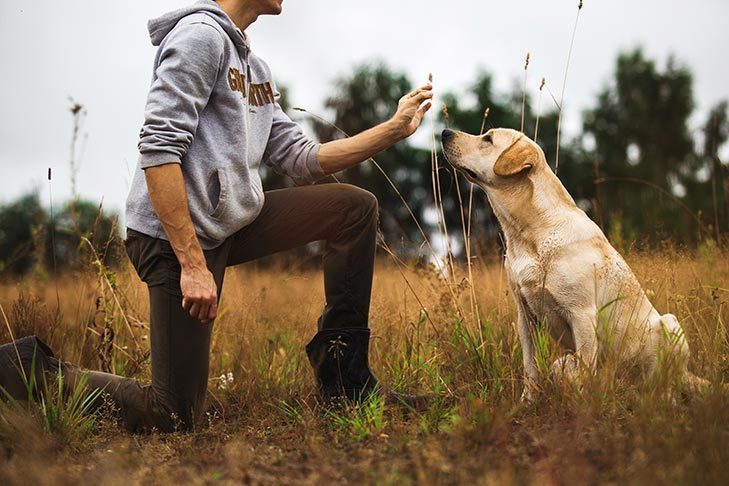
Yellow Labrador retriever being trained by a man outdoors in a field.

Melissa had signed Zena up for a six-week puppy training course and the first session was today.  The circuitous route the GPS took us to get to the trainer’s house was only made more difficult when I missed one of the turns and was routed through back streets to arrive at our destination.  We had been asked to stop in the drive and call when we arrived.  The trainer said his larger dog was “aggressive” and needed to be in the house.  When we arrived, we saw the small dachshund liked to dig searching for moles in the yard.  When we called, he put his dogs in the house to give Zena full access to the back yard.  My first thought was these were traits that might need to be trained for his own pets, but I held my tongue.  As we entered the garage converted into a training studio, he explained he used the clicker approach to train dogs.

When I looked online, I found Clicker training (or mark and reward) is the same as positive reinforcement training, with the added benefit of a clicker, with the clicker being a small noisemaker.  The technique is based on the findings that rewarded behaviors are more likely to be repeated later.  Rather than focusing on what your dog is doing wrong, clicker training concentrates on what your dog is doing right. When you reinforce positive results, you can have a significant effect on how your dog decides to behave.  Dogs repeat behaviors that get them what they want and positive reinforcement training rewards the dog for behaviors you desire.  The clicker then tells your dog exactly which behavior you are rewarding.  When you click at the right time you “mark” the moment your dog did what you wanted.  That means the dog does not have to guess which behavior they are being rewarded for and will learn faster.

The trainer went on to explain the clicker is merely a way to mark a moment.  There is nothing magical about the specific noise, except you likely never make it around your dog outside of training.  That means you can substitute anything as a marker if it is distinct from other ways you communicate with your dog.  Although he had a clicker, the trainer used the marker word “Yes” as a marker to reinforce Zena’s response.  It was amazing to see how fast Zena caught on to the trainer.  In the hour she learned hand signals for sit, lay down, and come (with a lot of treats).  Most of the time was spent on training Melissa and I to be good puppy parents.

THOUGHTS:  After leaving the trainer’s house Melissa thought she knew where we were.  Rather than winding back through the neighborhood we turned left and came to a main road that led to the highway.  Three blocks later and we were on the Interstate.  I chose to follow the GPS on the way over to take the quickest route, but we got lost.  On the way back Melissa used her memory to find a more direct route.  We did not even have a clicker.  Both puppies and humans learn faster and retain more information using positive reinforcement.  Corporal punishment will eventually train children to behave, but willingness to learn comes from positive reinforcement.  You just need to find the right clicker.  Act for all.  Change is coming and it starts with you.