
Cinco

May 05, 2022

I received a text from my sister that her family are making tacos to celebrate Cinco de Mayo.  Smithsonian magazine wrote on the origin of the taco in a 2012 issue.  The taco crossed the US border along with the silver miners immigrating from Mexico.  “Taco” was the word the 18th century miners used to describe the small charges they used to extricate ore.  Tacos apparently began in the homes of working-class communities as inexpensive ways to feed their families.  Their popularity spread to the US along with Mexican migrants working in mines and railroads at the turn of the 20th century.  The first mention taco in a US newspaper was in early 1905.  Taco popularity increased when it began to use American ingredients and is now firmly in place as a staple of Cinco de Mayo celebrations in the US.

When I looked online, I found Cinco de Mayo (Spanish “Fifth of May”) is a yearly celebration held on May 5.  The festival commemorates the anniversary of Mexico’s General Ignacio Zaragoza’s victory over the French Empire at the Battle of Puebla in 1862 which provided a needed morale boost for the Mexicans.  President Juárez declared the anniversary of the Battle of Puebla as a national holiday on May 9, 1862, called the “Battle of Cinco de Mayo”.  On the downside, Zaragoza died from an illness several months after the battle, and a larger French force ultimately defeated the Mexican army at the Second Battle of Puebla the following year.  The commemoration is no longer observed as a national holiday in Mexico, but public schools are closed on May 5.  The day is still an official holiday in the State of Puebla, where the Battle took place, and in the neighboring State of Veracruz.

Cinco de Mayo is now associated with the celebration of Mexican American culture in the US.  Celebrations began in (Mexican) California in 1863 and have been observed annually since.  The day gained nationwide popularity in the 1980’s with the advertising campaigns by beer, wine, and tequila companies, and now generates beer sales on par with the Super Bowl.  Cinco de Mayo is sometimes mistaken by non-Mexican Americans for Mexico’s Independence Day.  Mexican Independence Day is celebrated on September 16, and commemorates the Cry of Dolores in 1810, which initiated the war of Mexican independence from Spain.  Cinco de Mayo is featured in the entertainment media and has become a global celebration of Mexican culture, cuisine, and heritage.  Nothing like tacos and a good party.

THOUGHTS:  The popularity of the taco in the US can be attributed to Glen Bell, the founder of Taco Bell.  Bell popularized the u-shape, hard shelled taco made in advance to provide an inexpensive “fast” food.  As Taco Bell grew in popularity among non-Mexican Americans so did the taco, and the popularity of the taco sparked campaigns for the general (unofficial) celebration of Cinco de Mayo.  Tex-Mex is just one examples of the many ethnic foods enjoyed in the US that are nothing like the original.  When we explore the original versions, we are brought closer to the culture from which they sprang.  Act for all.  Change is coming and it starts with you.
Nest

May 04, 2022

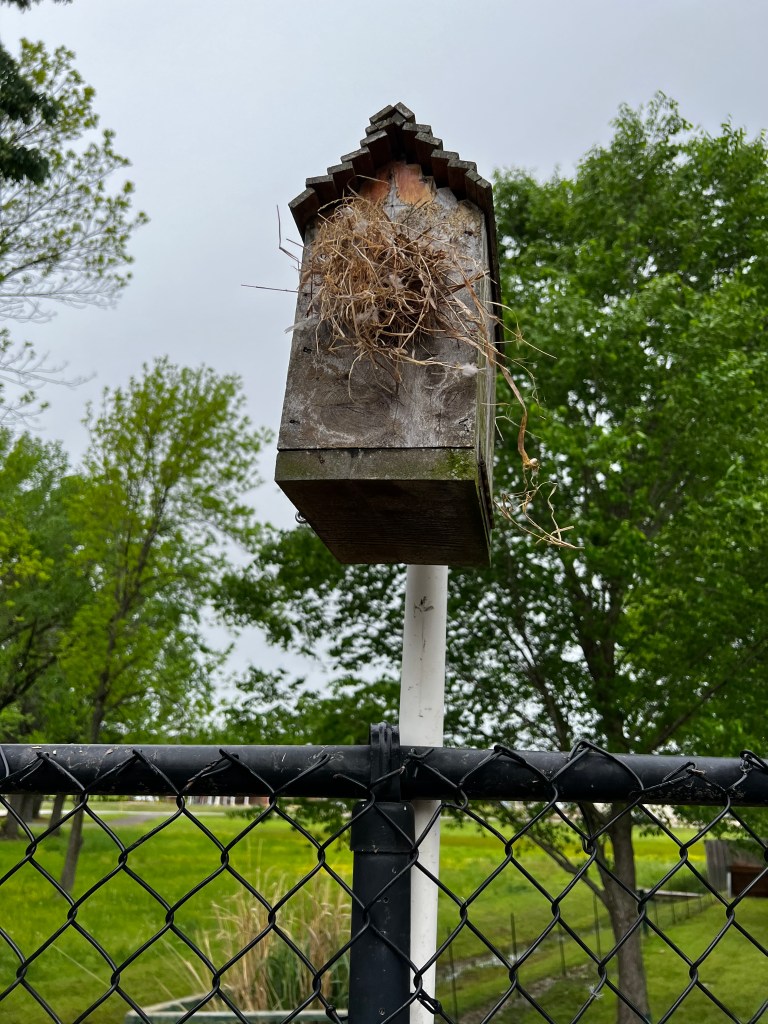
Melissa’s mom had set up a bird house for the blue birds that frequented our patio to nest.  When we arrived, the blue birds continued to nest in the house.  The birds would come in the spring and reestablish their nest, then leave after the hatchings were gone.  Other birds began to take an interest in the house at the end of last year, along with a squirrel.  This spring we saw several contests as various species tried to gain control of the house.  This became a daily battle between the blue jays, mockingbirds, blue birds, and house sparrows.  Eventually the sparrows seemed to win and established their nest, but the battle for space continued.  After last night’s storms Zena was taking particular interest in snuffling my new tomato plants.  I saw the nest material had been partially pulled out of the entrance hole to the house and I knew something was wrong.

When I looked online, I found that northern mockingbirds (Mimus polyglottos), blue jays (Cyanocitta cristata), and red squirrels (Sciurus vulgaris) are all known to attack and eat bird eggs, nestlings, and occasionally kill adult birds.  Mockingbirds can be very aggressive and will attack and even kill other birds if they feel their nests or babies are threatened.  Mockingbirds will kill other birds in defense, but they are not likely to kill birds to eat them.  Blue Jays are very territorial and will chase other birds from a feeder for an easier meal.  They may raid other birds’ nests, stealing eggs, chicks, and nests, but this is not common.  Squirrels go as far as raiding a bird’s nest for food, and the red squirrels are the most carnivorous.  They can climb into the nest or birdhouse holes and get to the eggs and chicks.  Nesting birds under attack by a squirrel often abandon their nests, leaving their eggs and chicks at the mercy of the squirrel.  If they do not flee, the adults are occasionally killed.  All three were possible suspects.

Zena continued to snuffle the tomatoes beneath the bird house despite my calls, so I went over to see what had caught her interest.  One of the adult house sparrows (Passer domesticus) was lying dead in the container.  Zena did not try to eat the bird, but she was interested in this motionless animal.  I thought it best to remove the carcass to keep Zena from further exploration in the tomatoes.  While I was at it, I decided to clean the nest material from the bird house.  The amount of nest pulled through the hole suggested the interior was filled with nesting material.  You need to use gloves to do this and thoroughly wash your hands afterwards to avoid diseases.  When I opened the nest box, I found I was right.  It was full of old nest.   

THOUGHTS:  I have read you should clean your bird house at least once a year, and preferably twice.  This allows potential occupants to start with clean fill for their nest.  I have been lax in this, and that may be why the blue birds chose not to nest this year.  Unlike the aeries built by eagles over years, smaller birds generally build a new nest and the old ones tend not to survive the winter.  During the pandemic many things have been allowed to accumulate.  Perhaps we should clean out the old nest (ways) and make a fresh start.  Act for all.  Change is coming and it starts with you.
Caterpillar

May 03, 2022

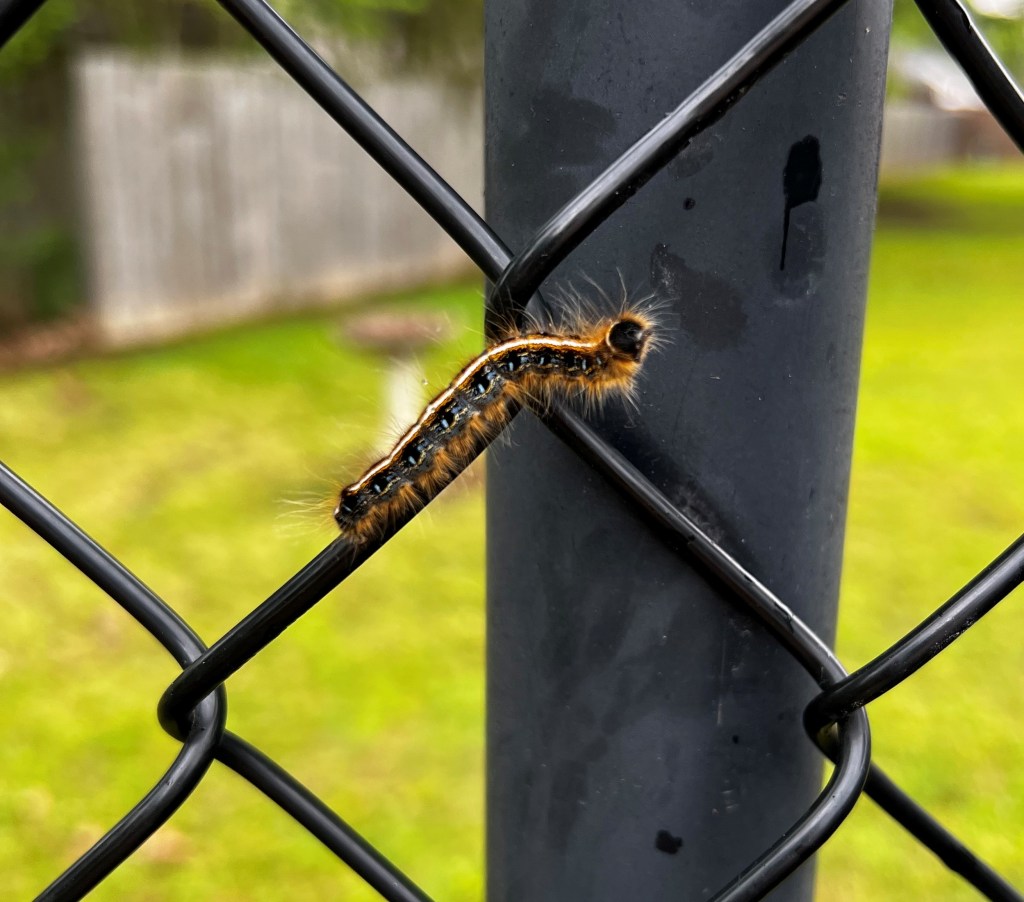
I mentioned Zena’s predatory behavior when she had encountered a large caterpillar on the patio deck last week.  I felt bad as she first stomped it with her front paws and then ended up chewing it.  It must not have tasted very good as Zena spit it out almost immediately.  While this did not do much for the caterpillar she ate, it may help other caterpillars Zena finds if she remembers the first encounter.  When I went outside with Zena yesterday afternoon, I noticed the same type of caterpillar slowly working its way along the chain link fence that surrounds the patio.

When I looked online, I found the eastern tent caterpillar (Malacosoma americanum) is a species of moth in the family Lasiocampidae, the tent caterpillars or lappet moths.  It is univoltine, which means it produces one generation per year.  The tent caterpillar is a social species that forms communal nests in the branches of trees.  It is sometimes confused with the gypsy moth and the fall webworm, and may be erroneously referred to as a bagworm, which is the common name applied to unrelated caterpillars in the family Psychidae.  The caterpillars are hairy with areas of blue, white, black, and orange.  Tent caterpillars are among the most social of larvae.  The adult moth lays 200 to 300 eggs in a single batch in late spring or early summer and fully formed caterpillars are found in the eggs by three weeks.  The small caterpillars lie dormant until the following spring, when they emerge from their eggs just as the buds of the tree begin to develop.

Several of the trees at our house developed tents last fall indicative of the caterpillars.  When they hatch the small caterpillars stay with the tent until they finally venture out into the world to form cocoons and hatch into tent moths.  The tent caterpillars will vigorously thrash the anterior part of their bodies when they detect predators and parasitoids.  These bouts of thrashing can be initiated by a single caterpillar but move rapidly through the colony resulting in group displays of dozens of caterpillars.  The displays create a moving target for predators or species that would lay eggs on or in the body of the caterpillar.  The cherry leaves they chew are cyanogenic and the caterpillars will regurgitate cyanide-laden juices when disturbed.  We do not have any cherry trees in the patio area.  Perhaps the caterpillars on our deck are looking for some.

THOUGHTS:  The eastern tent caterpillar is toxic to horses and has been linked to mare reproductive loss syndrome.  Experimental studies have shown that when pregnant mares are fed eastern tent caterpillars, they abort, but it is unclear if this is from the caterpillar’s toxicity or for other reasons.  Zena is not a mare or old enough to be pregnant, so I am not worried.  All plants and animals have found ways to ensure their survival.  For some it is sheer numbers, for others camouflage, and then there are the bright colors often associated with toxicity.  Humans adapted similar ways to ensure our early survival but have since risen to the top of the food chain.  Now we use these mechanisms to protect us from each other.  Act for all.  Change is coming and it starts with you.

Potawatomi

May 02, 2022

I was forwarded an article posted by KOSU (91.7 FM) about the newly formed Potawatomi Fire basketball team.  Like any new team, the players were confident they would win a championship this year.  Afterall, as player Mustapha Traore said, “Out here there’s nothing but land and basketball.”  The Citizen Potawatomi Nation’s new minor league basketball team kicked off its inaugural season March 4 in The Basketball League (TBL) after being unveiled last September.  The team logo and name were selected at a time when sports mascots and logos are drawing national attention, but brand recognition is still important.  The Potawatomi were originally called Bodewadmi, or the People of the Place of the Fire, and the tribal seal features a pipe and tomahawk over a log fire.  The Potawatomi Fire are looking to bringing the fire to the TBL.

When I looked online, I found the Potawatomi Fire is the first tribally owned sports team in Oklahoma, and one of only a handful of professional teams owned by tribal nations in the US.  The Citizen Potawatomi Nation already operates two casinos, gas stations and grocery stores, and several small businesses, but the Fire are part of a growing number of “casino adjacent” businesses growing across Oklahoma.  The Tribe’s investment serves as a lure for business partnerships from surrounding communities and to keep money circulating at home rather than being spent elsewhere.  Tribal Chairman John Barrett said “We have a huge payroll.  We have 2,200 employees.  And whenever you’re putting out that kind of money in a payroll, and another $450 million or $400 million in vendor purchases, you want those dollars . . . to turn at least four times before they leave the tribe’s economy.”  This is buying local at its heart.

The Potawatomi Nation installed a new basketball court, updated the scoreboard, and remodeled the changing and locker rooms to accommodate the TBL team.  Investments have been heavy with the team as well.  Players receive housing, a bus to get to the games, a per diem stipend, and other things not available with other TBL teams.  The players in turn are adding value to the community.  Player Deon Lyle knows he and the other players can be assets to the Tribe and the Shawnee area.  “We’re not here to just shut up and dribble.” said Lyle, “They’re taking care of us very well, and they’re not just having us here to entertain.  We’re here to, you know, be a part of the community and do more than just be a basketball player.”  The Fire are currently in fourth place at 12-4 in the Central, one of six TBL Divisions.

THOUGHTS:  Chairman Barrett likes to think of the tribe’s investments as in line with their view of the world and their vision for the future, the “Seven Fires” prophecy.  The prophecy describes a turbulent time in Potawatomi history when the tribe was visited by seven prophets, and its telling has helped the Potawatomi people understand who they were, are and will be in the future.  The Tribe looks at investments in terms of 50 years, not just 10.  While a willingness to invest in the local future may not produce immediate corporate gains, it is the way to create a stable local economy.  Jacob Marley viewed of the world as a hard and cruel place where you must learn to fend for yourself and died to regret it.  Act for all.  Change is coming and it starts with you.
Bramble

April 30, 2022

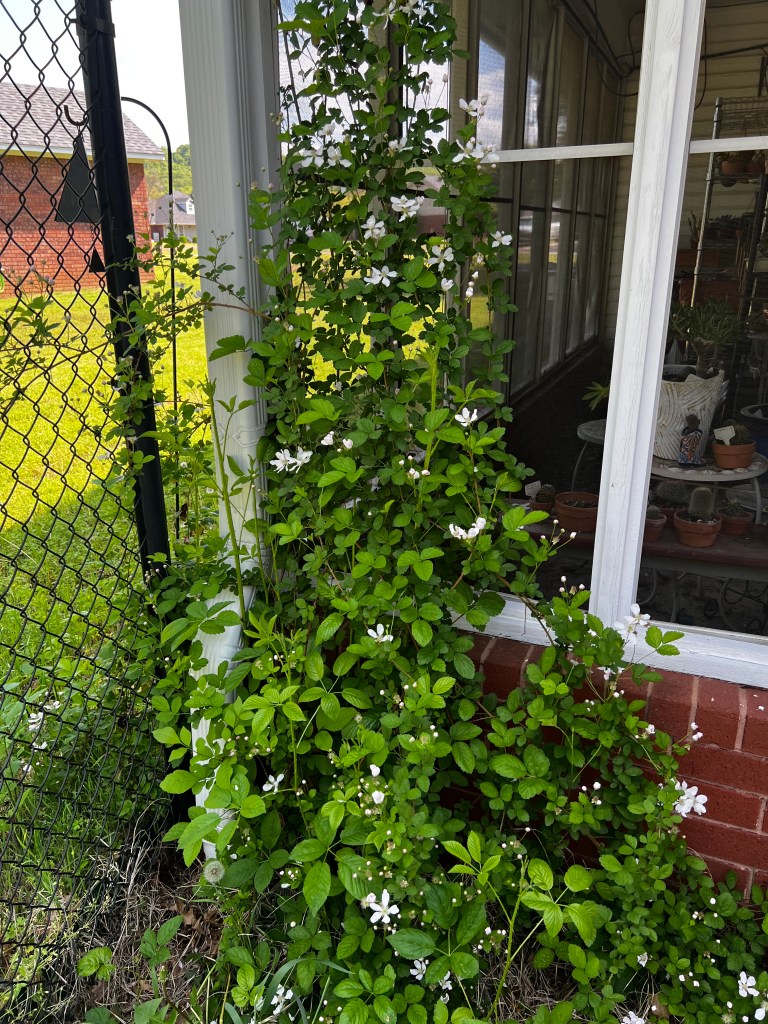
We have a spiny plant with arched canes that has been taking hold in the side patio bed for the last two years.  Two years ago, I made my disastrous attempt to grow onion sets in this bed.  I cleared everything out of the bed and kept it weeded, but the gutter spout was not draining right.  The water from the roof cascaded onto the bed, washing away most of the sets and causing the others to not produce.  I moved my onions last year and abandoned the bed.  When the roof and gutters were replaced last year it stopped the drainage problem, but I never got around to doing anything with the bed.  The bramble began to grow in the bed, but I ignored it.  I did find it interesting that the bush retained its leaves throughout the winter, and this year has begun to flower.  The bramble has finally gotten my attention.

When I looked online, I found bramble is the general term for any rough, tangled, prickly shrub, usually in the genus Rubus.  This generally refers to blackberries (Rubus fruticosus), raspberries (Rubus idaeus), or dewberries (ursinus), but is also used to describe other prickly shrubs such as roses (Rosa species).  Bramble bushes have long, thorny, arching shoots and root easily, sending up long, arching canes that typically do not flower or set fruit until the second year of growth.  Bramble fruits are aggregate fruits with each small unit called a drupelet.  The thorny varieties are sometimes grown for game cover and occasionally for protection.  Most bramble species are important for their conservation and wildlife value in their native range.

The bramble that has taken hold in my bed is the Rubus trifidus.  This is a Japanese species of bramble related to blackberries and raspberries.  This bramble is an evergreen shrub that grows to 6 feet 7 inches (2 m) in height.  It stays in leaf all year and flowers in May.  The trifidus is a hermaphrodite (both male and female organs) species and is pollinated by insects.  It can grow in semi-shade or no shade, and mine seems to like the north facing side of the house which has shade early and sun later in the day.  It prefers a damp, well-drained soil which it has not had because of the leaking gutter spout.  Now in the second season since the spout has been repaired the bramble appears to have taken off and is full flower.

THOUGHTS:  The bramble is often considered a nuisance as it invades unkept areas and is hard to get rid of.  The intertwining canes and prickly stems can be hazardous to humans but allow the plants to be used as fences in the field and for protection beneath windowsills.  The bramble flowers attract nectar-feeding butterflies (Lepidoptera) and hoverflies (Syrphinae) and are important food plants for butterfly larvae.  The common blackbird and small mammals feed on the nutritious fruits in autumn.  The brambles in the front of my bed are a nuisance and will be removed, but the brambles along the wall will serve as a wild food source for the birds and butterflies.  Many of the plants and animals we consider a nuisance play critical roles in the ecosystems they inhabited prior to humans.  Rather than removing the nuisance, we need to create innovative ways to incorporate these elements into the new human/nature environment.  Act for all.  Change is coming and it starts with you.
Stick

April 29, 2022

Few things match the pride felt by a parent when they provide the toy your child has begged for over the last year as a present.  These are usually expensive and just beyond the amount budgeted for either a birthday or Christmas.  Still, since there have been incessantly requests for this toy, your empathy breaks you down and you figure a way to make the buy.  The big day comes, and the box is opened with squeals of delight.  Your child begins to play, and after watching for several minutes, you go to the next room with a sense of smug satisfaction.  When you return to check on them you find they have abandoned the treasured toy, and are playing with the box it came in.  That is what happened today with the puppies and a stick.

When I looked online, I found like human babies, puppies explore the world by putting things in their mouth (Zena).  Unlike babies, puppies keep on chewing and seem to go through a super chewing stage as they approach one year old (Eddie).  The other difference is puppies are very effective at chewing.  There are many products offered to divert your puppy’s attention from the furniture, leather, and shoes they seem to prefer.  Real bones should be avoided as they can fracture teeth and the fragments can damage the mouth, stomach, and intestines.  Three chew alternatives were suggested.  Interactive toys can be filled with soft cheese, dog treats or peanut butter (if you freeze them, they last longer).  Some chews can be soaked in water and frozen, which provides relief for teething puppies.  Chew bones are designed to promote dental wellness.  We have purchased several types of chews for Zena, some of which were expensive, and found like a child with a box, Zena’s favorite chew is a stick.

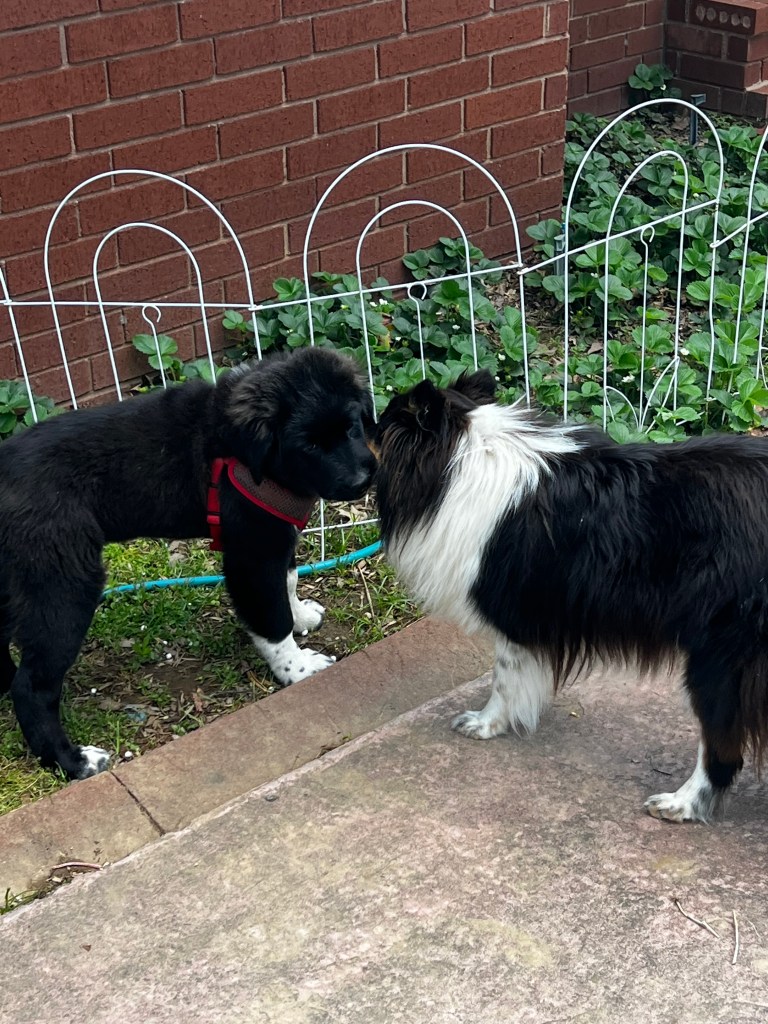
I have been sitting on the back patio to watch the puppies play during Melissa’s morning work call, and this morning watched the dynamic of their relationship.  While both puppies have chew toys, they tend to ignore them.  When they are outside, they find a stick which seems to suffice.  Since this is raw wood and not mulch, I have given up and just watch them chew.  This morning Eddie found a small stick they have both been chewing and began to gnaw.  Zena then decided to investigate.  When she could not wrestle the stick from Eddie, Zena went and got a bigger stick and sat close to Eddie to gnaw.  That caused Eddie to get up and try to take the big stick away.  They ran back and forth along the patio as first one and then the other carried the stick.  Finally, they both dropped the big stick and began a tug of war with the small stick.  This tussle went on for 15 minutes until they both happily sat down with a different stick to chew.

THOUGHTS:  While Zena and Eddie were playing with the stick, they inched close to tension several times.  Zena uses her size and weight to back into Eddie and push him around.  Eddie uses his knowledge and speed to either get away or around Zena’s push.  Like humans, Eddie’s willingness to be pushed is shorter than Zena’s desire to play.  What might begin as play can become irritating when the constant teasing does not stop and can become bullying.  Statistics for 2020 indicate 49% of children in grades 4-12 have been bullied at school at least once, 23% of college students have been bullied two or more times in the past month, and 20% of US students grades 9-12 reported being bullied.  It is no longer fun when someone say stop.  Act for all.  Change is coming and it starts with you.
Pumped

April 28, 2022

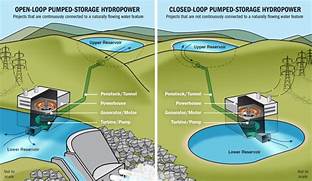
Sitting on the front page next to the lead story detailing the Garth Brooks concert at Razorback Stadium breaking the previous attendance record, our local newspaper carried an AP reprint of the “world’s largest batteries’.  One concern with transition from fossil fuel to renewable energy is where to get power if the sun is not shining or the wind is not blowing.  Pumped storage has been used in the US since 1930, but most systems were built later to hold electricity from nuclear plants.  These are called “the world’s largest batteries” since they hold large amounts of energy.  The US has 43 pumped storage facilities that hold about 22 gigawatts, but only one has been added since 1995.  There are more than 90 planned facilities, but it is unclear if they will prevail over the legal, economic, and practical issues faced.  Three projects have been permitted by the Federal Energy Regulatory Commission (FERC), but none are being built.  More than 60 are being built worldwide, mostly in Europe, India, China, and Japan.

When I looked online, I found pumped storage hydropower (PSH) is a type of hydroelectric energy storage where water is sent from a lower reservoir to an upper one.  The configuration of two water reservoirs at different elevations can generate power as water moves down from above while passing through a turbine.  The system requires power to pump water back into the upper reservoir to recharge the system.  PSH acts like a giant battery and can store power and release it when needed.  There are two different types of PSH systems.  An open-loop PSH has an ongoing hydrologic connection to a natural body of water, while the closed-loop PSH reservoirs are not connected to an outside body of water.

During a January hearing of the Senate Energy and Natural Resources Committee Malcolm Woolf, president of the National Hydropower Association, complained the process for approval involves too many agencies.  Although FERC permits new facilities and relicenses existing ones, other federal, state, and tribal offices have roles, and every project has case-specific issues.  The industry would like an investment tax credit like solar and wind receive.  The Administration’s plan calls for the tax break but is stuck in Congress.  The Australian National University used computer mapping to identify more than 600,000 “potentially feasible” pumped storage sites worldwide, including 32,000 in the US.  These sites could store 100 times the energy needed to support a global renewable electricity network.  The study did not check whether these sites would meet environmental or cultural protection standards or be commercially viable.  

THOUGHTS:  Opponents say pumped storage hydropower systems can have negative impacts on land and wildlife, such as disruption of fish spawning routes or creation of large reservoirs that fill canyons.  In geographically flat places, PSH may be difficult to use.  Constructing the PSH systems involves destruction of trees and green land to build reservoirs, and the reservoirs change the local ecological system which can create environmental consequences.  PSH projects raise hard questions and unpleasant tradeoffs.  Unless we reduce the amount of power (unlikely) used we are forced to decide what will we give up achieving decarbonization.  Act for all.  Change is coming and it starts with you.
Dig

April 27, 2022

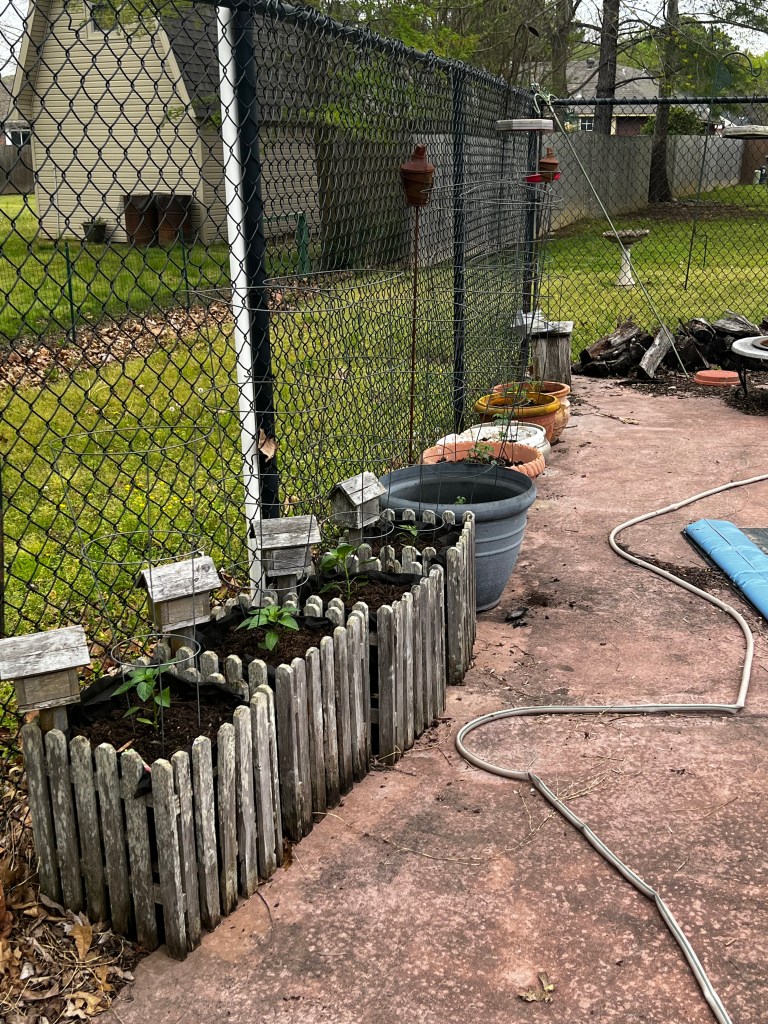
Before I went to Kansas last week, I planted my vegetables into containers.  I do not have an extensive garden, but there are 12 good sized containers I am planting this year.  While the immediate weather is not forecast as sunny and warm, the last frosts appear to be over.  I only added two new containers this year, so preparation was minimal.  I removed the leaves from the old pots along with the small shoots that managed to sprout.  I had removed the old plants and their root systems last year and mulched them into the yard, so all I had left was to add additional soil where needed and to dig up the top 6-8 inches (15-20 cm) of soil to provide for the new roots.  Zena was a constant companion as I prepared the containers.  I realized I needed to keep an eye on her to make sure she did not dig them up.

When I looked online, I found a dog’s instinct to dig in the ground is as ingrained as barking or sniffing.  There are four main reasons dogs dig and they are all tied to instinct.  Dogs are by nature predators, as evident in even the smallest Toy Puddle chewing squeaky toys and chasing squirrels.  As the dog explores the yard they may hear and smell animals underground and try and dig them up.  Dogs also have a strong instinct to cache things they value (food or toys) and they hide these valuables for safekeeping.  One of the hiding places is to dig a hole.  A third reason is to regulate the dog’s temperature.  By digging a hole, a dog can gain the warmth of the ground during the winter or the coolness during the summer.  This is particularly true for Nordic breeds, including the Prerinses Mountain Dog (Zena).  The final reason is stress and anxiety.  As dogs stress they participate in displacement behaviors, and one of these behaviors is digging.

Zena clearly displays the first three reasons to dig.  She has always liked to snuffle in the flower beds.  I assumed she was looking for a good piece of mulch to chew (another bad habit) until she proudly brought Melissa the snake she had captured and chewed.  Then there was the caterpillar that made the mistake of crawling by her path.  Zena is constantly trying to hide her treasures both inside and out.  When she catches me watching, she returns to the valuable and moves it to a new location hoping I did not see the new cache.  The first hole Zena dug was just big enough to fit her body to comfortably.  While it was neither warm nor cold outside, she seemed to find comfort lying in the shallow depression.  We will need to continue to stay alert and try to find ways to relieve any stress or anxiety.  That is what puppy parents do.

THOUGHTS:  When I planted my vegetables, I placed cages around them for support.  One of the small tomatoes had two plants in the pot and I placed this bonus in a small container thinking I could get a larger pot and a cage later.  Then went to mow the lawn.  When I rode by the fence, I noticed the unsupported plant was gone.  I finished mowing and went back inside to see what had happened.  There was dirt on Zena’s nose and a hole in the soil about the size of Zena’s snout.  While the caged plants were left alone, the unsupported plant seemed free to dig.  Over the last two years the pandemic has caused stress and anxiety.  This has led to a rise in drug abuse, overdose, and violent crime.  Since we cannot stick our nose in the ground, we need to find other ways to cope.  And, we need to find ways to support each other.  Act for all.  Change is coming and it starts with you.

Purple

April 26, 2022

I had decided to plant my garden last week.  I originally wanted to grow varieties of squash seeds in a seed starter tray and then replant them in the bed along the north side of the house.  This bed has been nothing but weeds since we returned, and Melissa told me it was never too good at growing things even when her mom planted.  I got the seed tray in February and listened when I was told it was too early to start.  March rolled around and rather than planting I got busy with projects.  April is almost over now, and it is time to plant the seeds outside rather than in the starter box.  It turns out it was a good thing I decided to wait.  Melissa bought six Cherokee Purple tomatoes from a friend and wanted to plant them in my potential Squash bed.

When I looked online, I found the Cherokee Purple (Solanum lycopersicum) is an old variety of tomato that develops fruit with a deep, dusky-rose color while maintaining a somewhat greenish hue near the stem even when ripe.  The combination of deep crimson interior and clear skin give it a distinctive color.  Southern Exposure Seed Exchange (SESE) was the first seed company to offer Cherokee Purple.  It was released in limited quantity in 1993 and has become a popular heirloom variety.  The tomato originated in Tennessee, and plant lore says the Cherokee Purple may have been passed down from the Cherokee tribe.  Heirloom plants means they have been around for several generations, and unlike hybrid varieties, heirlooms are open-pollinated so the seeds will produce tomatoes nearly identical to their parents.

In 1990 John Green of Sevierville, Tennessee mailed heirloom tomato expert Craig LeHoullier seeds of an unnamed purple tomato.  Green said the seeds came from tomatoes he had gotten from a woman who received them from her neighbors.  The neighbors said the varietal had been in their family for 100 years, and that the seeds were originally received from Cherokee Indians.  LeHoullier named the tomato “Cherokee Purple” and sent seeds to the SESE.  Jeff McCormack, the owner of SESE, said that the tomato “tasted fine, but was kind of ugly”, and thought people may not like it.  SESE featured the Cherokee Purple in the 1993 seed catalog and LeHoullier sent the seeds to several market growers.  One of them was Alex Hitt from North Carolina, who had immediate success growing and selling the tomato despite its appearance, which was described as “looking like a leg bruise.”  In 2014, Cherokee Purple was named one of the top ten tomato heirloom varieties by the SESE.

THOUGHTS:  Cherokee Purple are indeterminate, which means they will continue to grow and produce tomatoes until the first frost in autumn.  Melissa is hoping they will produce better by placing them in the ground rather than a container, despite being in the north bed.  Regardless, we need more cages as mine were used on the store-bought plants I planted in containers last week.  Whatever the purple’s origin, they are claimed and grown by members of the Cherokee Nation.  The tomato originated in the highlands of Peru and was transported to Mexico and by 500 BCE it had been domesticated.  The tomato was later spread by the Spanish and is now grown on every continent except Antarctica.  This includes the hundreds of heirlooms, hybrids, and varieties (from 42 Days to Zebra Cherry).  This is one of the few invasive species that ended up being a good thing.  Act for all.  Change is coming and it starts with you.
Honeybees

April 25, 2022

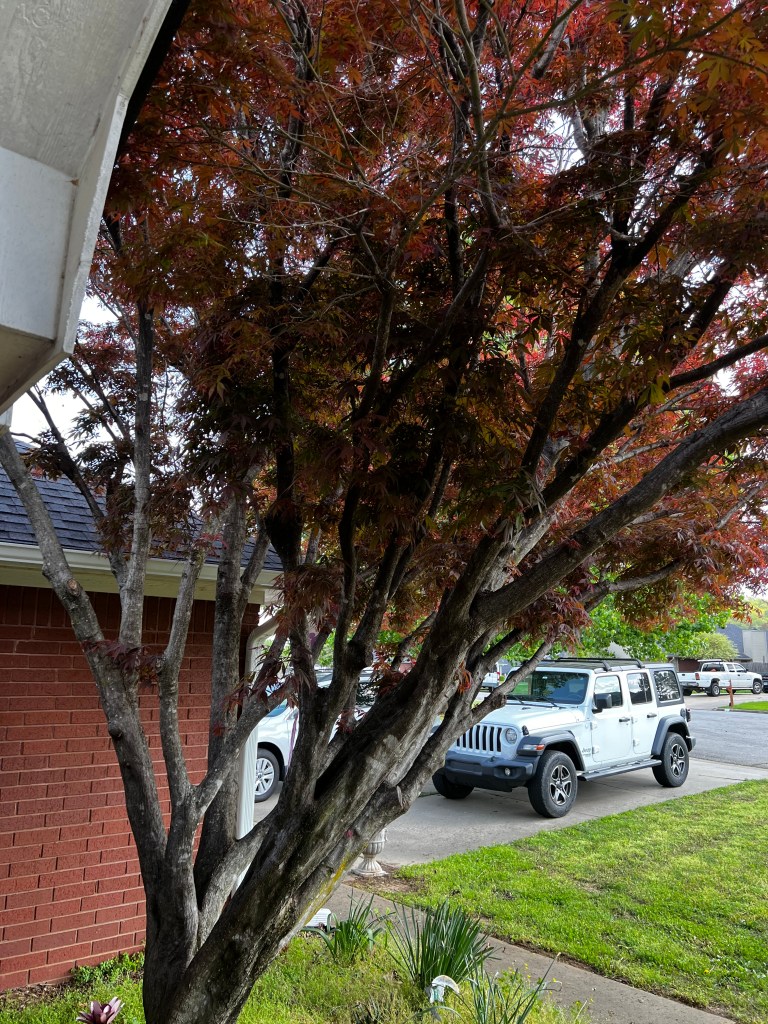
Last week I got a text from Melissa describing an incredible experience she had when she took Zena out for a potty break.  At 8:15 am, all was quiet in the neighborhood.  The kids were in school, and traffic was light.  She was standing on the sidewalk waiting on the puppy and kept hearing this low humming.  At first, she thought it might be the neighbor’s A/C unit, but it did not appear to be running.  Then she realized the closer she was to the porch the stronger the sound got.  She finally looked up at the Japanese Maple and saw it was in full bloom.  There were hundreds of honeybees working the blossoms.  It was so cool to hear them buzzing as they worked.  Nature is so Awesome!

When I looked online, I found the honeybee (also honey bee) is a eusocial flying insect within the genus Apis of the bee clade, all native to Eurasia.  They are known for their construction of perennial colonial nests from wax, the large size of their colonies, and surplus production and storage of honey.  This makes their hives a prized foraging target of many animals, including honey badgers, bears, and humans.  Only eight surviving species of honeybees are recognized, with a total of 43 subspecies, though historically 7 to 11 species are recognized.  Honeybees represent only a fraction of the roughly 20,000 known species of bees.  The best-known honeybee is the western honeybee (Apis mellifera), which has been domesticated for honey production and crop pollination.  The only other domesticated bee is the eastern honeybee (Apis cerana), which occurs in South Asia.  Other types of related bees produce and store honey and have been kept by humans for that purpose, but only members of the genus Apis are true honeybees.

Honeybees have three castes.  The drones are male, while the workers and queens are female.  Drones primarily exist for reproduction.  They are produced by the queen if she chooses not to fertilize an egg or by an unfertilized laying worker.  Drones take 24 days to develop, and the hive may hold as many as 500.  Drones are expelled from the hive during the winter months when the hive’s focus is warmth and food conservation.  Workers are produced from an egg the queen has selectively fertilized from stored sperm.  Workers develop in 21 days and a colony contains as many as 60,000 workers.  Workers exhibit a wide range of duties that change with age, including feeding the brood, receiving nectar, cleaning the hive, guard duty, and foraging.  Queen honeybees are created when worker bees feed a single female larva an exclusive diet of “royal jelly”.  Queens are produced in oversized cells and develop in 16 days.  The queen has functional ovaries, and a spermatheca, which stores and maintains sperm after she has mated. Apis queens practice polyandry, and the female will mate with multiple (40-70) males.  Once mated, queens may lay up to 2,000 eggs per day.

THOUGHTS:  Eusocial comes from the Greek “eu” (good) and social and is considered the highest level of animal social organization.  The division of labor creates specialized groups referred to as ‘castes’.  Eusociality is distinguished from other social systems as individuals of one caste lose the ability to perform behavior characteristics of another caste.  Humans use similar castes for both free individuals and slaves.  In 2019, 40 million people (26% children) in the world were illegally enslaved, and more than 50% of enslaved people provide forced labor in the private factories and sweatshops.  In industrialized countries, slavery is from human trafficking.  In non-industrialized countries, debt bondage enslaves people as domestic servants, forced marriage, and child soldiers.  Honeybees working in a tree can be awesome, the work of enslaved humans is not.  Act for others.  Change is coming and it starts with you.