Ides

March 16, 2022

While yesterday was the Ides of March, I did not want to write about it on the actual day.  Some might think I was waiting to see what happened before I put pen to paper.  Afterall, you never really know, right?  Your best friend might decide to stab you in the back (literally).  Obviously, that did not happen, or I would not still be blogging today.  I have always been intrigued by what “ides” meant.  I have heard that anything I really care about, I would research to find out what it meant.  While I am not sure “ides” meets those criteria, I decided to look it up anyway.

When I looked online, I found the definition of ides refers to the 15th day of March, May, July, or October or the 13th day of any other eight months in the ancient Roman calendar.  This can also broadly refer to this day and the seven days preceding it.  The Romans did not number each day of a month from the first to the last day.  Instead, they counted back from three fixed points of the month: the Nones (the 5th or 7th, nine days inclusive before the Ides), the Ides (the 13th for most months, but the 15th in March, May, July, and October), and the Kalends (1st of the following month).  Originally the Ides were supposed to be determined by the full moon, reflecting the lunar origin of the Roman calendar.  In the earliest calendar, the Ides of March would have been the first full moon of the new year.  Now I know.

Today, the Ides of March is best known as the date on which Julius Caesar was assassinated in 44 BCE.  Caesar was at a meeting of the Senate when as many as 60 conspirators stabbed him to death, including Brutus and Cassius.  According to Plutarch (Roman historian), a seer had warned Caesar that harm would come to him on the Ides of March.  On his way to the Theatre of Pompey where he would be assassinated, Caesar passed the seer and laughed, “Well, the Ides of March are come”, implying that the prophecy had not been fulfilled, to which the seer replied “Aye, they are come, but they are not gone.”  This meeting is famously dramatized in William Shakespeare’s play Julius Caesar, when Caesar is warned by the soothsayer to “beware the Ides of March.” 

THOUGHTS:  Caesar’s death triggered the civil war that resulted in the rise to sole power of his adopted heir Octavian (later called Augustus).  On the fourth anniversary of Caesar’s death in 40 BCE Octavian executed 300 senators who fought against him to avenge Caesar’s death.  Perhaps there is more to beware in the ides than we might think.  Unlike Caesar and Octavian, we need to pay more attention to what is to come than what has gone before.  We have no ability to change what has happened.  However, our attitude and response directly impact what is to occur.  We cannot forget history, but we can use history to make better choices in the future.  Do the work.  Follow the science.  Change is coming and it starts with you.
Fox

March 15, 2022

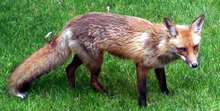
I received a text from Melissa today that while she was working in her kitchen office about a red fox that had run across the back of our property.  The two dogs who Eddie was in conversation with over the last weeks have also made a habit of running to the back of their yard and barking at nothing.  The division between our yard and the church property behind us has a thick (10 feet/3 meter) line of trees that separates us.  While it has always seemed the dogs were barking aimlessly, I wonder if instead they had seen (sensed?) the fox and that was what had set them off.  While the fox was beautiful to see, it quickly passed through the yard, across the open field, and was gone in a matter of seconds.

When I looked online, I found the red fox (Vulpes vulpes) is the largest of the true foxes and one of the most widely distributed members of the order Carnivora.  The fox is found across the Northern Hemisphere including most of North America, Europe, and Asia, plus parts of North Africa.  Apart from its large size, the red fox is distinguished from other fox species by its ability to adapt quickly to new environments.  Despite its name, the species often produces individuals with a variety of other colorings.  Forty-five subspecies are currently recognized, which are divided into the large northern foxes and the small southern grey desert foxes of Asia and North Africa.  Red foxes are usually together in pairs or small groups consisting of families.  The young of the mated pair remain with their parents to assist in caring for new kits.  The fox primarily feeds on small rodents, though it may target rabbits, squirrels, game birds, reptiles, invertebrates, and young ungulates (hoofed mammals).  The fox is vulnerable from larger predators, including wolves, coyotes, eagles, and large cat species.

This fox species has a long history of association with humans, having been extensively hunted as a pest and furbearer for centuries, as well as being represented in folklore and mythology. Because of its widespread distribution and large population, the red fox is one of the most important furbearing animals harvested for the fur trade.  Since it is too small to pose a threat to humans, it has benefited from the presence of human habitation.  The fox has successfully occupied many suburban and urban areas.  Domestication of the red fox is also underway in Russia and has resulted in the domesticated red fox.  While the fox seen by Melissa was not domesticated, it had been urbanized.

THOUGHTS:  The range of the red fox has continued to increase alongside human expansion.  The foxes were established in Australia through successive introductions in 1830’s and 1840’s by British settlers who wanted to foster the traditional English fox hunt.  The species is an apex predator on the mainland but is less common in areas where the dingo is prevalent.  Still, the red fox has been implicated in the extinction or decline of several native Australian species.  The spread of red foxes across the southern part of the continent coincides with the spread of rabbits (another invasive) in Australia and corresponds with declines in the distribution of several medium-sized ground-dwelling mammals.  The red fox is included on the list of the “world’s 100 worst invasive species”.  Hardly a desirable list to be noted on.  Once more, one person’s sport is another’s bane.  Follow the science.  Change is coming and it starts with you.
Tulip

March 14, 2022

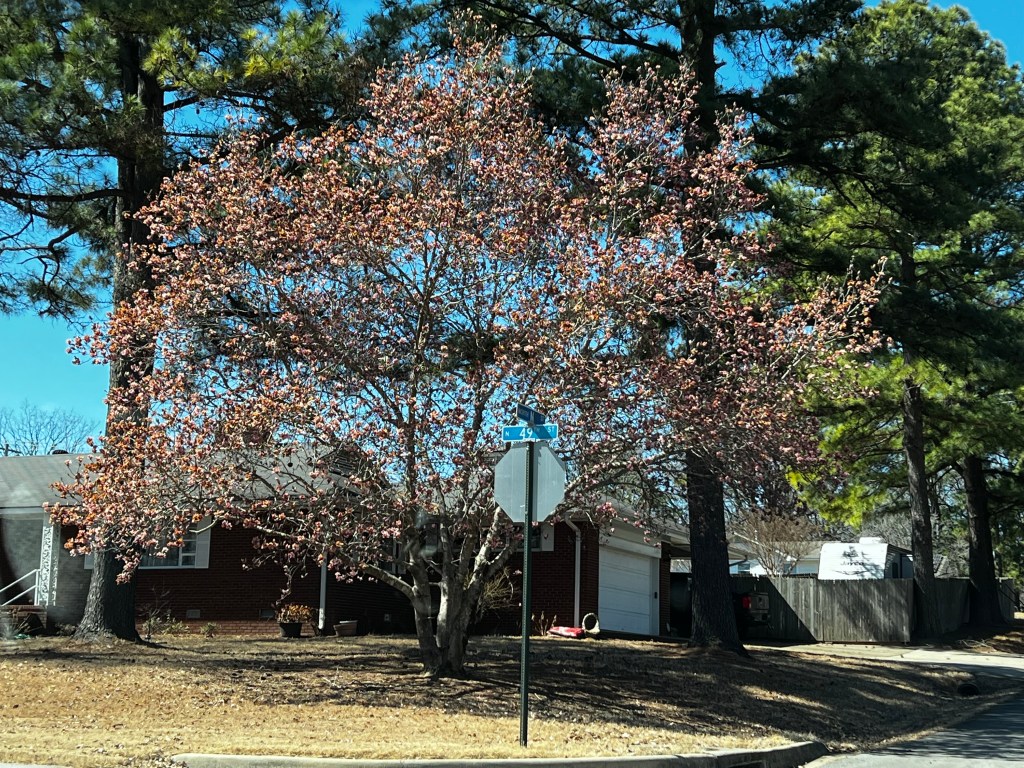
On our way home Sunday, we dropped by our friend’s house to pick up supplies for the display Melissa is planning for the local Farmer’s Market in May.  They had made a run to Florida and as always hit the flea markets and garage sales along the way.  This provides the items for her resale business, and she had picked up a variety of interesting pot for Melissa’s succulents.  We took this opportunity to say hello to Eddie.  Eddie had been ecstatic when they picked him up two days ago and was now again ecstatic to see us.  You have got to love puppies.  As we drove out of their subdivision, we noticed a tulip tree in full bloom on one of the street corners.  It was too early for the tree to bloom, but this year’s temperature fluctuations make the plants crazy.

When I looked online, I found the tulip tree (Liriodendron tulipifera), also called the tulip poplar, yellow poplar, or canoe wood, is one of the largest native trees in North America.  Liriodendron is a genus of two species of large deciduous trees in the magnolia family (Magnoliaceae).  The tree is widely known by the common name for the large flowers superficially resembling tulips.  The botanical name originates from Greek, as Liriodendron means “lily tree”, and tulipifera means “bringing forth tulips”.  There are two extant species, the Liriodendron tulipifera is native to eastern North America, and the Liriodendron chinense is native to China and Vietnam.  Both species can grow to great size.  The North American species reaches a mature height of 70-90 feet (21-27 meters) and a width of 35-50 feet (10-15 meters).  In the small valleys of Appalachia (cove forests) the tree is known to reach the height of 191.8 feet (58.49 meters).

The tulip tree produces goblet-shaped, orange-yellow-green flowers in late spring after the leaves have already emerged.  The cone-like seed clusters sit upright on the branches.  The tree provides many forms of food for animals.  In fall and winter, young trees are browsed by white-tailed deer and rabbits.  The spring flowers provide nectar for ruby-throated hummingbirds.  Tulip tree seeds mature in summer and persist into winter, providing food for both birds (finches, cardinals, and quail) and mammals (mice, squirrels, and rabbits).  The golden-yellow fall color of makes it an excellent choice for large landscapes.  This tulip fit well on the corner lot of the subdivision.

THOUGHTS:  The tulip trees of North America are commonly used horticulturally.  The tulip was favored by loggers for railroad ties and fence posts and are now used for furniture.  George Washington planted tulip trees at Mount Vernon which are now 140 feet tall.  Canoe wood refers to the tree’s use in construction of dugout canoes by eastern Native Americans, and Daniel Boone used the wood of this tree for his 60′ canoe.  While the tulip tree is sought after for its tall, straight trunks, the tree has grown in popularity as an ornamental landscape feature.  Its size requires a large lot, but when allowed to mature it creates an impressive display throughout the year.  When we nurture and allow our youth room to mature, they also have the potential to be impressive.  Nurture seems to be a greater force in shaping a child than nature.  The potential is there for them all.  Do the work.  Change is coming and it starts with you.
Store

March 12, 2022

Since the snow was predicted to come again yesterday, I decided it was a good time to go to the store.  Typically, I did not get off early and it had started snowing before I left.  This was not the emergency shopping that drives people to the store with impending snow.  I needed a squeaky toy and a harness for Eddie as he had chewed through both, and his people were on their way to pick him up.  I found it interesting that my next-door neighbor got into his truck as I was going to mine.  I followed him down the road and then saw him pull into the same store lot.  I parked and then got out in time to notice him walking ten feet in front of me.  As we both took carts I commented, “Nice day to go shopping, huh?”  He laughed and agreed.

One of the items I was looking for at the store was an Easter cactus.  Melissa had seen them advertised online by the corporate website and hoped our store would have them.  She already has the Thanksgiving and Christmas cacti I wrote about earlier and wanted to complete the holiday cactus set.  It was snowing heavily when I went out to the garden center.  The racks of flowers had been wheeled inside and most of the exposed plants outside had been covered with plastic.  I checked under several sheets and only found flowers.  When I asked the attendant (yes, I asked) about the Easter cactus, he checked his phone and politely told me they did not have any in stock.  I went back inside and completed my shopping list.

After getting the items I needed (and several others), I made my way to the self-check lanes.  This store is different than others as you cannot put your card in the reader until you finish ringing up your purchases.  I know this, as several times I have put my card in too soon and paid for one item.  When I reached for my card to pay it was not in my pocket.  I told the attendant I needed to get my card from the car, and she said she would hold the line.  My card was not in the car.  I asked if I could call my wife for the number, and although that was not possible, she said she would hold my order until I got back.  As I walked outside, she told me to “drive safe”, as the snow was getting thick.  I walked to my car and as I got in a man was standing outside my window.  I hesitated but rolled down the window.  He said he heard me say I needed to go get my card and offered to pay for my purchases, and I could mail him a check.  I thanked him, but politely declined.  I went home, got my card, and returned to the store to buy my items.

THOUGHTS:  When I got home from the store, I thought about my encounters.  I have been boosted and always wear a mask when I go to the store.  None of the people I spoke with had worn a mask and only 65% of the eligible people in our state have been vaccinated.  Despite the probability of our differences, they had treated my kindly and been concerned about me driving in the snow.  Later that night Melissa and I watched Rocky IV which came out toward the end of the Cold War in 1985.  After improbably winning over the crowd and winning the fight, Rocky says, “If I can change . . . and if you can change . . . maybe we can all change.”  While this may not be on par with de Tocqueville, the thought and my encounters give me hope.  Do the work.  Change is coming and it starts with you.
Hyacinth

March 11, 2022

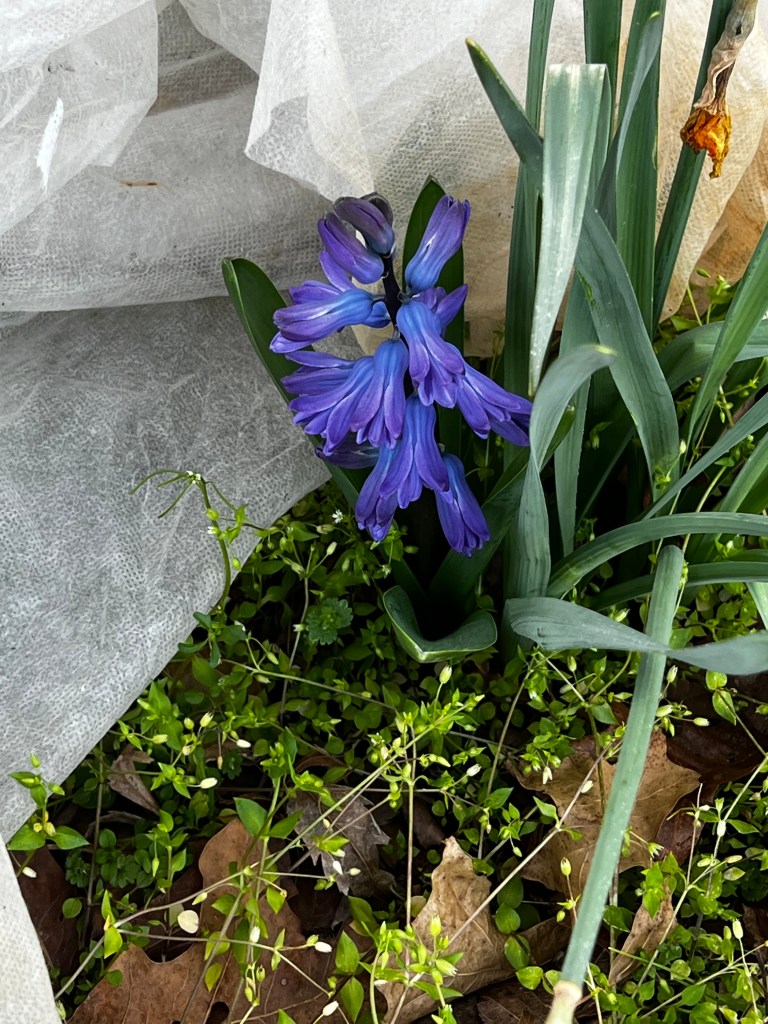
Years ago, Melissa and her mom planted a variety of bulbs in the front beds of our house.  The daffodils (Narcissus spp.) have bloomed every year, and this year we already have two different varieties in the maple bed and mailbox bed.  Grape Hyacinth (Muscari armeniacum) bulbs were planted at the same time, and they have literally exploded.  They take over the mailbox bed every spring and have spread seed throughout our yard.  These shoots come to flower prior to my first mow of the season.  The hyacinth never bloomed during Melissa’s time here, nor since our return three years ago.  This year the hyacinth finally bloomed, after lying dormant for over a decade.

When I looked online, I found the common hyacinth (Hyacinthus orientalis), also called the garden hyacinth or Dutch hyacinth, is a species of flowering plant in the family Asparagaceae (yes, like asparagus), native to southwestern Asia, southern and central Turkey, northwestern Syria, Lebanon, and northern Israel.  It was introduced to Europe in the 16th century and is now widely cultivated throughout the temperate world for its strong fragrant flowers which appear quite early in the season.  It appears our bulb is the ‘Royal Navy’ variety.  This is a hardy, perennial which bears up to 40 dark-blue double flowers, ¾-1½ inches (2-3.5cm) long, packed into a head 8 inches (20cm) tall.  Hyacinth bulbs need to be planted in fall to allow the bulb to experience the cold winter temperatures, allowing it to break dormancy in the early spring.  

All flowering plants do so at a particular time according to their species.  It is possible to make a plant flower at other times by artificially creating the proper conditions.  This process is known as “forcing” and is often used by commercial growers.  Hyacinth is among the most popular bulbs for forcing and this is commonly done around the Christmas season.  The bulbs can be forced indoors by depriving light and warmth for several weeks, then placing them in a bright, cool place such as a kitchen windowsill.  Hyacinth bulbs can also be forced in a narrow-necked vase of water, which allows you to view the root growth.  Other cultivars of bulbs suited to forcing are crocuses and daffodils.  It was advised to always wear gloves when handling the bulbs as they contain oxalic acid, which can cause skin irritation.

THOUGHTS:  When the hyacinth came up in our bed, Melissa thought it might be a crocus.  She made this suggestion without looking at the flower, but the hyacinth had never bloomed, and I knew this was not the daffodil blooming beside it.  I later realized this was a not a crocus due to the rows of double flowers.  Melissa’s sister suggested the hyacinth may have bloomed because of the garden netting we placed over the bed to protect it from the cold.  The hyacinth bulb received the cold needed for dormancy, and the mesh allowed the soil to warm quickly.  In essence, we had forced the bulb outside rather than on our windowsill.  Humans can create artificial conditions to force flowers to react at unnatural times.  We do the same thing with animals when we tame, then domesticate species.  This has not worked when we have tried to “force” other humans.  To live together we must treat everyone with respect and acknowledge their worth.  Do the work.  Change is coming and it starts with you.
Middleman

March 09, 2022

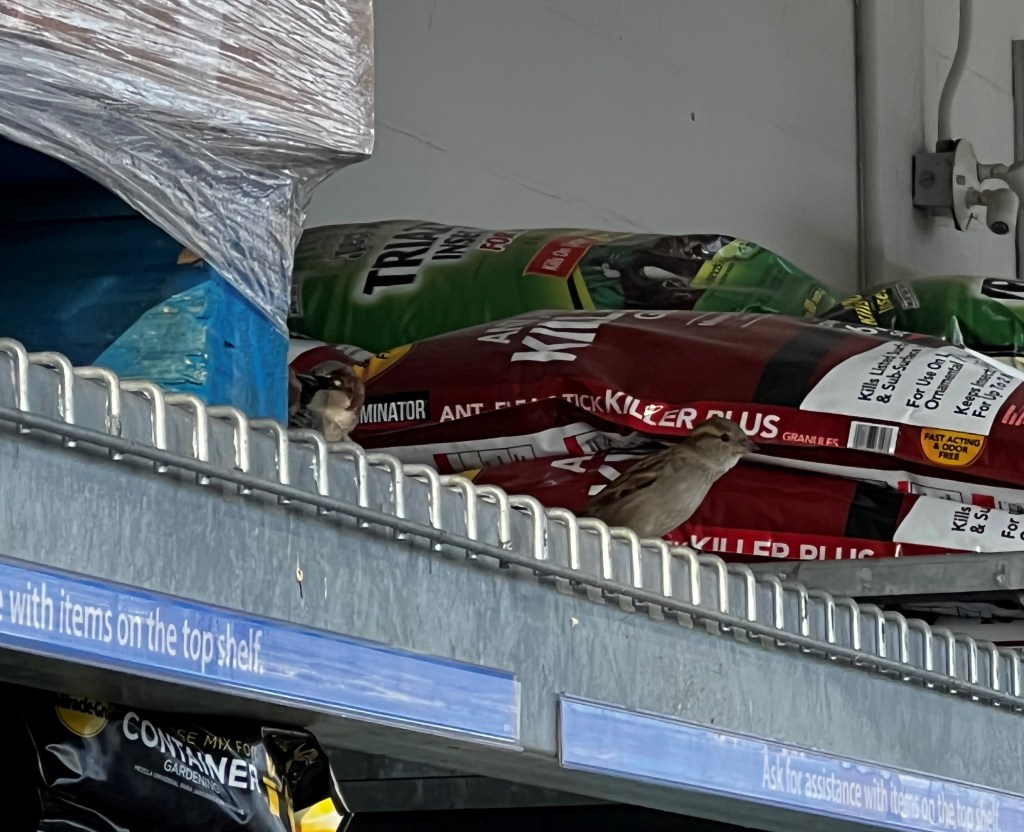
I stopped by our local market last weekend to restock my supply of bird seed.  I have mentioned how our store is rearraigning stock to meet the demand for online delivery.  Lately I have found it hard to know where many of my supplies are located.  As I passed another shopper talking with an employee, I heard the employee say, “I am not sure where that is, I have been off for two days and now I can’t find anything.”  I located the bird supplies in a different section of the store, decided on the seed and squirrel food I was looking for, and then went out to the garden center to check for early stock.  There were a few flowers and a small rack of vegetables and herbs.  The racks with lawn care treatments also had the 40-pound (18 kg) bags of seed that used to be inside the store.  As I approached the seed, I noticed a flurry of wings.  Apparently, the sparrows had decided to cut out the middleman and get their seed from the source.

When I looked online, I found that a middleman is defined as a trader who buys from producers and sells to retailers or consumers, serving as an intermediary or go-between.  The transfers of goods that occur between the producer to the retailer is called a supply chain.  This involves a middleman at each level of transfer.  For the last two years global supply chains have been strained as shipping routes are snarled by the pandemic, extreme weather slowed shipment, and a notable blockage of a canal caused delays.  The transfer of goods along the supply chain has caused the breakdown or delay in moving all sorts of goods to market.  Each transfer through a middleman raises the price and has the potential for added delays.

Many agribusinesses and food processors source raw materials from smallholder farmers, and over the past 20 years there has been a shift towards more traceable supply chains.  Rather than purchasing crops that have passed through several layers of collectors (middleman), firms are sourcing directly from farmers or trusted aggregators.  The drivers for this change include concerns about food safety, child labor, and environmental sustainability, as well as a desire to increase productivity and improve crop quality.  This also gives the retailer greater price control.

THOUGHTS:  Supply chain delays have caused businesses to react like our market’s sparrows and seek ways to cut out the middleman.  Restaurants and markets are increasingly advertising food as “locally sourced”.  The use of this term is not regulated and is determined by the seller.  Some stores consider vegetables grown within 100 miles as local, while others believe it only includes foods produced within a 10-mile radius.  Globalization encouraged corporations to seek the lowest cost goods, regardless of the middleman.  Supply chain delays now encourage goods manufactured or produced locally (nationally).  It is not cheaper if you cannot get it.  Do the work.  Follow the science.  Change is coming and it starts with you.
Varients

March 08, 2022

Variants

March 08, 2022

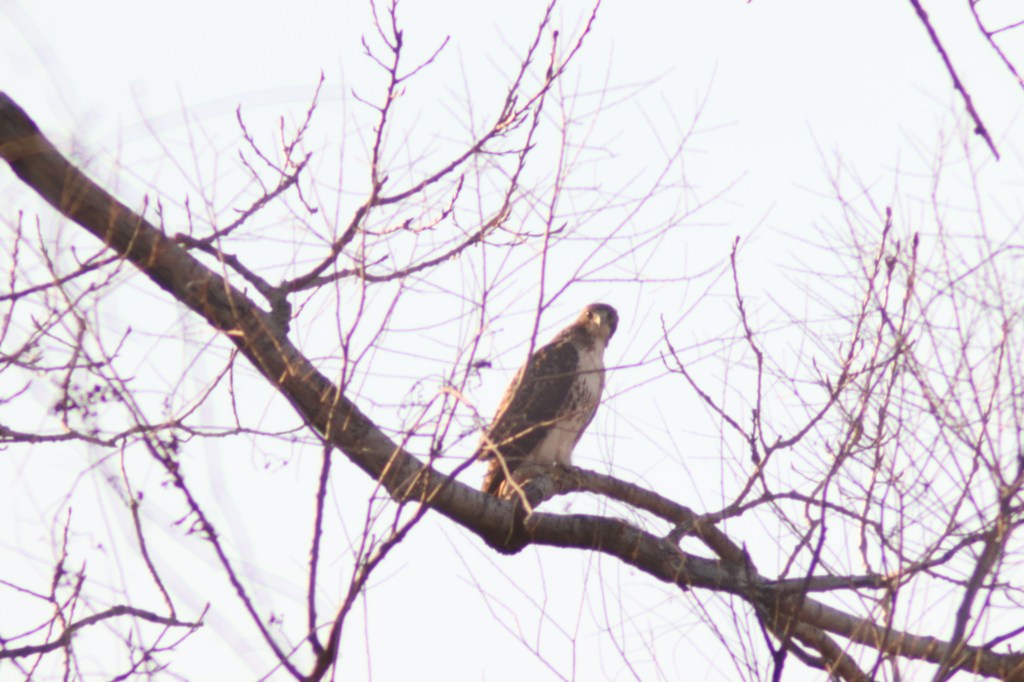
One of my favorite birds is the red-tailed hawk.  I have been enamored by raptors since my early college days and even (briefly) dreamed of being a raptor veterinarian in Alaska, until I was stymied by the memorization required by Chemistry I, II, and III.  While the majestic eagles soaring on the thermals are often the main attraction, the hawks were more common in the prairie state where I grew up.  Since becoming an Arkansas birder I have struggled to identify the hawks I see perched on tree limbs or power lines along the road.  I would take a picture and then compare it to the images in my guides.  What I finally realized is these “different birds” are all variants of the same species, my beloved red tail.

When I looked online, I found the red-tailed hawk (Buteo jamaicensis) is a bird of prey that breeds throughout most of North America, from the interior of Alaska and northern Canada to as far south as Panama and the West Indies.  It is one of the most common members within the Buteo genus in North America or worldwide.  The red-tailed hawk is one of the largest members of the Buteo, typically weighing from 1.5 to 3.5 pounds (690 to 1,600 g), measuring 18-26 inches (45–65 cm) in length, and with a wingspan from 3’7” to 4’8” (110–141 cm).  The species displays sexual dimorphism in size, with females averaging about 25% heavier than males.  The bird occupies a wide range of habitats and altitudes, including deserts, grasslands, coniferous and deciduous forests, agricultural fields, and urban areas.  Red tails are legally protected in Canada, Mexico, and the US by the Migratory Bird Treaty Act.  There are 14 recognized variants that differ in both appearance and range.

When I tried to identify the different hawks I photographed, their colors ranged from brown backs with a dirty white mottled front, to brown with full white breasts, to nearly white with a pinkish tail.  My research indicated that red tails are often strongly polymorphic, with individuals ranging from almost white to nearly all black.  These variants explained my different birds.  The red-tailed hawk is one of three species colloquially known in the US as the “chicken hawk”, though it rarely preys on standard chickens.  The diet of red-tailed hawks is highly variable and reflects their status as opportunistic feeders, but most often they are predators of small mammals such as rodents, and prey that is terrestrial and at least partially diurnal is preferred.  Like many Buteo species, they often hunt from a perch, but they can vary their hunting technique where prey and habitat demand.

THOUGHTS:  While speaking with my mom last week she mentioned the “chicken hawk” that had roosted on the tree outside her window.  This was joined by another smaller bird, and both were the same variants.  This must have been a female (larger) and her mate (smaller).   While I grew up hearing the term “chicken hawk”, I did not realize (until today) they were probably red tails.  When the pandemic began researchers struggled to identify the corona virus.  Once the virus’ genome was mapped, they began to identify later variants.  Like my red tails, none look quite the same on the microscopic level, but they are all covid.  So far, the vaccines have been effective against these variants.  Follow the science.  Change is coming and it starts with you.

Patrol

March 07, 2022

I have mentioned how we have been puppy sitting our friend’s Sheltie over the last week.  The routine he began with has altered as he has become more comfortable with the surroundings.  When he first arrived, he was met by the cat next door (at our front window) and challenged by the two dogs behind our back yard.  Initially, he would patrol the front by prancing along the edge of the yard when we let him outside.  The change came when the neighbor’s cat showed up across the street and he ran into their yard, forcing us to call him back.  Eddie now seems to think anywhere in the cul-de-sac is fair game.  That means he will take off on a wider patrol and we call him back to keep him close.  At least he is willing to return.

When I looked online, I found many animals identify territories or ranges they patrol.  Ethology is the scientific study of animal behavior, usually with a focus on behavior in natural conditions, and viewing behavior as an evolutionarily adaptive trait.  In ethology, territory is the area that a species of animal normally defends against related animals, and animals that defend the areas they patrol are referred to as territorial.  Territoriality is not shown by most species, and more common is for a group of animals to confine to an area (not defend) of home range.  These home ranges often overlap with different groups of animals, and the groups tend to avoid each other.  Members of the group use vocalization to advertise their territory and scent marking to let others know of their presence.  That is why a dog sniffs everything, to find who has been there.

Eddie is also used to having a large, fenced backyard at his house, which we do not have.  Still, he does enjoy being on patrol on our back patio.  There were some lively “vocalizations” in the beginning when our neighbor’s dogs were outside.  Now more often, these dogs will continue to bark and stir up the entire neighborhood, while Eddie stands and watches or even ignores them.  He seems to be confident in his own space and does not need to create a vocalized claim.

THOUGHTS:  I find it interesting how Eddie’s behavior has changed in the week he has been with us.  When he arrived in this new territory, he quickly made his presence known.  Still, he stayed close and limited his area to patrol.  Now that he is comfortable, he has a greater range and seeks new smells and challenges.  At the same time, he no longer seems to need to challenge the other dogs, knowing they are unable to enter his space.  Humans hold this same instinct to create and defend territory.  At times this is done with saber rattling (vocalizations) and at times by drawing lines in the sand (scent marking).  Unlike the animal groups which recognize and avoid interaction, human interaction may result in physical violence toward the other.  Humans are one of the few species willing to kill to exert territorial control.  War never creates a lasting peace.  Instead, it requires a willingness of both sides to listen.  Do the work.  Change is coming and it starts with you.
Green

March 04, 2022

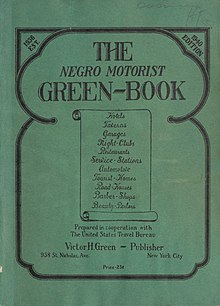
As Black History Month came to an end the Sunday edition of my local newspaper printed a front-page article on the Green Book and its impact on Black History in our area.  Tour Guides have been a popular way to direct travelers to needed services since the Middle Ages.  These were originally designed for the European rich, but in the US westward expansion, then trains, and later automobiles made these vital sources of information for the masses.  While cars opened travel for the Black middle class, Jim Crow laws and discrimination limited available amenities.  The Green Book listed locations that were friendly (or at least tolerant) of Black travelers.  Most of these sites were located near larger cities, but attention was also given to ways to traverse between cities.  Arkansas had around 230 listings, including four tourist homes in Fort Smith.  Two of these homes are still standing.   

When I looked online, I found the Negro Motorist Green Book (The Negro Motorist Green-Book, The Negro Travelers’ Green Book, or the Green Book) was an annual guidebook for African American travelers.  It originated and was published by a Black New York City mailman named Victor Hugo Green from 1936 to 1966.  This was during the Jim Crow era when open and often legally prescribed discrimination existed against Blacks and other non-whites.  Although racial discrimination and poverty limited Black car ownership, the emerging Black middle class began to buy automobiles during the late 1920’s to avoid the discrimination of mass transit.  Blacks still faced a variety of dangers along the road, including refusal of food and lodging and arbitrary arrest.  In response, Green wrote his guide to services and places relatively friendly to Blacks travelers, and eventually founded a travel agency.

From a New York-focused first edition in 1936, Green expanded the work to cover much of North America, including most of the US and parts of Canada, Mexico, the Caribbean, and Bermuda.  While the Green Book became “the bible of black travel during Jim Crow”, enabling black travelers to find lodgings, businesses, and gas stations that would serve them along the road, it was little known outside the Black community.  The Green Book was intended to make life easier for those living under Jim Crow, but its publisher looked forward to a time when such guidebooks would not be necessary.  Green wrote, “there will be a day sometime in the near future when this guide will not have to be published.  That is when we as a race will have equal opportunities and privileges in the United States.  It will be a great day for us to suspend this publication for then we can go as we please, and without embarrassment.”  Shortly after passage of the Civil Rights Act of 1964, publication ceased, and the book fell into obscurity.

THOUGHTS:  The Green Book inspired a 2018 movie of the same name that won three Academy Awards, including Best Picture and Best Supporting Actor.  The Green Book was a vital aid to travel for some, while nearly unknown to others.  Even though the book included locations around my birth state, the movie was the first time I recall hearing the term.  While the Green Book ceased publication, the discrimination it addressed still exists.  Not having a book does not make discrimination go away.  That only happens when we all change our attitude.  Do the work.  Change is coming and it starts with you.
Inoculations

March 03, 2022

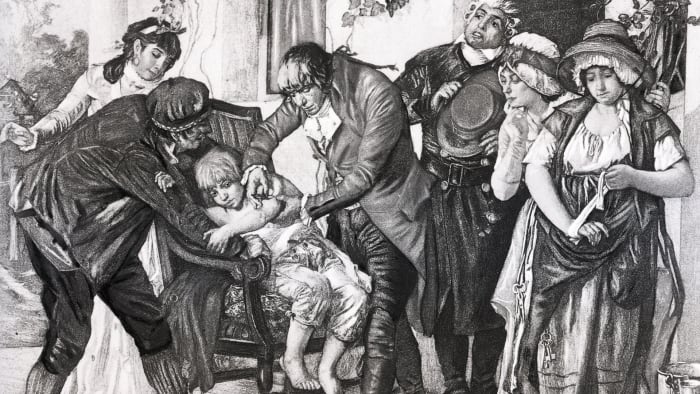
Today’s NY Times Morning feed posted an article on the difficulty of getting the 80 million eligible persons in the US to receive inoculations against the covid virus.  The first interest in inoculations in America came from an enslaved man brought to Boston from West Africa.  Onesimus had lived in an area of West Africa where inoculations for smallpox were common.  He had been deliberately infected with smallpox to make him immune to the severe version.  Onesimus told his owner, Cotton Mather, about the practice.  Mather was one of the colonies’ most prominent religious leaders in the 1720’s, as well as having a keen interest in science.  When smallpox began spreading in Boston in the 1720’s, Mather campaigned for inoculations.  Mather was met with fierce criticism as some argued the inoculations violated God’s will and others debunked it as folklore.  Arguments against inoculations were powerful because their use is counterintuitive.  Mather claimed people could avoid getting sick by getting sick.

Another early evangelist for inoculations was Benjamin Franklin, stemming from his own brush with smallpox.  As disease swept Philadelphia in 1736, the Franklin’s decided not to inoculate their 4-year-old son as he was sick with a cold.  Their son contracted smallpox and died, and rumors spread that Franky had died from the inoculation rather than the disease.  Franklin wrote the true story in his newspaper, The Pennsylvania Gazette, and in the following years tried to persuade others to avoid his mistake.  In a pro-inoculation pamphlet Franklin wrote, “Surely parents will no longer refuse to accept and thankfully use a discovery God in his mercy has been pleased to bless mankind with.”

Modern inoculations are not as counterintuitive as we now know drugs can teach the immune system to respond to a deadly virus without having to use the actual virus.  Inoculations are still considered strange by some, as an unknown cocktail of foreign substances are injected into the body.  Every new vaccine has had its skeptics and historically the two most effective responses to skepticism have been government mandates and relentless, calm persuasion.  Covid mandates are unrealistic in the US today, although it has been tried on a lesser scale, and persuasion will be required.  Persuasion means taking seriously the concerns of skeptics and creating opportunities for doctors, nurses, relatives, friends, and other trusted people to explain why inoculations can be counterintuitive yet lifesaving.  Dr. Vivek Murthy, the surgeon general, said “You build trust by listening to people, helping them feel they’re respected and valued.”

THOUGHTS:  Vaccine mandates have been used by governments since the 18th century and have been tried in recent years in response to disease outbreaks (smallpox and polio).  The covid death toll in the US exceeds 950,000, and many of those deaths occurred after inoculations were available.  Congress approved the National Childhood Vaccine Injury Act (NCVIA) in 1986 and established the National Vaccine Program within the US.  There are ten mandated vaccines that are routinely given to protect infants or children from the ravages of disease.  Since covid is not on the list, listening to concerns and respecting feelings is the best way to save lives.  Follow the science.  Do the work.  Change is coming and it starts with you.