Pigs

February 03, 2022

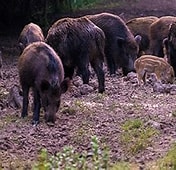
When I lived in the San Francisco Bay Area I was amazed by the length’s residents go to accommodate the diversity of local wildlife.  Turkeys, mountain lions, deer, bobcats, and foxes mix with the skunks, racoons, and squirrels that are all treated on laissez-faire terms by humans.  However, the line is being drawn on feral pigs.  They are tearing up lawns, ripping through golf courses, threatening drinking water, and disturbing the harvests at Napa vineyards.  “They are a pest to just about everybody,” said Eric Sklar, member of the California Fish and Game Commission who introduced a bill last week in the state legislature that would make it easier for hunters to kill feral pigs. 

Feral pigs have been a menace across the south for decades.  The US Department of Agriculture (USDA) estimates the pigs cause $2.5 billion in damage every year.  Now, in what one federal official called a “feral swine bomb,” the pigs are threatening states to the north and west.  Some Northeastern states say they have eliminated their feral pig populations, but at least 30 states still have wild pig populations.  In California, 56 of the state’s 58 counties have wild pigs. Hundreds of pigs have invaded the creek beds that feed into the San Leandro reservoir, which provides drinking water to cities across the East Bay.  The East Bay Municipal Utility District, which manages the water system, spends $50,000 a year trapping pigs, and on average captures and kills 60 to 70 pigs a year.  Last year it culled a record 226 pigs.

The USDA estimates there are 6 million feral pigs in the US. They are often hybrids of domestic pigs brought by European explorers five centuries ago and Eurasian or Russian wild boar imported in the 1900’s for sport hunting.  These hybrids have since become a super invader.  The California legislation introduced on January 19th would remove the need for hunters to purchase a $25 “tag,” which gives the legal right to kill one pig.  Some experts believe the nomadic pigs will just move to areas where hunting is not allowed.  Animal rights and conservation groups are opposed to culling of pigs, but more typical is the nuanced view of Brendan Cummings, conservation director at the Center for Biological Diversity, an organization that focuses on the protection of wildlife and endangered species.  These are “individual living animals that we should treat as ethically as possible.”  At the same time, he is not opposed to culling or hunting pigs in places where they are an invasive species damaging the environment.

Thoughts:  Most Americans do not understand, or choose to ignore, how our food arrives on the table.  While most complain when there is a shortage at the market, we may cringe at the thought of an animal (mammal, bird, fish, shellfish) being “culled” for our consumption.  Chris Davies is a licensed trapper who hunts feral pigs in the Bay Area.  He distributes the dead pigs to locals who butcher them into pork chops and sausage, yet others are unsure about eating the pigs.  One woman who struggles with the destruction the pigs cause said, “Honestly, if somebody said to me, ‘Would you like a pig carcass?’  I’d be like, what?  No, I’ll go to Safeway, thanks.”  The source of food is less specific when it is wrapped in plastic.  Do the work.  Follow the science.  Change is coming and it starts with you.
Lightning

February 02, 2022

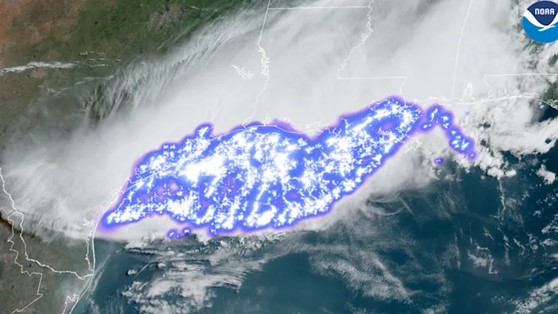
Hidden among the World News of my local paper I noticed an article on a lightning bolt that occurred during 2020 that set a new world record.  The single flash extended 477.2 miles across Texas, Louisiana and Mississippi in April 2020, the World Meteorological Organization said Monday.  That beat the old record set in 2018 in Brazil of 440.6 miles.  Also in 2020, a single lightning flash over Uruguay and northern Argentina lasted 17.1 seconds, nipping the old record of 16.7 seconds.  Normally lightning does not stretch farther than 10 miles and lasts less than a second, said Arizona State University’s Randall Cerveny, chief of records confirmation for the meteorological organization.  Both flashes were cloud-to-cloud and several thousand feet above the ground, so no one was in danger.  Neither was linked to climate change.  The two flashes were spotted and confirmed by new satellite tracking technology.  Both regions are two of the few places in the world prone to the intense storms that produce “megaflashes”.  It seems appropriate that both events occurred in 2020.

When I looked online, I found that lightning is a form of electricity.  Thunderclouds are made up of cold air that forms ice crystals and warm air that forms water droplets.  During a storm, these crystals and water droplets collide to create an electrical charge in the clouds.  The charges separate with the positive charges or protons at the top of the cloud and the negative charges or electrons at the bottom.  When the negative charge gets strong enough, energy is released from the cloud and goes through the air to a place with an opposite charge, such as the ground, a tree, or even a person.  Lightning kills an average of 49 people each year in the US, and hundreds more are injured.  Some survivors suffer lifelong neurological damage.  According to the National Weather Service, as lightning passes through air, it can heat the air to 50,000F (27,760C), or about 5 times hotter than the surface of the sun. 

I remember learning about lightning growing up.  My first experience was at Boy Scout camp where we encountered a thunderstorm.  The Scout Master taught us to listen for the thunder to see how far the lightning was away.  Since sound travels at 820 feet per second (252.3 mps), you can count the seconds since the flash and times the seconds since you hear the sound by 820.  It takes sound just under 6.5 seconds to travel a mile (1.5 kilometers).  The second learning came while I was on a family hike.  We were above the tree line when a lightning storm overtook us.  That meant we were the “tallest tree” on the side of the mountain.  There were precarious moments until we escaped into the forest below.

Thoughts:  Lightning strikes somewhere in the US nearly 25 million times a year.  Although summer months are the prime season for lightning, people can get struck any time of the year.  John Jensenius is a lightning specialist for the National Weather Service and says 80 percent of lightning fatalities occur in men.  He suggested several possible explanations.  Either men are unaware of the dangers associated with lightning (doubt it), are more likely to be in vulnerable outdoor situations (choose unprotection), or they are unwilling to be inconvenienced by the threat (better things to do).  I believe the same could apply for not getting a vaccine.  Follow the science.  Change is coming and it starts with you.
Orcas

February 01, 2022

John Daw/Australian Wildlife Journeys

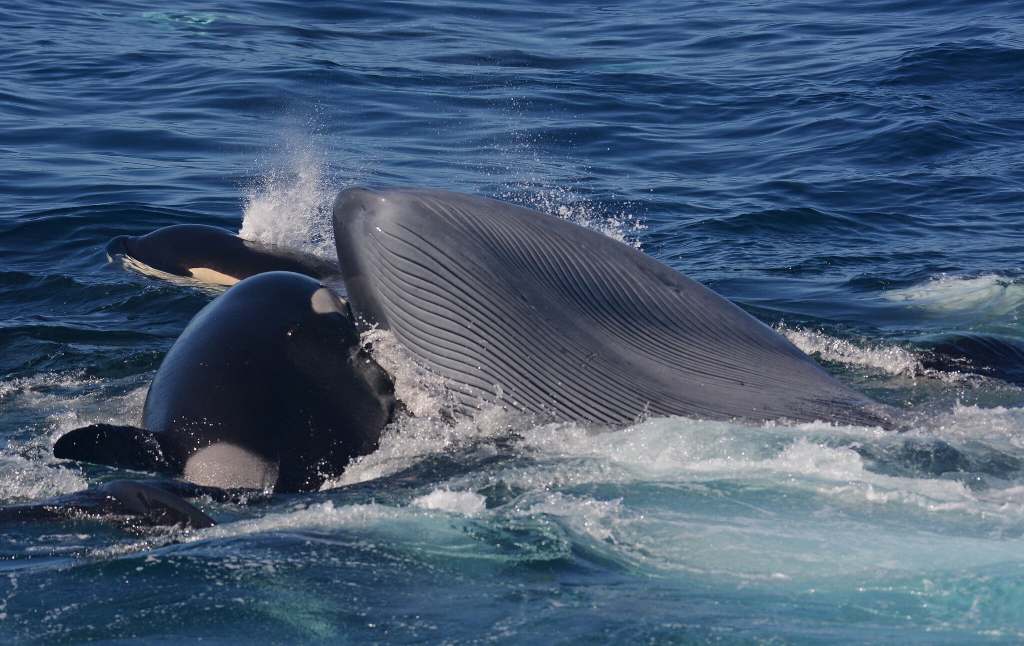
One of the articles on my weekend feed was a report published in Marine Mammal Science of three attacks by orcas on blue whales.  The scientific community has long debated if orcas can hunt the massive blue whales, and for the first time a pack of orcas have been observed hunting and killing the whales.  Three instances of packs of orcas attacking blue whales off the coast of Western Australia were recorded by marine scientists from Cetrec WA (Cetacean Research).  “Here we provide the first documentation of killer whales killing and eating blue whales: two individuals killed, 16 days apart in 2019, and a third in 2021,” researchers wrote in the paper. “Notably, the first whale taken appeared to be a healthy adult.”  The blue whale is the largest animal on the planet.

When I looked online, I found the blue whale (Balaenoptera musculusis) is the largest animal on the planet, growing up to 110 feet (33.8 meters) in length and weighing as much as 200 tons (approximately 33 elephants).  The blue whale has a heart the size of a Volkswagen Beetle and its stomach can hold one ton of krill.  These whales are the loudest animals on Earth (188 decibels) and are louder than a jet engine (140 decibels).  Their low frequency whistle can be heard for hundreds of miles and may be used to attract other blue whales.  The orca (Orcinus orca) or killer whale, is a toothed whale belonging to the oceanic dolphin family and is its largest member.  Orcas are recognizable by their black-and-white patterned body.  Orcas can be found in all the world’s oceans and in a variety of marine environments.  Blues and orcas are endangered and protected under the Marine Mammal Protection Act of 1972.

Orcas are highly social and can be found in very stable matrilineal family groups (pods).  Their hunting techniques and vocal behaviors are often specific to a particular pod and are passed across generations, all signs of animal culture.  When researchers arrived at the first 72-foot-long blue whale they saw large chunks of skin and blubber had been gouged from its body and most of the dorsal fin bitten off.  It was followed by relentless attacks by the orcas, where three lined up against the blue whale and pushed it underwater, while two attacked its head.  The study said 50 orcas joined the pack for six hours to feed on the carcass.  A few weeks later a 40-foot-long blue whale calf was targeted by twenty-five orcas.  The final recorded attack was on a 45-foot-long blue whale.  The orcas again pushed the whale under water while others attacked its head.  A pack of 50 orcas devoured the remains.  Previous studies thought orca attacks were executed by the bigger males.  This study documented the killings were led by female orcas.  The study suggested the drive to feed their offspring may make them more aggressive.

Thoughts:  Although the predation described of blue whales by orcas is gruesome, scientists say it could be a positive sign for the health of whale species in the area.  The whaling industry nearly drove blue whales to extinction, and having enough whales exist to be preyed on by orcas may hint at population growth.  Dr. Rebecca Wellard, who was among those who witnessed the 2019 attack said, “These hunts signal a positive step for both species’ populations.”  The interaction between predator and prey is part of the natural balance of life.  Humans throw this process out of balance when we refuse to regulate our actions.  Being at the top of the food chain does not give us the right to destroy the earth’s resources.  Follow the science.  Change is coming and it starts with you.
Brands

January 31, 2022

Melissa and I went to the market Friday to pick up several items.  Even though we make a list, we still cross paths with those “must have” items.  While we gathered our purchase, I could not help noticing the empty shelf space.  I could tell by the price labeling many of these spaces had held less expensive store brands.  It is well known that store brands (and especially groceries) are made by many of the same manufacturers as name brands.  Usually, the only difference is the packaging and the price.  Since I buy store brands, I assume these products sold out quicker due to cost.  The manufacturer filled their own orders, and there may not have been enough product to produce the store brands.  Regardless, this left a lot of open shelves.

When I looked online, I found many name-brand manufacturers also make store brands for retailers.  These often sit side by side on the shelf with the store brands but at a lower price.  Quite often what you are paying for with the brands is marketing and packaging.  Another marketing tactic is generic brands (often market goods) which are distinguished by the absence of any brand name.  These products are identified by the product characteristics (i.e., “Beets”) and are usually in black-and-white packaging.  These are also often made by manufactures of the name brands and imitate the brands but at a lower price.  While generic brands may be produced by the same manufacturer, they are thought of as lower quality by consumers.  If I buy them, the quality varies depending on the product. 

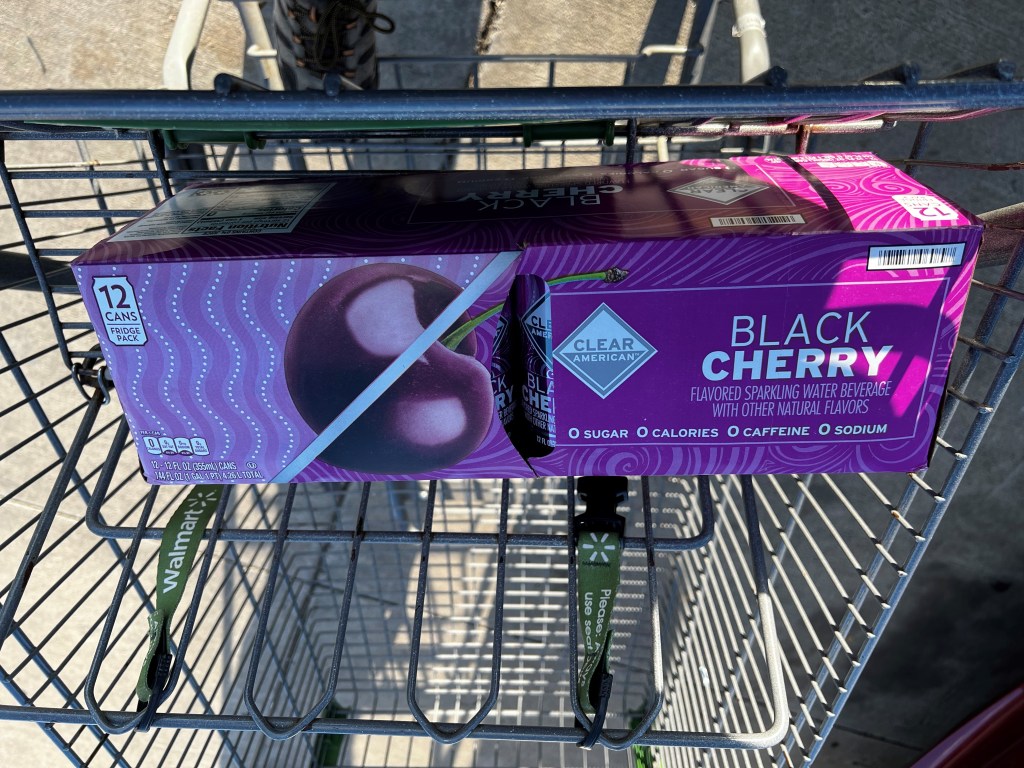
One of the store brands Melissa prefers is sweetener.  This was on our list, but after we got home, we had not purchased the item.  I went to the store the next day to buy sweetener.  I did not find the sweetener she wanted, but who can tell the difference, right?  I also purchased my flavored water.  The flavor I wanted was not available and I tentatively bought another.  I try to not use plastic bags and instead have reusable cloth bags.  During the pandemic our store has not allowed outside bags, so I leave them in my car and bag my purchases outside.  When I got outside, I realized I had not paid for the water.  I took the water back in and ran it through the register.  This time I ran the item twice without noticing until after I paid.  I went to customer service, and they refunded the money.  Shopping should not be this difficult.

Thoughts:  As you may assume, when it comes to sweetener, Melissa can tell the difference.  It was not because the brands were different, but due to the main ingredient.  I went back again, but this time to a closer market of the same chain to return the item.  When I went to the sweetener aisle, the only sweetener in stock was a name brand.  I had checked two different markets and not found what I was looking for.  I was done shopping and spent the extra $2 to purchase the name brand.  Marketing and packaging are the biggest difference between most brands offered at the market.  Marketing has also been the difference for whether to believe information concerning the pandemic.  Perhaps we should examine the facts rather than marketing.  Follow the science.  Change is coming and it starts with you.
Curiosity

January 29, 2022

Our friends got tickets for an out-of-town concert and asked Melissa if she would be willing to puppy-sit this weekend.  When they arrived, Eddie immediately began to sniff around the yard.  He already knew Melissa, so he ran to her for some love.  I had met him several times, so after he finally came to me after a few tentative approaches.  Melissa knew Eddie would have curiosity for the new house, so she blocked off most of the areas prior to his arrival.  She put boxes across the formal dining room and closed the doors to the bedrooms and the greenhouse porch.  When we went inside, he immediately began to search, but stayed close while our friends were here, only sniffing around the kitchen and the breakfast nook.   He became more comfortable after our friends left, his curiosity increased, and he ranged down the hall.

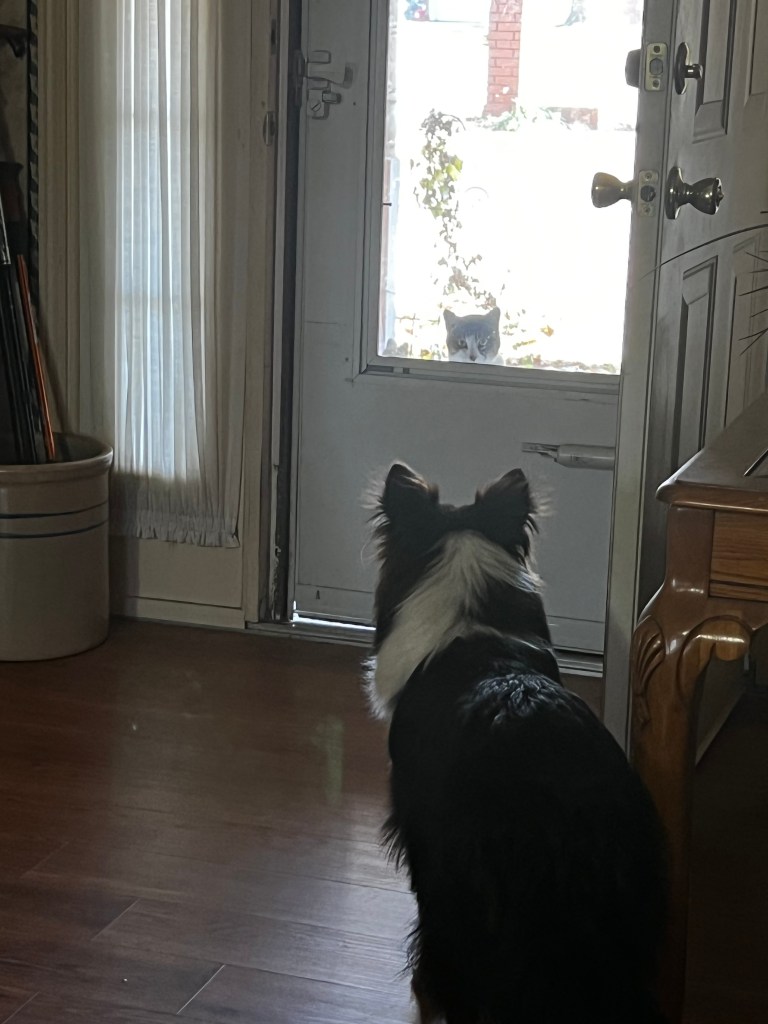
Eddie was not the only animal with curiosity today.  The white cat who lives across the street has become a daily visitor since I installed the bird feeders in the back but has never approached the house.  When Eddie arrived, I noticed her watching.  She must have been wondering about this new dog running around in our yard.  Not long after arrival, we looked up to see the cat peering through the screen door into our house.  When Eddie saw the cat, he took a few steps toward her and then the two had a stare off in the hall.  After staring at each other for a minute Eddie gave one bark and the cat took off. 

I have mentioned how the two dogs who live in the yard behind our house are always curious about Melissa sitting in the bay window while she works.  They bark at her when they see her move through the window driving her crazy.  If she goes out on the porch or back yard, they both bark incessantly until she comes inside.  The dogs had seen Eddie come in the house and were full of curiosity, patrolling the back fence to get another look.  I needed to fill the feeders and brought Eddie with me.  When he came outside the two dogs began to bark.  Eddie ran over to the fence and the larger dog ran off.  The smaller dog has always been more aggressive and continued to bark.  Eddie decided to bark back, apparently telling him this was his yard, and the other dog ran off.  Having fulfilled his curiosity and established his dominance in the cul-de-sac, Eddie spent the rest of the afternoon sleeping in the sun.

Thoughts:  Anyone who has ever watched a cat can attest to their curiosity.  “Curiosity killed the cat” is a proverb used to warn of the danger of unnecessary investigation or risk.  The original form of the proverb was “Care killed the cat”, where “care” meant “worry” or “sorrow for others.”  The earliest printed reference to the original proverb appears in a 1598 play while the later version is first found in an Irish newspaper in 1868.  The phrase continued to morph in the early 20th century with, “Curiosity killed the cat, but satisfaction brought it back”.  The added rejoinder indicates the risk could lead to resurrection because of the satisfaction felt after finding the answer.  During the late 1970’s the line appeared in the Iggy Pop song “Curiosity” and Stephen King’s novel, The Shining.  Human curiosity drives most technological advancement, but it needs to be tempered against unnecessary risks.  You do not want to kill the “cat”.  Do the work.  Follow the science.  Change is coming and it starts with you.

Attacks

January 28, 2022

One of the articles in my local paper referred to the marked increase in shark attacks during 2021 after three straight years of decline.  There were 73 unprovoked attacks worldwide in 2021, up from 57 bites the year before.  Eleven shark-related fatalities were recorded worldwide in 2021, with 9 of the attacks classified as unprovoked.  This compares with the annual global average of 5 fatalities.  “Unprovoked attacks” are defined as there being no human provocation.  Provocation happens when humans initiate the contact, such as divers trying to touch a shark or fisher people trying to remove a shark from their nets.  Florida has led the US and the world in unprovoked attacks for decades and continued to do so in 2021 with 28 attacks.  The only US fatality occurred in Moro Bay in California where a man was killed while boogie boarding on Christmas Eve.

When I looked online, I found that shark attacks are relatively rare considering the number of people who are in the world’s coastal waters every year.  Most attacks are attributed to the Great White Shark (Carcharodon carcharias), Bull Shark (Carcharhinus leucas), or Tiger Shark (Galeocerdo cuvier).  Far more unprovoked attacks are attributed to the varieties of Jellyfish.  Jellyfish are found in oceans of all temperatures and some locations have seasons and conditions when jellyfish are more abundant.  The warm weather and tides during 2018 brought an increase in jellyfish to Florida beaches, resulting in nearly 600 people suffering stings in one weekend.  An estimated 150 million people globally are stung by jellyfish each year.  While most stings in North American coastal waters cause relatively mild reactions (unless allergic), the box jellyfish (such as Chironex fleckeri) found in Indo-Pacific waters present a greater risk, including profound skin wounds and scarring.  In systemic cases this can lead to cardiovascular collapse and death within minutes.

A friend of mine in California would spend two weeks a year as an overseer at the state park in Moro Bay.  The park furnished a small trailer, and he checked reservations and assisted park visitors.  He told me of meeting three Abalone divers who were collecting from the rocks on the bottom of the 50-foot-deep (15 meters) bay.  They had entered the water and not long after came back out.  When he asked if they were all right, they said when they began collecting one of them had been brushed by a great white shark.  They looked up and saw three sharks that were all over 12 feet (3 meters) long.  They decided it was best to wait and go after the Abalone later.

Thoughts:  Shark attacks surged in 2021 after dropping drastically in 2020 due to the pandemic.  Researchers attributed the 2020 decline to pandemic-related lockdowns and fewer people at the beach.  The 2021 attacks closely align with the five-year global average of 72 attacks.  When there are less people in the water there are fewer shark attacks.  Enjoying the coastal waters can result in injuries, drownings, shark attacks, and jellyfish stings.  A researcher who was recently attacked by a jellyfish was asked if this would deter him from going into the water.  He responded, “Of course not.  But I’m reminded once again to never be lulled into a false sense of security.”  As the pandemic appears to be subsiding into an epidemic we need to adhere to this attitude.  We cannot let the virus deter us from interaction, but neither can we be lulled into a false sense of security.  Vaccines, masks, and common sense should still prevail.  Follow the science.  Change is coming and it starts with you.
Popper

January 27, 2022

When the daughter of a friend of mine had her second birthday I gave her a Corn Popper Push Toy.  The toy looked like a corn popper on a set of wheels and was meant to be pushed around the house by the child.  As the wheels turned the balls inside the clear sphere would bounce up and down, making the pop, pop, pop noise of a corn popper.  The toy seemed to be loved by most children at the time, and the girl would push the popper around the house for hours on end, driving my friend crazy.  One day she told me she could hardly wait until I had a child so she could buy such a thoughtful gift for them.  I had no children, so I was not worried.  When I did have a son, she made good on her promise and gave him a Corn Popper toy for his birthday.  Sadly, he also loved to play with his popper.

When I looked online, I found the latest toy craze are fidgets.  A fidget toy is an object that can be given to a child to regulate their need for movement and touch.  This enhances the ability to remain calm, focused, and attentive.  Fidget toys provide a place for kids to direct energy in a less distracting and more socially appropriate way while they focus on the task at hand (listening to a classroom lesson or paying attention to a book during circle time).  If you are the parent or grandparent of school-aged child, chances are you are aware of these toys.  A new fidget has taken the world by storm called Pop It.  The toy has spread around the world and is also known as crazy poppers, crazy snaps, push pop fidgets, and bubble pop.  This is basically a round disc that flips over when you are done popping so you can start again on the other side.  Pop It is advertised as having all the fun of bubble wrap without the waste (who does not like to pop bubble wrap?).  I bet this popper still drives parents and teachers crazy.

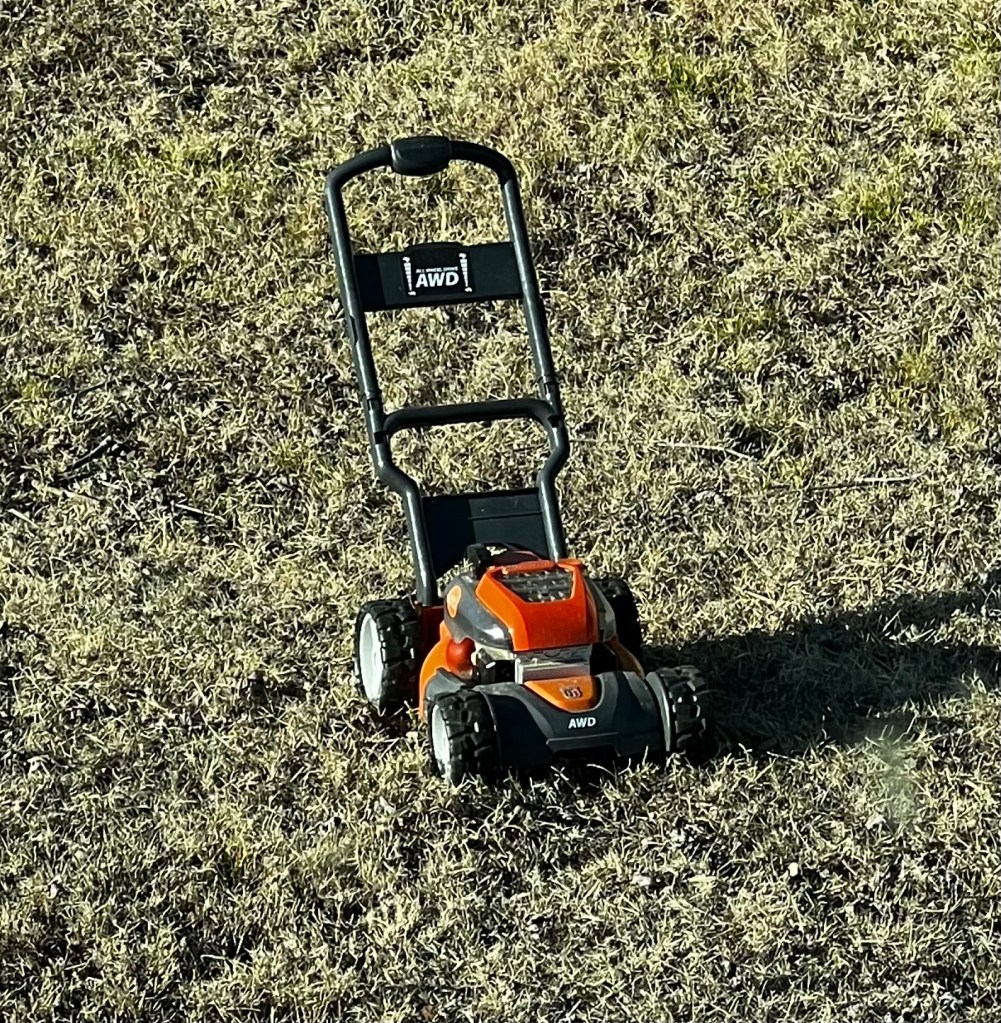
While the fidget toys have taken over the elementary age children, the traditional Corn Popper is still a best seller for pre-school children.  It has even morphed over the years and is offered in a variety of shapes (turtles, cars, telephones, lawn mowers).   Push and pull toys are designed for toddlers that have learned to walk but have yet to master the skill of pushing or pulling things behind them.  While some pull toys are animal-shaped, others feature moving parts like bobbing heads or gaping mouths.  I have seen (and heard) lawn mower toys like the one I saw sitting on a front lawn near our house last week.  Like the Corn Popper they are loud and maddening, even if they do help the child master motor skills.  I would bet the parents knew the toy was outside in the elements and left it anyway.  

Thoughts:  Like the Pop It craze the Fidget spinner was the craze in 2017.  The toy was promoted as helping people who have trouble focusing or those who may need to fidget to relieve nervous energy, anxiety, or psychological stress.  There are claims that a fidget spinner can help calm people with anxiety or neurodivergence (ADHD and autism).  There is no scientific evidence they are an effective treatment.  Office products like stress balls have been marketed for adults based on the same premise.  When I worked for the state, I was constantly asked (uninformed?) questions that it was my job to answerer.  I was given a stress cube by another worker.  After the person left, I could respond by pushing one of its explosive sounds (my head going off) buttons.  Perhaps this was still justice for getting my friend the Corn Popper.  Do the work.  Follow the science.  Change is coming and it starts with you.
Batteries

January 26, 2022

With all the cold weather we are (now) getting it has placed a stress on our batteries.  I had mentioned Melissa’s battery going weak and my replacing it before she went on her trip.  Two months before that I replaced the battery in our sports car as it had sat too long and had gone completely dead.  I replaced the battery in my niece’s car when she had stayed with us last fall.  I also replaced the batteries in both my lawn mower and boat over the summer.  I am getting to know the man who sells batteries very well.

When I looked online, I found the electric current generated by a battery is produced when a connection is made between its positive and negative terminals.  When the terminals are connected, a chemical reaction is initiated that generates electrons to supply the current of the battery.  Lowering the ambient temperature causes the chemical reaction to proceed slower, so a battery used at a low temperature produces less current than at a higher temperature.  As cold batteries run down, they can quickly reach the point where they cannot deliver enough current to start the vehicle.  When a battery is not in use, leakage between the terminals will still cause it to slowly lose its charge.  This chemical reaction is also temperature-dependent, so unused batteries lose their charge slower at cooler temperatures than at warmer temperatures.  I always buy household batteries in quantity to have them available, then store them in the refrigerator to make them last longer.  Now I know why.

The lead acid batteries in all my vehicles contain lead and sulfuric acid and were all recycled at the automotive store where I purchased the new ones.  The secondary (rechargeable cells) of Nickel Cadmium (NiCd) have heavy metals and should be recycled properly.  The button cells are hard to identify as being silver, mercury, or alkaline, so it is recommended to treat them as hazardous and recycle them properly.  The small household batteries are alkaline cells (manganese dioxide) and along with the heavy-duty batteries (carbon zinc) are considered harmless.  These batteries can be disposed of in the normal waste stream (except in California), but that does not mean they should be.  Recycling batteries not only diverts potential hazardous metals from the landfills but allows valuable metals to be reclaimed, minimizing the need to mine virgin resources.  Recycling centers are located across the US.

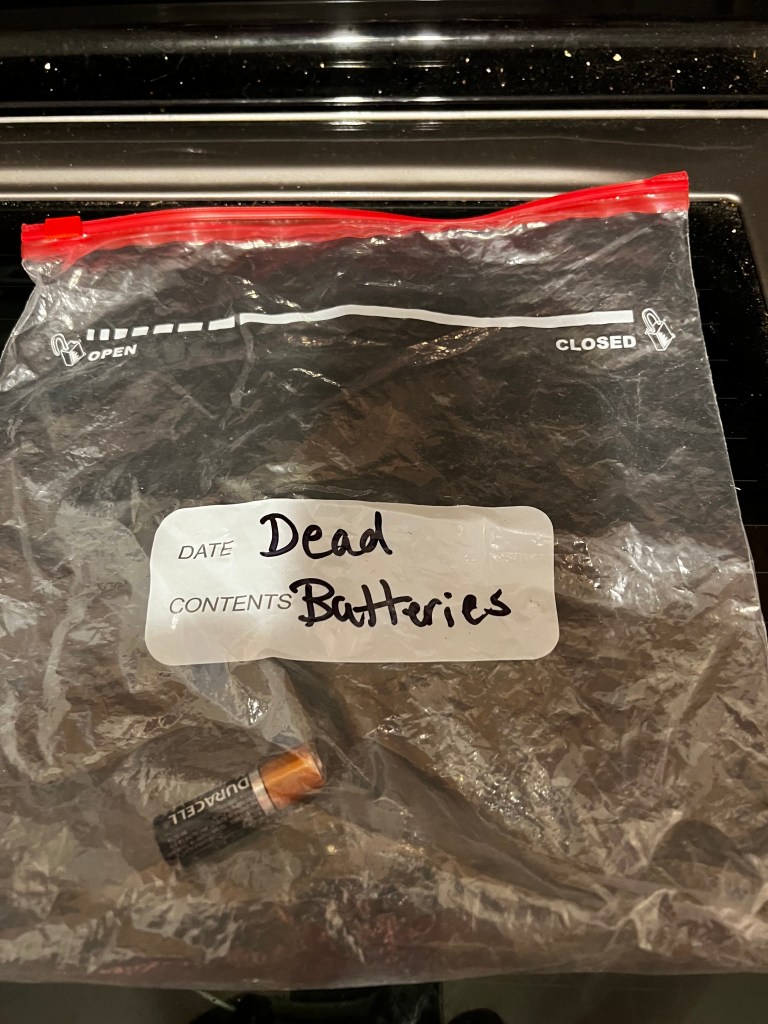
Thoughts:  While I was on my reorganization mission last week, I took some of my electronics to the city recycling center.  When I looked in the recycle bin, I saw a large bag filled with old household batteries.  I had felt bad about throwing these in the trash but did not know where to take them instead.  Melissa later replaced the batteries in her flashlight and asked if we were recycling the batteries.  I told her of the center, and she made a plastic bag to store our used batteries until they go to recycling.  Another tip I found was to cover the end node with cellophane tape to avoid sparking as the batteries rub together, as this can ignite a fire.  As with most things, the information is out there if you care enough to look.  Do the work.  Follow the science.  Change is coming and it starts with you.
Fiona

January 25, 2022

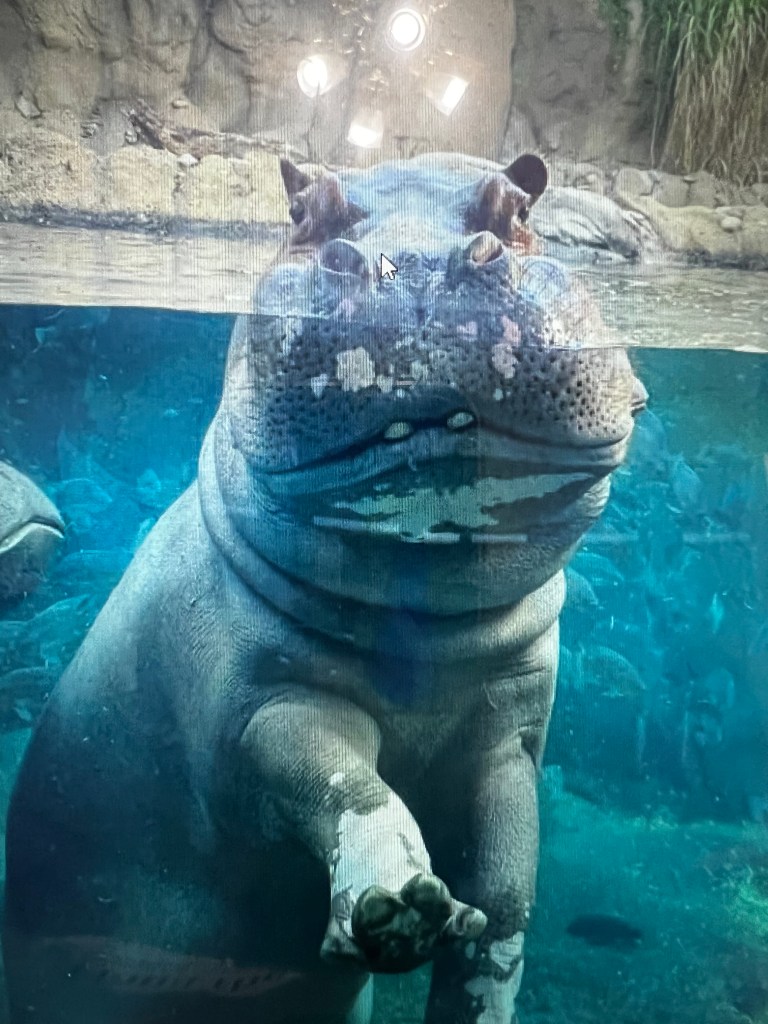
Fiona the Hippo turned five yesterday (January 24) along with all the fanfare that has marked her life since before birth.  The initial concern of the Cincinnati Zoo and Botanical Garden staff was Fiona’s mother Bibi, and it did not appear the calf would survive.  Fiona was born six weeks premature when she arrived in 2017 and only weighed 29 lb (13 kg).  Over the next critical days Fiona captured the attention of Cincinnati and the world.  The zoo’s marketing spokesperson said Fiona symbolizes the perseverance, resilience, and attaining the impossible.  “She is the story of hope.”  Fiona is also a brand, as her image has been attached to cookies, coffee, shirts, mugs, and books.  More than 375,000 books have been sold and given to teachers, children, and parents to spread Fiona’s story of perseverance.  While the zoo does not have a specific accounting of the Fiona commerce, it was thought to be nearly $500,000 by her first birthday. 

When I looked online, I found the hippopotamus (Hippopotamus amphibius), also called the hippo, common hippopotamus, or river hippopotamus, is a large, mostly herbivorous, semiaquatic mammal and ungulate native to sub-Saharan Africa.  It is one of only two extant species in the Hippopotamidae family, the other being the pygmy hippopotamus (Choeropsis liberiensis or Hexaprotodon liberiensis).  The name comes from the ancient Greek for “river horse”.  The hippopotamus is the third-largest land mammal, after the elephant and rhinoceros.  Despite their physical resemblance to pigs the closest living relatives are cetaceans (whales, dolphins, porpoises), from which they diverged about 55 million years ago.  Hippos are recognizable by their barrel-shaped torsos, wide-opening mouths revealing large canine tusks, nearly hairless bodies, columnar legs, and large size.  Adults average 3,310 lb (1,500 kg) for males and 2,870 lb (1,300 kg) for females.  Despite the stocky shape and short legs, hippos can run 19 mph (30 km/h) over short distances.  Fiona is still small, weighing in at 1800 pounds (816.5 kg).

The Cincinnati Zoo held an invitation-only virtual birthday party to celebrate Fiona’s five years.  You could visit the Cincinnati Zoo’s website and a $5 gift gave you a digital thank you card from Fiona, and a chance to win a prize package containing a one-of-a-kind hippo table by Mark Stoddart, an original kiss painting by Fiona, and a copy of “Happy Birthday, Fiona” by Richard Cowdrey.  Fiona received a Cincinnati Reds jersey with her name and the number 5 on the back, although it was too small for her to wear.  The virtual party took place at noon on the 24th with the grand prize winner announced.  I did not win, but then again, I did not buy a ticket.

Thoughts:  When Fiona was born, she was the zoo’s first newborn hippo and the smallest premature hippo to survive in human care.  The name comes from the tiny, fluted ears which resembled those of the “Shrek” heroine.  While hippos are common in zoos, they can become a nuisance in the wild and are among the most dangerous animals in the world due to its highly aggressive and unpredictable nature.  In the late 1980’s, Pablo Escobar kept four hippos in a private zoo at his residence.  They were deemed too difficult to remove after Escobar’s death in 1993 and were left on the untended estate.  By 2007, the animals had multiplied to 16 and had taken to roaming the area for food.  There are still no plans on managing the population.  Scientists say these hippos are breeding voraciously and are an increasing menace.  Introducing invasive species is rarely a good thing.  Follow the science.  Change is coming and it starts with you.

Weekend

January 24, 2022

Last week’s Super Wildcard Weekend turned out to be mostly predictable, even if there were several good games.  Seven of the eight games ended with the home team winning with the only loss being the Dallas Cowboys.  The Niners had made it a mundane game and led 23-7 going into the fourth quarter.  Dallas roared to life and put up ten points.  The Cowboys got the ball back with 32 seconds on the clock and moved 39 yards on three quick passes.  With second-and-one at San Francisco’s 41, with 14 seconds and no timeouts, the Cowboys called a QB draw.  Prescott raced through the middle for a 17-yard gain to San Francisco’s 24-yard line.  Dallas hurried to the line to spike the ball, but the referee needing to spot the ball down ran into Prescott on his way to the line.  Time expired before the ball was spiked and the game was over.

I thought the Dallas–Niners game might be the wild finish of the year, but I was wrong.  The first three games of Divisional Weekend ended with game winning field goals in the last seconds by the visiting teams.  That included a low-scoring duel between Rogers and Garoppolo.  San Francisco tied the game at 10-10 with 4:41 left after blocking a punt and running the ball in from the 6-yard line.  After the Packers went three-and-out, the 49ers got the ball back at their 29 with 3:20 left and again drove down the field.  After a disappointing offensive performance, the Niners pieced together the drive they needed at the end of the game.  Facing a third-and-seven, wide receiver Samuel took a handoff nine yards for a first down at Green Bay’s 38.  Samuel’s run set up Robbie Gould’s winning 45-yard field goal as time expired.

Exciting as the first three games being decided by last-second field goals by the visiting team, the fourth game between Kansas City and Buffalo was even better.  The final two minutes saw 25 points scored and the lead changed hands three times.  Buffalo was down 26-21 with two minutes left but the Bills rallied back with a touchdown pass from Allen and a successful 2-point conversion.  Mahomes and the Chiefs stormed down the field in 52 seconds ending with a 64-yard touchdown pass with 1:13 to play.  Allen and the Bills again took the ball down the field and scored with 13 seconds on the clock.  Mahomes then drove the Chiefs into range in to set up a game-tying field goal.  The Chiefs won the coin toss in overtime and immediately drove down the field for a touchdown toss to Kelce.  The final score was 42-36.  This completed the wildest weekend of football I can remember.

Thoughts:  Lost in the middle of the players fireworks this weekend was a fan who ran on the field.  These occurrences do not happen often and for years broadcasters have refused to show the intrusion to discourage copycats.  As always, someone in the stands captured the event and placed it on Twitter.  After the fan eluded security and ran on the field, Stefon Diggs got a running start and leveled him with his shoulder.  Stadium security locked him in a chokehold and promptly escorted him off the field.  The unwelcome visitor was wearing a Travis Kelce jersey and riled up the crowd as he was walked off the field.  While the fan disturbance did not adversely affect the outcome of the game, other interference has.  Fans reach over the fence to catch home runs or fair balls.  Fans use offensive language or throw drinks at players on the court.  Others instead cause fights on planes over having to wear a mask.  It is never all about me.  Do the work.  Follow the science.  Change is coming and it starts with you.