Wolves

January 11, 2022

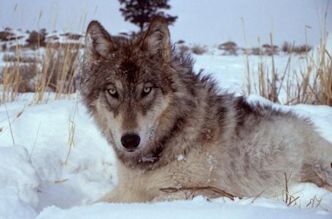
One of the stories I have reported on in the past was the reintroduction of Grey Wolves into Yellowstone National Park beginning in 1995.  Although wolf packs once roamed from the Arctic tundra to Mexico, loss of habitat and extermination programs led to their demise throughout most of the US by the early 1900’s.  In 1973, the US Fish and Wildlife Service (FWS) listed the northern Rocky Mountain wolf (Canis lupus) as an endangered species and designated the Greater Yellowstone Ecosystem (GYE) as one of three recovery areas.  From 1995 to 1997, 41 wild wolves from Canada and northwest Montana were released in Yellowstone.  As expected, wolves from the growing population dispersed to establish territories outside the park, where they are less protected from human-caused mortalities.  January 12, 2020, marked the 25th anniversary since wolves returned to Yellowstone and tomorrow marks the 26th.

When I looked online, I found that 20 of the approximately 115 Grey Wolves in Yellowstone National Park had been shot by hunters in recent months.  According to park officials this represented the most Yellowstone wolves killed by hunting in a single season since the predators were reintroduced to the region.  Fifteen wolves were shot after roaming across the park’s northern border into Montana and five more died after doing the same in Idaho and Wyoming.  Park officials said in a statement to the Associated Press that the deaths mark “a significant setback for the species’ long-term viability and for wolf research.”  The Phantom Lake Pack is now considered “eliminated” after most or all its members were killed over a two-month span beginning in October.  With months to go in Montana’s hunting season and the wolf trapping season just getting underway, park officials said they expect more wolves to die after roaming outside Yellowstone.  While protected within the park hunting is permitted outside the park’s boundaries.

Park Superintendent Cam Sholly first raised concerns last September about wolves dying near the park border and urged Republican Montana Governor Greg Gianforte to shut down hunting and trapping in the area for the remainder of the season.  Gianforte is an avid hunter and trapper and did not directly address the request to halt hunting in a letter responding to Sholly.  “Once a wolf exits the park and enters lands in the State of Montana it may be harvested pursuant to regulations established by the (state wildlife) Commission under Montana law,” Gianforte wrote.  Gianforte last year received a warning from a Montana game warden after trapping and shooting a radio-collared wolf about 10 miles (16 kilometers) north of the park without taking a state-mandated trapper education course.

Thoughts:  Montana’s efforts to make it easier to kill wolves mirror recent actions by Republicans and conservatives in other states such as Idaho and Wisconsin. The changes came after hunters and ranchers successfully lobbied to reduce wolf populations that prey on big game herds and occasionally livestock.  The states’ increased aggression toward the predators has raised concerns among federal wildlife officials.  In September, the US Fish and Wildlife Service said it would examine if federal endangered species protections should be restored for more than 2,000 wolves in northern US Rockies states including Montana, Idaho, and Wyoming.  Protections for the region’s wolves were lifted a decade ago, based in part on assurances the states would maintain viable wolf populations.  Obviously, “viable” is a relative term.  History has again shown that we cannot rely on “people” to do the right thing, for the wolves or the pandemic.  Follow the science.  Change is coming and it starts with you.
Covers

January 10, 2022

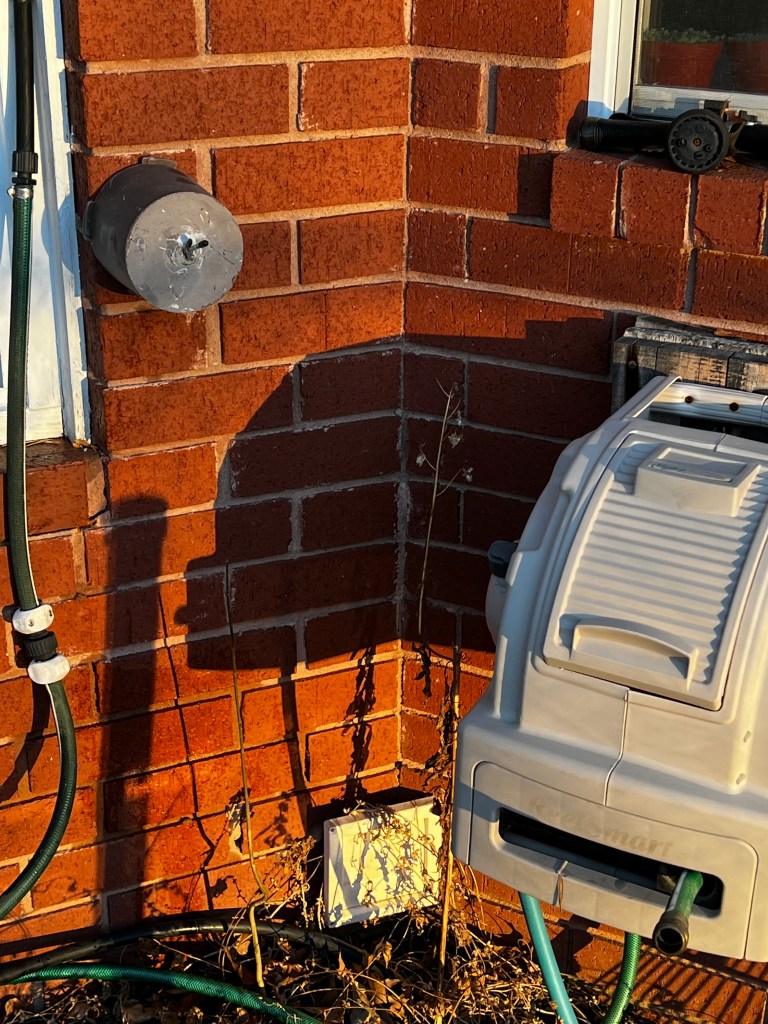
I grew up in colder climes and learned early how important it was to winterize your pipes against the cold.  That usually meant making sure to remove the hoses from the faucets if the outside temperature was going to drop below freezing.  I have known several friends who have had the pipes in their houses freeze.  These were rarely the outside faucets, but instead the open pipes in the crawl spaces under the house.  These crawl spaces needed to be at least enclosed, and preferably insulated.  If the pipe did not burst, there was the lengthy process of wrapping the pipe in thermal tape and hoping it would thaw before the pipe broke.  It was not until I moved to the southern state of Arkansas that I ever heard of putting faucet covers on the outside spigots.

When I looked online, I found that in colder climates, the winter cold may cause your water pipes to rupture, especially those attached to outdoor faucets.  The best way to minimize the damage from cold weather is to winterize during the late fall.  The first step in winterizing the hose spigots is to attach insulated covers to the tap.  Faucet covers are generally one of two styles.  This can be a square or dome-shaped shell made of rigid thermal foam with flexible gaskets that fit over outdoor faucets.  They may also be a flexible bag made of thick fabric stuffed with insulation.  Faucet covers work by trapping heat that naturally radiates through the interior pipes to the outdoor spigot.  When properly installed both form a tight seal around the base of the faucet.  If they are not, the pipes could freeze.

I was diligent installing my faucet covers last year, but not so much this year.  I mentioned we had installed a pool cover in October.  When I filled the water bags that kept them anchored down, two of the bags did not get enough water.  I told myself I needed to fill the bags before I took the hose off the faucet.  While this was not a big job, but it was not done, and the hose was still on.  The other excuse came when the weather was warm in December, and I was not motivated to complete the job.  When it finally dropped below freezing in January it was then too cold to entice me outside to finish the job.  Bottom line, the covers had not been installed and my pipes were in danger of freezing.  I finally filled the bags and installed the covers today.  It is supposed to drop below freezing again tonight.

Thoughts:  I find it easy to make excuses to not complete tasks I know are important when I do not want to do them.  It was not that I did not think installing the covers was important.  Instead, I was willing to risk delaying the installation because I figured the pipes freezing would never happen to me.  I knew I was putting Melisa and her succulents in danger if the pipes broke, but it was still hard to get motivated.  Many of the reasons I have heard for not getting vaccinated are similar.  People know it is important to protect others, but do not think there is a risk for them.  Sometimes we need to do things for others.  Follow the science.  Change is coming and it starts with you.
Barbertonicus

January 08, 2022

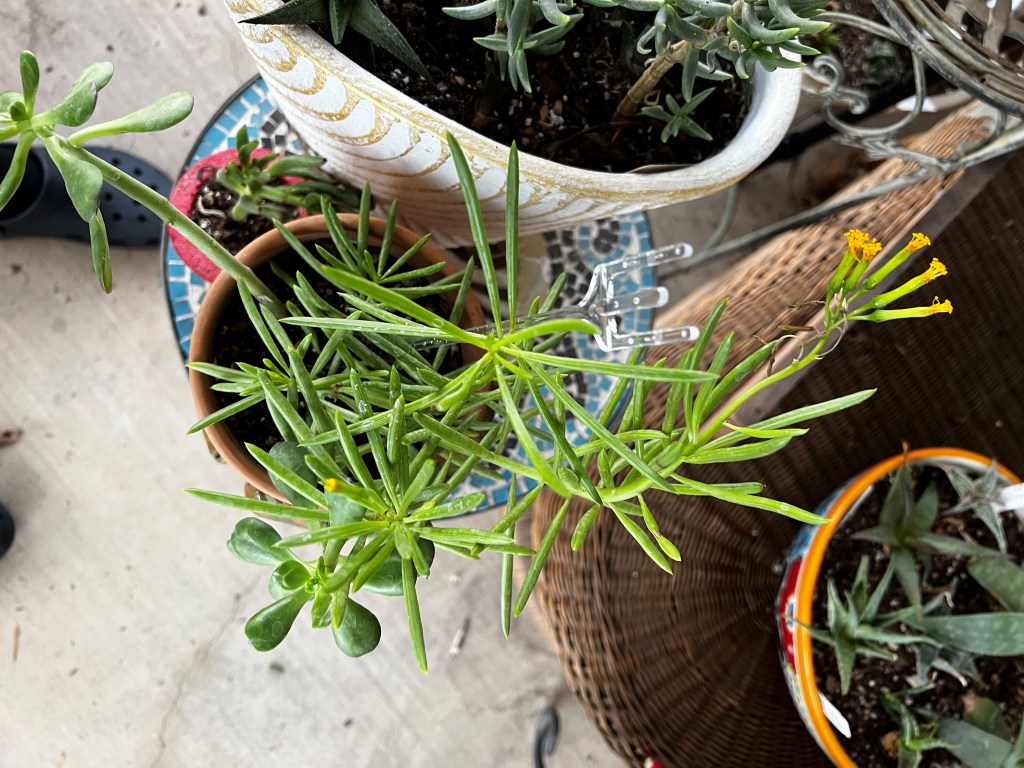
Melissa called me out to the porch greenhouse yesterday to see one of the new blooms on her succulents.  Her holiday cacti blooms have been flourishing and I assumed they were again the cause for her excitement.  It seems every day there are more blooms on the four plants and the previous blooms have continued to fully expand.  Many of the greenhouse succulents and cacti are winter dormant but several (including the holiday) are winter growers.  The mix of warmth and intermittent cold have prompted Melissa’s barbertonicus to bloom.    

When I looked online, I found the Barberton groundsel or succulent bush senecio (Senecio barbertonicus Klatt) is an evergreen succulent shrub of the family Asteraceae and genus Senecio.  It is native to Southern Africa and is named after Barberton, one of its native localities, although it is now cultivated elsewhere for its drought resistance.  The barbertonicus bush grows to over 6 feet (2 m) tall and wide with a fleshy trunk.  The bush has light green, cylindrical, finger-like leaves 2 to 4 inches (5 to 10 cm) in length and 1⁄4 to 3⁄8 inches (6 to 10 mm) in diameter.  These are densely packed around the stem and curved at the base to lie parallel to the stem and pointing upwards.  Barbertonicus is hardy to at least 25F (−4C).  The flowers form clusters of sweetly scented, golden-yellow, tufted flower heads in winter that are attractive to butterflies.  Our bush is one foot (1/3 m) high and for some reason has yet to attract butterflies to our greenhouse porch this winter.

Carl Linnaeus published his Systema Naturae in 1735, which contained his taxonomy for organizing the natural world.  Linnaeus proposed three kingdoms (animal, vegetable, mineral), which were divided into classes.  From classes, the groups were further divided into orders, families, genera (singular: genus), and species.  An additional rank beneath species distinguished between highly similar organisms.  While his system of classifying minerals has been discarded, a modified version of the Linnaean classification system is still used to identify and categorize animals and plants.  As I researched the scientific names of everal of the succulents, I have noticed they end with a surname or a capital letter (example: Senecio barbertonicus Klatt or Crassula tetragona L.) following the scientific species name.  What I found is these refer the scientist (Friedrich Wilhelm Klatt and Carl Linnaeus respectively) who originally identified and classified the plant.  Seems a good way to make sure people know your name.

Thoughts:  Other common names for the barbertonicus are Barberton coltsfoot, lemon bean bush, and finger-leaved senecio.  As mentioned previously, common names have more to do with characteristics than genetic relationships.  While the common name may be easier to remember they are confusing as the name often refers to several different species.  The news recently announced a growing number of “fluvid”cases.  While this sounds like a new variant of virus, it refers to someone who has managed to contract both viruses simultaneously.  Even though this is a recent news item, simultaneous cases have been identified as early as January of 2020.  Perhaps the increased use of the term is also another way to get noticed.  Follow the science.  Change is coming and it starts with you.

Starlings

January 07, 2022

Melissa has been texting me in bed lately about the birds that have been hitting my feeders early in the morning.  By the time I get up and around they are mostly gone, but I still have been able to get some shots of the smaller sparrows and wrens that frequent after the larger birds have had their fill.  This morning I was determined to catch the larger birds, but when I came to the window, they had been replaced by a flock of several hundred starlings.  A smaller flock had descended on the feeders in December but there was no food available.  Instead, they smarmed the field behind our house for a short time and quickly left.  This time the feeders had been recently filled so there was food available.  The starlings swooped in, drove the other birds out, and had their fill.

When I looked online, I found the European Starling (Sturnus vulgaris) is a very successful family of small birds that inhabit much of Europe as well as Asia, Africa, and North America.  An interesting fact on coloration is their ability to turn from spotted white to glossy and dark each year without shedding their feathers.  The new feathers grown in fall have bold white tips, giving them their spots.  By spring the tips have worn away, and the rest of the feather is dark and iridescent brown.  This color change is called “wear molt.”  Starlings are most famous for their fantastic flying displays, called murmurations, where they gather in the thousands and move across the sky in one synchronous swirling mass.  Starling murmurations are considered one of nature’s most remarkable and ethereal displays.  These displays are performed as a survival strategy that makes it more difficult to single out a bird by predators.

When the starlings invaded our feeders, Melissa tried to rap on the glass to scare them away.  This is true for many people who try and keep starlings away from their gardens and bird feeders.  The starlings will quickly consume anything available and leave nothing for other birds.  Starlings have evolved to feed in flocks, and consuming vast amounts of food in a short space of time is an advantage.  Most of our flock spent their time in the grass rather than the feeders.  Even in the cold of winter, the grass contains an ample supply of worms, larvae, beetles, and other insects, as well as seeds, grains, and nuts. Moving across the grassy field is easy for starlings as they have particularly strong legs developed for hopping. After the starlings left I refilled the feeders.

Thoughts:  The Bird Facts site suggested if you want to feed starlings you need to remember they are a soft bill species.  Soft bill seed mixes are also suitable for robins, thrushes, blackbirds, and wagtails and contain a mix of soft grains, sunflower hearts, raisins, sultanas, and mealworms.  The site warned that a flock of hungry starlings will make quick work of almost anything you put out for them.  That includes the more expensive suet or bird seed mixes that are put out.  Whether it is a swarming flock of starlings or a single marauding squirrel, I have found there is no effective way to keep them out of the feeders.  I have instead learned to enjoy the antics of these occasional visitors as part of the amazing cycle of life.  Do the work.  Follow the science.  Change is coming and it starts with you.
Better

January 06, 2022

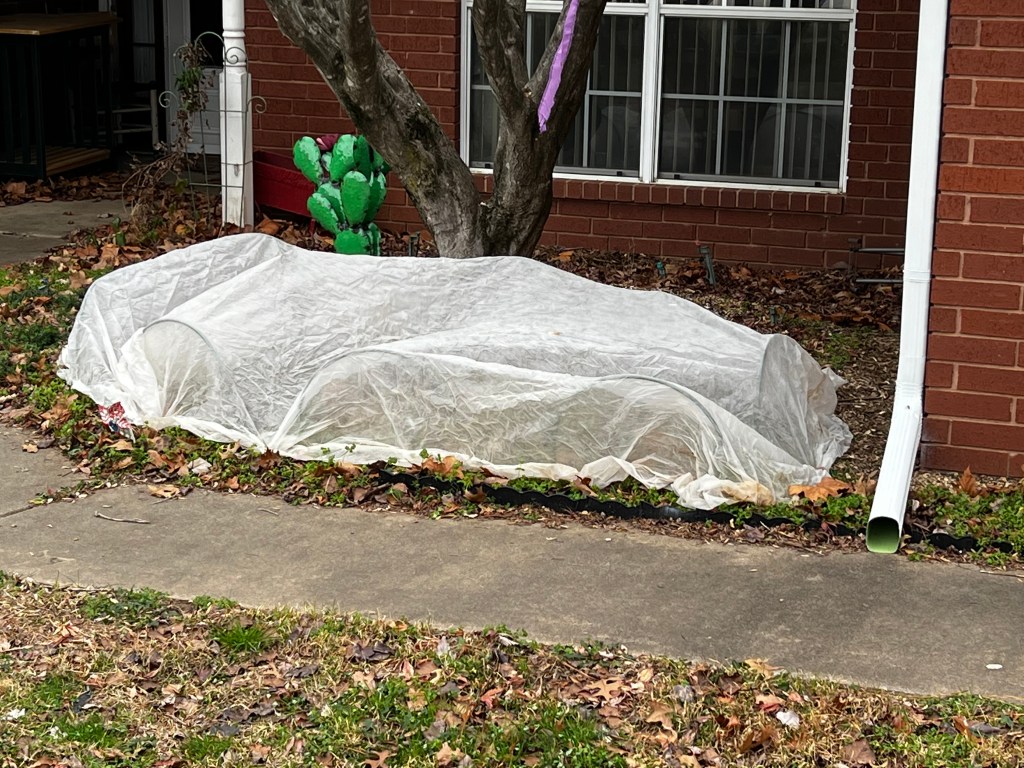
When Melissa put some of her succulents in the ground last year it was toward the end of summer.  That meant temperatures were still warm, but not too hot to risk killing the small plants before they could get set in the ground.  Our winter was initially a mild cold, but we knew it would eventually drop below freezing.  That is why we created the back porch greenhouse and placed cover cloth over the outside beds.  The greenhouse worked great, and even though it dropped to -20F (-29C) outside the plastic and space heater never allowed the temperature to drop below 26F (-3C).  The front beds did not fair so well, and we lost most of the uncovered hen and chick and several of the covered larger agaves.  As the temps began to drop again this year, we are hoping the outside plants will fare better.

When I looked online, I found there are thousands of varieties of succulents, but it is hard to identify the exact number of species.  In botany, succulents are “plants with parts that are thickened, fleshy, and engorged, usually to retain water in arid climates or soil conditions.”  This characteristic is not used as a scientific definition of most succulents as it can often only be an accurate characteristic at the single species level.  Erin Marino, plant expert and director of brand marketing at The Sill explains, “succulent is an umbrella term that can be attributed to any plant that has evolved adaptations to survive arid conditions [and] does not refer to any specific family of plants.”  It is also possible for non-succulents to become succulents in response to changes in their climate conditions.  The site recommended growing succulents if you do not have a green thumb as they grow better without constant monitoring.  While that may be true with a single plant, it is not the case with over 300 of the little guys.

When we built the porch greenhouse and covered the front beds last year it was a labor-intensive task.  That does not mean it was hard, but it took a long time.  I measured and cut the plastic, figured out a way to attach it to the windows, and then set it in place.  I used gromets on the outside cloth to keep it from tearing.  This did not work and caused the mesh to tear in the wind.  This year setup went better.  The outside plastic went up quickly, and we only resealed one of the seven sheets we had kept from last year.  Melissa decided to move most of the outside hen and chick and repurpose them inside, so we only covered the bed under the Chinese Elm.   I omitted the gromets, reset the stakes to keep the cloth off the plants and along with Melissa’s help had the entire bed covered in less than 20 minutes.  This was not only quicker, but the results seem much better.

Thoughts:  In the Merriam-Webster online dictionary I found, “bet·ter (adjective) 1 : higher in quality, 2 : more skillful, 3 : more attractive, appealing, effective, useful, etc.”  As I compared this to our succulents and their care, it seemed to match all three usages.  The placement of the cloth on the front bed was done with higher quality by eliminating the gromets this year.  It was done more skillfully as we laid the cloth both faster and achieved more even coverage of the plants.  Finally, the result looks more compact and attractive than it did before.  We did better.  As we continue to struggle with the lasting effects of the pandemic we need to do better.  Better when it comes to caring for others.  Better with showing compassion for those with different understandings.  Better when it comes to supporting essential workers.  Better when it involves our children.  We just need to do better.  Do the work.  Follow the science.  Change is coming and it starts with you.
Bales

January 05, 2022

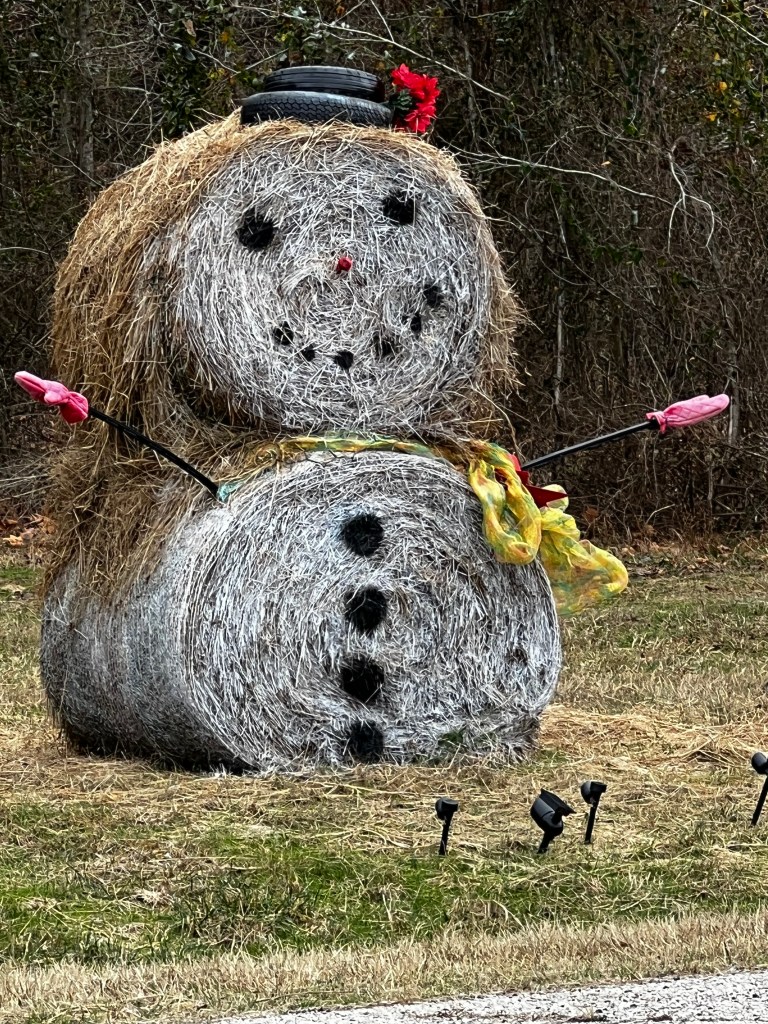
Over the last years Melissa and I have enjoyed the turkey sculpture made from hay bales we have encountered along the road to one of the outlet tubes we fish.  This usually arrives before Thanksgiving with a pilgrim hat and is later given a red felt hat for Christmas.  The body of the turkey is comprised of one of the large round bales and the tail feathers and neck/head or made of painted planks of wood.  I decided to take the back way to work last week and encountered another hay bale sculpture along the road.  This time it was a snowwoman painted white with a fancy hat and gloves on its stick hands.  It was even equipped with solar lights.

When I looked online, I found hay balers have been around since the late 1800’s.  This was the same time the agricultural industry was evolving through the introduction of new machines.  Before the introduction of the baler hay was stored loose in the field or the upper story of a farmer’s barn.  Both took up valuable space and the balers were a welcome invention.  Hay was taken from the field and put into the machines bale chamber by hand.  The baler was horse-driven to compress the hay until it reached the right size, then twine or wire was wrapped around the bale and tied.  Steam engines took over from the horse and then the internal combustion tractor replaced the steam engine.  In the 1930’s, balers were attached to tractors, allowing them to pick the hay up from the ground.  Thirty years later, hydraulics allowed the introduction of the large round baler.  The most popular baler on the market today is the round hay baler which produced the two bales that made up the snowwoman.

Today the small rectangular bales that once prevailed are primarily used on small acreages where large equipment is impractical.  These bales are about 15 x 18 x 40 inches (38 x 46 x 102 cm) and are wrapped with two strands of knotted twine.  The bales are light enough for one person to handle, or about 60 pounds (27 kg) but with more pressure can be up to 100 pounds (45.5 kg).  The round baling machine produces bales that are approximately 1.5 meters (4.9 feet) in diameter, 2 meters (6.6 feet) long, and weighed about 270 kilograms (600 pounds) after they are dried.  The other form of today’s bales are the large square baler developed in 1978.  This produces bales that can be easily transported and stacked.  Depending upon the baler, these bales can weigh from 1,000 to 2,200 pounds (450 to 1,000 kg) for a 3 x 3 x 9 foot bale (0.91 x 0.91 x 2.74 meter), or 3 x 4 x 9 foot (0.91 x 1.22 x 2.74 meter) bale.  These bales are wrapped with 4-6 strings to maintain the bale’s shape.  Both are too big for one person to move.

Thoughts:  One of my memories in high school was bucking bales on my grandfather’s farm.  While most of his energy went toward growing wheat, he also ran cattle on pastures where wheat would not grow.  The hay was pressed into small bales and then two of his sons would supervise the grandsons as we moved the bales from the field to the trailer, and then to the loft of the barns for storage.  I recall the comradery we enjoyed sweating in the heat as we worked, joked, and told stories about life.  That is harder to find as one person on a tractor now moves the round or large bales around the farm.  As our world become increasingly mechanized and digitized, we can still find ways to create community.  All it takes is a willingness to create comradery by sharing a part of yourself.  Do the work.  Follow the science.  Change is coming and it starts with you.

List

January 04, 2022

While compiling my bird list for 2021 I came across another way for birders to track the birds they have identified called a life list.  A life list is a cumulative record of the bird species an individual birder successfully identifies, and keeping a list is the easiest way to track which birds you have seen.  Birders often keep life lists for other reasons as well.  Some are motivated to see a greater number of species than just the same species annually.  Others keep the life list as a source of prestige that comes from having higher count numbers than another birder.  A life list can even be submitted to some birding organizations for recognition or for contest purposes.  For most birders, it is just fun way to list the number of bird species you have seen throughout your life.

Like the big year, a life list has guidelines, but since it is your list, you can record species any way you want.  Casual birders may record every species they see no matter what the circumstances of the sighting.  This could include an aviary or birds in a zoo as well as wild birds.  For an “official” life list to be accepted by most dedicated birders and birding organizations, birders need to follow certain guidelines.  First, the species should be positively identified through field markings or sounds.  Second, it should be ethically Observed.  That means no laws were broken and the bird was not harmed or harassed.  Third, the bird must be alive (and no eggs).  Fourth, the bird must be observed in the wild and behaving as a wild bird would act, and not as zoo or domesticated fowl would act.  Finally, the bird must be free rather than captive or restrained.  While I understand identification by bird call, it seems odd to “officially” count a bird you never see.

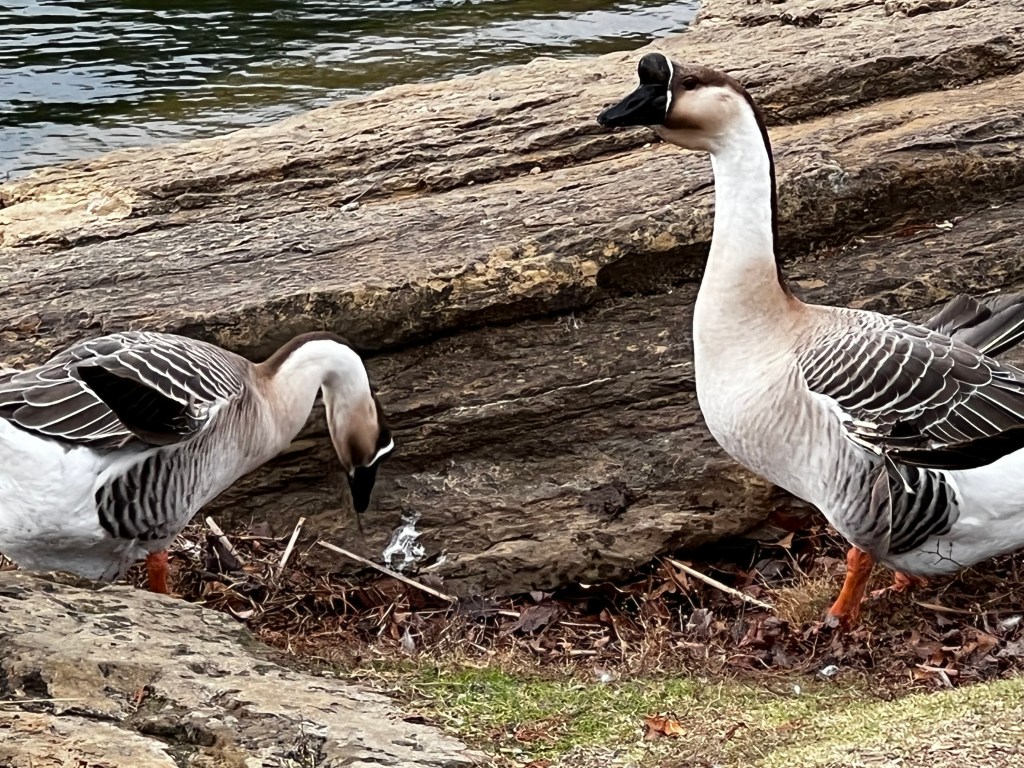
There are also guidelines for what birds cannot be added to your life list.  These include birds that are just different color morphs of the same species or different genders of the same bird.  Hybrids of different species or subspecies of a bird are not acceptable.  Lastly, birds identified by a band or other mark rather than through field sightings or sounds are not eligible.  For most birders, neither the big year nor the life list is a competition.  Instead, it is an enjoyable way to keep track of sightings and share and compare your lists with other birders and others.  All that said, my life list stands at 62 recorded species.  Obviously, the peacock is not included.

Thoughts:  It seems every time I hear the phrase, “It is not a competition”, it is uttered by someone who would be losing if it were.  While it is true that most of life is not a competition, it can be fun to make a competition out of many tasks.  When Melissa and I fish we always track the number of fish caught by each of us.  While I rarely win the “numbers” category, I often do “win” the biggest fish.  That is due to the different fishing techniques we use (Melissa tends to use live bait while I tend to use flies or stink bait).  When I checked the Worldometer list for the current number of covid cases in the world, I found that as of this morning we are at 293,264,764 cases with 5,468,191 deaths.  The US leads the world with 57,131,187 cases and 848,885 deaths.  It is a good thing it is not a competition.  We would not know whether we were winning or losing.  Follow the science.  Change is coming and it starts with you.
Report 2021

January 03, 2022

As 2021 has ended I wrapped up my bird count for the year and this is my “official” report.  During my first attempt at birding during 2020 I recorded 26 different species.  I had decided for my totals I would only count those birds I was able to take photos of (not the permissible “hear or see”) so while I had identified several other species, they were not included in my count.  When I tallied my birds for last year, I found that I had exactly doubled my identifications, with 52 species.  This was due to being more purposeful in looking for birds, being willing to stop along the road to take a picture, and by increasing my ability to identify the birds I see.  All three need much more work before I become proficient.

When I looked online, I found a big year is “a personal challenge or an informal competition among birders who attempt to identify as many species of birds as possible by sight or sound, within a single calendar year and within a specific geographic area.”  This was popularized in North America, and big years are commonly done within single US states and Canadian provinces, as well as within larger areas such as the entire world, the lower 48 continental US states, or within the official American Birding Association Area (ABA).  The ABA big year record of 840 species was set by John Weigel of Australia in 2019 and the world big year record of 6,852 species was set in 2016 by Arjan Dwarshuis of Netherlands.  The 1969 foundation of the American Birding Association standardized and regulated North American Big Years, with the ABA area defined as “the 49 continental US states (excluding Hawaii), Canada, and the French islands of St. Pierre and Miquelon, plus adjacent waters to a distance of 200 miles from land or half the distance to a neighboring country, whichever distance is less.”  Hawaii has since been added to the official ABA area.  Only 788 species to go.

Several things changed to allow my bird count to increase last year.  I received a single lens reflex (SLR) camera with a standard and attachable telephoto lens to get photos from variable distances of more birds.  I increased the number of identification tools from my two identification guides to three manual guides, along with two online guides, all augmented by two phone identification apps.  I was also given an identification course to help with bird identification.  This year at Christmas I was given another tool, a digital class on photography and how to take wildlife photos (birds!).  I realize it would be a lofty goal, but what about again doubling my identifications to 104?  What, it could happen.

Thoughts:  Traditional big year birders have drawn criticism from environmentalists for failing to consider the ecological impact of their travel.  Several birders have attempted “green”, or alternative big years to raise awareness for both birding and the environment.  One teenager and his parent’s traveled over 13,000 miles by bicycle and tallied 548 species, raising more than $25,000 for bird conservation in the process.  The first continent-wide “green year” took place in 2014, as Dorian Anderson bicycled 17,830 miles around the United States, amassing a self-powered, petroleum-free 618 species during his 365 days on America’s roads.  Dorian visited 28 states and raised $49,000 for habitat conservation.  Big years require a combination of knowledge, skill, determination, and luck.  The same could be said about outlasting the pandemic.  It takes more than just luck.  Follow the science.  Change is coming and it starts with you.
Horsehair

January 01, 2022

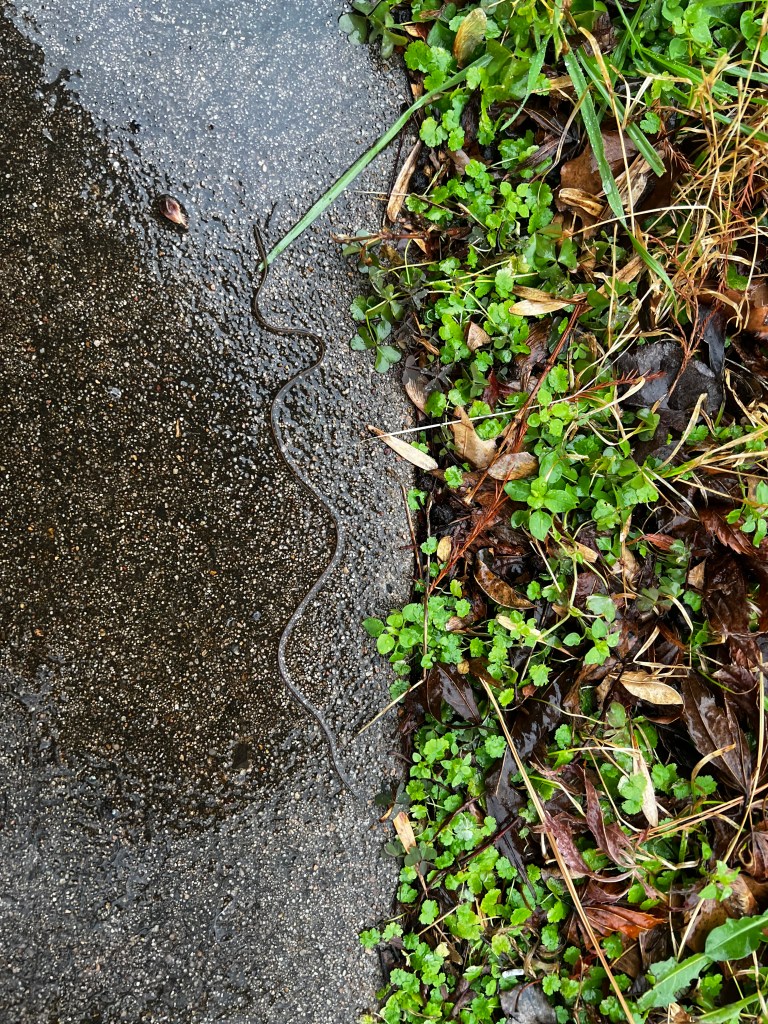
During the first rainfall I encountered after moving to Arkansas I noticed several long thin worms wriggling on the driveway.  I assumed they were some sort of long worm, and probably parasitic.  Since We still had Bella, I was worried whether this could cause her problems, or even if the worm had come from her and been deposited on the grass.  When we took her to the vet, she checked out fine and got her quarterly deworming.  Studies show that prevalence of intestinal worms in dog populations can be as high as 54.3%, depending on location, and these can spread to humans.  The worms looked like a long horsehair from the mane.  They went away when the water dried up, and off my mind.  They frequently appear after rains and did so again last week.  I asked my gardener friends and they confirmed they have seen them as well, and only after a good rain.  I decided to find out what they were.

When I looked online, I found horsehair worms are insect parasites that belong to the phylum Nematomorpha (round worms), and one of the most common species of these worms in the US is Gordius robustus.  The body of the horsehair worm is extremely long and thread-like.  They are creamy to blackish in color and are frequently twisted and coiled like a discarded thread.  Not much is known about the life of horsehair worms.  The stage seen most common are adults who may appear late summer or fall in streams and ponds.  They are more commonly noticed in domestic water containers such as bird baths, swimming pools, water troughs, pet dishes, sinks, bathtubs, and toilets, but they may also be found on damp garden soil or vegetable plants after a rain.  Or in my case, on the driveway.  Despite their scary appearance, these species are not harmful.

Horsehair worms are about the size of a kite string (1/25 to 1/16 inch or 1 mm to 1.3 mm wide) and are very long (4 to 14 inches or 10 to 35.5 mm).  Amazingly, the entire horsehair worm grows and develops as a parasite inside the body cavity of large insects like crickets, grasshoppers, katydids, beetles, and cockroaches.  This internal parasite of insects does not harm humans, animals, or plants.  Because horsehair worms are parasitic, they are assumed to be beneficial in control of certain insects, but their value as a parasite is questioned as the worm does not kill its host until it matures.  The creatures are primarily of interest as one of nature’s oddities.

Thoughts:  Horsehair worms resemble hairs from horses actively moving in the water. A superstition once surrounding the species held the worms in water troughs and puddles had miraculously come to life from the long, thin hairs of a horse’s mane or tail that had fallen into the water.  The worms often squirm and twist in the water, knotting themselves into a loose, ball-like shape, resembling the “Gordian Knot,” so another name for horsehair worm is Gordian worm.  The Gordian Knot is a legend of Phrygian Gordium associated with Alexander the Great.  It is often used as a metaphor for an intractable problem (untying an impossibly tangled knot) solved easily by finding an approach to the problem that renders the perceived constraints of the problem moot (“cutting the Gordian knot”).  Both superstitions surrounding the horsehair worm illustrate finding a simple solution to a complex problem.  In the same way, there is a simple solution to the complex problem of the pandemic.  Get vaccinated and wear a mask.  Follow the science.  Change is coming and it starts with you.

Isolate

December 31, 2021

It seems appropriate to provide a public service announcement as we prepare for one of the busiest celebration nights of the year.  Last year many chose to isolate during the holidays, but the vaccines have provided new confidence this year.  Contrary to Thanksgiving and Christmas where we gather around family or close friends, New Year’s Eve is the traditional time to get out and mingle with unknown crowds.  This celebration comes as the Omicron variant continues to spread around the country, meaning more people, including those who have been vaccinated, will test positive for the virus.  For many, taking a self-test or being tested at a recognized center may give more confidence to not risk spreading the virus.  The CDC tells us 74% of the US population has received at least one dose of the vaccine and 63% have been fully vaccinated with the highest rates among elderly and nursing home residents.  This population will probably not be out socializing on New Year’s Eve.  Even at best, one in every three people is at risk, and as we have found with the latest variant, we all may be vulnerable.

When I watched the news this week it mentioned despite major surges and record numbers of cases, the reality is much worse.  Like many others, Melissa, and I self-tested (negative) prior to visiting family over Christmas, but many who self-test positive do not report their case and are not counted in the numbers.  I looked online at USA Facts to find out what to do if you test positive.  If you are in public or around people when you get the test news, immediately put on a mask, and isolate yourself as quickly as possible, even if you do not have symptoms.  The CDC now recommends isolating for five days if you are asymptomatic or if you do not have a fever and your other symptoms are improving.  Isolation should be followed by five days of wearing a mask when you are around people.  If you have a fever, the agency advises you to stay home until the fever ends.  That means isolate for the short term.

Over the last year I have encountered several businesses who inexplicitly closed and never said why.  While I have assumed the answer was covid, I also know that is the default answer for everything now (went on vacation and forgot to post info?).  The real question becomes, who should you tell?  You do need to contact your employer so they can follow their protocols for contact tracing when an employee tests positive.  You may also want to alert anyone you have spent significant time with over the last two days before the test or when the symptoms started.  If you took a self-test, you should also inform the local department of health.  It is not numbers; it is about accurate numbers to ensure safety.

Thoughts:  It may feel overwhelming to tell people about your positive test.  Dr. Ashish K. Jha, dean of the Brown University School of Public Health, said “A lot of people think it’s some failure if you get infected.  This is an incredibly contagious variant.  A lot of people are going to get it.  That is not a moral failure.”  Several scientists have publicly stated there is a good chance that everyone (at least most of us), will end up contracting the virus before the pandemic is over.  That is why the vaccine is so critical.  When/if you get sick, the chance of anything more than a mild case is significantly reduced.  If you get the virus, it is safest to isolate to protect others.  Until then, we need to adhere to the guidelines for the same reason.  Follow the science.  Change is coming and it starts with you.