
Goose

December 30, 2021

When we were coming home after Christmas, we stopped at one of our favorite Mexican restaurants in Tulsa.  I admit one of the reasons we eat there is because it is located next to a large outdoors supply chain where I shop for fishing supplies.  The supply store has a fishing pond next to it which allows customers to test different rod and reel or fly-fishing setups.  As we drove out of the restaurant’s parking lot it took us by the pond and I stopped as a mom and her young son scrambled across the road on their way toward an afternoon of fishing.  As usual, there were several mallard ducks wintering on the pond, along with a few white and black geese.  I initially dismissed them as Canada, but the more I looked I realized they were a new species of goose I did not have on my bird identification list.

When I looked online, I found the Chinese goose (Anser cygnoides domesticus) is a breed of domestic goose descended from the wild swan goose which originated in China.  Chinese geese are much larger in size than the wild goose, with males weighing between 11 to 22 pounds (5-10 kg) and females between 8 to 22 pounds (4-9 kg).  They often have a strongly developed basal knob on the upper side of the bill, with the knob more prominent on males than females.  It takes several months for the knob to become pronounced enough but it can be used for determining sex by the time the juveniles are 6 to 8 weeks.  The Chinese goose are a close cousin of the African goose, a heavier breed also descended from the swan goose.  The Chinese goose have two varieties: brown, like the wild swan goose, and white.  While many domestic Chinese geese have a similar body type to other breeds, the breed standard as defined in the American Poultry Association’s Standard of Perfection call for “a slimmer, taller fowl.”

The Chinese goose is said to be the most beautiful and graceful member of the goose family.  They have long and graceful necks and are sometimes referred to as ‘Swan Goose’.  The Chinese goose was brought to the US early, and both varieties of the goose were well established in colonial times.  The breed was admitted into the American Poultry Association’s Standard of Perfection in 1874, and into the British Waterfowl Standards in 1954.  White Chinese goose have orange-colored shanks, beaks, and knobs.  The brown variety also has orange-colored shanks but it’s beaks and knobs are black or very dark green.  Both varieties have blue eyes.  The Chinese goose are not only lovely to look at but are easier to raise than many other goose breeds due to their exceptional foraging ability.  It is because of their great foraging that they have been used as a weeder goose in strawberry, tobacco, and other crops.

Thoughts:  While the Chinese goose may be a domesticated bird, the ones at the pond had obviously flown the coop (pun intended).  As I watched a pair on the shore nearby, I realized they were in process of building a nest.  Chinese geese are among the better laying breeds of goose and a female can lay 50–60 eggs over the course of the breeding season (February to June), although there are reports of Chinese geese laying up to 100 eggs during that time.  The mated pair I saw seemed to have been fooled by the warm weather into thinking spring had arrived and were preparing their nest in late December.  Breeding in the wild can be a tricky event.  If the chicks come too early, they will die in the shell from the cold or not find enough food after they hatch.  If they come too late, they risk not being mature enough to fly and will be left by the flock.  Either way, there are dire consequences when you misjudge what should be the appropriate action.  The same is true for humans.  Follow the science.  Change is coming and it starts with you.

Dichotomous

December 29, 2021

I was recently sent a link to the National Park Service web site addressing the use of dichotomous keys in species identification.  The sender knew I often struggled with a variety of identification tools to find what species I am blogging about.  The dichotomous key is a tool created to help scientists and the public identify objects and organisms.  Typically, a dichotomous key for identifying a particular type of object consists of a specific series of questions.  When one question is answered, the key directs the user to what question to ask next.  Dichotomous keys stress identifying species by their scientific name, as each individual species has a unique scientific name.  By contrast, common names for organisms often refer to many different species that may look like each other or share common characteristics.

When I looked the definition up online, I found the first known use of the English language word dichotomous occurred in 1752 and was used to refer to “dividing into two parts.”  The word is borrowed from the Late Latin “dichotomos,” which was borrowed from the Greek “dichótomos,”, meaning “cut in half, or divided equally.”  A dichotomous key then, is a key for the identification of organisms based on a series of choices between alternative characteristics.  The first known use of the phrase dichotomous key was 1889.  An example for using a dichotomous key in tree identification might ask whether the tree has leaves or needles.  The key then directs the user down one list of questions if the tree has leaves, and a different list of questions if it has needles.  This is like a questionnaire I just completed, where it stated, “If no, skip to question 3b.”

Dichotomous keys are useful because they allow non-expert users to identify organisms by directing them to look at known, important features.  Many people might not know how to distinguish different species of pine trees based on the arrangement of needles on a branch, but the key would be able to ask that question and give them useful information based on the result.  A dichotomous key arrives at the answer to species identification by presenting a series of questions with two possible answers.  Each answer given cuts down the list of possible candidate species by eliminating incorrect characteristics.  Dichotomous keys are useful to identify an organism as a member of a single, closely related group of organisms.  Complications may arise if multiple closely related species with similar characteristics live in the same geographic area.  Still, the key will get you closer to an identification than you were.

Thoughts:  The information on the National Park Service (NPS) site was part of a national program developed to educate children about the outdoors.  While this was online training, the NPS also offers in person education events, youth conservation corps, and young ranger internships.  This is part of the larger national education effort to train youth with skills in science, technology, engineering, and math, including computer science, collectively known as STEM/CS.  It is of growing importance to understand and solve the complex challenges of today and tomorrow, and literacy in STEM fields is essential.  This effort is designed to transcend where children live and provide access to quality learning environments.  If you do not build it, they will not come.  Follow the science.  Change is coming and it starts with you.
Clematis

December 28, 2021

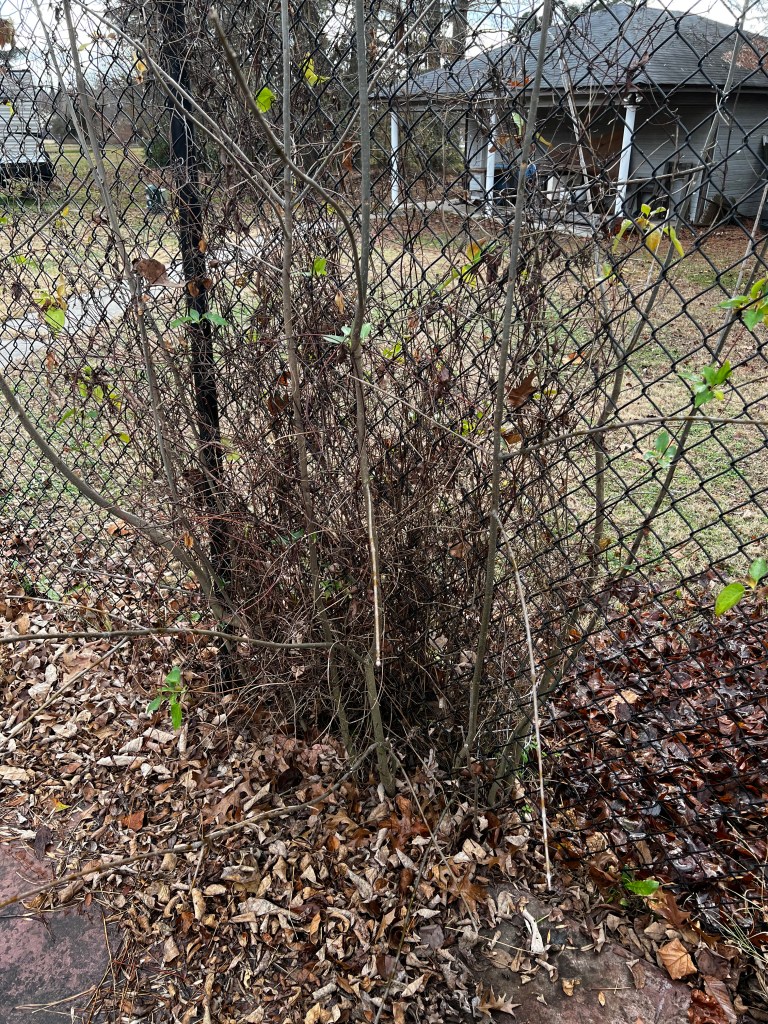
While I was cleaning up my garden last week, I noticed the one of our large Clematis had become overrun by tree shoots.  I had noticed this earlier in the year, but the leaves and flowers that graced the vine obscured many of the limbs that were now exposed.  I decided it was a good time to remove the intruding tree since both the vine and the tree were dormant.  I retrieved my loppers from the garage and quickly cut the tree away.  I did notice this was not the first time the tree had been cut out, as there was an established root system that had sprouted the limbs.  I guess I need to go to the outside of the fence and dig it out before spring.  Or maybe just decide to grow a tree?

Our two clematis plants are of the Clematis President variety.  The genus name Clematis is from the Ancient Greek klematis, (“a climbing plant”) and is also translated as “twig, sprout, or tendril”.  Clematis patens is native to Japan and was introduced to Europe in 1836.  The wild clematis species (Clematis florida) is native to China but made its way into Japanese gardens by the 17th century and are the species brought to Europe from Japan.  The plant acquired several symbolic meanings during the Victorian era and was said to symbolize both mental beauty and art, as well as poverty.  The climbing varieties are valued for their ability to scramble up walls, fences, and other structures, and will grow through other plants, such as shrubs and trees.  The opposite happened with our clematis, as the tree grew through the vine.

In the American Old West, the white clematis (Clematis ligusticifolia), was called pepper vine by the early pioneers who used the seeds and the acrid leaves of as a pepper substitute.  The entire genus contains essential oils and compounds which are extremely irritating to mucous membranes and skin, and in large amounts cause internal bleeding of the digestive tract.  Native Americans used very small amounts of clematis as an effective treatment for migraine headaches and nervous disorders, as well as an effective treatment of skin infections.  Clematis has also been used to prepare a variety of remedies as an alternative medicine.  However, according to Cancer Research UK, “there is no scientific evidence to prove that flower remedies can control, cure or prevent any type of disease, including cancer.”  When has that ever stopped people from using things however they might.

Thoughts:  When I was researching the clematis vines, I found that while the vines and flowers flourish in full sun, the roots prefer to be shaded.  It was suggested the way to accomplish these opposites is to either grow a low ground cover or mulch around the vines.  Even though my vines have put out great blooms think what they could be doing.  It is said that when a researcher on sleep patterns was told that Einstein only slept four hours a night rather than the minimum of seven the response was, “Think what he could have done if he had gotten enough sleep!”  Humans tend to follow what has been suggested by others as fact, regardless of what the science may say.  I wonder where we would be if people had decided to follow the experts when the pandemic first began?  Follow the science.  Change is coming and it starts with you.
Jumping

December 27, 2021

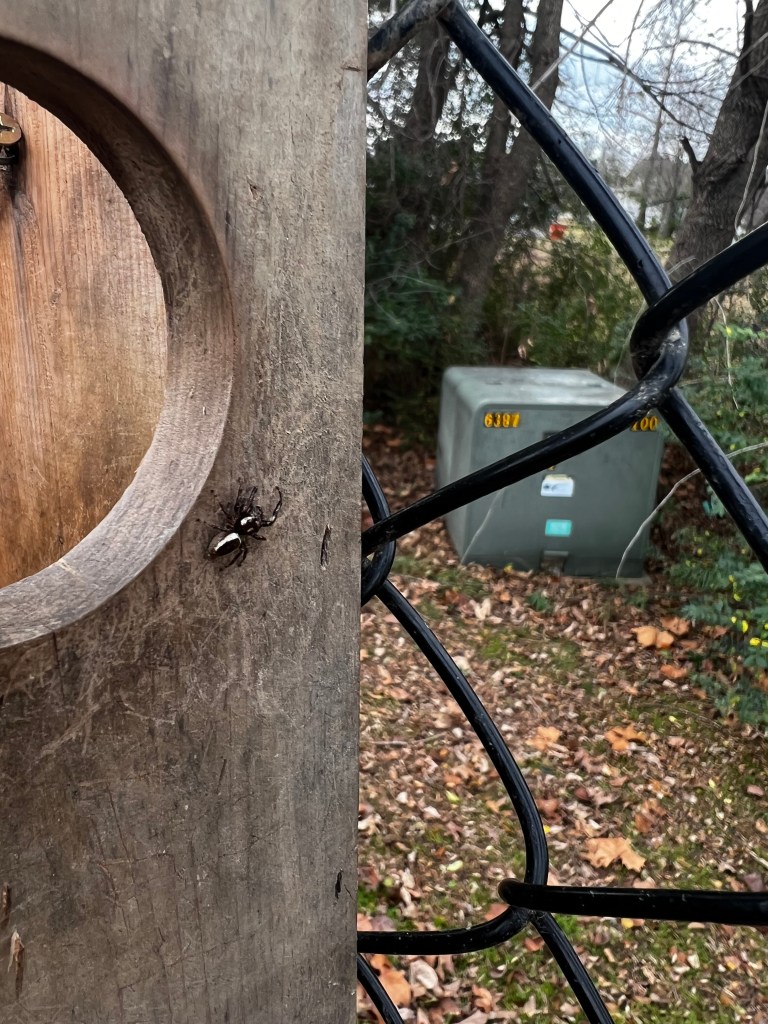
Since it was warm last week, I thought it might be a good time to do some cleanup in my garden and refill the bird feeders.  As I suspected, all five of my feeders were empty, although there was a bit of corn log left that I had attach to the side of the squirrel feeder box.  As I approached the box to refill it, I noticed a flash of white on a small black spider.  The spider had just come out of the entrance hole in the side of the box and was working its way around toward the back.  I had seen these spiders previously but thought they had all gone into hibernation for the winter.  Apparently, the warmer weather had brought this one back into the open and it was hunting for a meal.

When I looked online, I found there are a variety of species of black and white jumping spiders of the family Salticidae.  The Jumping Spider (Phidippus audax) is the most common species and is found around the house or in gardens.   As of 2019, the Salticidae family contained over 600 described genera and over 6,000 described species, making it the largest family of spiders at 13% of all species.  Jumping spiders have some of the best vision among arthropods and use it in courtship, hunting, and navigation.  Although they normally move slow and unobtrusively, most species are capable of very agile jumps.  These jumps are usually when hunting but can also occur in response to sudden threats or when crossing long gaps.  Jumping spiders have both book lungs and a developed tracheal system and they use both (bimodal breathing).  Jumping spiders are easily recognized by their eye pattern, as all have four pairs of eyes with the anterior median pair being particularly large.  Jumping spiders are generally carnivorous but many species include nectar in their diets.  They are not venomous to humans.

Jumping spiders use their excellent vision to stalk their prey.  The eyes cannot move which causes the spider to move (sideways hop) its entire body to look at what it wants to see.  However, it can move the retinas of its two main eyes on the inside of the eye, so the center of the eye’s picture can be moved.  This trait gives the jumping spider binocular vision.  Very few species of jumping spider make a web, and instead use their silk for a safety rope while hunting.   The silk is also used to make a kind of tent where they sleep at night, shed their skins (molt), lay their eggs, and hibernate during winter.  This one was awake.

Thoughts:  Jumping spiders can climb glass and other smooth surfaces using the sticky hairs (scopulae) on each foot that hold onto the surface.  The ends on each hair are held to the glass by Van der Waals forces.  The van der Waals force is named after Dutch physicist Johannes Diderik van der Waals and is a distance-dependent interaction between atoms or molecules.  This adhesive force is also used by geckos who have microscopic projections (spatulae) which cover the hair-like setae found on their footpads.  In May 2014, Defense Advanced Research Projects Agency (DAPRA) demonstrated the latest iteration of its “Geckskin” technology by having a 220-pound (100 kg) researcher with 44 pounds (20 kg) of recording equipment scale a 26-foot (8-metre) glass wall using only two climbing paddles. Tests are ongoing, but DARPA hopes one day to make the technology available for military use, giving soldiers Spider-Man-like abilities in urban combat.  Now if we could only develop those cool shooting webs.   Follow the science.  Change is coming and it starts with you.
Holiday

December 25, 2021

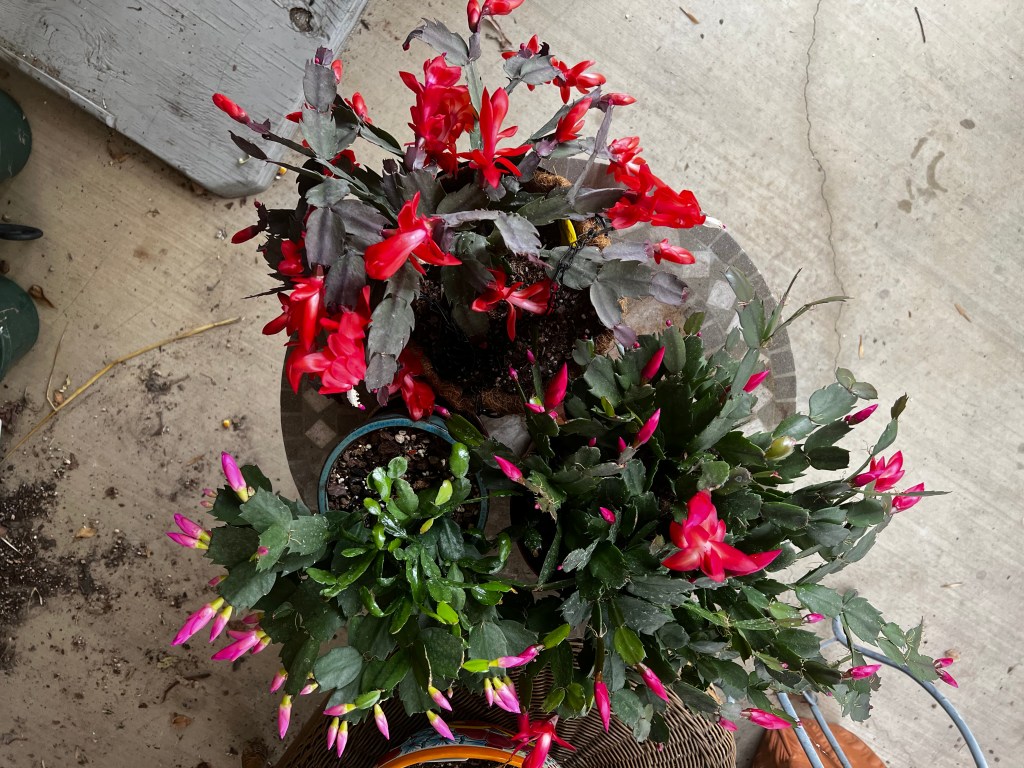
I have spoken several times about trying to nurture a Christmas Cactus without success.  While I have given up, Melissa has picked up the gauntlet and began sustaining them as part of her succulents.  She had several good blooms during the 2020 holiday, but a variety of maladies took several of the plants and then the cold got the stems of a few more.  Still, Melissa was determined to try and resuscitate the plants.  We had solo stems lying around the kitchen most of the early year trying to create epiphytic roots (air roots).  When these sprouted, the stems were transplanted into small pots, and as the stems grew, they were moved into larger pots.  This fall they were strong enough to be transferred into larger hanging pots and they are on the back porch greenhouse.  Now that the holiday is again upon us, they have decided to burst into blooms.

I previously reported that there are three types of holiday cacti: the Easter cactus (Schlumbergera gaertneri), Thanksgiving cactus (S. truncata), and Christmas cactus (S. x buckleyi).  Each is named as they typically bloom closest to a particular holiday.  While the time of flowering is a clue to which of the holiday cactus you possess, there are other features that distinguish between the varieties.  The stem segments (phylloclades) on the Thanksgiving cactus have distinctly pointed edges, while stem segments of the Christmas cactus are more rounded.  The Easter cactus has sharp leaves like the Thanksgiving cactus, but also has flowers that have pointed tips as opposed to the rounder petals of the Christmas cactus.  Another marker is the anther (part of a stamen that contains pollen) is yellow on a Thanksgiving cactus but purplish brown on the Christmas cactus.  These differences are quite minute, but I found if I just call them a holiday cactus, I am always right.

One characteristic of holiday cacti is ease of propagation.  To start new plants, just pinch off a three-leaf segment during the growing season and place it in 1 inch of a similar potting mixture as that of the parent plant.  The cutting should develop roots within two to three weeks of planting.  The cutting should be planted in a container no larger than 3 inches in diameter at this stage.  To get the holiday cactus to bloom and rebloom, you need to place them into similar conditions as the Poinsettia.  The main difference being, Poinsettias prefer temperatures of 65F to 75F (18C to 24C), and the cacti prefer temperatures closer to 50F (10C).  The holiday plants are triggered into bloom stage by the daylight hours and temperatures and prefer 12 hours of darkness per day for at least 30 days to set flower buds.  Once the buds set, they can be placed back into a cool well-lit location to enjoy the blooms for up to six weeks.

Thoughts:  As with many things we have around us throughout the year, the holiday cactus seem boring most of the time.  When they come into season, they transform from what we have taken for granted into an amazing display of color.  The same can happen with friends or members of our family.  Since we are always around them, we forget how special they really are.  If the pandemic did provide a positive, it may be the gift we have been given to appreciate the mundane and commonplace that we once took for granted.  Enjoy those who surround you and have a Merry Christmas!  Do the work.  Follow the science.  Change is coming and it starts with you.

Displays

December 24, 2021

While I used to do elaborate displays when I was director of a camp in Kansas, we have yet to put up lights in Arkansas.  Still, Melissa and I have enjoyed the light displays set up in the communities around us.  In Kansas we would walk the displays at the local zoo and botanical gardens.  The gardens were especially extravagant, with lights timed and set to music as the central feature.  In recent years individuals have created computer synchronized displays in their family yards or have coordinated efforts with the other houses on a block or cul-de-sac.  Now we usually walk or drive the community displays near us since we moved to Arkansas.  One even features a miniature train ride that winds you among the lighted displays that stretch throughout the park.  On cold and brisk nights, they offer hot cocoa and other treats for sale at the concession stand.

Hidden in what I call the fluff section of my local newspaper was an article on the resurgence of light displays.  Communities and individuals across America have launched displays during the pandemic, and they have become more elaborate each year.   A wholesale light distributor in Wisconsin said the reason was that people were looking for something to do, and the displays let them get out of the house.  Some of the displays require tickets but more are free to the public and are available first come first served.  These displays have been set up for both foot traffic and drive through events.  The drive throughs have the advantage of never leaving your car and staying safe (and warm) while enjoying the displays.

The large drive through event is on the rise this year.  An Indiana-based distributer estimates there is a 42% increase in popup events hoping to draw on the success of last season.  The displays are becoming increasingly intricate and technical.  Many of the operators started with lavish shows for their homes and decided to get into the business of creating displays for others.  A Texas based firm said the average budget for holiday light displays synced with music has grown to around $500,000.  “Everybody continues to try to outdo each other in terms of size, scope and technological complexity.”  These events are beyond the capacity of individual families and are run by corporations and municipalities.

Thoughts:  Churches have continued to create displays that try to emphasize the “reason for the season” rather than the technical commercialization of lights.  When I looked online, I found displays listed from across America.  These ran the gamut from a living creche like the one where I work to lavish 12 stage events depicting the story of Jesus’ life, from birth to resurrection.  Friends of ours know I collect creche sets and gave one they had found to Melissa for me.  It now sits on a table in the foyer as our only Christmas display.  Sometimes simple is the true meaning of Christmas.  Do the work.  Change is coming and it starts with you.
Ice

December 23, 2021

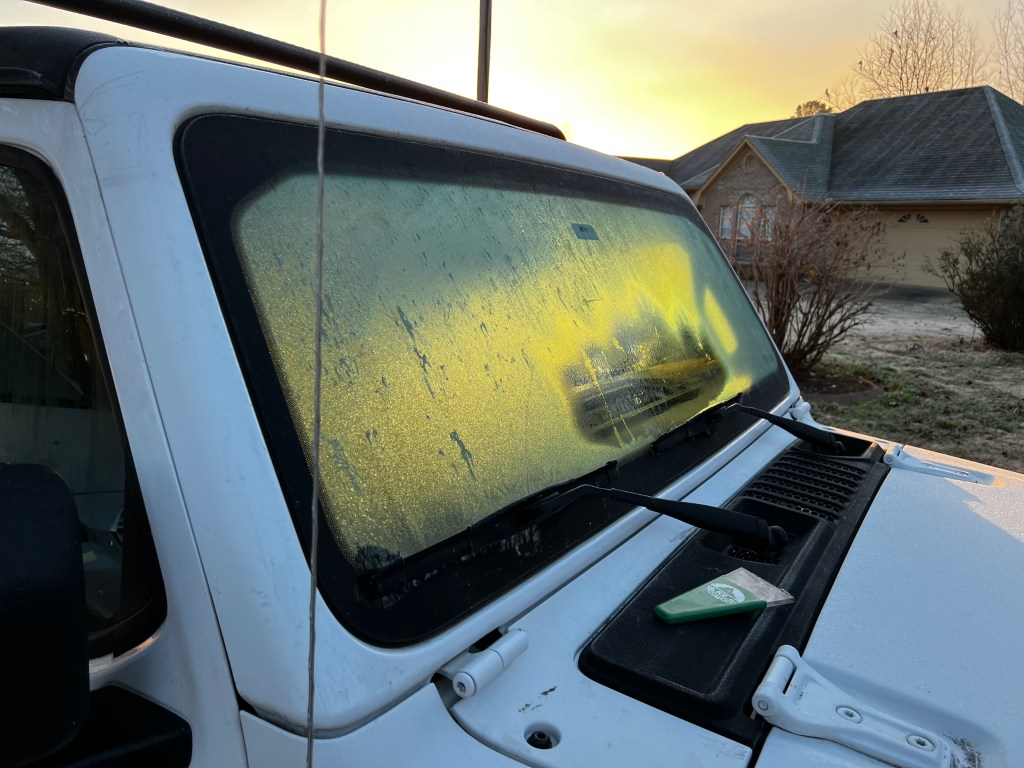
For those of you in the northern climes this may not seem like a big deal, but when I came out to start my vehicle yesterday there was ice on the windshield.  This was an almost daily experience during the winters of Kansas, but it is only the second or third time I can remember needing to scrape ice since we moved to Arkansas.  Some of this might be since I get up later and even then, I tend to stay inside on frosty mornings rather than venture out.  Today I had an early meeting, so I gathered my things and rushed out to the car.  Although surprised by the ice I was not dismayed.  Being from Kansas I keep an ice scraper in the car “just in case”, and cotton gloves in the pockets of my jacket to protect my hands from the cold.  I turned on the defroster and the ice had nearly melted by the time I worked my way around the vehicle and back to the front windshield.

When I checked online, I found that while October brings the changing leaves and fall colors, it rarely brings more than one or two mornings of ice or frost.  By November light frost begins to become common and the trees will drop their leaves.  December signals the beginning of the winter chills, and a heavy ice frost becomes more common.  This is the preferred month for cold weather Arkansans, as January and February temperatures often fall below the average minimum and occasionally drop into the 0F (-10C) range and snowfall may occur.  Conditions are generally good during the day, but ice patches are common during early morning and late evening hours.  That said, there has not been much “normal” frost since we moved here three and a half years ago.

The ice and frost are probably the worst thing Melissa found about living in Kansas.  She had grown up in Arkansas and was not used to the colder weather.  We were married in December, and I took her dad to see the Arkansas River that wound through our city.  During the summer you could walk across without ever getting above your waist.  During his visit the winter ice had frozen the river over and the frosty ice cacked the trees and bank.  It was the only time he had seen the Arkansas River in either condition.  This is part of the McClellan-Kerr Arkansas River Navigation System, and the river is a tad bigger (deep and wide) in Fort Smith and never freezes.

Thoughts:  When I attended school in the Bay Area (Berkeley), I had a friend who planned on returning to his home state of Minnesota after graduation.  His girlfriend was from Southern California and not accustomed to either ice or snow.  As they prepared the car to leave, she kept coming across these small plastic handles with acrylic triangles attached to them and finally asked him what they were.  His response was, “That is an ice scraper, you will become intimately familiar with those this winter.”  As I can attest, when the cold sets in it is good to have several scrapers of different sizes to remove the ice from your windshield.  Despite the one day of ice on my windshield, temperatures have been near record highs for much of December and we are expecting mid 70’sF (24C) over Christmas weekend.  We are going north where it will drop all the way to the low 60’sF (16.5C).  So much for a white Christmas.  Do the work.  Follow the science.  Change is coming and it starts with you.
Winter

December 21, 2021

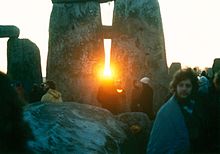
Today saw the annual occurrence of the winter solstice in the Northern Hemisphere.  This year the winter solstice happened on Tuesday, December 21 at 10:59 am EST.  Contrary to popular belief, this is marked by only a moment, and is not a complete day.  Our northern winter solstice can vary in time from December 21 to December 22, and occurs when the Earth’s pole reaches its maximum tilt away from the Sun.  A little before 10:59 am, and the tilt away from the sun is not yet at its maximum.  A little after 10:59 am, and the earth’s tilt has already begun shifting away from its maximum.  While the event ranges across these two days in December, the traditional celebration occurs at sundown on the 21st.  It is on this day and time that the ancients believed the sun “officially” died and was resurrected with the dawn of the 22nd.

When I looked online, I found the winter solstice is also called the hiemal solstice, hibernal solstice, and brumal solstice (all mean relating to or occurring in the winter), and occurs with either of Earth’s poles reaching maximum tilt away from the Sun.  For each respective hemisphere (Northern and Southern), the winter solstice is the day with the shortest period of daylight and longest night of the year, as the Sun is at its lowest daily maximum elevation in the sky.  Either pole experiences continuous darkness or twilight around its winter solstice.  The opposite event is the summer solstice where the respective poles experience continuous daylight or dawn.  Depending on which of the hemisphere’s is in winter solstice, at the Tropic of Cancer or Capricorn the Sun reaches 90° below the observer’s horizon at solar midnight, or to the point of the celestial sphere that is directly opposite the zenith and vertically downward from the observer (called nadir).

The winter solstice occurs during each hemisphere’s winter.  In the Northern Hemisphere, this is the December solstice (usually December 21 or 22) and in the Southern Hemisphere, this is the June solstice (usually June 20 or 21).  Although the winter solstice itself lasts only a moment, the term often refers to the day on which it occurs.  Other names are the “extreme of winter” (Dongzhi), or the “shortest day”.  Since the 18th century, the term “midwinter” has sometimes been used synonymously with the winter solstice, although it carries other meanings as well.  Traditionally, in many temperate regions, the winter solstice is seen as the middle of winter, but today in some countries and calendars, it is seen as the beginning of winter.

Thoughts:  Although the instant of the winter solstice can be calculated, direct observation by amateurs is impossible, but through use of astronomical tracking the precise timing of the solstice is available to the public.  Since we cannot directly detect the precise instant of the solstice, we have marked the observance at a point within the general timeframe (i.e., sundown of the 21st and dawn of the 22nd).  Humans have always found ways to track what is important.  Whether it is the rebirth of the sun for the ancients or number of days until Christmas for a child, and we use this information to make changes in our lifestyle.  With nearly 5.4 million covid deaths in the world and over 800,000 in the US, you would think it might be time to change lifestyles.  Follow the science.  Change is coming and it starts with you.

Monkeys

December 20, 2021

One of my news feeds today reported the story of two monkeys who had been captured by authorities in India after they killed over 200 dogs in “revenge” attacks after the death of a baby monkey.  Officials with the forest department from the Beed district of Maharashtra state said the monkeys were trapped on Sunday and transported to a forest near Nagpur where they were released in their natural habitat.  A spokesperson from Lavool village said the attacks had been happening for three months, with the two monkeys taking puppies and placing them on roofs or other high places.  The puppies had either died from lack of food or water or had fallen from the height.  

When I check online, I found some monkey species are known to practice revenge, either directly or indirectly.  In 2017, researchers published a study that looked at the social interactions of macaques.  They analyzed 500 hours of video, including 15,000 episodes of aggression, and found monkeys tracked their associates’ behavior and would carry out revenge.  Whether the monkeys in Beed district were killing dogs for revenge is unclear.  Range Forest Officer Amol Munde said he was aware of three to four cases of puppies dying after being taken by two monkeys in Lavool.  He said he was not aware of dogs killing a baby monkey in the village and does not believe the deaths were retaliatory in nature. “They take care of puppies.  They used to keep puppies on roofs or tall trees.  The puppies couldn’t survive at such places as they couldn’t get food or water.  If a puppy escaped from the two monkeys it used to die after falling from a height.”

When I researched the story online, it became more bizarre.  I found a different version of the story which spoke of a troop of monkeys who threw over 250 dogs off rooftops for revenge.  Villagers who tried to save the puppies had been attacked and injured.  The authorities had finally been called because most of the dogs (puppies and adults?) were gone and the monkeys had begun to attack small children on their way to school.  Other people had been injured while fleeing from the marauding troop.  All the stories were filled with facts and quotes from local villagers and government officials and were all said to be reported by the local media.  I found this was a viral story spreading across the internet.  As the story continued to grow, I realized I needed to do a fact check.

Thoughts:  The facts were there is no confirmation that the dogs attacked or killed any infant monkey, and the evidence is based on hearsay.  Local officials confirmed two monkeys have been taking pups to the rooftops of a building in the area, but no one can confirm they threw the puppies from the height.  It is believed the monkeys left the pups on the rooftop and they might have died of hunger or fallen on their own.  The locals said they are terrorized by the monkeys, so they do not go on the rooftops.  The two monkeys (not troop) who were involved have been relocated to another part of the forest.  Many of the facts that cross my path daily need to be checked for accuracy.  Just because a story is online, or even in print, does not mean it is true.  Government officials and influencers constantly spread lies and innuendos hoping they will be picked up and go viral.  If you get enough likes, it must be true.  Do the work.  Follow the science.  Change is coming and it starts with you.

Signal

December 18, 2021

When we first purchased our Jeep three years ago the salesperson warned us about the automatic shutoff system that was installed on the vehicle.  The 3.6L Pentastar V6 in the 2018 Wrangler JL utilizes an Electronic Start Stop System (ESS).  Once the Jeep’s engine and the interior is warmed up the engine enables ESS, and a signal light comes on letting you know it is active.  If ESS is enabled when the Jeep comes to a stop and the brake is pushed the engine will shut off, but the lights, HVAC, radio, and any accessories will remain on.  As soon as the brake pedal is released the engine starts and you are on your way.  I was warned because drivers new to ESS tend to experience a moment of panic the first few times the engine automatically shuts off.

The reason for the ESS is to achieve a higher fuel rating.  The estimated fuel consumption of an idling engine is 0.16 gallons/hour per liter of engine displacement.  This means an idling 3.6-liter engine consumes .57 gallons of gas per hour.  The average jeep driver will average 4.5 minutes per day in idle, and over a 5-day work week 22.5 minutes of idle time.  Pushed out over a year that is 1170 minutes or 19.5 hours of idling, or just over 11 gallons (around $30) of fuel burned.  Jeep produced over 200,000 Wranglers in 2018 and if we assume an average idle time for those 200,000 2018 JL Wranglers ESS could collectively save 2.2 million gallons of fuel per year.  The ESS is automatically disabled in 4wd lo and on max A/C.  You can also press the A switch signal on the dash to turn off ESS, but ESS will turn on the next time the Jeep is started.  Jeep continues to use ESS on their Wranglers in an effort to save fuel.

While the fuel savings is a great feature, ESS itself is maddening.  Melissa and I both worry about running the A/C with the engine off.  We also worry about the constant starting and stopping, as these are times of maximum wear and fuel consumption.  Jeep’s website says they thought of that and have safeguards built into the system.  The real problem is it drives us crazy.  Whatever the advantage, it seems to be a race to see who can disable the feature the first time it shuts off.  One suggestion I found concerning the annoyance was, “It’s a new concept for most and . . . like anything else in life, it takes getting used to.”  Essentially, I was told to deal with it.

Thoughts:  There is another signal on the jeep they did not tell me about.  This automatically engages when you leave the blinker on too long.  This usually happens when you make a turn that is not sharp enough to engage the automatic turnoff.  Then you drive down the road with your blinker signal on and others shaking their heads when they pass.  I never have this problem when Melissa is in the car as she will tell me to turn it off.  Several times while by myself I have not seen the flashing blinker or heard the beeping signal, and my gauge indicator screen will flash a picture of a white Jeep Wrangler with a yellow flashing signal indicator.  I have wondered if the color of the picture changes if you have a different color Jeep.  During the pandemic there have been many new concepts we have been forced to get used to.  Rather than ignore them or their benefits, we also need to learn to deal with it.  Follow the science.  Change is coming and it starts with you.