Critter

September 15, 2021

Melissa sent me a link to an article by John Green for The Hutchinson News.  It seems Kansas State Fair officials judging 4-H entomology entries last week discovered one display included a Spotted Lanternfly.  A specimen of the invasive species was found pinned on a 4-H student entomology display at the state fair.  The student had properly identified it as a spotted lanternfly but was unaware the bug was an invasive species that has prompted quarantines in at least 45 counties in Pennsylvania and New Jersey to stop its spread.  “We had one entomology issue,” Fair Board member Gregg Hadley, Director for Extension at K-State Research and Extension, advised the rest of the board Friday morning. “It was a dead one, but it was in a critter box.”  That triggered a federal investigation.

When I looked online, I found the Spotted Lanternfly (Lycorma delicatula) is a planthopper indigenous to parts of China, India, and Vietnam.  It has spread invasively to Japan, South Korea, and the United States.  Although it has two pairs of wings, it jumps more than it flies.  The critter cannot harm humans or pets, but they cause massive damage to plants and are known to feed on over 70 different types of trees and plants.  The insect deposits sticky honeydew excretions that then grow mold which prevents plants from photosynthesizing and causing the plants to die.  The critter feeds on some 70 different plant species and has spread widely since showing up in Pennsylvania in September 2014.  By 2020 was an invasive species throughout the Delaware River Valley (Eastern US).  It is believed it arrived on cargo from China.  In its native habitat, it is kept in check by natural predators or pathogens.  Neither exist in the US.

I was intrigued by the word critter associated with the entomology display (critter box) and did some research to find out where the term came from.  The Free Dictionary defines crit·ter (krĭt′ər) n. Informal, as, 1. A living creature, 2. A domestic animal, especially a cow, horse, or mule, 3. A person.  A word history was also provided for critter.  It seems many regional dialects considered the word bull (adult male bovine) to be highly taboo.  When speaking in mixed company, people would substitute another word, calling the bull a booman, brute, gentleman cow, or surly.  In the Northeast, critter was a common word used to avoid saying bull, both by itself and in combinations like beef critter and cross critter.  The most common meaning of critter is “a living creature,” whether wild or domestic.  It also can mean “a child” when used as a term of sympathetic endearment, or it can mean “an unfortunate person.”  Critter originates as a dialectal variant of creature, but owing to the pronunciation spelling critter, the term has taken on something of a life of its own as a separate word.

Thoughts:  Residents in quarantine areas for the spotted lanternfly are asked to follow a checklist before moving vehicles or other outdoor items out of the quarantine areas to ensure they aren’t transporting the bug or its eggs.  As an entomology judge Hadley was familiar with the critter and the requirement for reporting it to the USDA’s Animal and Plant Health Inspection Service.  The USDA will investigate to trace how the insect moved 1,100 miles to Kansas.  “They think it came in on a camper,” Hadley said.  Since the insect was dead, the student was allowed to enter the exhibit.  This critter was able to travel from China to Pennsylvania on a cargo ship and from Pennsylvania to Kansas on a camper.  The advantage of globalization is it allows rapid movement of goods over vast distances.  The disadvantage is it allows rapid movement of invasive species and pathogens over vast distances.  This has been true since the beginning of human interaction and resulted in the demise of Indigenous peoples around the globe during colonialization.  Humans need to constantly monitor the baggage we bring with us.  Follow the science.  Change is coming and it starts with you.
Spillway

September 14, 2021

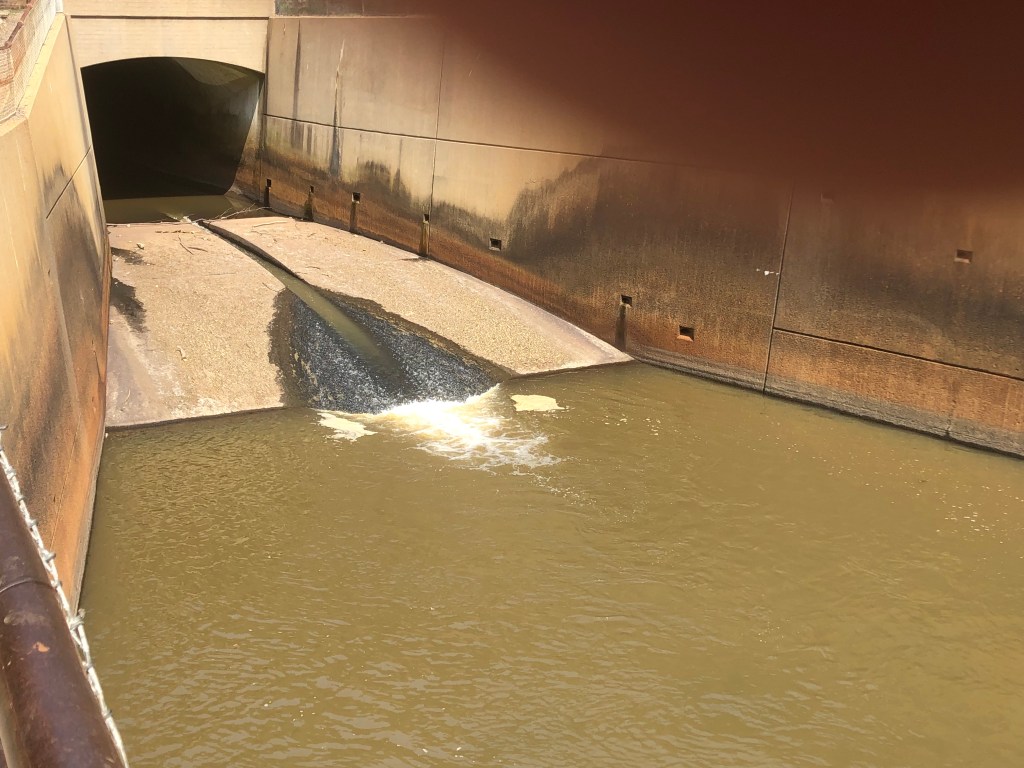
After stopping for a doctor visit last week, we had browsed through the big outdoors warehouse located a few blocks south of the office.  While we were mostly killing time waiting to go out to dinner with friends, it is always fun to watch the fish and dream about fishing gear.  Melissa surprised me by deciding she would like to look at the flies.  While I already have most of what I use, she thought it would be fun to buy some odd patterns and colors to see if they would work.  I suspect all the flies in the store must work somewhere.  While the warehouse says they are “hand-tied,” I also know they are mass produced by people.  I doubt the store would buy flies that did not represent some sort of insect, or that people would tie a fly the store would not buy.  I was thinking that perhaps one of these new flies might work on the spillway I like to fish.

When I looked online, I found the definition for a spillway as “a structure used to provide the controlled release of flows from a dam or levee into a downstream area, typically being the river that was dammed.”  While dams may have bottom outlets with valves or gates which operate to release flood flow, most also have an overflow spillway located at the top of the reservoir pool.  The two main types of spillways are controlled and uncontrolled.  A controlled spillway has mechanical gates to regulate the rate of flow and the design allows nearly the full height of the dam to be used for water storage year-round.  An uncontrolled spillway does not have gates, and when the water rises above the lip or crest of the spillway it is released from the reservoir.  The storage volume of the reservoir can only be used for temporary storage and the rate of discharge is controlled by the depth of water above the spillway.  Most of the earth or rockfill dams constructed by the Army Corps of Engineers are an intermediate type, with normal level regulation of the reservoir controlled by mechanical gates and an auxiliary emergency spillway acting as a safety valve.  Technically, the spillway I fish is a gate, but fisher people (and me) generally call both by the generic name spillway.

Melissa felt like getting out over the weekend and suggested we go up to Blue Mountain.  It was supposed to be cooler, and she thought we could find some shade and do some fishing.  This was the go-to reservoir I thought about fishing while Melissa was buying flies.  There are always fish in the spillway.  When we pulled in the volume of water coming from the tube was low from the lack of rain, with just a small stream coming from the mouth rather than the usual river.  Undeterred, I cast my trout magnet into the pool and quickly caught four fish.  Interestingly, each was a different species, a bluegill, crappie, channel cat, and a drum.  While I caught four fish, I saw several Gar that were over three feet (1 meter) long.  The water was so low I also snagged on the rocks that breakup the usual flow of water and reduce erosion of the spillway bed.  Just as quickly as I caught fish, I lost two magnets.

Thoughts:  The pools that form beneath a release tube or spillway are great places to fish.  While the release tubes usually have roads associated with them, the spillways often do not, making it more difficult to get to the pools.  The water that rushes down the ramp tends to gouge a large hole either beneath the gates or at the end of the reinforced spillway, and they generally hold large fish.  The Southwest has been in drought for much of the past two decades, only punctuated by rare wet years.  This is causing rivers, reservoirs, and spillways to dry up.  Even when there is no running water there are fish that seem able to survive.  Humans are generally not that lucky.  We need a constant refreshing of our water to survive.  Follow the science.  Change is coming and it starts with you.
DIY

September 13, 2021

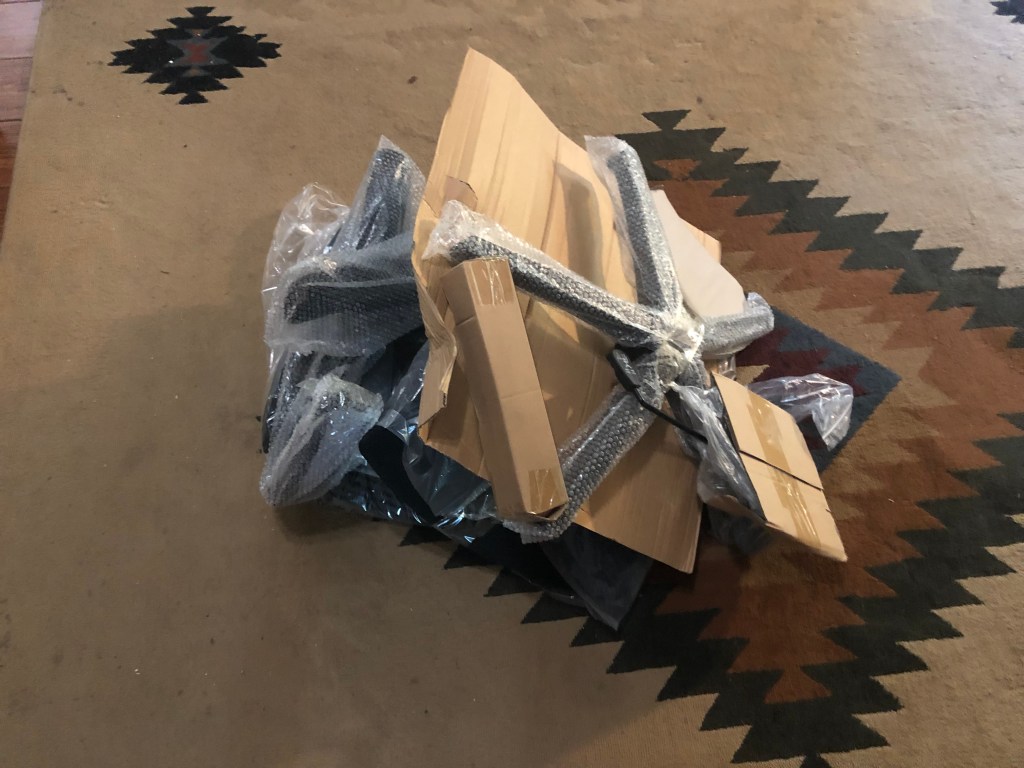
Melissa bought a new chair online and it arrived at the house last week.  Like so many large items that come through the mail, it arrived with “some assembly required.”  This was going to be another Do-It-Yourself (DIY) project.  When I opened the box the pieces all slid out and formed a pile in the middle of the living room floor.  I was not intimidated because after all, this was a chair.  How hard could it be, right?  The first thing I noticed was there was no instruction book to walk me through assembly.  Again, not a problem.  The pile did have a single page picture guide that vaguely associated the various screws with the multitude of holes they were designed to fill.  There was no writing but that was just as well.  Translated instructions tend to confuse me.   Half an hour and several restarts later Melissa had a chair.

When I looked online, I found the term DIY is defined as “the method of building, modifying, or repairing things by oneself without the direct aid of professionals or certified experts.”  The term “do-it-yourself” has been associated with consumers since at least 1912, primarily referring to home improvement and home maintenance projects.  The phrase came into common usage by the 1950’s with the emerging trend of people taking on home improvement and various small craft and construction projects.  These projects were both a creative-recreational activity and a cost-savings.  Since the 50’s, DIY has grown to a broader meaning that covers a wide range of skill sets and has been described as a “self-made culture” of designing, creating, and repairing things without special training.  As I worked on my chair it became evident that I lacked “special training.”

DIY has grown beyond home repair to become a social concept of people sharing ideas, designs, techniques, methods, and finished projects with one another either online or in person.  DIY can be seen as a cultural reaction to modern technology and the increasing academic and economic specialization.  Specialization forces the experts to focus on a tiny area of any given field of research.  The DIY movement then becomes a holistic engagement of your field of study.  A DIY ethic is the ethic of self-sufficiency through completing tasks without a paid expert.  The ethic promotes the idea that anyone can perform a variety of tasks, if they decide to Do-It-Yourself.  I have found that true only to a point.

Thoughts:  When I worked for the state, we were in a cost freeze and purchases were tightly monitored.  My stapler was continually jamming, and I finally decided to take time to fix it.  As I worked on this DIY project, the state architect joined in to help me figure out the problem.  After working with the stapler for an hour, I realized between the two of us we had wasted about $50 worth of time on an $8 stapler.  I put it on the floor, stepped on it, and said, “Oh look, it’s broken.”  I requisitioned a new stapler from supply.  I have found DIY projects to be both fulfilling and frustrating.  When I get the project to work, it builds my self-esteem.  When I struggle it can have the opposite effect.  While DIY can be a fun way to solve problems and creatively explore options, there are times when we need to differ to the experts.  None of the home remedies devised to “cure” the covid virus have been found to be effective, and many can be harmful.  Perhaps this is a time to defer to the experts.  Follow the science.  Change is coming and it starts with you.

Infamy

September 11, 2021

At 12:30 pm on December 8, 1941, President Franklin D. Roosevelt stood before Congress and gave what is now known as his “Day of Infamy” speech.  This was given a day after Japan’s attack on the US naval base at Pearl Harbor, and the Japanese declaration of war on the US and the British Empire.  Sixty years later another infamy happened when hijackers took control of four jet liners, smashing into the North and South Towers of the World Trade Center, the Pentagon, and a field in western Pennsylvania, all within just over one hour.  President George W. Bush was informed of the attack while reading a book to 2nd graders to promote his education program.  Bush remained calm and waited until after the reading was over to explain the nation was under attack.  That night, Bush gave a speech to explain what happened, and what was going to happen.  The primary goal was to express comfort that we would recover and resolve that the acts would not go unpunished.  The attack on September 11, 2001, was the most devastating surprise attack on America since Pearl Harbor.

Those who lived during the attack on Pearl Harbor can tell you what they were doing when they first heard the news about the infamy.   Those who lived through the attack on the Twin Towers can tell you what they were doing when they first heard of this infamy.  At 8:46:40 EDT, Flight 11 crashed into the north face of the North Tower (1 WTC) of the World Trade Center and at 9:03:02 EDT, Flight 175 crashed into the south face of the South Tower (2 WTC).  The South Tower collapsed 56 minutes after impact and the North Tower collapsed 1 hour and 42 minutes after the impact.  I lived on the west coast, and it was not until 7:08 PDT (10:08 EDT) that I woke to a call asking me to turn on the TV.  The scenes around all four crashes continued to reply for days, until it was finally considered too violent to replay. 

Twenty years later to the day we are being asked to remember the events of what is known as 9/11.  The immediate response to the infamy was four-fold.  The aftermath sent the US into two wars in Iraq and the longest war ever for the US forces in Afghanistan, known as the “forever wars.”  The Bush Administration created the Department of Homeland Security by merging 22 government agencies and the US Customs Service and Immigration and Naturalization Service were consolidated into the new US Immigration and Customs Enforcement (ICE), resulting in deportations doubling since 9/11.  Airport security underwent a series of overhauls and is overseen by the Transportation Security Administration (TSA).  The US intelligence state boomed, resulting in a marked increase in government oversight, primarily through a network of phone and web surveillance.  In short, government control got tighter without much improved safety in our daily life.

Thoughts:  My NY Times feed reported how the events of infamy have inspired great accomplishments.  The Civil War led to the emancipation of Blacks and a sprawling program of domestic investment in railroads and colleges.  World War II spark the creation of the middle class and cemented the “American Century.”  The Cold War caused investment in the space program, computer technology, and science education.  After the attacks on 9/11 we chose to pursue a “freedom agenda.”  By toppling the Taliban in Afghanistan and Saddam Hussein in Iraq we sought to inspire people to rise for democracy and defeat autocracy around the world.  Twenty years later we found this did not work any better than in Korea or Viet Nam.  We must never forget 9/11 and the immediate and long-term sacrifices of the fallen.  We also need to remember and learn from our responses.  Do the work.  Change is coming and it starts with you.
Onion

September 10, 2021

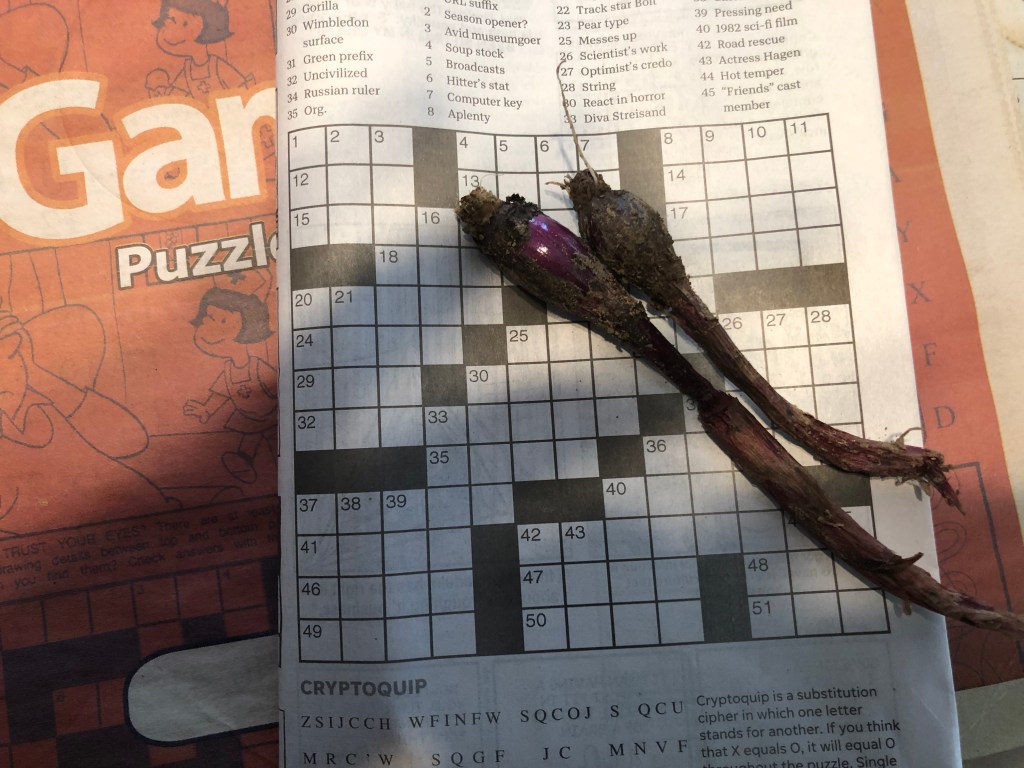
I have been wavering on whether to tear into the overgrown mess that began as my onion sets last June.  Melissa had reminded me at that time that I had vowed (several times) to never grow onions again.  My gardener friend had grown red onions last year and they were beautiful.  I had tried yellow onions.  Few sprouted and the ones that did, did not grow.  Still, I succumbed to the alure of fresh onion completing the trifecta of onions, peppers, and tomatoes from my own garden that comprise salsa.  I thought perhaps if I grew red onion this year the results would be different.  I had let my cilantro go to head without harvesting, but if I could only get an onion this year . . .

When I looked online, I found the red onion is a cultivar of the onion (Allium cepa) species, and have purplish-red skin and white flesh tinged with red.  The yellow, white, and red onion are all varieties of the same species.  Red onion is commonly used in cooking, but the skin of the red onion has also been used as a dye.  These onions tend to be medium to large sized and have a sharp flavor and eye-watering qualities.  They are often consumed raw (added to salads for color and bite), grilled, or lightly sautéed with other foods.  Red onions are available throughout the year.  Red onion is high in flavonoids and fiber compared to white and yellow onion.  Cut red onion can be soaked in cool water for a period, and the water can be drained off.  This results in less “bite” and pungency.  My thought was, why would you do that, when that is why you selected the red onion in the first place?

After planting 50 onion sets this year only 20 of the bulbs sprouted.  Still, I thought, 20 onions were better than none.  I had weeded the bed during the season and confirmed they were still doing well.  With the heat and the rain, the bed had again become overgrown and frankly, I ignored the onion sets.  When I weeded my onion patch today, I found what I expected to find.  Only two of the onion sets had survived, and they were the same size as when I had planted them.  I knew they were mature as their green tops had withered and died.  My hope of fresh onion had been dashed one more time.  This time I am not saying, “Never Again!”, but probably not next year.

Thoughts:  Much of what we do in life is based on hope and expectation.  That has been true every time I decide to once more plant an onion.  When our hope is fulfilled, we are overjoyed.  When it is not, we are forced to refocus and try again.  Last May we were told “if” people would continue to wear their mask, social distance, and get vaccinated, we would be able to gather in backyards by the 4th of July celebration.  Instead, governments across America dropped mask mandates and vaccination rates fell dramatically.  The Delta variant exacerbated our lack of action, and hope and expectation has become another wave of mostly unvaccinated infections and hospitalizations.  Hope and expectation rarely succeed on their own.  We also need to do the work to make them happen.  Do the work.  Follow the science.  Change is coming and it starts with you.
Gourds

September 09, 2021

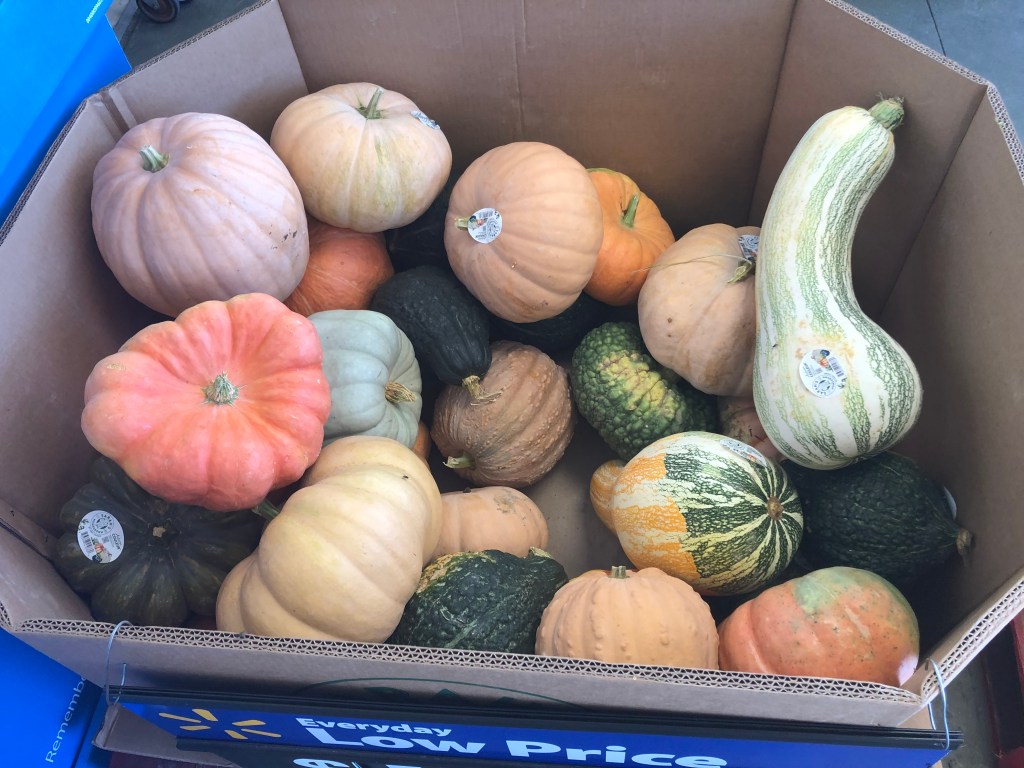
One of the sure ways I find to gage the season is by the displays found in the markets.  The easiest transition can be found on the candy aisle.  While there are always the old staples (candy bars, gums, and notions), even these take on a festive flare and wrappers to mark the different holidays (M&M’s feature red and green Christmas packs).  The candy corn and pumpkins are hard to find until the fall, and peeps seem to only thrive around Easter.  What is more subtle are the display changes in the produce department.  When I entered the store last week, I noticed the watermelons that had dominated the entrance all summer had been replaced by gourds.  These gourds are inedible, but they do make nice holiday displays.  Even though we are still in the mid 90’sF, this is a sure sign that fall is on the way. 

When I looked online, I found that Gourds are among the oldest cultivated plants.  Botanically speaking, there’s really no difference between gourds, squash, and pumpkins.  They all belong to the family Cucurbitaceae and are all frost tender.  Gourds are the common name for hard-shelled, non-edible cucurbit fruits suitable for decorative ornaments or utensils.  They were the early water bottles of the Egyptians, and have been used for utensils, storage containers, and dippers for centuries.  While some of the squashes and pumpkins are ornamental, they are soft-shelled and will not last longer than a single season.  The tough gourds have outlasted the civilization and appear in the archaeological record.

Gourds come in a variety of shapes and colors, but there are three general types of gourds.  The ornamental gourds (Cucurbita pepo) are the colorful gourds used for decorations. They are soft-shelled gourds that are closely related to squash.  These are native to America and are usually not good for more than one season.  The bottle gourds (Lagenaria siceraria) are hard shell gourds whose name means “drinking vessel.”  Hard-shelled gourds will last for several years and have been grown for over five thousand years for use as containers and utensils, although the immature gourds are edible.  The Sponge gourds (Luffa aegyptiaca or Luffa cylindrical) is the well-known bath sponge.  While many believe Luffas are sea sponges, they are gourds related to cucumbers.  After they mature and dry the shell is scraped off and the scratchy inner fiber becomes your bathtub scrubber.

Thoughts:  After defining the three types of gourds, the site went on to describe a fourth.  The Snake gourds (Trichosanthes cucumerina var. anguina) are a member of the pumpkin family (Cucurbitaceae) but has seeds like the watermelon (Citrullus lanatus).  Their name is derived from the long and wriggly shape which resembles a snake.  They can be eaten when young, but they are not very flavorful.  Once fully mature, snake gourds are tough enough to be turned into didgeridoos (an Australian wind instrument like a straight trumpet).  I find is fascinating that these varieties of gourds have been grown for over 5000 years and are more aesthetic than edible.  Humans obviously tried to eat them, in various stages of growth, but then continued to use the fruits for other purposes.  As the saying goes, “Humans do not live by bread alone.”  Apparently, we also need the arts and etiquette.  Do the work.  Follow the science.  Change is coming and it starts with you.
Beavers

September 08, 2021

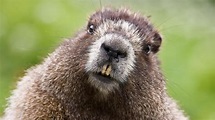
One of the lead stories this week on my NY Times feed reported on the return of beavers to Scotland four centuries after they were hunted to extinction for their fur.  Not all have welcomed this return as it means a resumption of their age-old battle with humans.  Beavers have incurred the wrath of the farming community as they decimate trees and build dams that flood fields, wreck drainage systems, and collapse riverbanks.  Some farmers have obtained permits to kill the otherwise protected animals, setting off outrage among conservationists and igniting a debate about farming, biodiversity, and the future of Scotland’s countryside.

When I looked online, I found the scientific name of the Eurasian beaver is Castor fiber.  The North American beaver’s scientific name is Castor canadensis.  These two species are the only extant (living) species in both the Castor genus and the Castoridae family, which is part of the Rodentia order.  The main predators for the Eurasian beavers are red foxes, lynx, and Eurasian wolves.  Historically, humans were the main threat for Eurasian beavers.  Beavers disappeared from Britain due to over-hunting and destruction of habitat from farming and deforestation.  Beavers were hunted for their rich, lustrous fur, which was often made into hats.  Another use was for their castoreum, a musk-like substance contained in the scent glands of both male and female beavers.  While beavers use the castoreum to mark their territory, humans use it in perfumes.  It seems to fill the same purpose for both.

In May 2009, the Scottish Wildlife Trust, in partnership with the Royal Zoological Society of Scotland, and Forestry and Land Scotland, released the first wild beavers in Scotland in over 400 years.  The Scottish Beaver Trial was one of the largest field trials of its kind in Europe and aimed to help the Government make an informed decision on the future of the species in Scotland.  An independent monitoring program was carried out by NatureScot to assess the effect that the trial population had on the local environment and how well they settled in Scotland.  This evidence contributed to a comprehensive report called Beavers in Scotland, which was published and presented to the Scottish Government in 2015.  The final report for this project, Beavers in Knapdale, was published in January 2021.  While some object to the beavers, they are a major attraction and bring significant ecotourism money to the area.

Thoughts:  I took a high school class in Ecology (it was the 70’s) that required a field report on a relevant project.  I decide to take a float trip down a ten mile stretch of the Kaw River that meandered through the hills and trees of the Flint Hills.  The purpose was to record the diversity of wildlife on this low human impact section of the river.  One of the things I encountered was a family of river beavers.  The water was deep, so they had not built a dam, but they did have a beaver lodge.  The beavers were sunning on the steep bank, but as they saw me pass, they all slide into the water.  These were the only wild beavers I ever saw in forty years living in Kansas.  I was amazed not just by the beavers but by the surprising diversity that existed away from regular human contact.  We need to be willing to restore and preserve our fragile waterways.  Both for the beavers and for us.  Follow the science.  Change is coming and it starts with you.
Dauber

September 07, 2021

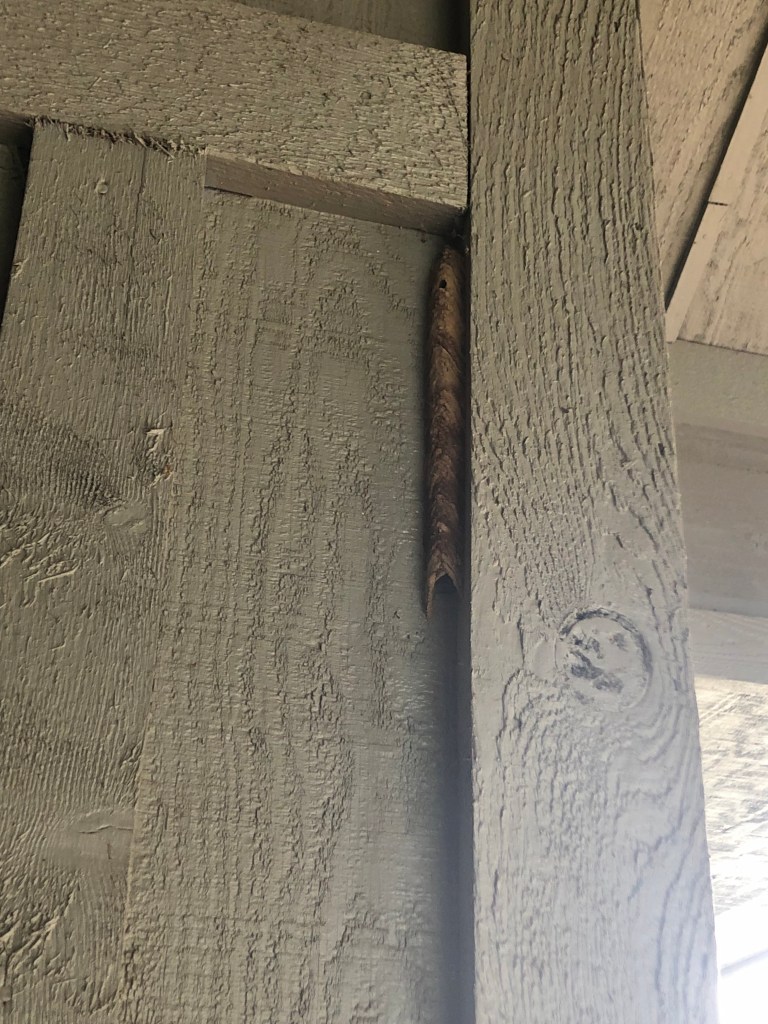
I have noticed a long tube-like structure above the entrance where I work for several weeks.  I was unsure of what this was as I had never seen one before.  My curiosity finally got the best of me over the weekend, and I did a google search with my phone on the tube.  I found it belonged to a type of mud dauber.  The mud dauber nests that I am used to are a single cell, but this one was about seven inches long.  I have never been fond of wasps as I have found they are aggressive when guarding their nests.  When I was director of the rural camp, I was constantly trying to get rid of wasp nests and the angry wasps that guarded them.  Luckily there are spray cans that shoot a spray twenty-seven feet to take out the wasp nests that seemed to accumulate under the eaves of our buildings.  

When I went online, I found the Organ pipe mud dauber (Trypoxylon politum) is a predatory wasp in the family Crabronidae that ranges from Southeastern Canada to Eastern US.  These are large wasps, ranging from 1.5 to 2 inches (3.9 to 5.1 cm) that are active from May to September.  The female and male are similar in color, being a shiny black with pale yellow to white hind tarsomere.  The Organ pipe mud dauber feeds on various species of the orb-weaver (Araneidae) spiders.  The female dauber forms a long mud tube consisting of multiple cells, each fortified with a paralyzed spider.  The female then lays an egg in each cell, and when the egg hatches the larvae feed on the spider.  The larvae then pupate until they become adults.  The female generally constructs 5 to 6 pipes in a cluster, either side-by-side or on top of each other.  A newly hatched adult female will usually begin building her new nest within 48 hours of leaving her birth nest.  Interestingly, our nest had only one pipe.

The Organ pipe mud dauber is said to be an exceedingly docile species of wasp.  They also serve to keep down the spider populations that thrive in and around buildings.  Stings to humans are only in self-defense, such as if a wasp is squeezed (whose bright idea found this out?).  The tufted titmouse (Parus bicolor) is a known predator of the mud dauber and may feed on them more commonly than previously thought.  The holes made by the titmouse are similar in shape and size to those made by a mud dauber leaving the nest after pupation.  The mud tube I found was located near an abandoned paper wasp (vespid subfamily Polistinae) nest under the portico at the entrance of our building.  A barn swallow nest is located against the light in the center of the portico.  It made me wonder if the barn swallow that lives in the nest had feasted on both types of wasps before they could complete building their nests.

Thoughts:  While I have never been too concerned about the mud dauber nests, I cannot say the same for the paper wasps.  I once walked into a bathroom at the lake where I worked and was immediately stung five or six times by the wasps who had taken up residence there.  Then it became my job to get them out, so it did not happen to other campers.  I could have used one of the spray cans on that day.  The single Organ pipe mud dauber tube reminded me of the interrelated cycle of life.  The orb spiders create spiral webs to capture small flying insects.  The mud dauber captures the spider and leaves it as food for its larva.  The dauber is caught and eaten by the swallow.  Usually, all three nests would be destroyed by the humans who live in the building.  While the nests were created to continue the cycle of life, their destruction by humans occurs for aesthetics.  The different nests serve as a reminder for me to respect the creatures who live around me.  If I do not get stung.  Follow the science.  Change is coming and it starts with you.
Labor

September 06, 2021

Labor Day is a federal holiday in the US celebrated on the first Monday in September in any given year.  The day falls anywhere from September 1 through September 7.  The day was created to honor and recognize the American labor movement and the works and contributions of laborers.  Beginning in the late 19th century, trade unionists proposed a day be set aside to celebrate labor.  “Labor Day” was promoted by the Central Labor Union and the Knights of Labor, which organized the first parade in New York City.  In 1887, Oregon was the first state of the United States to make it an official public holiday.  By the time it became an official federal holiday in 1894, thirty states in the United States officially celebrated Labor Day.  Canada’s Labor Day is also celebrated on the first Monday of September.

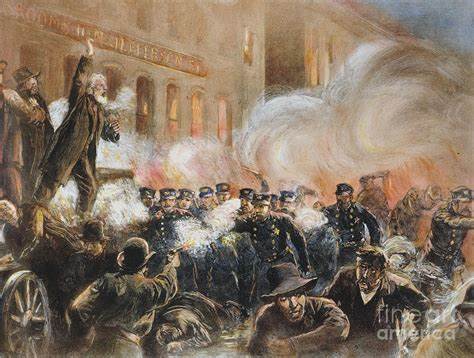
While the US and Canada celebrate in September, more than 80 countries celebrate an International Workers’ Day on May 1, the ancient European holiday of May Day.  May Day was chosen for recognition by the Second International of Socialist and Communist parties to commemorate the Haymarket affair (riot) which occurred in Chicago on May 4, 1886.  The Haymarket affair, or the Haymarket massacre, was the aftermath of a bombing that took place at a labor demonstration on May 4, 1886, at Haymarket Square in Chicago, Illinois.  It began as a peaceful rally in support of workers striking for an eight-hour workday, the day after police killed one and injured several workers.  An unknown person threw a dynamite bomb at the police as they acted to disperse the meeting, and the bomb blast and ensuing gunfire resulted in the deaths of seven police officers and at least four civilians.  Dozens were wounded.

Before it was a federal holiday, Labor Day was recognized by labor activists and individual states.  After municipal ordinances were passed in 1885 and 1886, a movement developed to secure state legislation.  New York was the first state to introduce a bill, but Oregon was the first to pass a law recognizing Labor Day on February 21, 1887.  During 1887, four more states; Colorado, Massachusetts, New Jersey, and New York passed laws creating a Labor Day holiday. By the end of the decade, Connecticut, Nebraska. and Pennsylvania had followed suit.  By 1894, 23 more states had adopted the holiday, and on June 28, 1894, Congress passed an act making the first Monday in September of each year a legal holiday.

Thoughts:  While Labor Day was created out of a long struggle to acknowledge the rights of workers, the only thing most now seem to remember about the celebration is that they get a day off during the first part of September.   This began as a day of revolt when workers simply refused to come to work.  When enough workers refused, it was acknowledged by states and then the federal government.  A similar action occurred when Blacks Lives Matter activist took to the streets during 2020.  The movement demanded the government recognize police needed to provide the same rights to Black citizens that was shown to others.  Somehow this is seen as controversial.  Do the work.  Change is coming and it starts with you.
Cats

September 04, 2021

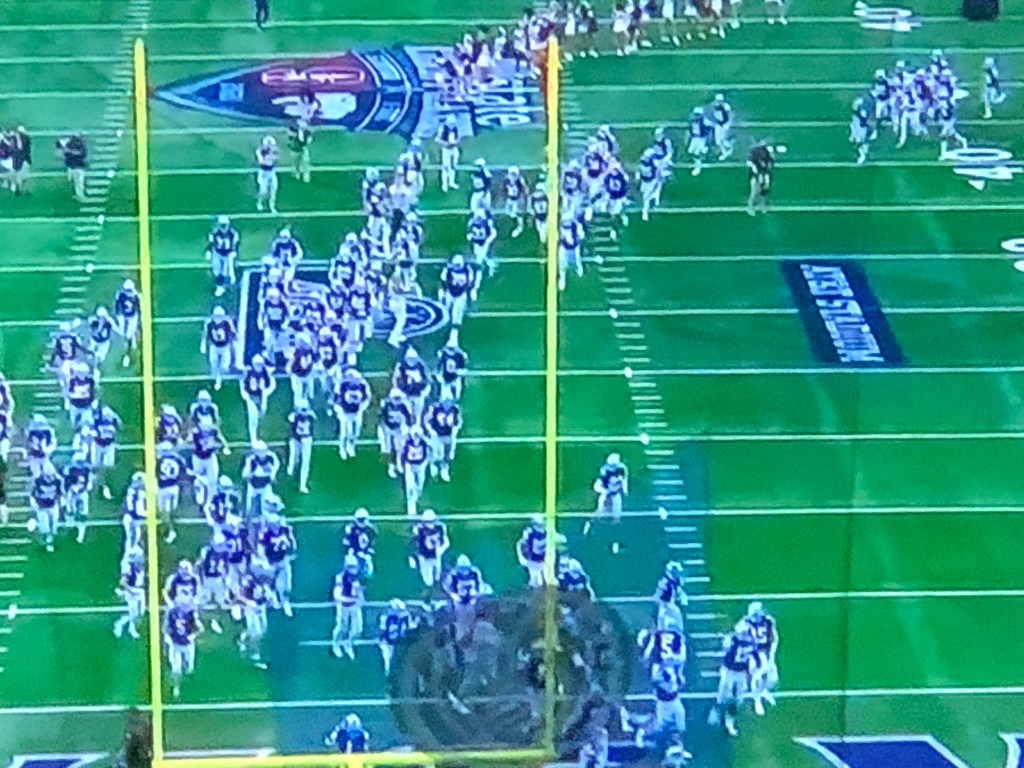
The Kansas State Wildcats kicked off their football season today with a home game hosting the Stanford Cardinal.  Well, sort of a home game.  The Cats chose to open at a neutral location in Dallas’ AT&T stadium.  The Cats were originally scheduled to host Stanford this year at Bill Snyder Family Stadium, but athletics director Gene Taylor decided to move the game to the home of the Dallas Cowboys in exchange for $2.8 million.  The Cardinal only played six games last year and went 4-2 but ended the season winning their last four.  The Cats went 4-6 but ended losing the last five.  The game will be treated as a K-State home game and the Cats will have a significant fan advantage as the Cardinal travels from the West Coast.  The Cats were a 3-point favorite, but won 24-7.

The Cats’ mascot (Willie the Wildcat) is patterned after the bobcat (Lynx rufus), also known as the red lynx.  This is a medium-sized cat native to North America, and ranges from southern Canada through most of the contiguous US to Oaxaca in Mexico.  This wide range and large population place it as Least Concern on the IUCN Red List since 2002.  It has been hunted extensively for both sport and fur, but populations have remained stable even if declining in some areas.  The term bobcat comes from a stubby (“bobbed”) black-tipped tail.  A wildcat is a species complex comprising two small wild cat species, the European wildcat (Felis silvestris) and the African wildcat (Felis lybica).  The European wildcat inhabits forests in Europe and the Caucasus, while the African wildcat inhabits semi-arid landscapes and steppes in Africa, the Arabian Peninsula, Central Asia, into western India and western China.  Neither is found in America, but their similar size and appearance led to the American species being mistakenly called a wildcat.

Stories featuring these cats are found in Indigenous cultures of North America and have parallels in South America.  One story of the Nez Perce depicts the bobcat and coyote as opposed, antithetical beings, while another version represents them as equal and identical.  In a Shawnee tale, the bobcat is outwitted by a rabbit, which gives rise to its spots.  After trapping the rabbit in a tree, the bobcat is persuaded to build a fire, only to have the embers scattered on its fur, leaving it singed with dark brown spots.  The Mohave believed dreaming habitually of beings or objects would afford you their traits as supernatural powers.  When you dreamed of two deities, the cougar and lynx, the belief was it would grant the superior hunting skills of other Tribes.  European-descended inhabitants of the Americas also admired the cats for their ferocity and grace.  It is this ferocity that earned Willie the title of mascot.

Thoughts:  Anthropologist Claude Lévi-Strauss argued the opposing depictions of the cats in Nez Perce stories are a later adaptation resulting from regular contact between Europeans and native cultures.  The concept of twins representing opposites is an inherent theme in New World mythologies, but that they are not equally balanced figures.  The animals represent an open-ended dualism rather than the symmetric duality of Old World mythologies.  The earlier version of the Nez Perce story is of much greater complexity, while the version of equality seems to have lost the tale’s original meaning.  It seems when different cultures meet and interact, crossover of ideas can go both ways.  Europeans embraced bobcats into their tales and Indigenous altered the story to reflect world changes.  Adjusting to a new reality does not have to be one sided.  Do the work.  Change is coming and it starts with you.