Spawn

July 07, 2021

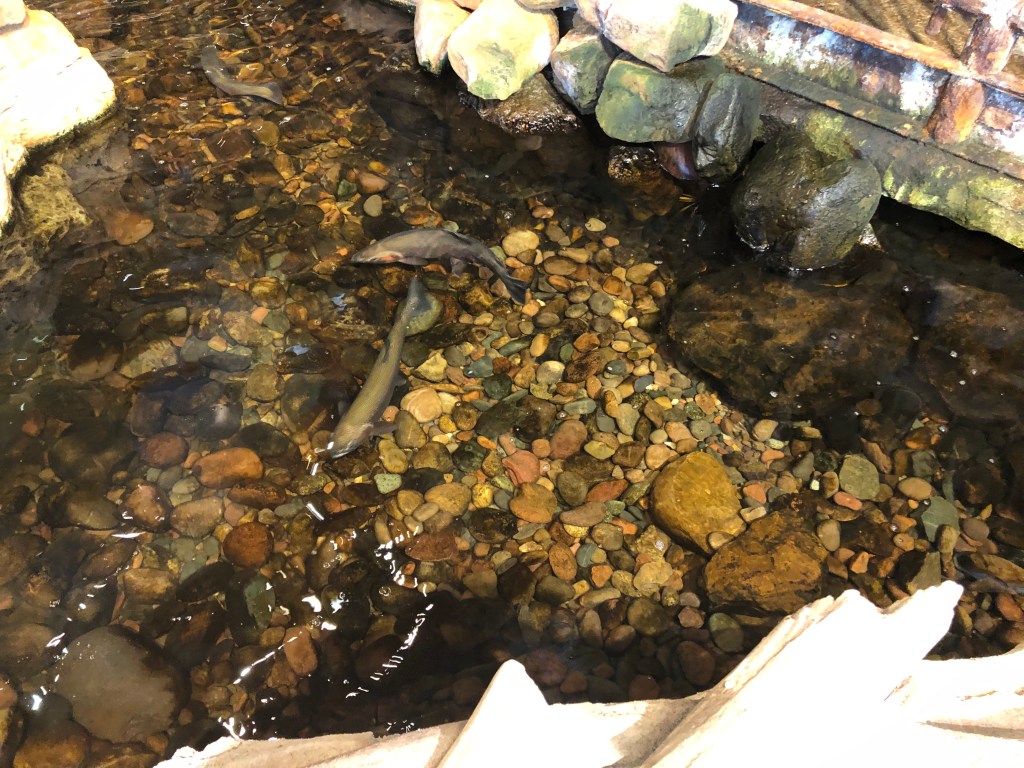
On our way home from Kansas Melissa and I decided to stop at the big outdoor retailer in Tulsa.  This chain of stores is known for the staged displays of stuffed trophy animals as well as the fish displayed in large aquariums.  The store in Tulsa has a small stream/pool that holds several ten-pound Rainbow Trout.  While I went up the elevator to look for a new pair of hiking shoes (the last ones only lasted 10 years of near daily wear), Melissa watched the trout in the pool.  It was not long before she texted me saying I needed to come down and see what she was watching.  When I arrived, she pointed out a pair of fish that were spawning.  The female would swim around in the same spot and occasionally lay a flurry of eggs, which the male would quickly fertilize.  We continued to watch for several minutes.

When I looked online, I found the rainbow trout (Oncorhynchus mykiss) is a species of salmonid native to cold-water tributaries of the Pacific Ocean in Asia and North America.  The popularity of the fish as a fighter and for food have spread the species around the world.  The exact timing for the spawn varies slightly based on the river system.  In most cases however, rainbow trout spawn in the spring or late spring (March through late May).  The snow runoff often hits a few weeks after the spawn is complete.  In tailwater fisheries where the water temperatures see little variance below the dam, the spawn can even cycle out of season at random.  The constant temperatures of the human made stream had obviously resulted in a random July spawn, several months later than normal in the wild.

The real show we watched was the male defending his territory.  There were two other large Rainbows of the same size who were constantly challenging the male for access to the female.  While the female stayed relatively still over her improvised nest, the male was constantly on the move.  The other big fish would take turns entering the basin where the female was only to be driven back by the protective male.   This was happening as he kept an eye on the female to see when she showered the bottom with eggs.  While I never saw him, Melissa said there was another much smaller male who would sneak in and try to eat the eggs.  While I had not thought much about trout eating their own eggs, I did know salmon eggs are one of the preferred natural baits when fishing for trout.  I guess one spawn is as good as another.

Thoughts:  In the wild, the female trout will build a nest, called a redd, to lay the spawn.  The redd is easy to identify either by the fish gathered or by the cleaned section of pea gravel.  When building a redd, the females fan their tails over the gravel to create the nesting zone, and the area stands out visually when compared to the rest of the river bottom.  It is not uncommon for the female to stay on the redd as other males wait downstream, jostling for position to spawn or eat any free-floating eggs.  The store fish live in an anomalous environment.  There were no pea gravel beds to form the redd, nor were there additional females for spawn.  The fish adapted as their innate nature allowed.  While humans are driven by natural instincts, we are not bound by them.  We make individual choices that ensure personal survival (or wants), and at times at the expense of others.  We can choose to protect others as well.  Do the work.  Follow the science.  Change is coming and it starts with you.

Parade

July 06, 2021

When we arrived at my nephew’s house in Topeka on Sunday they had just got back from a local parade.  We were told it was being held in the park near their house and they had all walked over.  I envisioned a large city-wide parade with 1000’s of spectators and was not keen on attending.  We drove by the park, and it was a small square about half the size of a city block.  While the parade could not have been large, we were told it was festive.  My son also sent pictures of the parade they had at their beach house.  This is a community of about 30 houses and the children had dressed up and decorated their bikes to circle around the park located in the center of the community.  The parades were not Gala, just enjoyed.

While parades are a good way to get people’s attention and to honor individuals or events, they are not always the best approach.  During the waning months of World War I, officials across the country were being pressured to sell war bonds, or Liberty Loans.  On Sept. 28, 1918, Philadelphia city officials refused to cancel their parade amid the Spanish flu pandemic.  The decision is now held up by the CDC as an example of what not to do during a pandemic and has obvious parallels with modern-day refusals.  The Spanish flu was a new strain of the influenza that gained a foothold among soldiers in the trenches of Europe.  It would eventually infect a third of the world’s population and kill an estimated 675,000 Americans and 50 million people globally.  Boston had held a parade that resulted in the city’s hospitals being “taxed to their limits.”  St. Louis faced the question and chose to cancel the parade rather than face the risks.  Philadelphia instead warned people to cover their mouths when they coughed or sneezed.  “If the people are careless, thousands of cases may develop, and the epidemic may get beyond control.”  Within a week, 45,000 citizens were infected, and the city had shut down.

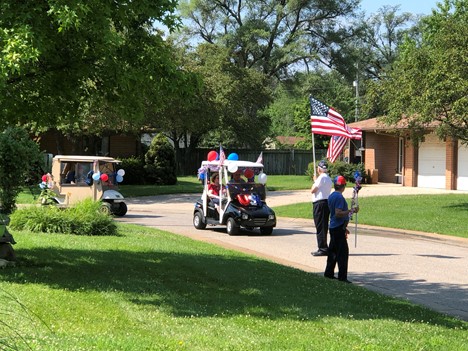
While I missed the two parades mentioned on the 4th, I was able to participate in a parade at mom’s retirement community celebrated on the 5th (the observed day off).  This began with a dedication service for the recently installed flag poles as part of a remodeling campaign for the community.  Then about thirty of the residents joined in a parade that has become a tradition, except for last year during the height of the pandemic.  The residents decorated the bicycles and golf carts they use to move around the campus and wound their way through the community’s streets.  Mom and I stood on the porch and watched the parade go by.  It even included the traditional candy toss to the children visiting their grandparents across the street.  I enjoyed it.

Thoughts:  The three local parades mentioned indicate a resurgence of our need to reunite our local communities.  Humans are by nature social animals, and we crave interaction.  The parades also illustrate we can come together without large crowds in potential super-spreader events and still have fun.  The 70% vaccination rate sought by Biden by July 4th did not happen, primarily because of a parade of people who refuse to do anything unless “my team” says it is right.  There are two approaches for achieving the interaction we desire.  We can split into competing teams and hope to choose the winning side, or we can unite across barriers to become stronger together.  Choosing to cross barriers is harder because it means we need to care for others rather than just ourselves.  It is also the only workable long-term solution.  Do the work.  Follow the science.  Change is coming and it starts with you.
Fireworks

July 05, 2021

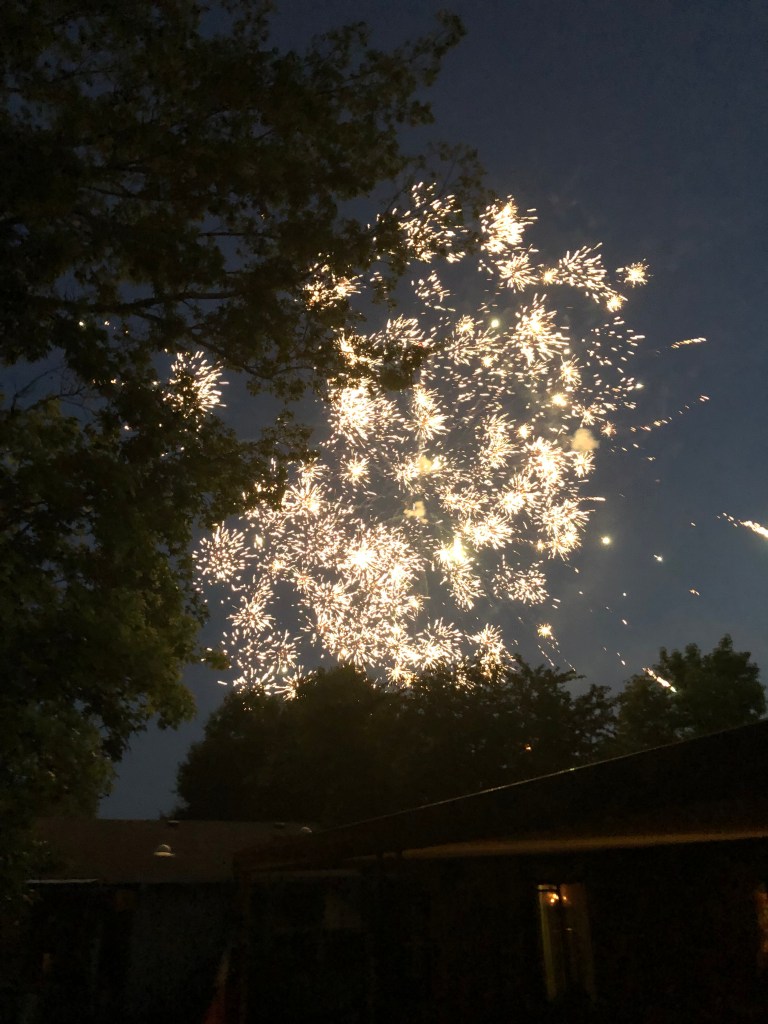
The fireworks display we watched last night were some of the most impressive we have seen in years.  I am not fond of large crowds, and it is hard to go to community displays without encountering one.  Instead, we stayed home.  I tried to watch one of the national displays on TV, but it is not the same watching on a small screen without the noxious smell of gunpowder.  That was when the sound of exploding shells began outside our house.  When I walked out, you could just see the bursts over the top of the trees from the three different community displays near us.  More impressive were the personal displays that began at the same time and lasted well into the night.  These were not just roman candles and bottle rockets.  They included all the chrysanthemum bursts, artillery shells, and crackles usually reserved for the community displays.  They even appeared to have “Repeaters.”  These preset boxes of are chain-fused fireworks that shoot a series of aerial shells, comets, or mines from collectively attached tubes to produce various colors, noises, and effects.  I could not imagine what those might have cost.

The earliest fireworks came from China during the Song dynasty (960–1279) and were used to accompany celebrations and festivities.  The art and science of making fireworks developed into an independent profession in China, where pyrotechnicians were respected for their knowledge of complex techniques in mounting firework displays.  Fireworks displays were common among both the local people and the grand displays by the emperors.  Fireworks were produced in Europe by the 14th century and became widely popular by the 17th century.  Music for the Royal Fireworks was composed by George Frideric Handel in 1749 to celebrate the Peace treaty of Aix-la-Chapelle, which had been declared the previous year.  The modern-colored fireworks were invented in the 1830’s as modern chemistry added different chemicals to make the brilliant colors.

As we approached the fourth of July all the talk was about the potential lack of fireworks.  When I looked online for the reason, I found that fireworks were the latest casualty of the supply chain crisis.  Many large vendors have not been able to replenish their inventory from last year.  Last year also saw a record demand for fireworks as the pandemic canceled many of the community shows and “forced” Americans to create their own fireworks shows.  The buying frenzy caused vendors to sell out early and depleted supplies for 2021.  First manufacture, and later shipping problems, have caused the prices to soar and availability to wane.  Just like the toilet paper run last year, my neighborhood seemed to get their supply of fireworks before they ran out.

Thoughts:  Not long after we were married Melissa and I decided to checkoff one of her bucket list items, attending a Pops Fourth of July.  We arrived in Boston the night before and took in some of the sights.  One of the things I do not like about crowds is trying to drive home after the event is over.  We instead walked to the Commons.  Even though it was early afternoon, we joined the throng of people moving toward the park.  We soon heard the 300,000-person capacity near the stage had been filled.  Instead, we joined the rest of the 3,000,000 who sat near one of the 40’ screens that dotted the park.  While we did not get the smell, the screen and the crowd were large enough to make you feel you were there.  As we come out of the pandemic, there are many traditions that have been altered to meet the new normal. This is neither good nor bad, as much as different.  It also illustrates the ingenuity humans have when it comes to continuing traditions.  Do the work.  Follow the science.  Change is coming and it starts with you.
Travelers

July 03, 2021

Yesterday Melisa and I got back out on the road as travelers for the first time since last September.  Even then it was a solitary trip to the White River where we were joined by friends for one day and a fishing guide for another.  We saw few additional people, but if you recall, the “girls” (the neighbor’s two dogs) kept us entertained throughout the week.  This time we decided to go north to see mom again.  While we try to get to Wichita several times during the year, it has been 19 months since our last visit due to the pandemic and the travelers shutdown.  We had tried to go up over Mother’s Day but got sidetracked and went to Melissa’s surgery instead.  This time we made it.

We were not surprised by the State Troopers and County Sheriffs we saw between the Arkansas boarder and Tulsa.  This weekend is predicted to have 47.7 million travelers, the most since pre-pandemic days.  Melissa heard on the news that the worst times be car travelers were 3 pm Friday (when we took off) and 3-6 pm Monday (when we come home).  What did surprise me was we did not see a patrol car of any type from outside of Tulsa all the way to Wichita.  I began to wonder if they were just trying to crack down on the crazy travelers from Arkansas. 

As we got off 412 to drive north into Kansas, we were passed by a constant stream of travelers driving north from Texas and Oklahoma.  Oklahoma had raised the speed limit since the last time we were travelers on this stretch and Melissa was happy to take the extra 5 mph.  Apparently, that was not enough for the cars who seemed to pass in caravans coming from the south.  We were amazed to see cars zip past and then weave in and out of traffic.  Each driver seemed to think it was their right to pass and then cut off the car that had just passed them.  Every car that passed us for 90 miles had either an Oklahoma or Texas license plate.  I was glad Melissa did not get caught up in this passive-aggressive game of these travelers. 

Thoughts:  The Red River Showdown, more commonly called the Red River Shootout, is an American college football rivalry.  The game matches the University of Oklahoma Sooners and the University of Texas Longhorns.   In October, both teams are travelers to a neutral site at the Cotton Bowl.  The name is derived from the Red River that forms part of the boundary between Texas and Oklahoma that has caused conflict between the two states in the past, most notably the Red River Bridge War in 1931.  Both teams see the rivalry as bitterly emotional and territorial in nature.  This stems from the states’ proximity, past border disputes, and economic and cultural differences.  As we drove, I wondered aloud if the rivalry had not spilled into the travelers on the road.   During the pandemic, the cases of homicide and road rage dropped dramatically across the US in part due to restrictions on travelers.  We are now seeing those rates again rise dramatically.  Hatred and uncontrolled rage are a choice.  Do the work.  Change is coming and it starts with you.

Rough

July 02, 2021

When I went out to look at my feeders yesterday, I noticed one of the hanging tripods had broken and it was dangling along the fence.  I had previously written about the mystery of the suet feeder first being knocked to the ground, and then completely disappearing from the same general location.  While I had not mentioned it, the squirrel feeder had the Plexiglas barrier torn off and thrown to the ground several weeks ago.  I have never seen the perpetrator for any of these events, but as I mentioned previously, the likely suspects are one of the three squirrels that I have seen feeding in all five stations.  Now they appear to be getting rough.

Squirrels are best known as the cute little animals found in parks across America.  What you may not know is they are often intentionally placed in man-made parks.  They are generally not aggressive toward humans, but they can be rough toward each other.  That is especially true when humans decide to feed the squirrels.  When you feed wild animals such as squirrels, others that are not getting fed get jealous.  Just like gulls at the beach, when you feed one you will observe that quickly becomes countless birds also wanting their share.  The same is true of squirrels, and they will get rough with each other for food if they are hungry.  Feeding squirrels in the park also makes them become more aggressive toward humans.  That is why most parks have signs advising visitors to not feed the animals.

While I am not feeding park squirrels, I am suffering some of the same consequences.  My squirrels have become rough with the feeders and have driven off the birds to keep the food for themselves.  There are two differences between the park and my yard.  First, many people in the park feed processed human food to the squirrels.  Even the peanuts that are still in the shell are often heavily salted to conform to the human pallet.  Processed food does not have the nutrients that the squirrels need and find in their normal diet.  Second, as I mentioned when I started feeding them, they were robbing the feeders whether I fed them or not.  These are not hand fed, and they still run away when I come out of the house.  I guess I better go get some more shelled and unsalted peanuts to add to the squirrel mix.

Thoughts:  I admit I did resonate with one of the statements made by the anti-feeding site, “How many squirrels are you willing to feed?  One?  Two?  One hundred?”  Whether you deliberately feed wild squirrels in your backyard, or actively try to keep them out of your feeders, the result is the same.  They will get their cut and will be rough with each other and the other birds until they do.  Apparently, they are just as rough with the feeders if they do not provide access to the needed seed.  About 14 percent of U.S. households, or roughly 48 million people (1 in 7), go hungry at some point during the year, child rates are higher (1 in 5 in US and 1 in 4 in my community).  The major cause of food insecurity is the lack of jobs (especially with high enough wages to avoid food insecurity), lack of job skills, and single parent families.  When we see hungry animals, we place feeders in our yard to help keep them from going hungry.  When we see humans who live in the food deserts of the inner cities and rural areas of the US, should we not do the same?   Do the work.  Change is coming and it starts with you.
Turkeys

July 01, 2021

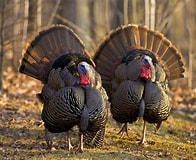
The numbers are in, and the Wild Turkey season recorded 7,014 birds checked in Arkansas this spring, including 28 hens.  Wild turkey is the second most popular game animal in Arkansas with 112,000 hunters.  Deer is by far the most popular with 308,000 participants and Ducks come in third with 87,000.  The squirrel ranks fourth with 75,000 hunters.  For turkeys, that means just over 6% of the participants come home with a bird.  The turkey hunt is intended to be a challenge, and the regulations are in place to bolster declining populations to ensure better (if any) hunts in the future.  There are some who find ways to beat the odds by not playing by the rules.  This resulted in 152 major wildlife violations during the 21-day season.  Hunting turkeys over bait accounted for 72 of those cases.

When I looked online, I found the wild turkey (Meleagris gallopavo) is an upland ground bird native to North America.  This is one of two extant species of turkeys, and the heaviest member of the order Galliformes.  It is the ancestor to the domestic turkey, and originally derived from a southern Mexican subspecies of wild turkey.  Although native to North America, the turkey probably got its name from the domesticated variety being imported to Britain from the Levant.  The British associated the wild turkey with the country Turkey and the name prevailed.  The term was transferred to the New World bird by English colonizers with knowledge of the imported birds.  Wild turkeys are omnivorous, foraging on the ground or climbing shrubs and small trees to feed.  That is what makes them easy to bait.

I came across another site offering a 5-step process for baiting wild turkeys: get the right tools (including cracked corn), scout the hunting area, set the bait, arrange the decoys, and call the turkeys.  The article claims, “I can say without any doubt that now you know everything about how to bait turkeys.”  The small print at the bottom of the page adds, “Don’t forget to check the local laws and regulations before you try to bait turkeys.”  When I checked another site on hunting turkeys it stated that baiting wild turkeys with food is banned in all states with turkey populations.  The only exception is if you have a permit to capture and relocate turkeys or for a depredation hunt.  The author described himself as having been “hunting and fishing for over 20 years now!”  I hope it has not all been illegal.

Thoughts:  While domestic turkeys are not known to fly, their wild counterparts are fast and agile fliers.  In their ideal habitat of open woodland or wooded grasslands, they may fly beneath the canopy top and find perches in the trees.  My sister tells of walking through a wooded area of Maine in the morning when suddenly a turkey dropped to the ground close by.  This was followed by another and then another, as the entire flock dropped from their evening roost to begin foraging on the forest floor.  Perhaps Herb Tarlek should have used wild rather than domestic turkeys when he dropped them from the helicopter (vis a vie, WKRP in Cincinnati).  Baiting turkeys seem to provide the same result.  As Les Nessman said, “Oh, the humanity!  Regulations are there to help us overcome circumstances, not to deprive us of rights.  Follow the science.  Change is coming and it starts with you.
Resting

June 30, 2021

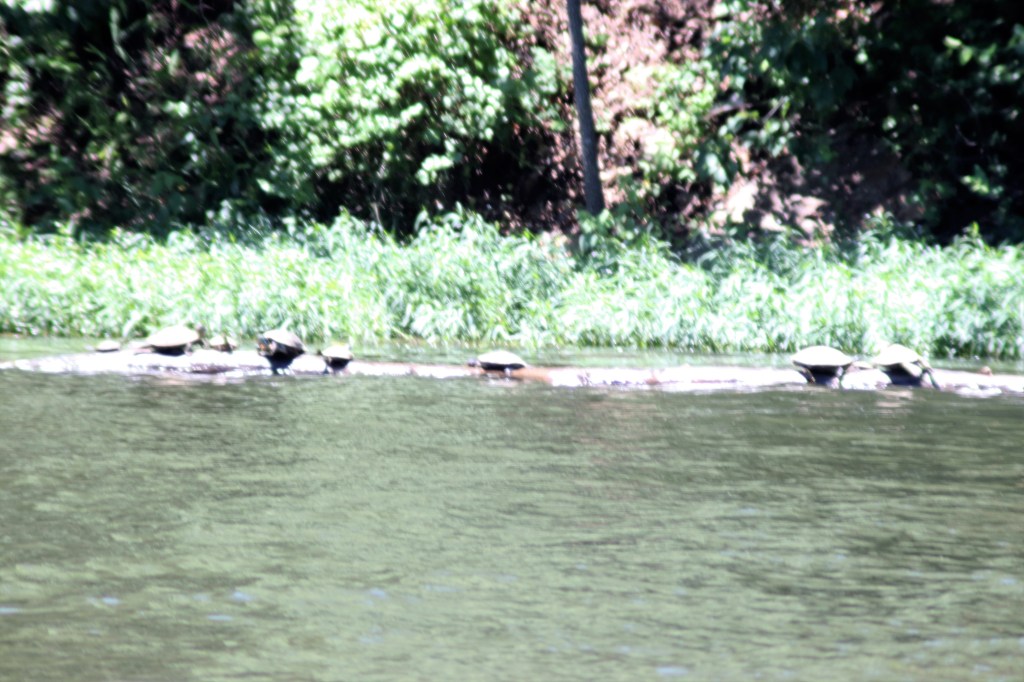
When I was out at the lake last week, I noticed a group of turtles resting on a log floating in the water.  The vegetation around the lake came right down to the shore giving little area for the turtles to lay in the sun.  I also saw only one log floating in the water for the turtles to rest on.  Since turtles are cold-blooded animals, they need to regulate their body heat by the surrounding temperature.  When turtles are too cold, they will slow down.  If they are too hot, they will overheat and risk internal damage.  That means the turtles alternate between warming in the sun and cooling off in the water.  There were eight turtles resting on the log.

When I looked online, I found the Red-eared Slider (Trachemys scripta elegans) is one of 17 species of turtles which live in the ponds, lakes, and streams of Arkansas.  In the wild they can often be found resting in the sun on a log or sand bar.  Red-eared sliders are native to the southern US and northern Mexico.  It is the most popular pet turtle in the US and is popular as a pet across the world.  Since the Sliders are the most traded species of turtle, they are also the most invasive turtle in the world due to pet releases.  The slider is included on the list of the world’s 100 most invasive species published by the International Union for the Conservation of Nature.  This seems pretty busy for an animal who spends so much time resting.

Another name for a turtle resting in the sun is basking.  When turtles bask, they absorb heat from both the sun and the substrate on which they bask.  The sandy shore or the log they are resting on absorbs and gives off the sun’s heat.  For North American turtles including sliders, the optimum temperature of the basking spot is between 90F to 95F.  Exposure to UVB light enables turtles to produce vitamin D3, which is needed for the absorption and utilization of calcium.  Drying out in the sun helps the turtle deal with fungal infections and parasites as those require moisture to live, as well as drying out the algae on the turtle’s shell, which will then fall off.  Who knew resting could be so beneficial?

Thoughts:  Some US states have laws and regulations regarding possession of Red-eared Sliders because they can be an invasive species where they are not native.  It is now illegal in Florida to sell any wild-type red-eared slider, as they interbreed with the local yellow-bellied slider population (Trachemys scripta scripta).  In Australia, the turtles are considered a significant threat to native turtle species, as they mature more quickly, grow larger, produce more offspring, and are more aggressive than native species.  It seems these invaders are quite active when they are not resting.  During the height of the pandemic many decided to forgo their usual vacations.  Whether it was fear of losing a job, believing you were essential to your work, or finding nowhere to go with the country basically shut down, many workers powered through.  Setting time aside for resting is just as important as being active during working hours.  We need to learn from the Sliders.  Follow the science.  Change is coming and it starts with you.
Phlox

June 29, 2021

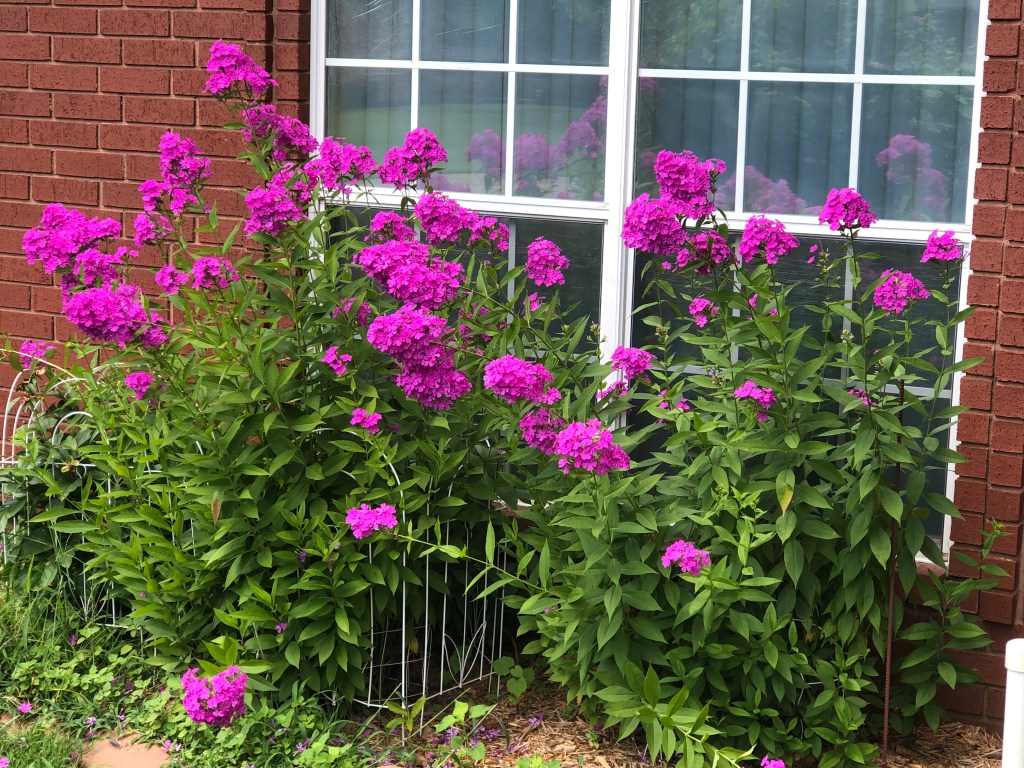
Once more the intermittent rains have caused another of the flowers in our front bed to flourish.  The phlox were one of the flowers planted by Melissa’s mom when her parents moved in with her twenty years ago.  I previously talked about taking the time to weed around these plants and cut back the dead stems that die over the winter.  If you do not remove them, they will persist as dead casings and detract from the overall beauty of the flowers.  Even though I have given the plants only limited attention, they have now exploded in a flurry of color over the last week.

When I looked online, I found that Phlox are one of the most diverse perennial plants in nature.  They fall into one of two groups, the creeping phlox (Phlox subulata) and the tall phlox (Phlox paniculate).  The name of the plant is derived from the Greek word “phlox” meaning “flame” and refers to the intense flower colors of the different varieties.  While both groups feature masses of small florets in a range of vibrant colors, the similarity ends there.  The creeping phlox is a semi-evergreen ground cover that bursts into bloom in the spring.  It is often seen in rock gardens or spilling over walls.  Tall phlox are conical flower spikes made up of hundreds of florets that bloom in the summertime.  I guess the intense heat conditions this year mean the flowers know it is already summer.

Tall Phlox is a native American wildflower that grows from New York to Iowa, and south to Georgia, Mississippi, and Arkansas that blooms from July to September.   The Phlox paniculate are also commonly known as garden phlox and rather than creeping along the ground, they grow upright.  Fertilized flowers typically produce one relatively large seed.  The seed is a longitudinally dehiscent capsule with three or more valves that sometimes separate explosively.  All phlox are fragrant, and the aroma is used to attract birds, bees, and butterflies to your garden.  Melissa’s mom loved hummingbirds and butterflies, and that was why the Phlox were planted.  They have done well.

Thoughts:  While melissa knew the plants in our front bed were phlox, the only examples I could find were creeping phlox.  The creepers hug along the surface and the flowers do not get more than 6-8 inches above the ground.  Our phlox were almost 3 feet high, so I knew this could not be what we had.  It took a diligent search to identify the second type, the tall phlox.  Quite often humans will “know” something even though the facts do not bear it out.  I knew the flowers were phlox even though none of the images I found were remotely similar.  What I found was it was close, but different.  In matters of importance, close enough rarely works in the long term.  We got close enough to herd immunity with the vaccine, and many decided it was no longer their responsibility to protect themselves or others.  That is why the cases are again on the rise across the US.  Follow the science.  Change is coming and it starts with you.
Vaccination

𝘑𝘶𝘯𝘦 28, 2021

Both my national and local news feeds led with the same story this morning.  The NY Times article by David Leonhardt stressed how heavily Republican areas of the US have a growing covid-19 problem.  This is a reverse of earlier this spring when the virus was not spreading any faster in areas with low vaccination rates than in those with high rates.  That seems to have convinced some that the pandemic was over.  Governments opened doors and relaxed rules.  Masks fell to the ground (literally) and social distancing was reserved for those who struggled with other immune deficiency problems.  Now it seems we have moved too quickly, especially for those who have not or refuse to get a vaccination.

My local feed opened with an article by Yacob Reyes declaring our governor is making a push to reverse the low vaccination trends.  Arkansas has one of the lowest rates of vaccination in the nation, and as I watch the nightly broadcast the rate has stayed right around 40% for the last several weeks.  Even the initial dose has stayed steady at around 10%.  Our Republican governor commented on the slowed rate saying, “People saw the cases of hospitalizations go down.  And so, the urgency of getting the vaccine slowed down.”

The Times article went on to report that the places with the lowest vaccination rates tend to be heavily Republican.  In an average US county that voted Republican, only 34% of people are fully vaccinated.  In an average country that voted Democrat, the share is 45%, and those receiving one shot is even higher.  While it is too early to know whether the trend will continue and cases will rise in communities with low vaccination rates, it does seem likely.  We have always bet on vaccination as the way the pandemic will end.  Now we cannot get people to get the shot.

𝗧𝗵𝗼𝘂𝗴𝗵𝘁𝘀:  The US is in a phase where we will make a political statement out of anything.  That seems true with masks and vaccination.  While it might be argued that wearing a mask is a way to keep others from getting the virus from you (hopefully unknowingly, but not always the case), getting the vaccination is essentially about you.  With waning numbers of vaccinations, many states have begun to offer incentives to entice people to get the shot.  My state has already spent $2 million on incentives that include scratch-off lottery tickets and $20 gift certificates good toward hunting and fishing licenses.  Some residents have been annoyed by the timing of the program, as only those who received a vaccine after May 26 qualify for the incentive.  It is not enough incentive to keep from dying.  Follow the science.  Change is coming and it starts with you.
Determined

June 26, 2021

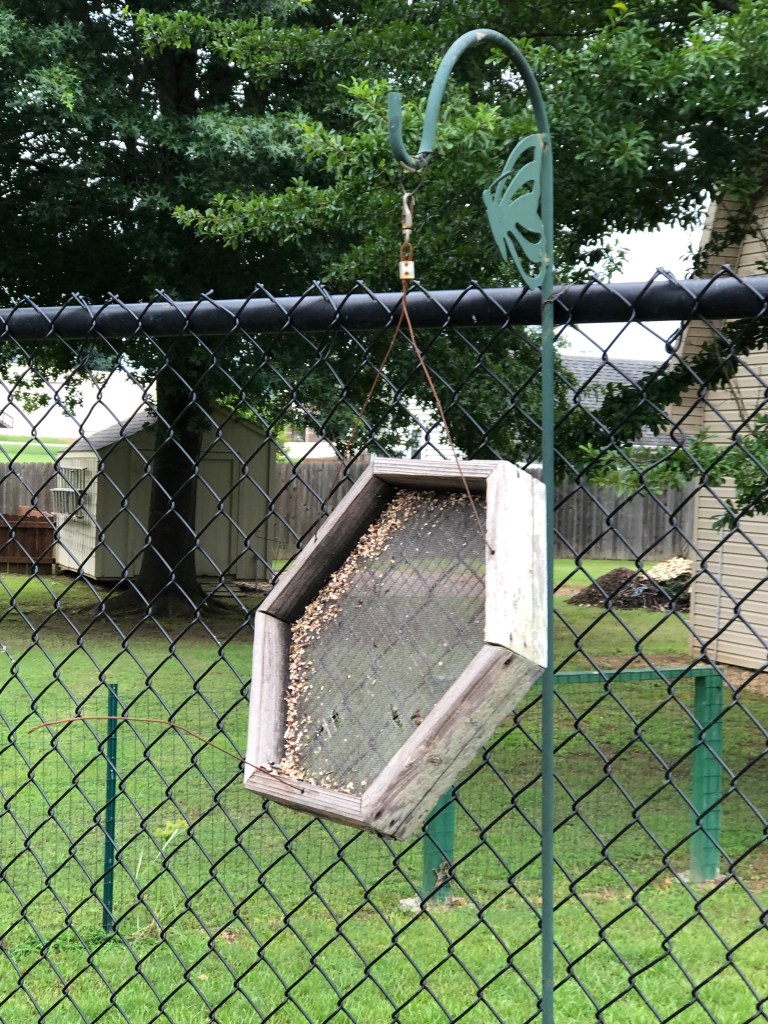
The squirrel(s) seem to have finally decided the squirrel feeder is there for them.  Many of the birds that frequent the feeder do not like the large corn seed that is offered and spend a lot of time tossing it out onto the pool deck.  That is especially true for the Blue Jays.  I have noticed that even when they do, the doves will hop down on the pool deck and eat the larger kernels of corn that have been discarded.  As determined as the squirrels are to raid the feeders, I have never seen them eating on the ground below the feeder.  When the corn disappears, I sometimes wonder who ate the kernels.   The alternative to the doves is other critters that come in at night and eat the corn.   I am determined to not think about what those critters might be.

When I Looked online, I found that squirrels are members of the family Sciuridae, a family that includes small or medium-size rodents.  The squirrel family includes tree squirrels, ground squirrels, chipmunks, marmots (including groundhogs), flying squirrels, and prairie dogs amongst other rodents.  Squirrels are indigenous to the Americas, Eurasia, and Africa.  Someone obviously liked to watch the determined antics of the little rascals, and they were introduced by humans from England to Australia.  They are now extinct in Australia except for a group of Northern Palm Squirrels (Funambulus pennantii) living in the Sydney Zoo where they are thriving.  There are three known species of squirrel in Arkansas, the Eastern Gray Squirrel (Sciurus carolinensis), the Eastern Fox Squirrel (Sciurus niger), and the Southern Flying Squirrel (Glaucomys volans).  Mine are Fox Squirrels.

When I looked at the squirrel feeder today, I saw a squirrel was determined to get the best seed first.  It had its head stuck inside the feeder and was munching on the peanuts that tend to rise to the top of the seed.  I made some comment about the little imp and Melissa immediately corrected me, saying not to disparage “her” squirrels.  She works from home and sits next to a window that gives her full view of the feeders and loves to watch the determined rodents as they move from feeder to feeder trying to get as much seed as they can.

Thoughts:  One of the cartoons I loved to watch was Rocky and Bullwinkle.  The lead characters were Rocky the flying squirrel and Bullwinkle J. Moose.  I started watching this show when I was a child, but like so many cartoons of the 1960’s, it was also written with an adult audience in mind.  I never understood many of the jokes in the show until I rewatched them in High School.  The plot rarely varied as Boris Badenov and Natasha Fatale from Pottsylvania (between Wrestlemania and Yoursovania), are determined to keep our heroes from saving the day.  This Cold War plot was lost some of its humor with the fall of the Berlin Wall on 9 November 1989.  Over the last years it is clear there are some determined to keep the conflict alive.  As we have witnessed in America over the last year, Democracy is something which we need to be determined to keep alive.  There are always those determined to keep power for themselves.  Do the work.  Change is coming and it starts with you.