Glockenspiel

December 04, 2025

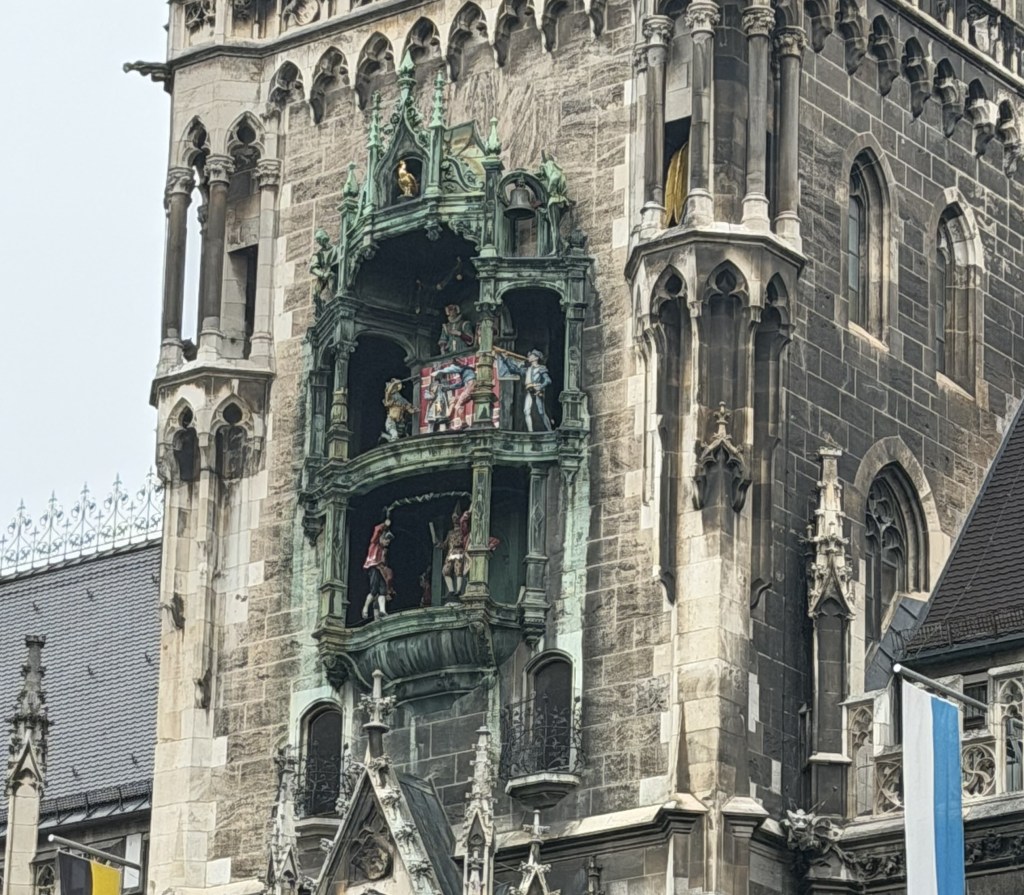
Our walking tour of Munich was timed so the first section of our walking tour would arrive in the city center in time for the sounding of the bells at noon.  On arrival our guide asked if we had seen the bells of the Ankeruhr clock in Vienna (what?? must have missed it).  This unusual Art Nouveau work was created by Franz von Matsch in the period between 1911 to 1914, and Franz Morawetz the court clockmaker had made the clockwork mechanism.  Although the city square was the site for the largest Christmas market in Munich, the bells had nothing to do with the markets.  The bells and figures were added to the town hall in 1908 and consist of 43 bells and 32 life-sized figures.  The mechanism is powered by solar power and is only semi-automatic, as it needs a player to turn the levers at the exact right times 364 days a year.  The glockenspiel at Munich is the largest in Germany and the fourth largest in Europe.

When I went online, I found glockenspiel is a percussion instrument that originally consisted of a set of graduated bells, and later a set of tuned steel bars (a metallophone).  These are struck with wood, ebonite, or even metal hammers.  The bars are arranged in two rows, the second corresponding to the black keys of the piano.  The name glockenspiel is German (“bell play”) and refers to the sound of small bells.  The very first instruments to carry this name did indeed consist of a set of small bells which were played either by a group of musicians or struck by means of a complex mechanism.  At the end of the 17th century steel bars began to replace the bells.  Initially they were only a substitute for real bells, but this arrangement of metal bars soon developed into a musical instrument of its own and retained the name “glockenspiel”.  Like the xylophone, the glockenspiel is a great favorite with children.  Carl Orff used it from the 1930’s for his Method.  The children’s instruments have a smaller range, are tuned diatonically, and have bars resting over a frame like a trough.  Lower-pitched glockenspiels have short resonators and are generally known as metallophones.

The glockenspiel of the Munich New Town Hall (Neues Rathaus) on the central square (Marienplatz) attract huge crowds every day for reenactments of two events from Munich’s city history.  The first is the wedding of Duke Wilhelm V and Renate of Lorraine, in February 1568 when a jousting match in honor of the bride and groom took place on the square.  The Bavarian knight (of course) triumphed over his opponent from Lorraine.  The lower floor shows the famous Coopers’ Dance (Schäfflertanz) is a guild dance of the coopers (Barrel makers) originally started in Munich.  Early documented cases of Schäfflertanz are dated by 1702 when the Münich magistrate approved the performance of the dance as a well-established tradition.  For a long time the date 1517 was prevalent in the literature originating the legend that the tradition started after the 1517 plague to revive the spirits of the people “to lure them out of their houses”.  There are no records of any plague in Münich at this period.  Still, the 500th anniversary was celebrated in 2017.  There is no clear indication of the origin of the seven-year cycle, but since the early 1800’s the custom has spread, and it is now a common tradition over the region of Old Bavaria.

THOUGHTS: We waited in the city square to see the glockenspiel along with a select group of 3000 of our closest friends.  We had been told the figures did not move until the third song.  First came the church bells (always the priority) followed by a introductory number.  The third number set the first group of jousters in motion and the fourth featured the dancing coopers.  The finally was the cock crowing three times.  Our guide had warned us that time had not been good on the crow mechanism and he was right.  It sounded more like the honking of a goose.  It felt good to join others in a century-old tradition.  Act for all.  Change is coming and it starts with you.
Holiday Travel

November 23, 2025

Melissa and I decided to go two days early for our trip up the Danube River and set our flights to arrive on Sunday prior to embarking Tuesday afternoon.  Our 11:30 am flight meant we began our trip taking the kids for boarding on Friday evening.  Loki has recently become frantic with visits to the Vet and again became frantic as we dropped him off at the kennel.  I watched as he got past the first door and by the second he was straining to get inside.  That made me feel better about leaving the kids for an extended visit.  Saturday began with a 1-1/2-hour drive to our connecting airport, a two hour wait for the plane to depart (customs was a breeze), and another 1-1/2 hours to arrive in O’Hare.  Since we had a 4-hour layover, we proceeded to the airlines lounge.  This was a first for us and I was pleased with the comfort, food, and drink offered for free (for members).  We sat as a steady stream of people came in and out, while another steady stream was turned away without the proper credentials.  We had planned on early travel as flights in the US have been disrupted by the government shutdown, but our greater concern was the potential crush of holiday travel. 

When I went online, I found US airlines are predicting another record Thanksgiving holiday travel season.  Airlines for America, a lobbying group representing the largest US carriers, predicted Thursday that airlines will carry more than 31 million people between Friday, November 21, and Monday, December 1.  The busiest days are expected to be the Sunday after Thanksgiving (30th), with about 3.4 million people flying, and the Monday after Thanksgiving (31st), with around 3.1 million passengers.  The airlines have expressed relief after the longest-ever government shutdown ended November 12th.  Shortages of air traffic controllers delayed and canceled flights, disrupting travel plans for some 6 million people.  The industry is pushing lawmakers to pass legislation to ensure that air traffic controllers are paid in the event of another shutdown.  The latest bill only funds the government through January, so industry members are hoping to avoid a repeat of the closure just before winter break and spring break seasons begin.

We arrived at our hotel in Budapest after 20 hours of holiday travel.  This included two drives (car 1-1/2 hours and taxi-1 hour), two layovers (6 hours), two short hops (O’Hare – 1-1/2 hours and Budapest – 1 hour), and an overseas flight to Munich (9 hours).  We were tired but thankful the trip had been relatively easy.  We had purchased economy plus (for legroom) on the overseas flight.  I got up several times to go to the restroom (actually to stretch my legs) but it was still uncomfortable.  We were both exhausted when we reached the hotel and after check-in decided to eat in the hotel bar.  We ordered a cheese and meat plate along with a variety of humus dips.  I was so tired during the meal I almost fell asleep.  By the time we went to our room it was 5:00 pm local time, but we decided it was late enough to go to bed. 

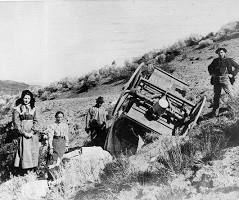
THOUGHTS: You have got to love holiday travel.  I went right to sleep but woke with horrific cramps in my left calf.  Apparently, I had not moved enough on the flight.  I looked at my watch, and it said 8:20.   Even though the blackout curtains were pulled it seemed like there should be morning light coming through from outside.  That was when Melissa told me I had only been asleep for an hour.  Since I was wide awake, I wondered how I was ever going to get through the night.  Then I realized in my new time zone it was still early.  I putzed around for a couple of hours and then went back to bed.  Even as I bemoaned the difficulty faced arriving at my trip destination, I realized how easy it was compared to earlier travelers.  It took four to six months to cover the 2,170-mile (3,490 km) to traverse the Oregon trail by wagon and 20,000 to 30,000 people died (1 in 10).  I guess cramps are not all that bad.  Act for all.  Change is coming and it starts with you.
Trails

October 10, 2025

We had decided to take our second trip out in our newly acquired RV just as the US government decided it was not in their (our?) best interest in keeping the government operational.  While many of the National Parks are at least partially open, we learned the Corp of Engineers location we planned to visit was shut down.  We have some neighbors who were also planning on the same trip and learned they had booked a private location about an hour away.  We already had two events scheduled for the week and thankfully these were both centrally located to the RV Park.  Melissa made reservations and we took off Tuesday morning.  The park described itself as “rustic”, and when our neighbors arrived, they called to make sure we were comfortable with what that meant.  Melissa and I both thought the unpaved location along the Mulberry River was going to be perfect.  There was even a trail/road that led back along the river that was perfect (and away from other campers) for walking the kids.  The trail provided a moderate walk that wound through the trees and wildflowers.

When I went online, I found a trail, also known as a path or track, is an unpaved lane or small paved road generally not intended for usage by motorized vehicles, and usually passing through a natural area.  However, it is sometimes applied to highways in North America.  In the UK and Ireland, a path or footpath is the preferred term for a pedestrian lane or hiking trail.  In the US historically, the term was used for a route into or through wild territory used by explorers and migrants (i.e., the Oregon Trail).  A “trace” is sometimes used as a synonym for trail (i.e., the Natchez Trace).  Some trails are restricted to only walkers, or cyclists, or horses (equestrians).  During the winter these same trails can be used for snowshoeing or cross-country skiing.  Others, like the bridleways in the UK, are shared and are jointly used by walkers, cyclists, and equestrians.  Although most trails ban motorized use, there are unpaved trails used by dirt bikes, quad bikes, and other off-road ehicles.  This is especially true for extreme sports and rally races.  In places like the mountainous Europe (Alps), trails are also used by alpine agrarian communities for moving cattle and other livestock.

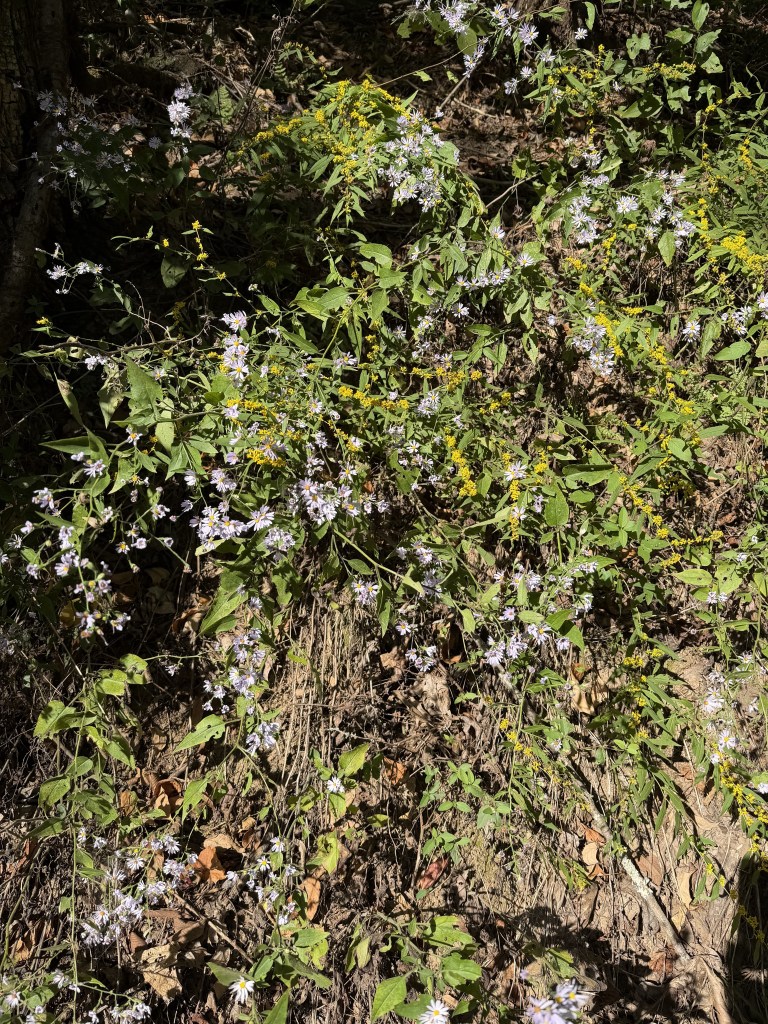
Over the last several days I have been walking the trail along the river marveling at the amazing views.  The track passes above the river and in places rises on the bluffs that overlook the water.  Being an avid fisherperson, this has given me pause to dream of climbing down the slope and fishing the fast water and pools that dot the river’s course.  Several days I did exactly that, although I did so by following the rocks at th e water’s edge.  My other pleasure has been seeing the patches of Tatarian Aster (Aster tararicus) and goldenrod (genus, Solidago) that line the trail.  This is the freedom and escape we had hoped to find when we decided to start RVing.

THOUGHTS: Following most modern-day trails is a far cry from the trails that cut through the thick forests and lush grassland that filled North America when the European explorers and settlers first arrived.  These trails possessed unseen dangers (animals and nature) along with the impressive beauty.  Still, I can get a glimpse of the wonder of days gone by.  We need to work hard, an together, to preserve those areas that still exist for future generations to enjoy.  Act for all.  Change is coming and it starts with you.