Cigarette Snail

June 10, 2026

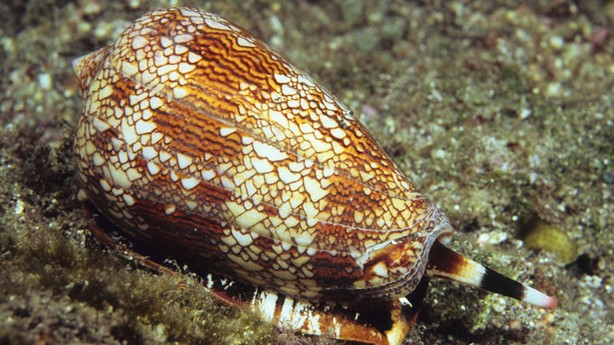
While perusing my MSN browser I came across a post from the journal Sciencing addressing one of the worst ways to die.  During the summer people are drawn to the beach for the nice sea breeze and warm sand.  Rather than relaxing and trying to get a suntan (harder now with my SPF 50 sunscreen) I like to spend time walking along the shore looking for shells.  Melissa and her family did the same and we have several snail-shaped glass vases filled with some of the shells rescued and brought home as souvenirs.  The best time of day to collect is after high tide as the water recedes and the shells are deposited on the beach.  An even better time is after a storm has passed and more shells and creatures have been deposited along the shore.  The article cautioned to avoid picking up one particularly pretty, cone shaped shell.  The occupant resting inside this beautiful relic is equipped with enough venom to kill 700 people.  It is said that if you were stung by this snail, you would perish before you had time to smoke one last cigarette.

When I went online, I found the geography cone (Conus geographus), also called the cigarette snail, is a species of predatory cone snail that lives in reefs of the tropical Indo-Pacific and hunts small fish.  While all cone snails hunt and kill prey using venom, the venom of this species is potent enough to kill humans.  Individuals grow to about 4 to 6 inches (10 to 15 cm) in length, with the size of an adult shell between 1.7 to 6.5 inches (43 and 166 mm).  The color of the shell is pink or violaceous white, but occasionally reddish and has a mottled appearance with two irregular chestnut or chocolate bands.  This intricate brown-and-white pattern is highly prized by shell collectors.  Geography cones are common and occur in the Red Sea, off the coast in the Indian Ocean, and are indigenous to the reefs of the Indo-Pacific (except Hawaii), and off northern Australia.  The snail’s distribution is largely explained by the temperature of its habitat and alterations due to climate change are predicted to impact its distribution in the following decades.

There are over 600 species of cone snails that are not equally dangerous to humans.  Only two species, the geographic cone and the textile cone (Conus textile), have reportedly resulted in human death.  There is also rich diversity in the venom that these snails produce.  Their venom is generally characterized by peptides known as conotoxins. Each snail produces over 100 of these conotoxins, and only 5% of them are estimated to overlap among species.  Only a few of these toxins have been characterized fully, which makes development of an antidote a challenge. The complexity of the conotoxins makes it difficult to understand exactly how death occurs in humans.  While scary, there have not been a lot of human fatalities recorded.  A review from 2016 showed that there have been a total of 36 recorded cone snail deaths and researchers are unsure whether these deaths have been a result of cardiovascular damage or damage to the respiratory system.  Humans are fortunate not to be a target species for the cigarette snail, leading to relatively rare toxic encounters.

THOUGHTS: While a sting by a cigarette snail may be one of the worst ways to die, their toxins may lead to medical innovation that could save lives.  Researchers have identified a drug based on cone snail venom that was approved in 2004 to treat chronic pain.  Another potential benefit might be derived from the cone snail insulin, which takes effect more quickly than human insulin.  There are currently about 11 to 12 FDA-approved medications derived directly from animal toxins, with 100’s more in clinical trials and research, adapted to treat everything from high blood pressure to chronic pain and diabetes.  If you do not provoke (pick up) the pretty shell, the snail cannot kill you.  Act for all.  Change will come and it starts with you.
Cherries

July 11, 2025

Our gardener friend is always on the lookout for fresh fruit and vegetables sourced from local farms and orchards.  She often buys in bulk and then splits the cost (and produce) with Melissa.  Several weeks ago, we got a baker’s dozen ears of corn (Zea mays), but we missed out on a bushel of fresh peaches (Prunus persica).  She texted Melissa several days ago and said she had found another farm selling peaches nearby and she was going to get them.  These were the free-stone variety that I really like, and I began to think of ways to use a half bushel of sweet Georgia peaches.  After she bought them, she called Melissa and said she also had 10 pounds (4.5 kg) of cherries.  When Melissa told me she was going to pick up the fruit, the only thought on my mind was, “What are we going to do with 10 pounds of cherries?”

When I went online, I found a cherry is the fruit of many plants of the genus Prunus and is a fleshy stone fruit (drupe).  Commercial cherries are obtained from cultivars of several species, such as the sweet Prunus avium and the sour Prunus cerasus.  The English word cherry derives from Old Northern French or Norman “cherise” from the Latin “cerasum”.  These are a reference to the ancient Greek region of Kerasous near Giresun, Turkey, where cherries were first thought to be exported to Europe.  The name ‘cherry’ also refers to the cherry tree and its wood and is sometimes applied to almonds and visually similar flowering trees in the genus Prunus, as in “ornamental cherry” (Prunus serrulate) or “cherry blossom”.  The word “cherry” is also used for some species that bear fruits with similar size and shape even though they are not in the same Prunus genus.  These include species like the “Jamaican cherry” (Muntingia calabura) and the “Spanish cherry” (Mimusops elengi).  Cherries, along with many other fruiting trees and plants, probably first arrived in North America around 1606 in the New France colony of Port Royal, which is modern-day Annapolis Royal, Nova Scotia.  

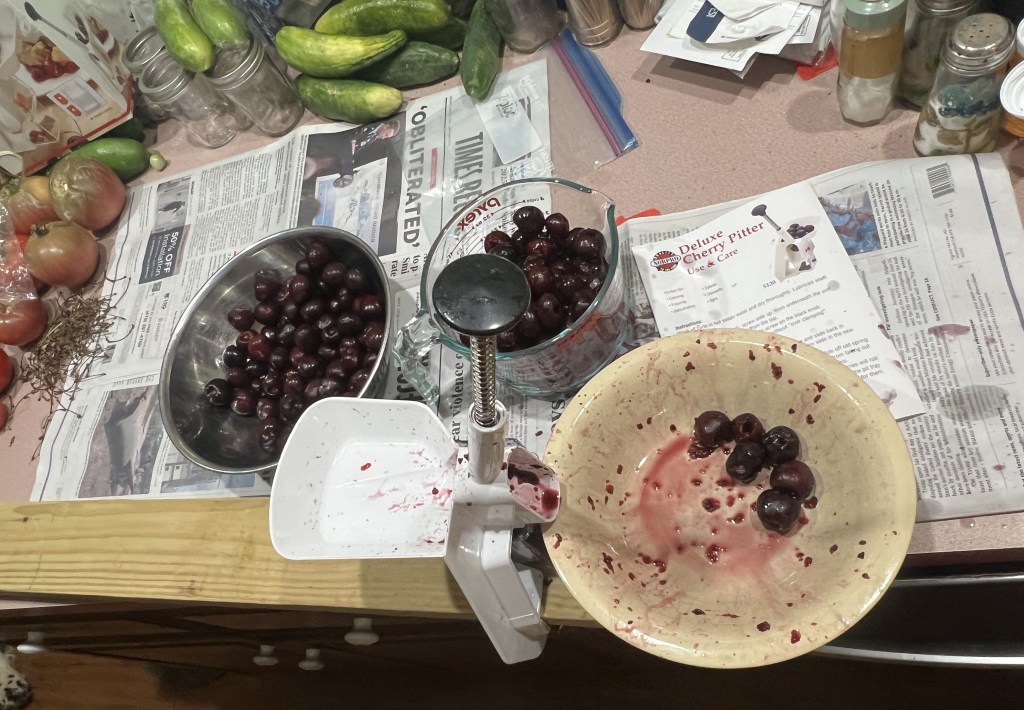
While Melissa was picking up the cherries, I googled to find out what to do with 10 pounds (4.5 kg) of cherries.  I was surprised to find several sites attempting to address the exact issue.  It seems unless you buy a controlled amount in the grocery store, they come in bulk.  The obvious choice (other than eating them fresh) was to turn them into jellies, jams, or preserves.  Melissa occasionally eats jam, but I rarely do, so 10 pounds of cherry jam seemed a bit much.  Then there was cherry cheesecake and other cherry desserts.  Again, we rarely eat dessert, let alone 10 pounds of such.  That is when I came across a recipe for brandied cherries (brandy, water, sugar).  This was said to be like maraschino cherries but with a wonderful flavor.  The suggestion was to replace the maraschino in your favorite cocktail, but they could be used in a variety of ways.  When the cherries arrived, it turned out to only be five pounds (2.25 kg), or 5 each.  Our friend also lent us her cherry pitter.  This quickly popped out the seed rather than cutting the pits out of a bulk of cherries with a knife.  Five pounds (2.25 kg) of cherries is still a lot.

THOUGHTS: As we were pitting the cherries Melissa came up with several ways to use them.  We made four cups into two pints brandied cherries, one of which was destined to become cheesecake.  Another four cups were reserved to become cherry crisp.  The last batch we left unpitted for Melissa to snack on.  The first cherry pitter dates to the 1880’s as home cooks sought to simplify the task of cutting the stones out of the cherries for canning, baking, or other food uses.  A straw or chopstick can also be used to push out the pit.  The pitter I used reminded me of the cotton gin invented by Eli Whitney in 1793.  Both were designed to speed up the process and reduce the tedious task of seed extraction.  Mechanical ingenuity saves time.  These savings could/should be put back into building your family or community.  Act for all.  Change is coming and it starts with you.

Parthenogenesis

February 21, 2025

undefined

Inside the front section of Monday’s newspaper was a USA Today article on the birth of a baby swell shark (Cephaloscyllium ventriosum).  The swell shark pup hatched on January 3rd after an egg was spotted by the Shreveport aquarium’s animal husbandry team eight months ago.  The birth could be from rare form of asexual reproduction (parthenogenesis), or from delayed fertilization.  The two female sharks present in the tank had not been in contact with a male for more than three years.  A DNA analysis once the pup is big enough for a blood sample to be taken will determine how the birth occurred, but it will take months before the test can be performed.  “This situation is incredible and shows the resilience of this species,” said Greg Barrick, the curator of live animals at Shreveport aquarium. “We are very excited in the coming months to confirm whether this was indeed a case of parthenogenesis or if it was delayed fertilization.”

When I looked online, I found parthenogenesis (Greek parthénos, “virgin” and “génesis, “creation”) is a natural form of asexual reproduction in which the embryo develops directly from an egg without need for fertilization.  In animals, parthenogenesis means the development of an embryo from an unfertilized egg cell.  Parthenogenesis occurs naturally in some plants, algae, invertebrate animal species, and a few vertebrates (some fish, amphibians, and reptiles) and has been induced artificially in animal species that naturally reproduce through sex (fish, amphibians, and mice).  Normal egg cells form in the process of meiosis (division) and have half as many chromosomes as their mother’s body cells (haploid).  Such individuals are usually non-viable, and parthenogenetic offspring usually have a complete number of chromosomes (diploid).  In parthenogenesis, the offspring having all of the mother’s genetic material are called full clones and those having only half are called half clones.

The baby shark has been named Yoko, after the Native American Chumash people’s word for shark (onyoko) and is said to be thriving, although sharks born by such reproduction face significant challenges.  The aquarium staff said she will leave an “unforgettable legacy” to the study of shark reproduction and conservation.  If Yoko was born via parthenogenesis, she would join a small number of invertebrate animals capable of “virgin births”.  Laying eggs without mating is much rarer in vertebrates, but it has been seen in zebra sharks (Stegostoma tigrinum), sawfish (Pristis zijsron) and a handful of reptiles.  This type of birth was first documented in Komodo dragons (Varanus komodoensis) in 2006 in two separate British zoos.  Charlotte, a stingray (Hypanus americanus) in an aquarium in North Carolina, was found to be pregnant in 2024 despite not having been in contact with a male for eight years.  While scientists assume vertebrates turn to parthenogenesis when no mates are present, it is unknown why they occur and what triggers birth. 

THOUGHTS: Whether Yoko was born from delayed reproduction or parthenogenesis, she is an extraordinary birth. The aquarium staff said she will leave an “unforgettable legacy” to the study of shark reproduction and conservation.   While the behavior of domesticated animals has long been studied (ethology) attention has only focused on animals in the wild during the last century.  What we have found is they are far more complex and diversified than we previously believed.  The study has even forced us to reconsider what “makes us human”.  It seems we are not so different after all.  Act for all.  Change is coming and it starts with you.