
October 11, 2024
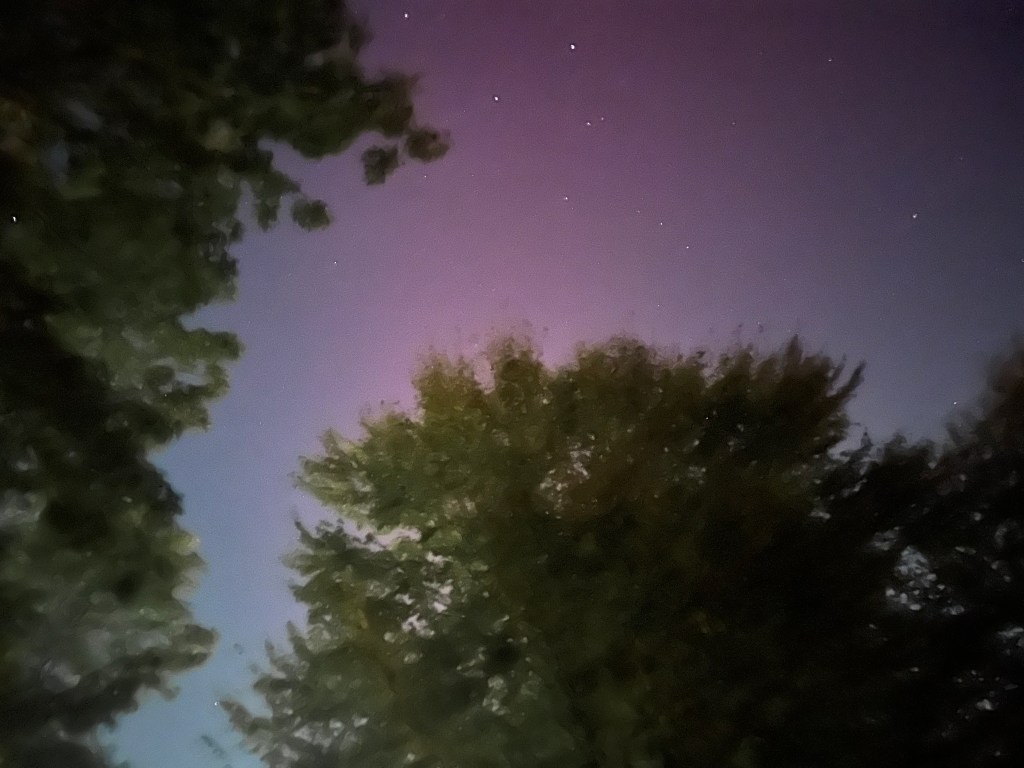
Both the national and local news were abuzz yesterday with predictions of the amazing light displays that were going to appear in the northern sky last night. This dazzling display of color was the result of a powerful solar storm that slammed into Earth. This celestial phenomenon is more often a tourist attraction for people traveling to Alaska, Iceland, and regions within the Arctic Circle, but last night’s storm triggered lights in the night sky much further south. This is the second time a severe solar storm hit the Earth this year, with the first being in May. My sister lives in Maine and she started the buzz for our family, posting photos on our family feed of the crimson display seen from her back yard. It was also suggested by the National Oceanic and Atmospheric Administration that the lights were going to be visible as far south as Alabama and northern California. Reports came in from as far south as Texas and Arizona, while the southern lights were seen in parts of Australia. As we watched the 10 pm news, there were postings of the aurora from areas of northwest Arkansas.
When I looked online, I found an aurora, commonly known as the northern lights (aurora borealis) or southern lights (aurora australis), is a natural light display in Earth’s sky that is predominantly seen in high-latitude regions around the Arctic and Antarctic. Auroras display dynamic patterns of brilliant lights that appear as curtains, rays, spirals, or dynamic flickers covering the entire sky. An aurora is the result of disturbances in the Earth’s magnetosphere caused by the solar wind. Major disturbances result from enhancements in the speed of the solar wind from coronal holes and from coronal mass ejections that alter the trajectories of charged particles in the magnetospheric plasma. The particles, mainly electrons and protons, then precipitate into the Earth’s upper atmosphere (thermosphere or exosphere) and the ionization and excitation of atmospheric components emit light of varying colors and complexity. The form of the aurora is dependent on the amount of acceleration the solar winds impart to the precipitating particles. Most of the planets in Sol’s Solar System, some moons, brown dwarfs, and even comets can display an aurora.
Melissa and I had taken the bait in May and gone outside to look for the aurora on our back deck. The TV news had been posting photos taken throughout our state and we wondered if we could see anything. Our deck is mostly surrounded by trees, but there is a patch of northern sky that is visible. At the time we had not seen anything. This time Melissa’s friends began sending photos and we were again lured into the dark. Melissa used her flashlight rather than the porch lights to keep the area as dark as possible. When situated she turned off the flashlight and we scanned the horizon. Nothing. The night was pitch black with only the faint lights of the city to the north visible. Then I remembered the lights could often be seen through filters such as a phone camera. Again, I scanned and horizon. Nothing. However, as I looked higher in the sky, I began to see the pink glow above the blue caused by the lights of the city to the north. We saw the aurora.
THOUGHTS: Witnessing the aurora goes along with the total Eclipse of the sun as memorable celestial events for Melissa and me during 2024. The contrast between the blackness seen by the naked eye and the colors seen by the camera were amazing. While ancients watched the skies and considered such events as omens or predictors of the future, but this aurora would have gone unseen in the past. The problem with celestial predictions, is they portend “something”, more so than “a thing”. History predicts the coming elections in the US will bring some sort of change. While that may be an easy prediction for modern pollsters, the last two elections have proven the “what” is far less known. Change happens, but humans can play an active role in what that change is going to be. Work for positive change. Act for all. Change is coming and it starts with you.
 A travelers odyssey