Wildflower Bed 2026

April 18, 2026

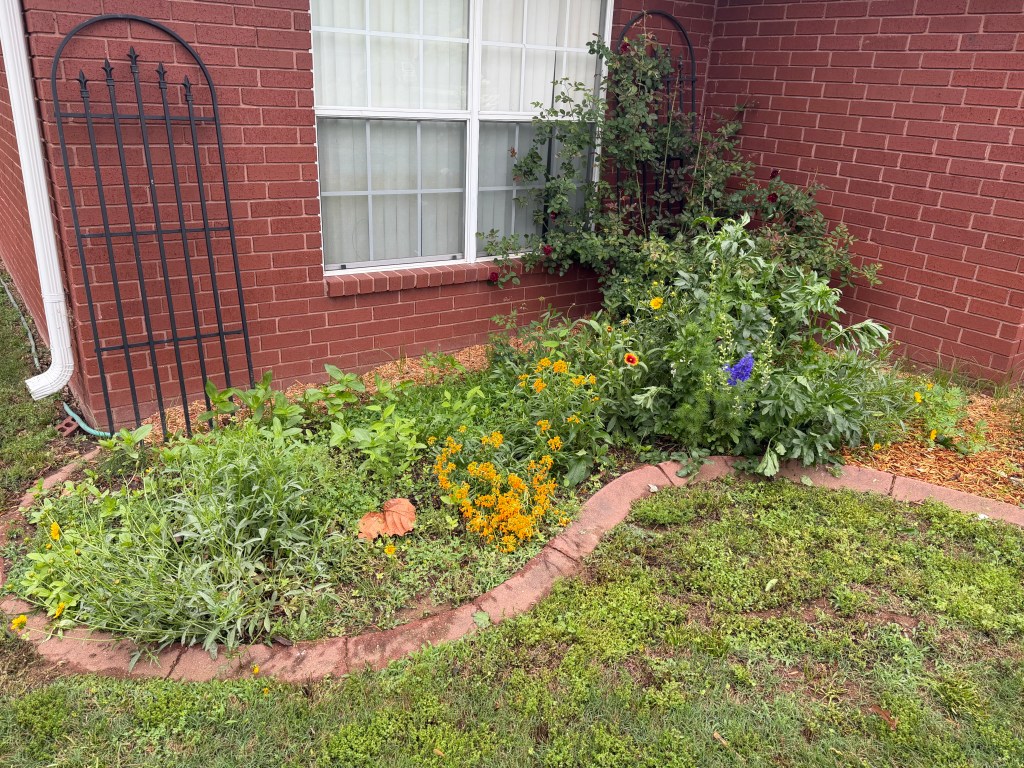
Last July I mentioned Melissa and I had established a wildflower bed in one of the flower beds in the front of the house.  This had been a vision of mine since we moved to Arkansas 8 years ago.  I had planted native grasses and flowers on sections of the 60 acres (24 ha) I managed as director of a conference center in Kansas.  This was done to rebuild a small part of the rapidly disappearing tall grass prairie as well as to create an oasis for the pollinator’s dependent on this ecosystem.  While we do not have tall grass prairie in Arkansas, last year we planted an area appropriate mix of perennial wildflowers.  The bed had done well after I removed the Bermuda grass (Cynodon dactylon) that had taken over the bed (several times) and some initial hesitation.  The flowers filled the entire area (72 feet2/7 m2) and bloomed well into Fall, providing nectar for the butterflies (lepidopteran superfamily Papilionoidea) and bees (monophyletic clade Anthophila within the superfamily Apoidea) that flocked to the garden.  Late in the Fall I took care to brush out the seeds from the old blooms and scatter them back into the soil before I carefully removed the dead plants.  Although I did a quick weed (grass) and cleaned out the bed in early April, I did not plant more seeds as I wanted to see if the bed would continue to reproduce itself.  I have been anxious to see the wildflower bed in 2026.  

When I went online, I found US Fish and Wildlife Service encourages homeowners to plant wildflower beds as a way of supporting pollinators, reducing maintenance, and conserving water.  Helping pollinators like bees, butterflies, and birds involves creating safe habitats by planting native, nectar-rich flowers, eliminating pesticide use, providing water sources, and leaving “messy” areas for nesting.  This includes planting diverse, blooming species to provide continuous forage to support local ecosystems.  The key is to choose a variety of native plants that bloom at different times of the year and are already adapted to your local climate and provide the best nectar and pollen. Planting milkweed (genus, Asclepias) is another way to aid monarch butterfly caterpillars (Danaus plexippus).  You should also reduce or eliminate insecticides and herbicides which can kill or harm pollinators. Other ideas beyond your wildflower bed are to leave fallen leaves and dead wood for nesting sites and delay garden cleanup in the fall and spring to protect overwintering insects.  Finally, create a “pollinator bath” with a shallow dish of water and stones help landing for a drink without drowning.

After clearing out the grass trying to reestablish itself, several plants began to emerge.  I did not have luck along the edge of the house last year (except for grass so I put a layer of mulch along the one foot (0.3 m) next to the house.  There were still quite a few bare spots, but these have begun to fill in this past week.  Most of the ground is now covered and several of the plants have begun to bloom and the pollinators are coming back.  I have also transformed our bird bath into a pollinator bath by keeping water in it along with a brick for the bees to cling to.  It appears my wildflower bed 2026 is well on its way.       

THOUGHTS: The insects that visit my wildflower bed in 2026 are fulfilling a critical ecological function.  Without pollinators, humans and all of Earth’s terrestrial ecosystems would not survive.  Over 80% of the world’s flowering plants require a pollinator to reproduce as they have separate male and female cones or flowers (monoecious).  While it is possible to hand pollinate between the male and female flowers in a small garden, this becomes untenantable for commercial growers.  Pollinator populations are declining rapidly, with over 20% of North American native species at elevated risk of extinction and US managed honeybee colonies experiencing average annual losses of 30% to 40%. Key drivers include habitat loss, pesticide use, and climate change.  Providing pollinator habits is everyone’s responsibility.  Act for all.  Change is coming and it starts with you.

Hornet

September 22, 2025

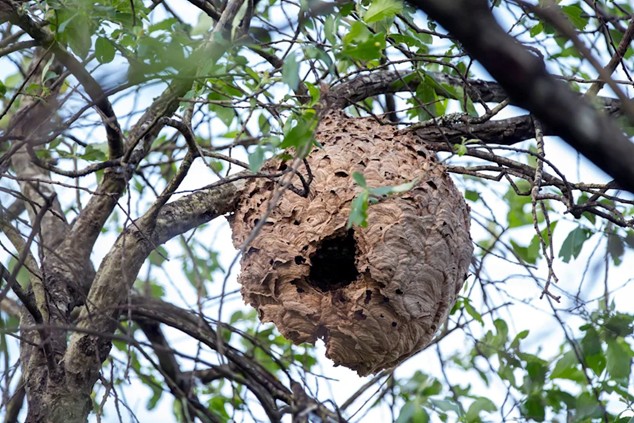
I found an article on yahoo!news about an innovative approach toward eradicating an invasive species in England.  British scientists are attaching miniature tracking devices to the invasive insects which allow teams to locate and destroy their hidden nests within an hour instead of several days.  Time is critical as the nest can reproduce within seven days.  Inspectors capture individuals near bait stations, secure hair-thin transmitters around their bodies, and follow them straight to their colonies.  According to The Guardian, Britain’s Animal and Plant Health Agency found 64 nests through August 2025, setting a seasonal record.  Public participation drives much of the success for the eradication program.  Citizens use the Asian Hornet Watch app to submit thousands of sightings and enabling rapid response teams to investigate reports near ports where the species often arrive hidden in shipments of wine, produce, or building materials.  The invasion started when a single Asian Hornet female likely arrived in France aboard a pottery shipment from China back in 2004.

When I went online, I found the Asian hornet (Vespa velutina), also known as the yellow-legged hornet, Asian predatory wasp, or murder hornet, is a species indigenous to Southeast Asia.  This is significantly smaller than the European hornet, with queens 1.2 inches (30 mm), males about 0.94 inches (24 mm), and workers about 0.79 inches (20 mm) in length.  The species has distinctive yellow legs (tarsi), a velvety brown or black mid-section (thorax), and a brown abdomen.  Each abdominal segment has a narrow posterior yellow border, except for an orange fourth segment.  The hornet has a black head and a yellow face.  The coloration of the species can vary regionally which causes difficulty in classification and resulted in several subspecies to have been identified and later rejected.  The most recent taxonomic revision of the genus treats all subspecific names in the genus Vespa as synonyms, effectively relegating them to no more than informal names for regional color forms.  The Asian hornet is an invasive species of concern in most of Europe.

The Guardian reported the Asian hornet feasts on honeybees (genus, Apis) and other pollinators that enable the production of approximately one-third of the crop humans consume.  A single colony of hornets consumes about 24 pounds (10.9 kg) of insects during one season, putting pressure on the bee populations already struggling with habitat loss.  Testing shows Britain has prevented permanent colonies from establishing, with only three of 24 nests last year originating from females that survived winter in England.  While government teams fight Asian hornets with high-tech solutions, homeowners can help in their own yards with intelligent landscaping choices.  Replacing portions of traditional lawns with native plants can create a refuge for local pollinators.  Native plants also demand less water and maintenance than non-native species, which cuts both utility bills and maintenance.  These plants support local bee populations naturally by providing the nectar and pollen sources these insects evolved to use.

THOUGHTS: The Asian hornet was declared eradicated by the US Department of Agriculture in December of 2024.  Eradicated means there has not been a sighting in three years.  Even without the threat of this hornet, we have taken two steps to assist pollinators in our yard.  The wildflower bed in the front draws both bees and butterflies while also providing cover from any predators.  The side yard has a bird bath that I fill every time I water the vegetables.  This has a half brick in the middle to allow bees to cling to the brick and take a drink.  It took little effort for either of these features and the result has provided food and water for countless pollinators.  Act for all.  Change is coming and it starts with you.

Leafcutter

June 29, 2025

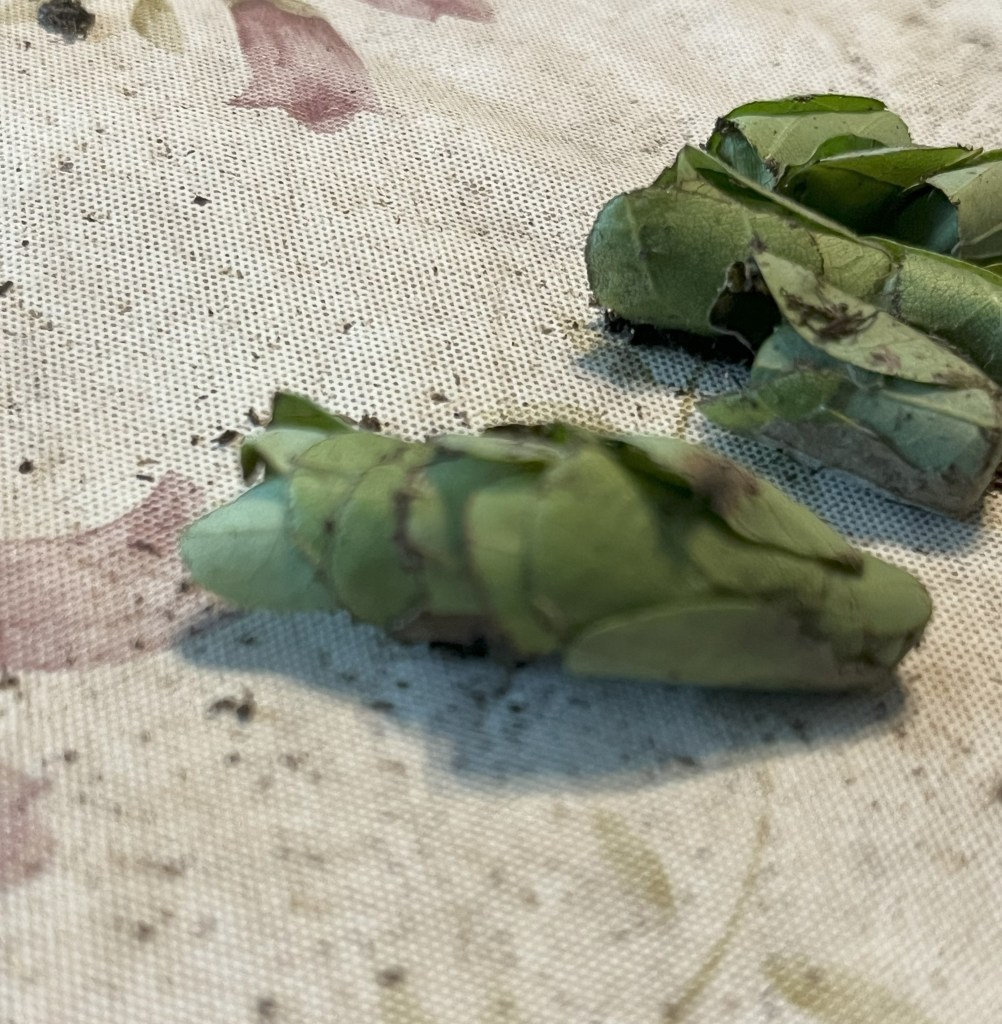
Melissa went shopping with me yesterday to get out of the house.  I needed to get some roasted peanut chips for the birds and Melissa wanted to look at the succulents.  She was surprised by the large number of inexpensive arraignments, and by their state of disrepair.  They were all soaked in water (causes root rot) and the leaves were starting to fall off.  Melissa bought a large arraignment to divide into separate plants and try and save them.  As we were checking out, I mentioned to the attendant that the plants were getting too much water.  She agreed and said she had also bought several to save them from dying.  When we got home Melissa began dividing the arraignment and repotting them into a cactus medium.  The plants were in potting soil (retains water) rather than cactus medium and the bright containers were made of plastic (retains heat).  Each of the plants were root-bound from their previous pots and the soil had not been broken up.  As Melissa dug through the potting soil she came across what looked like a leaf tube buried deep in the soil.  When she googled the odd structure, she found it was the egg nest of a leafcutter.

When I went online, I found leafcutter bees (Megachilidae), are part of a widespread (cosmopolitan) family of mostly solitary bees.  Characteristic traits of this family are the restriction of their pollen-carrying structure (scopa) to the ventral surface of the abdomen, rather than on the hind legs as in other bee families, and their typically elongated flap-like structure immediately in front of the mouth (labrum).  The scientific name Megachilidae refers to the genus Megachile, translating roughly as large lipped (Ancient Greek mégas – “big” and kheîlos – “lip”).  Their “large lips” and strong jaws are well-suited for collection of building materials for the nest.  These bees get their names from the materials they use to build their nest cells.  Leafcutter bees use leaves while mason bees use soil.  A few species collect plant or animal hairs and fibers (carder bees) while others use plant resins in nest construction (resin bees).  All species feed on nectar and pollen, but a few are kleptoparasites, which feed on the pollen collected by other megachilid bees.  The parasitic species do not possess scopae.  North America has an estimated 630 different megachilid species.  Most are native but a few are introduced, accidentally and intentionally.  Globally the number of species identified exceeds 4,000 and represents 15% to 20% of named species of bees.

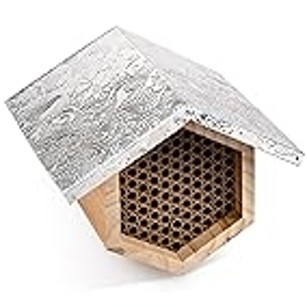
The Nonparasitic Megachilidae divide their nests into cells with each cell receiving a supply of food and an egg.  The larva hatches from the egg and consumes the food supply.  After molting a few times, it spins a cocoon and pupates, then emerges from the nest as an adult.  Males die shortly after mating, but females survive for another few weeks, during which they build new nests.  Nest cavities are often linear, like the one found by Melissa, but not always.  Above ground megachilid bees are more commonly cultivated than ground nesting bees.  They accept nesting materials made from hollow stems, tubes, and blocks with preformed holes (“nest blocks”), and several megachilids have become important species for agricultural or horticultural pollination.  In North America these cultivated bees include the introduced alfalfa leafcutter bees (Megachile rotundata), used extensively in alfalfa pollination, and the orchard mason bee or blue orchard bee (Osmia lignaria), used in orchard pollination.  Other species are also in commercial use in North America, Europe and Asia.

THOUGHTS: Arkansas is home to at least 40 species of bees and the genus Megachile, has an estimated 15 to 20 species, including many leafcutter species.  Finding the nest tube of a leafcutter bee shows how easy it is to transport a species to another area.  While the leafcutter is beneficial, not all invaders are.  People criticize states like California which have tight controls on agricultural products.  Perhaps we should all be vigilant.  Act for all.  Change is coming and it starts with you.