
October 30, 2024
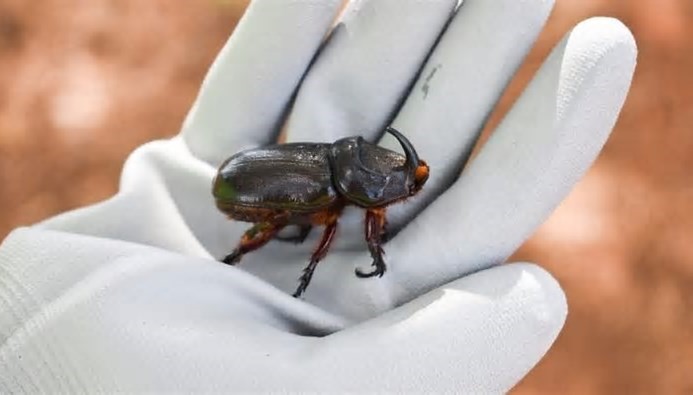
Hidden in the back of the front section in yesterday’s newspaper was a USA Today article about Hawaii’s attempts to stop an invasive insect. According to the Hawaii Invasive Species Council, the invader “jeopardizes the economy, the entire ecosystem, agriculture and food security.” This species feeds by biting and boring into emerging palm fronds, creating holes in the top of the tree. While they prefer to feed on coconut, royal, date, and fan palms, they will also feed on hala, taro, banana, pineapple, and sugarcane if the palm trees are unavailable. The insects are nocturnal and can fly up to two miles if they are looking for food. The insect attacks a palm at the base of the fronds (leaves) where they are attached to the trunk, bore through the base of the fronds into the center of the crown (the palm heart), and feed on the undeveloped white fronds. Attacks cause a reduction in leaf area on the damaged fronds and results in a reduction in the number of nuts produced. Newly planted palms can have their growth point destroyed resulting in the palms death and even mature palms may die after extremely heavy attacks by the coconut rhinoceros beetle.
When I looked online, I found the coconut rhinoceros beetle (Oryctes rhinoceros), also known as Asiatic rhinoceros beetle, is a large species of beetle belonging to the subfamily Dynastinae. This dynastid beetle has a length of 1.4 to 2 inches (3.5 to 5 cm) and is a dark brown to black color. The head has a horn which is more prominently developed in males and in larger specimens. The first segment of the thorax (pronotum) has a large central depression with two humps at the hind margin and the tibia of the foreleg has three large teeth. Male beetles can be reliably distinguished from females as the tip of the abdomen is rounded, shiny, and hairless. In females the tip is more pointed and densely covered with hair. The larvae are C-shaped white grubs typical of other scarab beetles. The beetle breeds in decaying palm trunks or other organic matter (sawdust or compost heaps). The native distribution of this beetle covers most parts of tropical Asia, but human activity accidentally introduced the beetle to a large number of tropical islands throughout the Pacific. The beetle has most recently invaded Guam, Hawaii, the Solomon Islands, and Vanuatu.
A virus disease of coconut rhinoceros beetle (Oryctes rhinoceros nudivirus) has turned out to be the most effective natural control agent. This virus was discovered by Alois Huger in Malaysia in 1963 and was later found to occur naturally in other countries within the native range of the beetle. The introduced beetle populations in the Pacific and in the Maldives were found to be virus-free. The virus was introduced into the virus-free populations and caused a significant decline in the beetle population. The virus mainly effects the adult population and spreads easily, reducing their life span and the fertility of females. During replanting of palms more breeding sites become available and transmission of the virus is often interrupted, and outbreaks still occur. There is also evidence of resistance to the virus in some coconut rhinoceros beetle populations. A fungus (Metarhizium majus) is also effective in controlling the beetles in breeding sites, but it does not spread well by itself. The fungus does have the advantage that it survives for some time outside its host (as conidia).
THOUGHTS: Use of a virus to control the coconut rhinoceros beetle population is common, and natural biological controls include predators, parasitoids, pathogens, and competitors. Biological control can have side-effects on biodiversity through attacks on non-target species by any of these mechanisms, especially when a new species is introduced without an understanding of the possible consequences. Viruses being transmitted to other species (and humans) may cause greater harm than the original problem. Alexander Pope’s proverbial phrase in 1711 was, “To err is human”. Even without forgiveness, this is more than an adage. Act for all. Change is coming and it starts with you.
 A travelers odyssey