Seed Bank

November 21, 2025

Today’s NYT The Morning scroll included a link to photos and an article from Times photographer Ruth Fremson about an island used to gather seeds to replace parts of the deforested Amazon forest.  The Brazilian government built a hydroelectric dam fifty years ago and flooded 100s of 1,000s of acres of rainforest along the Tocantins River and transforming a mountainous peak into an island.  That island now supplies seeds to replenish deforested areas and preserve native species throughout the Amazon.  Workers arrive by boat and scale towering trees to reach the fruit that contains the seeds which are then donated to schools, government agencies, and farmers.  The owner of the dam, AXIA Energia, said it compensated the 32,000 people displaced by the project and uses the seed bank to replenish areas throughout the Amazon.  Workers gathered almost nine million seeds last year and are on pace to far exceed that amount this year.  Their seed bank stores about 30 million seeds in one of three chambers (cold, humid, and dry).

When I went online, I found the worlds’ largest seed bank is the Svalbard Global Seed Vault, a secure backup facility for the world’s crop diversity on the Norwegian island of Spitsbergen in the remote Arctic Svalbard archipelago.  The vault provides long-term storage for duplicates of seeds from around the world, conserved in gene banks.  This provides security of the world’s food supply against the loss of seeds in gene banks due to mismanagement, accident, equipment failures, funding cuts, war, sabotage, disease, and natural disasters.  The vault is managed under terms spelled out in a tripartite agreement among the Norwegian government, the Crop Trust, and the Nordic Genetic Resource Center (NordGen).  The Norwegian government entirely funded the Seed Vault’s KR$45 million (US$8.8 million in 2008) construction cost.  Norway and the Crop Trust pay for operational costs and storing seeds in the vault is free to depositors.  As of June 2025, the seed bank conserves 1,355,591 accessions, representing more than 13,000 years of agricultural history.

Another Amazon Basin living seed bank is located at Camino Verde in the richly biodiverse region of Madre de Dios in Peru.  This resource grows over 400 species of native trees and plants, and some with often incredible properties little-known to science.  Camino Verde sits alongside the Tambopata River, whose basin is one of the richest ecological areas on the planet.  It is home to native (endemic) species of birds, reptiles, and mammals, along with at least 1,255 plant species.  However, the unique biodiversity of this region has been disappearing over the past decades.  In 2020, Peru recorded its highest levels of deforestation in history, with a total of 502,296 acres (203,272 ha) of Amazonian forest lost due largely to logging and mining.  Since 2001, almost 741,3161 acres (3 million ha) have been deforested.  Similar deforestation is taking place across the tropics both legally and illegally.

THOUGHTS: I do not have a seed bank, but Melissa did buy me several 100 packets of seed two Christmases ago.  I used several varieties that first year and then replanted some of the leftover seeds again this year.  Most seed packets state the year of intended use and many also list minimum germination standards and usual seed life.  Seeds that have been stored in a cool, dry place are generally viable for at least a year past the season for which they were packaged and may be good for up to five years.  I realize I do not have the perfect conditions required for a seed bank, but I was surprised by how many of the seeds were not viable.  My “survival seed packets” are still sealed in airtight packaging intended to keep them viable for longer periods.  The oldest viable seed ever planted and successfully grown is a 32,000-year-old narrow-leafed campion (Silene stenophylla) found in the Siberian permafrost. Preserving seeds for the next year is another step toward being sustainable.  Act for all.  Change is coming and it starts with you.
Inversa

October 28, 2025

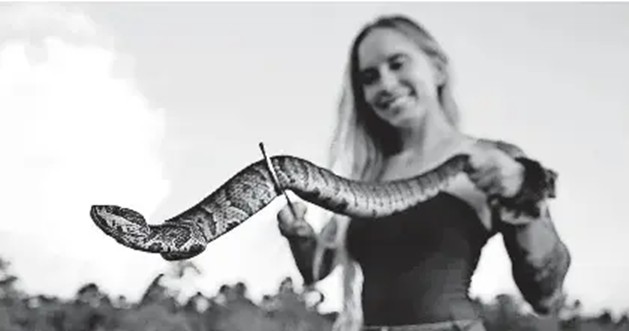
A USA Today article in the middle of the front section of Monday’s local newspaper highlighted a partnership between the state of Florida and a Maimi based leather manufacturer.  Governor Ron DeSantis announced the partnership on the 21st.  The decision to join in partnership was made in 2024 to remove invasive Burmese pythons (Python bivittatus) from the Florida Everglades.  In three months, this summer, 1,022 pythons were removed, compared to 343 during the same period in 2024.  The approximately 50 hunters previously contracted by the Florida Fish and Wildlife Conservation (FWC) now work for the private company, reducing their administrative burden by 89%, increasing python removal, and paying about 60% more for the harvested pythons.  DeSantis said a lot of progress had been made in python removal but “at that pace it was not enough to get where we needed to go”.  The South Florida Water Management District has its own python hunting program separate from the partnership formed between FCW and the leather maker Inversa.

When I went online, I found Inversa is a leather products company that claims to make “ethical exotics that restore nature”.  This is done by “managing” (harvesting) harmful non-native species to help revive natural ecosystems.  Invasive species are a driving force in around 60% of today’s species extinctions and cause US$423B annual damage around the planet.  Management of invasive species restores indigenous species populations by up to 70%, enhances carbon sequestration and water purification, and strengthens global environmental and human health.  Using invasive species to create leather products rather than bovine leather not only removes invasives, it also comparatively uses 99.9% less land, 95% less water, and emits 89% less greenhouse gases.  Inversa partners to create job opportunities in rural and developing economies, empowering communities to protect their ecosystems by creating new jobs in nature restoration and directly increasing local incomes.  According to their website, the company “works closely with our restoration cooperatives to ensure the stable livelihoods and humane labor conditions of all partners in ecosystem management.”

Inversa currently harvests three invasive species for leather production to protect critical habitats.  The Greater Everglades provides critical habitats for hundreds of animal species and coastal protection against flooding for Southeastern America.  Non-native pythons cause a severe decline in animal populations that keep the ecosystem in balance.  The Mississippi River Basin is an ecological lifeline for North America, supporting over 870 species of fish and wildlife.  The overpopulation of the invasive Silverfin carp harms native biodiversity, degrades water quality, and threatens community livelihoods.  The Caribbean coral reefs are biodiversity hotspots that support 42 million livelihoods and, when healthy, protect coastlines from storms and erosion.  The invasive lionfish threatens the health and stability of these already vulnerable ecosystems through its prolific predation.  Inversa produces leather shoes, belts, purses, and accessories from all three invasives.

THOUGHTS: Inversa represents the latest of a series of efforts to remove invasive species from local ecosystems.  I have previously blogged on the use of biological predators, but these are risky and can result in the cure creating their own invasions.  Others are trying to convince diners to adjust their palates to consume the invaders, but this can be a hard sale that often involves reconstituting the product into a more acceptable form.  Turning invasives into high-end leather products is a niche market (what I saw was expensive) but another good approach.  Like most solutions, reduction or removal of invasives takes a long-term concerted cooperative effort.  It is worth the time and cost.  Act for all.  Change is coming and it starts with you.
TREES

December 02, 2024

Last week my browser featured an effort sponsored by the UN that received designation as a Flagship project. The Flagship award is part of an effort by the UN Decade on Ecosystem Restoration to ensure that measurable progress is made on the UN’s environmental goals by 2030. When Africa’s fertile terrains become drylands, farmers are thrown into poverty and biodiversity shrinks. Trees for the Future (TREES) is successfully reversing this trend by assisting hundreds of thousands of smallholder farmers in several African countries to fight soil degradation, biodiversity loss, and climate change. TREES has restored 102,165.72 acres (41,345 ha) since 2014. The restoration supports over 50,000 households and captures 382.5 tons (347 metric tons) of CO2 per hectare through its model, the equivalent of emissions from over 26,420 gallons (100,000 liters) of diesel fuel. Restoration of the drylands helps increase the income and improve the health of farmers and their families. TREES is expecting to create 230,000 jobs by 2030 in Kenya, Mali, Senegal, Tanzania, and Uganda, and is recognized as one of the best large-scale ecosystem restoration efforts on the planet. Central to the TREES model is the creation of a series of structures known as a bund.

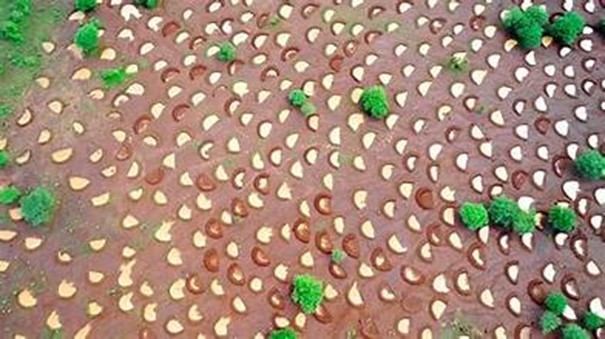
When I looked online, I found a bund, also known as a demi-lune or half-moon, is a rainwater harvesting technique consisting in digging semi-lunar holes in the ground with the opening perpendicular to the flow of water. The holes are oriented against the slope of the ground which generates a small dike in the curved area with the soil from the hole itself. The dikes capture the rainwater as it runs downhill, allows the water to seep into the subsoil, and prevents the loss of fertile soil by erosion. Semi-circular bunds are used to reforest arid zones with irregular rain patterns and allow the growth of plants and trees. The TREES initiative works closely with tens of thousands of farmers living in poverty on degraded lands following decades of unsustainable agriculture practices, deforestation, pollution, and climate change by providing training in a regenerative agroforestry technique called the Forest Garden Approach. In this four-year program, farmers receive training, seeds, and other resources, while planting thousands of trees and dozens of food and resource crops on their property. The small farmers typically own less than 2.5 acres (1 ha) of land.

TREES projects in Senegal and Mali are a part of the African Union’s initiative as part of the Great Green Wall. Elvis Tangem, Great Green Wall Initiative Coordinator, says, “Once it’s completed, the Great Green Wall will be the largest natural structure on the planet. It’s a massive undertaking, but the dedication and teamwork of organizations like TREES will ultimately make it a reality.” The Great Green Wall project was adopted by the African Union in 2007 to combat desertification in the Sahel region and hold back expansion of the Sahara Desert. The original dimensions of the “wall” were to be 9 miles (15 km) wide and 4,831 miles (7,775 km) long. The program has evolved to encompass nations in both northern and western Africa and promotes water harvesting techniques, greenery protection, and improving indigenous land use techniques, aimed at creating a mosaic of green and productive landscapes across North Africa.

THOUGHTS: TREES is recognized as one of the best examples of large-scale and long-term ecosystem restoration in any country or region, embodying the 10 Restoration Principles of the UN Decade on Ecosystem Restoration. The announcement was made ahead of the 6th UN Environment Assembly, held from February 26 to March 1, 2024. The Assembly convenes to address the triple planetary crisis of climate change, nature and biodiversity loss, and pollution and waste. This should represent an ongoing emphasis not just for the developing countries of Africa, but for the world. Act for all. Change is coming and it starts with you.