Birds 2024

January 04, 2025

I am a little later than usual, but it is again time to recap my annual birder list. Once more I saw a number of red-tailed hawks (Buteo jamaicensis) on the power lines going to and from town but this year I was unable to actually get a picture, so they were not added to my count. I was unable to take my usual trip to the wildlife area this year and so missed out on any of the birds I might have seen there. The end of year presence on my feeders was good as the cold weather brought the small Passerines (sparrows and finches), although the larger birds (cardinals and jays) were mostly absent. I cleaned out the bluebird (Sialia sialis) house last week. One of the squirrels who frequent the feeders has taken to gnawing on the entrance, so I opened it to check if everything was ok. It was fine but I cleaned the nest and debris in preparation for the next nesting season. BTW: for those who read last week’s blog (Gaggle) a group of squirrels is called a “dray” or a “scurry”.

All that said leads up to the “great reveal” concerning my birder totals for 2024. You may recall I recorded 26 species in my first year (2020). I got off to a great start in 2021 with 29 species by the end of January and a total of 52 species for the year. During 2022 the sightings were slower, with 44 different species, not counting the six European sightings (50 total?). During 2023 I recorded my lowest number of sightings since my first year, with only 30 species. During 2024 the numbers rose slightly to 39 documented species. Building a fence in the side yard helped as the kids no longer play near the feeders and the birds feel free to come and go more frequently. Still, early morning and early evening are the best times to watch. We also added three new feeders that attach to the glass on the bay window next to where Melissa works. This allows her to watch as the American gold finch (Spinus tristis) and Dark-eyed junco (Junco hyemalis) as they battle for feeding rights.

As I pulled onto the entrance road to the lake to take the kids for a walk yesterday, I caught sight of a large bird perched in the trees. I drove by as the bird turned and flashed the unmistakable white head of a bald eagle (Haliaeetus leucocephalus). I slowed and then pulled over as soon as I (no shoulders). I walked back the 1/4 mile (400m) scanning the trees and hoping to be able to get a photo for my birding list. Unfortunately, the eagle had moved on and was now out of sight. When we began our walk out onto the first spit of land, I heard the call of a red-bellied woodpecker (Melanerpes carolinus). I scanned the trees along the road and caught sight of the bird high among the branches. I pulled out my phone to take a photo but again, by that time the bird was gone. That made two birds I usually only see a couple of times a year and I had missed documenting them both. These were part of the many birds I have seen but not photographed over my last five years of birding. The official Cornell Lab of Ornithology bird list guide does not require documentation with a photo to count as a sighting, although that has been my criteria. Perhaps I should rethink.

THOUGHTS: I acquired several new feeders (now 13, plus 9 hummingbird feeders) during 2024. Melissa asked about the cost as she watched me buying seeds and filling the feeders on a daily basis. I tend to buy seeds in bulk, and I only have to restock two or three times a year. Watching the birds (and squirrels) gives us both pleasure. Like my garden and Melissa’s succulents, the expense to feed the birds is well spent. Be sure to mark your calendars for the Great Backyard Bird Count 2025 (February 14 to February 17, 2025). As I mentioned last year, birds are the (literal) canary in the mine shaft (earth) when it comes to gauging the health of our ecosystems. Act for all. Change is coming and it starts with you.
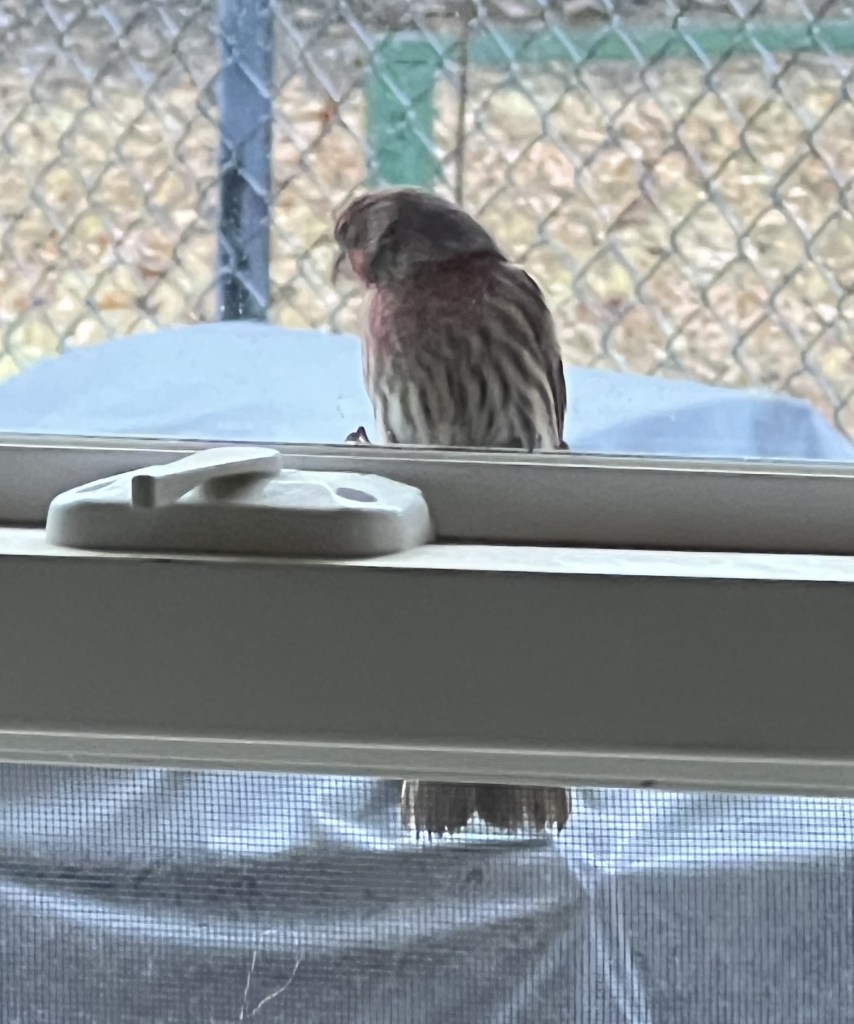
House Finch

November 05, 2024

Melissa received a window box bird feeder as a gift from our son and family earlier this year. The feeder has suction cups on the back that allow it to attach directly to the glass. I placed the feeder in the bay window in the breakfast nook that serves as her home office so she can enjoy the bird activity while working. I fill the two sections of the feeder with different seeds to make it more attractive to the small birds willing to approach the window. One side has always had black sunflower seed (Helianthus annuus). I have varied the seed on the other side, but it currently has cracked safflower seed (Carthamus tinctorius). This feeder has become a preference for the eastern bluebirds (Sialia sialis), the sparrows (Genus, Zonotrichia), and purple finches (Haemorhous purpureus) that frequent our back yard. On Sunday I noticed what seemed to be a new species at the feeder. This was similar to the finches I have been watching but somehow seemed different. When I checked my bird ID this turned out to be a house finch.

When I looked online, I found the house finch (Haemorhous mexicanus) is a North American bird in the finch family. The species is native to Mexico and southwestern US but has been introduced to the eastern part of North America and Hawaii and is now found year-round throughout the US and most of Mexico. The house finch is a moderate-sized bird at 5 to 6 inches (12.5 to 15 cm) long, with a wingspan of 8 to 10 inches (20 to 25 cm). Body mass can vary from 9⁄16 to 15⁄16 ounces (16 to 27 g) with an average weight of 3⁄4 ounces (21 g). Adults have a long, square-tipped brown tail and are a brown or dull-brown color across the back with some shading into deep gray on the wing feathers. Breast and belly feathers may be streaked, and the flanks usually are. Most adult males have reddish heads, necks, and shoulders, and the color can extend to the belly and down the back as well. Male coloration varies in intensity with the seasons as it is derived from a diet of berries and fruits. Adult females have brown upperparts and streaked underparts. There are around 40 million house finches across North America, making it the second-most populous finch behind the American goldfinch.

The house finch and purple finch are closely related species and can be hard to identify. The main difference between the two species is the amount of red on the bird and the pattern on the face. They have similar body shapes, but the bill of the purple finch is a bit bigger, more conical, and deeper, while that of the House Finch has a more rounded shape. Both species get along with other small birds except during breeding season when they become protective of their territory. The other big difference comes with habitat. The house finch prefers a wide range of arid, open, and semi-open habitats, and will live in oak-juniper woodlands, open coniferous forests, and shrubby, and desert habitats from sea level to more than 11,000 feet, the house finch avoids dense forest of the purple finch. A small flock of house finch in Long Island, NY, escaped captivity in 1939 and has become the common bird of the eastern US and southern Canada. Their population has grown and expanded to millions of birds that thrive in urban and suburban places, preferring parks and urban settings with conifers and ornamental trees. Their songs are similar, but the purple finch sings a more melodious and “warbling” song, while the house finch incorporates chattering and trilled sounds.

THOUGHTS: Another similarity between the house finch and purple finch is they are both attracted to bird feeders. This explains why I have seen both species (and probably not realized it until now) in our backyard. Neither species is rare, but the house seems more urban and the purple more forest. Nature tells us that when the same species spend enough time separated and/or refusing to interact they grow apart and eventually become distinct. While humans have not yet reached that point as a species, it is a good lesson to be learned. Act for all. Change is coming and it starts with you.