Gaggle

December 30, 2024

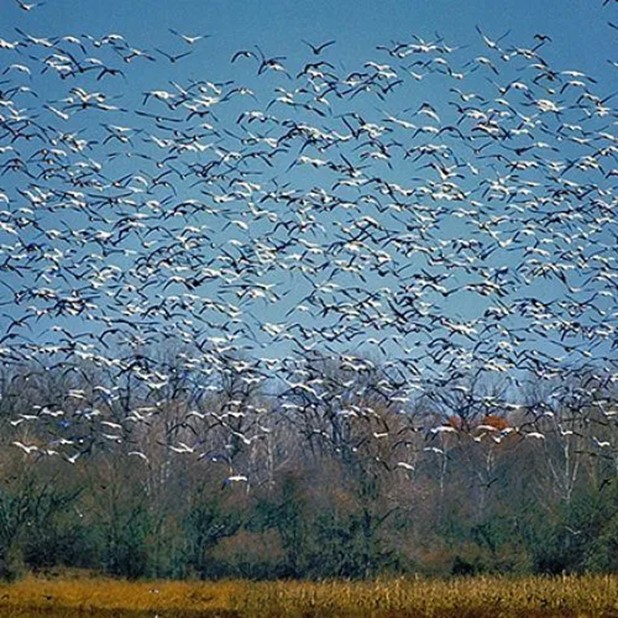
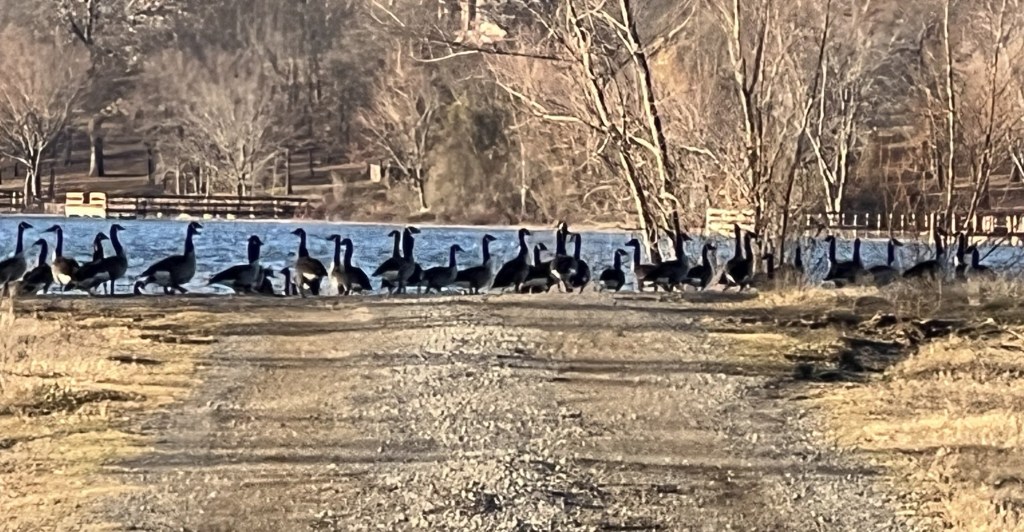
The kids were overwhelmed as we took our walk at the lake last week. They had been intrigued in the past by the occasional greater egret (Ardea alba) or great blue heron (Ardea herodias) that spend time in the shallows at the end of the two spits we walk. The kids will stop and even strain on their leash trying to get a better look at these large solitary birds. They were not prepared for the mass of birds we encountered on this occasion. The herons had flown away as the kids approached, but the Canada geese (Branta canadensis) stood their ground. Both Zena and Loki hesitated in the face of this loud and raucous group of birds. It was not until the kids composed themselves and began to move forward that the group decided they wanted no part of these two large dogs (Canis familiaris). This gaggle of geese took flight and moved to the safety of the water.

When I looked online, I found a gaggle of geese occurred in English print in Julia Berners book, “The Book of Hawking, Hunting and Blasing of Arms” in 1486. Geese are called a “gaggle” because together they are noisy and rowdy. Little is known of Berners, and much of what is known cannot be verified with certainty, but she is thought to be the earliest female author writing in the English language. Based on her last name, scholars suggest that she was either the daughter of the courtier Sir James Berners or wife to the lord of the manor of Julians Barnes, and she was high-born and well-educated. Since she was most likely brought up at court, she would have hunted and fished with the other fashionable court ladies. It is generally believed that she entered the monastic life and became the prioress of Sopwell Nunnery near St Albans. Berners seemed to retain her love of hawking, hunting and fishing, and her passion for field sports, leading her to write her treatise on hunting and others. These treatises are some of the earliest extant writings of their kind and include remarks on the virtues of environmental conservation and on etiquette for field sports. These concepts would not become commonly accepted for hundreds of years after the publication of these treatises. She is also remembered as one of the first authors (of either sex) to write on angling.

A gaggle is just one of the 165 collective nouns (a “naming word for groups of things) for groups Berners defines in her publication. A group of owls (Order: Strigiformes) is called a parliament, possibly attributed to the idea that owls are considered intelligent and wise. A group of wildebeests (Genus: Connochaetes) is called a confusion. This could be due to the huge numbers of animals that in the annual Great Migration and the resulting confusion and noise that happens when the animals migrate. A group of lemurs (Superfamily: Lemuroidea) is called a conspiracy. Lemurs are social animals and live in communities of around 10 to 25 members who often work together (conspire) to outwit predators using a technique called “mobbing”. A group of hippopotamuses is called a bloat. Hippos live in groups of 10 to 20 females and one male, and bloat may refer to their large, bloated bellies. Finally, a group of wild cats is called a destruction. Feral cats can be territorial and fight to protect their territory, and when a group of feral cats get together, they can become destructive.

THOUGHTS: Canada geese thrived around the golf courses I played in Salt Lake City and would form into a large gaggle around the water hazards. The geese were generally docile as they sat on the lawn or swam in the ponds. The problem came when you hit your ball in their midst, when they cackled and blustered a warning. One even decided my ball was her egg and made an aggressive defense. Animals form groups for protection and defend their territory against predators. Humans use the same tactic and form resistance movements against tyrants or marauders. Like a gaggle of geese, we are stronger together. Act for all. Change is coming and it starts with you.
Beards

November 27, 2024

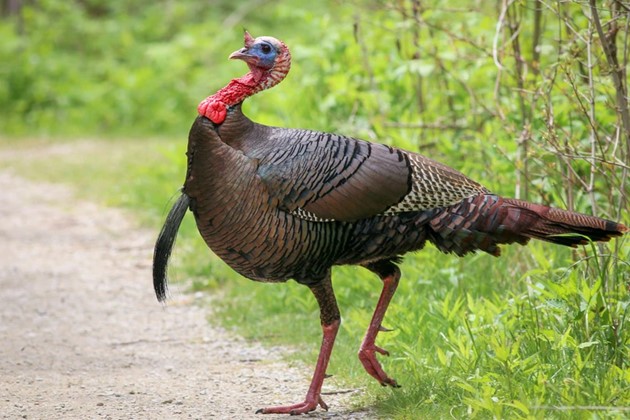
As we approach Turkey Day, also known as Thanksgiving in the US, there have been a rash of stories on my browser about these interesting birds. These include the recent tradition of the Presidential Pardon. The first official presidential turkey pardon was given by George H.W. Bush in 1989, but reports credit many presidents with the tradition. Abraham Lincoln’s son took a liking to the turkey destined for Christmas dinner and the bird was spared. Harry Truman liked his bird so much he had the first presidential photo op, but that bird was not so lucky and was later served as a meal. Two days ago, President Biden pardoned Peach and Blossom. These domesticated turkeys weighed an impressive 40 and 41 pounds (18.1 and 18.6 kg) respectively. Another story was offered by the National Audubon Society and provided 10 Fun Facts About the Wild Turkey. The most interesting of these facts concerned the bundle of feathers sprouting from their chest is known as turkey beards, and it gets longer as the bird ages.

When I looked online, Audubon also offered an in-depth discussion on turkey beards. Turkey beards are plumes of dark brown or black feathers, more hair-like than a typical feather, that protrude from the bird’s chest. “If you had it in your hand, it has the consistency of a miniature horsetail,” says Gary Norman, a retired gamebird biologist at Virginia Department of Game and Inland Fisheries. While all adult male turkeys (toms) have beards, nearly 10% of hens also have one, although it is a smaller and wispier version. Male turkey beards are thought to be used as another tool for mate selection, but it is unknown why some female birds have them. Kelsey Sullivan, a gamebird specialist with the Maine Department of Inland Fisheries and Wildlife, says the beards can “indicate dominance and health”. Turkey beards start sprouting when youngsters are around five months old and continue to grow at a rate of nearly 5 inches (12.7 cm) a year throughout a bird’s life allowing the biologists a rough estimation of the bird’s age. While a one-year-old beards may measure only a few inches older males can have beards over 10 inches (25 cm). The longest beard length recorded on the National Turkey Wildlife Federation website is 11.75 inches (29.2 cm). Some toms even grow 2 or 3 (and even up to 13) separate beards. In the rare occasion where multiple beards are grown most are just short, wispy feathers with a single dominant cluster.

Turkeys can lose their beards several ways. Turkey beard rot is caused by vitamin deficiency and may result in the beards shearing off. Longer beards can snap from the heavy weight of snow and ice that collects on them during winter. Fraying from being dragged on the ground is also an issue. Terrain is another factor that influences beard length, and turkeys inhabiting rocky terrain may have shorter beards than those foraging across flat, sandy ground. The abundance of bearded hens varies by region and is perhaps affected by previous conservation efforts to recover Wild Turkeys. In the mid-1900’s, wildlife biologists trapped turkeys and moved them across state boundaries to restore severely depleted turkey populations due to hunting and habitat loss. Wild Turkeys have sharply rebounded and now inhabit every US state except Alaska. Wild turkey populations peaked at 7 million birds by the early 2000’s.

THOUGHTS: There are only two species of Wild Turkey; the North American (Meleagris gallopavo) and the Ocellated Turkey (Meleagris ocellata) in Central America. The domestic turkey (Meleagris gallopavo domesticus) shares their cousin’s trait by having beards, neither sex of the ocellated turkey have beards. As for the two pardoned turkeys, they will live out the remainder of their life at Farmamerica, a 360-acre agricultural interpretive center in Waseca, Minnesota. Act for all. Change is coming and it starts with you.

House Finch

November 05, 2024

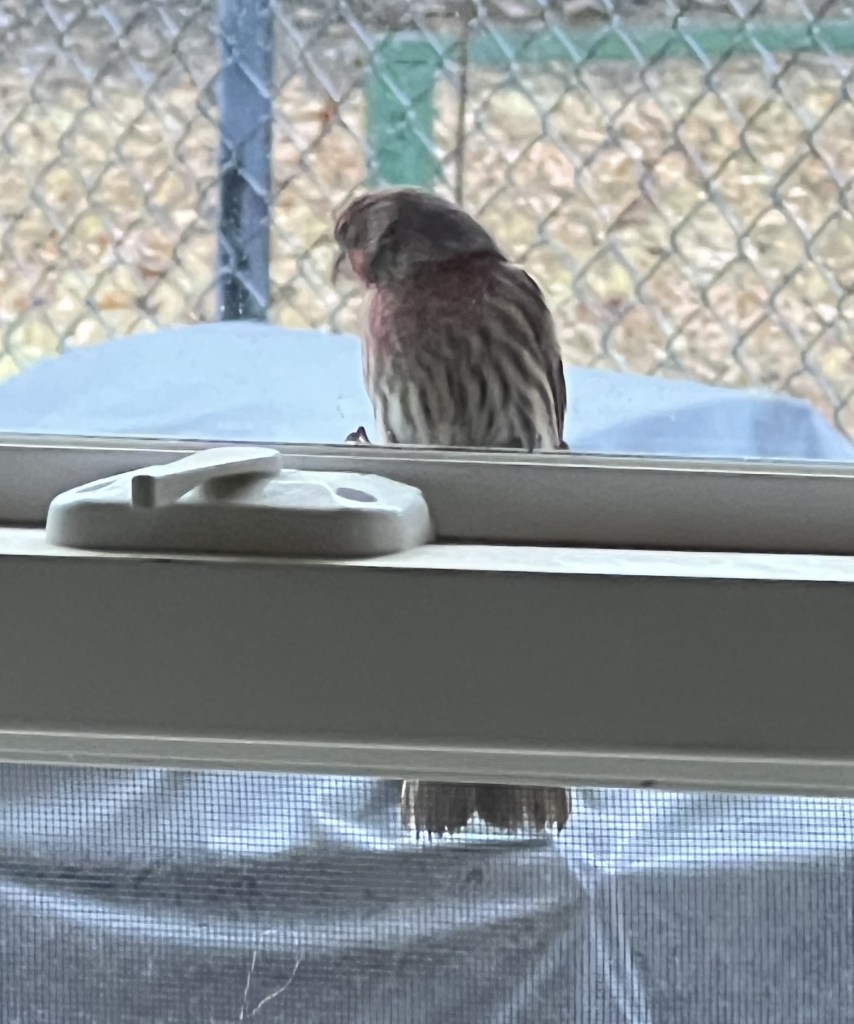
Melissa received a window box bird feeder as a gift from our son and family earlier this year. The feeder has suction cups on the back that allow it to attach directly to the glass. I placed the feeder in the bay window in the breakfast nook that serves as her home office so she can enjoy the bird activity while working. I fill the two sections of the feeder with different seeds to make it more attractive to the small birds willing to approach the window. One side has always had black sunflower seed (Helianthus annuus). I have varied the seed on the other side, but it currently has cracked safflower seed (Carthamus tinctorius). This feeder has become a preference for the eastern bluebirds (Sialia sialis), the sparrows (Genus, Zonotrichia), and purple finches (Haemorhous purpureus) that frequent our back yard. On Sunday I noticed what seemed to be a new species at the feeder. This was similar to the finches I have been watching but somehow seemed different. When I checked my bird ID this turned out to be a house finch.

When I looked online, I found the house finch (Haemorhous mexicanus) is a North American bird in the finch family. The species is native to Mexico and southwestern US but has been introduced to the eastern part of North America and Hawaii and is now found year-round throughout the US and most of Mexico. The house finch is a moderate-sized bird at 5 to 6 inches (12.5 to 15 cm) long, with a wingspan of 8 to 10 inches (20 to 25 cm). Body mass can vary from 9⁄16 to 15⁄16 ounces (16 to 27 g) with an average weight of 3⁄4 ounces (21 g). Adults have a long, square-tipped brown tail and are a brown or dull-brown color across the back with some shading into deep gray on the wing feathers. Breast and belly feathers may be streaked, and the flanks usually are. Most adult males have reddish heads, necks, and shoulders, and the color can extend to the belly and down the back as well. Male coloration varies in intensity with the seasons as it is derived from a diet of berries and fruits. Adult females have brown upperparts and streaked underparts. There are around 40 million house finches across North America, making it the second-most populous finch behind the American goldfinch.

The house finch and purple finch are closely related species and can be hard to identify. The main difference between the two species is the amount of red on the bird and the pattern on the face. They have similar body shapes, but the bill of the purple finch is a bit bigger, more conical, and deeper, while that of the House Finch has a more rounded shape. Both species get along with other small birds except during breeding season when they become protective of their territory. The other big difference comes with habitat. The house finch prefers a wide range of arid, open, and semi-open habitats, and will live in oak-juniper woodlands, open coniferous forests, and shrubby, and desert habitats from sea level to more than 11,000 feet, the house finch avoids dense forest of the purple finch. A small flock of house finch in Long Island, NY, escaped captivity in 1939 and has become the common bird of the eastern US and southern Canada. Their population has grown and expanded to millions of birds that thrive in urban and suburban places, preferring parks and urban settings with conifers and ornamental trees. Their songs are similar, but the purple finch sings a more melodious and “warbling” song, while the house finch incorporates chattering and trilled sounds.

THOUGHTS: Another similarity between the house finch and purple finch is they are both attracted to bird feeders. This explains why I have seen both species (and probably not realized it until now) in our backyard. Neither species is rare, but the house seems more urban and the purple more forest. Nature tells us that when the same species spend enough time separated and/or refusing to interact they grow apart and eventually become distinct. While humans have not yet reached that point as a species, it is a good lesson to be learned. Act for all. Change is coming and it starts with you.