
September 26, 2024
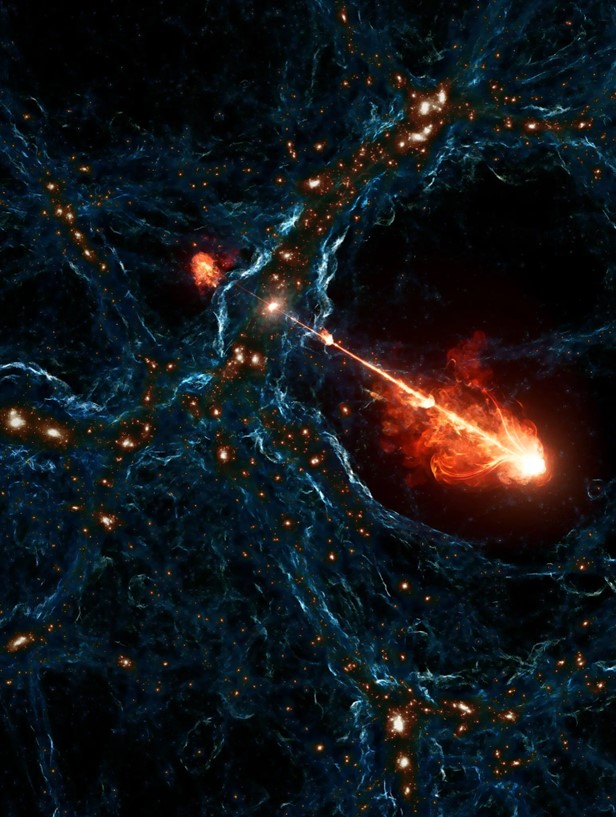
Today’s NY Times feed reported on the massive pair of jets releasing from a supermassive black hole (SMBH) 7.5 billion light-years from Earth. The megastructure spans 23 million light-years in length, making these black hole jets the largest ever seen, according to new research. While Black holes gobble up nearly everything that comes close to them, a fraction of material is ejected before an object falls in, forming a jet on either side of the black hole, said Martijn Oei, a postdoctoral scholar at the California Institute of Technology and the lead author of a new study describing the discovery published September 18 in the journal Nature. The jets have a power output equivalent to trillions of suns and are so massive that researchers have nicknamed the megastructure Porphyrion after a giant from Greek mythology. The discovery is causing astronomers to rethink their understanding of how massive black hole jets can be as well as how these giant features can affect their surroundings and the structure of the universe.
When I looked online, I found a supermassive black hole (SMBH or SBH) is a black hole more than one hundred thousand times the mass of the Sun. Solar mass (M☉) is a standard unit of mass used in astronomy equal to approximately 2×1030 kg, or the approximate mass of the Earth’s Sun. It is often used to indicate the masses of other stars, as well as stellar clusters, nebulae, galaxies and black holes. Black holes are a class of astronomical objects that have undergone gravitational collapse, leaving behind spheroidal regions of space from which nothing can escape, including light. The discovery of SMBH was a consequence of the investigation of quasars in the mid-20th century. Nearly every large galaxy has a SMBH at its center. Active galactic nuclei, such as Seyfert galaxies and quasars, are powered by supermassive black holes. The largest SMBH is in the galaxy cluster Abell 1201 and has a mass thirty billion times that of the Sun. The SMBH at the center of the Milky Way Galaxy (Sagittarius A*) has a mass four million times that of the Sun. Two supermassive black holes have been directly imaged by the Event Horizon Telescope: the black hole in the giant elliptical galaxy Messier 87 and Sagittarius A* at the Milky Way’s center.
When sustained for mega years, high-power jets from SMBH become the largest galaxy-made structures in the Universe. “This pair is not just the size of a solar system, or a Milky Way; we are talking about 140 Milky Way diameters in total. The Milky Way would be a little dot in these two giant eruptions” Oei said. The structure consists of a northern lobe, a northern jet, a core, a southern jet with an inner hotspot, and a southern outer hotspot with a backflow. This system demonstrates that jets can avoid destruction by magnetohydrodynamical instabilities over cosmological distances. How jets can retain such long-lived coherence is unknown at present. The haunting question is what Porphyrion is doing to the rest of the universe. Cosmologists have found that the visible features of the universe are structured in a weblike manner, with galaxies clumped in giant clusters and connected by thin filaments that span dark voids of tens to hundreds of millions of light-years. In Porphyrion’s day, this cosmic web was half the size it is now, and these jets would have been big enough to affect the overall web.
THOUGHTS: In total, the team spotted 10,000 new black hole jet pairs. Like many discoveries, the researchers were not looking for jets from the SMBH but were trying to observe the cosmic web. Research (and exploration) often mistakenly makes discoveries that expand our understanding of the universe, the Earth, and even humanity. The quest for understanding is one aspect that (we think) sets humans apart from other animals. Act for all. Change is coming and it starts with you.
 A travelers odyssey