Vienna

November 28, 2025

Yesterday we continued our trip along the Danube River to Bratislava, Slovakia.  Bratislava is the capital and largest city of Slovakia.  The city has deep historical ties to Hungary and served as its capital and coronation city for centuries and is now the capital seat of Slovakia.  Bratislava borders both Austria and Hungary, making it the only national capital in the world to have land borders with two other sovereign states.  After the Ottoman conquest in 1526, Bratislava (then Pozsony) became the capital of the Kingdom of Hungary from 1536 until 1783.  Eleven Hungarian kings and eight royal consorts were crowned in the city’s St. Martin’s Cathedral.  “Bratislava” was adopted as its name following World War I (1919) after it became part of Czechoslovakia.  After an afternoon walking tour of the city and a lively evening of entertainment (dancers and operetta), we departed Bratislava late last night and continued our way up the Danube River toward Vienna.   

When I went online, I found Vienna is the capital and largest city (2 million inhabitants) of Austria.  Its larger metropolitan area has a population of nearly 2.9 million, representing nearly one-third of the country’s population. Vienna is the cultural, economic, and political center of the country, the fifth-largest city by population in the European Union, and the most populous of the cities on the Danube River.  The city lies on the eastern edge of the Vienna Woods (Wienerwald), the foothills of the Alps that separate Vienna from the more western parts of Austria.  The city sits on the Danube and is traversed by the Vienna River (Wienfluss).  Although surrounded by Lower Austria, the city lies 31 miles (50 km) west of Bratislava, Slovakia, 31 miles (50 km) northwest of Hungary, and 37 miles (60 km) south of Moravia (Czech Republic).  The Romans founded a fortress (castrum) at the site in the 1st century CE called Vindobona, which was elevated to a town (municipium) with Roman city rights in 212.  In 1155, Vienna became the seat of the Babenbergs (976 to 1246) and was granted city rights in 1221.  The Habsburgs succeeded the Babenbergs during the 16th century and Vienna became the seat of the emperors of the Holy Roman Empire, a position it held until the empire’s dissolution in 1806.  With the formation of the Austrian Empire in 1804, Vienna became the capital of the Austrian and all its successor states.

Our morning in Vienna began with a panoramic (bus) tour of the major sites of the city followed by a walking tour of the interior.  This tour took us from the old city gates (no longer in existence) toward St. Stephen’s Cathedral.  We had toured St. Stephen’s Cathedral in Bratislava, but this was named for Stephen I, the first king of Hungary reigning from approximately 1000/1001 until his death in 1038 CE.  Although his parents were baptized, he was the first of his family to be a devout Christian.  Stephen led the Church in Hungary to develop independently from the archbishops of the Holy Roman Empire and encouraged the spread of Christianity by meting out severe punishments for those ignoring Christian customs.  He became the principal patron saint of Hungary.  St. Stephen’s Cathedral in Vienna is named for the first martyr of Christianity according to the Acts of the Apostles (Chapter 6).  During the modern era, Vienna has been among the largest German-speaking cities in the world and host to major international organizations.  In 2001, the city center was designated a UNESCO World Heritage Site.

THOUGHTS: One excursion in Vienna is a concert by the Vienna Residence Orchestra that features some of Vienna’s most beloved music, including Strauss waltzes and Mozart’s The Magic Flute.  This is a bucket list for Melissa I am grateful to share.  Sharing each other’s expectations and hopes bonds relationships.  The more the better.  Act for all.  Change is coming and it starts with you.
Locks

November 27, 2025

One of the smarter things Melissa and I did on our Danube River trip was to fly into Budapest several days prior to our embarkation date.  Still, we were not prepared for the toll the trip would have.  We were both so exhausted that we struggled to make it through our first dinner and suffered cramps the first two nights from being on the plane (not moving enough).  Our embarkation point was close to our hotel but did not relish the thought of dragging our luggage along the banks of the river.  We were able to secure the hotel car (for a small fee) to drop us in front of the ship on Tuesday.  The next two days were spent exploring the sights of Buda, the hilly south side, and Pest, the flat north side of the river.  I had exchanged 50 Euros into 17,450 Forint thinking there would be shops who would not take foreign currency but everywhere took both Euro and credit cards.  Since Forint is not excepted anywhere but Hungary, the maid and guides were tipped with Forint.  On the last day in town, I took a final walk to the Christmas market to spend my last 2000 Forint (5.26 Euro).  I watched from the sundeck as we pulled out marveling at the breadth and power of the Daube.  It was hard to fathom that tomorrow we would pass through several locks that would raise the ship 60 feet (18.3 m).

When I went online, I found the Danube has a series of locks to allow river passage associated with the 18 river power plants (from Kelheim to Sulina) that generate energy from the dams.  These locks are of either one (4) or two (14) chambers that can allow simultaneous locking of vessels travelling upstream and downstream.  The steep gradient of the Upper Danube (Kelheim and Gönyu) has 16 power plants with locks, while the Middle and Lower Danube has only 2 locks situated at the Iron Gates, a gorge forged by the Danube through the Carpathians, which forms the border between Romania and Serbia.  The Iron Gate locks are also the largest on the Danube.  Iron Gate I (river km 942.90) and Iron Gate II (river km 863.70/ 862.85) each have two lock chambers which are 1017 feet (310 m) long and 111.5 feet (34 m) wide, located on the right bank and the left bank.  The lock chambers on the right bank (Djerdap I and II) are maintained and run by Serbia, while those on the left bank (Portile de Fier I and II) are maintained and run by Romania.

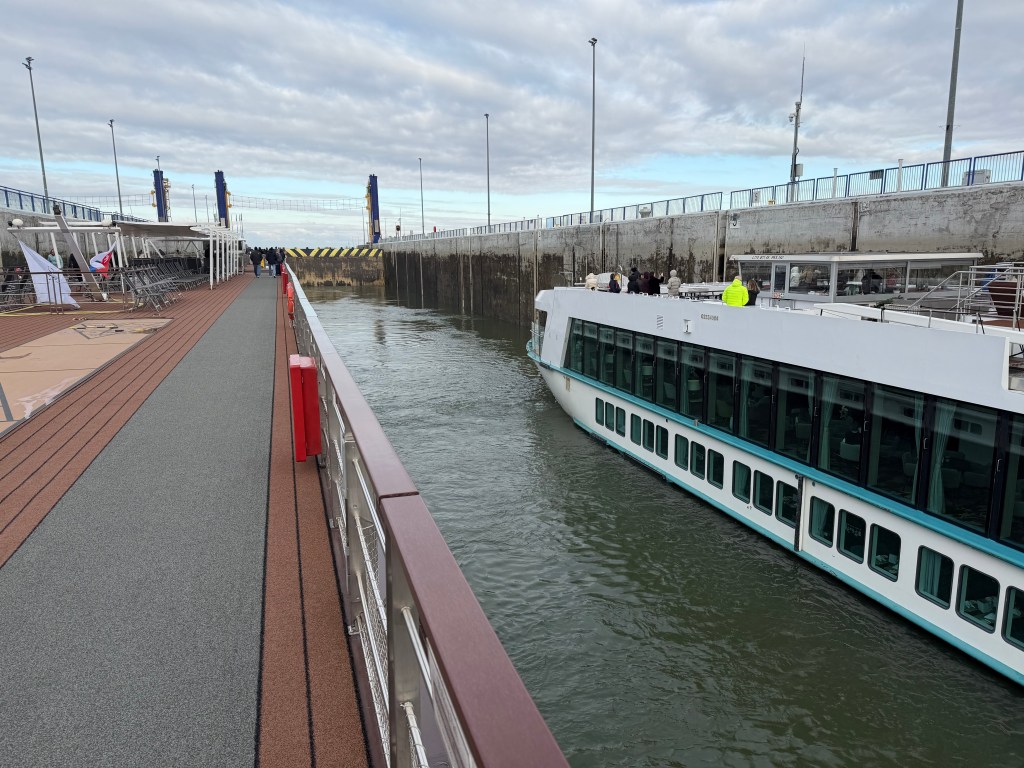
When I woke up this morning, I opened the curtains of our stateroom and was surprised to see the banks of the Danube only 20 yards (18 m) away as this was such a contrast to the massive river channel we had left in Buda pest.  While the banks did widen some as we continued upstream, they never reached the distance of the previous night.  When we arrived at the first lock (Gabclkovo) we squeezed into an area 111.5 feet (34 m) wide and 902 feet (275 m) long.  We were nearly pressed against the side of the lock, with a wide berth on the right hand (starboard).  Once we began to rise, a new friend and I went to the observation deck to watch the process.  That was when I saw another small cruise ship situated beside and slightly behind our larger craft.  At least now our proximity to the side of the lock made sense.  As the lock opened, we sailed into the Dunajsky canal that connected us back to the river.  We were on our way to our second destination city of Bratislava.

THOUGHTS: Locks are designed for boats and not for migratory fish and can act as a barrier to migratory fish.  The lock can also be modified by adapting operation protocols to guide fish through a lock with a series of controlled water-level changes that mimic a fish lift.  The effectiveness of an adapted lock depends on sufficient attraction flow and careful timing to ensure fish enter and move upstream successfully.  Under standard operation, the area near the lock is calm, making it difficult for fish to find the entrance, and less than 1.5% of fish may use the lock.  The impact on ecosystems along the Danube has been partially mitigated through various national and international agreements and national parks.  It takes planning.  Act for all.  Change is coming and it starts with you.
PS: For my American followers, Happy Thanksgiving!

Forint

November 24, 2025

Melissa and I both finally got to sleep last night and woke ready to see some sights of Budapest.  We checked with the concierge at the front desk about what to see and were given a map which he marked with possible locations.  The first thing I wanted to do was check the location of our tour line’s port.  We have heard at times there may be more than one point of embarkation.  We set out using my phone map app knowing it was only 650 feet (198 m) to our location.  We got closer and then the distance began to increase as I had made a wrong turn.  It turned out it will be an easy trip tomorrow, but I am glad I checked before dragging our luggage around Budapest.  I made several purchases last night using Euros and received sighs, and calculators, so I decided I should convert some of my US$ to Forint, the official currency of Hungry. 

When I went online, I found the forint’s name comes from the city of Florence, where gold coins called fiorino d’oro were minted from 1252.  In Hungary, the florentinus (later Forint), also a gold-based currency, was used from 1325 under Charles Robert, with several other countries following Hungary’s example.  Between 1868 and 1892, the Forint was the name used in Hungarian for the currency of the Austro-Hungarian Empire, known in German as the Gulden.  It was subdivided into 100 krajczár.  The introduction of the forint on 1 August 1946 was a crucial step in the post-World War II stabilization of the Hungarian economy and remained relatively stable until the 1980’s.  Transition to a market economy in the early 1990’s resulted in inflation, which peaked at 35% in 1991.  Between 2001 and 2022, inflation was in single digits, and the Forint has been declared fully convertible.  In May 2022, inflation reached 10.7% amid the Russian invasion of Ukraine and economic uncertainty.  As a member of the European Union, the long-term aim of the Hungarian government may be to replace the forint with the euro, although under the current government there is no target date for adopting the euro.  Currently 1 Euro equals 382.45 Hungarian Forint.

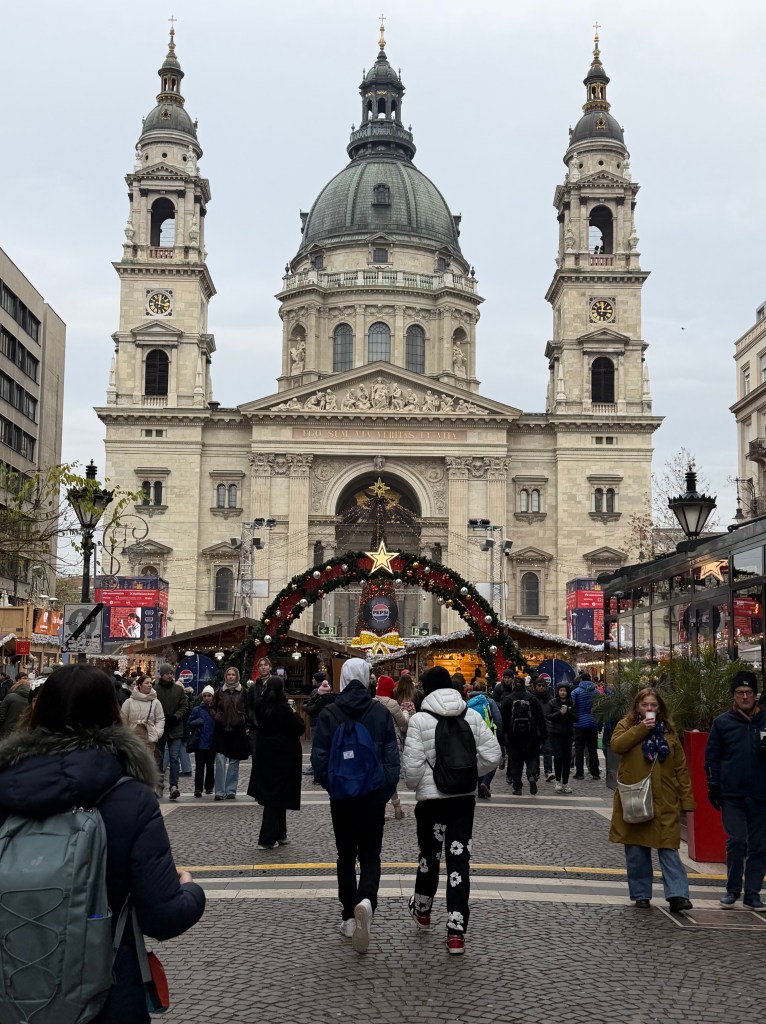
When I checked with the concierge desk I was told to go to a bank or exchange station to convert my currency to forint.  We had decided to go to St. Stephen’s Basilica which was only a few blocks farther and (sort of) in the direction of the cruise dock.  As we approached, we saw a Christmas market in full swing on the streets surrounding the church.  We knew there would be shops, and after last night’s experience I wanted at least some forint for a purchase.  We found an exchange shop not far from the market.  It turned out they did not know how to convert US$ into Forint (?) but it was easy to convert with Euros.  We had prepared our credit card with our trip as they accepted foreign exchanges (no fee).  Armed with nearly 17,000 Forint (50 Euro) we were ready to face the markets.  We browsed the shop and food venders on our way to the basilica, deciding what to eat on our return.  When we arrived at St. Stephens, we were both cold and decided to see the exterior rather than the tour.  We then stopped for a large Hungarian sausage, potato cake, and stuffed cabbage.  None of the shops took cash, so we used our credit card.  Now what to do with 17,000 Forint.       

THOUGHTS: After we got back to the hotel with my Forint in hand (and tons of food) we laid down for a rest before taking off again.  This time it was my foot that woke me up in pain.  I decided to go back to the shop I visited last night and buy some Gatorade (or facsimile) with my forint.  I bought 3 Gatorades, orange juice, and a bag of chips for 4500 Forint.  When we went to Greece we came home with 450 Euros.  We did not mind as we knew the Danube trip ended in Germany so it would be spent.  We still have another day and a half to spend our Hungarian forint.  Many charities, airports, and airlines collect leftover currency for donations.  I saw a donation bin in Munich but did not understand what it was for, until now.  Act for all.  Change is coming and it starts with you.