Volatile

November 17, 2025

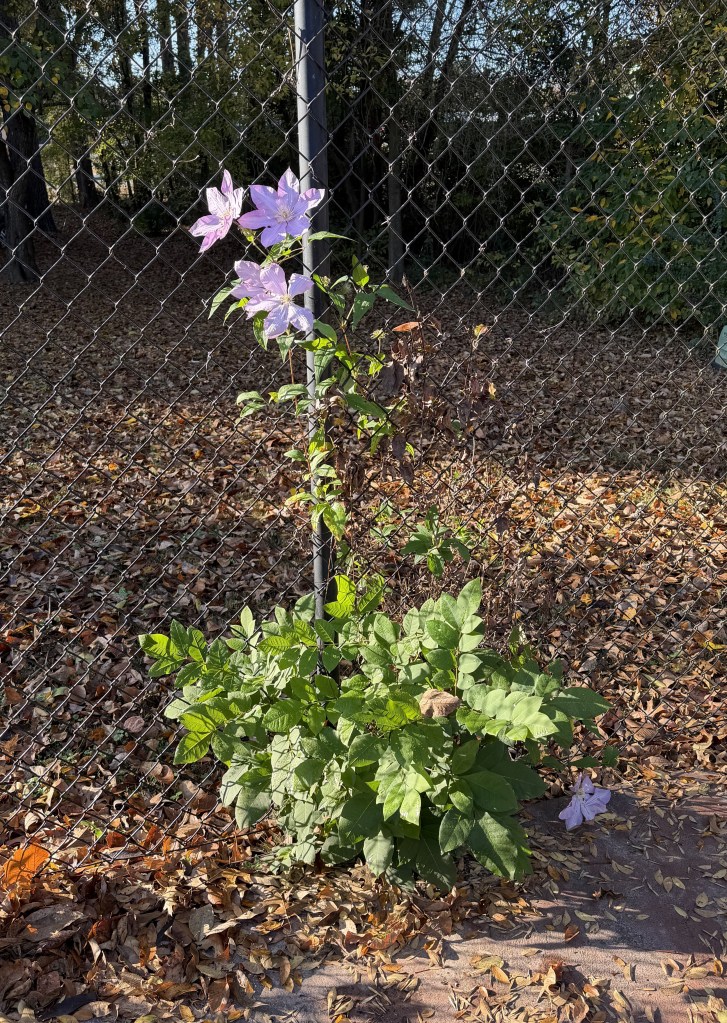
It seems hard to believe that last week I was protecting the pipes in our RV from a hard freeze.  The temps dropped to 28F (-2C) on consecutive nights.  While it did warm up to the mid 40’sF (7C) on both afternoons it was still a cause for concern.  I did not winterize the water lines and tanks since we are still hoping to take a trip around Christmas.  Our mechanic told us the lines in our Sunseeker are contained inside the compartment and there are water heaters to keep the tanks warm.  I turned on the water heater, set the tanks to Arctic mode, and turned the inside furnace to 60F (15.5C), its lowest setting.  After a brief spell, the temperatures warmed again.  Two days later it climbed back to 80F (26.6C) and our unit had survived its first test.  The temps have stayed in the 70’s+F (21+C) this week, although they will dip just as we leave for another extended trip at the end of the week.  While the wildflowers in the front bed did not survive the chill, the clematis (Clematis var. “The President”) on the back fence decided to burst into bloom.  Is it just me or does the weather seem more volatile?

When I went online, I found the weather is becoming more volatile.  This includes rapid temperature swings and increases in atmospheric instability due to a warmer, moister atmosphere.  According to climate scientists and studies global warming is a primary driver, making the atmosphere more unstable and extreme events more common.  Studies show the frequency and intensity of extreme weather are increasing, and this trend is expected to continue.  An increase in low-level moisture content and warmer air temperatures have significantly increased atmospheric instability over the past 40 years.  This makes the weather volatile with more frequent and intense “climate whiplash” or rapid temperature changes, which give little time for adaptation.  This volatility contributes to a rise in extreme events such as record-breaking heatwaves, more intense rainfall, and more powerful storms.  The world’s oceans are at the highest temperatures recorded in the last 1,000 to 2,000 years, which can fuel more extreme weather.  A study in Nature noted rapid intensification rates in the Atlantic have resulted in an increase for hurricanes since 1971.

While most changes to address the volatile nature of the weather require systemic shifts, there are some things individuals can do to prepare.  Pay attention to local weather forecasts and heed warnings for extreme events like flash floods.  Encourage your community to plan for volatility by designing resilient infrastructure will be better equipped to handle extreme events.  Understand your local flood risk and take steps to prepare, as weather patterns are changing.  Lori Peek, director of the Natural Hazards Center at the University of Colorado, said, “Infrastructure is aging in our country and is more vulnerable given the fact that there are just simply . . . more people living in harm’s way.”  This is true for the wildfires of California, the floods of the Midwest, and the hurricanes of the east coast.  None are going to go away on their own.

THOUGHTS: The US is responding to this volatile weather with mass layoffs and cuts to the agencies that study climate and help warn and deal with disasters.  Workers at the Federal Emergency Management Agency, the National Weather Service, and research labs at the National Oceanic Atmospheric Administration and the US Geological Survey are also leaving and taking their expertise with them.  It could take years to make up for this brain drain.  The country needs to plan for worst case scenarios and build infrastructure to lessen the effect.  The dinosaurs did not know the comet was going to strike.  We know but need to act.  Act for all.  Change is coming and it starts with you.

Cloud Seeding

September 09, 2025

I thought it was appropriate after a recent blog on planting my second set of seeds that yesterday’s local newspaper carried a USA Today article responding to the July storm that dumped 20 inches (50.8 cm) of rain in parts of central Texas.  This was the equivalent of a month’s worth of rain and swelled the Guadalupe River over its banks, resulting in the death of 130 people.  As is typical for most disasters, people sought to place the blame in a variety of places.  One unexpected place was on the activity of a small startup called Rainmaker two days prior and 100 miles (160 km) away.  The flight had lasted 20 minutes and released 2.5 ounces (70 grams) of silver iodide into a set of clouds, resulting in a drizzle of less than 0.2 inches (1/2 cm) of rain on farmlands struggling with drought.  Scientists said the distance made it scientifically impossible for this cloud seeding to have played a role in the flooding.       

When I went online, I found cloud seeding is a type of weather modification that aims to change the amount or type of precipitation, mitigate hail, or disperse fog.  The usual objective is to increase rain or snow.  Cloud seeding involves dispersing particulate substances into the atmosphere to serve are the center (nuclei) that water vapor or ice condenses on.  Common agents include silver iodide, potassium iodide, and dry ice, but water attracting (hygroscopic) materials like table salt are gaining popularity.  Techniques include a static seed which encourages ice particle formation in supercooled clouds to increase precipitation or dynamic seeding which enhances cloud development through the release of latent heat.  The substance is usually dispersed by aircraft or ground-based generators, but newer approaches involve drones delivering electric charges to stimulate rainfall or infrared laser pulses aimed at inducing particle formation.  The effectiveness of cloud seeding remains a subject of debate among scientists despite decades of research.  Environmental and health impacts are considered minimal due to the low concentrations of substances used, but concerns persist.

Cloud seeding has been used as far back as the 1940’s for various purposes, including agricultural benefits, water supply augmentation, and event planning.  Eric Betterton, professor emeritus in atmospheric sciences at the University of Arizona, said “people have been worried about using silver iodide in the past, but the amounts are so small it’s insignificant . . . there are no known effects on the environment.”  The technique also has limitations.  You cannot create a storm or control the climate.  Seeding simply speeds up the natural process that causes rain or snow to fall.  As extreme weather events increase along with climate change, so do explanations offered by conspiracy theorists, including possible military involvement.  Lawmakers in several states have introduced bills to ban or restrict cloud seeding and other forms of weather modification.  Legal frameworks primarily focus on prohibiting the military or hostile use of weather modification techniques, leaving the ownership and regulation of cloud-seeding activities to national discretion. Despite skepticism and debate over its efficacy and environmental impact, cloud seeding continues to be explored and applied worldwide as a tool for weather modification.

THOUGHTS: Rainmaker’s 20-minute cloud seeding flight was part of a local program and these are usually funded by a water district or utility.  While it did not fuel the distant flooding disaster it did produce fear and legislation to ban or restrict weather modification.  As global warming increases, understanding how clouds behave and interact with our warming and ever more polluted atmosphere is why scientists want to study cloud seeding and not ban it.  Information is critical in understanding how our planet works.  The article closed, “You can’t engineer a flood.”  Act for all.  Change is coming and it starts with you.
Corn Sweat

July 23, 2025

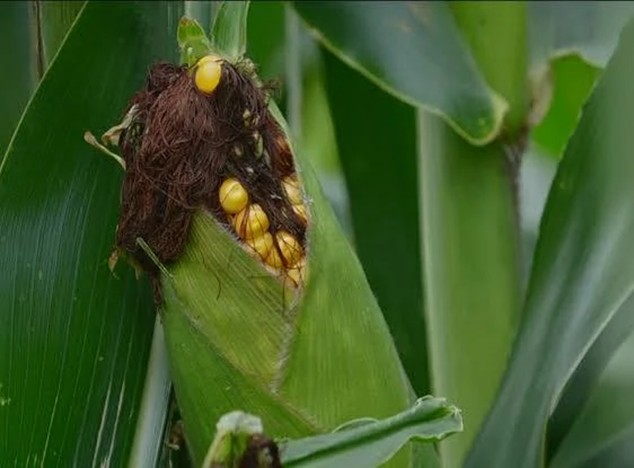
Hidden in the back of today’s local newspaper was a USA Today article about the heat and humidity pushing up the heat index.  This is typical during mid-summer, especially in the wetter eastern half of the US.  Bob Oravec, lead forecaster at the National Weather Service’s (NWS) office in College Park, Maryland, says it is unlikely to break records, but it can be dangerous.  On Monday the heat and humidity were centered over the Southeast and along the Gulf Coast.  By midweek, they moved northward along the Mississippi Valley and up into the Midwest, then shift toward the Mid-Atlantic and Northeast by the end of the week.  Highs are expected to be 95F to 100F (35C to 38C), but the humidity will make it feel closer to 110F (43C) in some areas.  This places most of the eastern US in the “major” Heat Risk category, an NWS classification that incorporates heat, humidity, and data on heat-related hospitalizations.  Pockets will be in the highest “extreme” category on the four-category scale.  Part of the reason for the humidity is that the wet weather pattern has saturated everything, causing more evaporation from soil and transpiration from plants.  This is particularly true in the Midwest, where huge fields of corn, soybeans, and other crops release moisture as the temperature climbs.  This is akin to how humans sweat in the heat and is nicknamed “corn sweat.”

When I went online, I found corn sweat is scientifically known as transpiration, the process of water movement through a plant and its evaporation from aerial parts, such as leaves, stems and flowers.  This is a passive process that requires no energy expense by the plant.  Transpiration also cools plants, changes osmotic pressure of cells, and enables mass flow of mineral nutrients.  When water uptake by the roots is less than the water lost to the atmosphere by evaporation, plants close small pores called stomata to decrease water loss, which slows down nutrient uptake and decreases CO2 absorption from the atmosphere by limiting metabolic processes, photosynthesis, and growth.  In growing season, an acre of corn gives off about 3,000 to 4,000 US gallons (11,000 to 15,000 liters) of water each day.  A large oak tree can transpire 40,000 US gallons (150,000 liters) per year.  Crop plants transpire 440 to 2200 pounds (200 to 1000 kg) of water for every 2.2 pounds (1 kg) of dry matter produced.  Roughly 95.3 million acres (38566541.7 ha) are planted with corn and soybean in the Midwest, representing approximately 75% of the region’s total agricultural land.

In Iowa, corn sweat releases 49 to 56 billion gallons (185,212 billion liters) of water each day.  The NWS said that it can add 5 to 10 degrees to the dew point, a measure of humidity, on a hot summer day.  Illinois boasts about 12 million acres (4,856,227.7 ha) of corn, that sweats up to 48 billion gallons (181.7 billion liters) of water daily.  The weather service in Chicago is warning that the heat index in Illinois could reach 115F (46.1C) by July 23-24.  Corn sweat will only add to the misery.  Iowa state climatologist Justin Glisan said, “Of course, there’s a local contribution from corn/bean transpiration which can add additional low-level moisture and exacerbate dew points.”  Weather patterns contribute more to the heat and humidity in the Midwest than corn sweat, which he said is “a more local or smaller-scale effect”. 

THOUGHTS: While corn sweat might make summer days feel more oppressive, it is a sign of healthy crops.  Evapotranspiration is essential for plant growth and helps crops reach their full potential.  Once the harvest begins, corn sweat is eliminated.  I had a summer job at a lake in the heart of Kansas corn country (7th largest producer in US).  While the humidity averages in the mid-60’s, we joked about the temps being “100 degrees and 100 percent humidity”.  The advantage of working at the lake meant whenever it got too unbearable, we jumped into the lake to cool off.  Not everyone is so lucky.  Act for all.  Change is coming and it starts with you.