
October 16, 2025
Last week I decided to harvest the last of my jalapeños (Capsicum annuum). While they had been turning red (ripening) they were not getting over 2 inches (5 cm) long. This gave me a dozen peppers that I stored in the refrigerator. I have been waiting for the green tomatoes (Solanum lycopersicum) to ripen for the last several weeks. I mentioned how the vines did not produce much fruit during the heat of summer. Now that cooler weather is (intermittently) on us they have begun to make fruit. The problem has been that most of it has stayed green. Yesterday I resigned myself to the idea they will never ripen on the vine. That left me wondering what to do with over 5 gallons (19 liters) of green tomatoes. While making green tomato relish (“chow-chow”) or frying them was an option, I wanted something more ambitious (that I would eat). One of the suggestions was to use green tomatoes as a substitute for the tomatillos (Physalis philadelphica and Physalis ixocarpa) found as the base for salsa verde.
When I went online, I found salsa verde (Spanish, “green sauce”) is a versatile green sauce with two main variations: Mexican and Italian. The type commonly found in Mexican and Tex-Mex cuisines is a spicy condiment made with tomatillos, while the classic Italian version is an uncooked, herbaceous sauce. The Mexican version is a vibrantly green, tangy sauce featuring tomatillos and chili peppers that can be made by boiling or roasting the main ingredients. For the boiled version, the tomatillos, chili peppers (Capsicum annuum), and sometimes onion (Allium cepa), and garlic (Allium sativum) are simmered in water until soft. The softened ingredients are then blended with fresh cilantro (Coriandrum sativum), salt, and lime (Citrus aurantiifolia) juice to create a bright and fresh-tasting salsa. The roasted version has a deeper, smoky flavor. The tomatillos, chiles, onion, and garlic are roasted or broiled until they are blistered and charred and again blended with fresh cilantro, salt, and lime juice. Italian salsa verde is a no-cook, chopped green sauce made from fresh herbs like parsley (Petroselinum crispum), basil (Ocimum basilicum), or mint (Mentha spicata). This version is known for its fresh, savory, and tangy flavor and is typically served with meat or seafood.
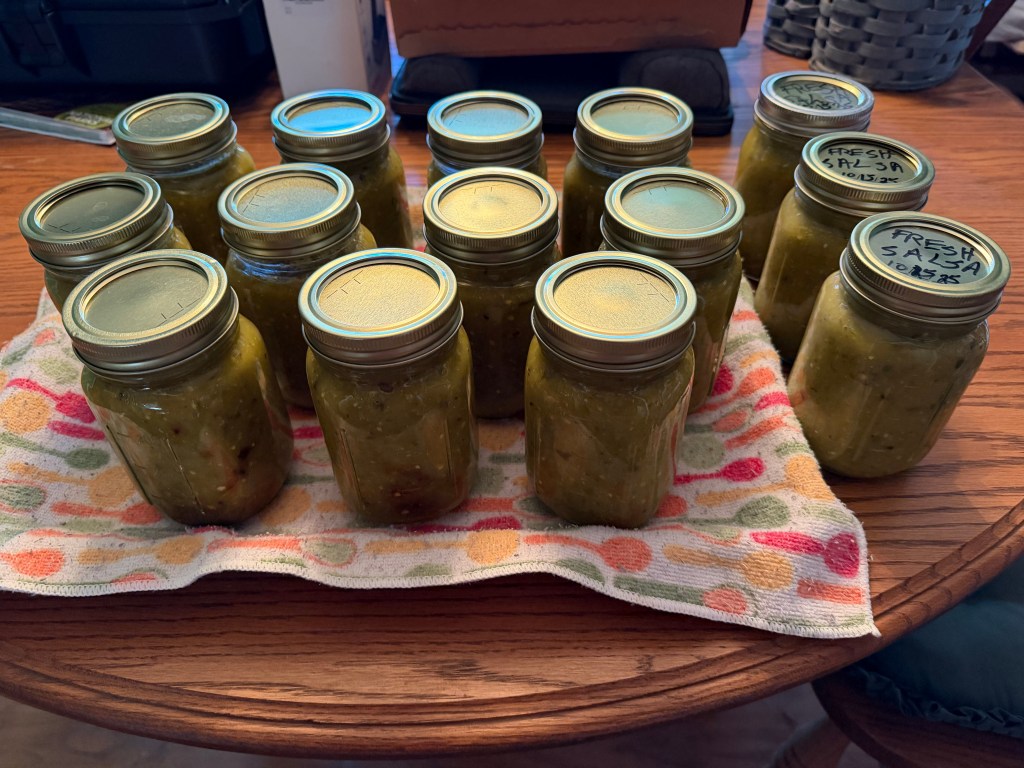
Melissa wanted to make a fresh salsa verde that is stored in the refrigerator. The problem was it has a limited shelf life (2 to 3 weeks). With the number of tomatoes we had there was no way to use all the verde before it would go bad. I decided to make several pints of fresh verde and then can the rest. We roasted the ingredients, and I used a hand blender to chop it, then blended in the lime juice, cilantro, and salt. We filled 3 1-pint (0.47 liters) jars with the verde and set them aside. Next, I prepared the verde for canning. This required adding vinegar (for acidity) and cooking the mixture on the stove while the water bath was coming to a boil. I can only get 6 or 7 pints in my water bath, which worked well as my largest pan could only hold about half of the verde mixture. I processed the verde and set the jars on the dining room table to cool. We produced 14 jars of salsa verde and an extra bowl of canning mixture (I ran out of pint jars). I had some with a burrito and it was excellent.
THOUGHTS: Even though I harvested most of the green tomatoes to make salsa verde, I hedged and kept three vines in the ground. The vines are filled with green tomatoes that I (still) hope will ripen. If not, I can always make fried green tomatoes or chow-chow. We plan on sharing some of the salsa verde with friends, but Melissa is looking forward to enjoying the verde as our main salsa until next season. We now have half of a pantry shelf filled with the vegetables I have canned this year, taking us closer to being self-sustainable. That is a good thing, as the second crop I planted in August has not faired well. It may be the seed is pushing its limit (3 years old) and is no longer viable. Always more to learn. Act for all. Change is coming and it starts with you.

 A travelers odyssey