
March 31, 2025
© Laurent Ballesta
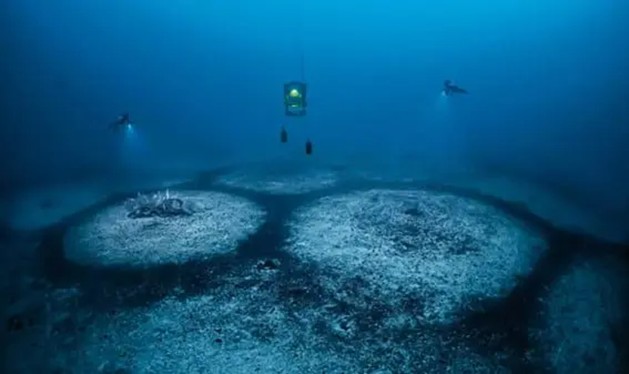
Today’s MSN browser carried an article about the mysterious circles found on the floor of the Mediterranean. The circles were discovered in 2011 by a team of scientists led by marine biologist Christine Pergent-Martini. More than 1,300 rings, about 65.5 feet (20 m) in diameter with a dark spot at their center, were detected through satellite images and confirmed through underwater explorations. Theories on the circle’s origin ranged from unusual geological formations to extraterrestrial intervention (when in doubt it must be UFO’s). A decade of research has found the key to their origin. When biologist Laurent Ballesta submerged himself to reach one of the rings he realized “it was alive”. The formations are composed of calcareous algae and various marine organisms which create rigid structures on the seafloor that, over time, form a circular arrangement. The study of these circles revealed that they are biological structures known as coral atolls.
When I looked online, I found atolls are ring-shaped islands with a coral rim that encircles a lagoon. Atolls occur in warm tropical or subtropical parts of the oceans and seas. Most of the approximately 440 atolls are in the Pacific Ocean. There are two models which explain how atolls form. Charles Darwin described the subsidence model, where the atoll is formed by the sinking of a volcanic island that had a coral fringe reef. The extinct volcanic island erodes and sinks under the surface of the ocean until the reef and small coral islets on top of it are all that is left, leaving a lagoon in place of the former volcano. The antecedent karst model has formation as the development of a flat top, mound-like coral reef during the sinking of an island (volcanic or nonvolcanic) below sea level. When the sea level drops, the coral reef is exposed to the atmosphere and is dissolved by rainfall to form limestone karst. The rate the exposed coral is dissolved is lowest along its rim and increases inward to its maximum at the center of the island resulting in a saucer shaped island with a raised rim. When the sea level rises the island is submerged and the rim provides a core where the coral grows to form the atolls, and the flooded bottom of the saucer forms the lagoon.
While the Mediterranean coral atolls do not breach the surface, they form in a similar fashion. The perfect symmetry of the rings is due to the radial growth of the algae and corals that make up the ecosystem. The interaction between the ocean currents and the development of the living organisms generates this unusual arrangement on the ocean floor. The discovery of coral atolls has important implications for the study and conservation of marine ecosystems as these formations play a crucial role in the biodiversity of the Mediterranean, providing shelter for numerous species and acting as indicators of the health of the oceans. Experts warn these structures are extremely fragile and climate change, pollution, and human activity could affect their development. Ocean acidification and rising temperatures may alter the growth of the organisms that form these atolls, threatening their existence.
THOUGHTS: We still know very little about the submerged coral atolls found in the Mediterranean. Pergent-Martini said, “What is clear is that their preservation is key to maintaining the balance of marine ecosystems in the region.” The ocean covers approximately 70% of Earth’s surface and represents the largest livable space on our planet. Its surface area is about 139 million miles2 (360 million k2) and an average depth of 12,080 feet (3,682 m). Life exists throughout these depths, but much of the ocean is unexplored. As of June 2024, 26.1% of the global seafloor had been mapped with modern high-resolution technology (multibeam sonar systems). While 54% of the seafloor beneath US waters had been mapped to these modern standards, the US seafloor is larger than the land area of all 50 states, the District of Columbia, and the five territories combined. The future of exploration is both out there and under here. Act for all. Change is coming and it starts with you.
 A travelers odyssey