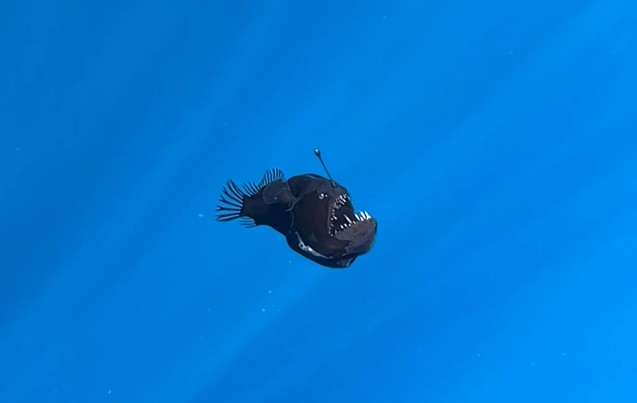
Seadevil

February 19, 2025

My NY Times feed carried a story about an eerie looking creature from the ocean’s depths that has become an inspiration for intense emotions on social media.  It is easy to believe a fish with a gaping mouth of razor-sharp teeth, a bioluminescent rod sticking out of its head, and lidless eyes to scan the darkest depths of the ocean, might elicit fear.  The freakish looking creature is also moving people to tears of emotion.  Social media has turned the fish into a folk hero after it swam great lengths from its usual home 650 to 6,500 feet (200 to 2,000 m) deep in the ocean to the surface.  Fans of the fish have turned this odyssey (which ended in death) into a version of the hero’s journey, a quest to reach the light.  Hannah Backman, of Minneapolis, who posted about the fish on TikTok, said she succumbed to the poetry of a lone fish approaching the light, “spending her literal last seconds trying to do something beautiful.”  The fish made headlines in late January when it was spotted by a group of researchers off the coast of Tenerife in the Spanish Canary Islands.  The team observed the fish, which was already injured, for several hours and it ultimately died.  Fans of the Black seadevil anglerfish have posted tributes set to ballads, written poems, created fan art, and even gotten tattoos.

When I looked online, I found a Black seadevil (Melanocetus johnsonii) is small, deep-sea fish of the order lophiiform and family Melanocetidae.  There are five known species (only two are given common names) within the genus Melanocetus.  They are found in tropical to temperate waters of the Atlantic, Indian, and Pacific Oceans, with one species known only from the Ross Sea.  The Black seadevils are named for their intimidating appearance and typically pitch-black skin and are characterized by a gelatinous, mostly scaleless, globose body, a large head, and their large, sharp, glassy, fang-like teeth lining the jaws of a cavernous mouth.  These teeth are depressible and present only in females.  Like other anglerfishes, the black seadevil possess a modified dorsal spine “fishing rod” (illicium) and a bulbous, bioluminescent “fishing lure” (esca).  The bioluminescence is produced by symbiotic bacteria thought to enter the esca via an external duct suggesting they originate from the surrounding seawater.  The bacteria are apparently different in each anglerfish species.  There is a strong sexual dimorphism, with females reaching a length of 7 inches (18 cm) or more, and males under 1 inch (3 cm).  Males also lack lures.

It is unclear why the seadevil came to the surface, although scientists speculate it might have been from an illness or an unusual current.  The fans on TikTok have woven a beautiful, albeit fanciful, narrative for the fish.  This is a story of a creature in its final days, desperate to experience a source of light not generated by its own body.  Madison Sharp, a behavioral therapist in Dallas, noticed an outpouring of emotion for the fish in her social media feeds.  “Instead of just seeing a fish reach the surface, they see hope, and meaning, and symbolism,” she said.  She was inspired to draw a picture of the seadevil approaching the surface, adding tears to its eyes, and the word “finally” floating above the waterline.  “I think the most important part was the expression of the fish,” she said. “I added the little eyebrow on top to show the longing of it.”  Well, there you go.

THOUGHTS: Humans often turn charismatic animals into anthropomorphized heroes.  Consider Flaco, the Eurasian eagle-owl that escaped from the Central Park Zoo.  Sadly, neither Flaco nor the seadevil survived.  It seems their death is taken as indicative about our own struggle with life.    Or as sci-fi writer David Gerrold is quoted, “Life is hard.  Then you die.  Then they throw dirt in your face.  Then the worms eat you.  Be grateful it happens in that order.”  Being anthropomorphic about a seadevil does not seems so bad after all.  Act for all.  Change is coming and it starts with you.

Flat Stanley

October 31, 2024

Last week we received a text from my son saying we would receive a package from our grandson.  His second grade teacher in Washington state started a project for the students to connect with their relatives living in different parts of the country.  The idea was to get responses over the next month and a half by sending a journal to track the progress of his avatar, a two dimensional representation of himself.  When the package arrived, I took pictures of the avatar participating in activities around our house.  He joined the fall pumpkin display, hung out with the succulents on the porch, and spent time in the garden among the tomatoes.  I e-mailed these back to his teacher to share and sent a letter to describe the fun he was having in Arkansas.  As requested, I sent the package along to my sister in Maine for her to do the same.  The project was based on the children’s book character, Flat Stanley.         

When I looked online, I found Flat Stanley is an American children’s book series written by author Jeff Brown.  The idea began as a bedtime story for Brown’s sons, which Brown turned into the first Flat Stanley book published in 1964 featuring illustrations by Tomi Ungerer.  Brown did not continue the series until two decades later, when he published five more books: Stanley and the Magic Lamp, Stanley in Space, Stanley’s Christmas Adventure, Invisible Stanley, and Stanley, Flat Again!  By 2003, the Flat Stanley series had sold almost one million copies in the US and had been translated into French, German, Spanish, Italian, Japanese, and Hebrew.  Brown died in December 2003, but other children’s book authors have continued the series under a new name, Flat Stanley’s Worldwide Adventures.  The Flat Stanley Project began in 1995 under the direction of Dale Hubert, a third grade teacher in London, Ontario, Canada.  The project is meant to facilitate letter-writing between schoolchildren as they document Flat Stanley accompanying them around the world.  The goal of the project is to increase reading and writing skills, as well as teaching children about people and cultures from different places.  In 2008, more than 6,000 classes from 47 countries took part in the Flat Stanley Project.

My grandson’s teacher gave the Flat Stanley project a different twist.  Rather than having Stanley travel around the states, it was a (flat) picture of himself who was to participate in the adventures.  The students begin by reading the book to become familiar with Flat Stanley’s story.  Stanley is flat because a bulletin board had fallen on him, but he was able to overcome this drawback to excel and travel.  The journal will document the places and activities along the avatars’ journeys.  Each student’s journal is to be mailed back to the school with entries from family and friends.  Postcards or letters returned to the class during the project help track the various places their avatars travel.  The project is similar to the traveling gnome prank, except that the Flat Stanley Project has a focus on childhood literacy.  While the project is focused on writing letters, my grandson’s teacher also suggested using email (as well) to assist with quicker travel time.  I wrote in the journal, sent three pictures via email, and wrote a “flat” letter to the class about the wonders of Arkansas. 

THOUGHTS: When I asked my sister if she would participate, she mentioned she had met the Flat Stanley author.  She was with her daughter and entered a café in Maine that had cutouts of Stanley on the tables.  They had read the book, recognized the character, and exclaimed, “Flat Stanley!”  A man behind them answered “Yes?” and identified himself as the author.  Education can be innovative and fun when teachers take time to present learning as more than “just the 3 R’s”.  More critical is for the parents and larger family to participate.  It is one thing to force a child to do math at the kitchen table, it is quite another way to sit with them as they read or do their math tables.  It may not always take a village, but village support certainly helps.  Act for all.  Change is coming and it starts with you.