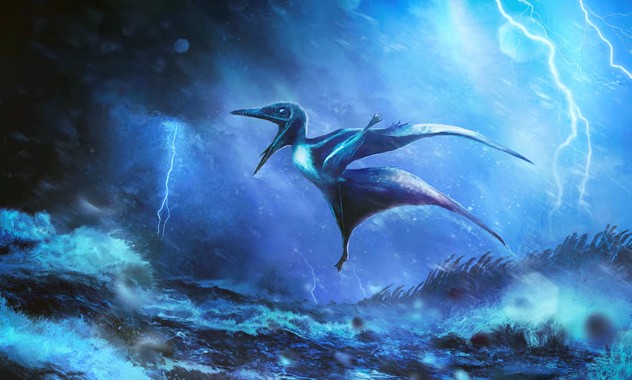
Pterodactylus

September 24, 2025

Toward the back of the front section of my local newspaper was a Reuters article about the demise of two flying reptiles.  Scientists suggest both specimens were caught in the powerful winds of tropical storms which snapped the upper arm bone (humerus) that helped support its membranous wing, then flung the helpless animal into a lagoon where they drowned and were covered by mud.  The exact same wind-caused fracture appeared during examinations on fossils of two individuals unearthed years ago in separate locales in the southern German state of Bavaria.  The fossils, of slightly different ages, were stored in two museum collections.  Paleontologist Rab Smyth of the American Museum of Natural History in New York, and lead author of the study published in the journal Current Biology, said, “We noticed the injuries completely by chance.”  Researchers nicknamed the two hatchlings Lucky and Lucky II.  While it was bad luck to be doomed by storms, it was good luck that paleontologists have been able to learn from their fossils about the anatomy of young pterosaurs.

When I went online, I found Pterodactylus (Ancient Greek, ‘winged finger’) is a genus of extinct pterosaurs thought to contain a single species (Pterodactylus antiquus).  This was the first pterosaur to be named and identified as a flying reptile and one of the first prehistoric reptiles to ever be discovered.  Fossil remains of Pterodactylus are primarily found in the Solnhofen limestone of Bavaria, Germany, which dates from the Late Jurassic period (Tithonian stage), about 150.8 to 148.5 million years ago, but fragmentary remains have been identified elsewhere in Europe and Africa.  Pterodactylus was a small pterosaur, with an adult wingspan at about 3 feet (1 m).  They possessed relatively short and broad wings, a lightly built body and a long, pointed beak lined with small, conical teeth.  Pterodactylus was a generalist carnivore that fed on invertebrates and vertebrates.  The wings were formed by a skin and muscle membrane stretching from its elongated fourth finger to its hind limbs and supported internally by collagen fibers and externally by keratinous ridges.  The species was small compared to other famous genera such as Pteranodon longiceps and Quetzalcoatlus northropi which lived during the Late Cretaceous.

Pterodactylus was the first pterosaur described by science in 1784 and fossils of more than 50 individuals of various sizes have been discovered.  The two in the study were a few days to weeks old when they died, with a wingspan less than 8 inches (20 cm).  The fossils of both animals show the upper arm bone broken in a diagonal split along the shaft which suggests the wing was bent under tremendous pressure (i.e., strong winds or waves during a storm).  The storm likely carried them several miles (km), from their original habitat and into the lagoon.  Smyth said, “While a broken wing alone probably would not have been immediately fatal, the fact that they sank quickly to the bottom suggests they inhaled water and drowned.”  They were rapidly buried in the fine sediments of the storm beds where the oxygen-poor conditions protected their delicate bodies from scavengers.

THOUGHTS: I was fascinated with dinosaurs as a boy and one of my favorites was Pterodactylus.  My small plastic models were marked with the name, length, and weight that I had committed to memory.  Paleontology began as a formal science in the early 1800’s and the discovery of dinosaurs in England was crucial in establishing the field.  The end of the 1960’s saw a surge in dinosaur research activity that is ongoing.  The large predators first depicted as sluggish creatures have been replaced by agile (often smaller) individuals.  When we take time to examine what we do not know it always leads to new comprehension.  That is also true with other people and cultures.  Act for all.  Change is coming and it starts with you.

Sea Robins

September 30, 2024

David Kingsley, the Rudy J. and Daphne Donohue Munzer Professor in the department of developmental biology at Stanford University’s School of Medicine, first came across an odd looking fish in 2016 when he stopped into a small public aquarium in Woods Hole, Massachusetts.  “The fish on display completely spun my head around because they had the body of a fish, the wings of a bird, and multiple legs like a crab,” Kingsley said.  Kingsley and his colleagues decided to study the fish in the lab and found differences between the sea robin species and the genetics responsible for their unusual traits.  The findings of the study team’s new research show how evolution leads to complex adaptations in specific environments, such as the ability of sea robins to be able to “taste” prey using their highly sensitive appendages.  According to their research, some types of the bottom-dwelling ocean fish use taste bud-covered legs to sense and dig up prey along the seafloor.  Sea robins are so adept at rooting out prey on the ocean floor with their leglike appendages that other fish follow them around hoping to snag some of the freshly uncovered prey themselves.

When I looked online, I found sea robins (order, Triglidae), commonly known as gurnards, are a family of bottom-feeding scorpaeniform ray-finned fish.  Triglidae is one of the five largest orders of bony fishes and is divided into 3 subfamilies and 8 genera that include 125 species distributed in temperate and tropical seas worldwide.  Most species are around 12 to 16 inches (30 to 40 cm) in length with the females typically being larger than the males.  They have an unusually solid skull, and many species possess armored plates on their bodies.  Another distinctive feature is the presence of a “drumming muscle” that makes sounds by beating against the swim bladder.  Sea robins have three “walking rays” on each side of their body that are derived from the supportive structures in the pectoral fins (fin-rays).  During development, the fin-rays separate from the rest of the pectoral fin and develop into walking rays.  These walking rays have specialized muscle divisions and unique anatomy that differ from typical fin-rays to allow them to be used as supportive structures during underwater locomotion.  The rays are used for locomotion and prey detection on the seafloor via tasting (chemoreception) and are highly sensitive to the amino acids in marine invertebrates.

While all sea robins have leglike appendages, only some have the macroscopic sensory organs that allow them to taste the environment.  Research revealed digging sea robins depend on a regulatory gene called tbx3a not only to develop their specialized fin adaptations but also to form the papillae that cause them to dig. Tbx3 also plays a role in limb development in humans, chickens, mice, and other fish species.  The fish grew legs using the same genes that contribute to the growth of our limbs and then repurposed these legs to find prey using the same genes our tongues use to taste food.  Sea robins stand out among other walking fishes because their pectoral fins (walking fin rays) are highly jointed and their skeletal and muscular anatomy showcase unique modifications that enable the sea robins to walk. 

THOUGHTS:  Sea robins have firm white flesh that holds together in cooking, making them well-suited to soups and stews such as the French bouillabaisse.  They were often caught in British waters as a bycatch and discarded, but as other species became less sustainable and more expensive, they became more popular.  Sea robins (gurnards) are used as bait by lobster fishers but are also now appearing in fish markets in the US.  As desirable species are overfished or become scarce humans turn to the “next one up” to meet our food needs.  We need to find ways to make fishing sustainable, or even the rough (trash) fish will be in short supply.  Act for all.  Change is coming and it starts with you.