Euphorbia Ingens

September 27, 2024

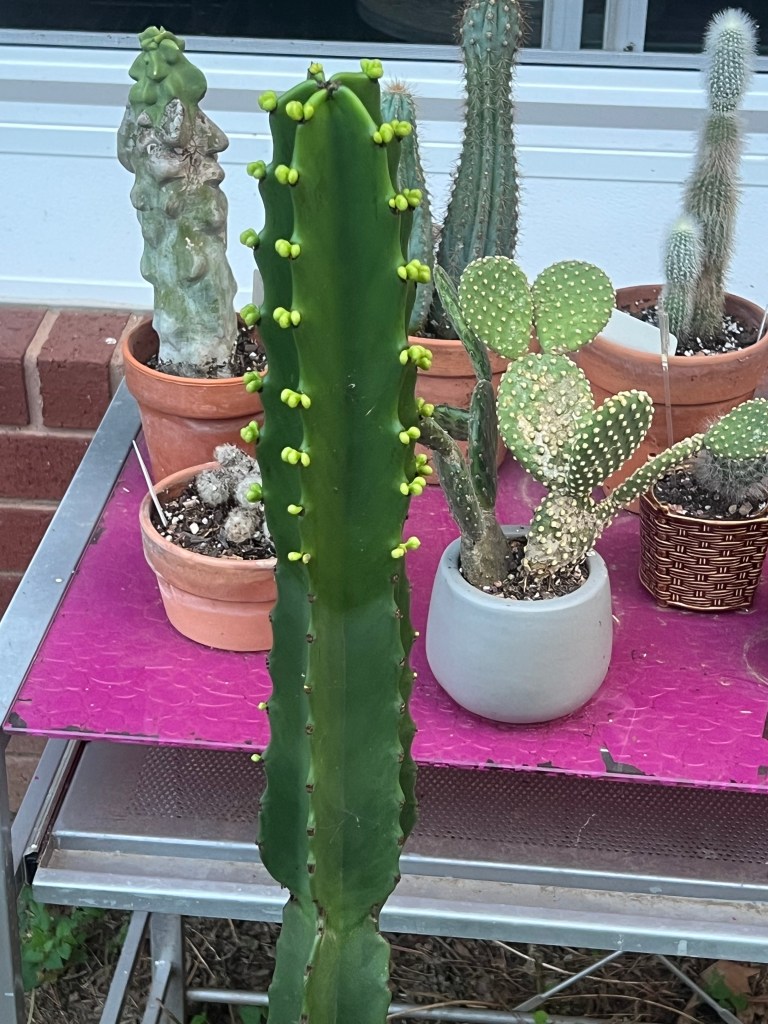
Melissa was working on her succulents over the weekend and called me out to see what was going on with her plants.  We had placed two tables in the flower bed on the north side of the house that we have yet to figure out what to do with.  Melissa decided in the short run this would be a good place to put some of her hardier cacti to take advantage of the outside.  Although these plants are visible through the porch windows, Melissa does not get out to physically check on them more than once a week.  As with most cacti and succulents, a good rule of thumb is to leave them alone and let them thrive on their own.  One of the plants has been growing particularly well over the last two years and is over 3 feet (1 m) tall.  The third section of the plant had developed greenish-yellow buds along its ridges which appeared to be ready to bloom.  When I asked, she told me this was a Euphorbia ingens (I sometimes think she uses the scientific names just to throw me off).   

When I looked online, I found the candelabra tree (Euphorbia ingens), or naboom, is a species of flowering plant in the family Euphorbiaceae native to dry and semi-savanna areas of southern Africa.  This tree is a tall succulent with green round-like branches resembling a balloon that grows to 19.5 to 26 feet (6 to 8m) tall.  The trunk of the candelabra is thick, and the stems have 5 ridges each and are 1-1/3 to 3 inches (3.5 to 7.5 cm) thick.  The segmented stems are dark-green and young sprouts have paired spines 3/16 to 5/64 inches (0.5 to 2 mm) long.  The plant blooms from autumn to winter and the small greenish yellow flowers sit on the ridges of the topmost segment.  A red, round, three-lobed capsule fruit turns purple when ripe.  The plant’s flowers are attractive for butterflies, bees and other insects, which pollinate them when gathering pollen and nectar.  The seeds are edible for birds, who also like to make their nests in the branches of these trees.  The light and solid wood of the main trunk is used in door, plank, and boat production.  The milky latex sap of the tree is highly poisonous and can cause blindness, severe skin irritation, and poisoning (when ingested) in humans and other animals.  The plant has few pests due to the toxic sap.

Euphorbia ingens grows well both indoors and outdoors and has become a popular choice for rock gardens and indoor houseplant collections due to its stately appearance and low maintenance.  In their natural environment, these succulents can grow up to 40 feet (12 m) tall, but they usually top out around 8 to 10 feet (2.5 to 3 m) tall when grown indoors.  Still, even this would take a high ceiling to accommodate a mature plant.  When grown indoors or in containers, it is extremely uncommon for this species of euphorbia to produce blooms.  Since Melissa’s plant has budded, we are waiting to see if it will break into full bloom.

THOUGHTS:  The buds on the Euphorbia ingens are only the latest of Melissa’s accomplishments.  Over the last two years she has repeatedly shown me the flowers that have bloomed on many of the succulents and cacti that are under her care.  In my case, with the exception of the ground cherry (Physalis angulate) that I did not plant and the red burgundy okra (Abelmoschus esculentus) I do not like to eat, I have often struggled with production of my plants (pole beans are another exception).  Melissa’s mom was a prolific gardener whose secret was to spend hours tending her flowers.  The same it true with Melissa who spends hours with her succulents.  I am willing to plant, water, and harvest.  Perhaps there is a lesson there.  When we are willing to put in the work, we can achieve most tasks.  That is true for gardening.  That is also true for creating positive human interaction.  Do the work.  Act for all.  Change is coming and it starts with you.
2nd Sister

September 24, 2024

I was excited over the weekend when I went out to check the remnants of the three sisters planting to find the pole beans (Phaseolus vulgaris) had finally begun to produce.  I have mentioned the poor production for the 1st sister, corn (Zea mays var. rugosa), with only dried kernels suitable for grinding or bird food.  That was followed by an ok harvest of the 3rd sister, Butternut squash (Cucurbita moschata), which produced 7 gourds.  It has now been nearly a month and while there were lots of flowers and buds, I had not seen any beans hanging from the vines until last weekend.  The vines had been growing well, even causing some of the drying corn stalks to collapse and again lay on the ground.  I felt lucky for having staked the stalks after their infamous “leaning” event in July.  I knew at least some of the stalks would be able to stand despite the weight of the bean vines.  Yesterday I decided to see if I could find anything worth harvesting among the twisted vines.  I was anxious to see the result from the 2nd sister.

When I looked online, I found the common bean (Phaseolus vulgaris) is an herbaceous annual plant grown worldwide for its edible dry seeds or green, unripe pods.  The bean’s botanical classification (as all Phaseolus species) is a member of the legume family Fabaceae.  Common beans acquire the nitrogen they require through an association with rhizobia (like most Fabaceae), or nitrogen-fixing bacteria.  The bean has a long history of cultivation with the wild Phaseolus vulgaris native to the Americas.  It was originally believed that it had been domesticated separately in Mesoamerica and in the southern Andes region 8000 years ago, giving the domesticated bean two gene pools.  Recent genetic analyses show that it was first domesticated in Mexico, and then split into the Mesoamerican and Andean gene pools.  As the 2nd sister (by planting order), maize (corn), beans, and squash are the three Mesoamerican crops that constitute the “Three Sisters” that were central to the indigenous agriculture.  All wild members of the species are climbing, but many cultivars are now classified as bush beans or climbing beans, depending on their style of growth.  Beans are grown on every continent except Antarctica, and during 2022, there were 28 million tons (28000 kt) of dry beans produced worldwide, led by India with 23% of the total.  The common bean arrived in Europe as part of the Columbian exchange, the widespread transfer of plants, animals, commodities, precious metal, culture, human populations, technology, diseases, and ideas between the New World (the Americas) and the Old World (Afro-Eurasia) in the late 15th and following centuries.

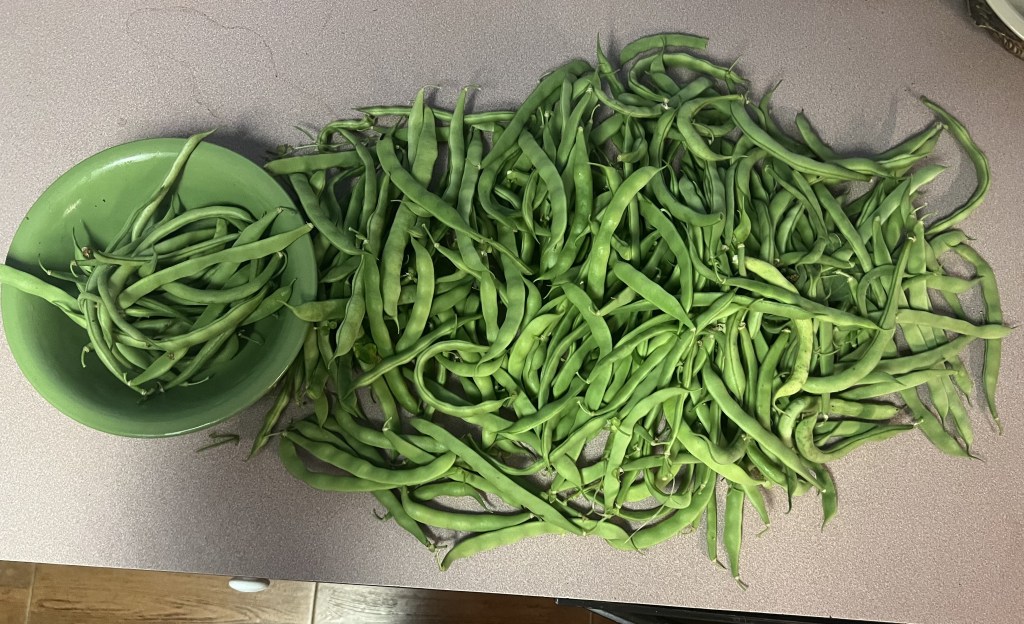
While I had (inadvertently) planted bush beans in my raised beds, I planted pole beans as my 2nd sister.  I have mentioned how bush beans are preferable for commercial cultivars as the fruit tends to ripen at the same time (yes, beans are another fruit that is eaten as a vegetable).  I harvested the bush beans last week and got a small return (the bowl in picture).  Unlike the bush beans I planted in the raised bed, the pole beans are expected to provide a continuous harvest throughout the growing cycle.  I look forward to several more weeks of harvest from my 2nd sister.    

THOUGHTS:  I was pleased with the harvest from the 2nd sister.  The first pick of pole beans yielded over 6 quarts of processed green beans.  I flash froze 4 quarts and plan for the other 2 quarts to be mixed with onions, bacon, and the Yukon Gold potatoes (Solanum tuberosum) I harvested earlier this month, for a meal later this week.  This Thanksgiving, I plan on providing a green bean casserole for the family using my home grown beans.  This is one of the joys I find in (trying) to provide subsistence agriculture.  While there are trials (i.e., the other sisters) in growing your own food, they make the successes sweeter.  This also forces me to explore a variety of preservation techniques.  Life-long learning is a good thing.  Act for all.  Change is coming and it starts with you.