
August 16, 2025
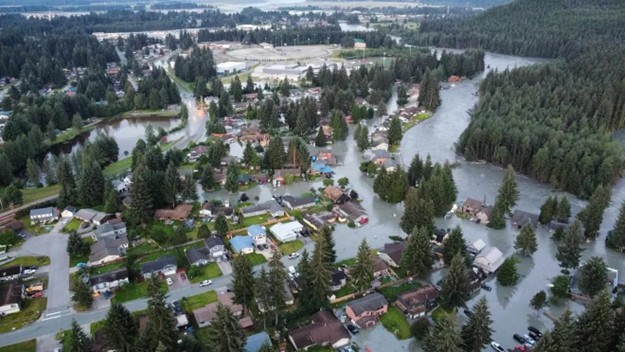
A USA Today article reported how water from a melting glacier has caused a river near Alaska’s capital city of Juneau to swell to historic levels. As of August 13th, emergency barriers protecting Juneau appear are holding. The risk from summer glacial flooding is on the rise as climate change increases temperatures, causing more ice to melt. Lakes form behind the unsteady dams made of ice and when these dams fail, the water rushes out, often resulting in catastrophic downstream flooding. The ice dam lake near Juneau ice is called Suicide Basin, which is part of the Mendenhall Glacier. If it collapses from summer heat it will release the water in a short period of time. Aaron Jacobs, a hydrologist at the National Weather Service office in Juneau, said as these events continue to unfold, scientists need to continue to improve their understanding of these glacial systems, especially as the climate continues to change and warm throughout Alaska. Glacial lake outburst flooding is produced by the quick, unexpected release of water from a glacial lake.
When I went online, I found a glacial lake outburst flood (GLOF) is a type of outburst flood caused by the failure of a dam containing a glacial lake. A similar event where the ice melts and overflows the glacier is called a jökulhlaup. The dam can consist of glacier ice or previous glacial deposits (moraine). Failure can happen due to erosion, buildup of water pressure, an avalanche of rock or heavy snow, an earthquake, or by a sudden cracking action in frozen soil or rock saturated with water or ice (cryoseism), volcanic eruptions under the ice, or massive displacement of water in a glacial lake when a large portion of an adjacent glacier collapses into it. Increasing glacial melting because of climate change along with melting of the permafrost means regions with glaciers are likely to see increased flooding risks from GLOFs. This is especially true in the Himalayas where geologies are more active. A 2023 study found 15 million people at risk from this hazard, mostly in China, India, Nepal, Pakistan, and Peru.
Glacial lake volumes vary but may hold millions (35,314,666+ cubic feet) to hundreds of millions of cubic meters (3,531,466,600+ cubic feet) of water. Catastrophic failure of the ice or glacial sediment containing the water can be released over periods of minutes to days. Peak flows as high as 529,720 cubic feet (15,000 cubic meters) per second have been recorded in such events. This suggests the v-shaped canyon of a normally small mountain stream could suddenly develop an extremely turbulent and fast-moving torrent of water some 160 feet (50 m) deep. Glacial Lake Outburst Floods are often compounded by a massive riverbed erosion in the steep moraine valleys resulting in flood peaks increasing as they flow downstream until the sediment deposits. On a downstream floodplain, it suggests a somewhat slower inundation spreading as much as 10 kilometers (6.2 mi) wide. Both scenarios are significant threats to life, property and infrastructure.
THOUGHTS: The glacial outburst in Alaska is not a new phenomenon and has occurred annually in Suicide Basin since 2011. What is new in the last few years is the amount of water being released all at once during these events. According to the National Centers for Environmental Information Alaska has warmed twice as fast over the last several decades Information compared to the rest of the US. Its average annual temperature has risen 3.1F (-16.0C) in the past century. Since 1990, humans have been the primary cause of melting glaciers worldwide due to rising temperatures from the burning of greenhouse gases and land-use changes. Such an outburst can be prevented. Act for all. Change is coming and it starts with you.
 A travelers odyssey